Quick answer: UHD (Ultra High Definition) is a resolution spec — it controls how many pixels make up the image. HDR (High Dynamic Range) is a brightness/contrast/color spec — it controls how realistic each pixel looks. Neither replaces the other, and for most commercial LED deployments in 2026, the safest baseline is 4K UHD + HDR10 (minimum), moving up to 4K UHD + HDR10+ or Dolby Vision for premium projects.
Key Takeaways
- UHD = pixel count (clarity). HDR = brightness/contrast/color (realism). A display can have either, both, or neither.
- A panel only qualifies as “genuine HDR” if it hits ≥600 nits peak brightness and ≥90% DCI-P3 color gamut — many products marketed as “HDR” fall short of this and are effectively “fake HDR.”
- Viewing distance decides which one matters more: under ~3m, HDR is more perceptible; over ~3m or on large-format walls, UHD’s added resolution matters more.
- For B2B video walls, UHD depends on more than resolution — pixel pitch, module alignment, and the control system (e.g., NovaStar, Colorlight) all affect whether the “4K” spec actually holds up on-screen.
- Micro LED and fine-pitch Mini LED are currently the best hardware for combining both technologies at scale.
1. Why the UHD vs HDR Distinction Matters for Buyers
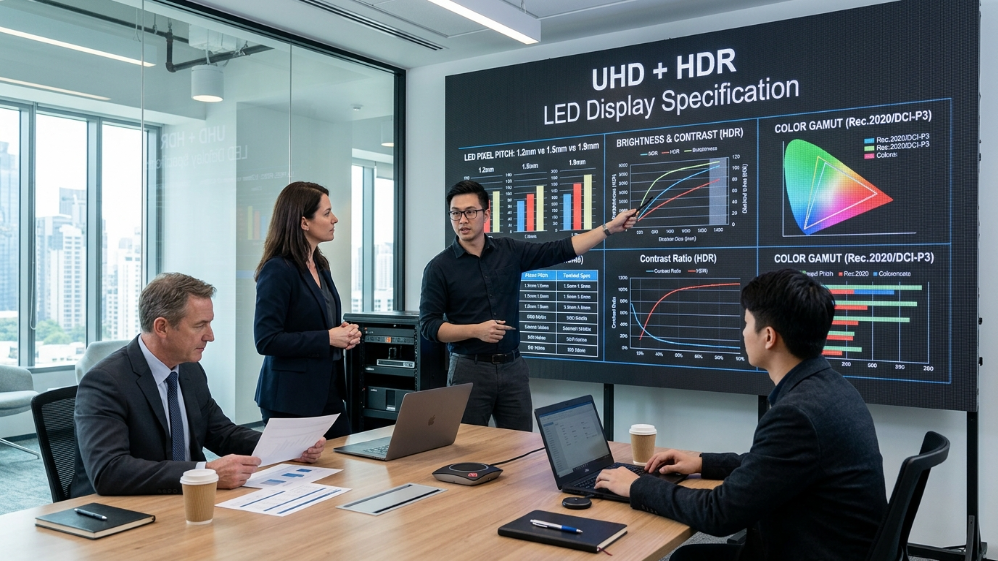
Display specs are increasingly used as a marketing shorthand, and “4K” or “HDR” badges get attached to products loosely. According to Omdia, global 4K TV penetration passed 70% in 2024, and HDR-compatible displays are growing just as fast — which means more buyers are comparing the two terms without a clear reference point for what each one actually controls.
Resolution ≠ Overall Picture Quality. A 4K UHD panel showing SDR (non-HDR) content in a bright room can look flatter than a well-calibrated 1080p HDR panel. Resolution only affects sharpness; HDR affects how convincing the brightness, shadow detail, and color actually look. Confusing the two is the single most common mistake we see AV integrators and event technical directors make when writing display specs into an RFP.
Market direction:
- UHD (mainly 4K) is now the default expectation for large-format LED walls, especially in outdoor advertising, conference displays, and broadcast backdrops.
- HDR is spreading fast at the content layer — Netflix, Disney+, and Apple TV all support HDR10 or Dolby Vision natively.
- The commercial LED segment is converging toward UHD + HDR combined, particularly in fine-pitch (sub-P1.5) products aimed at close-viewing environments.
2. What Is UHD LED?
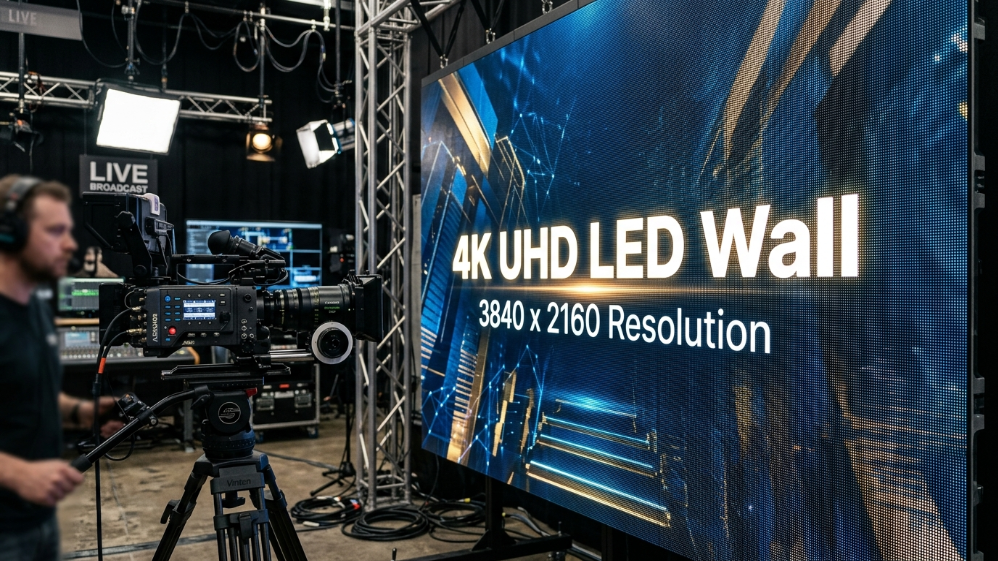
UHD (Ultra High Definition) is a resolution standard, defined per the ITU-R BT.2020 recommendation as significantly exceeding 1080p (Full HD):
- 4K UHD: 3840×2160 pixels — the current mainstream commercial standard
- 8K UHD: 7680×4320 pixels — still in early adoption, mostly flagship/showcase projects
On an LED video wall, “UHD” isn’t purely a resolution number — it’s a function of pixel pitch, module precision, and seamless splicing. A wall can technically output a 4K signal but still fail to render it cleanly if the pixel pitch is too coarse for the viewing distance, or if module seams introduce visible banding.
Practical rule of thumb: the minimum comfortable 4K viewing distance is roughly 1.5× the screen height. Closer than that, viewers will start to perceive individual pixels or module lines unless the pitch is tight enough (commonly P1.5 or below for near-viewing walls, down to P0.9 for control rooms and broadcast backdrops).
Where UHD matters most:
| Scenario | Why UHD is the priority |
|---|---|
| Conference rooms / broadcast studios | Precise detail on close-viewed text and graphics |
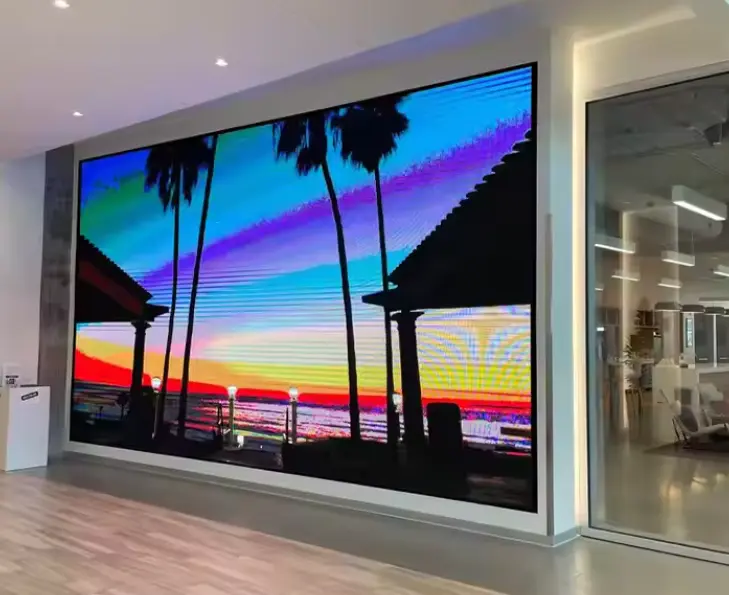
| Mall / retail advertising walls | Renders complex 3D and motion content cleanly at scale |
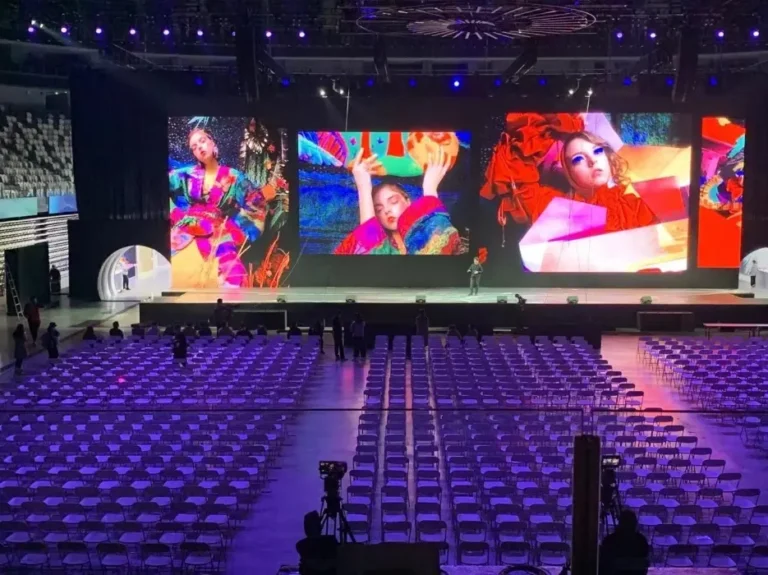
| Live event stages | Supports multi-screen splits without visible pixelation |
| Control rooms | Fine-pitch UHD keeps dense data legible from short distances |
3. What Is HDR LED?
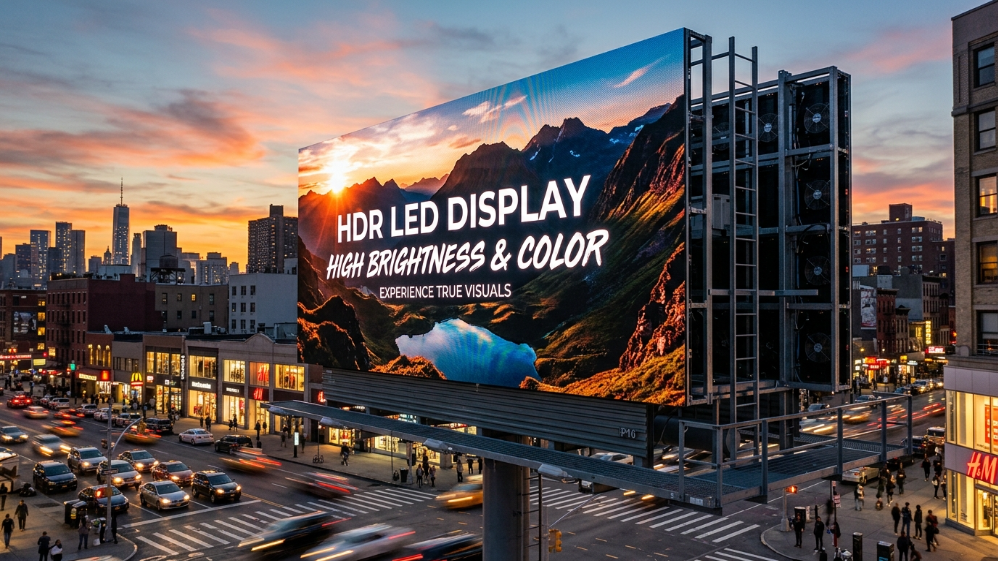
HDR (High Dynamic Range) expands the range between the darkest and brightest points a display can show, along with the color depth in between. It doesn’t add pixels — it makes existing pixels look more realistic.
Key HDR Metrics
- Peak brightness: premium HDR displays exceed 1,000 nits; standard SDR panels sit around 300 nits.
- Contrast ratio: Mini LED and Micro LED architectures can achieve near-infinite contrast through localized dimming or self-emissive pixels.
- Color gamut: genuine HDR performance requires wide-gamut coverage — typically referenced against DCI-P3 or BT.2020 — plus higher grayscale bit depth (10-bit or 12-bit processing rather than 8-bit) to avoid visible color banding in gradients.
Common HDR Standards
- HDR10 — the most widely supported baseline standard, static metadata.
- HDR10+ — adds dynamic, scene-by-scene metadata for more accurate tone mapping.
- Dolby Vision — the most precise standard, with frame-by-frame dynamic metadata; typically a licensing and hardware premium.
- HLG (Hybrid Log-Gamma) — designed primarily for live broadcast, backward-compatible with SDR displays.
UHD vs HDR at a glance
| Feature | UHD LED | HDR LED |
|---|---|---|
| What it controls | Resolution / pixel density | Brightness, contrast, color |
| Primary benefit | Sharpness and clarity | Realism and depth |
| Measured in | Pixel count (e.g., 3840×2160) | Nits, color gamut %, bit depth |
| Governing standard | ITU-R BT.2020 (resolution) | HDR10 / HDR10+ / Dolby Vision / HLG |
| Works standalone | Yes | Yes |
| Best paired with | HDR | UHD |
| Fails silently when | Pixel pitch too coarse for viewing distance | Panel can’t hit brightness/gamut thresholds (“fake HDR”) |
| Ideal viewing distance | Matters more at distance/large scale | Matters more up close (<3m) |
| Typical B2B use case | Video walls, broadcast, control rooms | Cinema-grade displays, premium retail, virtual production |
In short: UHD helps you “see clearly.” HDR makes what you see “look real.”
4. UHD vs HDR: Which One Actually Matters More?
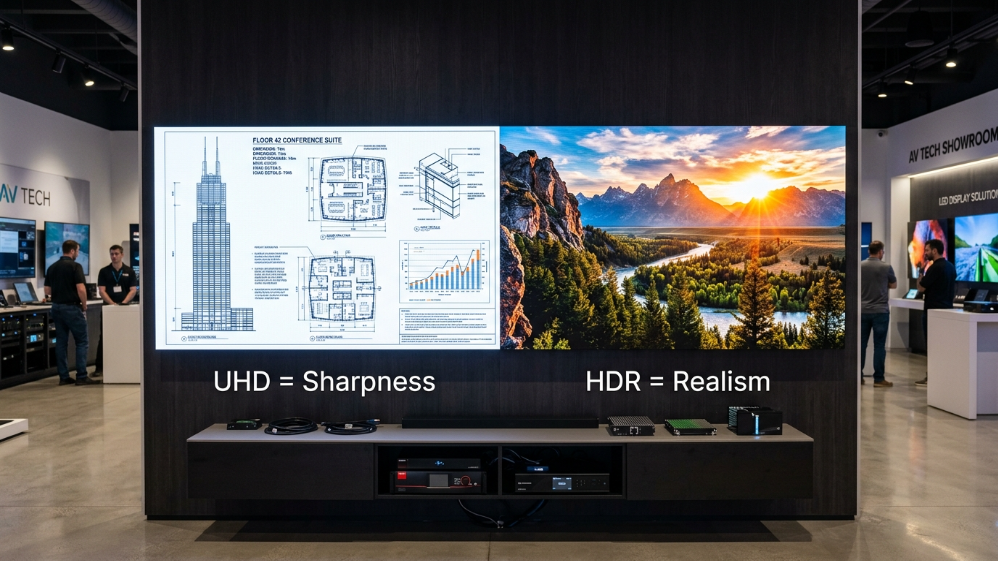
It depends on viewing distance and application — there’s no universal answer:
- Large-format displays or long viewing distances: UHD’s added resolution is what viewers actually notice.
- Close-range viewing, cinema, premium retail, and drama/film content: HDR delivers the more perceptible upgrade — better shadow detail, more natural skin tones, more convincing highlights.
- Best overall result: UHD + HDR combined, matched to your specific pixel pitch and viewing distance.
5. Scenario-by-Scenario Application Guide
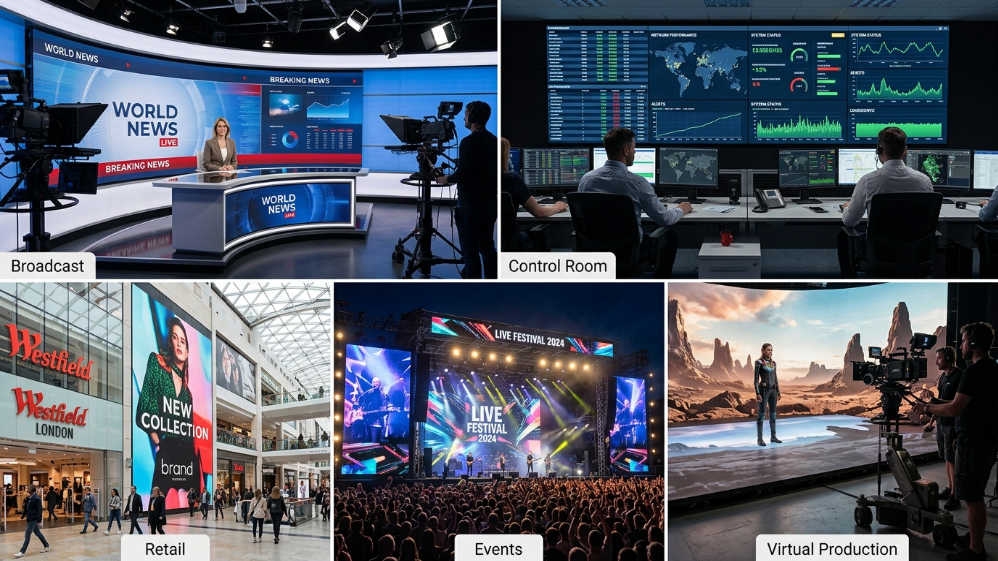
Corporate & Broadcast (Control Rooms, News Studios) Fine-pitch UHD (P1.2–P1.9) is the priority for legibility of dense data and graphics at short range; HDR10 support is a useful secondary spec for on-air realism but rarely the deciding factor. Recommend: fine-pitch 4K UHD panels with at least HDR10 support.
Retail & Mall Advertising Viewing distances vary widely (from a few meters to 20+ meters), so a mid-range pixel pitch (P2.5–P4) with HDR10 or HDR10+ typically balances cost and impact better than chasing 8K resolution.
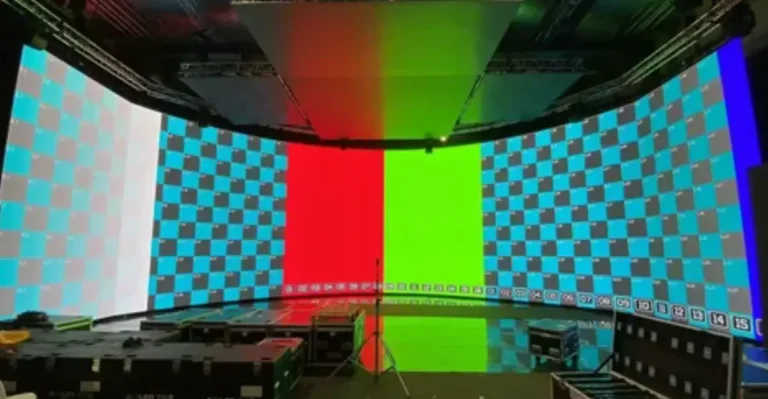
Virtual Production & XR Studios This is one of the fastest-growing commercial LED segments and is frequently underserved by generic buying guides. Virtual production walls (used for in-camera VFX) demand both high UHD pixel density (to avoid moiré on camera) and wide color gamut/high dynamic range (to match on-set lighting realistically) — typically fine-pitch (sub-P1.9) panels paired with HDR10+ or Dolby Vision-class color processing, run through dedicated LED processors for camera-accurate color mapping.
Live Events & Stage Rental Multi-screen splits and fast content turnaround favor UHD panels with robust control-system support (NovaStar, Colorlight, or equivalent); HDR support is a “nice to have” unless the show content is cinema-grade.
Creative & Irregular-Shaped Screens Curved, cylindrical, or spherical LED structures make both UHD and HDR harder to deliver consistently — even small module misalignments break the “seamless” look UHD promises, and uneven brightness across curved surfaces can undercut HDR’s contrast benefits. These projects usually require tighter manufacturing tolerances and a higher project budget than flat-panel equivalents.
6. Can UHD LED and HDR LED Coexist?
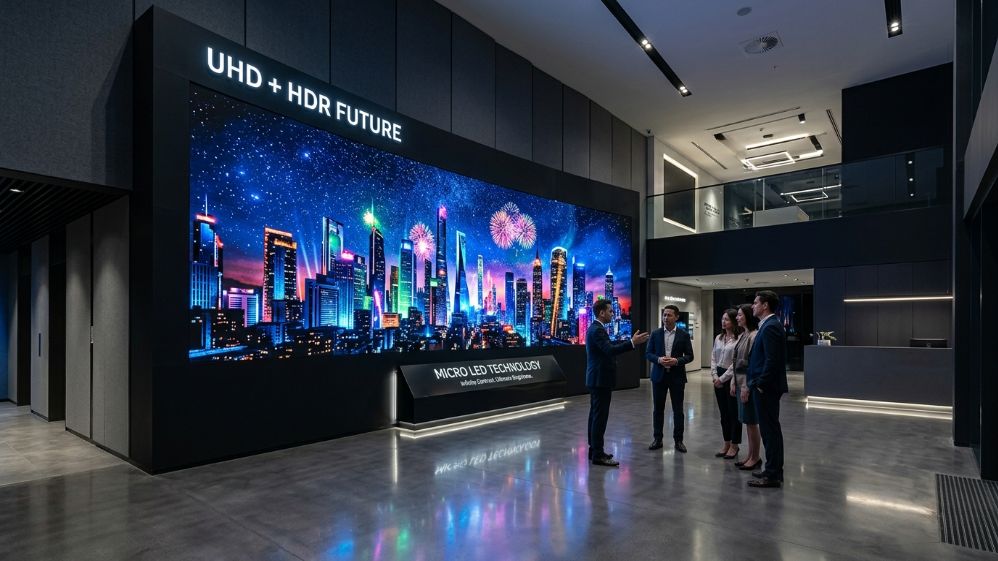
Yes — and in premium products, they’re expected to. Consumer flagships like the LG C3 OLED and Sony X95L already pair 4K UHD with Dolby Vision, and the same trend is happening in commercial fine-pitch LED: Micro LED and Mini LED architectures are the current benchmark for combining both technologies at scale, since their self-emissive or localized-dimming design is a natural fit for HDR’s contrast requirements alongside tight pixel pitches.
Content compatibility note: most major platforms (Netflix, Apple TV, Disney+) support HDR10 and Dolby Vision, but 4K content remains more prevalent overall than HDR content — factor your actual content source into the purchase decision, not just the panel’s theoretical spec ceiling.
7. Buyer’s Decision Framework (Checklist)
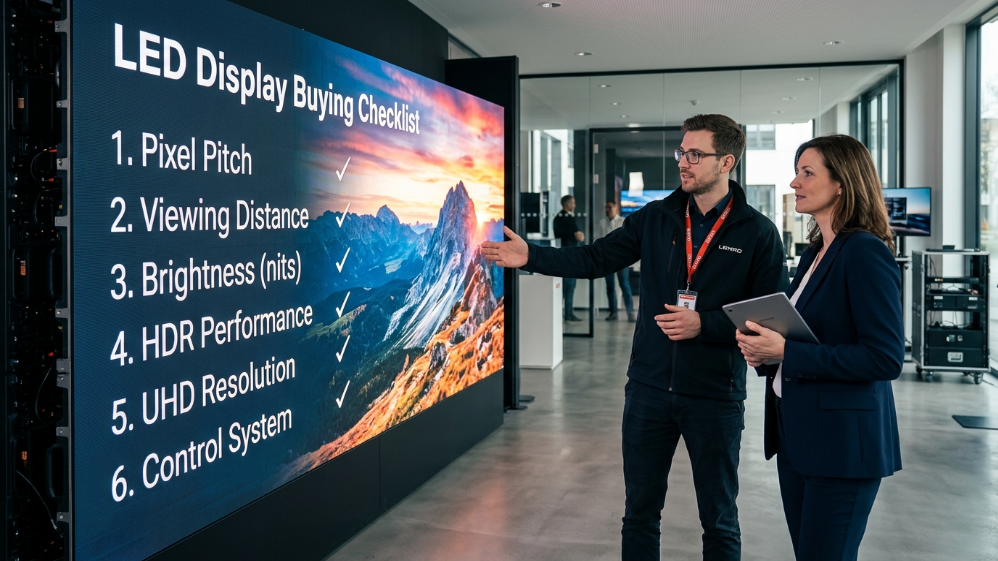
Use this sequence before finalizing a spec:
- Confirm your typical viewing distance. Under 3m → weight toward HDR. Over 3m or large-format → weight toward UHD/pixel pitch.
- Check for “fake HDR.” Ask the vendor for peak brightness (nits) and color gamut (% DCI-P3) test data — don’t accept “HDR-compatible” as a spec on its own. Minimum genuine-HDR threshold: ≥600 nits, ≥90% DCI-P3.
- Match pixel pitch to viewing distance, not just resolution. A “4K” wall with the wrong pitch for its viewing distance won’t deliver the clarity the spec implies.
- Identify your content source. If most of your content is SDR, prioritizing UHD resolution may deliver more visible ROI than an expensive HDR upgrade.
- Set a budget tier:
- Mid-range: UHD + HDR10
- High-end: UHD + HDR10+ or Dolby Vision-class processing
- Confirm control system compatibility (NovaStar, Colorlight, or your integrator’s preferred platform) — HDR performance depends as much on processing as on the panel itself.
8. Future Trends: Will UHD and HDR Merge?
They already are. 8K + HDR is the emerging high-end benchmark, with Sony and LG already shipping 8K HDR displays, and Micro LED is accelerating the same convergence in commercial installations — its self-emissive pixel structure supports both ultra-fine pitch and high dynamic range without the trade-offs older LCD/LED-backlit architectures required.
FAQ
Is 4K the same as HDR? No. 4K (UHD) refers to resolution — pixel count. HDR refers to brightness, contrast, and color range. A display can be one, both, or neither.
Do I need both UHD and HDR? Not always. For long-distance or large-format viewing, UHD alone may be sufficient. For close-range or premium content, HDR delivers more visible benefit. Combined, they offer the best overall result.
What is “fake HDR”? A display that decodes HDR metadata but can’t physically reproduce it — typically because peak brightness or color gamut falls below genuine HDR thresholds (≥600 nits, ≥90% DCI-P3).
Is HDR on an LED display the same as HDR on a TV? The underlying standards (HDR10, HDR10+, Dolby Vision) are the same, but commercial LED walls add variables like pixel pitch, module calibration, and outdoor brightness requirements that consumer TVs don’t need to solve for.
Which matters more for gaming: UHD or HDR? UHD improves image clarity but demands more graphics/bandwidth headroom; HDR makes lighting and color in games (especially action/sci-fi titles) look more lifelike. Most modern setups benefit from both, but HDR is often the more immediately noticeable upgrade on a given screen size.
What’s the minimum HDR standard worth buying? HDR10 is the practical minimum for genuine HDR benefit at a reasonable cost; HDR10+ or Dolby Vision are worth the premium for flagship or content-critical projects (e.g., virtual production).
Customer Scenario
A regional broadcast client recently required a control-room video wall where operators sit under 2 meters from the screen for extended shifts. Prioritizing fine-pitch UHD (P1.5) with HDR10 support — rather than chasing 8K resolution, which would have added cost without a perceptible benefit at that pitch and distance — kept the project on budget while meeting the legibility and color-accuracy requirements the operators actually needed.
Conclusion: Match the Spec to the Use Case, Not the Marketing
UHD and HDR solve different problems, and neither is a substitute for the other. The highest-ROI approach is to work backward from your actual viewing distance, content source, and budget tier — not from whichever spec looks more impressive on a data sheet. If you want the strongest all-around result, a 4K UHD + Dolby Vision-class setup is the premium benchmark; for budget-conscious projects, 4K UHD + HDR10 still delivers a meaningful, verifiable upgrade over SDR.
For fine-pitch UHD LED walls and HDR-ready display solutions engineered for control rooms, virtual production, and large-format advertising, see our LED display product range or talk to our technical team about matching a spec to your project.
Written by the SoStron LED Technical Content Team — 10+ years specifying and auditing commercial LED display configurations for AV integrators, broadcast studios, and large-format advertising deployments.
References:
ITU-R BT.2020 — Ultra High Definition Television (UHDTV) Standard
ITU-R BT.2100 — High Dynamic Range Television (HDR-TV) Standard
SMPTE Standards — HDR Imaging Standards (ST 2084 / ST 2086 / ST 2094)