The Short Answer: It Depends on What You’re Buying For
Micro LED is technically superior to OLED across most performance dimensions — brightness, lifespan, burn-in resistance, and environmental durability. That’s not a marketing claim; it follows directly from the physics of inorganic versus organic light emission.
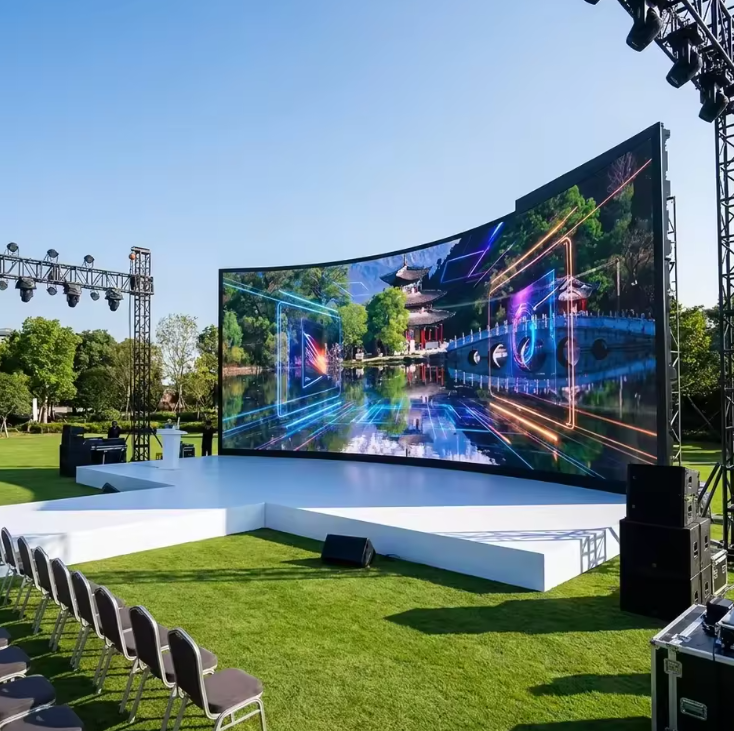
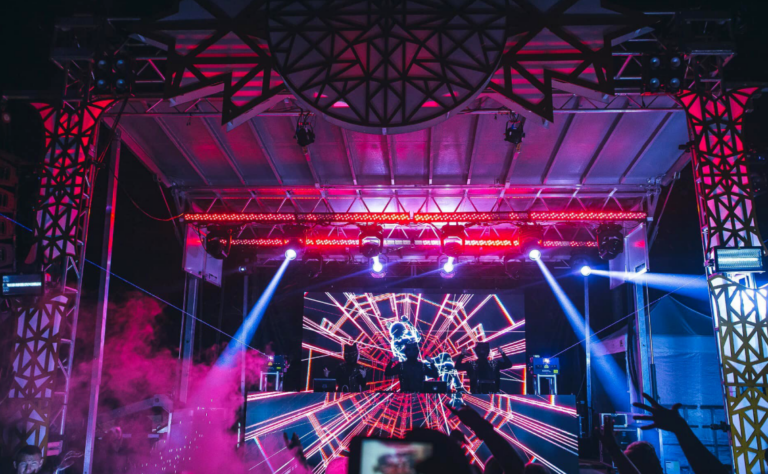
But “better” is only meaningful in context. OLED is cheaper, thinner, more flexible, and commercially mature. For a consumer buying a living room TV or a flagship smartphone, OLED delivers excellent image quality at a price point Micro LED cannot match in 2026. For a systems integrator specifying an outdoor billboard, a control room display, or an automotive instrument cluster, Micro LED wins on every metric that matters operationally.
This guide breaks down the comparison across seven dimensions with actual specifications — not vague claims — so you can make the right call for your application.
How Each Technology Actually Works
Understanding the performance gap starts with the underlying physics.
Micro LED uses microscopic inorganic LEDs — typically 1 to 100 micrometers in size, made from gallium nitride (GaN) — as individual self-emitting pixels. Each pixel generates its own light directly from an electrical current passing through a semiconductor junction. There is no backlight, no color filter, no organic material in the light path.
OLED (Organic Light-Emitting Diode) also uses self-emitting pixels, but the light source is an organic carbon-based compound that fluoresces when current is applied. The organic layer is sandwiched between electrodes and encapsulated to prevent moisture and oxygen exposure.
The critical difference: organic compounds degrade. Inorganic GaN does not degrade in the same way. This single fact explains the lifespan gap, the burn-in risk, and the environmental durability difference between the two technologies.
QD-OLED (Quantum Dot OLED, used in Samsung and Sony’s premium consumer panels) adds a quantum dot layer to improve color volume and peak brightness, partially closing the gap with Micro LED on color performance — but the underlying organic emitter still degrades.
Brightness and Color Performance
This is where the gap between the two technologies is most visible in real-world use.
| Metric | Micro LED | OLED (W-OLED) | QD-OLED |
|---|---|---|---|
| Typical peak brightness | 1,000–10,000+ nits | 400–1,000 nits | 1,500–3,000 nits |
| Outdoor-rated brightness | Up to 10,000 nits | Not suitable | Not suitable |
| Color gamut | >100% DCI-P3 | ~99% DCI-P3 | ~99–100% DCI-P3 |
| Black level | True black (pixel off) | True black (pixel off) | True black (pixel off) |
| Contrast ratio | Virtually infinite | Virtually infinite | Virtually infinite |
| Color shift at angle | Minimal | Moderate | Moderate |
Both technologies achieve true black by turning off individual pixels — this is the key advantage both share over LCD. Where they diverge is at the bright end of the scale.
A standard OLED TV panel sustains around 400–700 nits across a full white screen before automatic brightness limiting (ABL) kicks in to protect the organic material. Micro LED has no equivalent thermal constraint — it can sustain full-screen peak brightness indefinitely. For outdoor applications, this is non-negotiable: a display that dims itself in direct sunlight is not a viable outdoor display.
Burn-In and Lifespan: The OLED Achilles Heel
Burn-in is the most practically significant disadvantage of OLED for commercial and professional applications, and it’s frequently underplayed in consumer-facing reviews.
How OLED burn-in happens: Organic emitter materials degrade at different rates depending on how hard they’re driven. A static element — a channel logo, a navigation bar, a HUD overlay — displayed at high brightness for extended periods causes the organic material in those pixels to degrade faster than surrounding pixels. The result is a permanent ghost image visible even when the screen displays other content.
When it becomes a problem: In commercial deployments running 12–18 hours daily with static interface elements, burn-in can manifest within 1,000–2,000 hours of operation. Consumer use cases with varied content are less susceptible, but the risk is real and irreversible.
Micro LED lifespan data:
| Technology | Rated Lifespan (to 50% brightness) | Burn-in Risk |
|---|---|---|
| Micro LED | 100,000+ hours | None (inorganic material) |
| OLED (W-OLED) | 30,000–50,000 hours at high brightness | Yes — static content risk |
| QD-OLED | ~30,000–40,000 hours at high brightness | Yes — same organic emitter |
| LCD (for reference) | 50,000–70,000 hours | None |
For a display running 16 hours/day, 100,000 hours represents approximately 17 years of operation. OLED at 30,000 hours represents roughly 5 years under the same conditions — and that’s before accounting for burn-in from static content.
Power Consumption: Context Matters
The power consumption comparison is more nuanced than most articles acknowledge, and the original article’s framing — that OLED is simply more efficient — is only partially correct.
OLED’s efficiency advantage is content-dependent. Because OLED pixels switch off completely for black content, a display showing a dark film or a predominantly black UI consumes significantly less power than the same display showing a bright white page. This is why OLED is genuinely efficient in smartphone use cases with dark mode enabled.
Micro LED’s efficiency advantage is brightness-dependent. At equivalent brightness levels, Micro LED’s GaN emitters are more efficient than organic emitters — they produce more lumens per watt. At the high brightness levels required for outdoor or high-ambient-light environments, Micro LED consumes less power than OLED would to achieve the same output (if OLED could achieve it at all).
Practical implication: For commercial displays running at 3,000+ nits in high-ambient environments, Micro LED is the more energy-efficient choice. For consumer displays running at 200–400 nits with mixed dark/light content, OLED’s pixel-off efficiency is a real advantage.
Manufacturing Cost and the Mass Transfer Problem
Micro LED’s cost premium over OLED is real and significant in 2026. Understanding why helps set realistic expectations for when cost parity might arrive.
The mass transfer challenge: A 4K Micro LED display contains approximately 24.9 million individual micro LEDs (three sub-pixels per pixel × 8.3 million pixels). Each LED is 10–50 micrometers in size. Placing all of them on a substrate with sub-ppm defect rates — meaning fewer than one defective placement per million transfers — requires precision robotics and process control that is genuinely difficult to scale.
Current mass transfer yields are improving but remain the primary cost driver. Any defective LED requires either repair (expensive) or acceptance of a dead pixel (unacceptable for premium displays).
Cost comparison in 2026:
| Technology | Relative Cost (equivalent size/resolution) | Maturity |
|---|---|---|
| Micro LED | 5–10× OLED | Early commercial |
| QD-OLED | 1.5–2× W-OLED | Mature |
| W-OLED | Baseline | Mature |
| LCD (Mini-LED backlit) | 0.5–0.8× W-OLED | Mature |
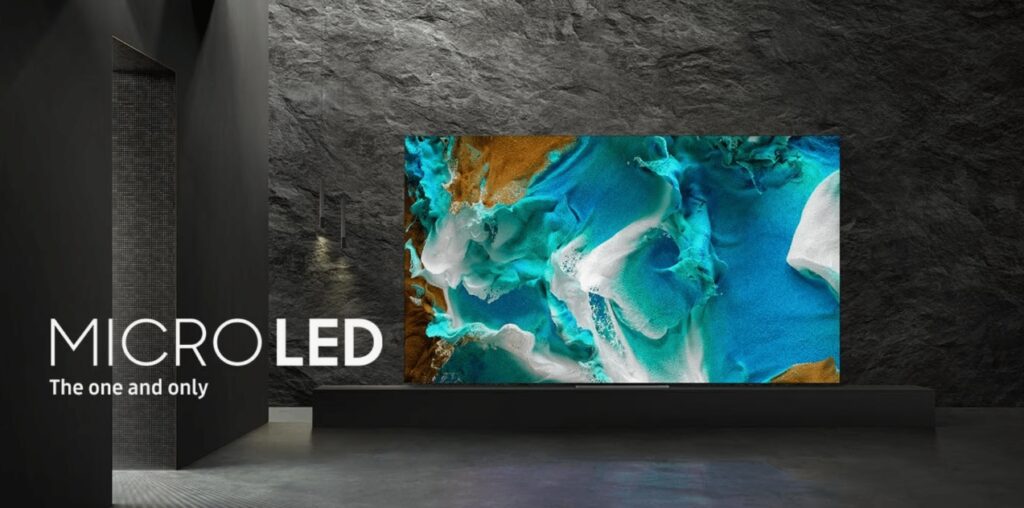
Samsung’s The Wall (commercial Micro LED) and Sony’s Crystal LED remain priced for enterprise and luxury segments. Consumer Micro LED TVs from Samsung start above USD 10,000 for smaller sizes. Cost reduction is happening — industry projections suggest meaningful price compression by 2027–2028 as mass transfer yields improve — but Micro LED is not a mass-market consumer technology yet.
OLED manufacturing is mature. LG Display’s WOLED process and Samsung Display’s QD-OLED process are high-volume, well-optimised, and continue to improve in yield and cost efficiency.
Application Scenarios: Where Each Technology Wins
The right technology depends entirely on the deployment context. Here’s a practical decision matrix:
| Application | Recommended Technology | Reason |
|---|---|---|
| Outdoor LED billboard | Micro LED | 5,000–10,000 nit brightness required |
| Automotive HUD / instrument cluster | Micro LED | Wide temperature range, no burn-in |
| Control room / 24/7 operations display | Micro LED | Lifespan, no burn-in from static UI |
| Large-format commercial display (indoor) | Micro LED or Mini-LED LCD | Depends on budget |
| Consumer TV (living room) | QD-OLED or W-OLED | Cost, image quality, form factor |
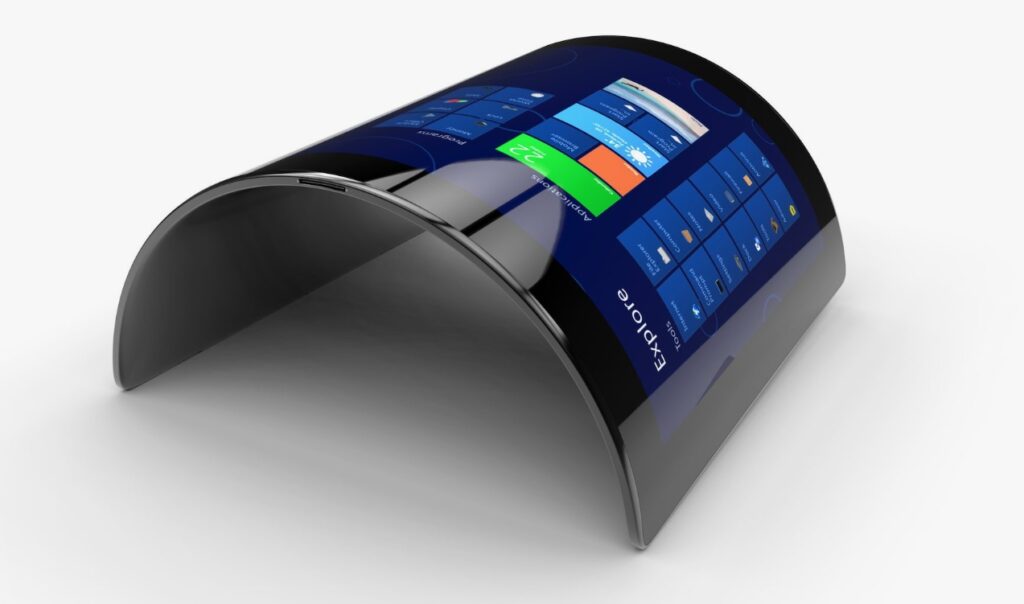
| Smartphone display | OLED | Thinness, flexibility, cost, efficiency |
| Wearable / smartwatch | OLED or Micro OLED | Form factor, power efficiency |
| VR/AR headset | Micro OLED (near-term) / Micro LED (future) | Pixel density, brightness |
| Retail digital signage (indoor) | OLED or Mini-LED LCD | Cost-effective, good image quality |
| Stadium / arena scoreboard | Direct-view LED / Micro LED | Scale, outdoor brightness |
A note on VR/AR: Apple Vision Pro uses Micro OLED (Sony-manufactured), not Micro LED. Micro OLED achieves extremely high pixel density in small form factors but retains the organic material limitations. True Micro LED headsets are in development but not yet commercially available at scale.
Environmental Adaptability
This dimension is straightforward: inorganic materials are more robust than organic materials across every environmental stress parameter.
| Environmental Factor | Micro LED | OLED |
|---|---|---|
| Operating temperature range | -40°C to +85°C (typical) | -20°C to +60°C (typical) |
| Humidity resistance | High — no organic degradation pathway | Moderate — moisture accelerates organic decay |
| UV exposure | Stable | Degrades organic emitters over time |
| Altitude / pressure variation | No impact | No significant impact |
| Vibration resistance | High | Moderate |
For outdoor installations in Melbourne, Singapore, the Middle East, or any environment with significant UV exposure, temperature extremes, or humidity, Micro LED’s environmental robustness is a practical operational advantage — not just a spec sheet number.
OLED panels used outdoors require aggressive encapsulation and are generally not recommended for direct outdoor exposure. The organic emitter layer is sensitive to moisture ingress; even small encapsulation failures accelerate degradation significantly.
2026 Market Landmarks
A few products define where each technology stands commercially right now:
Micro LED:
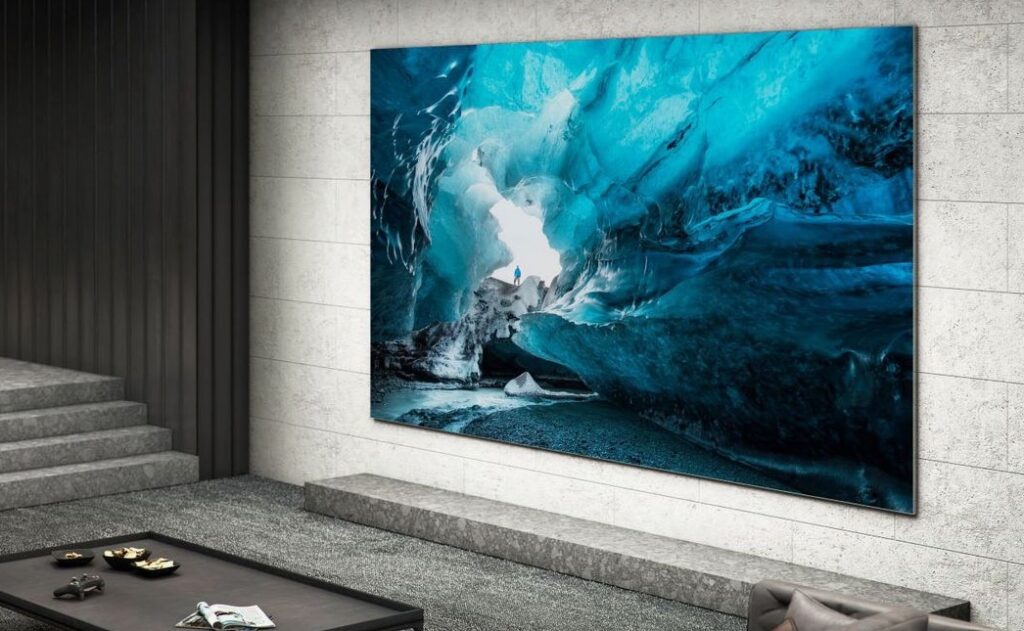
- Samsung The Wall — the commercial benchmark for large-format Micro LED, available in modular configurations from 110″ to custom sizes, used in broadcast studios, luxury retail, and high-end hospitality
- Sony Crystal LED — enterprise-grade Micro LED for control rooms and premium commercial environments
- Leyard / Unilumin commercial Micro LED — Chinese LED manufacturers bringing Micro LED to broader commercial price points
OLED:
- LG OLED evo (G-series) — the consumer TV benchmark, ~800–1,000 nits peak
- Samsung QD-OLED — highest brightness consumer OLED, ~2,000–3,000 nits peak in small window
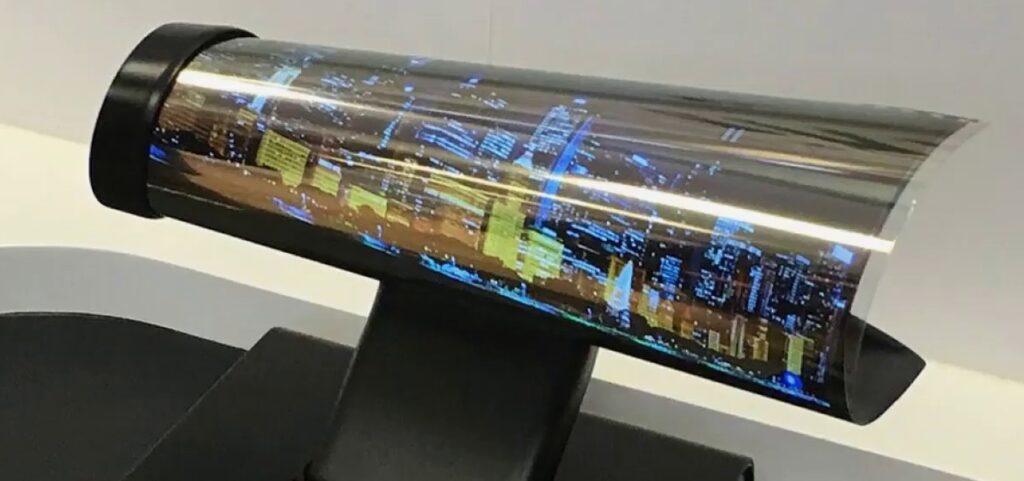
- Samsung / BOE flexible OLED — dominant in smartphone displays globally
FAQ
Will Micro LED replace OLED?
In professional and commercial applications, yes — the transition is already underway. In consumer electronics, cost parity is likely 3–5 years away. OLED will remain dominant in smartphones and mid-range TVs for the foreseeable future.
Does Micro LED have any burn-in risk?
No. Burn-in is a property of organic material degradation. Micro LED uses inorganic GaN emitters that do not degrade in the same way. This is one of the primary reasons Micro LED is preferred for 24/7 commercial deployments.
Is QD-OLED a middle ground between OLED and Micro LED?
QD-OLED improves color volume and peak brightness over standard OLED, narrowing the gap with Micro LED on those metrics. But the underlying organic emitter still degrades, so lifespan and burn-in characteristics are similar to standard OLED.
What pixel pitch is typical for commercial Micro LED displays?
Commercial Micro LED displays currently range from P0.9 to P2.5 for indoor applications. Sub-P1.0 Micro LED is available but commands a significant price premium. Outdoor Micro LED typically uses P3–P6.
When will consumer Micro LED TVs become affordable?
Industry consensus points to meaningful price compression by 2027–2028 as mass transfer yields improve and production volumes scale. A sub-USD 3,000 consumer Micro LED TV is not a 2026 reality.