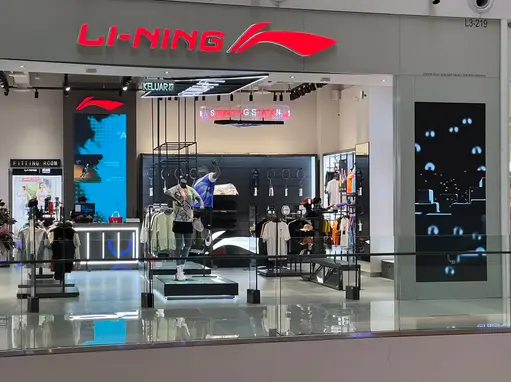
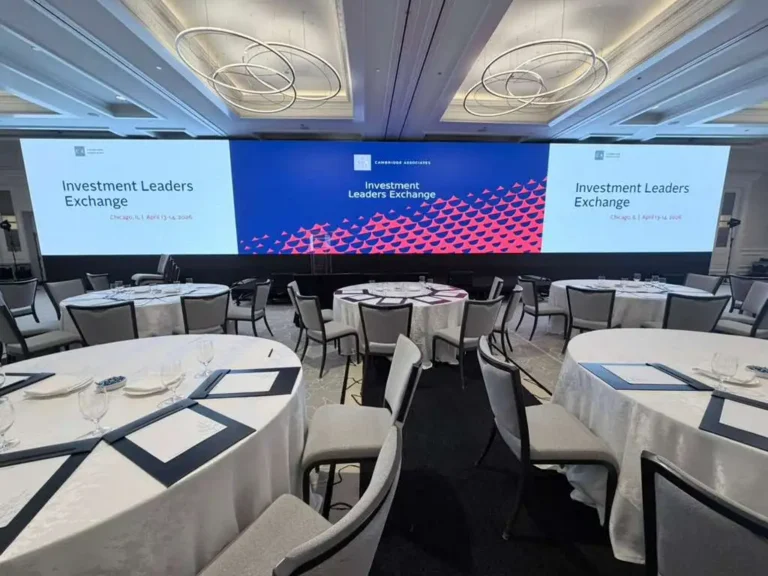
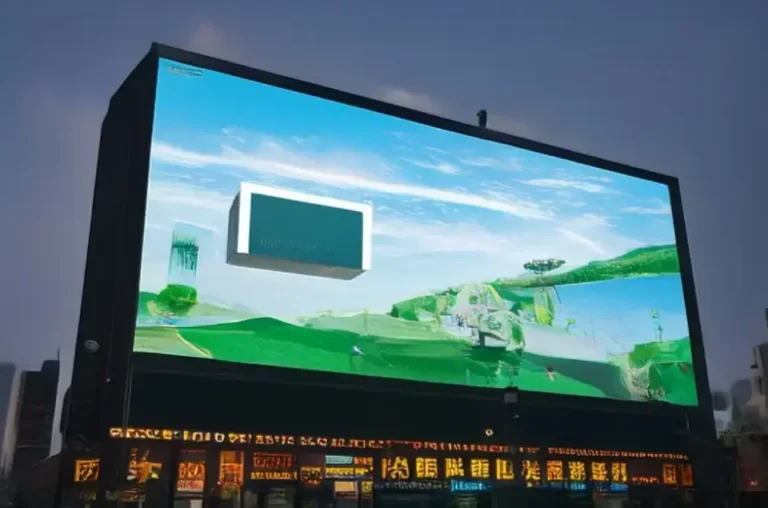
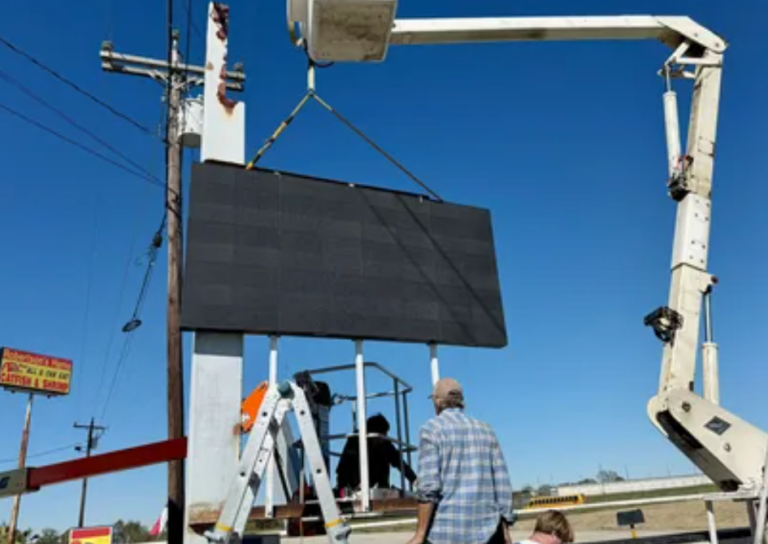
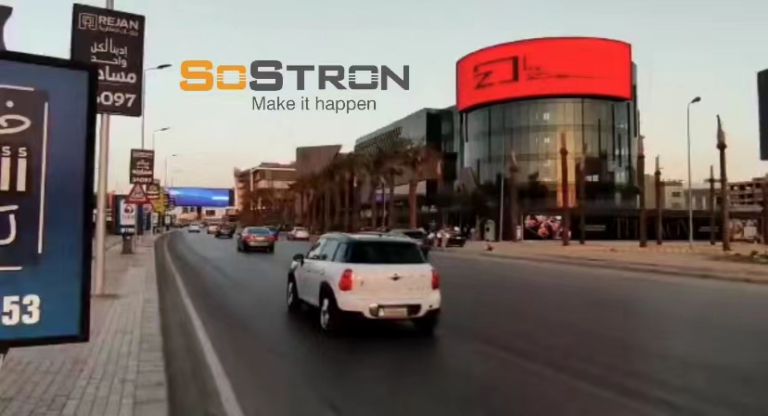
A creative LED display is a custom-engineered digital screen that breaks free from the conventional flat rectangle—built with flexible PCB modules, modular cabinet architecture, or transparent mesh substrates to form spheres, cubes, cylinders, curved skins, and fully bespoke geometries. Unlike a standard video wall, it delivers immersive 360° visual impact that standard panels simply cannot replicate. Here is what B2B buyers need to know at a glance before going deeper:
| Buyer Type | Recommended Form Factor | Key Spec Priority | Typical Pixel Pitch |
| Retail/Flagship Store | Transparent or Curved LED | Light transmittance ≥70%, nits 800–1,500 | P2.5–P4 |
| Live Events/Staging | Flexible + Rental Cabinet | IP54, fast-lock mechanism, <30 min setup | P2.9–P3.9 |
| DOOH Operator | Outdoor Cylinder/Sphere | IP65, ≥5,000 nits, 7×24 uptime | P4–P8 |
| System Integrator (Corporate) | Custom Bespoke Shape | CE/FCC certified, front-access service | P1.5–P2.5 |
| Museum/Exhibition | Spherical or Floor Tile | 160°+ viewing angle, interactive touch option | P2–P3 |
Most suppliers will not tell you this upfront: the form factor is the easy part. The decisions that will make or break your project—pixel pitch relative to viewing distance, cabinet load tolerance against your steel structure, CMS compatibility with your media workflow—those are engineering decisions that catalog pages and spec sheets will never answer. We have seen integrators order a P3 flexible module for a lobby installation with a 1.2-meter average viewing distance, then spend six weeks managing a disappointed client. The math was wrong from day one.
Based on our experience deploying creative LED solutions across more than 200 large-scale projects globally—from transit hub DOOH networks in Europe to custom branded installations in retail flagships across Southeast Asia—the projects that fail do not fail because of bad screens. They fail because of misaligned specifications, unvetted suppliers, and missing integration plans. This guide exists to close that gap.
What Is a Creative LED Display, and How Does It Differ from a Standard Video Wall?
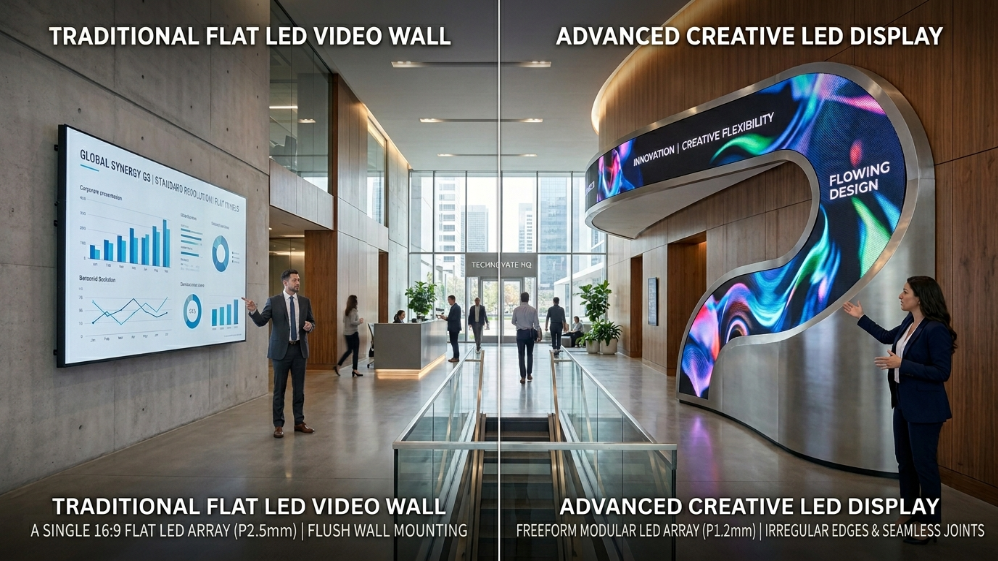
The simplest answer: a standard video wall is a tiled flat array of rectangular cabinets. A creative LED display is any configuration that departs from that geometry.
The technology that makes non-planar LED possible is the flexible PCB module—a printed circuit board manufactured on a polyimide or rubber substrate instead of rigid FR4. The substrate can be bent horizontally, vertically, or in compound curves, allowing LED panels to conform to spherical frames, wrap around columns, or tile into diamond and hexagonal tessellations. Cabinet architecture compounds this flexibility: rather than the standard 500×500 mm or 960×640 mm rigid cabinet, creative displays use custom-fabricated housings—often die-cast aluminum for indoor lightweight builds, or carbon-fiber composite for rental applications where mass matters.
The LED packaging itself matters here. COB (Chip-on-Board) technology embeds multiple LED chips directly into the PCB substrate under a single phosphor layer, rather than mounting individual SMD (Surface Mounted Device) diodes. On a curved or spherical surface, this distinction is commercially significant: COB modules have no exposed individual chip points, delivering a contrast ratio advantage of up to 50,000:1 versus the 5,000:1 typical of standard SMD panels. For a retail client whose creative sphere display sits at eye-level in a naturally lit atrium, that contrast ratio is the difference between a display that punches through ambient light and one that looks washed out by noon.
One more specification that buyers consistently underestimate on non-planar surfaces: grayscale depth. Standard commercial LED runs at 8-bit grayscale (256 brightness steps per channel). A creative LED display rendering smooth gradient content—a brand identity sweeping across a curved facade or a sunrise animation on a spherical lobby installation—requires 16-bit grayscale (65,536 steps). Banding artifacts on curved geometry are dramatically more visible than on flat surfaces because the human eye uses the surface curvature itself as a reference. Specify 16-bit minimum. The cost delta is marginal; the visual difference is not.
7 Types of Creative LED Displays: Which Form Factor Fits Your Project?
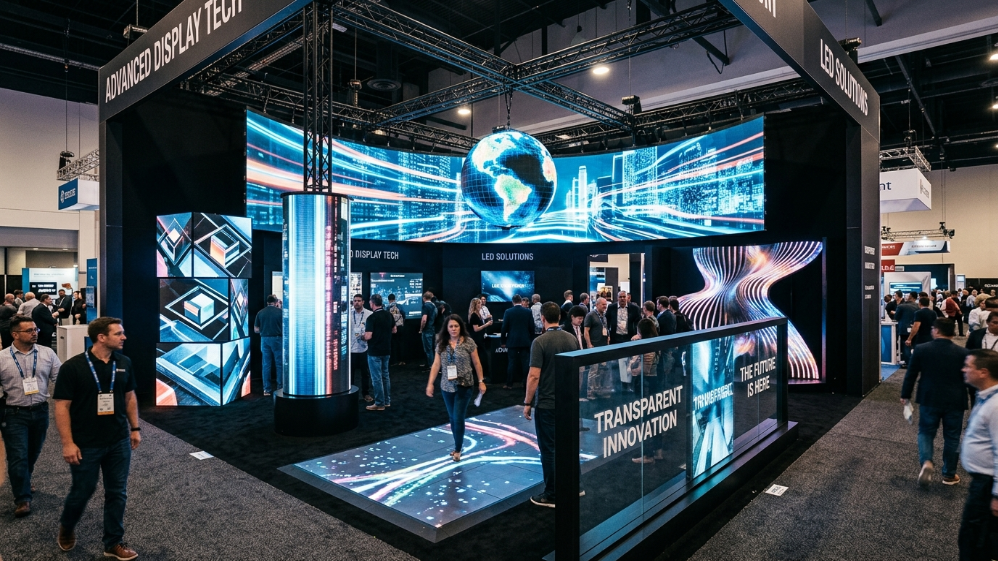
Spherical LED Displays
A spherical display is assembled from two semi-spherical aluminum subframes tiled with flexible PCB modules. Diameter ranges from 0.5 m (retail countertop) to 6 m+ (outdoor landmark installations). The defining advantage is the full 360° horizontal viewing angle—every observer in the space receives a front-facing image regardless of where they stand.
Pixel pitch for sphere displays typically runs P2 to P3 for indoor environments. At P2.5 and a 2.5 m diameter sphere, you are delivering roughly 3 million addressable pixels—sufficient for complex animated brand content. The engineering constraint is power density: a 3 m diameter sphere can draw 18–24 kW at peak brightness, which demands careful circuit planning well before installation day.
Cube LED Displays
The LED cube is built from 4 to 6 display faces joined at 90°—no visible seam at the corner edges when precision-machined aluminum extrusions are used. Cubes can be floor-mounted, corner-suspended, or ceiling-hung, making them one of the most installation-flexible creative formats available.
From a commercial standpoint, the cube excels at retail brand activations and product launch environments because it occupies vertical space efficiently and commands 270° to 360° sightlines in an open floor plan. A well-executed 1.2 m cube in a flagship store entrance converts from “digital signage” to “architectural feature.” That categorization shift is worth real money in brand ROI.
Transparent LED Displays
Transparent LED screens are constructed using a sparse LED array on a thin aluminum or acrylic substrate, with light transmittance typically between 60% and 90% depending on pixel density. The screen plays dynamic content while the background—a storefront window, glass curtain wall, or exhibition vitrine—remains partially visible.
According to market data from the Global LED Display Industry Report (2025), transparent LED adoption in retail and architectural contexts grew 34% year-over-year, driven primarily by luxury retail and airport duty-free operators. The reason is straightforward: a transparent display doubles as structural glass architecture during off-hours, eliminating the visual intrusion of a conventional screen.
The spec that matters most here is aperture ratio—the percentage of the substrate surface actually occupied by LED emitters. A 10% aperture ratio delivers approximately 85% transparency but limits maximum brightness to around 1,000 nits. For environments with strong ambient sunlight (south-facing retail windows, airport terminals), specify aperture ratios of 15–20% to push brightness above 1,500 nits without sacrificing too much transparency.
Flexible/Curved LED Screens
Flexible LED panels achieve minimum bending radii of R300 mm to R500 mm depending on module pitch. The commercial application set is broad: interior column wraps in hotels, concave or convex stage backdrops for live events, and curved architectural skins on building facades.
A common integration error: treating flexible LED as a drop-in replacement for rigid panels without accounting for the signal distribution chain. Curved surfaces create longer and more complex data cable runs between modules. Signal repeaters are frequently required every 6–8 modules on complex geometries to prevent image degradation at cable termination points.
5–7. Floor Tile, Cylindrical, and Bespoke Displays
Floor tile LED panels are engineered to sustain dynamic loads of 1,500–2,000 kg/m², with IP65 or IP66 ratings as standard for wet-environment use in event production. Cylindrical displays—frequently specified for shopping center atriums—offer continuous 360° media delivery from a single compact footprint. Fully bespoke shapes (brand logos, product silhouettes, architectural motifs) require a structural engineering brief and CAD-to-fabrication workflow that adds 4–8 weeks to the project timeline and 15–30% to the hardware cost. Budget accordingly.
The Pixel Pitch Decision Matrix: How to Choose the Right Resolution for Your Creative LED Display
This is the specification question we receive most frequently—and where the most costly mistakes are made.
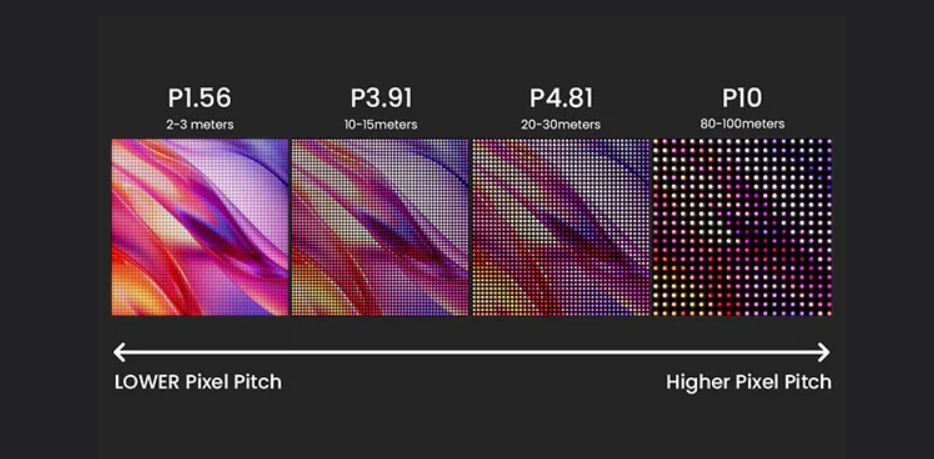
The foundational formula: Minimum Viewing Distance (meters) ≈ Pixel Pitch (mm) × 1,000 / 1,000 = Pixel Pitch value in meters. More precisely, the comfortable minimum viewing distance for full-resolution perception is approximately P value × 1.0 m to P value × 1.5 m, depending on content type. A P3 screen delivers acceptable image quality from 3.0 m; for photographic or brand-grade content, move to 4.5 m or step down to P2.5.
| Pixel Pitch | Min. Comfortable Viewing Distance | Optimal Content Type | Typical Application | Brightness Range |
| P1.2–P1.5 | 1.2–1.5 m | Brand graphics, video, data visualization | Corporate lobby, boardroom, control room | 600–1,000 nits |
| P1.9–P2.5 | 1.9–2.5 m | High-res video, product imagery | Retail flagship, museum exhibit, sphere display | 800–1,500 nits |
| P2.9–P3.9 | 2.9–4.0 m | Live event broadcast, stage backdrop | Concert, conference, event rental | 1,000–2,500 nits |
| P4–P6 | 4.0–6.0 m | Motion graphics, signage | Indoor DOOH, sports arena concourse | 2,000–4,000 nits |
| P6–P10 | 6.0–10 m | Large-format advertising, wayfinding | Outdoor DOOH, building facade, roadside | ≥5,000 nits |
One variable that flat-panel calculations ignore: curved geometry compresses effective viewing distance. A convex spherical surface seen from a fixed point at 3 m actually presents some panel sections at an oblique angle—effectively increasing the perceived pixel pitch of those sections by 15–25%. For sphere and cylinder displays, specify one pitch step finer than your flat-panel calculation suggests. A project where a standard calculation recommends P3 should be specified at P2.5 to account for angular distortion across the curved surface.
The second variable is content motion speed. Static or slow-motion brand content is forgiving at the lower edge of a pixel pitch range. High-motion sports content or fast-cut event programming demands a higher refresh rate—specify ≥3,840 Hz for any creative installation that will be filmed or livestreamed. At lower refresh rates, rolling-shutter cameras capture horizontal banding across the LED surface, which translates directly into poor broadcast quality and unhappy clients.
Creative LED Displays for DOOH Advertising: Specs That Drive Measurable ROI
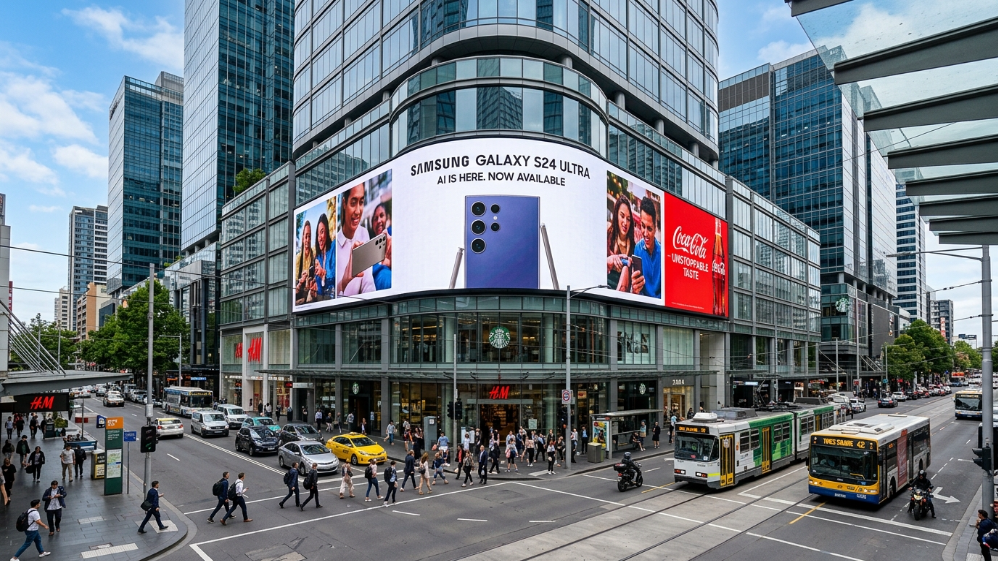
Pixel pitch and viewing distance solve the image quality problem. They do not solve the revenue problem. For DOOH operators, the hardware decision is ultimately a financial model—and the inputs that matter are uptime percentage, daily impression volume, and proof-of-play compliance, not nits alone.
Here is the reality that separates profitable DOOH creative LED networks from expensive experiments: ROI is a system problem, not a screen problem. According to INFiLED’s 2025 DOOH benchmarking analysis, a well-located creative LED installation in a high-footfall transit environment achieves break-even within 18 to 30 months at a CPM rate of $8–$12 and 60,000–80,000 daily impressions. The variable that collapses that timeline—or extends it past viability—is not which manufacturer you chose. It is uptime.
A creative LED display running at 95% uptime over five years delivers 438 fewer operational hours per year than one running at 97.5%. On a network of ten screens at a $10 CPM, that 2.5-percentage-point uptime gap costs approximately $180,000 in undelivered impressions annually. That number reframes the entire procurement conversation. The $4,000 premium for a cabinet with passive thermal management, a common-cathode LED driver, and a documented 100,000-hour rated lifespan is not a cost. It is insurance.
Three hardware specifications DOOH operators must lock in before signing a purchase order:
-
Brightness stability over time. LED luminance degrades with age—this is called lumen depreciation, measured as L70 (the point at which output falls to 70% of initial brightness). Insist on published L70 data. A quality outdoor creative display should maintain L70 at 50,000+ hours. Screens that cannot provide this data are managing your expectations downward from the beginning.
-
Proof-of-play system compatibility. Programmatic DOOH platforms—Vistar Media, Viooh, OpenDirect-compliant DSPs—require hardware that communicates real-time play confirmation logs. Verify that your LED controller supports API-level integration with your content management system. BrightSign OS, Mvix, and Nova Star’s VNNOX cloud platform are the three most common CMS environments in creative DOOH deployments. Confirm compatibility before procurement, not after.
-
Common-cathode power architecture. Standard LED drivers power R, G, and B sub-pixels at the same voltage even when displaying content that only activates one channel. Common-cathode drivers supply each sub-pixel at its optimal individual voltage, reducing energy consumption by 30–40% at the power supply level. On a creative cylindrical display drawing 12 kW at peak, that efficiency gain translates to roughly $3,800 in annual electricity savings per screen—a figure that compounds meaningfully across a multi-unit network.
Installation & Integration Guide for System Integrators: What No Manufacturer Tells You Upfront
The purchase order is signed. The cabinets are on a container ship. Now the real work starts—and this is where projects get expensive if the pre-installation engineering was skipped.
Structural load
Creative LED displays are heavier than their spec sheets suggest once you account for the full assembly: cabinets, subframe, power supplies, data harnesses, and rigging hardware. A suspended spherical display 2.5 m in diameter typically weighs 280–320 kg complete. Your rigging engineer needs the certified load rating of the overhead structure, not your integrator’s optimistic estimate. Building owners will ask for this documentation. Have it.
Power density planning
Calculate total draw at peak brightness—not average content brightness. A creative flexible LED installation covering 30 m² at P3 with standard SMD modules will draw approximately 450–600 W/m² peak. That is 13.5–18 kW for the surface area alone, before accounting for control systems, cooling, and content players. Circuit capacity must be planned against peak draw with a 25% safety margin. Under-specifying circuits is the single most common cause of on-site commissioning delays, in our direct experience.
Signal distribution on non-planar geometry
A flat video wall runs a predictable daisy-chain or star-topology data signal route. A sphere or cube introduces cable routing challenges that flat-panel installation experience does not prepare you for. Data signal degrades over cable runs exceeding 5–7 m between receiver cards without signal repeaters. Map your receiver card positions against the physical geometry before fabrication. On a 3 m sphere, this calculation typically requires 8–12 receiver cards and a network switch capable of handling the latency-synchronized output—otherwise you see micro-tearing at panel seams.
Content mapping
Non-rectangular displays require a pixel mapping software layer between your content source and the LED processor. Nova Star’s CourtCaster, Brompton Technology’s Tessera, and Barco’s E2 are the processing platforms most commonly specified for complex creative geometries. Budget 2–4 weeks for content mapping, testing, and calibration. This timeline is non-negotiable and non-compressible regardless of what a supplier’s timeline suggests.
MicroLED vs COB vs SMD: Is the Premium Worth It for Creative Displays?
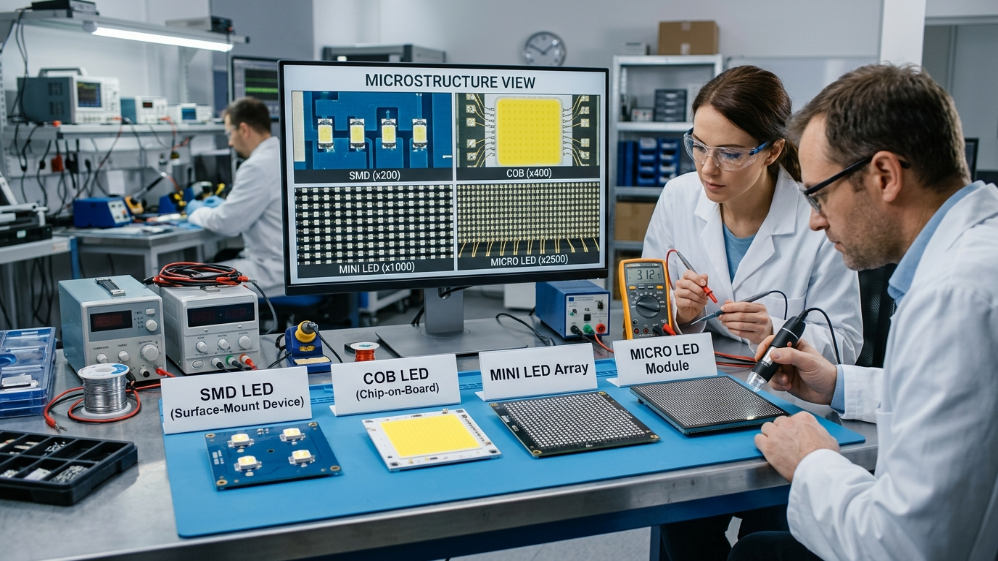
The LED packaging landscape has shifted materially in the last 24 months. Understanding the trade-offs is no longer optional for serious B2B buyers.
| Technology | Contrast Ratio | Durability (Impact) | Energy Efficiency | Current Cost Premium vs SMD | Best Creative Application |
| Standard SMD | 3,000:1–5,000:1 | Moderate (exposed chips) | Baseline | — | Rental stages, temporary events |
| GOB (Glue-on-Board) | 4,000:1–6,000:1 | High (epoxy protective layer) | Baseline + 5% | 8–12% | Outdoor DOOH, high-touch environments |
| COB (Chip-on-Board) | 20,000:1–50,000:1 | Very High (no exposed chips) | 15–20% better | 25–35% | Retail flagship, museums, corporate lobby |
| Mini-LED | 10,000:1–30,000:1 | High | 20–30% better | 40–60% | Control rooms, broadcast, fine-pitch creative |
| MicroLED | 100,000:1+ | Excellent | 40–50% better | 150–300% | XR virtual production, ultra-premium flagship |
The practical takeaway: MicroLED is currently overkill for the vast majority of creative LED display projects. Its case is compelling in two narrow scenarios—XR virtual production walls where camera-facing contrast uniformity is commercially critical, and ultra-fine-pitch flagship installations at P0.9 or below. For everything else, COB at P1.9–P2.5 delivers the contrast, durability, and energy efficiency that justify the premium over standard SMD without the MicroLED cost multiplier.
One emerging use case worth monitoring: interactive creative LED floor tiles with COB packaging. The absence of exposed LED chips makes COB floor surfaces genuinely resistant to impact and moisture intrusion, extending replacement cycles from 2–3 years (SMD floor tile) to 5–7 years under equivalent foot-traffic loads. That maintenance delta alone can close the COB premium gap within the first service cycle.
How to Vet a Creative LED Display Supplier: A 10-Point Procurement Checklist
The LED display manufacturing landscape is not homogeneous. There are tier-one manufacturers with in-house R&D, dedicated quality control lines, and global service networks. There are tier-three assemblers buying commodity modules and rebadging them. The product photographs look identical. The five-year experience does not.
Before committing to a supplier, validate every item on this list:
-
Certifications on file—CE (EU), FCC (US), RoHS (global), and UL (for North American commercial installations). Request the actual certificates, not logos on a website. Verify issuing body and expiry date.
-
L70 lumen depreciation data—Published test results, not sales claims. LM-80 test reports from an accredited laboratory are the standard reference.
-
IP rating documentation—IP65 minimum for outdoor creative displays. IP66 or IP68 for floor tile and wash-down environments. Request IEC 60529 test certificates.
-
Pixel pitch tolerance—Ask for quality control data on pitch uniformity across production batches. Variance above ±0.1 mm at P2.5 and below creates visible moiré at seams on curved surfaces.
-
Gray-scale depth confirmation—Specify 16-bit minimum in writing. Have the supplier confirm with hardware documentation, not a spec sheet checkbox.
-
Refresh rate verification—≥3,840 Hz for any broadcast or camera-facing application. Request oscilloscope test footage if the application is XR production.
-
After-sales SLA in contract—Response time commitment for critical failures (define: complete display section dark). Industry standard from tier-one suppliers is 24-hour remote response, 72-hour parts dispatch.
-
Spare module stock commitment—A minimum of 3–5% replacement module stock held at a regional warehouse for the duration of your warranty period. Get this in the contract, not as a verbal assurance.
-
Reference installations in your region—Ask for two completed projects you can physically visit or video-call the end client about. Supplier reluctance here is itself a data point.
-
Factory audit access—Tier-one manufacturers welcome remote or in-person factory audits. If a supplier declines or delays this request without a credible reason, treat it as a disqualifying signal.
According to industry procurement data, 62% of B2B LED display disputes arise from specification mismatches—not from outright product failure. A rigorous pre-contract checklist is not bureaucratic overhead. It is the document that prevents a six-figure claim.
Frequently Asked Questions
Q1: How much does a creative LED display cost compared to a standard video wall?
Creative LED displays carry a 30–150% cost premium over equivalent-area flat video walls, depending on form factor complexity. A spherical display at 2 m diameter starts at approximately $18,000–$35,000 for the display system alone, excluding structural engineering, installation labor, and content mapping. Transparent LED and bespoke custom shapes sit at the higher end. The structural and installation costs for complex geometries frequently equal or exceed the hardware cost—budget for both from the outset.
Q2: What pixel pitch should I specify for a creative LED display in a retail store?
For retail environments with typical viewing distances of 2–4 meters, P2.5 is the practical sweet spot for spherical, cube, and curved installations. For transparent window displays viewed from outside at 1.5–3 m, P3–P4 is sufficient and reduces the aperture ratio, improving transparency. Always apply the curved-geometry correction: specify one pitch step finer than your flat-panel calculation recommends.
Q3: Can creative LED displays be used outdoors year-round?
Yes, with the correct specification. Outdoor creative displays require IP65 minimum ingress protection, operating temperature range of -20°C to +60°C, brightness of ≥5,000 nits for direct sunlight readability, and anti-UV coated module surfaces. Spherical and cylindrical outdoor displays additionally require wind-load engineering of the subframe structure—consult a structural engineer with the display manufacturer’s published wind resistance data (typically rated to Beaufort Scale 10 or 12 for permanent outdoor installations).
Q4: How long does a creative LED display last, and what drives early failure?
Quality creative LED displays have rated lifespans of 100,000 hours (approximately 11 years at continuous operation). The primary causes of premature failure are: thermal management failure (inadequate ventilation in enclosed cabinet designs), moisture ingress at IP-rated junction points on outdoor installs, and power supply degradation from poor-quality capacitors. COB-packaged modules consistently outlast SMD equivalents under equivalent conditions due to the absence of individual chip solder joints—a common point of failure in high-humidity environments.
Q5: What content format and resolution should I use for a non-rectangular creative LED display?
Non-rectangular displays require a custom pixel map file generated by your LED processor software (Nova Star, Brompton, Barco, or equivalent). Source content should be delivered in the native pixel resolution of the display’s total pixel map—not a standard 1920×1080 or 4K frame. For sphere displays, equirectangular projection formats adapted to the LED’s UV coordinate map are the most reliable approach. Work with your processor supplier to generate the pixel mapping template before commissioning content production—retrofitting content to an unknown map is always more expensive than building the map first.
Expert Verdict
The creative LED display market in 2026 is not short of products. It is short of projects done right.
The gap between a spectacular creative installation and a chronic maintenance problem comes down to four decisions made before a single cabinet ships: pixel pitch matched to actual viewing geometry, not rule-of-thumb; a supplier who can produce LM-80 and IP certification on request; a power and signal infrastructure plan completed by a qualified engineer; and a CMS integration tested before site installation, not during.
Buyers who treat creative LED as a premium commodity purchase—comparing only unit prices and shape options—will find the real costs later, in service calls, in unhappy clients, and in early replacement cycles. Buyers who treat it as a system engineering project with a hardware component will find that the premium form factor pays back in audience engagement, brand differentiation, and DOOH revenue that flat panels simply cannot generate.
The screens are the easy part. Get the engineering right.
References:
IES TM-30-18: Method for Evaluating Light Source Color Rendition
IEEE Std 1789: Recommending Practices for Modulating Current in High-Brightness LEDs