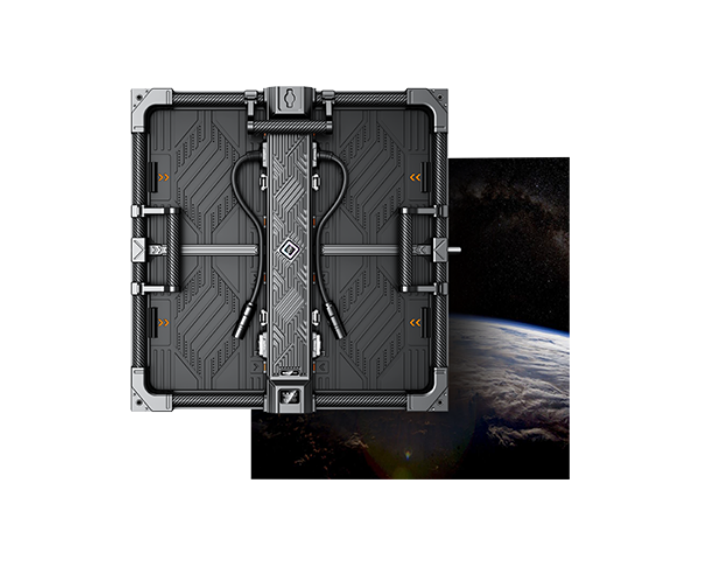
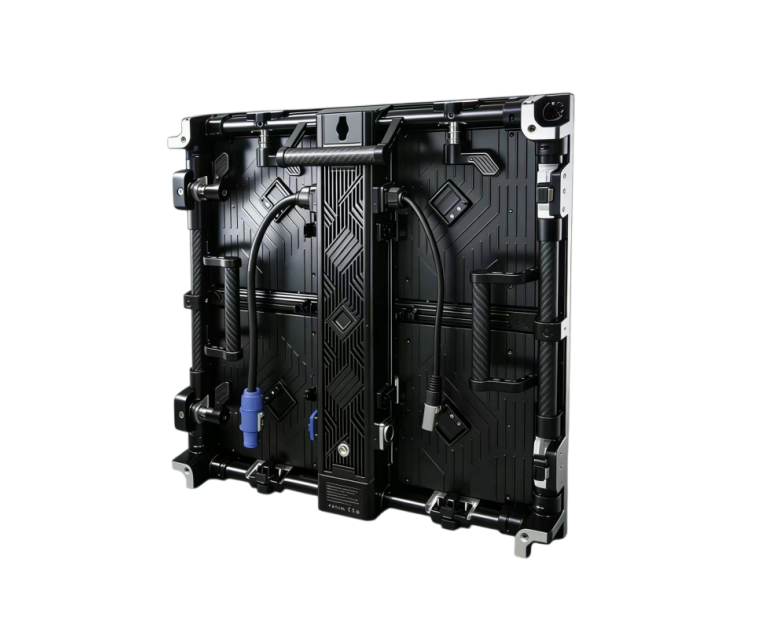
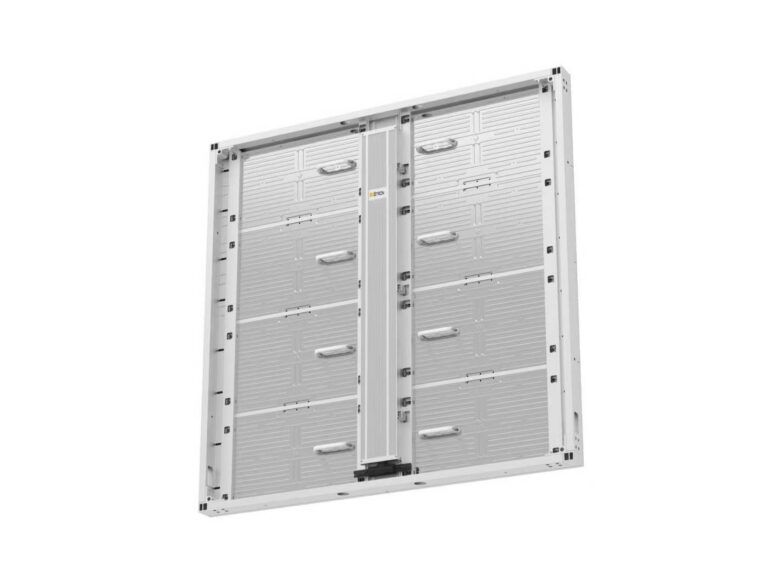
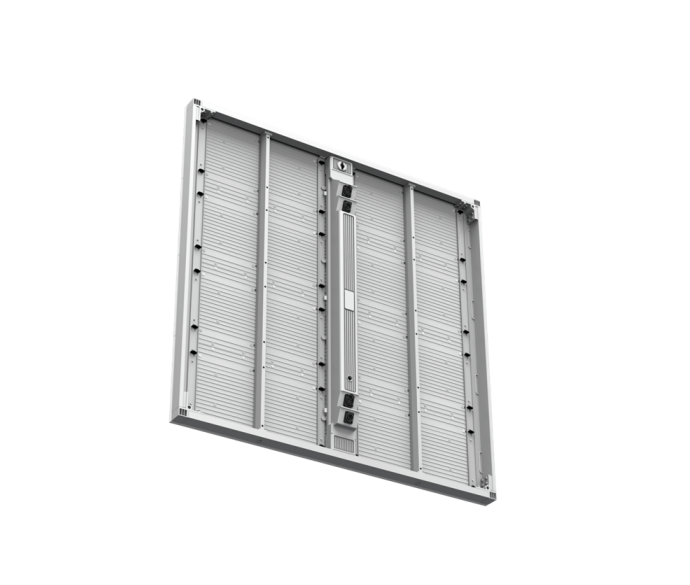
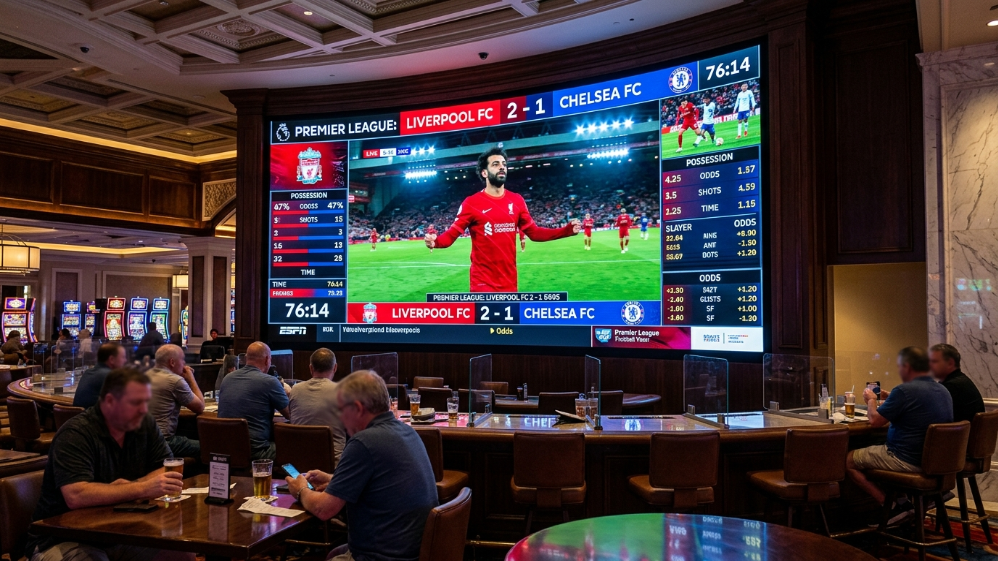
A casino LED display is a direct-view LED (dvLED) screen system purpose-built for gaming environments—delivering brightness above 1,500 nits, fine pixel pitches of P1.2–P2.5mm, and dual-redundant power/signal architecture for uninterrupted 24/7 operation. Sportsbook video walls, creative ribbon screens above slot banks, and grand-entrance resort façade canopies all fall under this category. If you are specifying a display system for any of these applications, the table below is where every evaluation should start.
| Application Zone | Recommended Pixel Pitch | Min. Brightness | Key Spec Priority | Form Factor |
| Sportsbook information wall | P1.5–P2.5mm | 1,500 nits | Refresh rate ≥3,840Hz, seamless bezel-free | Flat/slight curve |
| Slot machine top ribbon/canopy | P2.5–P3.9mm | 1,200 nits | Soft-module flexibility, bend radius ≤200mm | Flexible ribbon/wave |
| Casino entrance & lobby statement | P1.8–P2.5mm | 1,800 nits | Color gamut >110% NTSC, ΔE <3 | Creative/cylindrical |
| Resort exterior façade/canopy | P4–P6mm | 5,000+ nits (auto-dim) | IP65, wind load cert., photocell dimming | Large-format outdoor |
Why Casino and Gaming Resort Environments Demand a Different Class of LED Display
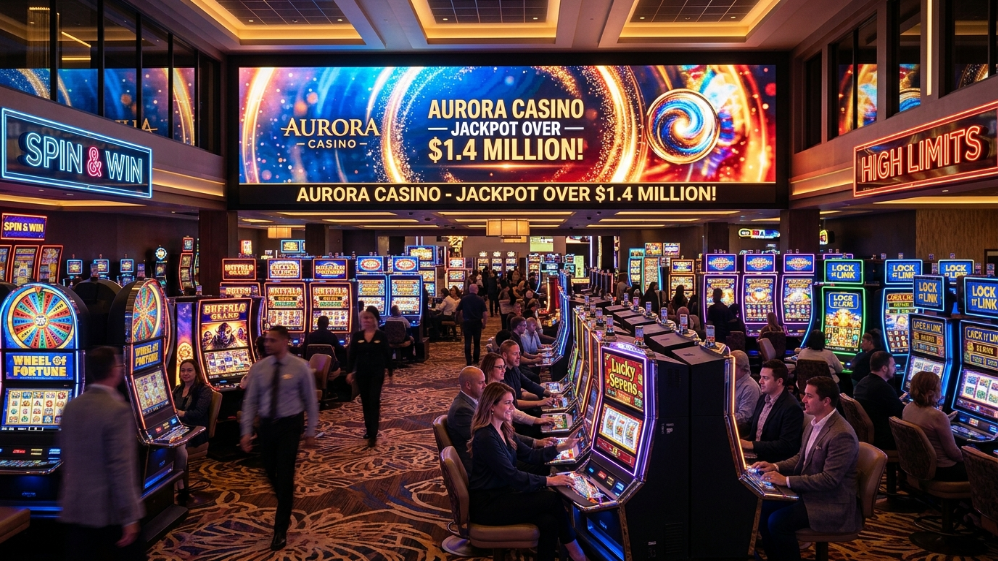
Walk onto a functioning casino floor and you will immediately understand the problem. The lighting environment is unlike anything else in commercial real estate—neon strips running at 800 lux, colored ceiling chandeliers, backlit bar shelving, and the constant pulse of slot machine animations, all competing for visual dominance within the same 20-meter sightline. A standard commercial LED screen rated at 800 nits does not stand a chance. It washes out, loses saturation, and communicates weakness rather than spectacle.
Based on our experience deploying display systems across gaming properties in the US, Southeast Asia, and the Middle East, the three non-negotiable performance pillars for any casino LED display are: extreme brightness and color fidelity under competing ambient light, mechanical flexibility to integrate with contemporary resort architecture, and zero-tolerance uptime reliability. Every procurement decision that ignores any one of these three will result in a costly retrofit within 24 months.
The Ambient Light Problem: Why Standard Displays Fail on a Casino Floor
The challenge is photometric, not cosmetic. A modern casino floor typically operates at 300–600 lux in general gaming areas, spiking to 800–1,000 lux near bar and lounge zones with architectural uplighting. At those lux levels, a display running below 1,200 nits produces a contrast ratio insufficient for comfortable content consumption at 5+ meters. The viewer’s eye adapts to the brighter ambient environment, and the screen appears grey, flat, and unconvincing.
Casino-grade fine-pitch LED solves this with two mechanisms working in concert. First, peak brightness is engineered well above that threshold—quality sportsbook video wall modules are rated at 1,500–2,000 nits for indoor applications, with auto-dimming calibrated to ambient lux via photocell. Second—and this is where most vendor spec sheets go silent—color gamut coverage must exceed 110% of the NTSC standard. Standard commercial displays typically achieve 72–90% NTSC. At >110% NTSC, reds remain saturated crimson rather than washing to orange, greens hold their depth, and the deep blues of team uniform graphics stay visually distinct under competing colored light sources. For a sportsbook video wall displaying 30+ simultaneous live feeds, this is not a cosmetic preference. It is legibility engineering.
The other metric that matters here is Delta-E (ΔE)—a measure of color consistency between modules across the full wall surface. A ΔE above 3 is visible to the naked eye as patchwork color variation, particularly noticeable on grey-scale content like broadcast sports graphics. Casino-grade LED systems are calibrated post-installation to achieve ΔE <3 across the entire display surface. This point-by-point calibration step is frequently skipped by lower-tier installers, and it is usually the first thing a property’s VP of Marketing notices and complains about three months after opening.
The Architecture Constraint: Why Modern Gaming Resorts Have Outgrown the Flat Screen
Here is a truth that surprises buyers coming from corporate AV backgrounds: a flat rectangular LED wall, however large and however sharp, reads as a screen bolted onto a casino rather than a feature built into one. The most admired gaming properties in the world—from the spectacle-first resorts of Las Vegas to the integrated resort complexes across Macau and Singapore—are architectural experiences first, gaming venues second. Their LED displays are not accessories. They are structural features.
This shift has created enormous demand for flexible LED and creative-shaped displays in gaming environments. The cylindrical LED column that greets guests as they enter a resort lobby. The undulating wave-form LED ribbon that flows above an entire bank of slot machines, creating a branded ceiling experience 40 meters long. The toroidal LED canopy suspended above the sportsbook lounge, giving bettors the sensation of being inside an arena rather than a hotel room. None of these are achievable with conventional rigid panel systems. All of them require soft-module flexible LED technology—LED modules built on pliable polyimide-based Flexible Printed Circuit (FPC) substrates with minimum bend radii as tight as 150–200mm, capable of achieving true physical curves without visible seams or crease lines.
According to data from the American Gaming Association, US commercial casino revenue reached $71.9 billion in 2023. Properties that fail to deliver differentiated physical experiences are losing the battle for the high-value recurring guest. Visual spectacle is infrastructure, not decoration.
Sportsbook Video Walls: Designing the Immersive Betting Environment That Keeps Bettors Engaged Longer
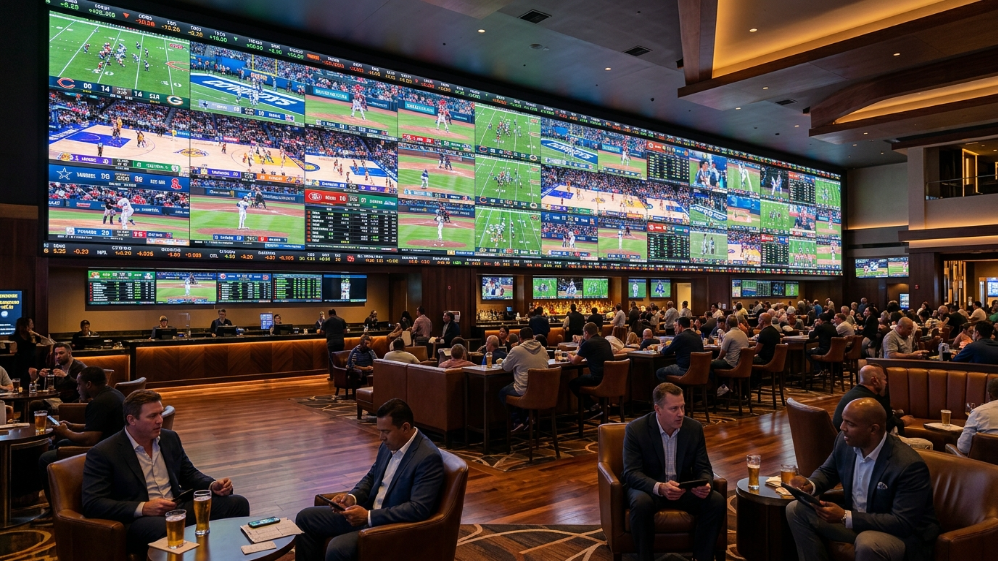
The sportsbook is the highest-stakes zone in any casino from an AV perspective—and not just because of the wagering. A bettor in a sportsbook is making active, real-time decisions based on information displayed on your screens. Odds feeds updating every 3–5 seconds. Live game broadcasts from 6 different time zones. Player statistics, injury reports, and line movements. If the display system cannot render all of that simultaneously, at broadcast quality, with zero perceptible motion blur on a fast break or a goal replay, you are degrading the product your guests came to use.
What Pixel Pitch Should You Specify for a Sportsbook Video Wall?
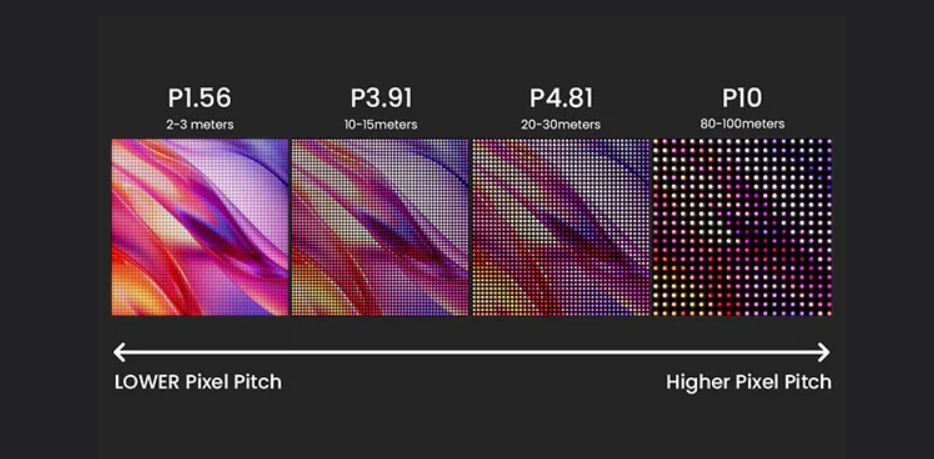
The viewing distance formula is straightforward, and it matters: minimum comfortable viewing distance (meters) = pixel pitch (mm) × 1,000 / 1,000 = pixel pitch in meters. A P2.5mm wall produces a minimum comfortable viewing distance of approximately 2.5 meters. For a sportsbook primary viewing zone of 4–8 meters—the typical distance from seating area to video wall—P1.5mm to P2.5mm covers the range well. Anything coarser than P3.9mm will show visible pixel structure to seated viewers in a mid-size sportsbook room.
Refresh rate is the spec most buyers overlook. A sportsbook video wall that reads great to the naked eye but flickers on smartphones produces a steady stream of poor-quality guest-captured content circulating on social media. Casino marketing teams are increasingly aware of this. Specify a minimum refresh rate of 3,840Hz—this eliminates rolling shutter artifacts entirely when shot on modern smartphone cameras at up to 240fps slow-motion. Driving ICs capable of 7,680Hz are available and worth the incremental cost for flagship installations where press photography and broadcast coverage are expected.
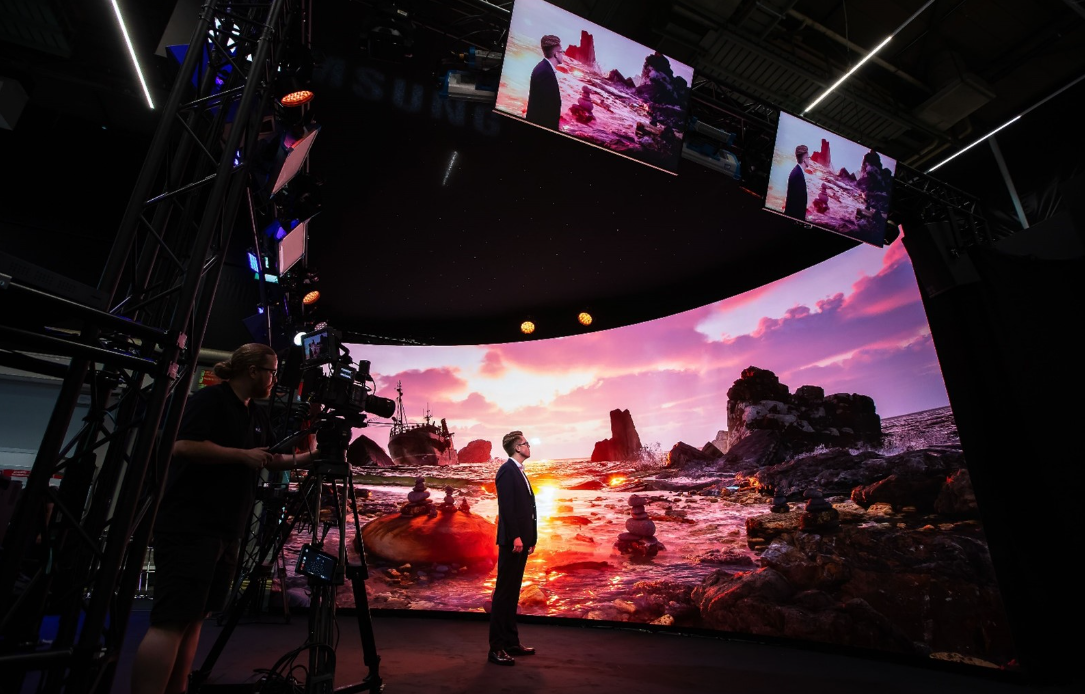
- Camera Flicker: Visible black bars (rolling shutter effect) when filmed.
- Content Loss: Fast-moving content may appear blurry or tearing.
- Not Broadcast Ready: Unsuitable for professional live streaming or TV.
- Flicker-Free: Crystal clear image on all cameras (1/2000s+ shutter speed).
- Smooth Motion: Perfect for fast video playback and sports.
- XR Ready (7680Hz): Essential for virtual production and XR studios.
The table below summarizes the decision framework for sportsbook video wall specification:
| Specification | Entry Level | Professional | Flagship Sportsbook |
| Pixel Pitch | P2.5mm | P1.8mm | P1.5mm |
| Min. Viewing Distance | ~2.5m | ~1.8m | ~1.5m |
| Brightness (nits) | 1,000 | 1,500 | 2,000 |
| Refresh Rate | 1,920Hz | 3,840Hz | 7,680Hz |
| NTSC Color Gamut | 90% | 100%+ | 110%+ |
| Redundancy | Single PSU | Dual PSU | Dual PSU + Signal Hot-Backup |
| Calibration | Factory | Factory | Post-Install Point-by-Point |
The Seamless Information Architecture Problem
A 30-foot sportsbook video wall showing 24 simultaneous sporting events is not just a display hardware challenge—it is a content management architecture challenge. The hardware must support multi-zone processing, where each zone can accept an independent video signal at full resolution, while a master control layer allows the operator to reconfigure the zone layout in real time: collapsing 24 small windows into one full-wall broadcast for a championship game, then expanding them again at halftime.
This requires a video wall controller with sufficient processing headroom—typically a 4K/8K-capable scaler-switcher architecture—and a CMS platform that can trigger zone presets from a single operator interface without requiring on-call AV engineering staff. The right display hardware vendor will not only supply the panels; they will advise on the control architecture and confirm software compatibility before contracts are signed.
The Solution: Sostron Products Engineered for Gaming Resort Environments
After analyzing the full scope of casino and gaming resort LED requirements—seamless sportsbook walls, flexible ribbon screens above slot banks, and grand-entrance creative installations—two product lines from Sostron’s portfolio stand out as the most technically appropriate fits.
For Sportsbook Video Walls and Indoor Casino Floor Displays: Reta 2 Small Pitch LED Display
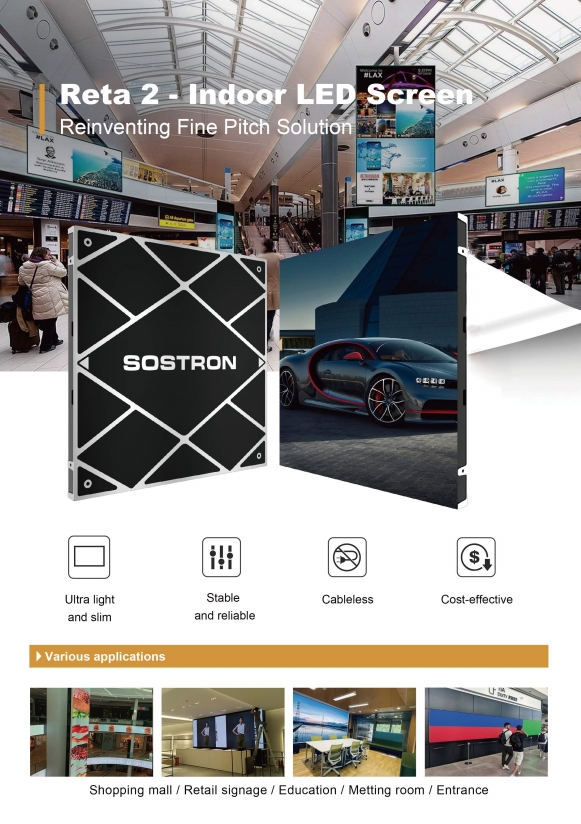
The Reta 2 is Sostron’s fine-pitch indoor workhorse, available in pixel pitches from P1.25mm through P2.5mm. Its ultra-thin, cable-free modular cabinet design means panels can be assembled into seamless large-format walls—exactly what a sportsbook information wall demands. Key specifications relevant to the casino environment: SMD1515 LED type with high-precision color reproduction, wide viewing angle, and energy-efficient operation rated for continuous 24/7 duty cycles. The P1.5mm and P1.8mm variants are particularly well-suited for primary sportsbook viewing zones of 3–6 meters, delivering the broadcast-quality resolution that live sports content requires. The modular architecture also simplifies front-access maintenance—a critical practical consideration in a sportsbook where a maintenance window during a major live event simply does not exist.
For Creative LED Ribbon, Cylindrical Columns, and Wave-Form Canopies: sPad Pro 2 Flexible Arc Rental Display
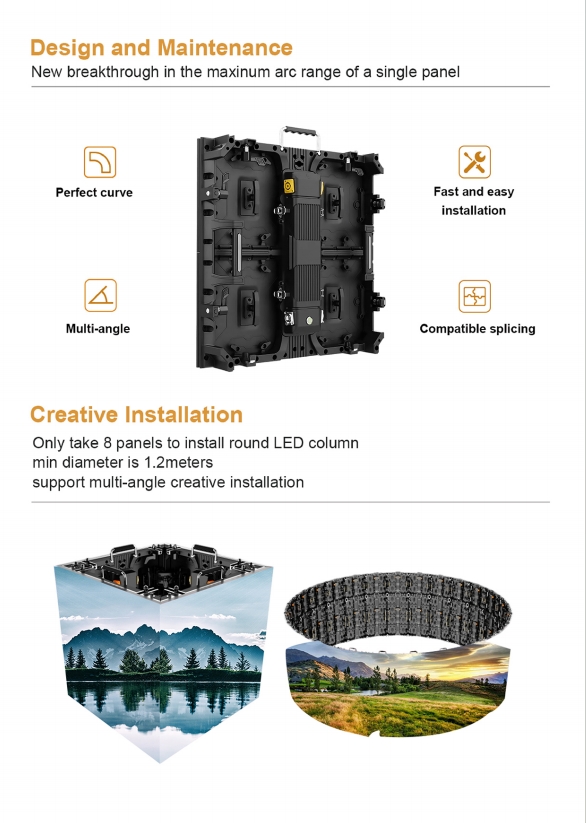
The sPad Pro 2 is Sostron’s dedicated flexible-curve LED panel, engineered specifically for creative form-factor installations. Built on a soft-module architecture with magnetic snap-fit panel connections, it achieves smooth convex and concave curves—making it the right mechanical basis for LED ribbon installations above slot machine banks, cylindrical entrance column wraps, and wave-form ceiling canopies. Its ultra-lightweight panel design reduces structural load requirements, which is significant when planning ceiling-mounted ribbon installations where rigging weight tolerances are a hard constraint. The sPad Pro 2 supports a wide curvature range—sufficient to achieve true arc, “S”-form, and toroidal configurations—without the visible seam lines that segmented rigid-panel approximations produce.
Real-World Reference: USA P1.9 GOB Indoor LED Wall Deployment
A directly relevant installation from Sostron’s case portfolio is the USA 100sqm P1.9 GOB LED Wall project, a large-format fine-pitch indoor deployment serving a high-end commercial venue in the United States. The installation demonstrates Sostron’s capability to supply, configure, and commission 100sqm+ continuous indoor fine-pitch walls at the P1.9mm pixel pitch range—the specification tier directly applicable to mid-to-large sportsbook primary viewing walls. The GOB (Glue-on-Board) encapsulation used in this deployment adds a secondary benefit highly relevant to casino environments: physical protection of the LED lamp face against impact and cleaning agents, reducing module replacement frequency in high-traffic, high-maintenance-contact settings.
7×24 Reliability Engineering: How Dual Redundancy Prevents Blackout in a Live Gaming Environment
Let’s be direct about something the rest of this industry dances around: a black screen in a sportsbook during a live event is not an inconvenience. It is an operational emergency. Bettors cannot place informed wagers on odds they cannot see. Floor staff face immediate complaints. In licensed gaming jurisdictions, extended display failures can trigger compliance notifications. The revenue loss from a 20-minute outage during a heavyweight title fight is not theoretical—it is calculable, and it runs into five figures for a mid-size property.
The engineering response to this risk is dual redundancy architecture, and it must be specified explicitly. Do not assume it is included. Many mid-market LED suppliers offer single-PSU cabinets as their default configuration and treat redundancy as an upsell.
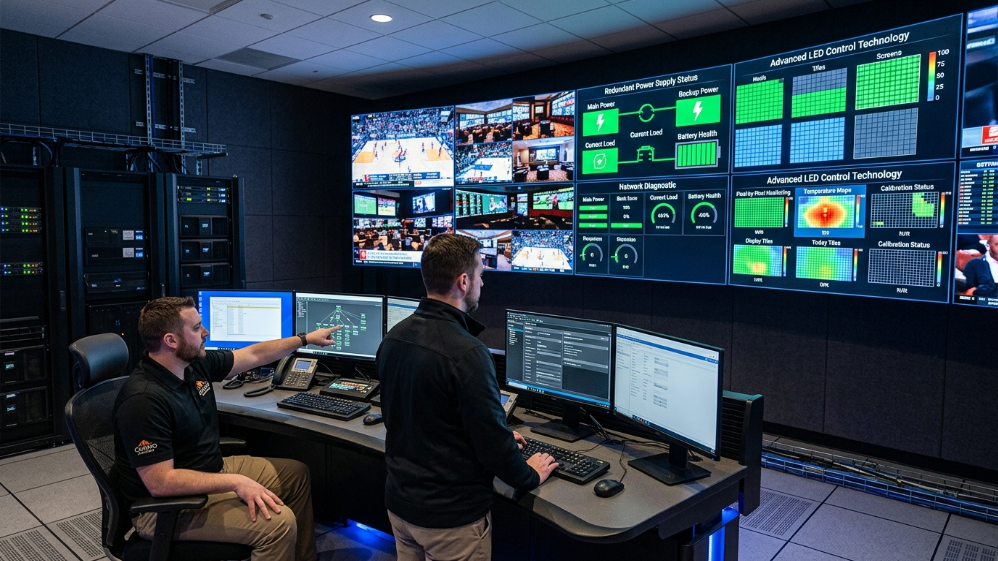
Here is how a properly engineered system works. Each display cabinet houses two independent power supply units wired in N+1 hot-standby configuration. If the primary PSU fails—due to surge, thermal event, or component fatigue—the secondary takes over in under 50 milliseconds. That is faster than the human visual system can register a change. The screen never goes dark. Simultaneously, the signal processing chain operates with a primary controller and a hot-backup unit monitoring the data stream in real time. If the primary controller drops signal, the backup assumes control within the same sub-100ms window. These two redundancy layers together eliminate virtually every single point of failure in the display chain.
Remote monitoring is the operational layer that sits above the hardware redundancy. A networked health dashboard—monitoring PSU status, cabinet temperature, pixel fault percentage, and brightness consistency across every panel in the installation—gives the property’s AV team early warning of degrading components before they fail. For multi-property gaming resort operators managing LED systems across multiple venues, this is not optional. It is how you move from reactive maintenance to predictive maintenance, which is the only model that makes financial sense at scale.
A note on MTBF (Mean Time Between Failure): the “100,000-hour lifespan” figure cited across almost every LED product page in the industry refers to the LED chips themselves under nominal operating conditions, not the system. PSUs, signal processors, and fan assemblies in 24/7 environments typically require inspection at the 3–5 year mark. A vendor who cannot provide system-level MTBF data—not just chip-level—is not equipped to support a serious gaming property deployment.
Color Science for Gaming: Delivering Saturated, High-Contrast Visuals That Win in a Neon-Saturated Environment
The ambient light problem introduced earlier has a precise solution, and it goes beyond raw brightness. Sustaining perceived color quality on a casino LED display under 800+ lux of competing light requires three calibration disciplines working together.
Brightness auto-calibration via photocell integration allows the display to track ambient lux in real time and adjust output accordingly—bright enough to maintain contrast when the house lights are up for cleaning, dimmed appropriately during late-night atmospheric lighting. This extends panel lifespan by preventing unnecessary drive current during low-ambient periods.
NTSC gamut expansion beyond 100% is achievable through LED chip selection at the manufacturing stage. Narrow-spectrum red, green, and blue LED chips—the kind used in broadcast monitor-grade displays—produce a wider color triangle on the CIE chromaticity diagram. For a gaming resort digital signage system that needs to render team colors accurately across sports feeds from NFL, NBA, Premier League, and Formula 1 simultaneously, this is the specification that separates professional-grade from commercial-grade hardware.
Post-installation point-by-point calibration using a spectrometer corrects for the manufacturing variance that exists between individual LED chips across a large surface. A 100sqm sportsbook video wall contains millions of individual diodes. Without calibration, you will see subtle but visible brightness and color hot-spots—particularly on grey backgrounds and white balance content. Demand this step from your supplier as a project deliverable, not an optional service.
5 Technical Questions Every Casino AV Director Should Ask Before Signing a Purchase Order
The following questions are not negotiation tactics. They are diagnostic filters. A vendor who answers all five confidently, with data, has earned the next stage of evaluation. A vendor who deflects or generalizes on any of them has told you something important.
Q1: What is the PSU redundancy configuration on your standard casino-spec cabinet—and what is the switchover time?
The correct answer is N+1 hot-standby with a switchover time under 100ms. Any answer that treats redundancy as a custom upgrade warrants scrutiny.
Q2: Can you provide post-installation color calibration as a contracted project deliverable, including ΔE <3 certification across the full wall?
This separates suppliers who ship panels from suppliers who commission display systems. The former will struggle with this question.
Q3: What is the minimum bend radius of your flexible LED modules, and can you provide structural load data for ceiling-mounted ribbon installations?
For any gaming resort digital signage project involving flexible or creative-shaped LED, this is the technical gateway question. Minimum bend radius determines feasibility for cylindrical, wave-form, and toroidal configurations. Structural load data—typically 10–15 kg/sqm for quality soft-module systems—is required before any ceiling rigging plan can be engineered.
Q4: What refresh rate do your sportsbook-spec panels support, and has it been tested for rolling shutter performance on smartphone cameras?
The target is ≥3,840Hz. Some suppliers quote driving IC capability rather than actual tested output—push for test documentation, not specification sheet figures.
Q5: How does your remote monitoring system alert on partial pixel failure, and what is your on-site response SLA for a critical display fault?
A 24/7 gaming environment requires a defined SLA—4-hour response for critical faults is a reasonable baseline. If the supplier does not have a structured service agreement framework for gaming clients, the post-installation support model does not match the operational risk profile of the venue.
Outdoor Gaming Resort Digital Signage: The Grand Entrance Canopy and Façade Display
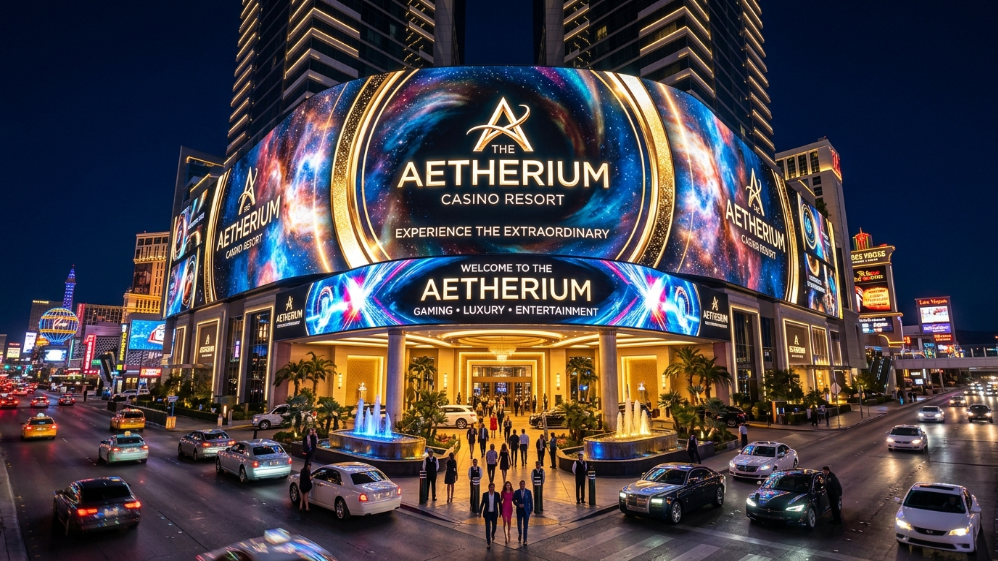
The exterior of a gaming resort is its first and most powerful brand statement. Before a guest sets foot inside, the building itself is communicating brand values, scale, and promise. A full-façade LED installation—or a programmable LED canopy over the resort’s porte-cochère entrance—is the category of gaming resort digital signage that generates the highest earned media value per square meter of any display investment the property will make.
Outdoor casino LED specifications diverge sharply from indoor in three key areas. Brightness requirements jump to 5,000+ nits to maintain contrast in direct sunlight. Ingress protection rating must meet IP65 at minimum—fully dust-tight and protected against water jets—with IP68 specified for installations in coastal resort environments subject to salt air and humidity. Thermal management becomes a primary engineering concern: outdoor LED cabinets in desert gaming markets like Las Vegas or Macau must sustain operation in ambient temperatures up to 50°C without thermal throttling, which demands active cooling design rather than passive heat dissipation.
The grand entrance canopy—a large-format LED ceiling installation over the resort’s main arrival area—represents the intersection of indoor and outdoor specifications. It must handle outdoor ambient light levels during daylight hours while delivering the color quality expected of an indoor creative display experience. Auto-dimming calibrated across a 1,000:1 brightness range, combined with IP65 protection against rainfall exposure at canopy edges, defines the engineering brief for this application.
For resort operators planning large exterior installations, wind load certification and local signage code compliance are procurement prerequisites, not afterthoughts. Work with suppliers who have structural engineering documentation prepared for their outdoor cabinet systems—not just CE/UL certifications, but load calculations specific to your installation geometry.
Expert Verdict
After two decades of engineering and specifying LED display systems for high-demand environments, the advice distills to this: the casino industry’s visual display requirements are the most rigorous in commercial real estate, and the purchasing mistake that costs the most is treating them like a corporate AV procurement.
Sportsbook video walls are not conference room screens scaled up. Creative LED ribbon installations above slot banks are not retail signage made flexible. The physics of the environment—ambient light competition, 24/7 operating cycles, broadcast-quality motion rendering, architectural integration demands—require specification depth that commodity LED suppliers are not equipped to deliver.
Specify dual redundancy as a baseline, not a premium. Demand post-installation color calibration as a contractual deliverable. Select flexible soft-module LED for any creative or architectural application. And choose a manufacturing partner with verifiable gaming industry case studies, not just a product brochure that mentions casinos.
The screen is on 24 hours a day. So should your confidence in the system behind it.
References:
SMPTE Standards for LED Displays and Digital Signage