Table of Contents
ToggleA hospital in Dubai nearly lost a major smart-building contract in 2023—not because the LED displays underperformed,but because they failed an EMC site audit three days before handover.The culprit:radiated emissions from the video wall’s power supply interfered with a bedside patient monitor two rooms away.The contractor replaced the entire installation at a six-figure cost.
That story is not exceptional.It is,in fact,the single most common failure mode we see in healthcare digital signage projects worldwide.Most guides on this subject tell you about wayfinding layouts and CMS software.This one tells you what actually gets procurement rejected,projects delayed,and contracts voided—and how to specify your way around every one of those risks from the start.
What Is Healthcare Digital Signage—and Why Standard Commercial Displays Fail in Hospitals
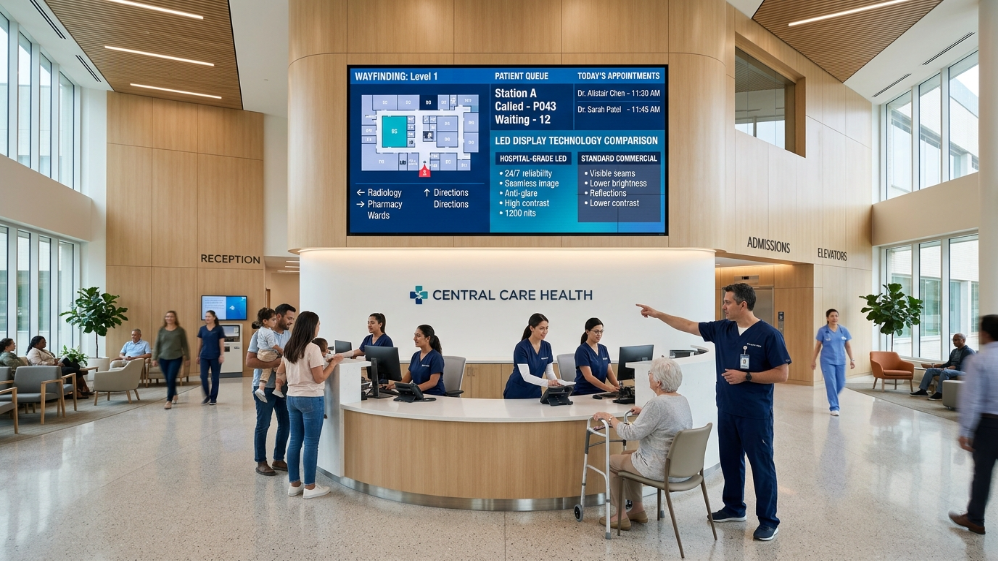
Healthcare digital signage is a networked system of LED and LCD screens deployed across clinical and administrative environments to deliver real-time information to patients,visitors,and staff.The hardware found in lobbies,wayfinding corridors,emergency department triage zones,command centers,and telemedicine consultation rooms must meet a fundamentally different performance and safety envelope than a display installed in a retail store or airport.
The table below captures the core gap that B2B buyers consistently underestimate:
| Specification | Commercial Grade Display | Medical-Grade LED Screen |
|---|---|---|
| EMC Standard | FCC Part 15/CE Class B(IT equipment) | IEC 60601-1-2(medical electrical equipment) |
| Continuous Operation | Rated to 8–12 hrs/day | Designed for 7×24h,MTBF≥50,000 hrs |
| Surface/Hygiene | Standard painted bezel | Sealed flat front,chemical-resistant,IP54+ |
| Leakage Current | ≤3.5 mA(Class I IT) | ≤0.5 mA patient vicinity(IEC 60601-1) |
| Brightness Stability | Degrades 30–40%in 18 months | ≤10%lumen depreciation at 10,000 hrs |
| Operating Environment | 0–40°C,standard humidity | 5–40°C,30–80%RH,fungal-resistance tested |
| Certification Path | CE,FCC,UL 62368-1 | CE MDD/MDR,UL 60601-1,ISO 13485 QMS |
According to MarketsandMarkets,the healthcare digital signage market is projected to reach$1.10 billion by 2030,growing at a CAGR of 8.0%from its 2026 base of$0.75 billion.The hardware segment—LED screens, SoC media players,interactive kiosks—holds the largest share of that value.System integrators and AV contractors who can credibly specify EMC-compliant,high-reliability hardware will capture the lion’s share of this growth.Those who cannot will hand the projects to competitors who do.
EMC Compliance:How to Ensure Your Hospital LED Screen Won’t Interfere With Life-Critical Medical Equipment
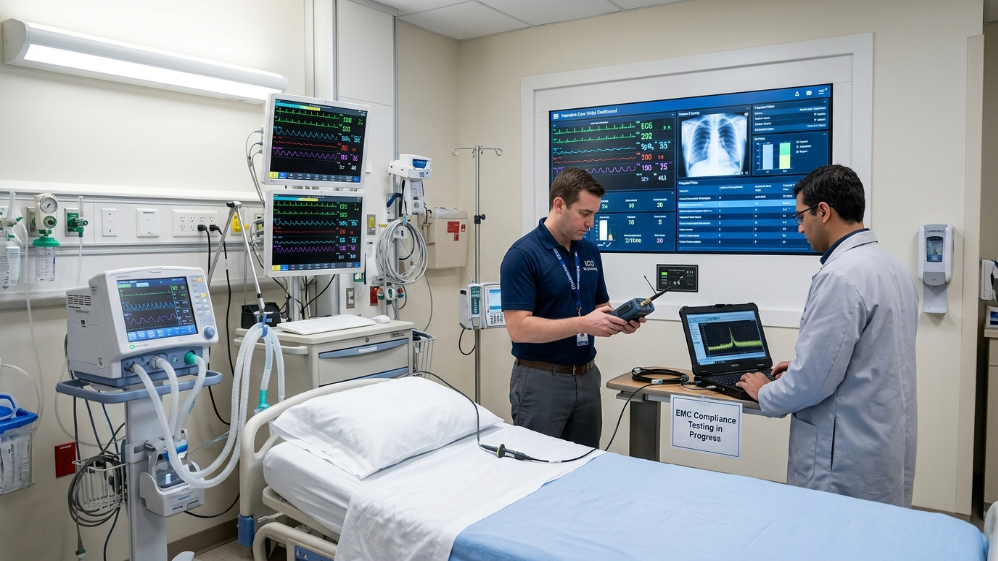
This is the section you will not find on any of the top-ranking pages for this search.And yet,based on our experience reviewing hospital AV project specifications across Europe,the Middle East,and Southeast Asia,EMC non-compliance is the single most common technical reason a hospital LED screen installation fails its pre-handover inspection.
Here is the mechanism.A large-format LED video wall—say,a 4×3 meter fine pitch installation in a cardiac ward waiting area—contains dozens of high-frequency switching power supplies cycling at 60–400 kHz.Each switching event generates radiated electromagnetic emissions.In a typical office or retail environment,those emissions are harmless background noise.In a hospital,that same noise floor sits alongside ECG monitors,infusion pumps,pulse oximeters,and ventilators—all of which have defined susceptibility thresholds.Exceed those thresholds and you risk false alarms,corrupted waveforms,or in the worst cases,interrupted therapy delivery.
Understanding IEC 60601-1-2:The EMC Standard Every Hospital IT Procurement Team Requires
IEC 60601-1-2 is the fourth edition electromagnetic compatibility standard for medical electrical equipment and medical electrical systems.It defines two distinct requirements that any hospital-grade LED display must satisfy:
Emissions limits
The maximum radiated and conducted RF energy the display may put into the environment.These are significantly stricter than FCC Part 15 Class B or CE EMC Directive limits for IT equipment,particularly in the 30 MHz–1 GHz band where most medical telemetry and monitoring systems operate.
Immunity requirements
The display must continue operating correctly when subjected to electrostatic discharge(ESD),radiated RF fields,electrical fast transients,and power surges that routinely occur in clinical settings(defibrillators,surgical electrosurgical units,MRI fringe fields).
A hospital LED screen supplier who hands you a CE mark based on EN 55032(IT equipment emissions)is not meeting the IEC 60601-1-2 requirement.The standards are not equivalent.Always request the actual IEC 60601-1-2 test report—not just the declaration—and verify it covers your exact model and cabinet configuration.Configuration changes(cabinet size,power supply substitution)can invalidate prior test results.
Zone-by-Zone EMC Risk Map:ICU vs.Waiting Room vs.Lobby
Not every hospital environment carries the same electromagnetic risk level.IEC 60601-1-2 defines deployment zones that determine which emission and immunity limits apply:
| Hospital Zone | Typical Devices Present | Required EMC Level | Recommended Pixel Pitch |
|---|---|---|---|
| Patient Vicinity(ICU,CCU,HDU) | Ventilators,ECG,infusion pumps | IEC 60601-1-2 Professional Healthcare Facility | P1.2–P1.56,shielded PSU |
| General Ward/Corridor | Portable monitors,IV pumps | IEC 60601-1-2 Professional Healthcare Facility | P1.56–P2.0 |
| Outpatient/Waiting Areas | Minimal active life-support | IEC 60601-1-2 Home Healthcare/General | P1.87–P2.5 |
| Lobby/Entrance/Cafeteria | None | CE Class B(standard commercial)acceptable | P2.5–P3.9 |
| Command Center/Nurse Station | Monitoring systems,EHR workstations | IEC 60601-1-2 Professional Healthcare Facility | P1.25–P1.875 |
This zoning logic matters enormously for system integrators pricing a multi-zone hospital rollout.Specifying ICU-grade EMC shielding across a 50-screen campus when only 8 screens are near patient care areas drives unnecessary cost.Conversely,installing standard commercial screens in patient care zones is not just a compliance failure—it is a clinical liability.
The Solution:Recommended SoStron Products for Healthcare Environments
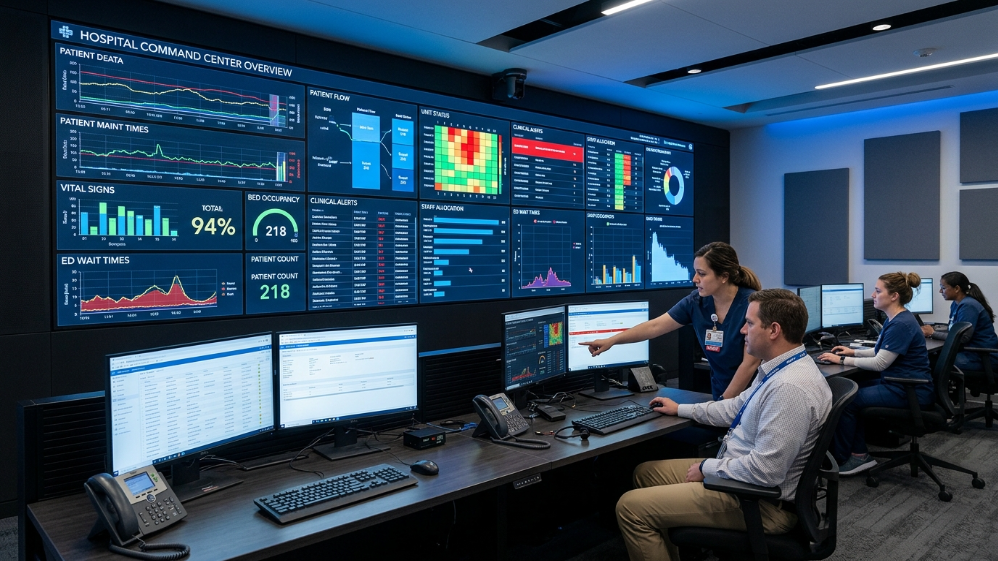
Based on the zone requirements above,two products from SoStron’s portfolio cover the majority of hospital digital signage use cases:
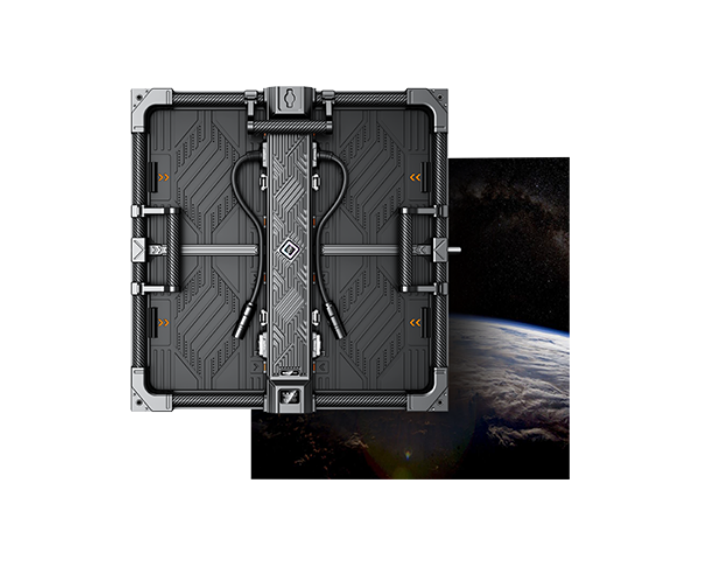
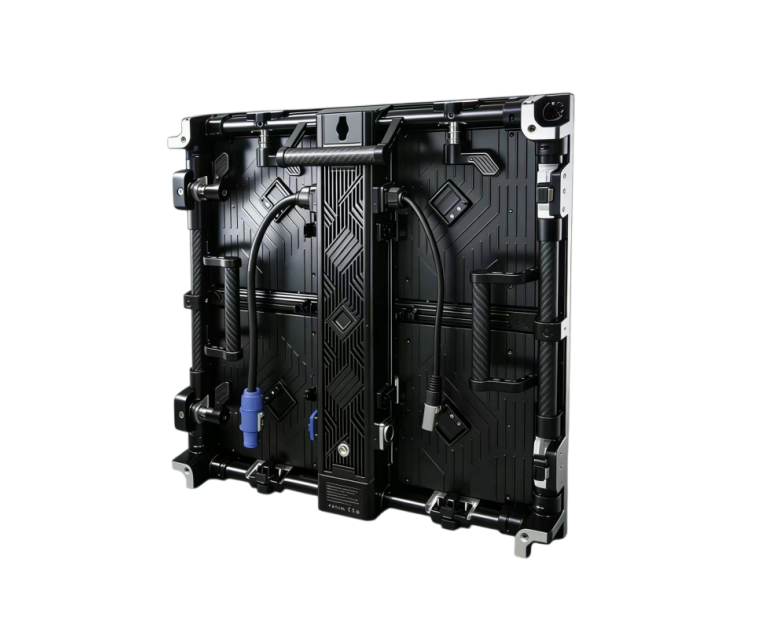
Reta 2—Fine Pitch Indoor LED Display(P1.25/P1.56/P1.87/P2.5)
The Reta 2 is SoStron’s flagship indoor fine-pitch series and the most technically appropriate choice for hospital command centers,nurse stations,waiting area video walls,and telemedicine consultation rooms.
Key specifications relevant to healthcare deployment:
- Pixel pitch options from P1.25 to P2.5—covers every hospital zone from patient-adjacent nurse stations to high-traffic lobby installations
- 3840 Hz refresh rate—eliminates moiréand flicker artifacts that cause eye fatigue for clinical staff working 12-hour shifts
- Ultra-thin modular cabinet design(≈30mm depth)with cable-free magnetic connections—reduces installation surface complexity and simplifies the sealed mounting required for infection control
- Brightness 800–1,000 nits with wide color gamut—sufficient for brightly lit clinical environments without exceeding eye-safe luminance thresholds
- Long lifespan,low maintenance architecture—supports the 7×24h continuous operation SLA that hospital facilities managers require
For medical video wall applications in command centers or telemedicine hubs,specify P1.25 or P1.56.For general waiting areas and wayfinding corridors at viewing distances of 3–6 meters,P1.87 or P2.5 delivers equivalent visual quality at meaningfully lower cost per square meter.
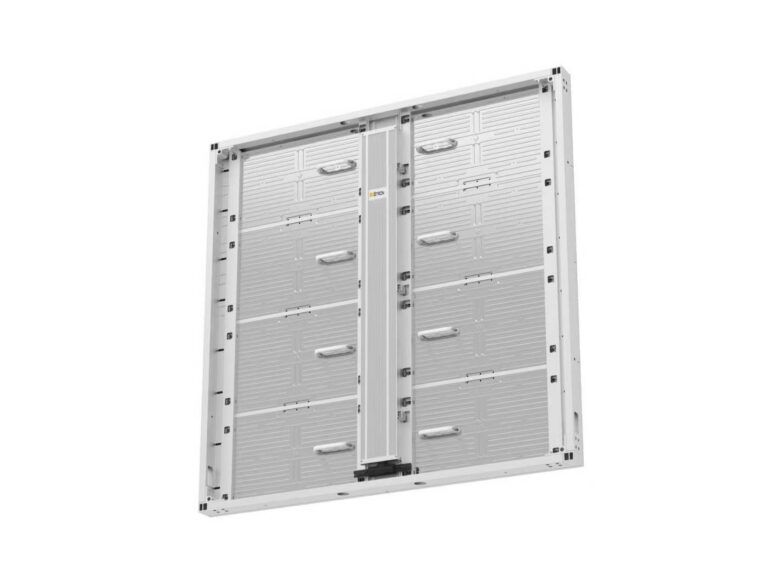
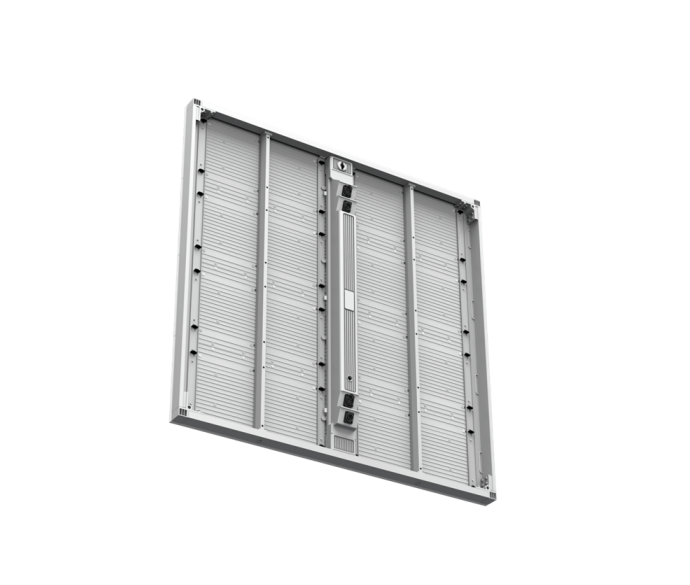
Ares 2—Energy-Saving Outdoor LED Display
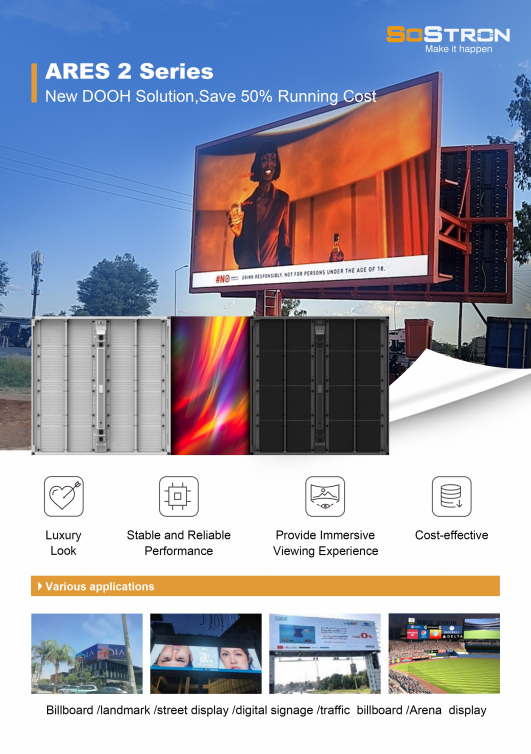
For hospital campuses requiring outdoor-facing healthcare digital signage—entrance marquees,parking guidance,emergency department exterior announcements,or DOOH-format health authority public information screens—the Ares 2 provides IP65-rated weatherproofing,high ambient-light brightness,and the energy efficiency critical for 24/7 outdoor operation.Its common cathode LED driver architecture reduces power consumption by up to 30%versus conventional designs—a tangible TCO argument for hospital estates teams managing energy budgets.
Real-World Case Reference:Indoor Fine-Pitch Installation for a Command&Control Environment
A project comparable to hospital command center deployments:SoStron supplied a P1.875 Reta 2 video wall for a large-scale enterprise command and visualization center.
The installation required seamless 24/7 stability,native 4K resolution without image stretching,and consistent grayscale rendering across the full wall surface—requirements that map directly to hospital operations center and telemedicine display applications.
The 240×240mm modular structure of the Reta 2 achieved native 1920×1080 and 3840×2160 configurations without the visual distortion that affects non-standard-module competitors,and the 3840 Hz refresh rate ensured footage remained artifact-free under broadcast-grade camera scrutiny.
For a hospital procurement team,the implication is direct:the same engineering that delivers flicker-free broadcast imagery also eliminates the eye strain and image instability that clinical staff cannot tolerate across an eight-hour shift.
7×24 Reliability Engineering:What an MTBF of 50,000+Hours Actually Means for Your Hospital Project
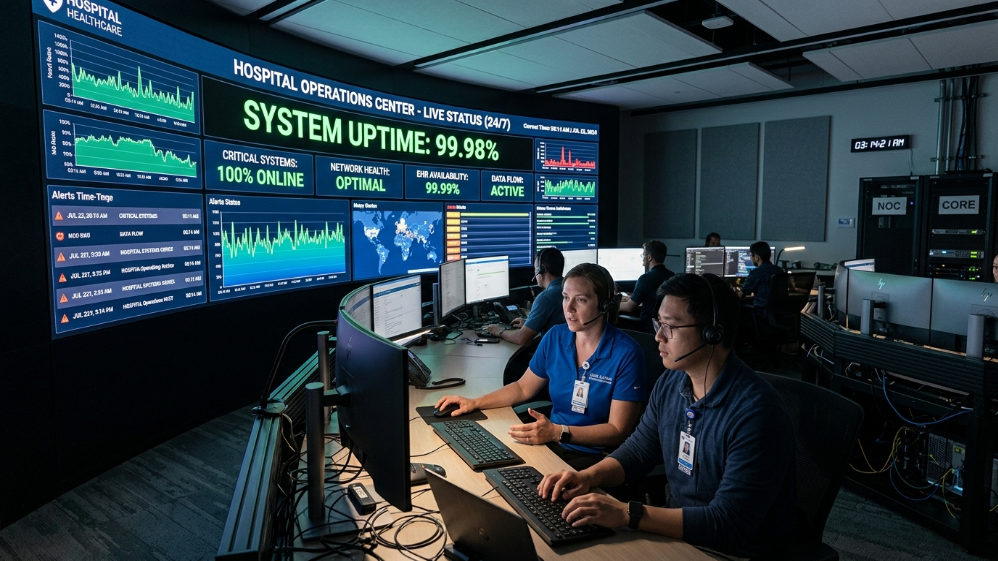
Eye strain aside,there is a harder commercial argument for reliability.A hospital display that goes dark during a shift change is not merely inconvenient—it can interrupt queue management,emergency alerts,and wayfinding for patients in acute distress.Facilities managers know this.In competitive tenders,an MTBF figure is often the specification line that separates shortlisted suppliers from disqualified ones.
MTBF(Mean Time Between Failures)of 50,000 hours translates to roughly 5.7 years of uninterrupted 24/7 operation before a statistically expected component failure.That number is not a marketing claim—it is an engineering outcome driven by three specific design decisions most suppliers do not discuss openly.
Common Cathode LED Driver Architecture
Common Cathode LED driver architecture reduces current through the LED chip by routing power more efficiently,cutting heat generation at the pixel level by 30–40%compared to conventional common anode designs.
Less heat means slower lumen depreciation,lower thermal stress on solder joints,and longer capacitor life in the PSU—all of which directly extend operational lifespan.
For hospital procurement teams calculating total cost of ownership over a 5–7 year contract,the energy savings alone(typically 20–30%lower power draw)are significant.
A 20m²installation running 24/7 at 30%lower power consumption saves approximately$2,800–4,200 USD annually at standard commercial electricity rates—before accounting for reduced HVAC load.
Redundant Power Supply Design
Redundant power supply design is non-negotiable for patient-adjacent zones.
A single PSU failure in a standard display kills the screen immediately.
A properly engineered hospital LED screen routes power through dual independent supplies in a hot-standby configuration:if one fails,the other assumes full load without interruption.
Specify this explicitly in your RFQ—”dual redundant PSU with automatic failover”—because it is not a default feature at mid-market price points.
Thermal Management Without Active Airflow
Thermal management without active airflow is the overlooked challenge.
Standard commercial displays use internal fans.
In clinical environments,fan-driven airflow inside a display cabinet creates two problems:
- Positive pressure can push contaminated air toward wall penetrations.
- Fan failure—more common than LED failure in long-run deployments—is the leading cause of thermal shutdown.
Medical-grade installations use passive cooling through precision heat-sink design and aluminum cabinet construction with calculated surface area.
It is quieter,more hygienic,and statistically more reliable.
Infection Control by Design:IP Ratings,Antimicrobial Surfaces&Chemical Compatibility

Hospital infection control teams evaluate display hardware with the same rigor they apply to clinical furniture.If your product cannot survive the cleaning regime,it will not survive the procurement process.
The Critical Specification Matrix
| Requirement | Standard Specification | Healthcare-Grade Requirement | Clinical Relevance |
|---|---|---|---|
| Front Panel Sealing | IP20(no protection) | IP54 minimum/IP65 for wet areas | Prevents cleaning fluid ingress during wipe-down |
| Surface Material | Standard ABS plastic bezel | Smooth,seam-free tempered glass or medical-grade polymer | Eliminates bacteria-trapping joints and grooves |
| Chemical Resistance | Not rated | Compatible with isopropanol,quaternary ammonium,bleach solutions | Matches hospital-standard disinfection protocols |
| Antimicrobial Coating | None | Optional AgION silver-ion or equivalent | Inhibits surface bacterial growth between cleaning cycles |
| Bezel Gap(at wall) | 2–5mm standard | ≤1mm or flush-mount with silicone seal | Zero-gap mounting prevents pathogen accumulation |
| Heat Emission(front) | Unrestricted | ≤40°C surface temperature | Prevents burn risk in patient-accessible locations |
IP54 is the practical minimum for general ward and corridor installations—it survives spray-and-wipe disinfection.
IP65(dust-tight,water-jet resistant)is required for wet areas such as patient bathrooms,hydrotherapy,or any space subject to high-pressure steam cleaning.
IP67 is rarely necessary for signage but becomes relevant in isolation rooms or decontamination zones.
One practical detail that routinely gets missed in specifications:
“IP65-rated front panel” is not the same as “IP65-rated complete unit.”
Confirm that the IP rating applies to the installed configuration including the rear cable management,not just the screen face.
Medical Video Wall&Telemedicine Display:Specifications That Determine Clinical Outcome
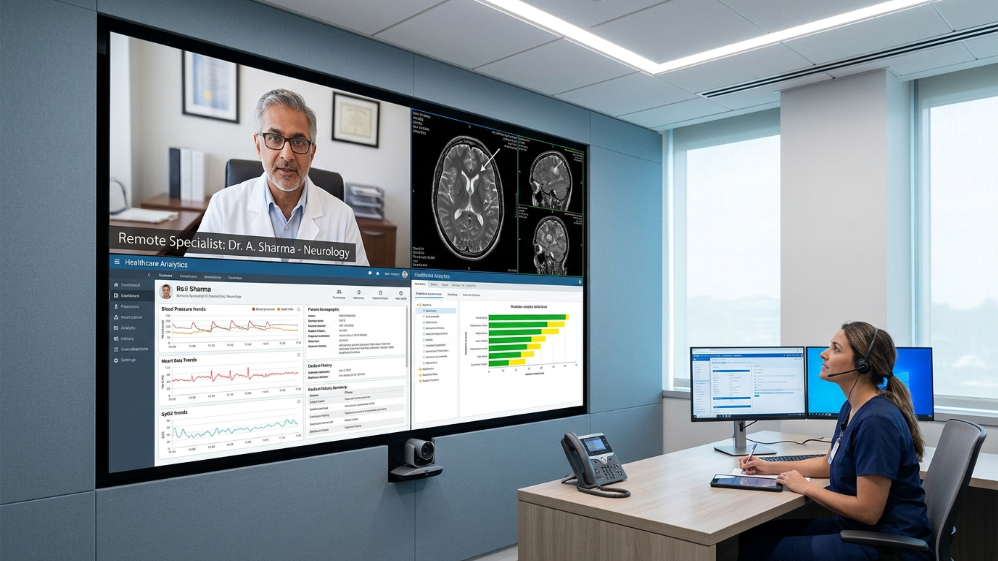
A medical video wall in a hospital command center is not a scaled-up lobby display.It is real-time infrastructure.
Command center walls aggregate patient census data,bed management dashboards,CCTV feeds,and EHR integrations simultaneously.
For these installations,pixel pitch below P1.56 is standard—at typical 2–4 meter viewing distances,P1.87 or coarser produces visibly pixelated text in EHR grid views,which is operationally unacceptable.
For telemedicine display applications—remote consultation rooms,tele-ICU monitoring stations,and telecardiology review workstations—the performance requirement shifts from size to calibration accuracy.
A display used for remote clinical assessment must maintain consistent luminance and color rendering over time.
DICOM GSDF Calibration
This is where DICOM GSDF(Grayscale Standard Display Function) calibration becomes clinically significant.
DICOM GSDF defines the relationship between digital driving values and displayed luminance across 1,024 grayscale levels,ensuring that a CT scan viewed by a radiologist in Singapore renders identically to the same scan reviewed by a referring physician in a rural clinic.
Uncalibrated consumer or commercial displays drift up to 30%from their factory white point within 12 months of continuous operation.
In a telemedicine context,that drift is not an aesthetic issue—it is a diagnostic risk.
Minimum Telemedicine Display Specifications for B2B Procurement
- Luminance:≥350 cd/m²sustained(not peak)after 1,000 hours
- Color Gamut:≥95%sRGB;DCI-P3 coverage for pathology imaging
- Bit Depth:10-bit internal processing(avoids banding in CT/MRI grayscale rendering)
- Refresh Rate:≥60Hz;120Hz recommended for live surgical video feeds
- Calibration:Factory DICOM GSDF calibration with on-site recalibration capability
5 Questions B2B Buyers Ask—and the Answers That Actually Close Deals
Q1:Do hospital LED screens require a separate medical device registration?
In most jurisdictions,a hospital LED screen used purely for information display—wayfinding,queue management,staff communication—is not classified as a medical device and does not require FDA 510(k)or CE MDR registration.
The classification changes if the display is used to render diagnostic images(radiology,pathology).
Clarify the clinical use case in your specification documents before procurement begins.
Q2:What refresh rate eliminates flicker for 12-hour clinical staff use?
3,840 Hz PWM refresh rate is the accepted threshold for flicker-free operation in extended-viewing clinical environments.
At this rate,the human visual system—including staff with photosensitive conditions—cannot perceive brightness modulation.
Displays operating below 1,920 Hz are measurably fatiguing in 4+hour exposure studies.
Q3:Can a standard CE-certified LED screen pass hospital site acceptance testing?
Unlikely,unless the CE certification was obtained under the EMC Directive against IEC 60601-1-2 limits specifically.
General CE marking to EN 55032(Class B IT equipment)does not satisfy the professional healthcare facility emission limits in IEC 60601-1-2.
Verify the specific standard against which EMC testing was conducted—this detail is on the test report,not the certificate.
Q4:What pixel pitch should I specify for a hospital waiting room with 4-meter viewing distance?
P1.87 or P2.0 delivers full-HD sharpness at 4 meters while reducing hardware cost by 35–45%versus P1.25.
Use the formula:
minimum viewing distance(meters)=pixel pitch(mm)×1.5–2.0
At 4 meters,P2.0 sits comfortably within the optimal viewing range and produces no perceptible grain for standard signage content.
Q5:How do I handle warranty and service response for a 24/7 hospital installation?
Require a 3-year parts-and-labor warranty with on-site response SLA of≤48 hours and confirmed in-region module stock.
A 5-year parts-only warranty with 6-week overseas shipping is operationally worthless for a display that cannot go dark.
Negotiate the service terms as rigorously as the hardware price.
Expert Verdict

The hospitals awarding the largest healthcare digital signage contracts in 2026–2026 are not buying screens.They are buying risk elimination—the documented assurance that a display will not interfere with a ventilator,will not fail at 2 a.m.,and will not become a pathogen reservoir that their infection control team cannot approve.
System integrators who walk into those tenders with IEC 60601-1-2 test reports,redundant PSU specifications,and IP65 surface documentation win at margins their competitors cannot match,because they are the only ones answering the question the client is actually asking.
Specify to the zone.Verify the EMC certificates.Demand the MTBF engineering basis,not just the number.Everything else—content,CMS,aesthetics—is secondary to getting those three things right.
References:
IEC 60601-1-2: Medical Electrical Equipment – Electromagnetic Compatibility Requirements and Tests

About SoStron
Marketing Strategic Director at Sostron