Choosing the wrong pixel pitch is the most expensive mistake in indoor LED procurement. Overspend on a P1.2 screen for a room where viewers sit 8 meters away, and you’ve paid 3× the necessary cost for resolution no one can see. Underspend on a P3 screen for a boardroom with a 3-meter viewing distance, and the image looks pixelated on camera.
This guide cuts through the spec-sheet noise. Based on hands-on deployment experience across conference centers, broadcast studios, and command rooms, here’s exactly which pitch to choose, what it costs, and where each model performs best in 2026.
How to Choose: The Pixel Pitch Decision Framework
Before looking at any specific model, answer these two questions:
What is the minimum viewing distance? Use the formula: minimum viewing distance (m) = pixel pitch (mm) × 1.0
What is the primary use case?
| Use Case | Recommended Pitch | Reason |
|---|---|---|
| Large hall / auditorium (>8 m) | P3–P4 | Long viewing distance; fine pitch wasted |
| Conference room / lobby (3–8 m) | P2–P2.5 | Balanced clarity and cost |
| Boardroom / showroom (2–4 m) | P1.875–P2 | Close viewing, HD content |
| Command center / control room | P1.25–P1.56 | Continuous operation, data-dense displays |
| Broadcast / virtual production | P0.93–P1.25 | Camera-facing, ultra-close viewing |
P3 Indoor LED Display
Best for: Large halls, lobbies, text-heavy information displays, budget-conscious projects.
The P3 module uses a 320 × 160 mm structure with a resolution of 106 × 53 pixels per module. At 3 mm pitch, it’s the coarsest option in this guide — and that’s not a flaw. For any application where viewers are seated 8 meters or more from the screen, P3 delivers perfectly adequate clarity at the lowest cost in the indoor fine-pitch range.
Key specs:
- Module size: 320 × 160 mm
- Pixel density: 111,111 pixels/m²
- Brightness: 800–1,200 nits
- Refresh rate: ≥1,920 Hz
- Typical use: Hall signage, lobby information boards, large auditoriums
Where it falls short: Close-up viewing below 3 meters will show visible pixel structure. Not suitable for 4K content display or camera-facing applications.
P2.5 Indoor LED Display
Best for: Conference halls, exhibition spaces, mid-size event stages.
P2.5 is the most widely deployed indoor pitch in corporate environments — and for good reason. It hits the sweet spot between resolution (comfortable from 2.5 m), cost (roughly half the price of P1.5), and technology maturity. Both module and cabinet form factors are available; the standard cabinet size is 640 × 640 mm.
Key specs:
- Cabinet size: 640 × 640 mm
- Pixel density: 160,000 pixels/m²
- Brightness: 800–1,500 nits
- Refresh rate: ≥3,840 Hz (broadcast-safe)
- Typical use: Conference rooms, trade show booths, hotel ballrooms
Practical note: At 3,840 Hz refresh rate, P2.5 panels are safe for video recording without rolling shutter artifacts — an important consideration for hybrid events where the screen appears on camera.
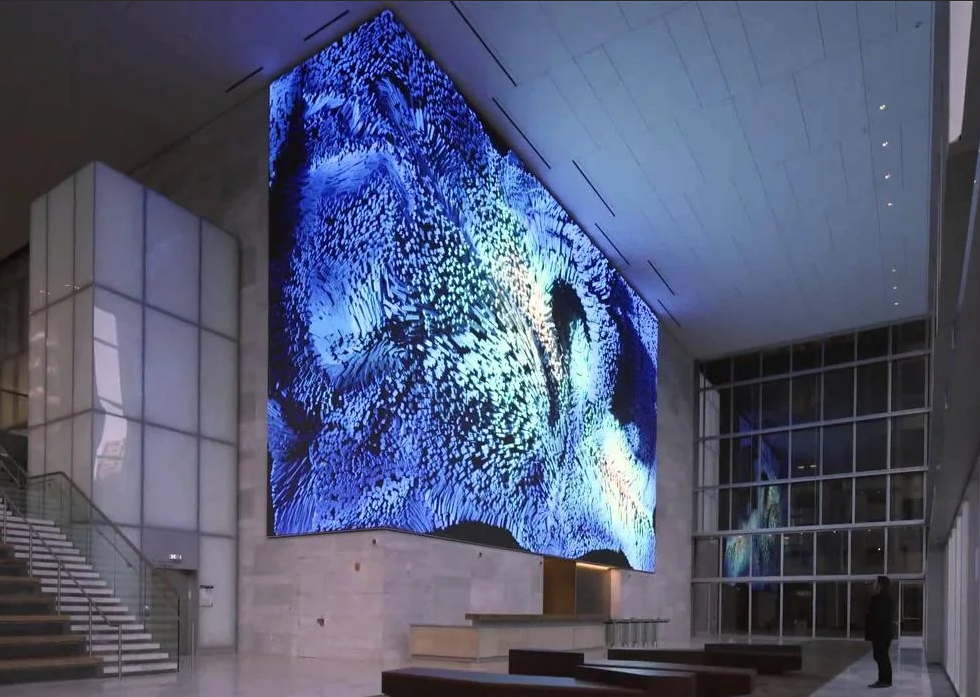
P2 Indoor LED Display
Best for: Large conference halls, government meeting rooms, multi-purpose venues.
P2 occupies a unique position: it’s technically classified as “small pitch” but remains one of the most cost-effective options in that category. The technology is fully mature, supply chains are deep, and pricing is competitive. For large conference halls where viewers range from 4–12 meters away, P2 provides more than sufficient resolution without the premium of sub-P2 products.
Key specs:
- Pixel density: 250,000 pixels/m²
- Brightness: 800–1,500 nits
- Refresh rate: ≥3,840 Hz
- Packaging: SMD (surface mount)
- Typical use: Government conference rooms, university lecture halls, corporate training centers
Why it’s still relevant in 2026: Despite the push toward finer pitches, P2 remains the dominant choice for large-format indoor installs where the viewing distance exceeds 4 meters. Dropping to P1.5 for a 200-seat auditorium adds cost with no visible benefit.
P1.875 Indoor LED Display
Best for: Conferences, exhibition halls, premium corporate environments.
P1.875 is the entry point into high-performance fine-pitch territory. The standard cabinet format (600 × 337.5 mm) is now the industry norm for this pitch range, and the technology has matured significantly since its introduction. SMD packaging remains standard at this pitch, which means field-replaceable components and straightforward maintenance.
Key specs:
- Cabinet size: 600 × 337.5 mm
- Pixel density: 284,444 pixels/m²
- Brightness: 1,000–1,800 nits
- Refresh rate: ≥3,840 Hz
- Packaging: SMD
- Typical use: Exhibition halls, premium conference centers, product launch venues
Viewing distance: Comfortable from 1.875 m; ideal range is 2–6 m.
P1.56 Indoor LED Display
Best for: High-end conference rooms, media centers, close-viewing premium installs.
At P1.56, you’re in territory where image quality becomes genuinely impressive at close range. The 600 × 337.5 mm die-cast aluminum cabinet keeps weight to 6 kg per unit — important for ceiling-mounted or flown configurations. The 16-bit grayscale and 3,840 × 2,160 refresh resolution make this a strong choice for any application where 4K content is displayed to viewers within 3 meters.
Key specs:
- Cabinet size: 600 × 337.5 mm
- Cabinet resolution: 384 × 216 pixels
- Cabinet weight: 6 kg
- Grayscale: 16-bit
- Refresh resolution: 3,840 × 2,160
- Packaging: SMD
- Typical use: High-end conference rooms, media production suites, luxury retail
Important: At this pitch, content quality becomes the limiting factor. A P1.56 screen displaying compressed or low-resolution source material will look worse than a P2.5 screen with properly mastered 4K content.
P1.25 Indoor LED Display
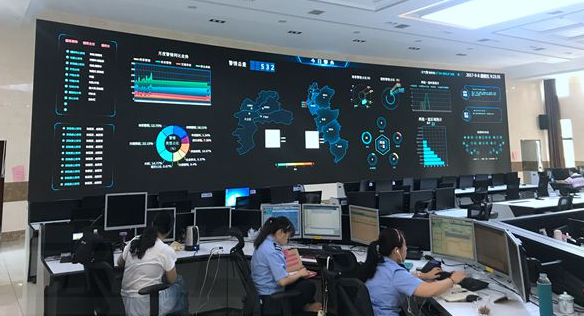
Best for: Command and control centers, big data visualization, broadcast studios.
P1.25 is a high-end product designed for environments where the display runs continuously and image precision is non-negotiable. The 5,000:1 contrast ratio and 480 × 270 pixel-per-cabinet density make it well-suited for data-dense applications — security operations centers, financial trading floors, network operations centers — where operators read fine text and detailed graphics from 1–3 meters away.
Key specs:
- Pixel density: 640,000 pixels/m²
- Contrast ratio: 5,000:1
- Brightness: 600–1,200 nits (adjustable for operator comfort)
- Refresh rate: ≥3,840 Hz
- Packaging: SMD or COB (varies by manufacturer)
- Typical use: Command centers, NOCs, broadcast control rooms, financial trading floors
2026 trend: P1.25 is increasingly specified for virtual production LED volumes alongside P0.93, particularly for broadcast environments requiring precise color calibration (ΔE ≤1.5).
P0.93 Indoor LED Display
Best for: Mission-critical displays, virtual production, executive boardrooms, broadcast environments.
P0.93 represents the current frontier of mass-market indoor LED. At sub-1mm pitch, the pixel density approaches LCD territory — but with the seamless, bezel-free advantage that LED provides. This pitch exclusively uses COB (Chip-on-Board) packaging, which bonds bare chips directly to the PCB under an epoxy resin layer. The result: no individual lamp components to fall out, IP54 environmental protection, and a dead pixel rate that is structurally near-zero.
Key specs:
- Cabinet size: 600 × 337.5 mm
- Cabinet resolution: 640 × 360 pixels
- Brightness: Adjustable (typically 100–600 nits for indoor use)
- Lifespan: >100,000 hours
- Packaging: COB
- Viewing angle: 170°
- Typical use: Virtual production studios, executive boardrooms, broadcast control rooms, high-security command centers
Real-world performance: In a controlled boardroom environment, a P0.93 COB display is visually indistinguishable from a high-end LCD at normal viewing distances — with the added benefit of seamless tiling at any size.
COB vs. SMD: Which Packaging Technology Is Right for You?
This is the question that separates informed buyers from spec-sheet readers. Both technologies produce excellent displays — the right choice depends on your priorities.
| Factor | SMD | COB |
|---|---|---|
| Upfront cost | Lower | Higher (2–3× for equivalent pitch) |
| Dead pixel risk | Present (lamp fallout over time) | Structurally eliminated |
| Field repairability | Yes — individual lamps replaceable | No — module must return to factory |
| Minimum pixel pitch | ~P1.2 | P0.9 and below |
| Environmental protection | Standard | IP54 (seamless surface) |
| Viewing angle | ~160° | 170° |
| Thermal management | Standard | Superior (direct chip bonding) |
| Long-term TCO | Higher (maintenance costs) | Lower (near-zero maintenance) |
Choose SMD when budget is the primary constraint, pixel pitch above P1.2 is acceptable, and on-site field repair capability is essential.
Choose COB when image quality is non-negotiable, ultra-fine pitch (P0.93 and below) is required, or the environment demands durability (high-traffic, dusty, or humid spaces).
2026 market direction: COB adoption is accelerating as manufacturing scales and costs decrease. For P1.0 and below, COB is now the de facto standard. SMD remains dominant for P1.2 and above.
2026 Pricing Reference
| Pixel Pitch | Packaging | Price per m² (Factory-Direct) | Best Value Window |
|---|---|---|---|
| P3 | SMD | 300–600 | Large halls, >8 m viewing |
| P2.5 | SMD | 500–900 | Conference rooms, 3–8 m |
| P2 | SMD | 600–1,100 | Large conference, 4–12 m |
| P1.875 | SMD | 800–1,400 | Premium conference, 2–6 m |
| P1.56 | SMD | 1,000–1,800 | High-end rooms, 1.5–4 m |
| P1.25 | SMD/COB | 1,500–2,500 | Command centers, 1–3 m |
| P0.93 | COB | 2,500–4,500+ | Broadcast, boardrooms, <2 m |
All prices are factory-direct panel costs. Add 15–25% for mounting hardware, signal processing, cabling, and shipping. Installation labor is separate.
Key rule: Dropping one pitch level (e.g., P2.5 → P1.875) typically increases panel cost by 40–60%. Only make that jump if your viewing distance actually requires it.
FAQ
What is the best indoor LED display for a conference room?
For most conference rooms with viewing distances of 3–6 meters, P2.5 is the optimal choice — it delivers clear 4K-equivalent imagery at a fraction of the cost of fine-pitch alternatives.
What is the difference between COB and SMD LED displays?
SMD uses individual surface-mounted lamps that can be replaced in the field but are prone to dead pixels over time. COB bonds bare chips directly to the PCB under epoxy resin, eliminating dead pixels and achieving IP54 protection, but requiring factory repair if a module fails.
How long do indoor LED displays last?
Standard SMD panels: 50,000–80,000 hours. COB panels (P0.93 and below): 100,000+ hours. At 12 hours/day operation, a COB display exceeds 22 years of rated lifespan.
Can indoor LED displays be used for video recording or live streaming?
Yes, but specify ≥3,840 Hz refresh rate to avoid rolling shutter artifacts in camera footage. For broadcast-facing applications, P0.93–P1.25 COB with ≥7,680 Hz is the professional standard.
What certifications should I require from an indoor LED display supplier?
Minimum: RoHS, CE, FCC, ISO 9001. For government or broadcast applications, also require CCC (China Compulsory Certification) and request factory audit documentation.
Is it better to rent or buy an indoor LED display?
Rent for episodic use (events, short campaigns). Buy for regular use — the breakeven point is typically 2–3 years of regular operation, after which purchase wins on total cost of ownership.