In the creative display industry of 2026, Flexible Curved LED Display Modules have become a core component for breaking the geometric limitations of architecture. Their fundamental definition can be summarized as follows:
| Core Dimension | Industry Standard Parameter (2026 High-End) | Sostron Strategic Advantage |
|---|---|---|
| Substrate Material | Reinforced FPC flexible board | Multi-layer anti-fatigue circuit design optimized through 14 years of engineering experience |
| Minimum Bending Radius (R_{min}) | R \ge 150mm | Lab-supported customization for ultra-small radius bending without damage |
| Packaging Technology | SMD / GOB | Patented GOB encapsulation with impact resistance, waterproofing, and anti-static protection |
| Refresh Rate | 3840Hz – 7680Hz | Flagship 7680Hz refresh rate supporting ultra-clear 8K filming |
A Deep Dive Into Industry Pain Points
For event production procurement managers or foreign trade factory owners, the real pain of flexible displays usually does not appear at the moment of purchase—it often surfaces three months after installation. Common issues include:
-
Warping along module edges
-
Frequent dead pixels
-
Screen drop risks caused by insufficient magnetic adhesion
As a national high-tech enterprise with a 15,000㎡ smart manufacturing base, Sostron has analyzed data from over 1,000 irregular LED display projects to explain how buyers can avoid these costly trial-and-error mistakes.
Understanding the Core: What Defines a High-Quality Flexible LED Module?
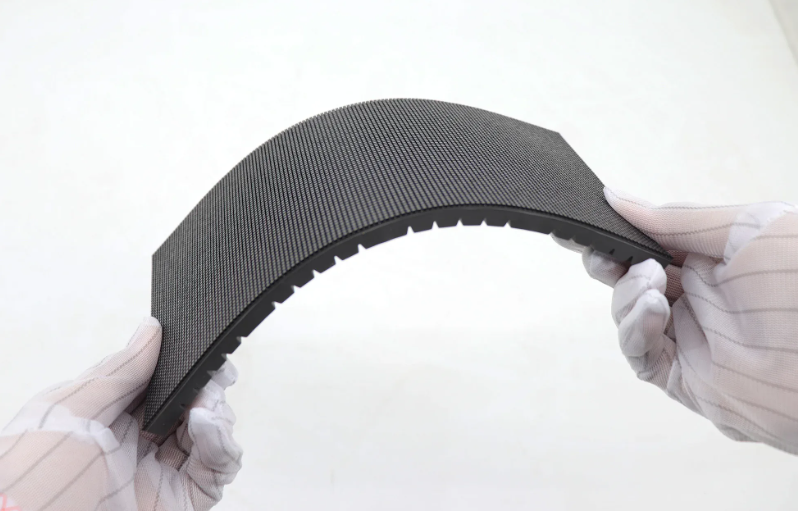
Within today’s global supply chain, flexible modules may appear similar on the surface. However, their internal structure determines whether they are a disposable product or a decade-long asset.
Layered Process of the Flexible PCB (FPC)
Standard flexible modules typically use dual-layer FPC boards. During repeated bending—especially with S-shaped installations—these boards are highly susceptible to circuit fractures.
Based on our experience with high-frequency rental projects, we insist on using custom multi-layer laminated FPC with high thermal conductivity.
This design provides two critical advantages:
-
Improved heat dissipation efficiency
-
Zero-delay pixel signal transmission even under extreme bending conditions
Magnetic Base and Flatness Control
The installation stability of flexible screens relies heavily on magnetic mounting systems. If the magnetic force distribution is uneven, curved surfaces will display visible “ribbed patterns.”
Sostron Professional Standard
Each 240×120mm standard module is equipped with 12–16 high-strength neodymium magnets.
Engineering Detail
Combined with an all-aluminum structural mid-frame, flatness tolerance can be controlled within ±0.1 mm—a critical threshold for achieving naked-eye 3D visual effects.
Key Technical Specs That Engineering Managers Can’t Ignore
For manufacturing engineers, the focus should shift from a simple question of “Is it bright?” to a far more important one: “Is it stable?”
Key Parameter Comparison: Standard Modules vs. Sostron Flagship (SPad Pro2)
| Technical Indicator | Standard Commercial Module | Sostron SPad Pro2 Flexible Series |
|---|---|---|
| Protection Level | IP30 (exposed) | IP65 GOB coating (moisture and impact resistant) |
| Maintenance Method | Rear maintenance (very inconvenient) | Full Front Maintenance |
| Contrast Ratio | 3000:1 | 8000:1 (low-reflection black LED technology) |
| Driver IC | Generic constant current IC | Advanced chip with integrated CMS fault warning |
Why GOB Technology Is the “Safety Umbrella” of Flexible Screens
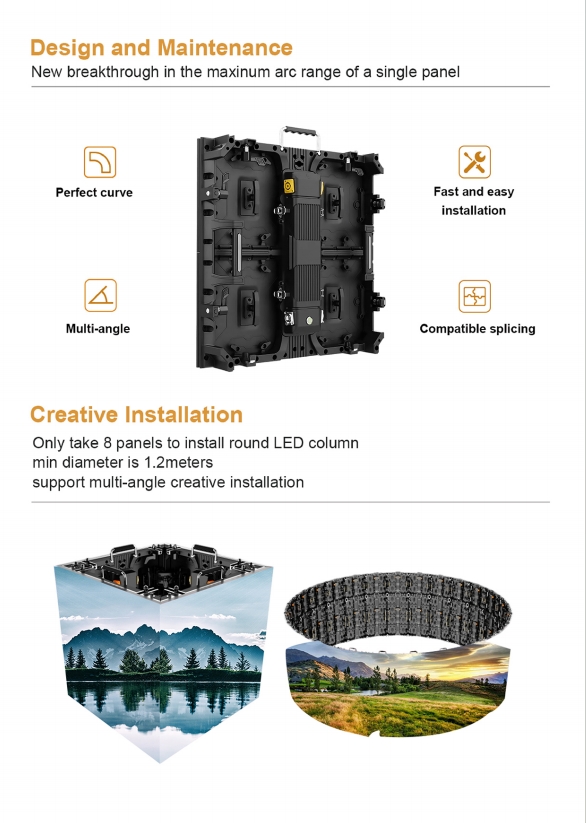
According to LED industry reliability data (2025-2026), more than 70% of flexible display failures occur due to installation impacts.
GOB (Glue on Board) technology addresses this issue by applying a nano-level transparent protective layer over the LED beads. This coating:
-
Reinforces the LEDs against mechanical shocks
-
Improves moisture resistance
-
Prevents electrostatic damage
For scenarios such as large music festivals in Chile, where LED screens are frequently assembled, dismantled, and transported under harsh conditions, GOB protection becomes indispensable.
The Golden Ratio Between Pixel Pitch and Viewing Distance
For indoor high-definition applications—such as luxury retail stores or conference rooms—P1.25 to P2.5 pixel pitch is typically preferred.
However, for creative cylindrical displays, we recommend:
-
P1.8 pixel pitch
-
Combined with the Reta 2 ultra-thin series architecture
This configuration enables an immersive viewing experience with no visible pixelation at a viewing distance of 2 meters.
Common Pitfalls in Curved LED Projects (And How to Avoid Them)
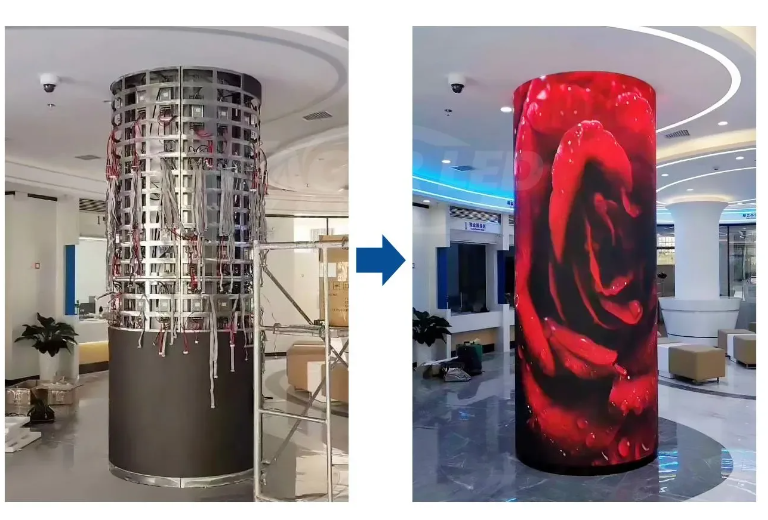
Although flexible display technology has matured by 2026, event procurement managers and manufacturing engineers still frequently fall into “low-price traps.”
Ignoring the Chain Reaction of Dead Pixels
Many low-cost modules develop micro-cracks in solder joints when bent beyond $30^\circ$.
Avoiding the Risk
Always confirm whether the module has passed a dynamic bending cycle test.
Based on testing at Sostron’s R&D center, a high-quality flexible module should withstand:
-
10,000+ micro-vibration cycles
-
500+ extreme bending cycles
without experiencing single-pixel failure.
Mismatch Between Control Systems and Physical Curvature
Irregular screens—such as S-shaped or wave-form structures—are highly susceptible to image distortion.
Technical Solution
Ensure the supplier supports Pixel-to-Pixel Mapping.
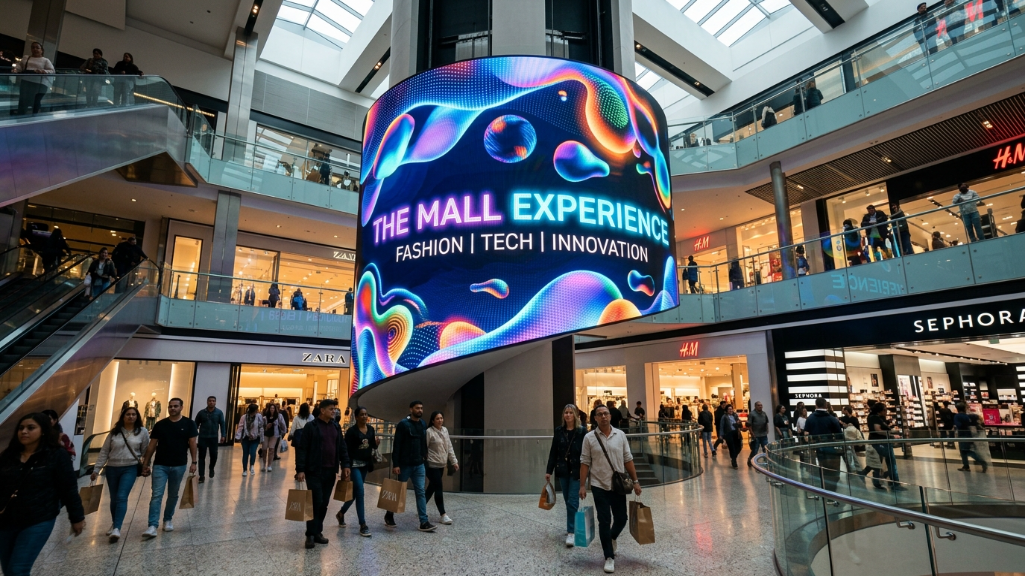
Sostron’s CMS integrated hardware-software system automatically calculates physical curvature, ensuring that video content remains distortion-free when displayed on a 360 circ cylindrical screen.
Heat Dissipation and Flatness Issues After Installation
Flexible screens are typically mounted against walls or wrapped around columns, leaving minimal rear ventilation space.
Sostron Solution
The SPad Pro2 flexible series uses:
-
High thermal conductivity all-aluminum back panels
-
Fanless silent cooling design
Even in 24/7 environments such as commercial shopping malls, the system maintains a core temperature below $55^\circ C$.
Case Study: Turning Complex Architecture into Digital Art
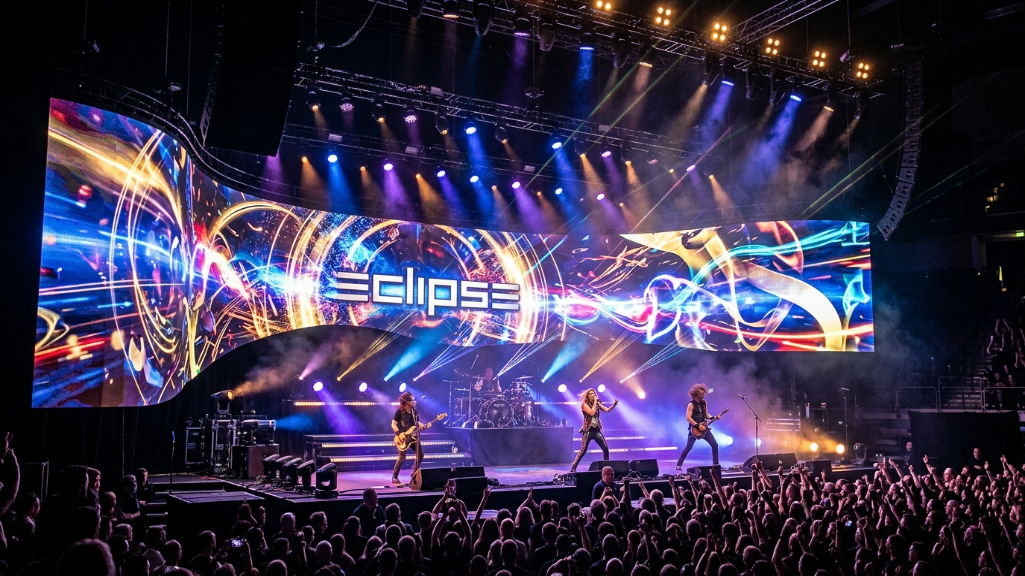
To better illustrate how these specifications translate into real-world results, consider the following project.
Project: P2.5 Indoor Irregular LED Installation in an International Bowling Center
Challenge
The client required a seamless circular LED ring display mounted across irregular structural beams and columns, while also supporting:
-
Real-time bowling score synchronization
-
Interactive 3D visual effects
Solution
-
P2.5 indoor flexible LED modules
-
Custom magnetic mounting framework
Results
Seamless Integration
With flatness controlled within ±0.1 mm, all physical seams became visually invisible.
Exceptional Visual Performance
The 7680Hz refresh rate ensured zero scan lines during smartphone recording and professional broadcasting.
Operational Efficiency
Thanks to full front maintenance, replacing a single module takes less than 30 seconds.
Expert Commentary
“This project proves that flexible screens are not just displays—they become part of the architecture itself. Fourteen years of industry experience taught us that great products must also consider the convenience of installers.”
— Sostron Technical Director
Why Sostron Is Your Strategic Partner in Flexible LED Manufacturing
Within the global LED supply chain, Sostron is more than a manufacturing factory—it acts as a technology consultant for your projects.
Smart Manufacturing Foundation
A 15,000㎡ intelligent manufacturing base ensures full-process control, from raw material screening to finished product aging tests.
R&D Strength
A 4,000㎡ research center continuously works to overcome signal attenuation challenges in 8K ultra-high-definition flexible displays.
Certified Quality
As a national high-tech enterprise, all flexible products undergo:
-
Strict fatigue resistance testing
-
Fire safety certification
Core Product Series Recommendation
| Core Series | Best Application Scenarios | Core Competitive Advantage |
|---|---|---|
| SPad Pro2 | Creative stages, streamlined auto shows | Extreme flexibility enabling perfect “S-shape” installations |
| ARES 2 (Outdoor) | Outdoor landmarks, naked-eye 3D displays | Ultra-efficient power consumption reducing operating costs by 50% |
| Carbon Pro | Large touring events, high-end product launches | Carbon fiber structure for ultra-lightweight strength |
FAQ: Frequently Asked Questions
Q1: Can flexible LED modules be used outdoors?
Traditional flexible modules are primarily designed for indoor environments. However, Sostron’s Storm series, combined with custom GOB encapsulation, can achieve IP65 protection levels.
For strong outdoor lighting environments, we recommend combining this with the ARES series high-brightness energy-saving technology, which can reach up to 10,000 nits.
Q2: What is the minimum bending radius, and will LEDs fall off during bending?
Our flexible modules support a minimum bending radius of 150mm or smaller.
Thanks to GOB (Glue on Board) patented encapsulation, LED beads are firmly sealed beneath a nano-protective layer, effectively preventing LED detachment caused by physical bending.
Q3: How is content managed and maintained on these screens?
We provide a CMS integrated hardware-software control system supporting:
-
Cloud-based management
-
Fault detection and early warning
Whether managing a single display or a global network of LED screens, users can monitor system status in real time and update content with one click via mobile app or PC software.
References:
International Committee for Display Metrology (ICDM) – Display Measurement Standard
Society for Information Display (SID) – LED Display Technology Papers English Source