A 10×8 foot LED display (approx. 3.05m × 2.44m, total area ≈ 7.4㎡) has a 2026 market price range of $3,800 to $68,000+. This massive price gap is not arbitrary pricing by merchants—it is collectively determined by three core variables: pixel pitch, indoor/outdoor specifications, and brand tier.
Below is a quick pricing reference table to help you anchor your budget within 60 seconds:
| Application Type | Recommended Pixel Pitch | 10×8 Screen Reference Price (Panel only, excl. installation) |
| Corporate Meeting Room / Showroom Fixed | P3.9–P4 | $3,800–$9,500 |
| Event / Exhibition Rental Screen | P2.6–P3.9 | $9,000–$22,000 |
| Stage Performance / HD Live Background | P1.9–P2.6 | $18,000–$38,000 |
| Fine Display / Command Center | P1.2–P1.9 | $32,000–$55,000 |
| Outdoor Fixed Advertising / Stadium | P4–P8 | $14,000–$68,000+ |
⚠️ Important Note: The above are bare panel prices. Actual total project costs are typically 25%–60% higher than the quote; see Part 5 for a breakdown of hidden costs.
The Real Market Price of a 10×8 LED Screen—Categorized by Use Case
First, clarify: What units are you using for 10×8?
This question often causes confusion during the inquiry process. The most common meaning of 10×8 is 10 feet × 8 feet, which converts to:
-
Total Area: 3.048m × 2.438m ≈ 7.43 square meters
If you mean 10 meters × 8 meters, the area is 80㎡, and the cost will be multiplied by more than 10 times—a completely different magnitude of project.
This article uses 10ft × 8ft (7.43㎡) as the standard for breakdown, which is the most common size requirement for small-to-medium meeting rooms, exhibition booths, and brand launch events.
Real Pricing Logic for Different Scenarios
Many buyers find that for the same size, prices can differ by 3 to 5 times without knowing why. Here is the reason:
Scenario A: Corporate Meeting Room Fixed Installation (Budget-Sensitive)
-
Viewing Distance: 4–8 meters, P3.9 is sufficient.
-
Typical Configuration: Rental cabinets converted for fixed installation, 500×500mm aluminum alloy cabinets.
-
Panel Price: $4,200–$7,800.
-
Core Logic: P3.9 has lower lamp bead density and lower module costs. A flagship brand like Absen A39Pro factory price is about $520/㎡, while a generic Chinese brand of the same spec is about $320/㎡.
Scenario B: Exhibition/Event Rental Screen (High Frequency, Durability Focused)
-
Viewing Distance: 3–6 meters, P2.6 or P3.9 are both applicable.
-
Typical Configuration: Fast-lock cabinets, front-maintenance design for quick assembly.
-
Panel Price: $9,500–$18,000.
-
Core Logic: Rental screens must withstand frequent assembly and disassembly, requiring higher cabinet strength and more expensive locking structures. Additionally, the rental market is dominated by brands like Unilumin and Absen, resulting in a significant brand premium.
Scenario C: Concert/Large Stage (4K Close-up Live Stream, Low Tolerance for Error)
-
Viewing Distance: 2–5 meters, filmed by cameras at close range; must be below P1.9.
-
Panel Price: $22,000–$38,000.
-
Core Logic: The number of lamp beads in a P1.9 module is approx. 4.2 times that of P3.9. Manufacturing difficulty and defect rates rise exponentially, causing prices to grow non-linearly.
The Primary Driver of Price Difference—How Pixel Pitch Increases Costs by 5x
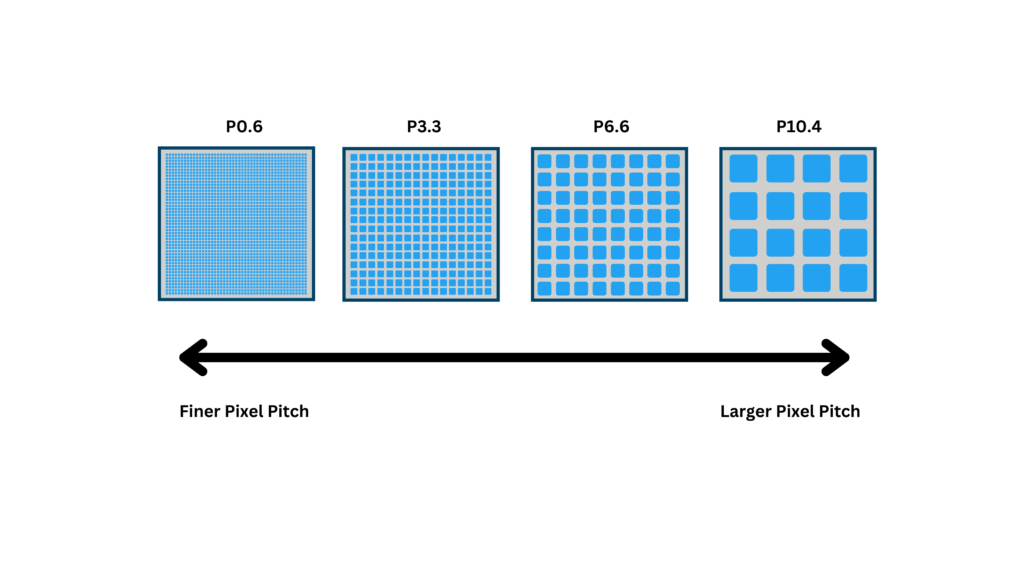
This is the most underestimated and easiest-to-miss technical parameter in LED screen pricing. Most salespeople will tell you “smaller pitch is clearer,” but they won’t tell you the mathematical logic behind it.
The Principle of Non-Linear Pixel Density Growth
Pixel Pitch represents the distance between the centers of two adjacent pixels in millimeters. For a fixed screen area:
Pixels per square meter = (1000 ÷ Pitch)²
This means:
| Pixel Pitch | Pixels per m² | Multiplier relative to P3.9 |
| P3.9 | 65,746 pixels/㎡ | 1× Baseline |
| P2.6 | 147,929 pixels/㎡ | 2.25× |
| P1.9 | 277,008 pixels/㎡ | 4.21× |
| P1.5 | 444,444 pixels/㎡ | 6.76× |
| P1.2 | 694,444 pixels/㎡ | 10.56× |
On a 7.43㎡ 10×8 screen, P1.2 requires welding approximately 4.69 million more LED lamp beads than P3.9. The packaging, welding, and aging tests for every single bead are costs, which is the root cause of the non-linear price explosion.
Lamp Bead Specifications Also Determine Cost: SMD 2121 vs. SMD 1010
Besides density, the packaging size of the lamp bead itself is a cost watershed:
-
SMD 2121 (2.1mm×2.1mm): Commonly used for P2.5 and above; mature process, controllable cost.
-
SMD 1515/SMD 1010: Dedicated for Fine Pitch products below P1.5; requires higher wafer cutting precision, cost per bead is 2–3x that of SMD 2121.
-
COB (Chip-on-Board) Packaging: LED chips are packaged directly onto the PCB without independent beads. It has extreme impact resistance, but process costs are 40%–80% higher than SMD, making it the current mainstream trend for high-end small pitch.
Engineer’s Advice: Unless your screen requires close-up camera filming or the viewing distance is truly within 2 meters, buying sub-P1.5 for a 10×8 meeting screen is a pure waste of budget. For a screen viewed from 3–5 meters away, there is almost no perceptible difference between P2.6 and P1.5 to the human eye, but the price gap can reach $15,000–$20,000. Let you know the 6 differences between SMD LED display and COB LED display.
Viewing Distance × Pitch Selection Quick Look
Optimal Viewing Distance (m) = Pixel Pitch (mm) × 1000 ÷ 3438
Simplified Formula: Minimum Comfortable Viewing Distance ≈ Pitch Value × 1.0 (meters)
-
P3.9 Screen: Min. distance approx. 3.9m, suitable for back rows of medium meeting rooms.
-
P2.6 Screen: Min. distance approx. 2.6m, suitable for close-range interaction at booths.
-
P1.9 Screen: Min. distance approx. 1.9m, suitable for TV stations/live rooms.
-
P1.5 Screen: Min. distance approx. 1.5m, suitable for command centers/monitoring walls.
Indoor vs. Outdoor—Why Costs Differ by 3x for the Same Size
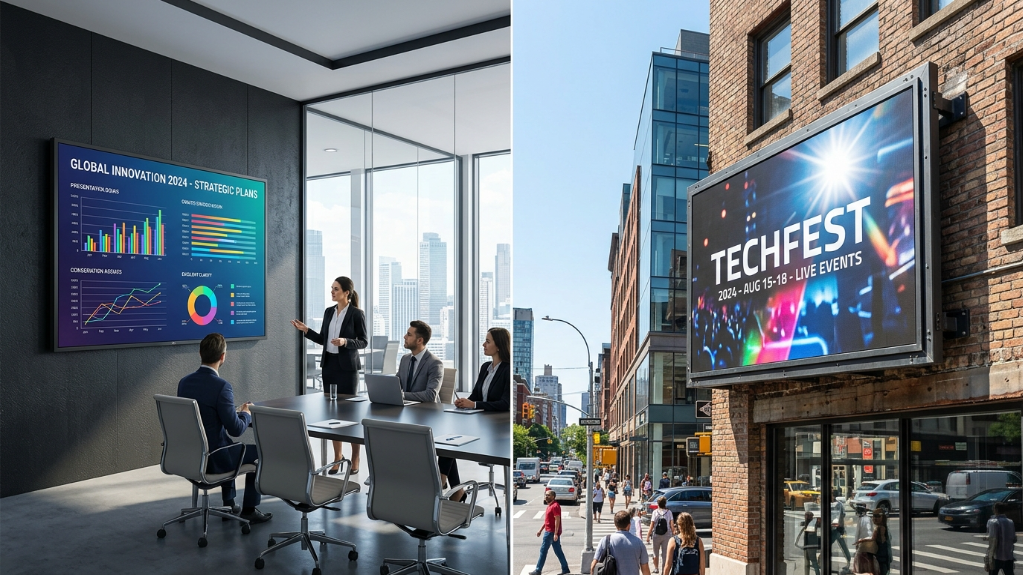
If you install an indoor screen outdoors, it will be destroyed within 6 months. This is not an exaggeration, but an engineering reality where the two types of products differ completely from structure to chips.
Three Structural Cost Additions for Outdoor Screens
① Brightness: The Price of Moving from 1200nits to 10,000nits
-
Indoor screen typical brightness: 800–1,500 nits.
-
Outdoor screens in direct sunlight need: 5,000–10,000 nits.
-
Achieving high brightness requires: Higher power LED chips + higher density driver ICs + more powerful cooling systems.
-
Direct cost impact: Outdoor cost per ㎡ is $300–$800 higher than the same pitch indoor screen.
② Protection Rating: IP65+ Cabinet Engineering Costs
Outdoor screens must pass:
-
IP65 (Dustproof and high-pressure water jet proof): Sealing silicone strips, waterproof connectors, hydrophobic coating treatments.
-
IP67 (Temporary immersion): Fully sealed welded cabinets, significantly increasing costs.
-
Projects in coastal or high-humidity areas also require Salt Spray Testing treatment, adding extra material costs.
③ Structural Load-bearing: Hidden Costs of Wind Load and Steel
-
Outdoor screens must withstand continuous wind pressure, usually required to meet local standards of ≥120km/h wind speeds.
-
Die-casting aluminum cabinets weigh about 30%–50% more per unit than indoor sheet metal cabinets.
-
Supporting steel structure cost: $1,500–$8,000 (depending on installation height and site conditions).
Brand Tiers and Supply Chain Sourcing—What are You Actually Buying?
Many buyers react to quotes by asking: “Why does Company A quote $5,200 for P3.9 while Company B quotes $11,800?” The answer is that you aren’t comparing the same category of product.
The Four-Tier Structure of the LED Supply Chain
-
Chip Manufacturers (Nationstar/Cree/Epistar)
-
Packaging/Module Factories (Independent module suppliers)
-
Panel Manufacturers
-
System Integrators/Local Dealers
Three Brand Tiers: Where is the Real Gap?
Tier 1—Listed Flagship Brands
-
Premium Sources: Global 24h service, strategic chip pricing power, full UL/CE/ETL/FCC certifications, MTBF ≥ 100,000 hours.
-
10×8 P3.9 Price (Landed): $9,500–$14,000.
Tier 2—Quality Mid-range Brands
-
Value Proposition: 20%–35% lower than Tier 1 with limited technical gaps in core lines.
-
10×8 P3.9 Reference Price: $6,800–$10,500.
Tier 3—OEM White-label Factories
-
Source: Factories around Huaqiangbei, Shenzhen; usually no in-house R&D.
-
Risks: Inconsistent chip batches (color issues), lack of UL certification, low after-sales response.
-
10×8 P3.9 Reference Price: $2,800–$5,500 (Attractive, but at your own risk).
TCO Full Cycle Hidden Costs—The Real Total Bill
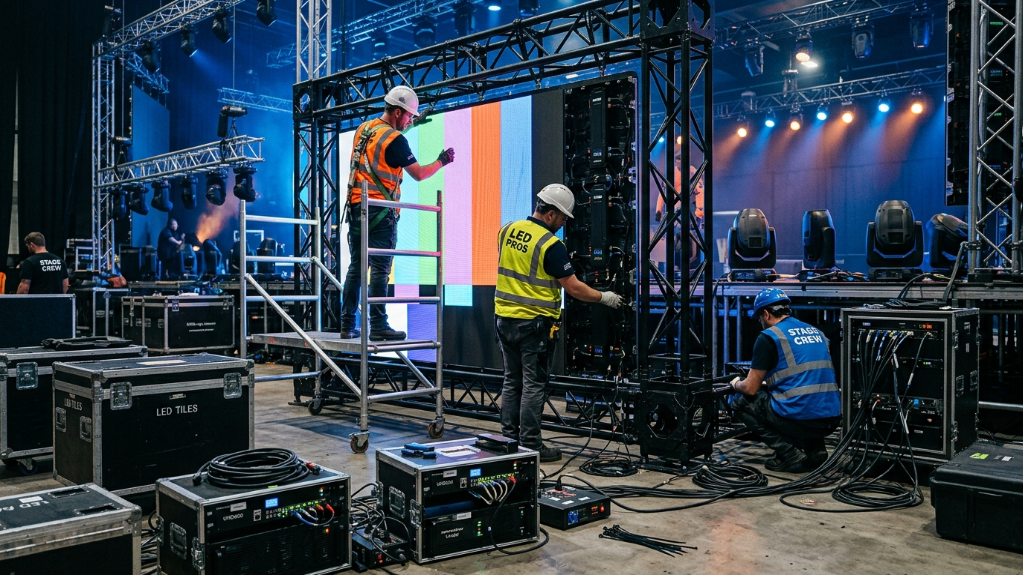
The “panel quote” is just the tip of the iceberg.
| Cost Item | Typical Range | Reason for being ignored |
| Video Processor/Controller | $850–$4,500 | Often listed separately or excluded |
| Steel Structure/Truss | $600–$3,200 | Varies greatly by installation method |
| Professional Installation Labor | $1,200–$6,000 | Hourly rates vary by region |
| Import Duties (from China) | 3.9%–7.5% | Section 301 tariffs are significant |
| Shipping + Customs + Delivery | $400–$1,800 | Volume weight (CBM) easily underestimated |
| Spare Modules (5% recommended) | $220–$3,400 | Failure rates systematically underestimated |
| Electrical Site Modification | $300–$2,000 | Requires professional electrician |
| Annual Maintenance Contract | 8%–15% of HW/yr | Largest long-term operational expense |
Total Hidden Costs: Typically an additional +28% to +62% of the initial quote.
10×8 Screen Procurement Decision Framework
Step 1: Lock Specifications with a 3D Matrix
-
Viewing Distance? → Determines pitch ceiling.
-
Environment? → Determines brightness and protection.
-
Frequency? → Determines cabinet structure.
Step 2: Send a Standardized RFQ
A qualified RFQ must specify:
-
Screen Size (Feet or Meters)
-
Target Pixel Pitch
-
Installation Method (Wall mount/Floor stand/Hanging)
-
Environment (Indoor/Outdoor + local climate)
-
Operating Hours (Daily)
-
Control System Requirements
-
Certification Requirements (UL/ETL/CE)
Step 3: Identify 5 Red Flags in Low Quotes
🚩 Refresh rate below 1920Hz: Standard should be ≥3840Hz.
🚩 Grayscale below 14-bit: 16-bit is the professional baseline.
🚩 MTBF not committed or < 80,000 hours: Quality brands promise ≥100,000.
🚩 Missing original certification docs: Verify UL/ETL ID online.
🚩 Warranty only 1 year: Industry standard is 2–3 years; premium is 5.
FAQ Module: Long-tail Questions from Real Buyers
Q1: How many panels make up a 10×8 LED screen?
A: Using standard 500×500mm cabinets, 10ft×8ft (3.05m×2.44m) requires approx. 30–32 units. If using 500×1000mm large cabinets, it requires approx. 16 units.
Q2: How much electricity does a 10×8 screen use?
A: Indoor P3.9 average power is approx. 0.35–0.45 kW/㎡ (7.43㎡ total ≈ 2.6–3.3 kW). At $0.16/kWh, 10 hours daily operation costs about $1,500–$1,900/year.
Q3: Is it cheaper to buy directly from China?
A: Ex-factory prices are 35%–55% lower, saving $4,000–$12,000. However, you must handle Section 301 tariffs, shipping (4–6 weeks), customs, and time-zone differences for support.
Q4: What is the actual lifespan?
A: Rated for 100,000 hours (approx. 27 years at 10h/day). However, most projects are refurbished in 8–12 years due to brightness decay (70% of initial value is considered end-of-life) and tech iteration.
Conclusion: Why Initial Unit Price is the Most Expensive Mistake
A $5,000 white-label P3.9 screen, after installation and duties, may exceed $10,000. Meanwhile, a $14,000 Tier 1 brand screen, with lower failure rates and longer life, may result in a 5-year TCO that is $3,000–$6,000 lower.
Smart procurement is about:
-
Correct Pitch—Don’t buy precision you don’t need.
-
Matched Brand Tier—Align with project lifespan.
-
Full TCO View—Include hidden costs in the first budget round.
References:
DISCAS (Display Image Size for 2D Content in Audiovisual Systems)
ENERGY STAR Program Requirements for Signage Displays