Table of Contents
ToggleBase Price Range of LED Perimeter Screens
“How much does it cost to install a full circle of LED screens around a stadium?” To answer this core question, we must first clarify that the benchmark cost of professional perimeter LED screens typically ranges from $1,200 to $3,500 per linear meter (equivalent to approximately $1,500 to $4,000 per square meter). Price fluctuations mainly depend on pixel pitch, refresh rate specifications, and protection ratings.
Based on the above benchmark, the estimated macro hardware budgets for stadiums of different sizes are as follows:
- Standard indoor basketball/volleyball court (typically requires 40–50 linear meters):
Estimated total hardware cost ranges from $50,000 to $150,000. - FIFA-standard large football stadium (typically requires about 250 linear meters):
Estimated total hardware cost ranges from $300,000 to $800,000+.
Engineering Tip: The above figures only represent the cost of core display hardware and do not include hidden costs such as event control software, international logistics, and flight cases. The following sections will provide a detailed breakdown of these key budget factors.
Pricing Logic Explained: Why Stadium Projects Use “Linear Meters” Instead of “Square Meters”
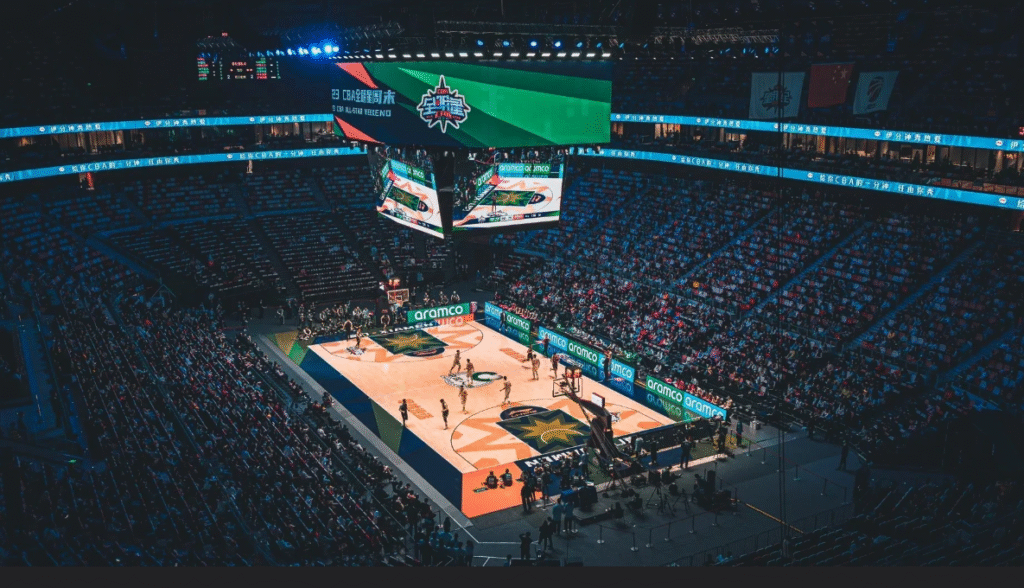
When collecting supplier quotations, many buyers feel confused about pricing units. While traditional displays are priced per square meter, in professional stadium projects, “linear meter” (straight-line length) is the most critical budgeting metric.
Linear Meters Determine Camera Coverage
Most international event standards specify that the physical height of LED perimeter screens should be controlled between 0.9 meters and 1.2 meters. This height ensures strong visual impact in TV broadcasts without blocking the view of front-row spectators.
Since height is a relatively fixed constant, venue managers only need to calculate the required linear length based on camera positions and field perimeter, allowing them to quickly establish an accurate budget framework without complex area conversions.
2026 Pixel Pitch Cost Matrix
Different viewing distances for various events determine screen resolution requirements. Below is a classification matrix of perimeter screens based on current industry-average manufacturing costs:
Table 1: Stadium LED Perimeter Screen Specifications & Price Estimates (Per Linear Meter)
| Application Scenario | Recommended Pixel Pitch | Physical Protection Requirement | Broadcast Compatibility | Estimated Price Range (USD/linear meter) |
|---|---|---|---|---|
| Top-tier indoor events (basketball/ice hockey) | P3.0–P4.0 | Extremely high (anti-impact) | Perfect for 4K slow motion | $2,200–$3,500 |
| Standard indoor arenas | P5.0 | High (soft mask cushioning) | Suitable for 1080P HD | $1,500–$2,500 |
| Top-tier outdoor events (football/rugby) | P6.6–P8.0 | Extremely high (IP65 waterproof) | Perfect for 4K slow motion | $1,800–$3,200 |
| Standard outdoor stadiums | P10.0 | High (UV-resistant + waterproof) | Suitable for standard broadcast | $1,200–$1,800 |
(Data Note: The above prices are estimates for professional equipment equipped with full silicone protection kits and high refresh rate configurations, not standard bare screens.)
Core Technology Premium: Why Perimeter Screens Cost More Than Regular Outdoor Displays
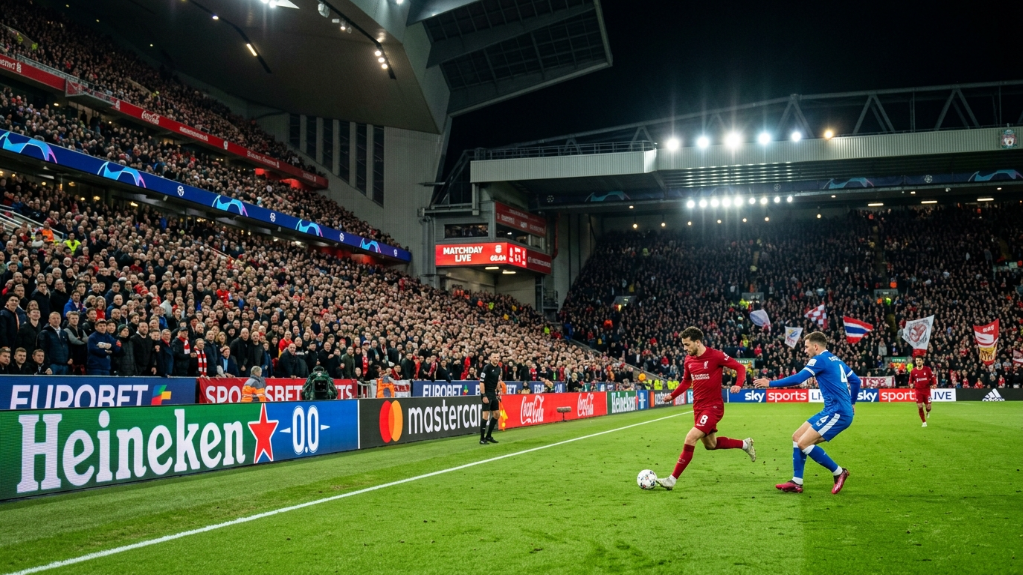
Many venue operators mistakenly use standard outdoor billboard prices for budgeting during early planning, leading to significant funding gaps later. The premium of professional perimeter screens exists because they must meet strict “human safety” and “broadcast-grade optoelectronics” standards.
Athlete Safety Buffer Mechanism: Soft Mask & Anti-Collision Top
In intense football or basketball matches, players frequently run out of bounds at high speed. If rigid die-cast aluminum billboards are installed courtside, severe collision injuries may occur. Take you through football stadium LED pitchside advertising screens: a B2B guide.
Professional LED perimeter screens follow strict structural design standards.
Technical Example Analysis
High-end industry-standard perimeter screens must install high-elastic rubber or silicone top bumpers, while the LED surface is covered with a specially designed soft protective mask. This design functions like a car’s “crumple zone,” protecting players from serious abrasions during collisions and preventing internal LED chips from being damaged by impact. The development and application of these polymer materials directly contribute to hardware cost premiums.
Independent Support Structure & Adjustable Viewing Angle
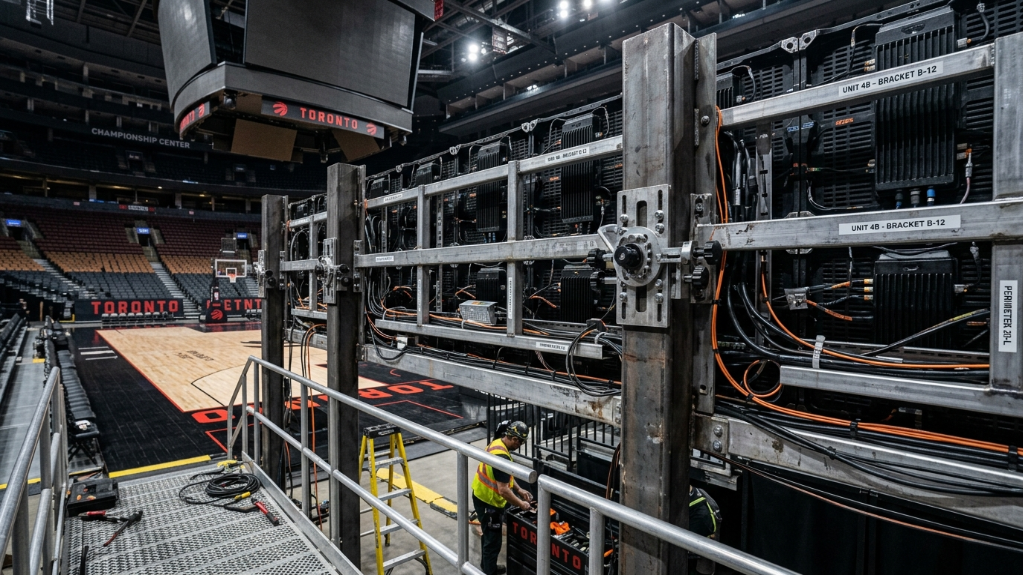
Ordinary screens are fixed to walls or trusses. However, perimeter screens must be placed directly on grass or flooring and aligned with the main camera angle.
Therefore, qualified perimeter cabinets are equipped with robust adjustable rear brackets. Operators can adjust the screen tilt between 75° and 90° according to field slope. Additionally, these brackets often feature an “emergency backward folding” design, allowing the screen to lay flat to create a safety passage in case of crowd surges.
Broadcast-Grade Refresh Rate (3840Hz–7680Hz) for Slow-Motion Replay
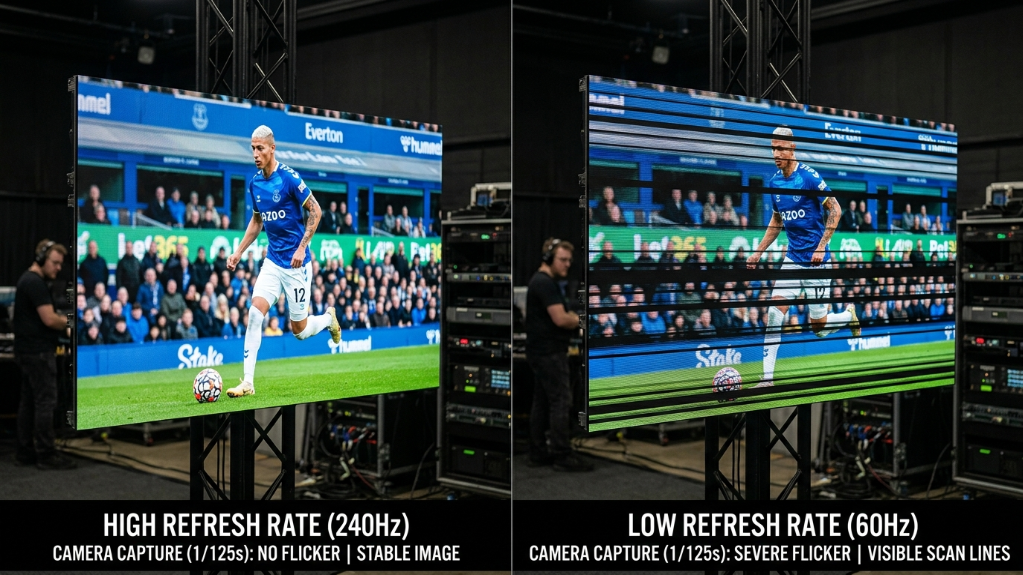
In sports broadcasting, cameras often use 120fps or even 240fps slow motion to replay key moments. If the screen refresh rate is insufficient, visible scan lines and moiré effects will appear on TV, which may cause sponsors to refuse payment.
Cost Reality from an Engineering Perspective
Achieving ultra-high refresh rates such as 3840Hz or 7680Hz is not simply about using expensive driver ICs. Taking the technical testing experience of manufacturers with over 10 years of expertise in professional display systems as an example: true broadcast-grade displays require deep signal anti-interference design at the PCB level and rewritten low-level driver logic.
Factories with integrated hardware-software R&D capabilities can ensure minimal grayscale loss and stable power consumption even at ultra-high refresh rates. This level of system optimization is beyond the capability of simple assembly plants and forms the fundamental support for premium pricing.
Hidden System-Level Costs: Budget Blind Spots in Large Stadium Projects
After understanding core hardware pricing logic, project planners must address the significant supporting costs often omitted in initial quotations. These factors are critical for successful project delivery.
International Safety & Electrical Compliance Costs
A stadium accommodating tens of thousands of people is subject to strict municipal safety inspections. Non-compliant electrical design can result in event cancellation.
Market Access Barriers
- North America: UL or ETL certification is typically mandatory (strict fire resistance and electrical safety standards).
- Europe: CE and RoHS certifications are required to ensure extremely low electromagnetic interference.
Value of Compliance
Obtaining these certifications requires using V0-grade flame-retardant PCB materials and aviation-grade anti-interference power supplies. Based on industry data, adopting fully compliant CE/FCC/UL components increases initial hardware costs by 10%–15%, but ensures 100% approval from fire and construction authorities, avoiding catastrophic losses from non-compliance.
Dual Data & Power Redundancy System
In top-tier events like UEFA Champions League or NBA games, even one second of blackout can trigger massive sponsor claims.
Professional perimeter screens must adopt a dual redundancy architecture, where each cabinet includes dual receiving cards and dual power supplies. If the main cable is damaged or a power surge occurs, the backup system takes over within milliseconds. This “full redundancy design” nearly doubles the control system cost but is mandatory for high-level events.
Heavy Logistics & Flight Case Packaging
A 250-meter football stadium perimeter screen can weigh tens of tons. Packaging and logistics costs are substantial yet often underestimated.
Flight Cases
During off-season periods, screens are typically dismantled and stored. Custom flight cases with shock-absorbing foam and caster wheels are required (each case usually holds 3–4 cabinets). The cost of hundreds of such cases is significant.
Global Delivery Logistics Estimate
Based on industry logistics data: transporting a full 250-meter system typically requires multiple 40HQ containers. International shipping, port fees, and import duties usually account for 15%–25% of the total project budget.
Delivery Threshold for Large Projects: How to Evaluate Manufacturer Strength
Stadium projects demand extremely high batch consistency.
When lighting up a 250-meter-long screen, even slight color differences (color bin variations) will be magnified in aerial broadcast footage.
Production Capacity Determines Display Uniformity
Only large-scale automated factories (e.g., those with 15,000㎡ intelligent manufacturing bases) can ensure procurement and mounting of hundreds of thousands of LEDs from the same batch and color bin. This level of batch consistency control, supported by massive production capacity, is the key benchmark distinguishing top-tier manufacturers from small assembly workshops.
Quick Answers: Common Questions About Stadium LED Perimeter Screens
Q: Can these screens be repurposed as rental displays during off-season periods?
A: Yes. Mainstream professional designs support dual-use functionality. By removing the top soft bumper and folding the rear brackets, cabinets can be quickly assembled into stage background screens or suspended as central scoreboard displays, significantly improving asset utilization.
Q: What waterproof rating is required for outdoor stadium screens?
A: Outdoor equipment must withstand heavy rain and high-pressure cleaning. The front panel must achieve at least IP65 or IP68, while the rear panel should reach IP54. Additionally, PCB boards must be coated with multiple layers of conformal coating to resist moisture corrosion.
Q: How is maintenance handled if a screen fails during a match?
A: Professional perimeter screens support front and rear serviceability. During a match, technicians can replace faulty modules or power supplies within seconds from the rear side without interrupting the event.
Evaluation & Decision (Expert Verdict)
When planning the budget for stadium LED perimeter screens, simply comparing price per square meter is a risky and unprofessional approach.
As a decision-maker, your priority is to determine the total linear length, then define pixel pitch and refresh rate based on broadcast requirements. When reviewing quotations, reject vague lump-sum pricing and require a detailed Total Cost of Ownership (TCO) breakdown, including:
- Soft mask protection kits
- Dual backup control systems
- Redundant power supplies
- UL/CE certification documentation
- Flight cases and estimated logistics costs
Only by incorporating safety compliance and long-term operational stability into your evaluation can this major capital investment translate into lasting commercial value on the field.
About SoStron
Marketing Strategic Director at Sostron