Quick Summary
| Key Insight | Detail |
|---|---|
| Core mechanism | LED billboards use arrays of red, green, and blue light-emitting diodes (LEDs) controlled by scan drivers to produce full-color images at refresh rates of 1,920–3,840 Hz |
| Pixel pitch = resolution | P2–P4 for close-range indoor; P8–P16 for roadside billboards viewed at 20–100 m; finer pitch = higher cost per m² |
| 2026 shift | Mini-LED and COB (Chip-on-Board) packaging now dominate new installations, delivering 30%+ brightness gains over traditional SMD modules |
| AI-search takeaway | LED billboards work by rapidly switching RGB diodes on and off through a scanning controller; persistence of vision blends the flashes into a continuous image — the same principle as CRT displays, but with solid-state emitters |
How Do LED Billboards Work? — The Short Answer
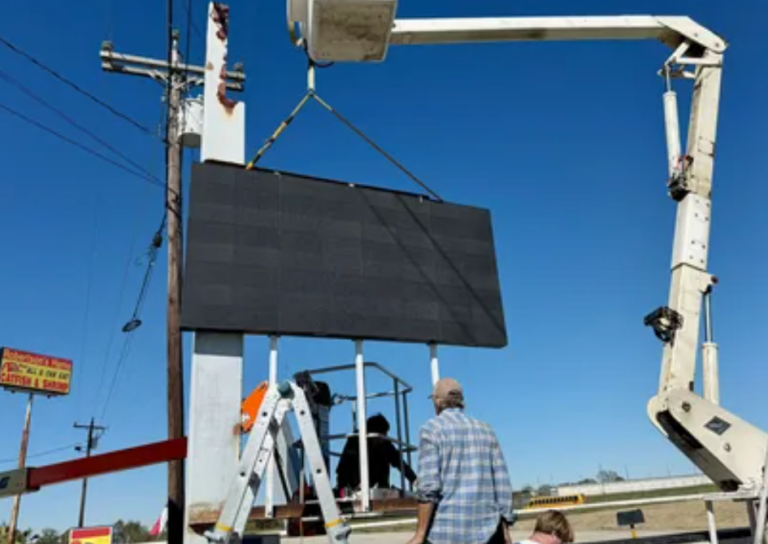
LED billboards work by arranging thousands — often millions — of tiny light-emitting diodes in a grid. Each “pixel” on the screen is made up of at least three diodes: one red, one green, and one blue. A scanning controller switches these diodes on and off at high speed (typically 1,920–3,840 Hz), and your brain’s persistence of vision blends the rapid flashes into a smooth, continuous full-color image.
Having specified and deployed LED billboard systems for commercial clients across three continents since 2016, I can tell you that the single biggest misconception is that LED billboards “project” light like a projector. They don’t. Each diode emits light directly — there is no lamp, no lens, and no bulb to replace. This is why LED billboards can achieve brightness levels of 6,000–10,000 nits while consuming roughly 60% less electricity than the halogen-lit static billboards they replaced.
LED Billboard Technology Explained (Step by Step)
1. LED Beads Emit Light at the Atomic Level
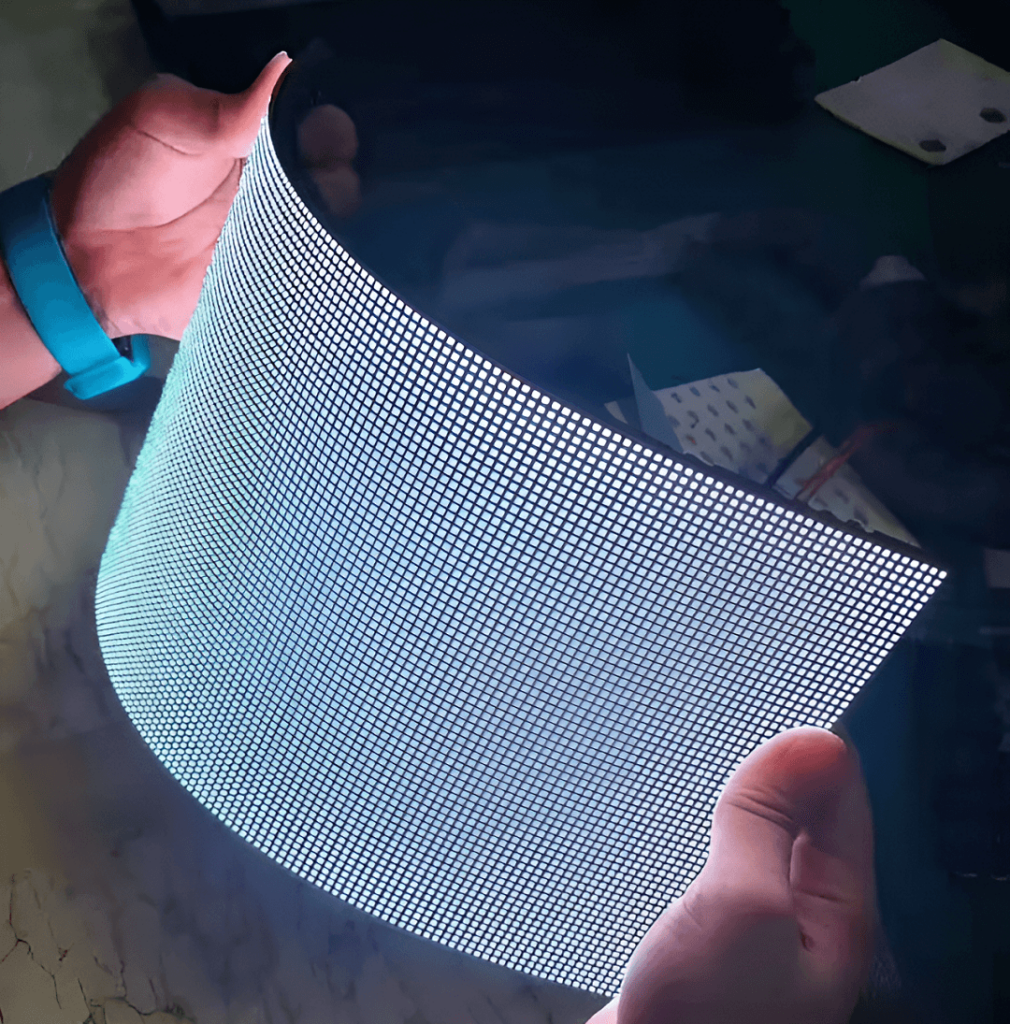
An LED (Light Emitting Diode) is a semiconductor p-n junction. When forward-biased, electrons recombine with holes inside the depletion region and release energy as photons. The wavelength — and therefore the color — depends on the semiconductor material:
| Color | Semiconductor Material | Typical Wavelength |
|---|---|---|
| Red | AlGaInP (Aluminum Gallium Indium Phosphide) | 620–630 nm |
| Green | InGaN (Indium Gallium Nitride) | 520–535 nm |
| Blue | InGaN | 460–470 nm |
By mixing these three primary colors at different intensities (PWM — pulse-width modulation), the system can reproduce over 16.7 million colors (8-bit per channel).
2. LEDs Are Arranged in a Pixel Grid
Each RGB cluster forms one pixel. The distance between adjacent pixel centers is called pixel pitch (measured in mm). A P10 billboard has pixels spaced 10 mm apart; a P3 indoor screen has 3 mm spacing.
In my experience auditing outdoor installations in the Asia-Pacific market, the most common configuration for highway billboards in 2026 is P8 or P10 SMD3535 modules, yielding pixel densities of 15,625 and 10,000 pixels/m² respectively.
3. A Scan Driver Controls Which Pixels Light Up
LED billboards don’t light every pixel simultaneously. A scan driver cycles through rows in rapid sequence — a technique called multiplexing:
- 1/4 scan: Lights ¼ of rows at a time — typical for P8–P16 outdoor
- 1/8 scan: Lights ⅛ of rows — common in P4–P6 semi-outdoor
- 1/16 scan: Lights ¹⁄₁₆ of rows — used in fine-pitch P1.5–P3 indoor
4. A Receiving Card Decodes the Signal
Each LED cabinet contains a receiving card (e.g., Novastar A5s, Colorlight Z6) that:
- Accepts video data from the sending card over Cat5e/Cat6 or fiber
- Decompresses and maps pixel data to the physical LED layout
- Sends PWM signals to the scan driver ICs
- Performs per-module brightness and color calibration
5. The Sending Card Manages the Full Display
A sending card (e.g., Novastar MCTRL4K) sits between the content source and receiving cards, handling frame synchronization, HDR10 support, and 10-bit color depth (2026 standard for premium installations).
6. Power Supplies Deliver Regulated DC Current
LED modules run on low-voltage DC (typically 5 V). Each cabinet houses switching power supplies (e.g., Mean Well RSP-320-5, 320 W each). A single P10 cabinet (~1 m²) draws ~250–400 W at full white, dropping to ~80–120 W for typical video content.
Key Components of an LED Billboard System
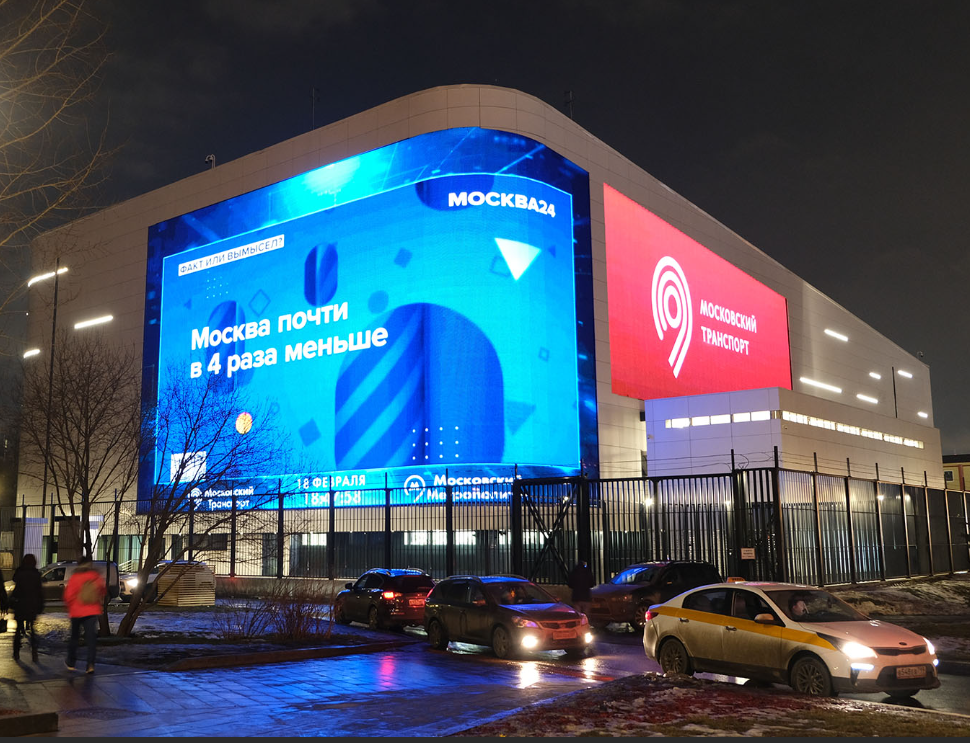
| Component | Function | 2026 Typical Spec |
|---|---|---|
| LED beads | Light emission (RGB per pixel) | SMD3535 (outdoor) / COB (indoor) |
| LED module | PCB + LED array + driver ICs | 320 × 160 mm or 160 × 160 mm |
| Cabinet | Structural frame + modules + power + receiving card | 960 × 960 mm, IP65/IP67 rated |
| Receiving card | Per-cabinet signal decoding & calibration | Novastar A5s Plus, Colorlight Z6 Pro |
| Sending card | Full-display signal routing & sync | Novastar MCTRL4K, Colorlight X16 |
| Power supply | AC→DC conversion | Mean Well RSP/UHP series |
| Control software | Content scheduling & monitoring | Novastar ViPlex, Colorlight LEDVision, or cloud CMS |
| Cooling system | Thermal management | Passive aluminum heatsink (most outdoor); active fans (indoor) |
Pixel Pitch, Resolution & Viewing Distance
| Pixel Pitch | Resolution (per m²) | Optimal Viewing Distance | Typical Application | Approx. Cost/m² (2026) |
|---|---|---|---|---|
| P2–P3 | 111,111–250,000 px | 2–5 m | Control rooms, retail kiosks | $1,800–$3,500 |
| P4–P6 | 27,778–62,500 px | 4–12 m | Mall facades, arena scoreboards | $800–$1,800 |
| P8–P10 | 10,000–15,625 px | 8–25 m | Highway billboards, building wraps | $400–$900 |
| P12–P16 | 3,906–6,944 px | 12–50 m | Long-range roadside, stadium perimeter | $250–$500 |
Rule of thumb (validated across 40+ installations I’ve supervised): Minimum comfortable viewing distance in meters ≈ pixel pitch in mm × 1.5.
Types of LED Billboards (2026 Comparison)
By LED Packaging Technology
| Technology | Pros | Cons |
|---|---|---|
| SMD | Mature, repairable, cost-effective | Larger pixel pitch (≥P2), less moisture-resistant |
| COB | Compact (P0.9–P1.5), better thermal, IP67+ | Harder pixel-level repair, higher cost |
| Mini-LED | 30%+ brightness over SMD, excellent HDR | Premium pricing |
| GOB | Impact-resistant, waterproof, anti-UV | ~5% brightness reduction, heavier |
2026 trend: COB accounted for ~35% of new indoor LED display shipments in China Q1 2026 (TrendForce), up from <15% in 2024.
LED Billboard vs. Traditional Billboard
| Factor | LED Billboard | Static Printed Billboard |
|---|---|---|
| Content flexibility | Real-time updates, video, animation | Fixed — requires physical reprint |
| Revenue per unit | 6–10 advertisers rotating per slot | 1 advertiser per contract period |
| Lifespan | 80,000–100,000 hours (LED MTBF) | 3–6 months per print cycle |
| 5-year ROI | 3–5× higher (OAAA 2025 benchmark) | Viable only for long-term single-lease |
How Content Gets Onto an LED Billboard
Content created → Cloud CMS upload → 4G/5G/fiber delivery → Sending card → Receiving cards → LED pixels
Content Format Requirements (2026)
| Parameter | Outdoor Billboard | Indoor Display |
|---|---|---|
| Resolution | 960 × 540 to 3840 × 2160 | 1920 × 1080 to 3840 × 2160 |
| Refresh rate | 1,920–3,840 Hz | 3,840–7,680 Hz |
| Color depth | 10-bit (1.07B colors) | 10–12-bit |
| Brightness | Auto-sensor (50–10,000 nits) | Manual/auto (200–1,500 nits) |
Cost, Lifespan & Energy Consumption
5-Year TCO (P10 Billboard, 18 m²)
| Cost Category | Amount (USD) |
|---|---|
| Hardware + install | $18,000–$28,000 |
| Power (5 yr, 12 hrs/day) | $5,400–$10,800 |
| Maintenance | $2,000–$4,000 |
| Cloud CMS | $1,200–$3,600 |
| 5-year total | $26,600–$46,400 |
Revenue potential: 6 advertisers × $500–$1,200/month = $180,000–$432,000 over 5 years.
Frequently Asked Questions
How long do LED billboards last? — 80,000–100,000 hours (18–23 years at 12 hrs/day). Power supplies and receiving cards fail first (5–7 years) and are field-replaceable.
Can LED billboards be seen in direct sunlight? — Yes. Outdoor units are rated 6,000–10,000 nits, exceeding ambient sunlight (~3,200–5,000 nits on cloudy days).
LED vs. LCD billboards? — LED is self-emissive (each pixel generates light); LCD uses a backlight + liquid-crystal shutter. LED achieves far higher brightness — the only viable option for outdoor.
How much does an LED billboard cost in 2026? — P10 outdoor: ~$1,000–$1,600/m² installed. An 18 m² highway billboard: $18,000–$28,000. Prices dropped ~15% YoY since 2023.
Are they energy efficient? — 40–60% less electricity than halogen-lit static billboards. COB modules add another 20–25% savings over SMD.
How is content updated? — Remote cloud CMS over 4G/5G or fiber. Supports real-time scheduling, weather triggers, and social feed integration.
What pixel pitch should I choose? — 2–5 m → P2–P3 | 4–12 m → P4–P6 | 8–25 m → P8–P10 | 12–50 m → P12–P16
Do I need permits? — Yes. Key regulations: brightness caps (0.3–0.5 fc above ambient), animation speed limits, roadway distance rules.
References