An interactive LED floor tile screen is more than a conventional LED display installed horizontally. A commercial system combines a load-bearing LED floor panel with sensors, a control system, real-time data processing, and interactive content. When a person walks, jumps, dances, or moves across the screen, the system detects the interaction and converts it into a corresponding visual response.
For B2B buyers, the key questions are usually practical: How does an interactive LED floor work? How much does an interactive LED floor cost? What specifications matter, and how can you choose a floor screen that is safe enough for continuous commercial use?
This guide explains the complete system from the engineering and procurement perspective.
What Is an Interactive LED Floor Tile Screen?

An interactive LED floor tile screen is a modular LED display designed for ground installation and equipped with an interaction system.
Unlike a conventional LED wall, the floor screen must perform two jobs simultaneously:
- Display high-quality visual content.
- Safely withstand people walking or performing on its surface.
The interactive function can be created through optical sensors, pressure sensors, radar, cameras, or other motion-tracking technologies. The detected information is sent to a controller or data processor, which determines what visual response should appear on the LED floor.
Commercial interactive LED floors are commonly used in stages, exhibitions, museums, shopping malls, brand experience centers, immersive installations, entertainment venues, sports environments, and other high-traffic commercial spaces.
How Does an Interactive LED Floor Screen Work?
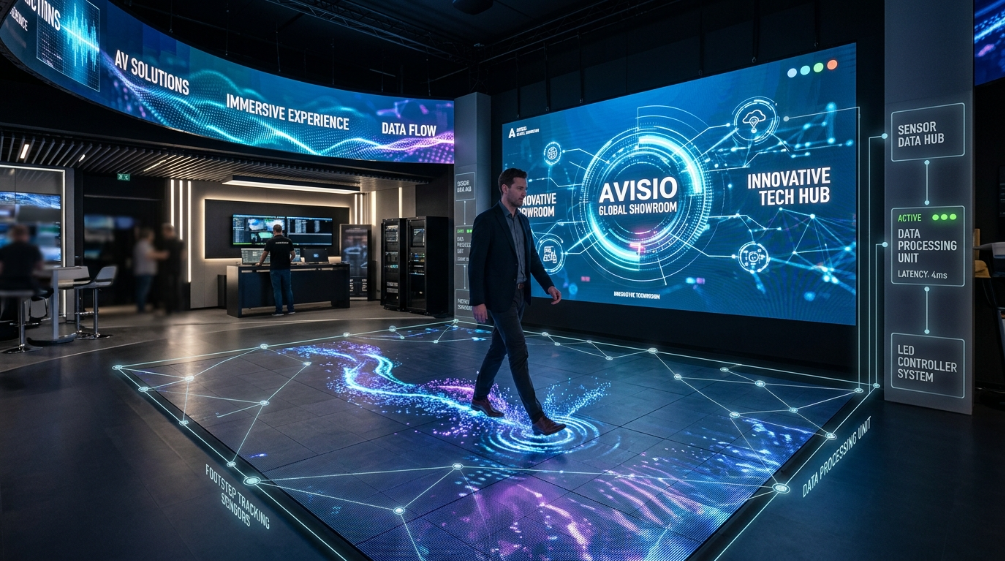
The working principle can be understood as a continuous five-step signal chain:
Human movement → Sensor detection → Data transmission → Data processing → LED visual response
The basic architecture is similar to the interaction system described in our original LED floor screen design, but modern commercial systems can integrate more sophisticated sensors and control software.
1. Human Movement Is Detected
The first step is interaction capture.
Depending on the project, the system may use:
- Optical sensors
- Pressure sensors
- Infrared sensors
- Radar
- Cameras
- Motion-tracking systems
For example, when a person steps onto a designated area, the sensor identifies the position or movement and generates a corresponding signal.
2. Sensor Data Is Transmitted
The captured information is transmitted to the control system through the appropriate data interface.
For a commercial installation, signal stability is important because a delayed or lost signal can create a noticeable mismatch between the user’s movement and the visual effect.
3. The Controller Processes the Interaction
The data processor determines what should happen next.
For example:
Footstep detected → position identified → interaction rule triggered → visual effect generated
The system may produce ripples, particles, color changes, light trails, animated graphics, game effects, or other customized content.
4. The LED Screen Displays the Result
The processed instruction is sent to the LED display system.
The corresponding LED modules immediately update their image, creating the impression that the floor is responding directly to the person’s movement.
This is the core difference between a conventional LED floor screen and a truly interactive floor system.
What Are the Main Components of an Interactive LED Floor System?
A complete commercial interactive floor is not simply a collection of LED panels.
The system normally includes:
LED Floor Panels
These are the visual output components.
Unlike conventional wall cabinets, floor panels require reinforced mechanical structures and protective surface materials because they are exposed to direct foot traffic.
Interactive Sensors
Sensors detect movement, pressure, touch, or position.
The correct sensor technology depends heavily on the application. A museum installation, a stage performance, and an interactive game floor may require completely different tracking methods.
LED Receiving and Control System
The receiving cards and controller distribute image data to the LED panels.
For large installations, signal stability, redundancy, synchronization, and processing capacity should be considered during system design.
Data Processor and Interactive Software
The software layer converts physical movement into digital interaction.
This is where the system can define rules such as:
Step on Area A → display a water ripple.
Move across Area B → generate a light trail.
Step on the correct tile → trigger a game animation.
Supporting Infrastructure
A complete project can also require:
- Power distribution
- Network/data cables
- Installation structure
- Adjustable feet
- Control computer
- Audio equipment
- Interactive software
- Spare modules
- Safety protection
The final quotation should therefore be based on the complete system rather than the LED cabinet price alone.
How Much Does an Interactive LED Floor Cost?
The Interactive LED floor price varies substantially depending on the hardware configuration and project requirements.
As a broad 2026 commercial reference, interactive LED floor systems can fall roughly within the $1,000–$4,000+ per square meter range, while premium customized systems can exceed this level. Current supplier pricing shows substantial variation because some quotations cover only LED hardware while others include sensors, software, structural systems, installation, and customization.
A more useful way to evaluate price is by configuration:
| System Level | Typical Configuration | Relative Cost |
|---|---|---|
| Basic LED floor | LED display without advanced interaction | Lower |
| Standard interactive floor | LED floor + basic motion/touch sensing | Medium |
| Professional interactive floor | Advanced sensors + control system + customized content | Higher |
| Premium immersive system | Multi-point tracking + custom software + reinforced structure + installation | Highest |
These figures should be treated as budget references rather than fixed market prices.
For an actual B2B quotation, suppliers normally need the floor dimensions, pixel pitch, indoor/outdoor environment, required load capacity, interaction technology, content requirements, installation method, and project quantity.
What Factors Affect Interactive LED Floor Price?
1. Pixel Pitch
Pixel pitch is one of the most visible cost factors.
Common commercial LED floor configurations include approximately P2.9, P3.9, P4.8, P5.2, P6.25, and P7.8, although the available range depends on the manufacturer.
A smaller pixel pitch provides higher pixel density, but it also increases cost.
Do not automatically choose the smallest pitch.
If the audience normally views the floor from several meters away, a larger pitch may provide an appropriate visual result at a substantially better project cost.
2. Interactive Technology
Adding an interaction system increases both hardware and software costs.
Optical sensing, pressure sensing, radar tracking, and camera-based tracking each have different accuracy, coverage, installation, and processing requirements.
3. Load-Bearing Structure
This is one of the most important differences between a wall LED display and a professional LED floor.
Commercial products on the market advertise load capacities ranging from around 1,500kg/m² to 2,000kg/m² or more, depending on construction and testing conditions.
However, buyers should not compare these numbers blindly.
Ask the supplier:
- Is the specification static or dynamic?
- Is the load distributed or concentrated?
- Does it include the installation structure?
- Has the complete system been tested?
- Is it suitable for dancing or only normal foot traffic?
4. Surface Protection
The surface must withstand repeated physical contact.
Important specifications include:
- Anti-slip performance
- Scratch resistance
- Impact resistance
- Anti-reflective treatment
- Surface friction
- Protective mask or tempered glass
The surface design affects both safety and image quality.
5. Brightness and Environment
Indoor and outdoor floor screens have very different requirements.
Indoor systems generally do not need the same brightness level as outdoor installations. Outdoor projects also need appropriate waterproofing, dust protection, UV resistance, and structural protection.
Some commercial interactive floor systems are available with IP65-rated outdoor configurations.
6. Software and Content
Hardware is only one part of an interactive floor project.
If the project requires customized games, branded animations, real-time tracking, sound synchronization, or integration with other immersive systems, software development can become a significant part of the total project cost.
Interactive Floor Panels: What Specifications Should Buyers Check?
When comparing different interactive floor panels, do not evaluate them only by price per square meter.
A professional specification sheet should include at least:
- Pixel pitch
- Pixel density
- Panel dimensions
- Panel weight
- Brightness
- Refresh rate
- Viewing angle
- Load capacity
- IP rating
- LED type
- Surface material
- Maintenance method
- Operating temperature
- Sensor technology
- Controller type
- Software compatibility
For professional stage, broadcast, and camera-based applications, refresh rate deserves particular attention. Modern commercial rental LED systems can reach refresh rates of 3840Hz or higher, with some configurations reaching 7680Hz.
Which Pixel Pitch Is Best for an LED Floor Tile Screen?
There is no universal “best” pixel pitch.
The correct choice depends on viewing distance and content requirements.
P2.9–P3.9
Suitable for:
- Premium exhibitions
- Indoor immersive installations
- Stage environments
- Close viewing distances
- High-detail visual content
P4.8–P5.2
A practical middle ground for many commercial applications.
P6.25–P7.8
More suitable where the viewing distance is relatively long and the project prioritizes durability and budget over close-up image detail.
The important engineering principle is simple:
Choose pixel pitch according to viewing distance, not marketing claims.
Are Interactive LED Floor Screens Safe to Walk On?
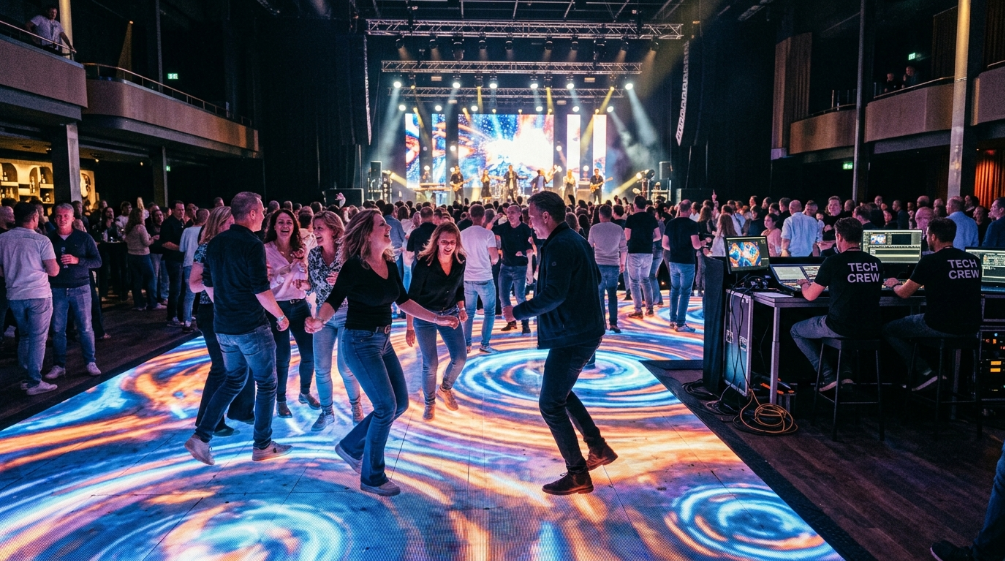
A professional LED floor screen should be specifically engineered for pedestrian use.
The safety design normally includes:
- Reinforced cabinet structure
- Load-bearing frame
- Anti-slip surface
- Protected LED modules
- Stable installation feet
- Proper cable routing
- Mechanical locking
- Appropriate electrical protection
For high-impact applications such as dancing, sports, staging, or large public events, the supplier should provide a clearly defined load-bearing specification and installation method.
A floor LED panel designed only for visual display should not automatically be treated as a walkable floor.
Interactive LED Floor vs. Traditional LED Floor Screen
The two products are related but not identical.
A traditional LED floor screen primarily displays visual content.
An interactive LED floor adds an input layer.
| Feature | Standard LED Floor | Interactive LED Floor |
| Video display | Yes | Yes |
| Walkable structure | Yes, if engineered for it | Yes, if engineered for it |
| Sensors | Optional/No | Yes |
| Real-time interaction | Limited | Yes |
| Interactive software | Optional | Usually required |
| Motion tracking | No/Optional | Yes |
| Interactive games | Limited | Possible |
| Installation complexity | Lower | Higher |
| Project cost | Lower | Higher |
If the project only requires animated graphics on the ground, an interactive system may be unnecessary.
If the objective is visitor participation, gamification, immersive storytelling, or real-time visual feedback, the additional interaction layer can justify the investment.
Rental or Permanent Installation: Which Is Better?
The choice between rental and permanent installation should be based on usage frequency.
Choose Rental LED Floor Screens When:
- The display is used for temporary events.
- The venue changes frequently.
- The project is a concert, exhibition, or corporate event.
- Fast installation and dismantling are important.
- The equipment needs to be transported repeatedly.
Choose Permanent LED Floor Installation When:
- The system will operate continuously.
- The project is inside a museum or retail environment.
- The floor is part of a permanent attraction.
- Long-term content updates are expected.
- The owner wants to control the hardware directly.
Commercial rental products such as the SoStron Hima Series are designed around modular deployment, floor applications, rapid assembly, and interactive event solutions.
How Is an Interactive LED Floor Maintained?
Maintenance should be considered before installation rather than after the first failure.
A modular LED floor should ideally allow technicians to replace individual modules, power components, receiving cards, or other serviceable parts without dismantling the entire display.
Before ordering, ask the manufacturer:
- Is front maintenance supported?
- Is rear maintenance required?
- Can one damaged module be replaced independently?
- Are spare modules available?
- How is calibration handled after module replacement?
- What is the expected service life?
- What warranty is included?
- Is remote technical support available?
For rental environments, fast replacement can directly reduce downtime and labor costs. Current Hima documentation, for example, emphasizes modular serviceability and front/rear maintenance options.
Where Are Interactive LED Floor Screens Used?
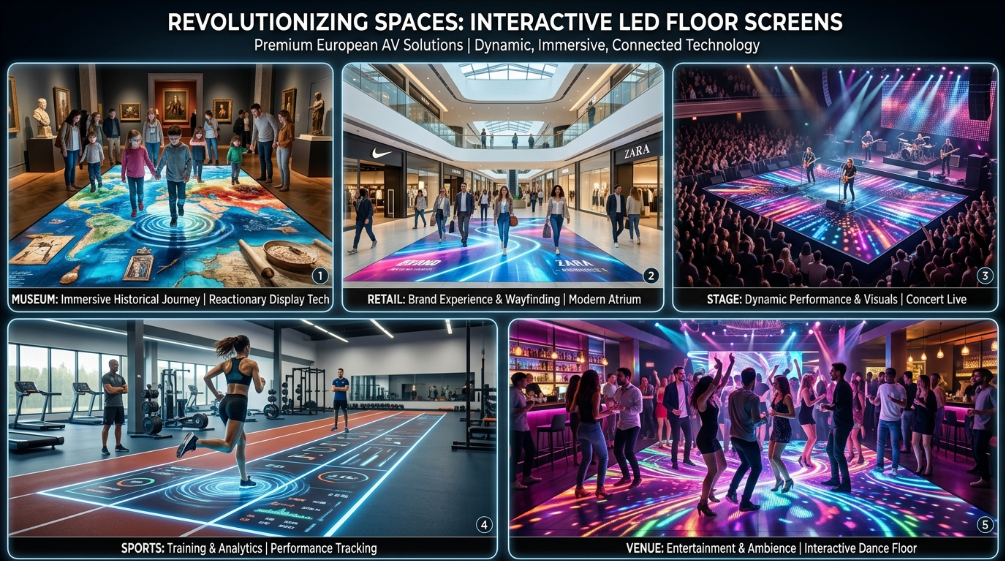
Interactive LED floors are particularly valuable where physical participation is part of the experience.
Stage and Live Events
Artists can interact with graphics beneath their feet, creating synchronized visual effects.
Shopping Malls and Retail
Brands can use interactive floor panels for product launches, promotions, navigation, games, and customer engagement.
Museums and Experience Centers
Interactive floors can respond to visitor movement and become part of an immersive storytelling system.
Exhibitions and Brand Activations
A responsive floor can transform passive visitors into active participants.
Sports and Training
The floor can display movement paths, targets, training zones, or real-time visual feedback.
Immersive Installations
Interactive floors can be combined with LED walls, ceilings, projection, cameras, AR/VR, and other digital systems to create a complete immersive environment.
Actionable Advice for B2B Buyers
Before requesting an interactive LED floor price, prepare these seven pieces of information:
1. Floor size:
For example, 20m², 50m², or 100m².
2. Viewing distance:
This determines the appropriate pixel pitch.
3. Traffic intensity:
Normal walking, dancing, sports, or heavy public traffic require different structural specifications.
4. Indoor or outdoor:
This affects brightness, IP protection, materials, and installation.
5. Interaction method:
Specify whether you need pressure sensing, optical sensing, radar, camera tracking, or another technology.
6. Content requirements:
Clarify whether standard video playback is enough or whether you need customized games and real-time interactive content.
7. Rental or permanent installation:
This determines the cabinet structure, connectors, maintenance design, and total cost of ownership.
Most importantly, ask suppliers to quote the complete system, not only the LED panels.
A low LED panel price can become an expensive project if sensors, controllers, software, structural supports, installation, spare parts, and maintenance are excluded.
Frequently Asked Questions About Interactive LED Floor Panels
How much does an interactive LED floor cost per square meter?
As a broad 2026 reference, commercial interactive LED floor systems can range from approximately $1,000 to more than $4,000 per square meter depending on pixel pitch, structural strength, interaction technology, software, protection level, and installation scope. Supplier quotations vary significantly because the included components are not always the same.
Can LED floor tile screens be used outdoors?
Yes, but the screen must be specifically designed for outdoor conditions. Buyers should check the IP rating, brightness, waterproofing, UV resistance, thermal design, and installation structure.
How much weight can an LED floor screen support?
Professional products can be engineered for heavy pedestrian loads, with commercial specifications reaching approximately 1,500–2,000kg/m² or more depending on the product. Always request the manufacturer’s test specification for the complete installed system.
What is the difference between an LED dance floor and an interactive LED floor?
An LED dance floor can display visual content while supporting foot traffic. An interactive LED floor adds sensors and software that allow the displayed content to respond to people’s movements.
Can interactive floor panels be customized?
Yes. Commercial systems can be customized in screen size, pixel pitch, cabinet structure, sensor technology, content, software, and installation configuration.
Final Recommendation
An interactive LED floor should be evaluated as an integrated commercial display system, not simply as an LED panel placed on the ground.
For procurement, prioritize five things:
structural safety, interaction accuracy, display performance, serviceability, and total cost of ownership.
The cheapest interactive LED floor price is rarely the most economical solution over several years. A properly engineered LED floor tile screen with reliable interaction hardware, replaceable modules, suitable pixel pitch, and a clear maintenance strategy will normally deliver a much better long-term return.
For projects involving museums, retail environments, stages, exhibitions, immersive spaces, or high-traffic commercial venues, the right specification should always be determined from the actual application first—and the price second.
References:
ENERGY STAR Displays Specification Version 8.0