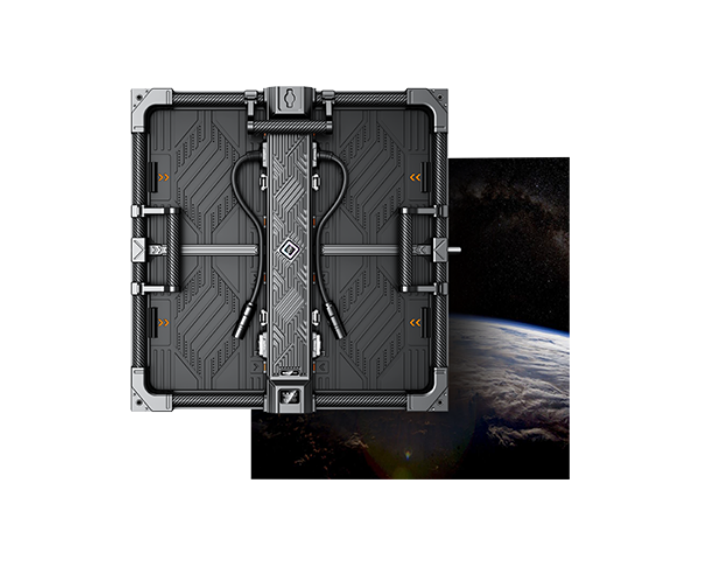
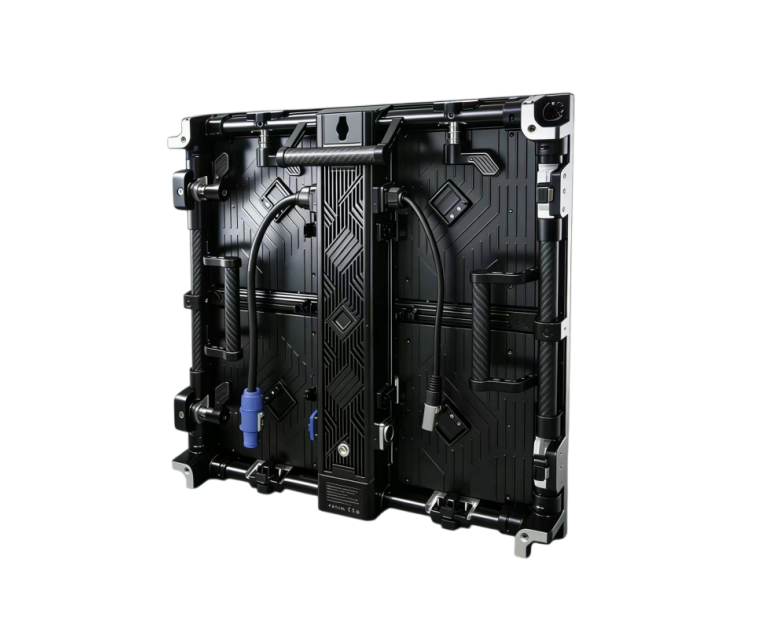
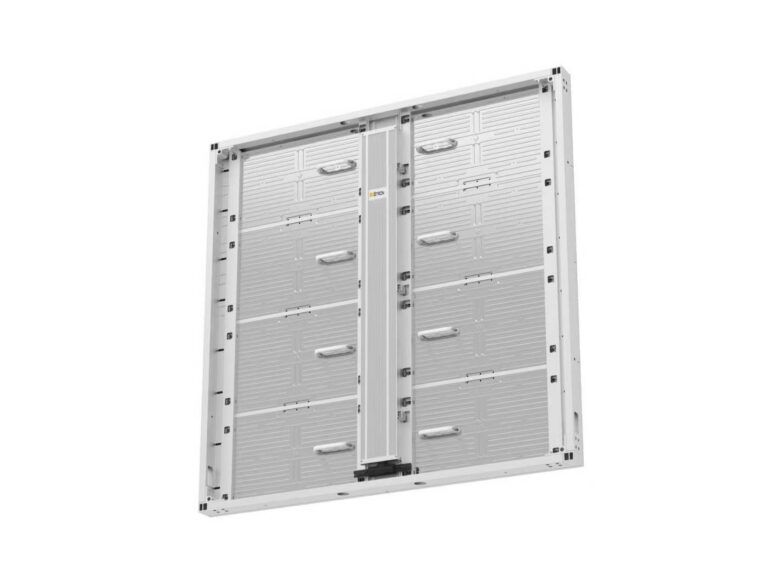
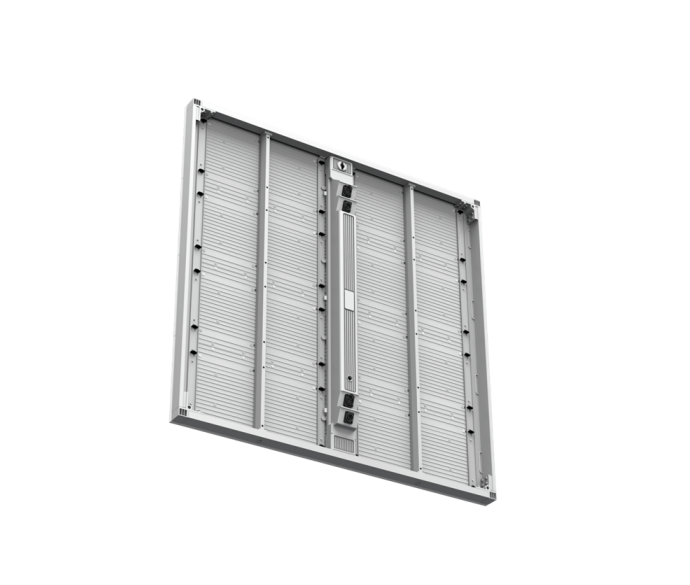
Quick Reference: Core Specifications at a Glance
| Parameter | Typical Range | B2B Decision Factor |
|---|---|---|
| Light Transmittance Rate | 60%–90% | Daylighting compliance, occupant comfort |
| Pixel Pitch | P2.8–P15.6 | Viewing distance vs. resolution trade-off |
| Peak Brightness (Nits) | 1,000–6,000 cd/m² | Indoor retail vs. street-facing glass facade |
| Panel Weight | 8–14 kg/m² | Structural load on glass curtain wall system |
| PCB Strip Width | 2–5 mm | Visual obtrusion when screen is powered off |
| Operating Temperature | -20°C to +60°C | Outdoor IP65-rated architectural installations |
What Is a Transparent LED Screen—And Why Architects, Integrators & DOOH Operators Are Specifying It in 2026
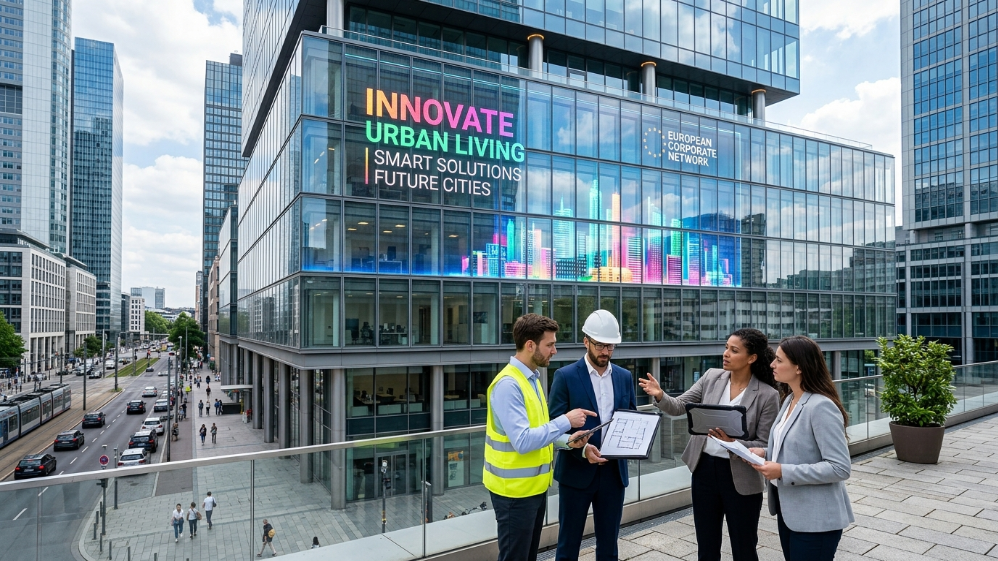
Here is the direct answer system integrators need before issuing any RFQ: a transparent LED screen is an open-grid LED display where individual SMD or COB chip packages are mounted on ultra-thin PCB strips, with the inter-strip gaps engineered to let ambient light pass through the panel plane. The result is a display that achieves 60%–90% light transmittance rate while simultaneously delivering vivid, high-brightness content. When powered off, the screen is effectively invisible against a glass curtain wall. When active, content appears to float on the glass—an effect that no opaque display technology can replicate.
That distinction matters commercially. Architects specifying Class-A office towers have LEED daylighting credits to protect. Retail flagship directors cannot afford to black out a storefront window. DOOH operators deploying glass wall LED displays on premium urban facades face landlord restrictions on structural modification. All three buyer profiles are, at root, solving the same problem: how do we deliver high-impact dynamic media without compromising the architectural and regulatory integrity of the space?
The market has voted on this question with capital. According to Mordor Intelligence’s 2024 report, the global transparent LED display market reached USD 1.87 billion and is projected to compound at 27.3% annually through 2030. Based on our analysis of procurement patterns across 70+ countries, the fastest-growing specification category is not retail window LED signs—it is architectural-scale glass facade integration on commercial real estate assets, driven by DOOH advertisers monetizing previously inert building surfaces.
How Light Passes Through: The Physics of LED Strip Arrays vs. Film Technology
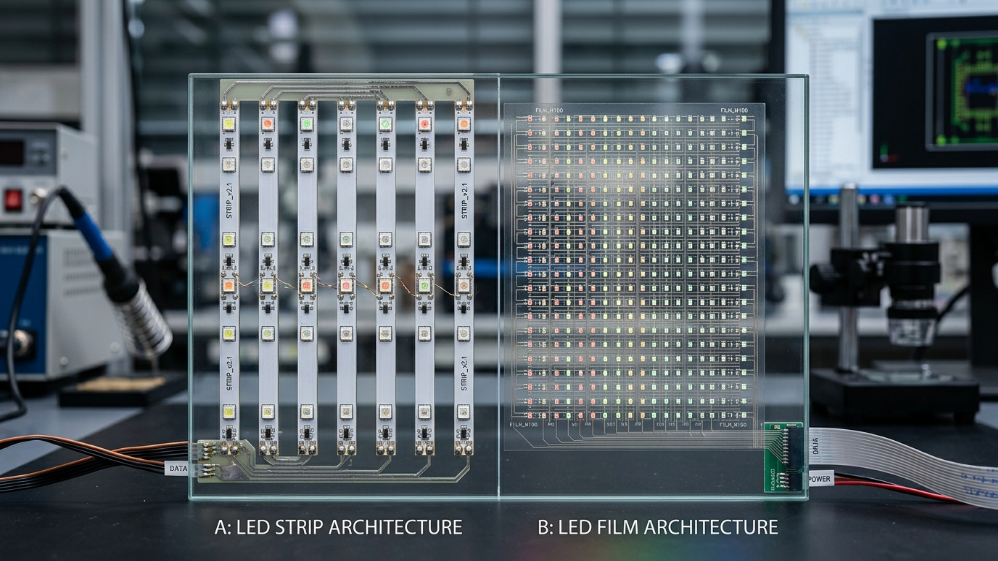
Two distinct hardware architectures dominate the transparent display category, and choosing between them is the first specification decision in any project.
Strip-Array Architecture
The strip-array architecture—used in the vast majority of commercial glass wall LED display installations—mounts LED nodes onto horizontal PCB strips typically 2–5 mm wide. The transparency rate is a simple geometric calculation: gap width divided by total pitch.
A Crystal Series panel at P3.9/7.8 mm configuration, for instance, has a 4.8 mm inter-strip gap within a 7.8 mm vertical pitch, yielding approximately 61.5% transparency. Increase the pitch to P10.4 mm and that figure climbs toward 80%.
The engineering trade-off is unambiguous: more transparency means larger pitch, larger pitch means lower resolution. Every project spec must resolve this tension explicitly.
Film Architecture
The film architecture—sometimes marketed as “LED film” or “transparent LED foil”—laminates micro-LED nodes directly onto a clear polymer substrate with silver nanowire or copper-mesh conductors.
Film products can approach 90% transparency and offer near-zero visual obstruction when inactive. The penalty is cost (approximately 2.5–3× the per-square-meter price of strip panels), lower peak brightness (typically capped at 1,500–2,500 nits), and significantly shorter operational lifespan under direct UV exposure.
Film is the correct choice for interior showcase vitrines, museum installations, and short-term activations. For permanent exterior glass facade deployments, strip-array panels remain the engineering standard.
Transparent LED vs. Traditional LED vs. LCD: Side-by-Side Specification Comparison
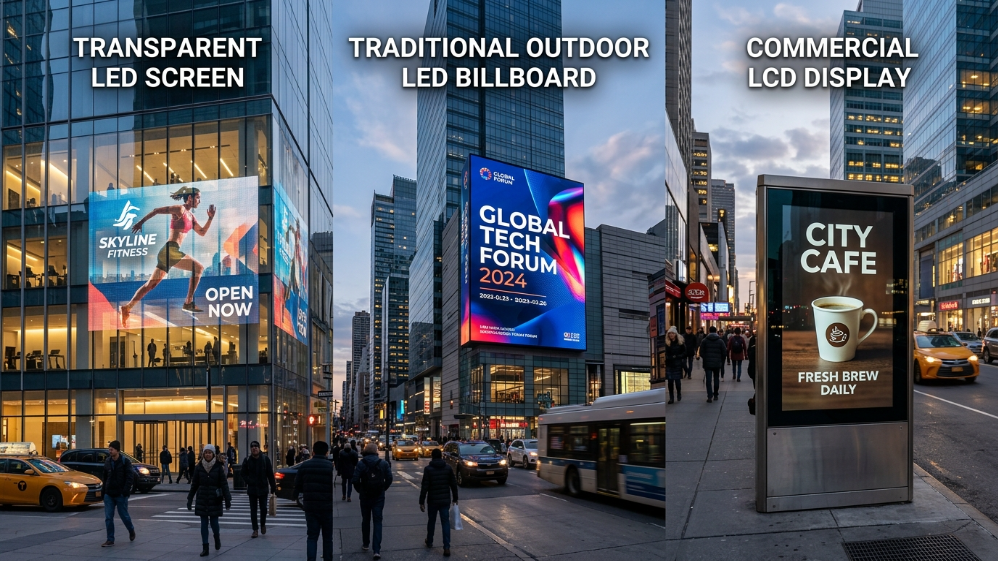
| Specification | Transparent LED Screen | Traditional LED Cabinet | Commercial LCD |
|---|---|---|---|
| Light Transmittance | 60%–90% | 0% (fully opaque) | 0% (fully opaque) |
| Panel Weight | 8–14 kg/m² | 28–45 kg/m² | 20–35 kg/m² |
| Installation Method | Glass-mounted/suspended | Steel structure required | Wall-mount frame |
| Peak Brightness | 1,000–6,000 nits | 3,000–10,000 nits | 500–2,500 nits |
| Structural Modification | None required | Secondary steel frame | Wall reinforcement |
| Viewing Angle | 140°–160° | 120°–140° | 90°–120° |
| Best Application | Glass facades, retail windows, atriums | Outdoor billboards, stadiums | Conference rooms, showrooms |
| 5-Year TCO (per m²) | Medium | High (structural cost) | Medium-Low |
The Specification Matrix Every B2B Buyer Must Master Before Issuing an RFQ
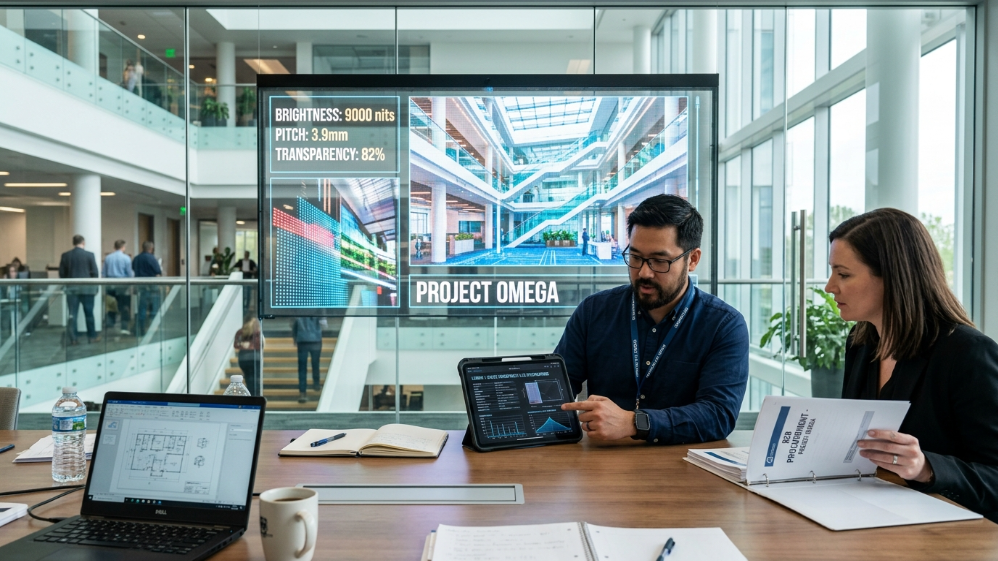
The single most common project failure mode we observe—and we have delivered across 6,000+ global LED installations—is a mismatch between the transparency rate specified on a purchase order and the transparency rate the end client actually needs for their space.
These are engineering parameters, not marketing claims.
Getting them wrong after installation means a return, a retrofit, or worse: a client relationship that doesn’t survive the project.
Light Transmittance Rate (60%–90%): Choosing the Right Value for Your Project’s Daylighting Requirements
60%–70% Transmittance
Sixty percent and ninety percent transparency are not interchangeable specifications. They represent fundamentally different use cases.
60%–70% transmittance is appropriate for street-level window LED signs in retail environments where the primary goal is content impact and viewing distance is 5–15 meters.
At this range, the PCB strip structure is virtually invisible from the pavement. The denser LED node spacing enables pixel pitches as tight as P2.8, which is essential for displaying fine text, product photography, and brand identity graphics at close range.
The trade-off: occupants inside a flagship store will be aware of the screen’s presence even when it is powered off.
75%–85% Transmittance
75%–85% transmittance—the commercial sweet spot, represented by configurations like P3.9/7.8—balances content quality with architectural integration.
This is the specification range governing the majority of permanent glass wall LED display installations in high-street retail and Class-B commercial buildings.
Interior occupants retain meaningful visual connection to the exterior environment. LEED reviewers typically accept this range for projects targeting Daylight credit compliance, though individual project certification should always be confirmed with the project’s LEED consultant.
85%–90%+ Transmittance
85%–90%+ transmittance is reserved for projects where the architectural intent is paramount: landmark buildings, museum facades, premium hospitality.
At this transmittance level, you are accepting a coarser pixel pitch (P7.8 and above) and a corresponding reduction in content resolution.
Viable content formats become large-scale motion graphics, brand color fields, and abstract visual patterns—not fine-detail imagery.
For architectural LED media facade deployments on towers designed for long-distance viewing (50+ meters), this is actually the correct and optimal choice.
Pixel Pitch Selection: Matching Resolution to Viewing Distance
The relationship between pixel pitch and minimum viewing distance is deterministic.
The rule of thumb used across the industry—minimum viewing distance in meters equals pixel pitch in millimeters—is a reasonable approximation for typical content.
A P3.9 panel is legible from approximately 4 meters; a P7.8 panel from approximately 8 meters.
The commercial implications are direct.
A luxury boutique deploying a window LED sign visible to shoppers at 2–3 meter sidewalk proximity needs P2.8 or finer.
A DOOH operator monetizing a glass curtain wall panel viewed by pedestrians 10–20 meters away can deploy P7.8 with no perceptible resolution penalty.
A media facade on a high-rise tower visible from street level at 50+ meters is correctly specified at P10.4 or larger—and will achieve 80%+ transparency as a structural consequence of that pitch selection, not despite it.
Glass Wall LED Display Integration: 3 Installation Methods That Preserve Building Structure
This is where the procurement conversation most often stalls.
System integrators can specify the right panel—correct pitch, correct nits, correct IP rating—and still deliver a failed project because the installation method was incompatible with the host building’s structural reality.
Architectural LED is not a product category; it is an integration discipline.
Based on our engineering delivery experience, three installation architectures cover the full spectrum of real-world glass facade scenarios:
Method 1 — Integrated Glass Curtain Wall Mullion Mount
The LED panel’s ultra-slim side-profile aluminum frame clips directly onto the existing mullion system of a unitized curtain wall.
This is structurally the cleanest approach—no drilling into glass, no new penetrations, no structural engineering sign-off typically required beyond the curtain wall manufacturer’s load tables.
The Crystal Series, with its 2 mm PCB strip and ≤50 mm frame depth, is engineered for this installation type.
A 50 mm air gap between panel and glass is maintained to prevent thermal buildup and allow access for cleaning.
Method 2 — Suspended Cable System for Mall Atriums
For multi-story atrium installations where the glass wall LED display needs to hang in free air—department store light wells, hotel lobbies, airport terminals—aircraft-grade high-tensile steel wire suspension provides the structural solution.
Dead loads for a Crystal Series installation run approximately 10–12 kg/m², comfortably within the capacity of standard atrium cable systems designed for decorative elements.
The critical engineering input is not the panel weight but the dynamic load factor under HVAC airflow—specify wind-effect damping in your structural brief.
Method 3 — Floor-Track Freestanding Frame for Retail Windows
For retail tenants in leased premises where the lease prohibits any modification to the building fabric—a near-universal clause in premium mall tenancy agreements—a weighted floor-track system allows a window LED sign to stand independently on the interior sill, with all structural loads transmitted to the floor slab rather than the facade.
Zero drilling. Zero lease conflict. Full removability at tenancy end.
The Solution: Recommended Sostron Products for Glass Facade & Retail Window Applications
Sostron Crystal Series (P2.8/P3.91/P5.2)
The flagship transparent LED screen for permanent commercial installations.
The Crystal Series is built around GOB (Glue-on-Board) optical nano-fill encapsulation technology, which serves two engineering functions simultaneously:
- It protects the SMD2020 LED nodes from moisture ingress without adding visual bulk.
- It preserves up to 75% light transmittance across the P3.91/7.8 configuration.
Peak brightness reaches 5,500 nits, making this one of the few transparent panel systems that remains genuinely readable on south-facing, direct-sunlight-exposed glass without additional daylight-compensation software.
Three mounting architectures are supported natively:
- Glass curtain wall mullion integration
- Suspended cable system
- Floor-track freestanding
This eliminates the need for custom structural fabrication on standard retail and commercial projects.
For DOOH operators requiring scalable large-format coverage and rental flexibility, the Crystal Series also supports modular assembly into contiguous video walls without visible frame intrusion at standard viewing distances above 4 meters.
Sostron Rental Transparent Display (P3.9/P5.2, Rental Configuration)
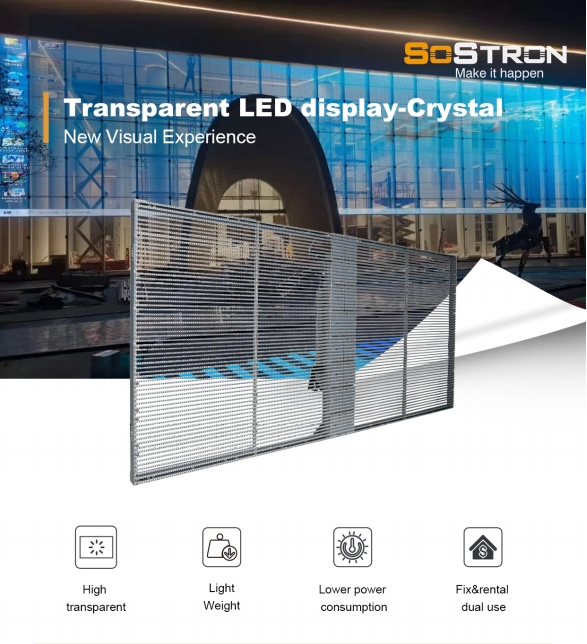
For event companies, pop-up retail activators, and integrators delivering short-cycle DOOH campaigns where capital purchase is not commercially viable.
The rental-configured panels share the same pixel pitch and transmittance specifications as the fixed Crystal Series but are engineered with quick-release magnetic connectors, flight-case compatible panel dimensions, and tool-free strip replacement for rapid turnaround between events.
Real-World Case Study: Oriental Pearl Tower, Shanghai
One of the most technically demanding transparent LED screen integrations in the Asia-Pacific region—and one directly relevant to the architectural LED category—was completed at the Oriental Pearl Tower observation deck in Shanghai.
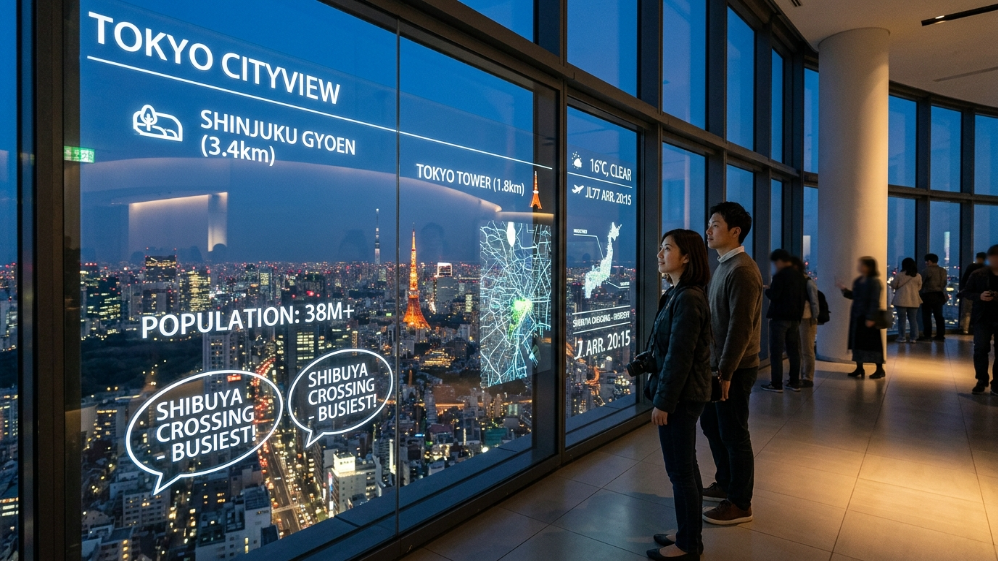
LED transparent screens were installed on the observation deck’s glass viewing platform to overlay contextual information about Shanghai’s historical development and river geography directly onto the view of the Huangpu River.
Project Constraints
- No secondary steel frame permitted
- Light transmittance requirement was non-negotiable
- High-humidity condensation operating environment
- Continuous public-facing operation
Key Engineering Measures
- IP-rated power distribution
- Thermal expansion-compensated mounting brackets
- Black-background content formatting
- Floating visual effect optimization
The installation demonstrated that a correctly specified transparent LED display can coexist with premium architectural glass without functional or aesthetic compromise.
B2B Procurement Qualification: 7 Technical Questions That Separate Serious Suppliers from Spec-Sheet Vendors
Before any RFQ converts to a purchase order, every B2B buyer should demand verifiable answers to these seven questions:
1. What is the measured light transmittance rate at your stated pixel pitch, and can you provide third-party test data?
Manufacturers routinely report transmittance at maximum pitch while selling at minimum pitch.
Require IEC or equivalent certified test reports, not factory datasheets.
2. What is the actual PCB strip width, not the marketed figure?
A 2 mm strip and a 4 mm strip at the same pixel pitch yield dramatically different visual obstruction at close viewing distances.
3. What chip packaging do you use—SMD, COB, or GOB—and what is your IP ingress protection rating for that package?
GOB encapsulation materially improves moisture resistance in condensation-prone environments.
For glass curtain wall systems, this is not optional.
4. What is the refresh rate, and can you demonstrate it at ≥3,840 Hz?
Below this threshold, camera-facing applications produce visible banding in video content.
This matters commercially, not just technically.
5. What thermal expansion compensation is built into the mounting system?
An aluminum LED frame and a building’s structural glazing expand at different rates.
Brackets without sliding-slot connectors will induce mechanical stress on the glass over seasonal temperature cycles.
6. What is the minimum spare parts commitment, and what is your typical module replacement lead time?
Best-practice operators reserve 3%–5% spare LED strips and ICs at time of installation.
A supplier unable to guarantee parts availability within 14 days represents unacceptable operational risk.
7. Do you provide a black-background content creation guide and CMS integration support?
The floating visual effect that defines transparent LED screen performance is almost entirely content-dependent.
Suppliers who deliver hardware without content system guidance are selling half a solution.
Total Cost of Ownership: What the Per-Square-Meter Price Tag Doesn’t Tell You

The most consistent pricing error in transparent LED display procurement is treating the panel cost as the project cost.
Based on 14 years of global delivery data, non-hardware costs—structural engineering review, installation labor, content system setup, customs compliance, and commissioning—typically represent 20%–35% of total project budgets.
5-Year TCO Comparison
| Cost Category | Transparent LED Screen (50m²) | Traditional LED Cabinet (50m²) | Printed Window Graphics (Annual) |
|---|---|---|---|
| Hardware (CapEx) | $55,000–$90,000 | $80,000–$140,000 | $3,000–$8,000/year |
| Structural Engineering | $2,000–$5,000 | $15,000–$35,000 | None |
| Installation Labor | $8,000–$15,000 | $20,000–$40,000 | $1,500–$3,000/year |
| Content Creation (Year 1) | $5,000–$12,000 | $5,000–$12,000 | $2,000–$5,000/year |
| Annual Power Cost (OpEx) | ~$1,200/year | ~$2,800/year | N/A |
| Maintenance / Spare Parts | $1,500–$3,000/year | $3,000–$6,000/year | Replace annually |
| 5-Year TCO Estimate | $83,000–$145,000 | $165,000–$290,000 | $43,000–$80,000 |
| Daylighting Preserved? | ✅ Yes | ❌ No | ✅ Yes |
| Dynamic Content Capable? | ✅ Yes | ✅ Yes | ❌ No |
The structural cost differential between transparent and traditional LED is where the ROI case is won or lost.
A conventional cabinet display on a glass facade requires a secondary steel support structure that can add $15,000–$35,000 in fabrication and installation alone—before a single panel is mounted.
For retrofit projects on existing buildings, this cost often triggers a building permit review cycle that adds 6–12 weeks to the project timeline.
A transparent LED screen, at ≤12 kg/m² and mounting directly to existing curtain wall mullions or glass, sidesteps this entirely.
5 Technical Questions B2B Buyers Ask Most—Answered Precisely
Q1: What is the maximum transparency rate achievable in a commercial transparent LED screen?
The practical ceiling for strip-array transparent LED panels in commercial deployment is 85%–88%, achieved at pixel pitches of P10.4 mm and above.
Film-architecture products can approach 90%–92% under controlled indoor conditions.
Stated figures above 90% in strip-array products should be treated with skepticism.
Q2: Can a transparent LED screen be installed directly on tempered or laminated safety glass?
Yes, with qualification.
Tempered glass is the preferred substrate for direct-adhesive film installations.
For strip-array panel systems using frame-mount or clip-mount methods, the glass specification matters less than the curtain wall system it is part of.
Q3: What brightness level does a transparent LED window sign need to be visible in direct sunlight?
South-facing glass in full sun at midday creates an ambient illuminance condition of approximately 100,000 lux at the glass surface.
To achieve a perceived contrast ratio sufficient for content legibility under these conditions, a minimum of 5,000 nits peak luminance is required.
Automatic ambient light sensors that modulate brightness dynamically between 30% and 100% of peak output are strongly recommended.
Q4: How does pixel pitch affect the transparency rate of a glass wall LED display?
The relationship is direct and calculable.
Transparency rate = (total gap area) ÷ (total panel area).
As pixel pitch decreases, the PCB strip occupies a higher proportion of total panel area, reducing transparency.
A P3.9/7.8 mm panel achieves approximately 75% transparency.
The same panel configuration at P2.8/5.6 mm drops to approximately 65%.
Q5: What is the operational lifespan of a transparent LED screen in a permanent glass facade installation?
A conservatively specified strip-array transparent LED panel, operated at 50%–70% average brightness with proper thermal management, will achieve 50,000–60,000 hours of operational life before luminance decays to 70% of initial output (L70 standard).
At 18 hours per day of operation, that is approximately 7–9 years before the first refurbishment cycle.
GOB-encapsulated products in high-humidity environments consistently outperform standard SMD configurations on lifespan by 25%–35%.
Expert Verdict
Transparent LED screen technology is no longer an emerging category—it is a mature, deployable solution with a clear specification language, proven installation methods, and a TCO model that consistently outperforms conventional LED cabinets on any glass-bearing facade project.
The remaining procurement risk is not technical; it is supplier qualification.
Specify your transmittance rate before you specify your pixel pitch.
Demand certified test data, not factory spec sheets.
Budget 25%–30% above the hardware cost for installation and engineering.
And if a supplier quotes you 90%+ transparency on a P3.9 strip-array panel without caveat, that number alone tells you everything you need to know about how they will handle every other specification in your project.
The glass on your building is already paid for.
The question is whether it is working for you.
References:
University of Central Florida – Micro‑LED Technology Report
National Academies Press – Display Technology Overview