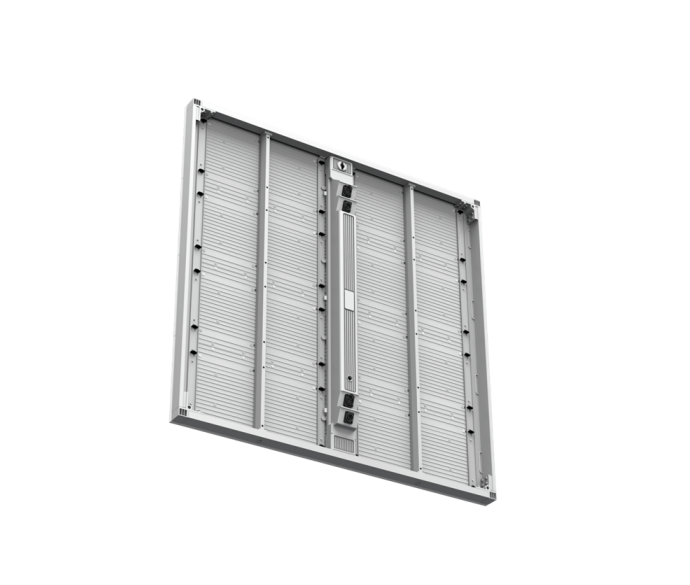
Every day, your delivery fleet covers hundreds of kilometers through dense urban neighborhoods—and earns you exactly zero advertising revenue doing it. A delivery box LED screen changes that equation permanently. The table below is your 60-second executive summary:
| Key Spec | Minimum Viable Threshold | Why It Matters for B2B Buyers |
| Brightness | 4,500+ nits | Readable under direct equatorial sunlight without glare |
| Ingress Protection | IP65 or above | Survives daily rain, road dust, and vibration shock |
| Pixel Pitch | P3–P5 | Optimal legibility at 3–8 m street-level viewing distance |
| Battery Draw | ≤80W per unit | Runs 8+ hours without impacting motorcycle range |
| Connectivity | 4G SIM + Wi-Fi + GPS | Remote content sync and geo-triggered ad delivery |
| Display Sides | 3-sided (front + 2 lateral) | 270° visibility to pedestrians, trailing drivers, and cross-traffic |
Bottom line: a 20-bike food delivery fleet equipped with 3-sided scooter LED signs can generate an estimated $3,000–$8,000/month in third-party ad revenue—enough to recover hardware costs within 4–6 months. The math is compelling. The technology is mature. What most buyers get wrong is the specification.
What Is a Delivery Box LED Screen—and Why Is Every Smart Fleet Adding One?
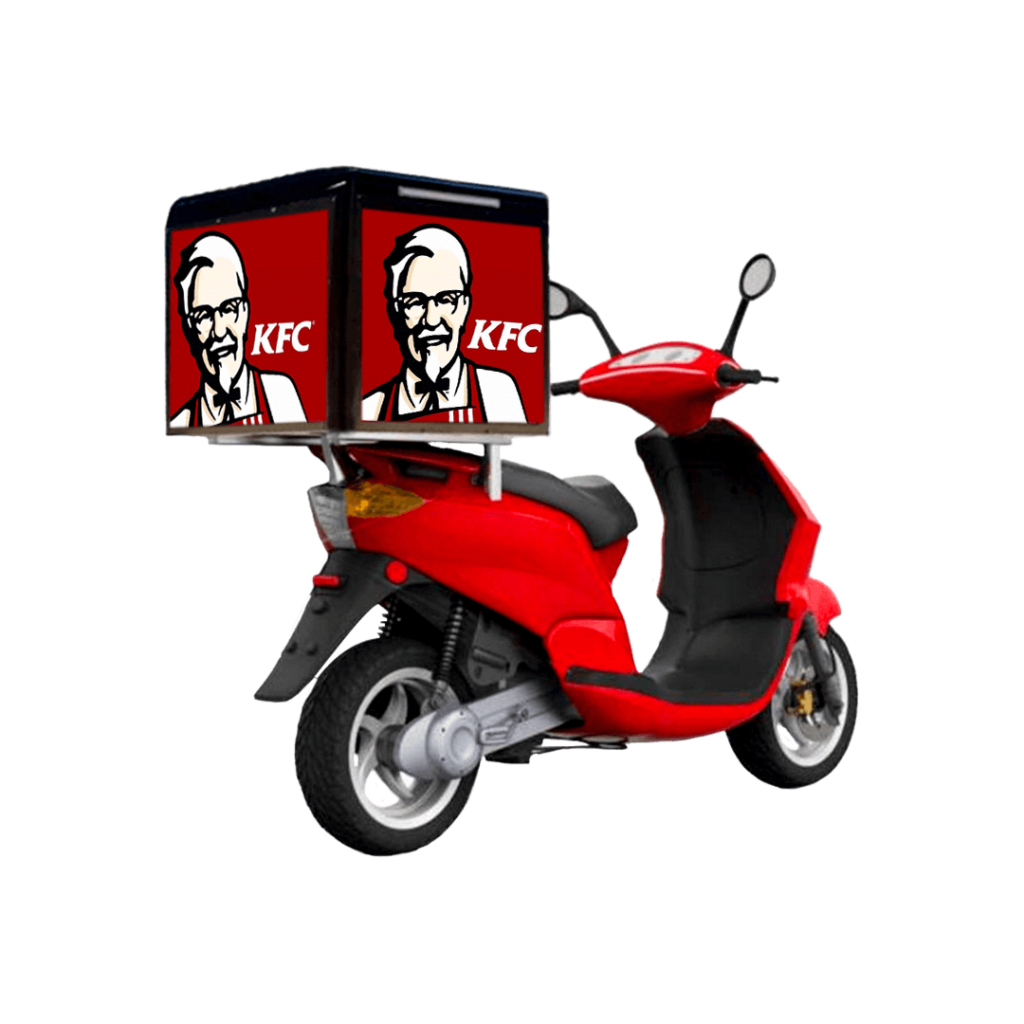
A delivery box LED screen is a three-sided digital display system mounted directly onto the top or rear face of a food delivery or logistics box carried on a scooter, e-bike, or motorcycle. Unlike vinyl wraps or magnetic panels, it plays dynamic video and animated content while the rider is already in motion—turning a cost-center journey into a paid media impression.
The format typically consists of one rear-facing LED panel and two angled side panels. That geometry is deliberate. Three display faces create simultaneous visibility to pedestrians on pavements, drivers trailing behind, and people approaching from cross-streets—all without the rider doing anything differently.
Content is managed remotely via a cloud CMS, pushing new creatives over 4G or Wi-Fi to every unit in the fleet simultaneously. No recalling vehicles to base. No USB sticks. No manual updates per bike.
Based on our deployment experience across Southeast Asia and Latin America, the buyers who get the best results treat the screen not as a hardware purchase but as a media infrastructure decision. Fleet managers who approach it that way recover their investment in under six months. Those who chase the cheapest unit on spec sheets alone typically spend more on replacements within the first year.
How a 3-Side LED Display Turns Every Delivery Trip Into a Paid Media Impression
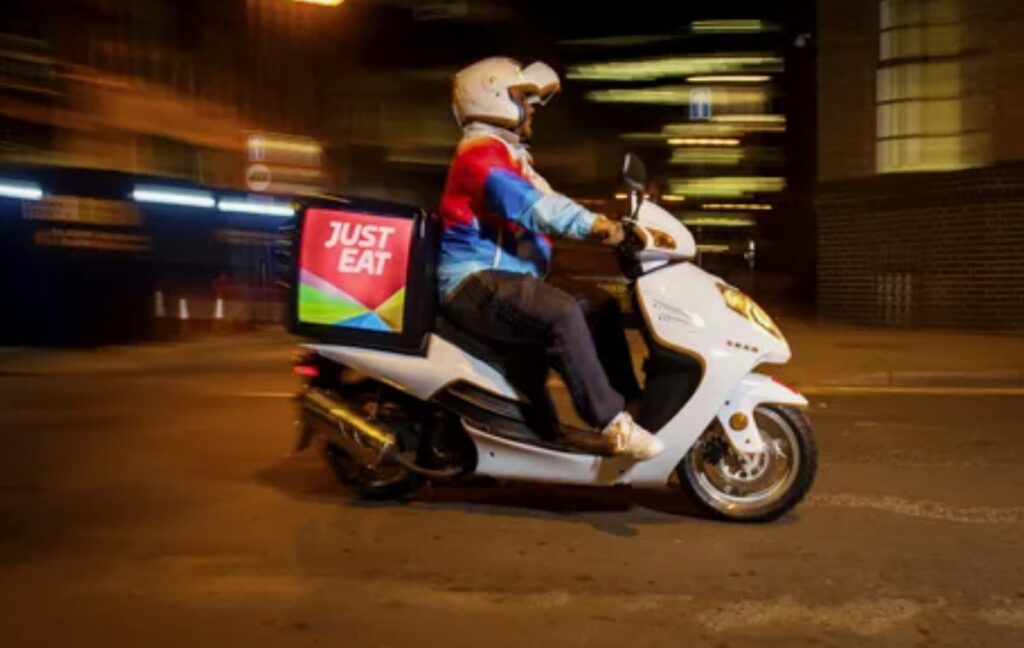
Here’s the unit economics that make this format impossible to ignore for franchise operators and OOH media planners alike.
A typical urban food delivery rider covers 80–120 km per day through high-density commercial and residential zones. At average traffic speeds of 20–35 km/h, that equates to roughly 3–5 hours of active street exposure per shift. Industry benchmarks place mobile LED billboard CPM (cost per thousand impressions) at $2–$6, compared to $15–$40 for static outdoor boards in equivalent locations.
The 3-sided format amplifies this further. Unlike a car top LED display that faces forward and backward only, a delivery box design with angled lateral panels at 45°–60° captures pedestrian sightlines on both sides of the street simultaneously. In dense urban corridors—think restaurant delivery zones, shopping districts, transit hubs—effective impression counts can reach 8,000–15,000 views per vehicle per day.
That is not a theoretical number. It is a conservative estimate based on foot traffic density data from comparable mobile OOH formats in markets like Bangkok, Jakarta, and Mexico City, where this product category has already proven its commercial model.
Delivery Box vs. Car Top LED Display vs. Scooter LED Sign: Which Format Fits Your Use Case?
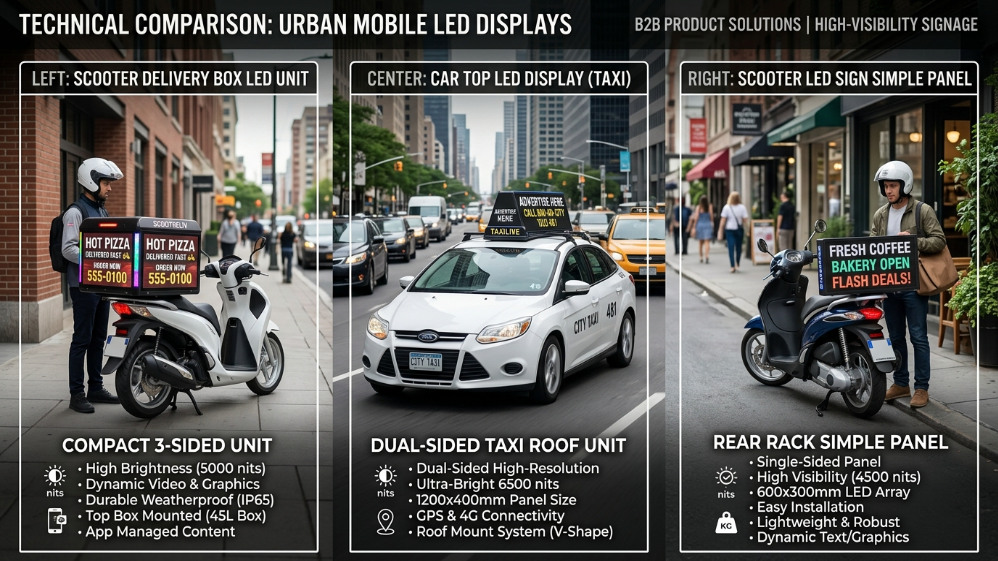
Buyers frequently conflate three distinct product formats. Choosing the wrong one is a costly mistake that no amount of good CMS software will fix.
| Format | Vehicle Type | Display Area | Viewing Distance | Best Use Case |
| Delivery Box LED Screen | Scooter/E-bike/Moped | 3 sides × ~384×348 mm | 2–6 meters | Food delivery fleet brand + 3rd party local ads |
| Car Top LED Display | Taxi/Rideshare/Patrol Car | 2 sides × 600–900 mm wide | 5–15 meters | High-traffic arterial road brand campaigns |
| Scooter LED Sign (standalone) | Any two-wheeler | 1–3 sides, compact | 3–8 meters | Event marketing, pop-up promotion, rental fleets |
| Van/Truck Mobile LED Billboard | Logistics van/delivery truck | 1–3 sides, large format | 10–30 meters | City-wide brand awareness, concert/event tours |
The delivery box format wins on density and proximity. It operates in exactly the same neighborhoods where your target customers live, work, and order food—residential streets, business parks, campus zones—rather than on arterials where a car top LED display gets faster eyeballs but less precise targeting.
For logistics and last-mile fleet operators running city-wide distribution, a mobile LED advertising screen on the vehicle roof panel (car top format) extends visibility range and suits higher-speed corridors. Both formats are frequently combined within a single fleet deployment strategy.
The 4 Real-World Scenarios Where Mobile LED Advertising Screens Deliver Maximum ROI
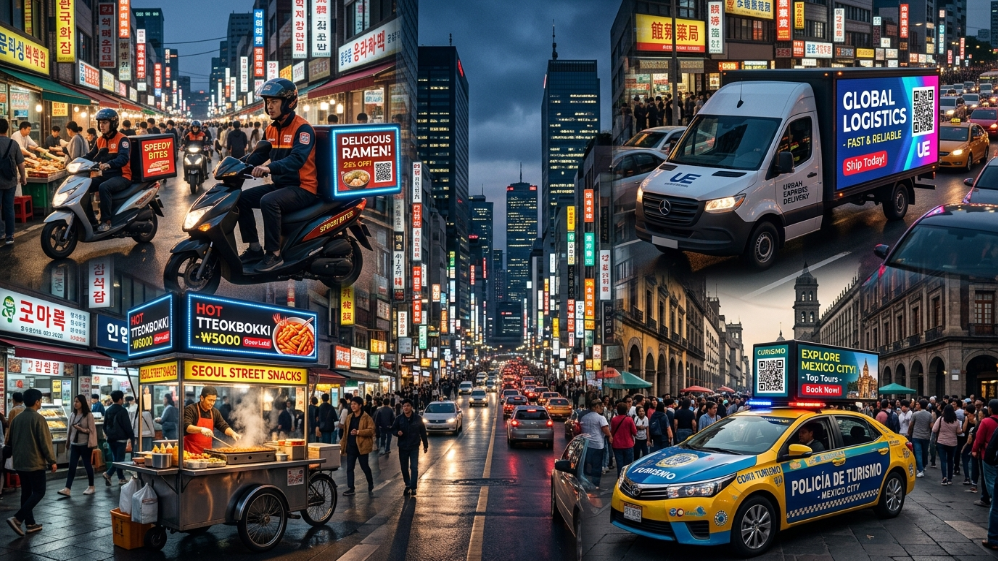
Not every scooter LED sign deployment performs equally. ROI depends heavily on matching the format to the operational context. Based on our project data from over 3,000 completed installations across 100+ countries, four scenarios consistently outperform all others.
1. Food Delivery Fleets (QSR & Third-Party Platform Model)
This is the highest-volume use case globally. Operators running fleets for McDonald’s, KFC, or platform-aggregated riders (Grab, Foodpanda, Deliveroo) gain a dual revenue model: the delivery fee stays intact, and the LED screen generates incremental ad income from local restaurants, retail brands, or QSR promotional campaigns.
Key operational advantage: delivery routes are already optimized for density. GPS geofencing can automatically switch ad content when a rider enters a high-footfall zone—showing a coffee promotion near a morning commuter hub, then switching to a lunch deal creative at midday in a business district. This is programmatic OOH at scooter scale, and it works.
2. Urban Logistics & Last-Mile Courier Vans
For courier operators (DHL, J&T, local last-mile players), a car top LED display or van-mounted mobile LED advertising screen unlocks advertising revenue on routes that were previously pure cost. The key differentiator here is cluster management: a fleet of 50 vans covering a city can be divided into geo-zones, with each zone displaying locally relevant brand content—all managed from a single web dashboard via 4G.
3. Mobile F&B Vendors & Market Traders
Coffee tricycles, food trucks, and market vendors occupy high-footfall locations but lack the budget for static billboard placements. A compact scooter LED sign mounted above their vehicle converts every stationary trading period into an active advertising surface visible from 30–40 meters. Because the unit is self-contained and battery-powered, no venue power connection is needed.
4. Scenic Area Patrol & Tourism Vehicles
Resort operators, theme parks, and municipal tourism bureaus are increasingly deploying patrol vehicles with 3-sided delivery box LED screens to broadcast real-time wayfinding information, event schedules, and sponsor content. The GPS module enables automatic content switching by zone—showing restaurant promotions near dining areas and activity schedules near attraction entrances, without manual intervention.
Our Solution: Recommended SoStron Products for Mobile LED Advertising Deployments
After analyzing the SoStron product range, two product lines stand out as the strongest fit for delivery fleet and mobile advertising scenarios.
① SoStron Delivery Box—3-Sided LED Display
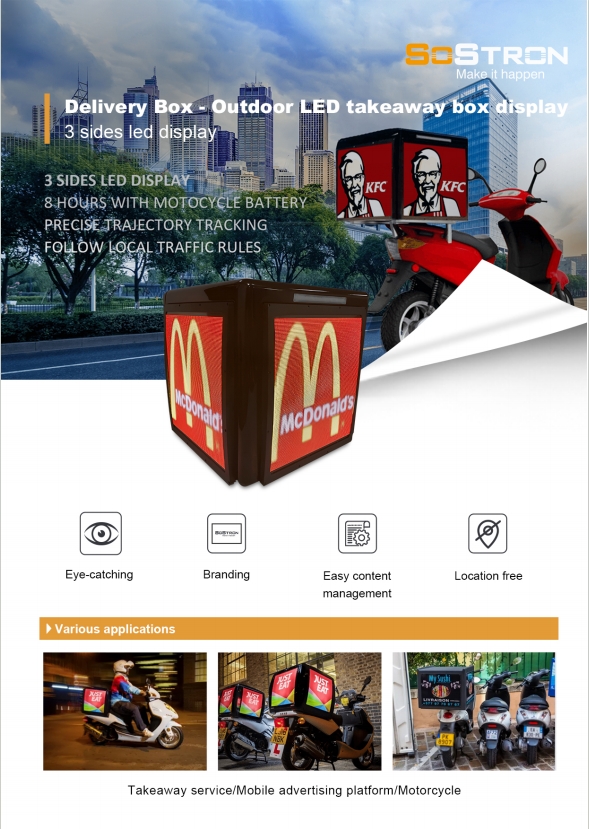
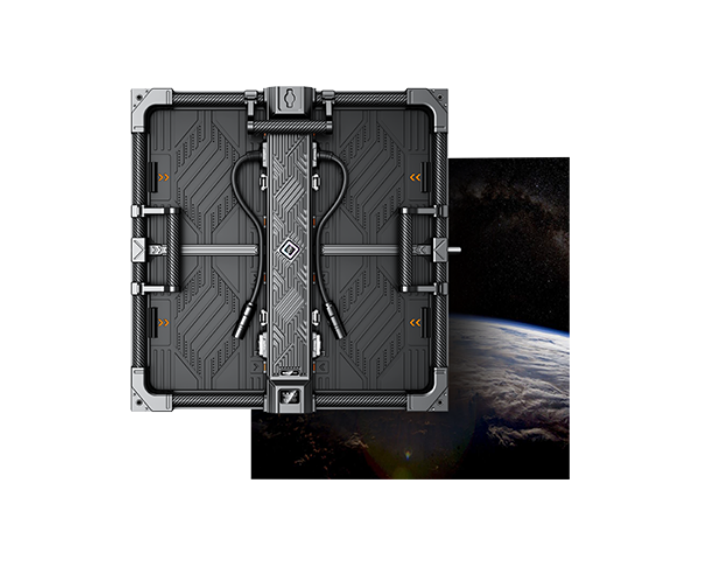
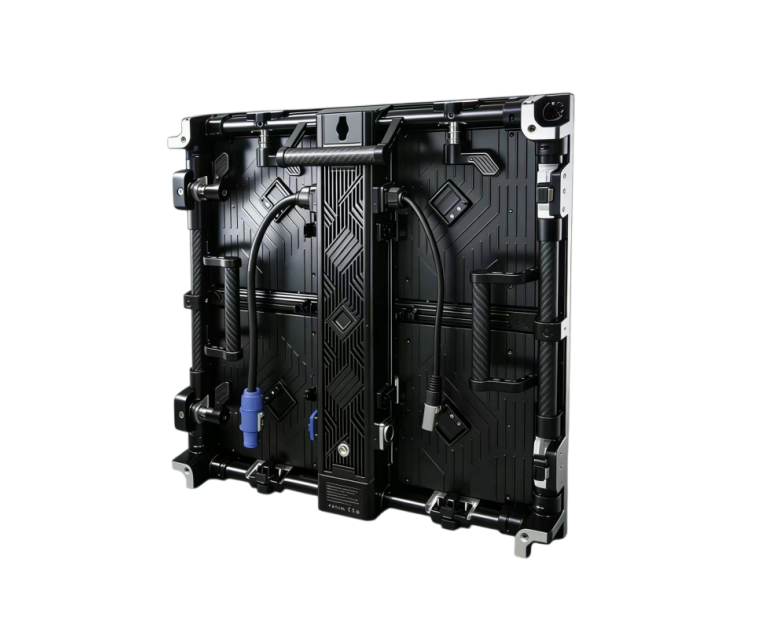
Built specifically for the food delivery use case, this unit mounts directly to a standard 500×500×500 mm delivery box with a 384×348 mm active display area per face. It runs up to 8 hours on a standard motorcycle battery, draws under 80W total across all three panels, and ships with a GPS module and 4G SIM slot pre-integrated. Pixel pitch P3–P5 options are available depending on whether the buyer prioritizes resolution or budget. IP65 housing is standard. The unit is plug-and-play with no third-party inverter or external battery pack required—a critical detail that non-specialists overlook when comparing supplier quotes.
Real-World Case Study: Mexico Mobile Advertising Truck Fleet
The closest comparable deployment in SoStron’s documented project history is the Mexican Advertising Truck Project—a fleet of outdoor advertising vehicles equipped with SoStron’s rental-grade LED panels in a lifting-frame configuration designed for street-level OOH campaigns.
Key project specifications:
-
Location: Mexico (urban commercial zones)
-
Display type: Outdoor waterproof rental screen, IP65+
-
Design feature: Adjustable lifting frame for variable height visibility
-
Performance: High brightness panels maintaining clear visibility under direct Latin American sunlight; color saturation preserved without post-installation calibration
The commercial logic of the Mexico deployment mirrors the delivery fleet model almost exactly: mobile routes + high-density urban exposure + remote content management = a media network that scales without proportional cost increases. The Mexico operator reported that the ability to update campaign creatives remotely—without returning vehicles to a depot—was the single most operationally valuable feature of the deployment.
The delivery box format takes this logic further by shrinking the hardware to scooter scale, reducing both capital expenditure and operational overhead while maintaining the same programmatic content management capability.
Outdoor Survival Specs: What Every B2B Buyer Must Verify Before Ordering
The Mexico case highlights something no spec sheet will tell you directly: a unit that performs in Latin American summer heat and monsoon-season Southeast Asia is a fundamentally different engineering object from one that merely claims outdoor compliance.
Here is how to read the numbers correctly.
Brightness: 4,500 nits is the floor, not the ceiling. Most manufacturers advertise peak brightness under laboratory conditions. Real-world performance on a sun-facing panel at 2 PM drops 15–25% from that figure due to thermal throttling. For a delivery box LED screen operating in tropical or subtropical markets, specify 5,000–6,000 nits nominal to guarantee 4,500 nits sustained. Anti-glare surface coating is equally non-negotiable—without it, specular reflection from direct sun creates a washed-out panel that pedestrians actively look away from.
IP65 vs. IP66: the difference matters for scooters. IP65 certifies protection against low-pressure water jets from any direction—adequate for rain. IP66 adds resistance to powerful direct water jets, which matters if your maintenance protocol involves pressure-washing the delivery box. For scooter-mounted units in cities with heavy monsoon seasons or road-spray from trucks, IP66 is worth the marginal premium.
Pixel pitch and the viewing distance equation. There is a simple engineering rule: multiply the pixel pitch (in mm) by 1,000 to get the minimum comfortable viewing distance in mm, or roughly 1 meter per 1 mm of pitch. P4 = comfortable from 4 meters. P5 = comfortable from 5 meters. For a scooter LED sign that will be viewed primarily by pedestrians at 2–4 meters, P3 or P4 is the correct specification. P5 is acceptable for car top LED display formats viewed by trailing drivers at 6–10 meters. Anything coarser than P6 on a delivery box is a visible degradation that undermines brand perception.
Battery Life & Power Draw: The Question Every Fleet Manager Asks First
This is the specification that kills deals when it’s wrong—and closes them when it’s right.
A standard 125cc–150cc motorcycle carries a 12V, 9–12Ah battery rated for roughly 108–144 watt-hours of usable capacity. A well-engineered delivery box LED screen running all three panels simultaneously draws 60–80W at full brightness. At that draw rate, the screen consumes the entire motorcycle battery’s capacity in under 2 hours if run in isolation—which is why every serious unit in this category ships with auto-brightness sensors and power management firmware, not just a high-brightness rating.
In practice, the math is less alarming than it sounds:
-
Auto-brightness reduction at night cuts draw to 20–35W
-
The motorcycle alternator continuously recharges the battery while the engine runs
-
Net additional load on a running motorcycle: approximately 15–30W sustained—equivalent to adding one extra headlight
Based on field data from fleet deployments we’ve supported in Bangkok and Jakarta, a correctly specified unit with auto-dimming enabled shows zero measurable impact on delivery range for motorcycles with engines 125cc and above. The problem only emerges with underpowered e-bikes (under 48V/20Ah battery), where a separate auxiliary battery pack is recommended.
Remote Fleet Control: 4G+GPS Cluster Management in Practice
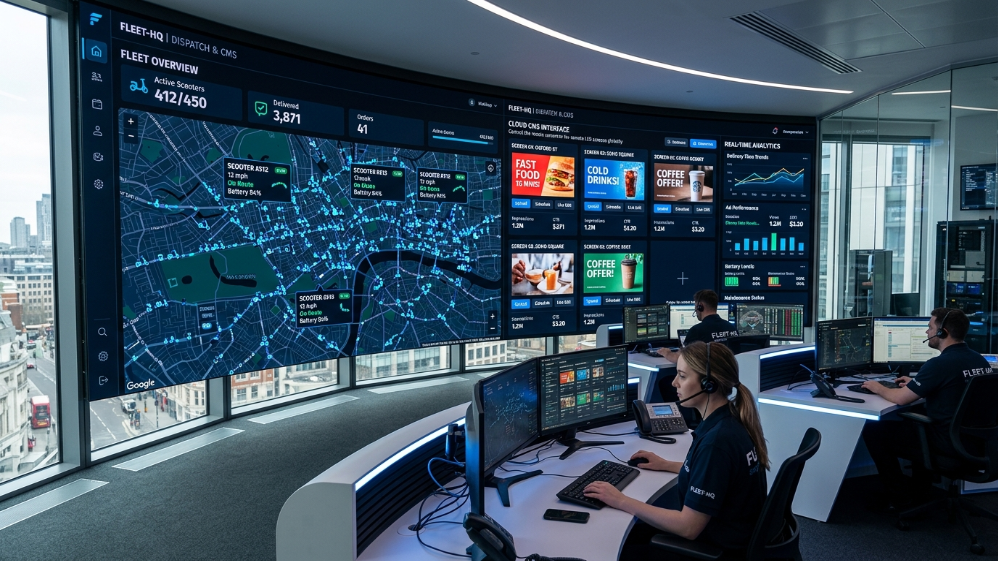
The 4G/GPS combination is where a mobile LED advertising screen graduates from a hardware product to a media operations platform. Here is how it works operationally:
Content is uploaded to a cloud CMS dashboard via browser or mobile app. Campaigns are scheduled by time window, vehicle group, or GPS zone. When a rider enters a defined geofence—say, a 500-meter radius around a shopping mall—the unit automatically switches to that client’s creative. Exit the zone, revert to the default playlist. No rider involvement. No manual override needed.
For franchise operators managing brand compliance across a distributed fleet, this also solves a persistent headache: ensuring that every unit in 50 cities is showing approved creative, at the correct brightness, on the correct schedule. Cluster control via 4G means a single operator can push a brand update to 200 units simultaneously in under 90 seconds.
GPS trajectory tracking adds a layer of campaign reporting that static billboards simply cannot match: verified route logs, zone dwell time, impression estimation by area. For clients paying for hyperlocal ad placement, this is auditable proof of delivery.
5 Critical Questions B2B Buyers Ask Before Purchasing
Q1: Will the LED screen affect my vehicle’s road legality or insurance coverage?
It depends on jurisdiction. In most markets, a rear-mounted commercial display on a delivery vehicle is treated as a modified commercial fixture and requires disclosure to your fleet insurer. Some markets (notably parts of the EU and certain Southeast Asian cities) also require that dynamic advertising displays meet local traffic authority approval for use on moving vehicles. Confirm with your local transport authority before fleet-wide rollout. A supplier who doesn’t raise this question proactively is a supplier you should pressure-test further.
Q2: What is the real lifespan of a delivery box LED screen in daily use?
LED modules themselves are rated for 100,000 hours—roughly 11 years of continuous operation. In a delivery fleet context, the practical limiting factor is mechanical stress from road vibration, not the LEDs themselves. Die-cast aluminum cabinets with shock-absorbing mounting brackets extend field life significantly. Expect 3–5 years of reliable operation with quarterly inspection on units that lack vibration dampening; 5–7 years on properly mounted, IP65-rated units with aluminum enclosures.
Q3: Can I run competitor brand ads on my own delivery fleet?
Yes, and many operators do exactly this. The CMS allows multi-client campaign scheduling, so a fleet operator running their own brand can simultaneously monetize empty time slots by selling 30-second rotations to local businesses. Some operators in Southeast Asia have structured this as a standalone media business, using the delivery fleet purely as the infrastructure vehicle.
Q4: What pixel pitch should I specify for a food delivery scooter box?
P3 or P4 for street-level pedestrian viewing. P5 is the acceptable minimum if budget is a hard constraint. Do not accept P6 or coarser on a delivery box format—the degradation is visible at normal interaction distance and reflects poorly on the brands being advertised.
Q5: How long does fleet installation take at scale?
A single unit installation on a standard delivery box takes 45–90 minutes with basic mechanical tools. For a fleet rollout of 50+ units, experienced installers working in pairs can complete 8–12 units per day. Factor installation logistics—rider briefing, CMS account provisioning, GPS calibration—into your project timeline. SoStron’s fleet deployment support covers pre-installation technical documentation and remote CMS onboarding as standard.
Expert Verdict
The delivery box LED screen is the most capital-efficient mobile advertising format available to food delivery operators, logistics fleets, and OOH media companies right now. The technology is proven, the CPM economics are favorable against every comparable out-of-home format, and the 4G/GPS remote management layer eliminates the operational friction that held back earlier generations of the product.
Specify correctly—4,500+ nits sustained, IP65 minimum, P3–P4 pixel pitch, auto-brightness firmware, confirmed GPS geofencing capability—and the hardware will earn back its cost before the first warranty period expires. Underspec on brightness or protection rating to save 15% on unit cost, and you will spend that saving twice over on replacements in year one.
If you are evaluating suppliers, the right conversation starter is not “what is your price per unit?” It is: “Show me real fleet deployment data from a climate comparable to mine.” The suppliers who can answer that question are the ones worth talking to.
Price Summary
Price Reminder for B2B Buyers: Delivery Box LED Screen pricing varies significantly depending on pixel pitch (P3/P4/P5), brightness level (4,500–6,000 nits), GPS & 4G integration, battery management system, cabinet material, and order quantity. While lower-priced units may appear attractive initially, insufficient brightness, weak waterproof protection, or poor vibration resistance often result in higher maintenance and replacement costs. For fleet deployments, buyers should evaluate the total cost of ownership (TCO), including hardware lifespan, CMS software, installation, maintenance, and advertising revenue potential, rather than focusing solely on the initial purchase price.
References:
Digital Signage Federation – Best Practices and Industry Standards
Society for Information Display – Display Technology Resources