With years of experience creating technical content for commercial LED display solutions, Dylan focuses on helping global buyers, AV integrators, and engineering companies understand LED technology, project requirements, and supplier selection strategies.
What Is a Gas Station LED Billboard?
A gas station LED billboard is an outdoor digital display system designed for fuel stations, roadside locations, and commercial areas to show fuel prices, promotional advertisements, brand messages, and real-time customer information.
Unlike traditional printed gas station signs, LED billboards allow operators to update content remotely, improve roadside visibility, and generate additional advertising value.
For most gas station projects, the correct solution depends on three factors:
- Viewing distance
- Outdoor environmental conditions
- Required content type
A fuel retailer displaying only gasoline prices may need a dedicated LED price sign, while a large station chain promoting fuel, convenience stores, EV charging, and advertisements may require a full-color outdoor LED billboard.
Gas Station LED Billboard vs LED Gas Price Sign: What Is The Difference?
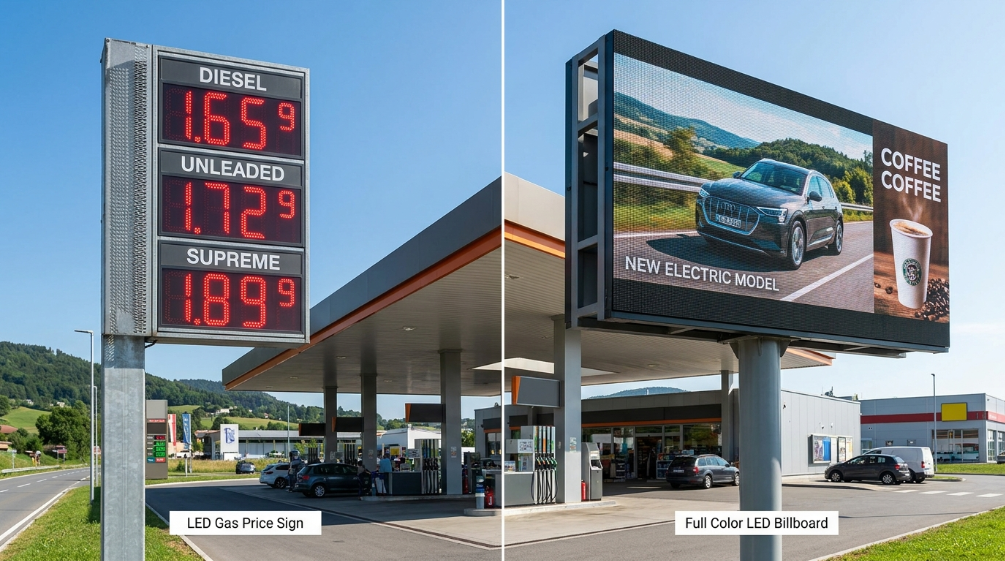
One of the most common purchasing mistakes is treating all gas station LED displays as the same product.
In reality, there are two major categories:
1. LED Gas Price Sign
A gas price sign is mainly designed to display fuel prices.
Typical features:
- Large numerical digits
- Limited content format
- High outdoor visibility
- Simple control system
- Low maintenance requirement
Example:
Regular   $3.59
Premium  $4.19
Diesel    $4.49
These signs are ideal for:
- Independent fuel stations
- Highway fuel stops
- Petroleum retailers focusing mainly on price communication
2. Full-Color Gas Station LED Billboard
A full-color LED billboard works more like a digital advertising platform.
It can display:
- Fuel prices
- Video advertisements
- Brand promotions
- Restaurant offers
- EV charging information
- Seasonal campaigns
Typical applications:
- Large fuel station chains
- Shopping center gas stations
- Highway service stations
- Stations with convenience stores
Comparison: LED Gas Price Sign vs Full-Color LED Billboard
| Comparison | LED Gas Price Sign | Full-Color LED Billboard |
|---|---|---|
| Main Purpose | Fuel price display | Advertising + information |
| Content | Numbers and simple text | Video, images, animations |
| Color | Single or limited colors | Full RGB color |
| Controller | Simple controller | Professional LED sending system |
| Pixel Pitch | Usually larger digit modules | P4-P10 outdoor LED modules |
| Advertising Revenue | Limited | High potential |
| Remote Content Update | Basic | Advanced CMS control |
| Best Users | Small fuel stations | Chains and commercial operators |
How Much Does a Gas Station LED Billboard Cost?

The cost of a gas station LED billboard depends on several components rather than only the LED modules.
A complete project cost usually includes:
Total Cost =
LED Display System
+
Steel Structure
+
Controller System
+
Electrical Installation
+
Transportation
+
Maintenance Solution
Typical Gas Station LED Billboard Price Range
The following prices are industry reference ranges. Actual quotations vary depending on size, specification, country, installation requirements, and supplier.
| Solution Type | Typical Price Range | Suitable Application |
|---|---|---|
| LED Digital Price Sign | $1,000–$10,000+ | Fuel price display |
| Small Outdoor LED Screen | $5,000–$20,000 | Independent stations |
| Medium Full-Color LED Billboard | $15,000–$50,000 | Retail fuel chains |
| Large Highway Gas Station LED Billboard | $50,000+ | Large commercial projects |
Main Factors Affecting Gas Station LED Billboard Price
1. Pixel Pitch
Pixel pitch determines image clarity.
For example:
- P10:
- Suitable for long-distance viewing
- Lower cost
- Common for roadside advertising
- P6:
- Better image quality
- Suitable for medium viewing distance
- P4/P5:
- Higher resolution
- Suitable when customers are closer to the screen
The smaller the pixel pitch, the higher the LED module cost.
2. Brightness Requirement
Gas stations operate outdoors, where direct sunlight can reduce visibility.
Typical recommendations:
| Environment | Recommended Brightness |
|---|---|
| Indoor service area | 800–1,500 nits |
| Semi-outdoor area | 2,500–5,000 nits |
| Direct sunlight roadside | 5,000–10,000 nits |
For outdoor billboard applications, high brightness is essential because insufficient brightness creates washed-out images during daytime operation.
The Ares 2 outdoor LED display series supports brightness levels suitable for outdoor advertising environments, with models reaching up to 7,500 nits depending on configuration.
Technical Specifications Buyers Should Evaluate
A professional gas station LED billboard should not be selected only by screen size.
The following specifications directly influence reliability and operating cost.
Outdoor Gas Station LED Billboard Specification Checklist
| Parameter | Recommended Requirement | Why It Matters |
|---|---|---|
| Pixel Pitch | P4–P10 | Determines viewing distance |
| Brightness | 5,000–10,000 nits | Ensures sunlight visibility |
| Refresh Rate | 1920Hz+ | Reduces camera flicker |
| Protection Rating | IP65 or higher | Protects against rain and dust |
| Operating Temperature | Around -20°C to 50°C typical | Outdoor reliability |
| Cabinet Material | Aluminum preferred | Better heat management |
| Maintenance | Front/rear access | Reduces downtime |
| Control System | NovaStar / Colorlight compatible | Stable operation |
Why Heat Management Matters for Outdoor Gas Station LED Displays
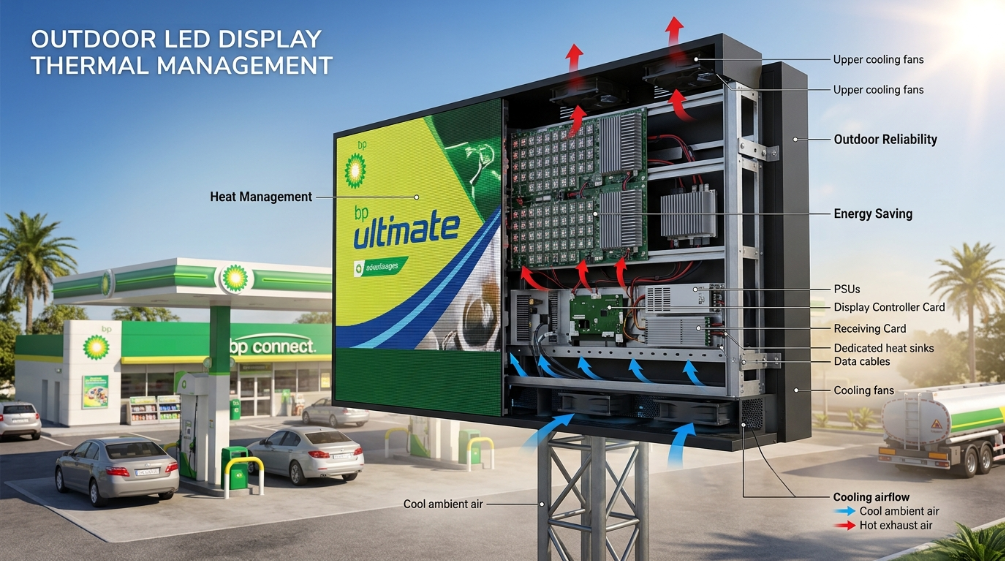
Outdoor LED displays usually operate for long hours every day.
Heat is one of the biggest factors affecting:
- LED brightness degradation
- Power supply lifespan
- IC component reliability
Traditional LED cabinets often use steel structures. Although steel provides strength, it has lower thermal conductivity compared with aluminum solutions.
Modern energy-saving outdoor LED displays increasingly adopt:
- Common cathode technology
- Lightweight aluminum cabinets
- Optimized ventilation structures
The Ares 2 Series uses common cathode technology and an aluminum cabinet design to reduce power consumption and improve thermal management. The manufacturer states that the design can achieve approximately 40% lower power consumption under suitable conditions.
Gas Station LED Billboard Application Scenarios and Product Selection Guide
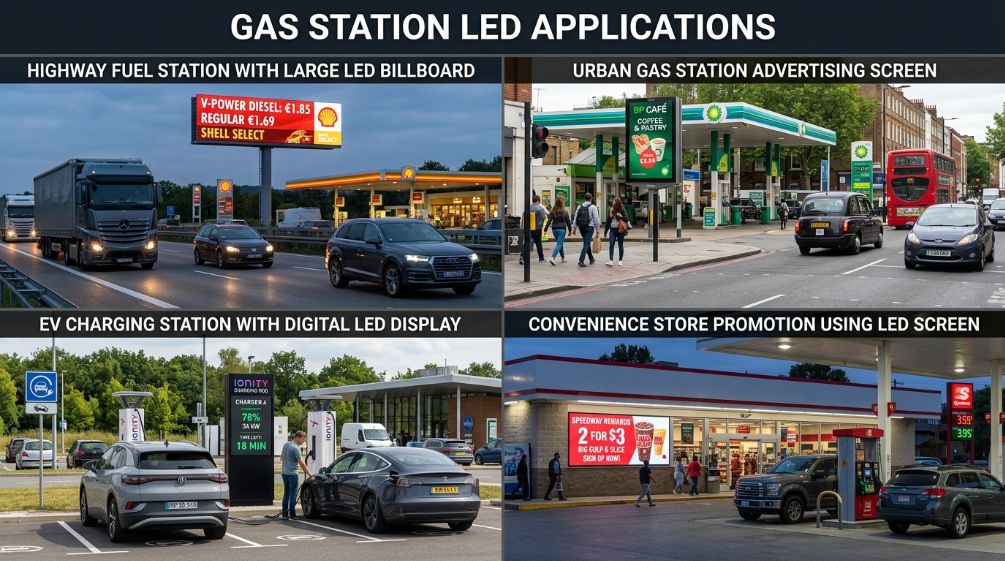
A gas station LED billboard is not only a fuel price display tool. With the development of digital signage, fuel retailers increasingly use outdoor LED systems as a communication platform for customers, advertisers, and service providers.
The correct LED solution depends on the station type, viewing distance, traffic flow, and commercial objectives.
1. Fuel Price Display: The Core Application of Gas Station LED Signs
Fuel price visibility remains the primary requirement for most gas stations.
Drivers usually make quick decisions while approaching a station, so the display must provide:
- Clear numbers
- High contrast
- Long-distance visibility
- Stable 24/7 operation
For pure fuel price communication, many operators choose:
- Large LED numerical modules
- High-brightness outdoor LED panels
- Integrated pylon sign solutions
Recommended Configuration
| Requirement | Recommended Solution |
|---|---|
| Viewing Distance | 50–200 meters |
| Pixel Pitch | P8–P10 |
| Brightness | 6,000+ nits |
| Operation | 24/7 |
| Protection | IP65 outdoor protection |
For fuel stations located near highways or major roads, larger pixel pitch displays are often more cost-effective because drivers view the screen from a longer distance.
2. Convenience Store Promotion and Brand Advertising
Many modern gas stations generate additional revenue through:
- Convenience stores
- Restaurants
- Car washing services
- Membership programs
- Partner advertising
A full-color LED billboard allows operators to display dynamic content instead of static posters.
Examples:
- “Coffee + Fuel Discount”
- “Weekend Car Wash Promotion”
- “New Product Launch”
- “EV Charging Available”
Compared with printed advertising boards, LED displays provide:
- Faster content updates
- Multiple advertising campaigns
- Higher customer engagement
Recommended Configuration
| Requirement | Recommended Solution |
|---|---|
| Content Type | Video + Images |
| Pixel Pitch | P5–P8 |
| Controller | NovaStar-compatible system |
| CMS | Remote management |
| Brightness | 5,000–8,000 nits |
3. EV Charging Station Digital Signage
As electric vehicle charging infrastructure expands, many energy retailers are transforming traditional fuel stations into integrated energy service centers.
LED displays can provide:
- Charging availability information
- Charging promotions
- Navigation guidance
- Advertisement content
Unlike traditional fuel customers who stay briefly, EV users may spend more time waiting, creating additional advertising opportunities.
Recommended applications:
- EV charging hubs
- Highway charging stations
- Energy service stations
4. Highway and Large Commercial Fuel Stations
Large roadside fuel stations require maximum visibility.
Typical requirements include:
- Long-distance recognition
- High brightness
- Large viewing area
- Weather resistance
For these projects, buyers usually consider:
- Large outdoor LED billboards
- Custom steel structures
- Double-sided LED displays
- Remote monitoring systems
Recommended Outdoor LED Display Solution: Sostron Ares-2 Series
For outdoor environments such as gas stations, highways, and roadside advertising locations, the LED display must balance:
- Brightness
- Energy efficiency
- Reliability
- Maintenance convenience
The Ares-2 Series Energy Saving Outdoor LED Display is designed for outdoor commercial applications.
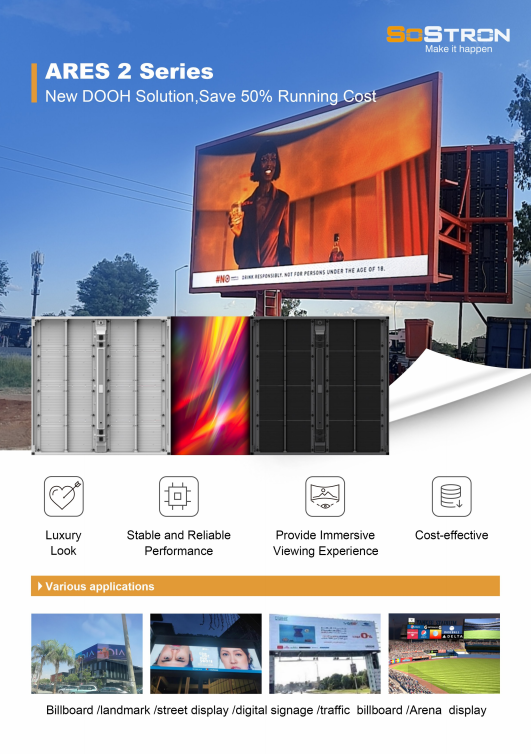
Product advantages include:
- High brightness outdoor visibility
- Energy-saving common cathode technology
- Outdoor weather protection
- Stable long-term operation
- Flexible cabinet configurations
Suitable applications:
- Gas station LED billboard
- Highway advertising display
- Outdoor commercial signage
- Public information display
How to Choose a Gas Station LED Billboard Manufacturer
Selecting a supplier is not only about comparing the lowest quotation.
A reliable manufacturer should provide complete project support.
Gas Station LED Billboard Supplier Evaluation Checklist
| Evaluation Factor | Questions Buyers Should Ask |
|---|---|
| Manufacturing Experience | How many years has the supplier produced outdoor LED displays? |
| Product Certification | Does the product meet CE, EMC, RoHS requirements? |
| Outdoor Reliability | What is the IP rating and operating temperature range? |
| Technical Support | Does the supplier provide installation guidance? |
| Control System | Are mainstream controllers supported? |
| Maintenance | Is front maintenance available? |
| Case Experience | Has the supplier completed similar projects? |
Gas Station LED Billboard Buying Decision Framework
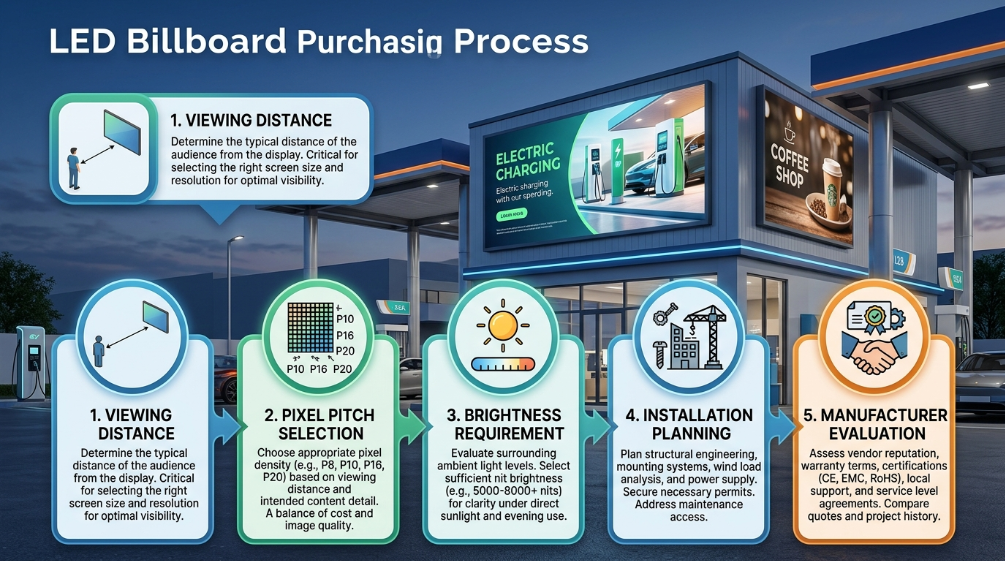
Use the following process before requesting quotations:
Step 1:
Determine viewing distance
        ↓
Step 2:
Choose pixel pitch
        ↓
Step 3:
Confirm brightness requirement
        ↓
Step 4:
Select display size and structure
        ↓
Step 5:
Evaluate supplier capability
        ↓
Step 6:
Confirm installation and maintenance plan
Gas Station LED Billboard Selection Checklist
Before purchasing, confirm:
- What is the maximum viewing distance?
- Will the screen face direct sunlight?
- Is the content only fuel prices or full advertisements?
- Is remote content management required?
- Is the installation location exposed to rain, dust, or extreme temperatures?
- Does the supplier provide technical drawings?
- Is spare parts support available?
Gas Station LED Billboard Maintenance Guide
A high-quality outdoor LED display can operate for many years, but proper maintenance improves lifespan and reduces unexpected downtime.
Recommended maintenance practices:
Regular Inspection
Check:
- LED module condition
- Power supply status
- Cabinet sealing
- Cable connections
Cleaning
Outdoor displays accumulate:
- Dust
- Vehicle emissions
- Rain residue
Regular cleaning helps maintain brightness and image quality.
Software Monitoring
Professional LED control systems can monitor:
- Temperature
- Voltage
- Signal status
- Cabinet operation
Remote monitoring reduces the need for unnecessary onsite service visits.
Frequently Asked Questions About Gas Station LED Billboards
1. How much does a gas station LED billboard cost?
The cost usually ranges from several thousand dollars to tens of thousands of dollars depending on screen size, pixel pitch, brightness, structure, and installation requirements.
2. What pixel pitch is best for a gas station LED display?
For roadside gas stations, P6–P10 is commonly selected because drivers view the display from a distance. Smaller pixel pitches are recommended when viewers are closer.
3. Can a gas station LED billboard display fuel prices and advertisements?
Yes. Full-color LED billboards can display fuel prices, videos, promotions, brand advertisements, and service information through a content management system.
4. How bright should a gas station LED screen be?
Outdoor gas station displays typically require 5,000 nits or higher brightness. Locations with strong direct sunlight may require higher brightness configurations.
5. How long does an outdoor LED billboard last?
The service life depends on component quality, operating environment, temperature management, and maintenance. Professional outdoor LED displays are commonly designed for long-term commercial operation.
6. Can fuel prices be updated remotely?
Yes. Many modern LED gas station systems support remote content management through network connections, allowing operators to update information without manual adjustment.
7. What is the difference between LED billboard and LED gas price sign?
An LED gas price sign mainly displays fuel prices using numerical digits, while a full-color LED billboard supports videos, advertisements, images, and interactive content.
8. How do I choose a reliable gas station LED billboard manufacturer?
Evaluate manufacturing experience, outdoor product quality, technical support, project experience, warranty policy, and after-sales service capability.
Conclusion: Choosing the Right Gas Station LED Billboard Solution
A gas station LED billboard is a long-term investment that affects customer visibility, advertising opportunities, and operational efficiency.
The best solution is not always the largest or highest-resolution screen. Instead, buyers should select a system based on:
- Viewing distance
- Outdoor environment
- Content requirements
- Energy consumption
- Maintenance expectations
For fuel retailers, AV integrators, and commercial contractors, working with an experienced LED display manufacturer can reduce project risks and improve long-term return on investment.
Get a Customized Gas Station LED Billboard Solution
Need a professional recommendation for your fuel station project?
Contact our LED display specialists to receive:
- Display size recommendation
- Pixel pitch selection
- Technical specification sheet
- Project quotation
- Installation guidance
Author
Dylan Lian — Marketing Strategic Director, SoStron
Dylan Lian is an LED display industry professional with experience spanning international LED display projects and B2B market strategy. His work focuses on translating LED hardware specifications into practical deployment decisions across commercial, rental, immersive and large-format display applications.
References:
IEC 60529: Degrees of protection provided by enclosures (IP Code)
NovaStar LED Control System & Processor Documentation