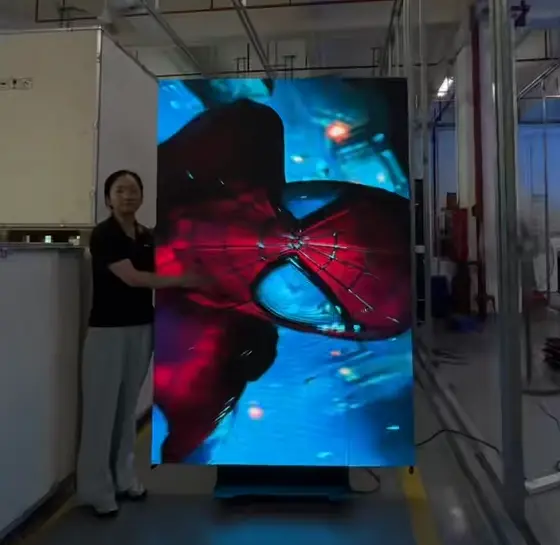
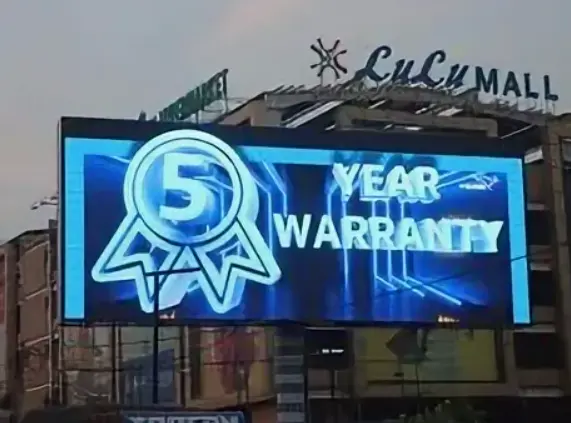
For direct sunlight visibility, outdoor LED screens need a minimum of 5,000 nits, with 6,000–8,000 nits recommended for south-facing, unshaded installations. Below that threshold, images wash out by mid-morning regardless of what a spec sheet promises.
Here’s the quick reference before we go deeper:
| Installation Environment | Minimum Brightness (Nits) | Typical IP Rating | Notes |
|---|---|---|---|
| Shaded/semi-outdoor | 3,500–4,500 | IP65 | Under canopies, transit shelters |
| Standard outdoor advertising | 5,000–6,000 | IP65 | East/west-facing billboards |
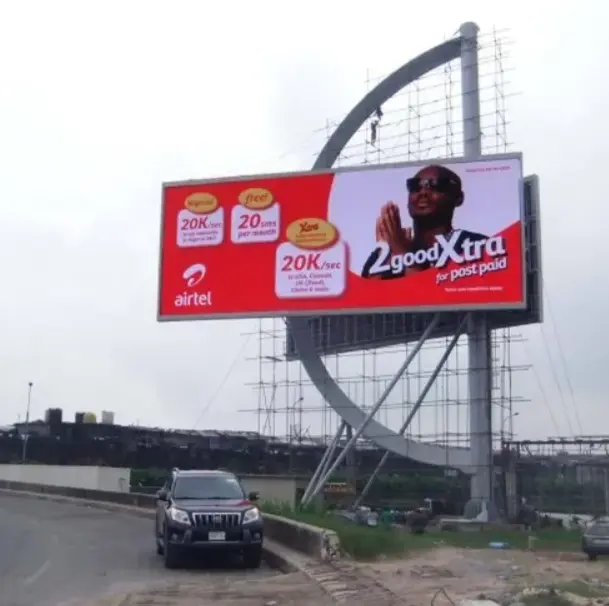
| Direct sunlight/south-facing | 6,000–8,000 | IP65–IP66 | Rooftop, highway billboards |
| Coastal/high-humidity | 6,000–8,000 | IP66–IP67 | Salt-air corrosion resistance required |
That table is the starting point, not the answer.
We’ve spent the better part of two decades specifying, testing, and—occasionally—troubleshooting failed outdoor LED installations across advertising, sports, and transportation projects, and the single most expensive mistake we see procurement teams make is treating “nits” as the only variable that matters.
Here’s the pattern: a system integrator gets a spec sheet quoting 8,000 nits, assumes that number alone guarantees performance, and signs off.
Six months later, the client is calling about a screen that looks dim at 2pm, draws more power than budgeted, and has a warranty dispute brewing because nobody asked how that 8,000-nit figure was actually measured.
According to industry benchmarking from display manufacturers’ associations, a meaningful share of brightness disputes in outdoor LED contracts trace back to inconsistent testing methodology—peak brightness under lab conditions versus sustained brightness in field operation are not the same number, and suppliers rarely volunteer the distinction.
Why This Guide Matters for Outdoor LED Screen Buyers
This guide exists to close that gap.
Whether you’re a system integrator writing tender specifications, an event production company sourcing rental panels, or a DOOH network operator modeling five-year ROI, the goal here is the same:
Give you a decision framework that goes beyond the nits figure on a datasheet, so you’re specifying based on physics and total cost of ownership rather than marketing claims.
What Counts as “High Brightness” for Outdoor LED Screens? (The Nits Benchmark Explained)
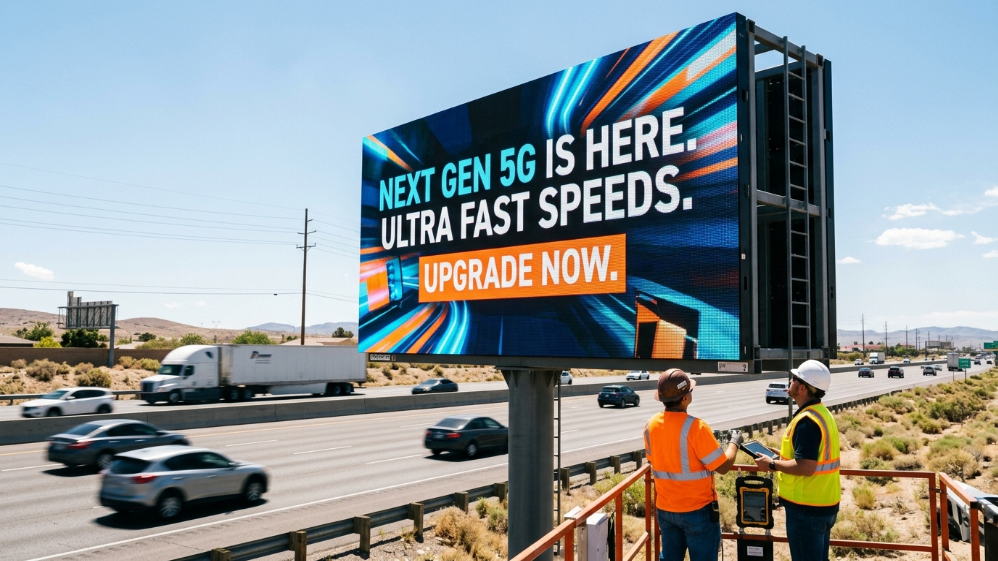
A nit (candela per square meter, cd/m²) measures luminous intensity—how much light the screen emits per unit area.
Indoor commercial displays typically operate between 600 and 1,500 nits, which would be uncomfortably harsh in a dark room but is completely inadequate outdoors.
Direct sunlight measures roughly 100,000 lux, and an LED panel has to overcome that ambient light to remain legible.
That’s why the outdoor threshold sits an order of magnitude above indoor requirements.
Why 5,000 Nits Is the Minimum—Not the Target
Treat 5,000 nits as a floor, not a design goal.
At exactly 5,000 nits, a screen remains readable under overcast skies and moderate daylight, but performance degrades noticeably during peak sun hours, particularly on south-facing installations in high-latitude or high-altitude regions where UV intensity is greater.
The feature-to-benefit logic here matters for procurement conversations:
Higher rated brightness isn’t a vanity spec—it’s the engineering margin that keeps content legible through the worst-case lighting condition your screen will face, not just the average one.
Specify for the harshest hour of the harshest day, not the annual average.
How to Verify a Supplier’s Nits Claim (Testing Standards Buyers Should Request)
This is where our engineering background changes how we advise clients to negotiate contracts.
Ask suppliers for three specific data points before signing:
| Verification Item | Why It Matters |
|---|---|
| Whether the quoted nits figure represents peak brightness or sustained operational brightness | Peak brightness and real operating brightness are not the same |
| Ambient temperature during measurement | LED output decreases as junction temperature rises |
| Third-party test certification | Independent verification is more reliable than in-house figures |
A supplier unwilling to provide sustained-brightness data under realistic thermal load is telling you something about the number they’re quoting.
Brightness by Installation Orientation: North-Facing vs. Direct Sunlight Facades
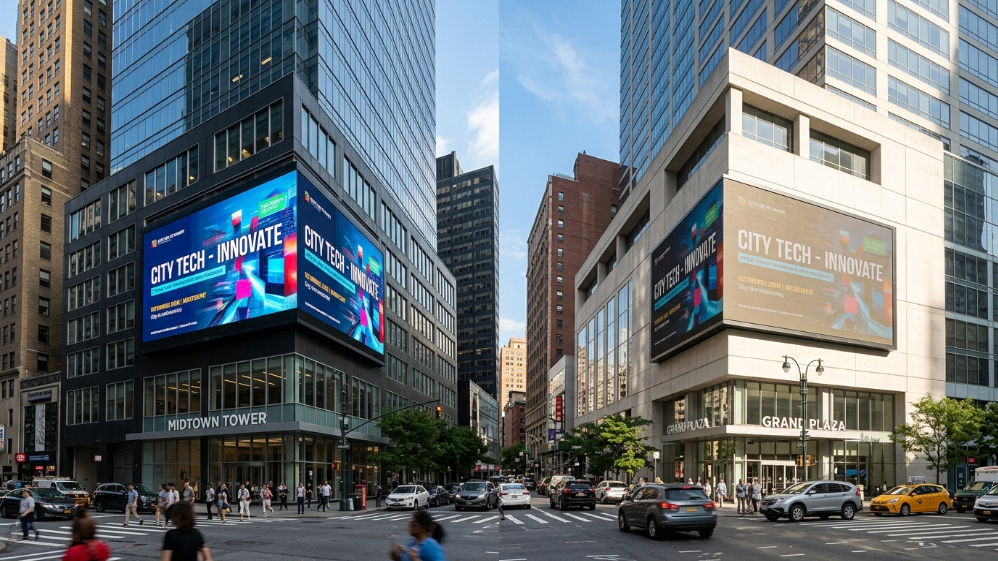
Orientation changes requirements more than most buyers expect.
A north-facing screen in the Northern Hemisphere receives significantly less direct solar exposure than a south-facing one and can often perform adequately at 4,500–5,500 nits.
A south or west-facing billboard catching late-afternoon sun needs the full 6,000–8,000 nit range to avoid the “washed out” complaint that dominates negative reviews of underspecified installations.
Building this into your RFQ—orientation, latitude, and shading conditions—lets a competent supplier recommend brightness tiers rather than defaulting everyone to the most expensive option.
Do You Actually Need Maximum Brightness? Matching Nits to Your Use Case
Not every outdoor application calls for the ceiling of what’s technically available, and overspecifying brightness carries a real cost: higher-nit modules draw more power, generate more heat, and often carry a price premium of 15–25% over mid-tier alternatives for a use case that may never need the extra output.
| Buyer Profile | Priority Beyond Nits | Recommended Brightness | Key Trade-off |
|---|---|---|---|
| System Integrator (permanent install) | Certification, warranty, IP rating | 5,000–8,000 nits (site-dependent) | Long-term reliability over lowest upfront cost |
| Event/Rental Company | Weight, quick-assembly cabinets, portability | 4,500–6,000 nits | Rugged transport case vs. maximum brightness |
| DOOH Advertiser | Energy cost, automatic dimming, uptime | 6,000+ nits with ABL sensor | Operating cost over multi-year deployment |
For System Integrators: Specifying Brightness for Client Contracts & Tender Documents
Based on our experience reviewing tender documents for municipal and commercial installations, the integrators who avoid disputes are the ones who write brightness specifications tied to measurable test conditions rather than a single headline nits number—for example:
“Minimum 5,500 nits sustained at 40°C ambient, verified by third-party test report.”
That language protects you contractually if a supplier under-delivers, and it forces bidders to compete on genuine engineering capability rather than marketing copy.
For Event Planners: Balancing Brightness, Portability, and Rental Turnaround
Event applications rarely need the top brightness tier, since most productions run during evening hours or under stage lighting rather than fighting noon sun.
What matters more here is cabinet weight, front-service maintenance access for fast strike-and-load turnarounds, and IP65 protection that survives outdoor festival conditions without requiring the coastal-grade IP67 rating that adds cost without adding value for a three-day deployment.
For DOOH Advertisers: Brightness, Dwell Time, and Ad Visibility ROI
For advertising networks, brightness ties directly to revenue:
A screen that’s illegible during peak foot-traffic hours is inventory advertisers won’t pay premium rates for.
This is also where automatic brightness sensors—which we’ll cover in depth in the next section—become a genuine ROI lever rather than a nice-to-have, since they let a screen run at full output only when ambient light demands it, protecting both energy budgets and LED lifespan over a multi-year advertising contract.
Beyond Brightness—The 4 Specs That Determine Real-World Performance
Brightness gets a screen noticed.
These four specs determine whether it survives, performs, and pays for itself.
IP Rating: Why IP65 Is the Baseline (and When You Need IP66/IP67)
IP65—fully dust-tight with protection against low-pressure water jets—is the non-negotiable floor for any permanent outdoor installation.
The feature-to-benefit case is straightforward:
A sealed enclosure keeps humidity and airborne particulates away from the driver ICs and power supply, which is where outdoor LED failures actually originate, not in the diodes themselves.
Coastal deployments, monsoon regions, and anywhere with salt-laden air warrant stepping up to IP66 or IP67, since chloride corrosion attacks connector contacts and PCB traces faster than standard-grade sealing can resist.
Skipping this upgrade to save a few percentage points on unit cost is the single most common false economy we see in coastal DOOH contracts.
Pixel Pitch vs. Viewing Distance: The Formula Buyers Get Wrong
The industry rule of thumb—minimum viewing distance (meters) ≈ pixel pitch (mm) × 1 to 1.5—gets misapplied constantly because buyers optimize for image sharpness when they should be optimizing for cost-per-square-meter at the distance viewers actually stand.
A highway billboard viewed from 50+ meters gains nothing from P4 resolution.
P8 to P10 delivers identical perceived clarity at a fraction of the module cost and, critically, a fraction of the power draw.
Reserve fine pixel pitch (P2.5–P4) for close-viewing retail facades and reserve your budget for brightness and weatherproofing everywhere else.
SMD vs. COB vs. MiniLED Packaging: Which Survives Outdoor Conditions Best?
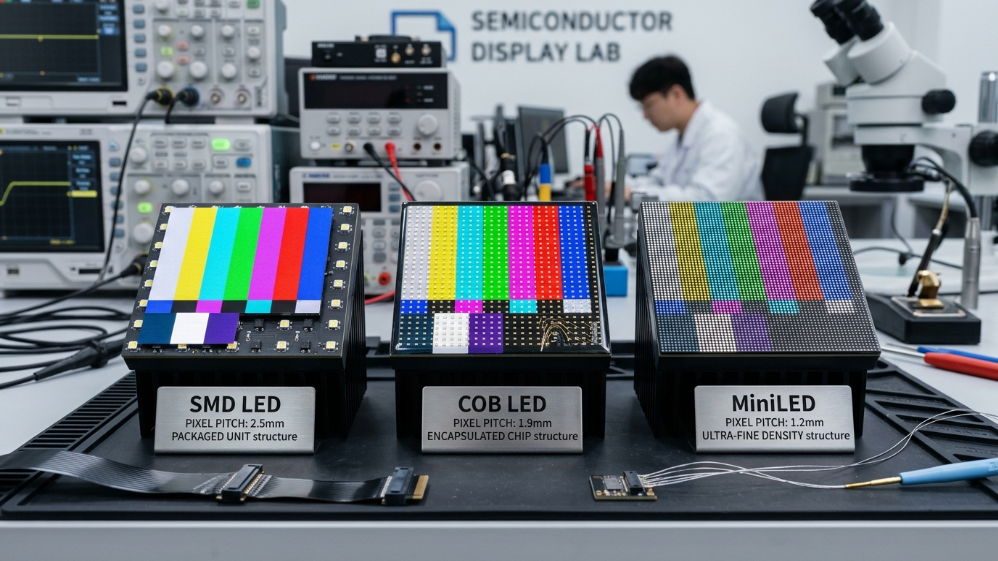
| Packaging Type | Outdoor Durability | Brightness Ceiling | Best Fit |
|---|---|---|---|
| SMD (Surface-Mounted Device) | Good—industry standard | High, cost-efficient | Standard billboards, retail, stadiums |
| COB (Chip-on-Board) | Excellent—sealed, low pixel failure rate | Moderate-high | High-traffic, tamper-prone public locations |
| MiniLED | Very good—improved contrast and lifespan | Very high | Premium DOOH, flagship installations |
SMD remains the commercial default for good reason:
Mature supply chains keep costs predictable and repair straightforward when individual pixels fail.
COB packaging embeds the LED chips directly into the PCB under a protective coating, which all but eliminates the “missing pixel” problem common on heavily touched or vandalism-prone SMD screens—a meaningful consideration for street-level installations.
MiniLED sits at the premium end, delivering higher contrast ratios and longer operational lifespans, and is increasingly the specification of choice for flagship DOOH networks where image quality doubles as a brand statement.
Automatic Brightness Sensors: How They Cut Energy Costs and Extend LED Lifespan
An ambient light sensor (ABL) continuously measures surrounding light levels and throttles output accordingly—full 8,000 nits at noon, dropping to a fraction of that after dusk.
According to manufacturer field data, this typically cuts energy consumption by 30–40% over a fixed-brightness screen running at maximum output around the clock, while also reducing thermal stress on the diodes, which is the leading driver of long-term brightness degradation.
For any buyer modeling multi-year operating costs, an ABL sensor isn’t optional—it’s the single feature with the fastest, most measurable payback.
How Much Does a High Brightness Outdoor LED Screen Really Cost? (TCO & ROI Breakdown)
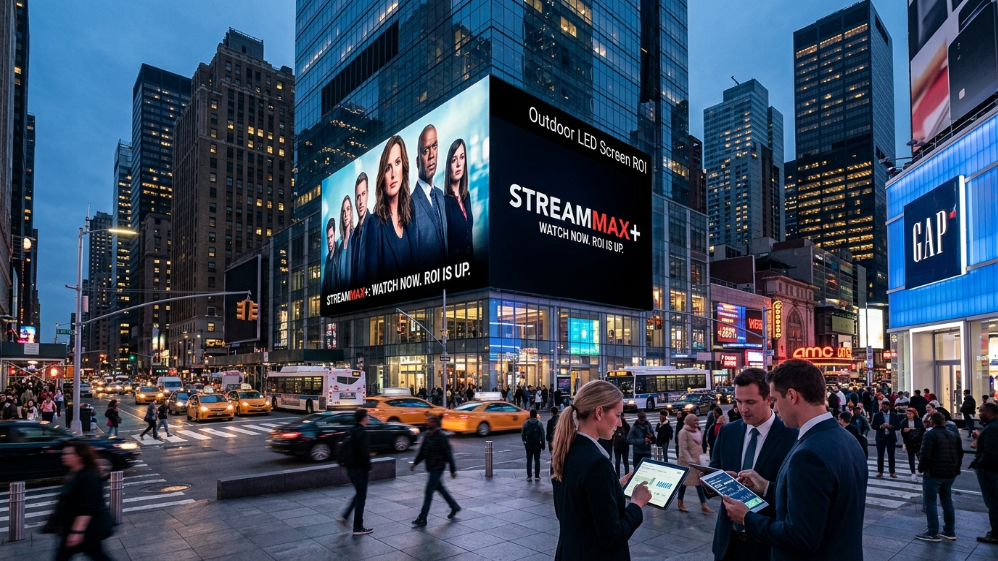
Upfront pricing is the number every quote leads with; it’s rarely the number that determines whether a project was a good investment.
Upfront Cost Drivers: Pixel Pitch, Cabinet Type, and Brightness Tier
Finer pixel pitch and higher brightness tiers both push unit cost upward, but not proportionally—moving from 5,000 to 8,000 nits typically adds 15–25% to module cost, while halving pixel pitch can double it.
Cabinet construction matters too:
Die-cast aluminum weatherproof cabinets cost more than standard steel but resist warping and corrosion over a decade of outdoor exposure, which matters more than the sticker price once you’re three years into a permanent installation.
Hidden Operating Costs: Energy Consumption, Maintenance, and Module Replacement
Buyers who budget only for the purchase price consistently underestimate operating expenses.
Power draw scales with both brightness and screen size, and a 6,000-nit outdoor panel running continuously can consume meaningfully more annual electricity than a comparably sized indoor display—a gap that ABL sensors and energy-efficient driver ICs narrow considerably.
Factor in front-service maintenance access as a cost lever too:
Cabinets requiring rear access for module swaps often mean scaffolding or bucket-truck rental for every repair, which adds up fast on facade-mounted installations.
Realistic ROI Timelines by Application (Advertising, Retail, Corporate Branding)
Advertising-driven DOOH installations in high-footfall locations commonly recoup capital investment within 14–18 months through ad revenue, based on industry deployment data—but that figure assumes near-continuous ad sell-through, which smaller or less-trafficked sites won’t achieve.
Retail and corporate branding installations don’t generate direct ad revenue, so their ROI case rests on foot traffic lift and brand impression value, typically modeled over 3–5 years rather than months.
Set expectations accordingly during the sales conversation; a mismatched ROI timeline is a common source of post-installation client dissatisfaction.
Common Mistakes B2B Buyers Make When Selecting High Brightness Displays
“Brighter is always better” leads buyers to overpay for nits their site orientation and viewing conditions don’t require, inflating both capital cost and ongoing energy spend.
Ignoring certification—CE, FCC, RoHS, UL—isn’t a paperwork formality; it’s frequently a legal requirement for import clearance and public installation permits, and missing it can halt a project after equipment has already shipped.
Skipping on-site sample testing before committing to a bulk order is the mistake we see cost clients the most:
A sample panel tested under your actual site’s lighting and thermal conditions catches brightness and color-consistency issues no datasheet will reveal.
Supplier Due Diligence Checklist: How to Vet an Outdoor LED Screen Manufacturer
Before issuing an RFQ, confirm:
| Verification Item | Requirement |
|---|---|
| Sustained brightness data | Realistic ambient temperature testing, not only peak nits |
| IP rating certification | Supported by third-party laboratory certification |
| Factory verification | Factory audit availability or verified video walkthrough |
| Warranty terms | Parts and labor coverage, ideally 2–3 years minimum |
| Spare parts availability | Confirm module and replacement availability for at least five years after purchase |
A supplier who hesitates on any of these points is signaling risk worth taking seriously before, not after, contract signature.
Frequently Asked Questions
What nits do I need for direct sunlight visibility?
6,000–8,000 nits for south-facing or unshaded direct-sun installations; 5,000 nits is an acceptable minimum for moderate exposure.
How much does an outdoor LED screen cost per square meter?
Pricing varies widely by pixel pitch and brightness tier, but expect a meaningful premium over indoor displays due to weatherproofing, higher-output LEDs, and reinforced cabinet construction—request itemized quotes to compare fairly.
What’s the lifespan of a high brightness outdoor LED screen?
Well-specified panels with ABL sensors and adequate thermal management commonly operate 80,000–100,000 hours before brightness degrades below usable thresholds—roughly 10+ years at standard daily runtime.
Can outdoor LED screens work in extreme heat or cold?
Yes, provided the driver ICs and power supply carry an appropriate operating temperature rating; always confirm this range against your region’s seasonal extremes, not just average conditions.
Do I need a different pixel pitch for video content versus static ads?
Not significantly—persistence of vision compensates for coarser pixel pitch in moving video, so the viewing-distance formula matters more than content type when selecting pitch.
Expert Verdict: Selecting the Right High Brightness Outdoor LED Screen
Skip the temptation to chase the highest nits number on the spec sheet.
Specify brightness against your actual site orientation, back it with third-party sustained-brightness testing, and put your remaining budget into IP rating, ABL sensors, and warranty terms.
That combination determines whether a screen still looks sharp and still turns a profit five years from now, long after the “8,000 nits” headline stops mattering.
Price Notice for High Brightness Outdoor LED Screens
Outdoor LED screen pricing depends on multiple technical and project-specific factors, including pixel pitch, brightness level, cabinet material, waterproof rating, installation environment, control system, quantity, and customization requirements.
The prices mentioned in this guide are general industry references only and should not be considered a fixed quotation. For accurate pricing, buyers should provide project details such as screen size, viewing distance, installation location, brightness requirements, and application scenario.
A professional supplier can recommend the most cost-effective configuration by balancing initial investment, energy consumption, maintenance costs, and long-term ROI rather than simply selecting the highest brightness specification.
References:
CIE 127:2007 Measurement of LEDs
IEC 60529 Degrees of Protection Provided by Enclosures (IP Code)