What Is Hotel Digital Signage? A Direct Answer for Buyers
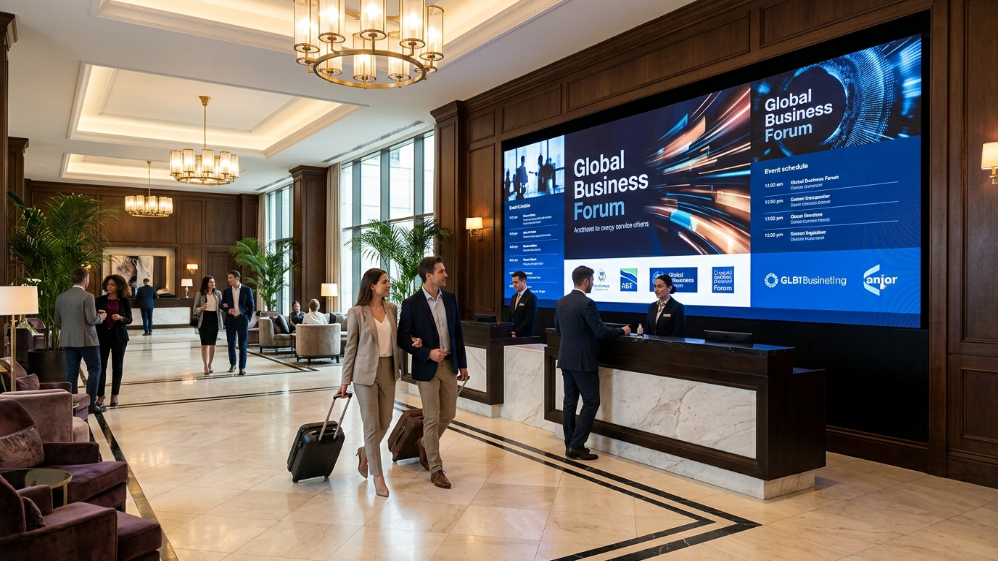
Hotel digital signage is a network of commercial-grade LED or LCD displays—deployed across lobbies, conference corridors, restaurant zones, and guest rooms—that delivers dynamic, remotely managed content 24 hours a day, 365 days a year.
It replaces static printed materials with real-time information: event schedules synced directly to your Property Management System (PMS), upsell promotions, wayfinding, and DOOH advertising inventory.
Core Decision Matrix Every B2B Buyer Should Verify Before Procurement
| Deployment Zone | Recommended Pixel Pitch | Minimum Nit Rating | Contrast Ratio | Primary B2B Benefit |
|---|---|---|---|---|
| Grand lobby/entrance | P1.5–P2.5 | 800–1,200 nits | 4000:1+ | Brand authority, instant upsell exposure |
| Conference & meeting rooms | P1.2–P2.0 | 400–600 nits | 3000:1 | PMS schedule sync, reduced staff workload |
| Restaurant & bar | P2.0–P2.5 | 500–800 nits | 3000:1 | Digital menu board, F&B revenue lift |
| Hotel entrance/porte-cochère | P4–P6 (outdoor) | 5,000–8,000 nits | 5000:1+ | DOOH ad monetization, exterior branding |
| Guest room (in-room display) | P1.0–P1.5 | 300–500 nits | 3000:1 | Personalized upsell, service automation |
The global hotel digital signage market reached USD 28.8 billion in 2024 and is on track to surpass USD 45.9 billion by 2030, according to industry market data.
That growth is not theoretical—87% of hotel groups surveyed by PwC Hospitality Outlook 2025 plan to expand their digital display networks within three years.
The arms race has started.
The question is whether your property is equipped with hardware built to last, or consumer-grade panels that will fail silently at 2 AM when your lobby is still full of international guests.
The Real Problem: Most Hotels Are Deploying the Wrong Displays
Let’s be direct.
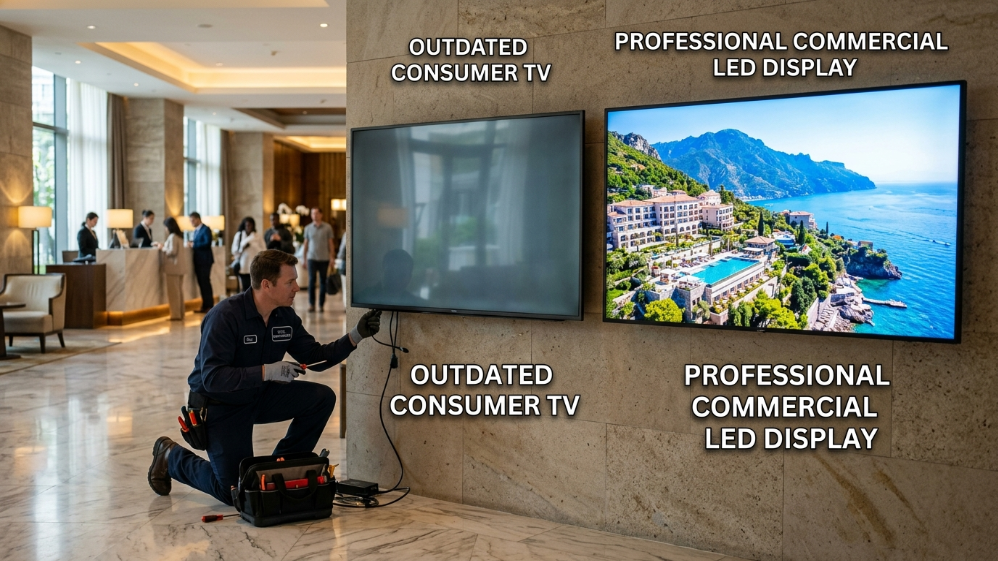
The most common mistake we see—and based on our experience evaluating display installations across hospitality projects in Southeast Asia, the Middle East, and Europe—is specifying consumer or entry-level commercial screens for a 24/7 operational environment.
A consumer television is rated for roughly 4,000 to 8,000 hours of continuous use.
A hotel lobby does not sleep.
Running that same panel non-stop for a year alone demands 8,760 hours.
Do the math: you will be replacing it inside 12 months, paying emergency service callout fees, and explaining to the GM why the entrance display is dark during peak check-in.
This is not a vendor’s talking point.
It is an engineering reality rooted in thermal management physics.
Consumer panels lack active cooling systems capable of dissipating heat at continuous load.
They have no burn-in protection, no remote health monitoring, and no industrial-grade power supply designed for voltage fluctuation tolerance across global markets.
The second failure—equally costly—is ignoring contrast ratio and nit brightness specifications relative to actual ambient light conditions.
A hotel lobby at noon can register 500 to 1,500 lux from combined daylight ingress and artificial lighting.
A display rated at 400 nits with a 1,200:1 contrast ratio will appear washed out, unreadable, and—from a guest’s perspective—simply off.
That is not a content problem.
It is a hardware specification problem that no CMS software can fix.
Commercial LED vs. LCD vs. Consumer TV: The Specification Reality Check
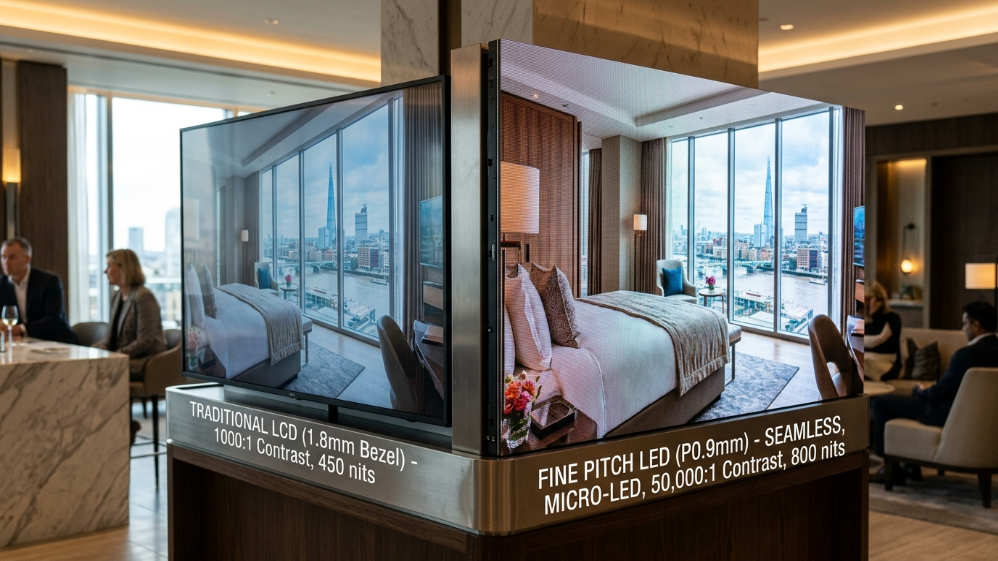
Before any procurement decision, system integrators and hotel procurement managers need to understand what the spec sheet actually means in an always-on hospitality environment.
| Specification | Consumer TV | Entry LCD Signage | Commercial-Grade LED |
|---|---|---|---|
| Rated operating hours | 4,000–8,000 hr | 16,000–30,000 hr | 50,000–100,000 hr (MTBF) |
| Brightness (nits) | 200–400 | 350–700 | 800–10,000+ (zone-dependent) |
| Contrast ratio | 1,000:1–1,500:1 | 1,200:1–2,500:1 | 3,000:1–8,000:1 |
| Active cooling system | None | Passive only | Industrial active cooling |
| Remote health monitoring | None | Limited | Full OTA, fault alert, reboot |
| Commercial warranty | Void under 24/7 use | 1–2 years limited | 3–5 years with SLA options |
| Burn-in protection | None | Basic | Advanced pixel-shift algorithms |
| Pixel pitch options | Fixed (TV panel size) | Fixed | P1.2 to P10+ configurable |
The Mean Time Between Failures (MTBF) figure—that 50,000-to-100,000-hour rating on commercial LED panels—is the most important number on this table.
It translates directly to an expected operational lifespan of five to eleven years under continuous 24/7 load.
That is not marketing copy; it is the statistical result of industrial-grade LED driver ICs, premium Kinglight or Nationstar binned diodes, and metal housing that manages thermal dissipation rather than hoping ambient air does the work.
According to a 2024 Hospitality Technology Review study, hotels using commercial-grade signage infrastructure reported 29% fewer display-related support tickets and a 21% reduction in front-desk directional inquiries—two very measurable operational savings that directly reduce labor costs.
The Solution: Recommended SoStron Product Series for Hotel Deployments
Based on our engineering analysis of the hotel environment and SoStron’s current product lineup, two series stand out as the most appropriate fit for different hospitality deployment scenarios.
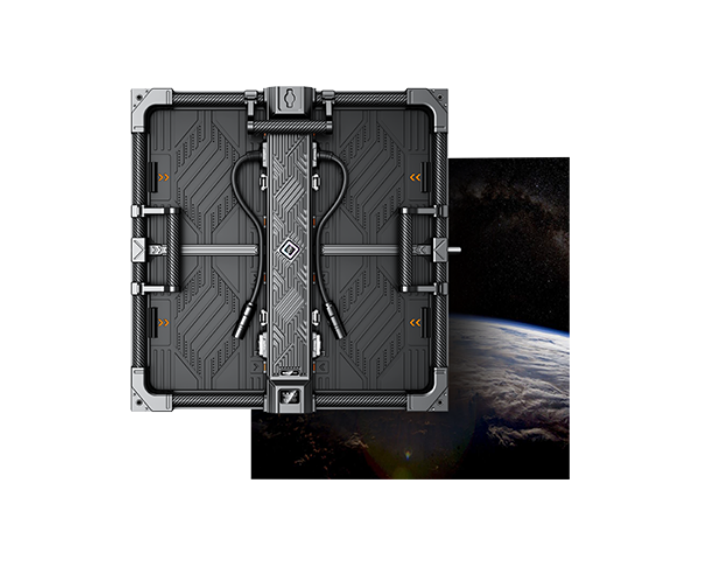
SoStron Reta 2 — Small Pitch Indoor LED Display (Lobby, Conference, Restaurant)
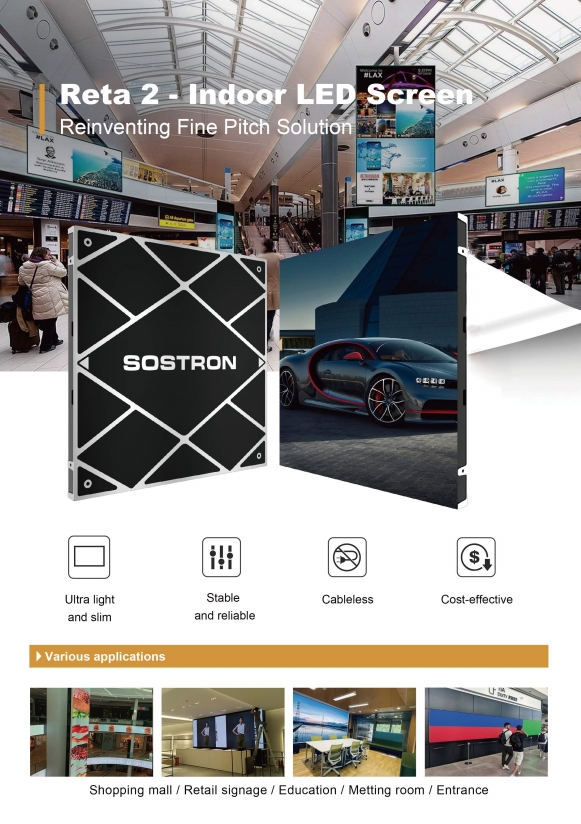
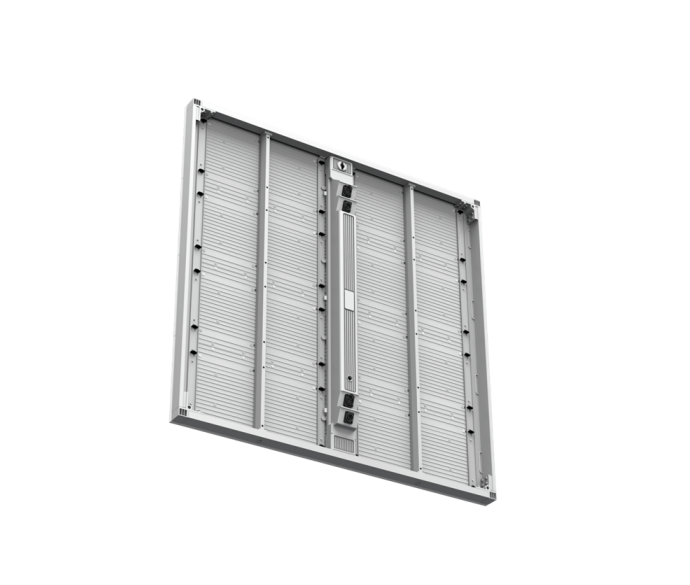
For interior hotel zones demanding fine-pitch resolution and 24/7 uptime, the Reta 2 series (pixel pitches from P1.2 to P2.5) delivers the high contrast ratios and pixel density that grand lobby video walls require.
Its modular panel design means individual cabinet replacements can be completed without full system downtime—a critical operational advantage in a hotel that cannot close its lobby for maintenance.
The Reta 2 is the recommended choice for system integrators specifying lobby feature walls, conference room displays, and restaurant digital menu boards.
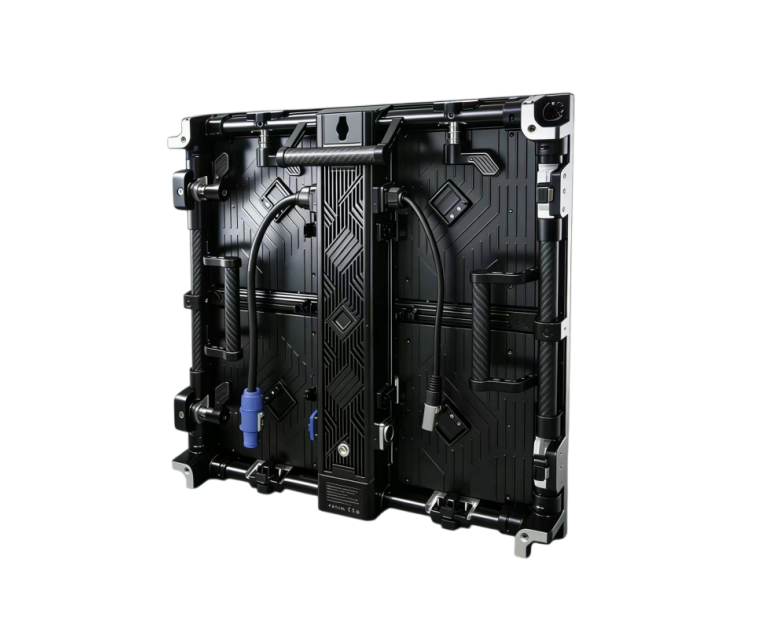
SoStron Ares/Ares 2 — DOOH Outdoor LED Billboard (Hotel Entrance & Exterior)
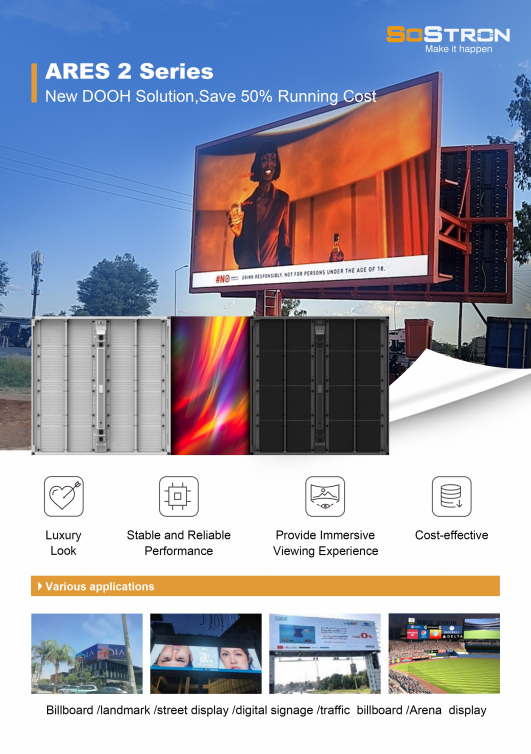
For hotel entrances, porte-cochères, and exterior-facing advertising positions, the Ares series brings energy-efficient outdoor performance with brightness ratings suited for full-sun visibility.
Hotels partnering with local businesses to run DOOH advertising inventory on their exterior displays—a growing monetization strategy—need a panel capable of sustained high-nit output without heat-related color drift.
The Ares 2 is engineered for exactly that operating profile.
Global Case Reference: Jinmao Plaza, Guangzhou, China
SoStron’s indoor and outdoor LED display installation at Jinmao Plaza in Guangzhou demonstrates the kind of multi-zone deployment complexity that hotel projects demand.
The project required coordinated indoor fine-pitch displays and outdoor high-brightness units operating across a high-traffic mixed-use property—a hardware and integration challenge directly analogous to a large hotel group’s signage rollout.
The system has operated continuously since installation, validating the MTBF specifications and centralized content management architecture that hotel system integrators need to see proven before committing to a multi-property contract.
Why 24/7 Operational Stability Is Non-Negotiable for Hotel Displays
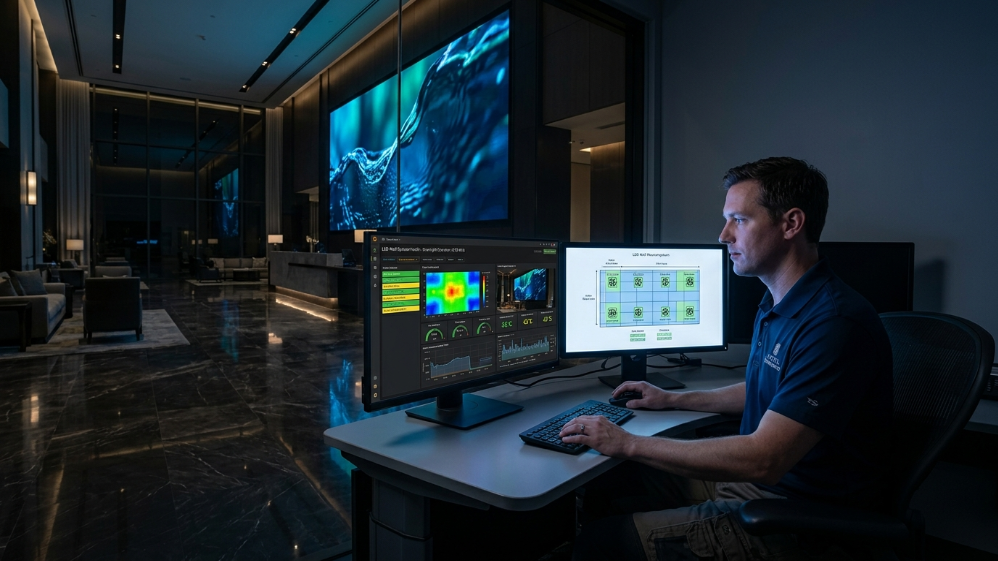
A hotel is, by definition, a round-the-clock operation.
Your check-in desk handles late arrivals at 3 AM.
Your conference wing may run a breakfast briefing at 6 AM immediately followed by a black-tie gala that evening.
Your lobby never rests.
The display infrastructure supporting all of that communication cannot either.
This is where the engineering gap between commercial and consumer hardware becomes a business risk, not just a technical footnote.
Why 24/7 Operational Stability Is Non-Negotiable for Hotel Displays (continued)
Commercial-grade LED panels handle continuous thermal load through active cooling architecture—internal fans, heat-dissipating aluminum extrusions, and thermally separated power supply compartments.
When ambient lobby temperatures rise during peak occupancy, the panel’s operating temperature stays within specification.
Consumer hardware has none of this.
The result is accelerated lumen depreciation: a consumer panel running at continuous load will lose 30–40% of its rated brightness within 18 months.
That lobby video wall that looked striking on day one looks dim and uninspiring before your first annual guest satisfaction survey arrives.
Remote health monitoring changes the operational equation entirely.
Enterprise-class hotel signage systems—properly specified—push fault alerts to a central dashboard the moment a power supply voltage deviates, a panel temperature threshold is crossed, or a content signal drops.
Your facilities team knows about the problem before the front desk does, and certainly before any guest notices.
That is not a luxury feature.
For a multi-property hotel group managing 200-plus screens across six time zones, it is the difference between proactive maintenance and reactive crisis management.
High-Contrast Readability: The Science Behind Displays Guests Can Actually Read
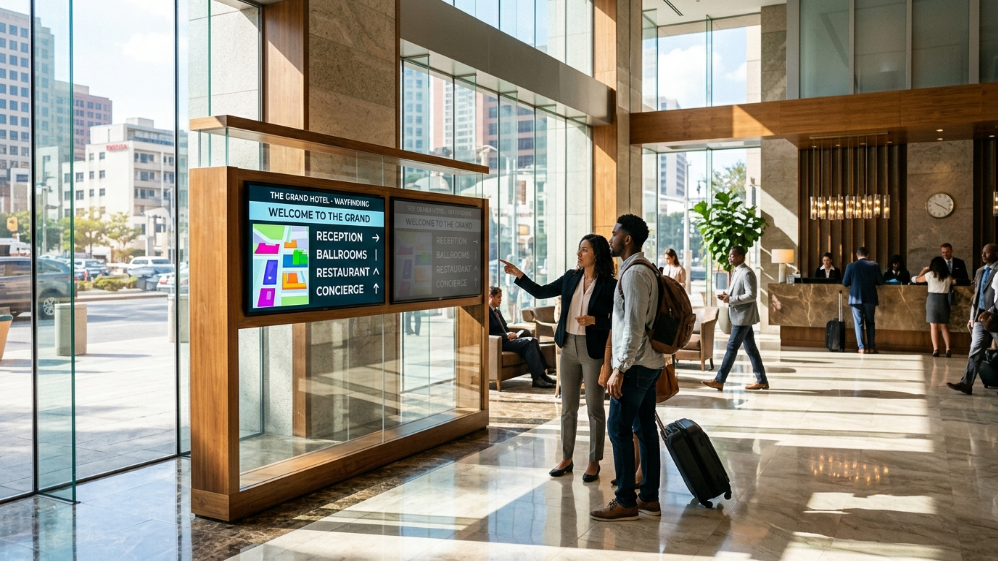
Brightness and contrast ratio are not vanity metrics.
They are engineering variables with direct consequences for guest experience and, ultimately, revenue.
A hotel lobby at midday, with floor-to-ceiling glazing and overhead LED architectural lighting, can register ambient illuminance levels of 800 to 1,500 lux.
At those levels, a display rated at 500 nits with a 1,200:1 contrast ratio is functionally illegible—the image washes out, text becomes unreadable, and the screen communicates nothing.
A commercial LED panel rated at 1,000 nits with a 4,000:1 contrast ratio remains crisp, punchy, and readable from 15 meters across the lobby floor.
Pixel Pitch Recommendations by Viewing Distance
| Viewing Scenario | Recommended Pixel Pitch | Viewing Distance |
|---|---|---|
| Reception desk display | P1.2 | 1–2 meters |
| Lobby feature wall | P2.0–P2.5 | 3–8 meters |
| Outdoor entrance display | P4–P6 | 8–25+ meters |
The pixel pitch selection compounds this.
For a lobby feature wall viewed from 3 to 8 meters, P2.0 to P2.5 is the engineering optimum—fine enough for text legibility at close range, cost-effective at scale, and matched to the viewing distances real guests actually experience.
Drop to P1.2 for a reception desk display where guests stand 1 to 2 meters away and read detailed room service information.
Step up to P4 or P6 for outdoor entrance displays where the relevant viewing distance begins at 8 meters and extends to 25 meters or beyond.
ADA compliance adds another layer of specificity.
The Web Content Accessibility Guidelines (WCAG) recommend a minimum contrast ratio of 4.5:1 for normal text and 3:1 for large text on digital displays—a standard that commercial LED panels achieve comfortably but that many entry-level LCD signage solutions fail under real ambient light conditions.
5 Common Questions from Hotel Signage Buyers (Technical FAQ)
1. What screen size is right for a hotel lobby?
Viewing distance drives this decision, not room size.
Use the 0.1× rule as a starting point: optimal screen height equals roughly one-tenth of the maximum viewing distance.
A lobby where guests view the display from up to 10 meters needs a screen at least 1 meter tall—a 65-inch diagonal minimum.
For a grand entrance video wall, multiple panels tiled to 3×2 meters or larger is standard for five-star properties.
Always confirm with an on-site lux measurement before finalizing the nit specification.
2. LED or LCD — which technology is better for hotels?
For large-format lobby installations above 100 inches diagonal, direct-view LED wins on contrast ratio, seamless tiling, and MTBF.
LCD remains appropriate for smaller zones—conference room scheduling panels, room-service menu boards under 75 inches—where fine-pitch LED would be overspecified.
The key differentiator is always the ambient light level and viewing distance, not a blanket technology preference.
3. Can hotel signage integrate with our existing PMS?
Yes—but verify the integration protocol before purchasing hardware.
Most enterprise PMS platforms (Opera Cloud, Mews, Cloudbeds) offer REST API endpoints that a competent CMS can query for real-time room status, event schedules, and guest name data.
The hardware itself is protocol-agnostic; the CMS layer handles the translation.
Specify this integration requirement explicitly in your RFP so the integrator demonstrates a working connection, not just a theoretical compatibility claim.
4. How much does hotel digital signage actually cost?
The honest answer spans a wide range.
A single commercial-grade indoor LED panel in the P2.0–P2.5 range runs USD 800–2,500 per square meter at the hardware level, depending on pixel pitch and panel brand tier.
A full lobby video wall installation of 6–10 square meters, including mounting structure, media player, CMS licensing, and professional commissioning, typically lands between USD 15,000 and USD 60,000 for a mid-to-upper market hotel.
The TCO calculus shifts dramatically when you factor in print elimination savings (industry average: USD 18,000–35,000 per property annually) and the upsell revenue lift—data consistently shows 18–22% increases in F&B and spa revenue when dynamic promotional content replaces static materials.
5. What happens if the display goes offline mid-event?
A properly architected system has three layers of resilience:
- Local media player storage (content plays from cache even if the network drops)
- Redundant power supply units within the panel itself
- Remote reboot capability via the CMS
For mission-critical conference signage, specify dual media players in active-passive failover configuration.
This is standard practice for any airport or casino deployment and should be non-negotiable for a hotel hosting large corporate events.
CMS & PMS Integration: The Architecture That Makes It All Work
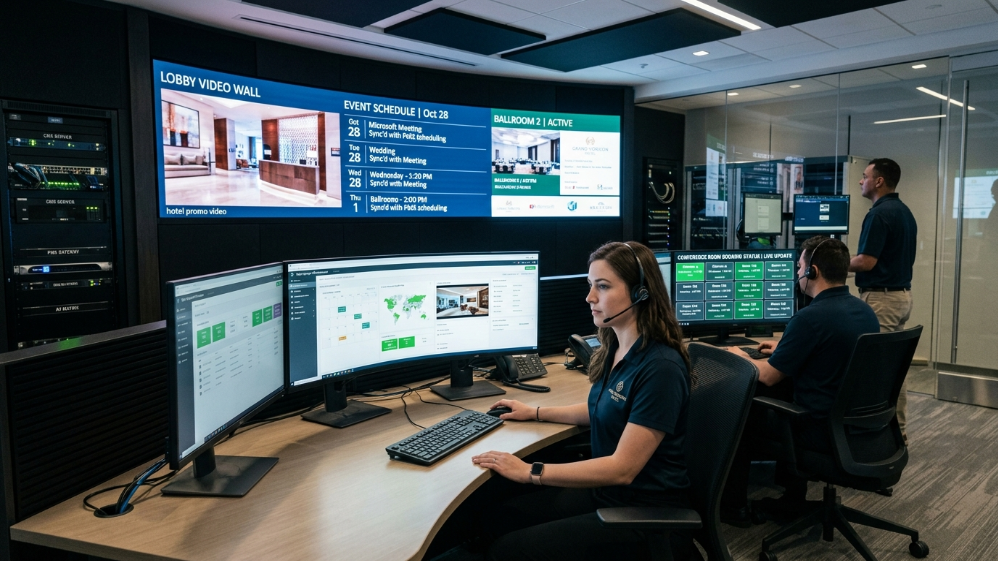
The display hardware is the visible part of the system.
The content management layer is what determines whether that hardware earns its capital investment or sits broadcasting stale content.
| CMS Capability | Basic Tier | Enterprise Tier | What It Means for Hotel Operations |
|---|---|---|---|
| Screen count managed | Up to 10 | Unlimited (multi-property) | Scales from boutique to global chain |
| PMS integration | Manual import | Live API sync (Opera, Mews, Cloudbeds) | Event schedules update in real time—zero staff touchpoints |
| Content scheduling | Time-of-day slots | Rule-based dynamic (occupancy, weather, guest segment) | Lobby shows breakfast promo at 7 AM, spa promo at 3 PM automatically |
| Remote monitoring | Basic online/offline | Full hardware telemetry (temp, voltage, uptime%) | Fault detected before guest notices |
| Multi-user permissions | Single admin | Department-level (F&B, Events, Front Desk) | Each team manages their own screens without IT involvement |
| DOOH ad management | None | Third-party DSP integration | Lobby screens generate advertising revenue from local partners |
| OTA firmware updates | Manual | Scheduled, push-based | Security patches and feature updates without on-site visits |
Based on our experience with multi-property deployments, the single biggest operational failure point is not the hardware—it is under-specified CMS licensing that locks a 300-room hotel into a 10-screen plan when they actually need 40 screens across four zones.
Negotiate your CMS license by screen count and property count upfront.
The cost difference between tiers is modest; the operational constraint of hitting a screen-count ceiling mid-rollout is significant.
Expert Verdict
Hotel digital signage is not a technology purchase.
It is an infrastructure decision with a 5-to-10-year operational horizon, and the specification errors made at procurement—wrong nit rating, insufficient contrast ratio, consumer-grade MTBF, no PMS API integration—cannot be corrected by software after installation.
Get the hardware right first.
For interior hotel zones, specify commercial-grade LED with P1.5–P2.5 pixel pitch, minimum 800 nits, 4,000:1 contrast ratio, and a documented MTBF above 50,000 hours.
For exterior and DOOH positions, step up to 5,000+ nit outdoor panels with IP65 protection.
Pair the hardware with an enterprise CMS that integrates natively with your PMS—not a workaround, a documented API connection.
The hotels that will extract maximum ROI from their digital signage investment over the next decade are the ones that treat display hardware the same way they treat their HVAC or elevator systems: mission-critical infrastructure that demands commercial-grade specification, professional commissioning, and a credible service agreement.
Everything else is an expensive screen that happens to be on.
References:
World Wide Web Consortium (W3C) – WCAG Accessibility Guidelines
AVIXA – Digital Signage Display Standards & AV Performance