For most professional wedding events, a Wedding LED Wall should be specified around five factors: screen size, pixel pitch, viewing distance, refresh rate, and venue lighting. For an indoor ballroom, a P2.6–P3.9 rental LED display with a high refresh rate is often a practical starting point; larger outdoor weddings may require higher brightness and weather protection. The correct specification is not the screen with the smallest pixel pitch or highest brightness—it is the configuration that delivers the required visual quality without paying for performance the audience cannot use.
The problem is that many buyers receive an LED rental quotation containing only screen dimensions and a price. That is not enough to make a sound purchasing decision. A 5 × 3 m display using P2.6 LED modules can behave very differently from a P3.9 display of the same physical size, particularly when guests are seated close to the stage or professional cameras are recording the ceremony. Based on our experience with LED display projects, viewing distance, camera requirements, ambient light, installation conditions, and content type must be evaluated together rather than treated as separate specifications.
What Is a Wedding LED Wall and Why Is It Different From a Traditional Backdrop?
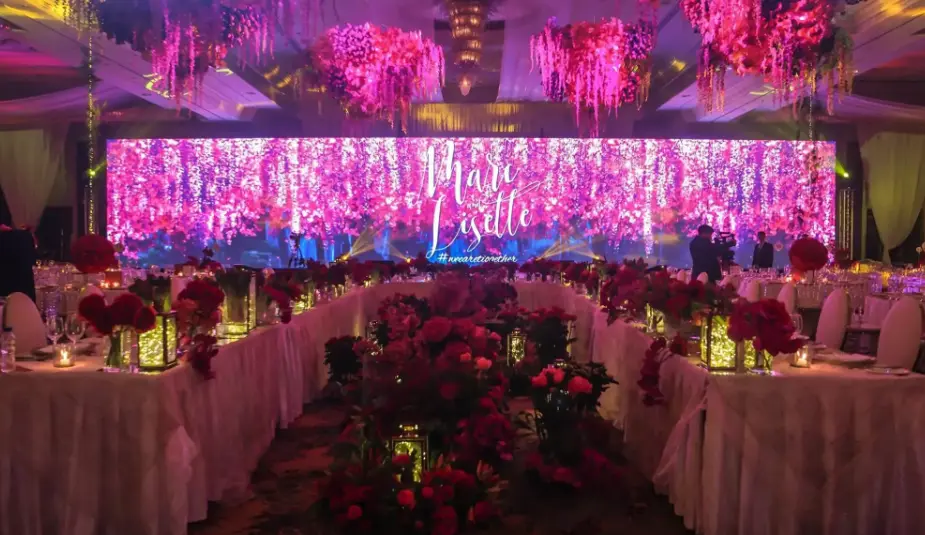
A wedding LED wall is a modular direct-view LED display used as a dynamic stage background, photo backdrop, live-video surface, or visual centerpiece during a ceremony and reception. Unlike a printed backdrop, fabric curtain, or conventional projector, the LED display generates its own light and can change content throughout the event.
That difference has practical consequences for event planners and AV companies.
A printed backdrop provides one fixed visual environment. An LED display can show a romantic animation during guest arrival, a couple’s photos during the ceremony, a live camera feed during speeches, branded graphics during sponsor activations, and a different visual sequence during the reception—all on the same physical installation.
For a B2B buyer, therefore, the value is not simply visual impact. It is content flexibility and asset utilization.
A rental company can use the same LED cabinets for weddings, conferences, exhibitions, concerts, corporate events, and brand activations. A hotel or wedding venue can deploy a permanent display across multiple event types. An event production company can build different stage configurations from standardized cabinets instead of purchasing a separate backdrop for every visual concept.
How an LED Wall Background Changes the Wedding Stage
A properly designed LED backdrop can occupy the entire stage width, frame the couple, create a central visual focal point, or form multiple independent display zones.
Common configurations include:
| Configuration | Typical Use | Main Benefit | Key Engineering Consideration |
|---|---|---|---|
| Full-width LED backdrop | Ceremony and reception | Maximum visual coverage | Stage width and viewing distance |
| Center LED wall | Smaller ballroom | Lower equipment cost | Content framing |
| Split LED screens | Large stage | Creates depth and visual hierarchy | Signal routing |
| Curved LED wall | Premium weddings | Immersive appearance | Cabinet geometry |
| LED side screens | Large venues | Improves rear-row visibility | Synchronization |
| Photo/entrance LED wall | Guest arrival | Interactive visual experience | Close viewing distance |
For a rental company, modularity matters. A lightweight rental cabinet with fast-locking connections can reduce load-in time and labor requirements. For the end customer, that technical feature becomes a business benefit: faster installation means fewer labor hours, less venue disruption, and more predictable event preparation.
How Much Does a Wedding LED Wall Cost?
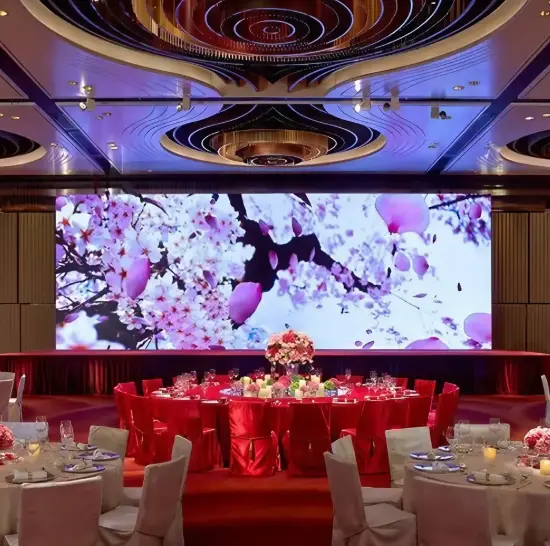
The price of a wedding LED wall depends less on the word “wedding” than on the technical specification and project logistics.
A professional quotation should consider at least:
| Cost Factor | What Determines the Cost | Business Impact |
|---|---|---|
| LED display area | Width × height | Directly affects panel quantity |
| Pixel pitch | P2.6, P2.9, P3.9, etc. | Smaller pitch generally increases pixel density and equipment cost |
| Cabinet type | Standard, lightweight, curved | Influences transportation and installation |
| Processor | Inputs, resolution and processing | Determines signal flexibility |
| Rigging | Ground support or suspended structure | Affects labor and venue requirements |
| Transportation | Distance and cargo volume | Can become significant for large rental walls |
| Installation | Crew size and setup complexity | Directly affects labor cost |
| Technician | Event duration and operating requirements | Adds operational reliability |
| Content production | Animation, graphics and video | Determines visual customization |
| Backup equipment | Spare modules/cabinets | Reduces event-day failure risk |
A low quotation can therefore be misleading if it excludes installation, transportation, rigging, processing equipment, or technical support.
For B2B buyers, the better question is not “What is the cheapest LED wall?” but:
What configuration provides the required visual performance at the lowest practical total project cost?
That distinction becomes particularly important when comparing a rental LED display with a purchase.
What Is Included in a Professional LED Wall Rental?
A professional event quotation may include:
- LED cabinets and modules
- LED receiving cards
- Video processor
- Signal cables
- Power distribution
- Structural support
- Transportation
- Installation
- Testing and calibration
- On-site technician
- Dismantling
The exact package varies by supplier and venue.
Some professional rental providers now market complete packages that combine delivery, setup, operation, and teardown rather than supplying panels alone. Current event-market offerings also demonstrate how strongly buyers value camera-safe refresh rates and turnkey deployment.
For an event planner, this matters because the LED wall is part of a temporary production system—not an isolated hardware purchase.
What Size LED Wall Do You Need for a Wedding?
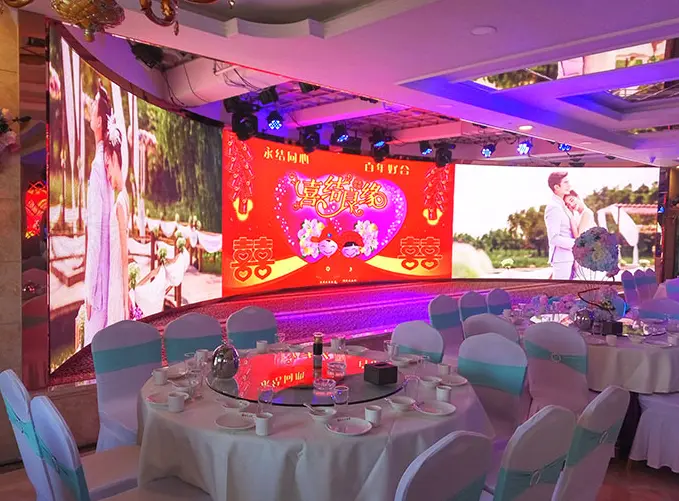
There is no universal “best” LED wall size for a wedding.
The screen should be sized according to stage width, viewing distance, venue architecture, guest count, content composition, and camera framing.
A useful starting point is to determine the physical stage first. If the LED wall is significantly narrower than the stage, the visual composition can feel disconnected. If it is excessively wide, the additional rental and installation cost may provide little benefit.
For example:
| Wedding Environment | Typical LED Wall Direction | Primary Consideration |
|---|---|---|
| Small ballroom | 3 × 2 m to 4 × 2.5 m | Close viewing |
| Medium ballroom | 4 × 2.5 m to 6 × 3 m | Stage coverage |
| Large reception | 6 × 3 m to 8 × 4 m | Audience visibility |
| Grand indoor event | 8 m+ width | Stage architecture |
| Outdoor wedding | Larger modular configuration | Ambient light and weather |
| Photo/entrance area | Vertical or custom format | Close-range image quality |
These are planning ranges rather than rigid specifications. The actual dimensions should be calculated from the venue and stage design.
Why Stage Width Matters More Than Guest Count
Guest count is useful, but it should not be the first engineering variable.
A 300-person wedding held in a narrow ballroom can require a very different LED configuration from a 300-person outdoor reception.
The key questions are:
- How wide is the stage?
- How far is the closest viewer?
- How far is the furthest meaningful viewer?
- Where will the main cameras be positioned?
- Will the LED wall appear in close-up shots?
- What aspect ratio will the content use?
This approach prevents a common procurement mistake: buying an LED wall based solely on the number of guests.
What Pixel Pitch Is Best for a Wedding LED Screen?
Pixel pitch is the distance between the centers of adjacent LED pixels, measured in millimeters. A smaller pixel pitch places more pixels into the same physical area, producing greater pixel density and generally allowing the screen to maintain image detail at shorter viewing distances.
For wedding applications, P2.6, P2.9 and P3.9 are particularly relevant for indoor rental configurations, although the correct selection depends on the venue.
The commercial logic is straightforward:
Smaller pixel pitch → higher pixel density → better close-range detail → higher equipment cost.
That final point matters. Buying the finest available pixel pitch is not automatically the best investment.
Industry guidance from Daktronics states that pixel pitch directly affects optimal viewing distance, with smaller pitches appropriate for closer-viewing environments and larger pitches more suitable for longer-distance applications.
P2.6 vs. P2.9 vs. P3.9 for Wedding Events
| Pixel Pitch | Typical Positioning | Suitable Wedding Use | Commercial Trade-Off |
|---|---|---|---|
| P2.6 | Fine pitch | Premium ballroom, close viewing, photography | Higher cost, better close-range detail |
| P2.9 | Fine/mid pitch | Ballroom, stage backdrop, reception | Strong balance of detail and cost |
| P3.9 | Mid pitch | Larger ballroom, event rental, longer viewing | Lower cost and practical scalability |
| P4.8 | Coarser pitch | Large venues and selected outdoor applications | Better for greater viewing distances |
The correct choice should be based on the closest meaningful viewing position rather than the distance from the screen to the back wall.
A P3.9 display can be entirely appropriate for a large wedding where the nearest audience members are several meters away. Conversely, a P3.9 display placed immediately behind a couple during close-up photography may reveal more pixel structure than the event producer wants.
A useful industry rule of thumb is that minimum comfortable viewing distance in meters is approximately related to pixel pitch in millimeters. Daktronics gives a roughly 3× pixel-pitch relationship in feet, while other professional display guidance uses similar distance-to-pitch relationships as starting points rather than absolute engineering limits.
The important word is starting point.
Content, camera position, display size, viewing angle, and human visual acuity can all change the practical result.
Why Fine Pixel Pitch Can Improve Wedding Photography
Wedding photography is unusually demanding because the display may sit directly behind the subjects.
Consider a bride standing three meters from a P3.9 LED wall. The photographer may frame the bride, groom, wedding dress, floral decoration, and LED background in the same shot. At that distance, the pixel structure is more relevant than it would be at the rear of a 20-meter event hall.
A finer pitch increases pixel density, which can produce smoother gradients, finer background details, and cleaner close-up imagery.
But there is a second issue that pixel pitch alone cannot solve:
camera performance.
A high-resolution LED wall can still produce poor photographs if its refresh characteristics, scan behavior, brightness, or camera settings are inappropriate.
That is why professional wedding LED specification should move beyond the simple question of “What P value is the screen?”
Why Refresh Rate Matters for a Camera-Friendly Wedding LED Wall
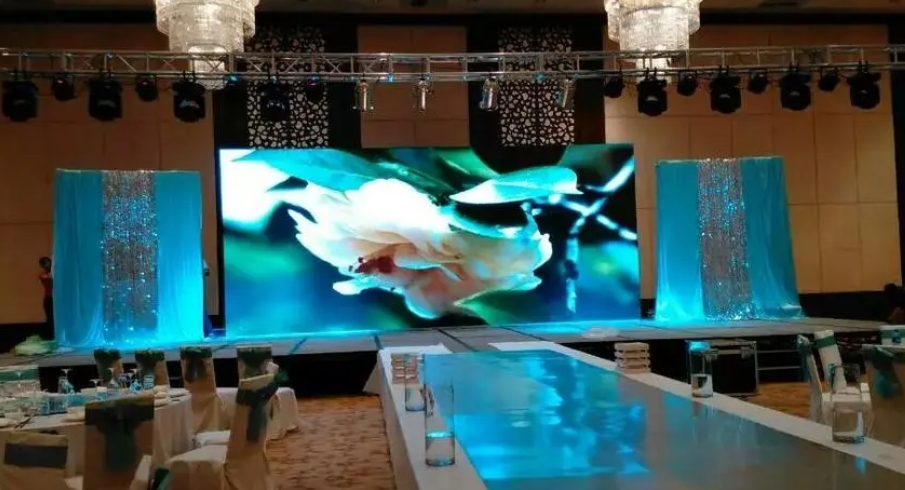
The LED wall may look perfectly stable to guests while producing dark bands, flicker, or uneven exposure through a camera.
This happens because the human eye and a camera sensor do not capture the LED refresh cycle in the same way. Camera exposure, shutter speed, LED driver behavior, scan configuration, and refresh rate interact with one another.
For a wedding production company, this is not a cosmetic specification.
It directly affects:
- Professional wedding photography
- Cinematography
- Live IMAG
- Social-media video
- Livestreaming
- Highlight reels
- Venue promotional footage
Current professional event LED rental offerings commonly specify 3,840Hz or higher when camera performance is important, with some premium systems offering 7,680Hz.
Is 3,840Hz Refresh Rate Enough for Wedding Events?
For many camera-critical indoor wedding applications, 3,840Hz is a sensible specification target rather than treating refresh rate as an afterthought.
The feature-to-benefit relationship is straightforward:
3,840Hz+ refresh rate → cleaner camera capture → fewer visible scan artifacts → better wedding footage → lower risk of disappointing the client.
However, refresh rate is not a magic number.
The camera’s shutter speed, exposure settings, LED processor configuration, driver IC, scan mode, and electrical environment can also affect the captured image. A supplier should therefore demonstrate the actual display under camera conditions instead of merely writing “high refresh rate” on a quotation.
For an AV rental company, this is an important supplier qualification test.
Ask to see:
LED wall + professional camera + actual content + actual operating brightness.
A specification sheet is useful. A real test is better.
Why Brightness Must Be Matched to the Wedding Venue
Brightness is another specification that should be selected according to the environment.
A display installed inside a dark ballroom does not need the same brightness strategy as a wedding held outdoors in direct sunlight.
Excessive brightness indoors can create its own problems. It can overpower skin tones, distract from stage lighting, and make the display look visually disconnected from the rest of the production.
Outdoor applications are different. Ambient sunlight can overwhelm a display that is perfectly adequate indoors.
Therefore:
Indoor wedding → controlled brightness + color accuracy + comfortable viewing
Outdoor wedding → higher brightness + weather protection + environmental control
The engineering objective is not maximum brightness. It is sufficient brightness with controllable image quality.
That distinction becomes especially important when the LED wall is used as the visual background behind the bride and groom, because facial exposure and background luminance must work together rather than compete.
Indoor vs. Outdoor Wedding LED Walls: Which Should You Choose?
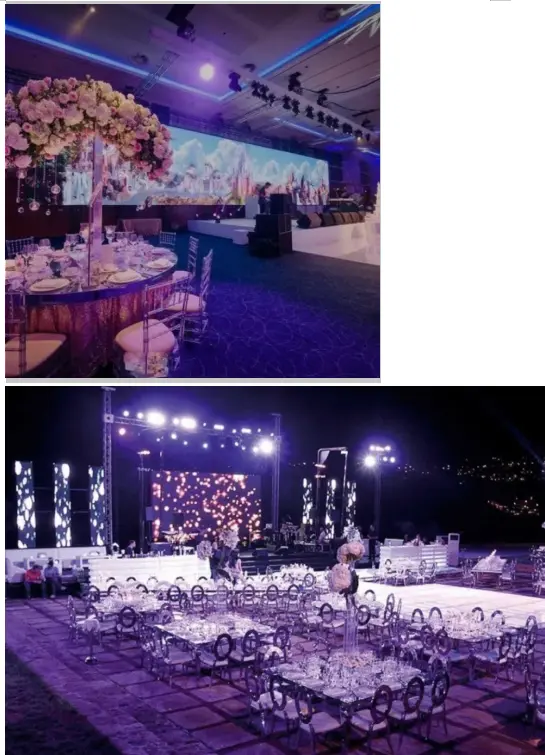
The venue determines more than the brightness specification.
An indoor ballroom generally offers:
- Controlled ambient lighting
- Stable temperature
- Lower environmental exposure
- Shorter viewing distances
- Greater demand for fine pixel pitch
An outdoor wedding introduces:
- Direct or variable sunlight
- Wind loading
- Rain and moisture
- Longer viewing distances
- More demanding structural requirements
- Higher brightness requirements
For outdoor deployment, the cabinet and module design should be appropriate for the environment, including suitable weather protection such as an IP65-rated configuration where required.
The benefit to the buyer is straightforward: appropriate environmental protection reduces the probability that weather becomes an operational failure point.
What Changes for Garden, Beach and Marquee Weddings?
Garden and beach weddings require additional planning because the LED wall becomes part of a temporary outdoor structure.
The project team should verify:
- Ground conditions
- Wind exposure
- Rain protection
- Power availability
- Cable routing
- Structural support
- Viewing direction
- Sun position
- Installation and dismantling time
A wedding LED backdrop may look like a simple rectangle on a design drawing. In the field, it is a temporary electrical and structural system.
That is where engineering experience matters.
A supplier that only sells LED cabinets can provide hardware. A commercial LED display solution provider should be able to evaluate the complete deployment—from pixel pitch and cabinet configuration to power, signal, installation, testing, and technical support.
Which Wedding LED Wall Layout Is Best for Your Stage?
Once the core LED specifications have been established, the next decision is how the display should interact with the stage. A technically excellent LED wall can still produce a weak result if its proportions fight the stage architecture, block lighting fixtures, or leave important visual areas outside the camera frame.
For professional event companies, the display should be designed as part of the stage—not added to it afterward.
Full-Stage LED Backdrop
A full-width LED backdrop is the most straightforward configuration for wedding ceremonies and receptions. It creates one continuous visual surface behind the stage and works particularly well when the production team needs to switch frequently between decorative graphics, couple portraits, video playback, and live camera feeds.
The commercial advantage is flexibility. One display can serve multiple event segments without physically changing the backdrop.
However, the screen should not automatically fill every available centimeter. The stage width, ceiling height, lighting positions, speaker locations, and camera sightlines should be reviewed first.
Split LED Screens for a More Layered Stage
A split configuration uses two or more LED surfaces with a physical gap between them. This can create visual depth while leaving space for the couple, musicians, floral arrangements, or scenic elements.
For example, a central LED screen can display the couple’s names while two side screens carry complementary motion graphics.
This approach is particularly useful for large wedding stages where a single continuous wall would make the visual environment feel flat.
Curved LED Walls for Immersive Wedding Designs
Curved rental LED cabinets can create a more architectural stage. They are useful when the production concept calls for a panoramic background, circular composition, or immersive visual effect.
The engineering challenge is content mapping. A curved display changes the relationship between the physical screen geometry and the image canvas. Content should therefore be prepared for the actual cabinet arrangement rather than simply stretched across the final wall.
For event rental companies, compatible curved cabinets can also increase inventory flexibility because the same panels may be deployed in concerts, exhibitions, product launches, and experiential installations.
LED Walls with Side Screens
For larger venues, side screens can solve a different problem: audience visibility.
The central wall serves as the primary scenic surface while auxiliary displays provide close-up camera feeds to guests sitting far from the stage.
This is especially useful when the wedding includes:
- Live speeches
- First-dance performances
- Musical performances
- Ceremony close-ups
- Guest interaction
- Live camera switching
The objective is no longer simply creating a beautiful background. It is ensuring that the entire audience can follow what is happening on stage.
What LED Cabinet Should You Choose for Wedding Events?
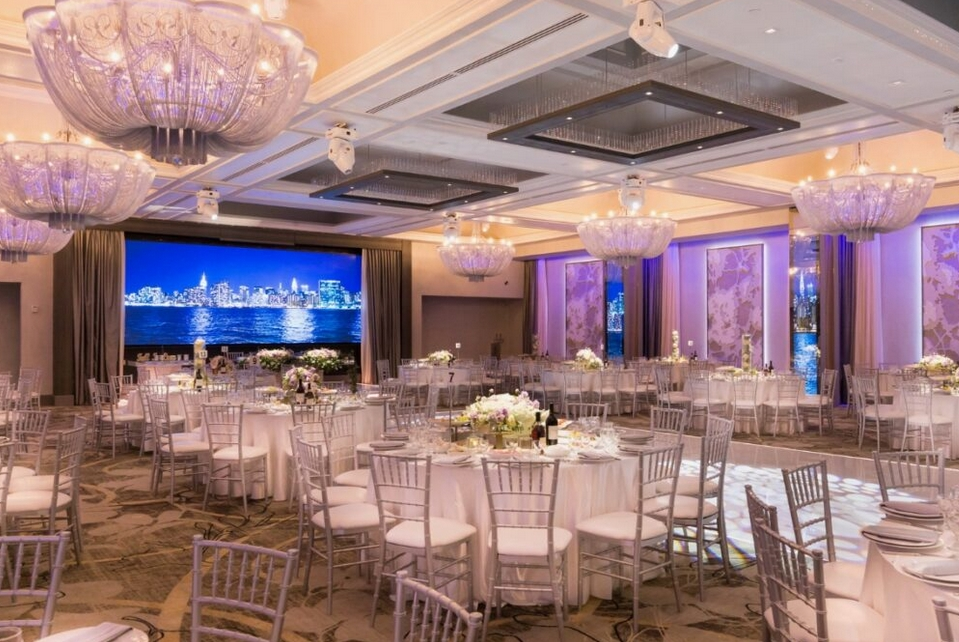
For temporary wedding applications, cabinet construction can be just as important as pixel pitch.
A rental LED display is repeatedly transported, assembled, dismantled, packed, and transported again. That operating cycle places demands on the cabinet frame, locking system, connectors, module protection, and serviceability.
| Cabinet Feature | Technical Function | B2B Benefit |
|---|---|---|
| Lightweight aluminum cabinet | Reduces cabinet mass | Easier transport and faster installation |
| Fast-lock mechanism | Connects adjacent cabinets quickly | Reduces load-in labor |
| Integrated power/data connectors | Simplifies connections | Fewer loose connections during setup |
| Front maintenance | Allows module access from display face | Useful where rear access is restricted |
| Rear maintenance | Provides service access from behind | Convenient for permanent or accessible stages |
| Curved compatibility | Supports concave/convex configurations | Expands creative rental applications |
| Reinforced corners | Protects cabinet during handling | Lower risk of transport damage |
| Calibration-compatible modules | Maintains image consistency | Better visual uniformity across repeated events |
For an event company, these are not merely engineering details.
A cabinet that takes less time to assemble can reduce crew hours. A cabinet that survives repeated transportation can reduce maintenance expenditure. A cabinet with accessible modules can shorten troubleshooting time when an issue appears during a live event.
That is the Feature-to-Benefit relationship a B2B buyer should look for.
Why Cabinet Weight Matters for Event Logistics
A large wedding display may contain dozens or hundreds of cabinets. A few kilograms saved per cabinet can become a substantial difference in total transportation weight and installation handling.
Weight also affects structural planning.
A supplier should provide cabinet dimensions, cabinet weight, connection method, support requirements, and installation recommendations before the equipment reaches the venue.
Do not leave structural questions until the morning of the event.
How to Install a Wedding LED Wall Safely
LED panels are only one part of the installation system. A complete event deployment may include structural support, power distribution, signal processing, cable management, safety systems, and access equipment.
The installation method should be selected according to the venue rather than the convenience of the supplier.
Ground-Supported vs. Truss-Mounted LED Walls
Ground-supported systems are generally suitable when the venue provides sufficient floor space and the stage design allows a rear support structure.
Suspended or truss-mounted configurations can preserve floor space and create a cleaner stage, but they introduce additional structural and rigging requirements.
The engineering team should verify:
- Total display weight
- Support structure capacity
- Rigging points
- Wind exposure for outdoor installations
- Floor conditions
- Cable routing
- Emergency access
- Maintenance access
An IP rating does not replace structural engineering. Similarly, a strong LED cabinet does not automatically make a temporary structure safe.
Power Distribution and Signal Connections
Large LED walls can involve substantial electrical loads, particularly at high brightness.
The project team should distinguish between average operating consumption and maximum design load. Power distribution should be designed with appropriate capacity and protection rather than based solely on an average wattage figure.
The signal path should also be mapped before installation:
Content source → video processor → sending system → receiving cards → LED cabinets
A wedding production may involve laptops, media servers, cameras, switchers, and other sources. The processor must support the required input formats and resolution.
A technically correct signal architecture reduces the chance of discovering compatibility problems after the screen has already been installed.
Pre-Event Testing and LED Calibration
A professional deployment should be tested before guests enter the venue.
The checklist should include:
- Dead pixels
- Module consistency
- Brightness uniformity
- Color consistency
- Signal stability
- Processor configuration
- Content resolution
- Camera feed
- Power distribution
- Emergency spare modules
- Cable connections
Calibration is particularly important when multiple cabinets are assembled from different batches or when a rental fleet has experienced repeated transportation.
A screen can be technically operational while still looking visually inconsistent. One cabinet with a different brightness or color temperature can become surprisingly obvious on a large white wedding background.
How to Prepare Content for a Wedding LED Wall
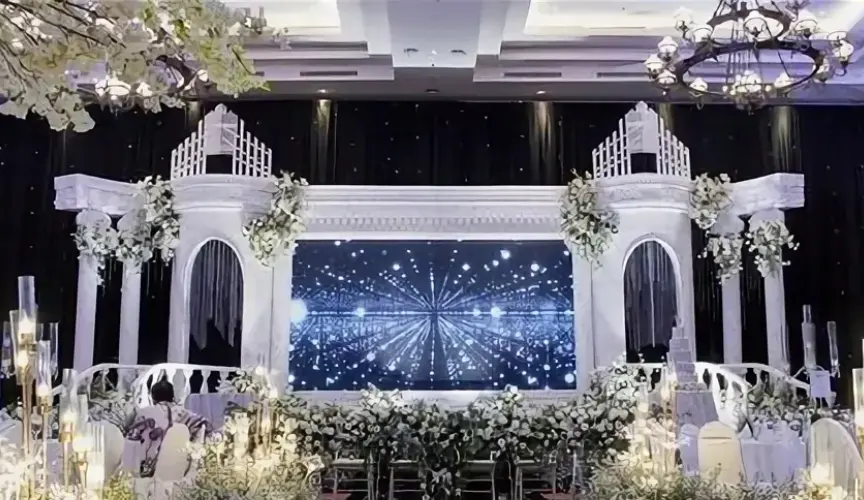
The physical display is only half of the visual system. Content must be designed for the actual pixel dimensions and aspect ratio of the LED wall.
A common mistake is taking a conventional 16:9 video and forcing it onto a custom LED backdrop without considering how the image will be cropped.
Recommended Content Workflow
Before production begins, the event team should confirm:
- Physical screen dimensions
- Pixel resolution
- Processor output resolution
- Content aspect ratio
- Camera-feed format
- Playback frame rate
- Safe areas for text and logos
For example, if the display is significantly wider than a conventional 16:9 canvas, the designer can use the additional horizontal space for decorative graphics rather than enlarging the original video until important subjects are cropped.
How to Avoid Stretched or Cropped Wedding Content
Content designers should create a master canvas based on the actual LED configuration.
Important elements such as:
- Couple names
- Wedding dates
- Logos
- Sponsor messages
- Faces
- Key text
should remain inside a defined safe area.
This becomes particularly important with curved or split LED configurations. The content processor and media server should know exactly how the physical cabinets are arranged.
Live Camera Feed and Switching
A live camera feed turns the LED wall from a passive backdrop into part of the event production system.
The production team may switch between:
- Pre-produced wedding graphics
- Couple portraits
- Live camera
- Speeches
- Presentation slides
- Video montages
- Sponsor content
The processor and switching architecture therefore need to be planned before the event rather than added during setup.
For venues and AV companies, reliable source switching is part of the service quality being sold to the client.
Should You Rent or Buy a Wedding LED Wall?
For a one-off wedding, renting is usually the more rational choice. For an event company, hotel, venue, or rental operator with recurring demand, ownership can become economically attractive.
The correct decision depends on utilization rather than emotion.
| Buyer Type | Recommended Approach | Main Reason | Key Consideration |
|---|---|---|---|
| One-time event organizer | Rent | Avoids equipment ownership | Compare all-in rental cost |
| Wedding planner | Usually rent | Variable event requirements | Build supplier relationships |
| Hotel / banquet venue | Consider buying | Recurring utilization | Storage and maintenance |
| AV production company | Buy or fleet-rent | Repeated deployment | Inventory compatibility |
| LED rental company | Buy | Multiple revenue-generating events | Utilization rate |
| Wedding venue group | Buy | Standardized recurring applications | Multi-location support |
Current wedding LED rental benchmarks vary widely by market and configuration. Recent supplier guides place standard wedding rental configurations anywhere from hundreds to several thousand U.S. dollars per event, with screen size, pixel pitch, installation, transportation, and technical support being major variables.
That spread is exactly why buyers should avoid comparing headline rental prices without checking what is included.
When Does Buying Make Sense?
Ownership becomes more compelling when the equipment can generate revenue repeatedly.
Suppose an AV company uses the same rental LED inventory for:
- Weddings
- Corporate conferences
- Concerts
- Exhibitions
- Product launches
- Hotel events
The asset is no longer a wedding expense. It becomes reusable production inventory.
The calculation should include:
Purchase Cost + Shipping + Storage + Maintenance + Financing
versus:
Cumulative Rental Cost + Transport + Setup + Technician Fees
The break-even point depends heavily on utilization, local rental rates, equipment life, and resale value. A supplier should therefore model the buyer’s actual annual event volume instead of offering a generic “buy after X events” claim.
How to Choose a Wedding LED Wall Supplier
A professional supplier should be evaluated as an engineering partner, not simply as a source of LED panels.
Start with the manufacturer’s ability to provide a complete technical specification.
Check the LED Display Manufacturing Capability
Ask whether the supplier can provide:
- Product specifications
- Cabinet drawings
- Module information
- Driver IC information
- Power requirements
- Brightness specifications
- Refresh-rate specifications
- Maintenance instructions
- Testing procedures
A factory-direct relationship can also simplify technical communication because the buyer is closer to the actual product engineering and manufacturing team.
Compare More Than Pixel Pitch
A supplier quoting “P2.6” does not automatically offer the same product quality as another supplier quoting P2.6.
Compare:
- LED package
- Driver IC
- Scan mode
- Refresh rate
- Grayscale
- Contrast
- Brightness
- Calibration
- Cabinet construction
- Module protection
- Power supply
- Processor compatibility
Pixel pitch determines pixel density. It does not describe the entire display.
Ask About Testing and Quality Control
For rental equipment, testing should include more than powering the screen on for a few minutes.
Ask about:
- Module testing
- Cabinet testing
- Aging testing
- Brightness consistency
- Color uniformity
- Signal stability
- Power stability
- Spare-parts availability
The purpose of aging testing is simple: identify potential failures before the equipment reaches the event site.
Confirm Warranty and Spare Parts Support
Wedding events are deadline-driven. There is no convenient “we will repair it next week” option when the ceremony begins in two hours.
The supplier should clarify:
- Warranty period
- Response time
- Spare module availability
- Receiving-card replacement
- Power-supply replacement
- Remote technical support
- Installation guidance
This is where after-sales service becomes a commercial feature rather than a footnote.
Why Choose Sostron for Wedding LED Wall Solutions?
Sostron approaches wedding LED applications as part of a broader commercial LED display engineering capability rather than as a decorative product category.
As a Global LED Display Screen Manufacturer & Commercial Display Solution Provider, Sostron can support the project from specification and product selection through manufacturing, testing, logistics, installation guidance, and after-sales technical support.
Rental LED Displays for Fast Event Deployment
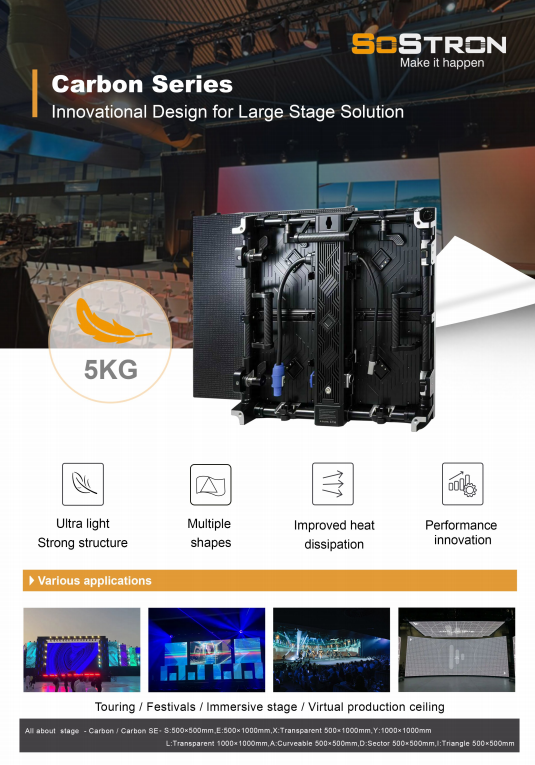
Sostron’s rental-oriented LED solutions are designed for temporary applications where transportation, assembly speed, cabinet handling, and repeated deployment matter.
That makes the configuration relevant not only to wedding planners but also to:
- Event rental companies
- Stage contractors
- AV integrators
- Hotels
- Exhibition companies
- Production agencies
Fine-Pitch LED Displays for Close Viewing
For indoor weddings where guests and cameras operate close to the backdrop, fine-pitch configurations can provide the pixel density needed for detailed visual content.
The right choice still depends on viewing distance and production requirements. Sostron’s role is to match the specification to the project rather than push the smallest available pixel pitch.
High-Refresh-Rate Displays for Camera-Critical Events
When the display appears in professional photography, livestreaming, or wedding video production, refresh rate should be treated as a project requirement.
A 3840Hz-class configuration is a practical target for many camera-facing event applications, but the final system should still be tested with the actual camera and operating conditions.
Custom and Curved LED Wall Solutions
Wedding stages are not always rectangular.
Sostron can support applications involving creative configurations, curved LED walls, transparent LED displays, fine-pitch indoor products, and other commercial display formats where the stage architecture demands something beyond a conventional flat wall.
Global Engineering and Technical Support
A wedding event may take place thousands of kilometers from the LED manufacturer. The ability to communicate technical requirements before shipment and provide installation guidance during deployment can therefore have more value than a small difference in the initial panel price.
Based on our experience with international LED projects, project documentation, configuration accuracy, spare-part planning, and technical communication often determine whether an installation runs smoothly long before the first cabinet is powered on.
Wedding LED Wall Buying Checklist
Before approving a quotation, use this checklist:
| Procurement Item | What the Buyer Should Confirm | Why It Matters |
|---|---|---|
| Application | Ceremony, reception, live feed, photography | Determines system configuration |
| Venue | Indoor, outdoor, ballroom, garden, beach | Determines environmental requirements |
| Screen size | Width, height, area | Controls visual coverage and cost |
| Viewing distance | Closest and farthest viewers | Determines practical pixel pitch |
| Pixel pitch | P2.6 / P2.9 / P3.9 / other | Controls pixel density and cost |
| Refresh rate | Camera-facing requirement | Reduces risk of camera artifacts |
| Brightness | Actual venue lighting | Prevents washed-out or overpowering images |
| Cabinet | Rental, fixed, lightweight, curved | Affects deployment and flexibility |
| Processor | Inputs and output resolution | Ensures source compatibility |
| Installation | Ground support or rigging | Determines structural planning |
| Power | Maximum design load | Supports safe electrical planning |
| Content | Native resolution and aspect ratio | Prevents distortion and cropping |
| Testing | Aging and pre-event testing | Reduces event-day failure risk |
| Spare parts | Modules, power supplies, cards | Speeds troubleshooting |
| Warranty | Coverage and response | Protects project investment |
| Technical support | Remote or on-site | Reduces operational risk |
If a supplier cannot answer these questions clearly, the quotation is not technically complete.
Wedding LED Wall FAQ
What is the best pixel pitch for a wedding LED wall?
For many indoor wedding applications, P2.6–P3.9 provides a practical balance between close-range image quality and project cost. The correct choice depends on the nearest viewer, camera distance, content detail, screen size, and venue. A finer pitch should be purchased because the application requires it—not simply because the number looks better on a specification sheet.
How much does a wedding LED wall cost to rent?
Rental pricing varies significantly by market, screen area, pixel pitch, rental duration, installation, transportation, rigging, and technician requirements. Recent market examples range from roughly hundreds to several thousand dollars per event. The safest way to compare quotations is to request an itemized, all-in price rather than comparing the panel rental alone.
What size LED screen do I need for a wedding?
Start with stage width, then verify viewing distance and camera framing. A small ballroom may need only a few square meters, while a large reception can require a much larger backdrop or multiple screens. Guest count is useful for planning, but it should not replace an actual venue and stage assessment.
Is 3840Hz refresh rate enough for a wedding LED screen?
For many professional wedding productions, 3840Hz is a sensible target when the LED wall will be filmed or livestreamed. However, refresh rate alone does not guarantee perfect camera footage. Shutter speed, scan mode, brightness, driver IC, processor configuration, and camera settings can all affect the final image. The best practice is to test the actual display with the intended camera setup.
Should I rent or buy an LED wall for weddings?
Renting normally makes more sense for a one-off event. Buying becomes more attractive for hotels, venues, AV companies, wedding planners, and rental operators that can repeatedly deploy the same inventory. The decision should be based on annual utilization, storage, maintenance, financing, transportation, and expected rental revenue rather than the purchase price alone.
Expert Verdict: Specify the System, Not Just the Screen
The best wedding LED display is not necessarily the biggest, brightest, or finest-pitch model available.
For most professional projects, the smarter specification is the one that matches viewing distance, camera requirements, stage dimensions, venue lighting, installation method, and total operating cost. For an event company, the winning system is one that can be deployed quickly, filmed cleanly, serviced efficiently, and reused across multiple revenue-generating events.
If the project involves a close-viewing indoor stage, start by evaluating P2.6–P2.9 and a camera-friendly 3840Hz-class configuration. For larger venues where viewers are farther away, P3.9 can often deliver the better balance between image quality and budget. Outdoor deployments require the additional engineering checks for brightness, weather protection, structure, and power.
The screen should serve the event—not become the event’s biggest technical risk.
For B2B buyers, that is the real value of working with an experienced LED display manufacturer: you are not simply buying cabinets; you are specifying a display system designed to perform when the lights go down and the cameras go live.
References:
ANSI E1.50-1 — Temporary LED & Display System Structures
Columbia University — LED Displays, Pixels & Flicker