For most B2B applications in 2026—including DOOH advertising,live events,control rooms,and retail immersion—direct-view LED curved video walls deliver superior ROI over LCD curved monitors.True DVLED solutions outperform in brightness,seamlessness,scalability,and long-term durability,especially for installations larger than 3-4 meters or in variable lighting.LCD remains viable only for smaller,budget-driven indoor setups with close viewing distances.
System integrators and event planners often face the same frustration:consumer-oriented comparisons blur the line between LED-backlit LCD panels and professional direct-view LED(DVLED)technology.This confusion leads to mismatched deployments that fail to deliver the wow factor or withstand 24/7 operation.Based on our experience delivering over 300 commercial LED video wall projects across North America,Europe,and Asia since 2018,the choice hinges on understanding real commercial metrics—not retail marketing claims.
Understanding LCD vs LED Technology:Beyond Consumer Confusion
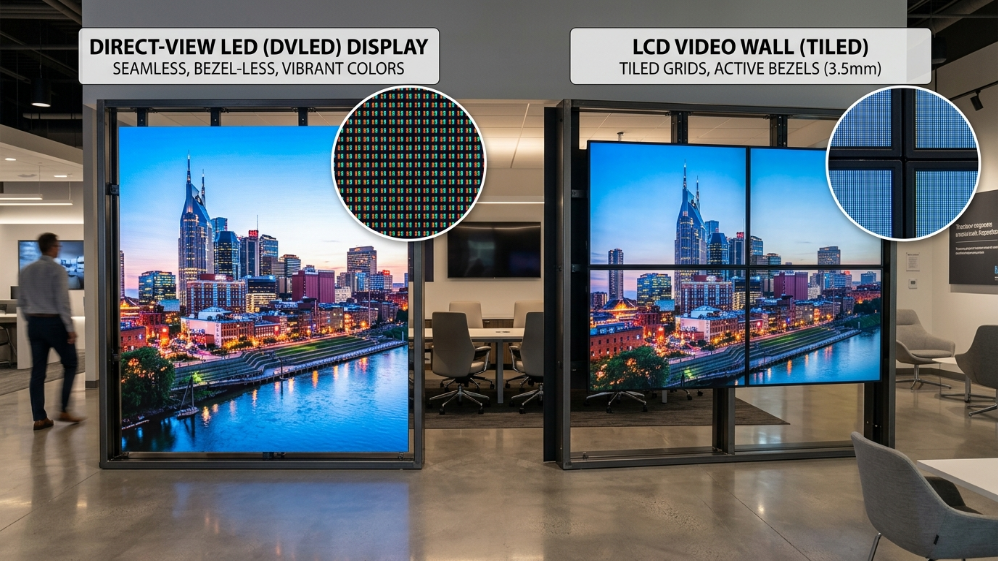
The core distinction starts with how each technology produces an image.LCD video walls rely on liquid crystal panels with LED backlighting.Multiple 55-inch or 65-inch panels are tiled together,creating a grid where even ultra-narrow bezels(0.88mm–3.5mm)introduce visible lines that break immersion.
Direct-view LED(DVLED)panels,by contrast,use an array of self-emissive SMD,COB,or GOB LEDs where each pixel generates its own light.No backlight,no liquid crystals,and—most importantly for curved applications—no rigid panel constraints.This modular approach allows true bezel-free tiling and flexible curvature.
Key Technical Differences at a Glance(2026 B2B Metrics)
| Aspect | LCD Video Walls | Direct-View LED Curved Walls | B2B Commercial Impact |
|---|---|---|---|
| Image Formation | Backlit LCD panels | Self-emissive LEDs(SMD/COB) | LED eliminates backlight uniformity issues for consistent branding |
| Seamlessness | Visible bezels(0.88mm+) | Truly seamless | LED creates single-canvas immersion critical for DOOH and events |
| Typical Brightness | 500-700 nits | 800-5000+nits | LED dominates high-ambient retail/airport environments |
| Scalability | Limited by panel sizes | Fully modular,any dimension | LED supports massive or custom curved installs without compromise |
| Curvature Flexibility | Expensive&limited | Convex,concave,cylindrical native support | LED enables unique architectural integration and viewer engagement |
This table highlights why many of our integrator clients switched to DVLED after one failed LCD refresh cycle.
Picture Quality,Brightness&Immersion:Which Delivers Better Visual Impact?
Contrast,Color Accuracy,and Black Levels in Real-World B2B Environments
LCD panels often advertise superior native contrast thanks to their crystal shuttering,but real-world performance tells a different story.Backlight bleed and viewing angle degradation become evident in tiled setups,especially when viewers move around an event space or retail atrium.Direct-view LED achieves exceptional contrast through precise current control per diode,delivering true blacks without halo effects.
According to 2026 industry deployment data,DVLED systems maintain consistent color gamut closer to Rec.2020 across wide viewing angles—essential for advertisers demanding brand-color fidelity from multiple perspectives.
Brightness(Nits)Showdown:Why LED Wins for DOOH and High-Ambient Light
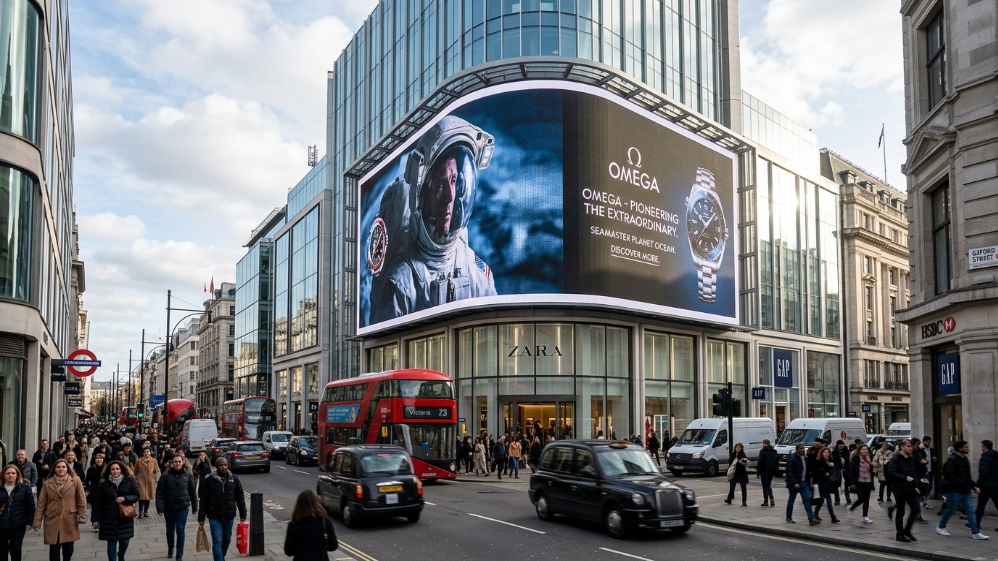
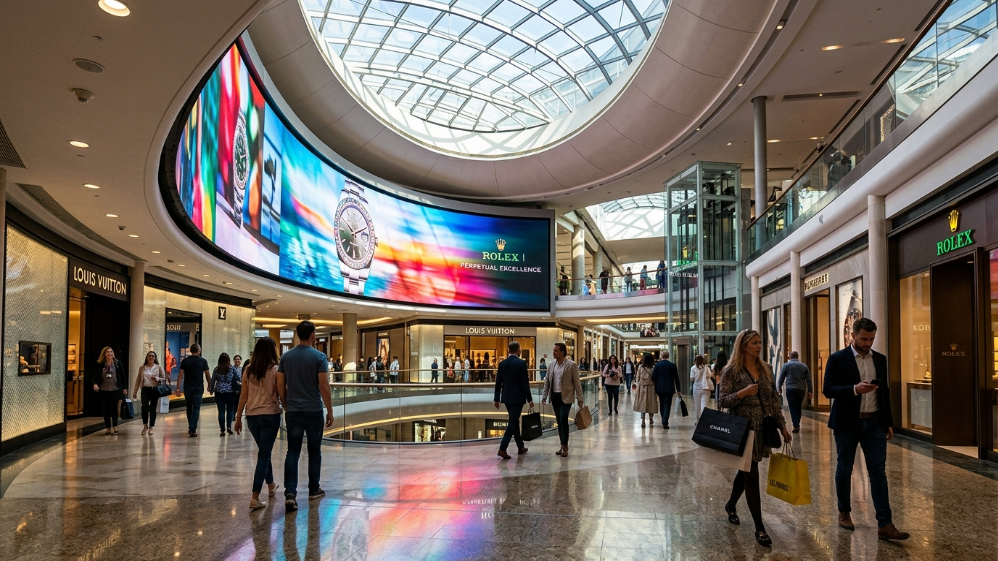
Brightness remains the clearest differentiator.While LCD tops out around 700 nits,high-performance DVLED video walls routinely deliver 1,500–5,000 nits indoors and higher outdoors.This translates directly to visibility:in brightly lit shopping malls or transportation hubs,an LED wall cuts through ambient light where LCD content washes out.
For event planners,this means reliable impact under stage lighting.A 3840Hz+refresh rate on modern LED panels eliminates moirépatterns on broadcast cameras—a common pain point with LCD walls during live streaming.The result?Smoother motion,higher viewer dwell time,and stronger sponsor ROI.
The Curved Advantage–Enhanced Immersion and Reduced Distortion for Events&Advertising
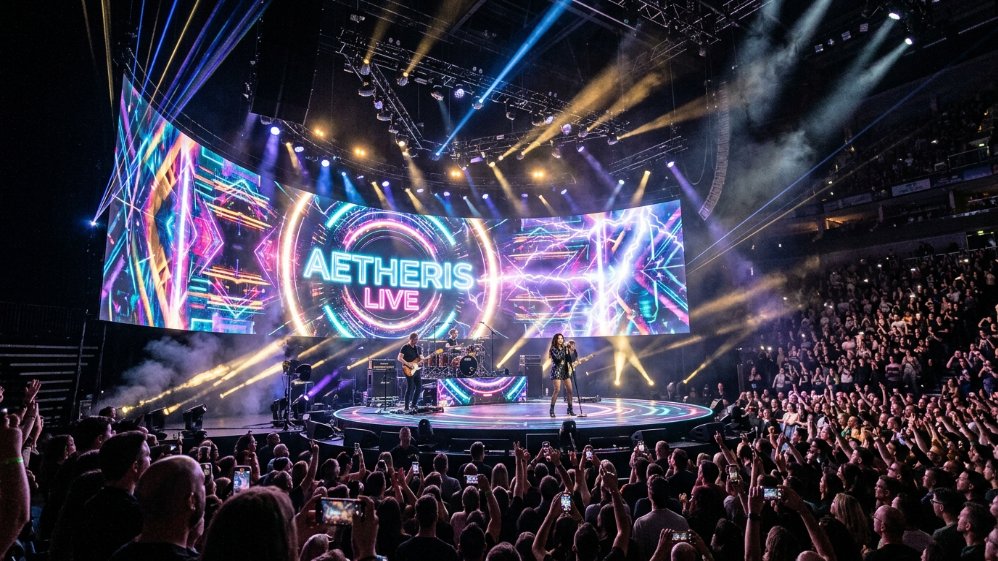
Curvature transforms passive viewing into active engagement.Direct-view LED modules support precise radii for convex,concave,or fully cylindrical configurations without sacrificing pixel alignment.This capability creates wrap-around experiences that LCD grids simply cannot match due to their rigid structure and bezel interruptions.
In practice,a concave curved LED video wall in a retail flagship store increases product interaction time by drawing eyes naturally across the display.For events,cylindrical LED pillars or arched stage backdrops deliver 360°impact that commands attention.The commercial benefit is measurable:higher foot traffic conversion and stronger emotional connection with content.
Design&Installation Flexibility:Why Curved LED Screens Excel for Custom Projects
Bezel-Free vs Bezelled:Seamless Video Walls for Professional Installations
The absence of bezels in DVLED systems creates a continuous visual canvas—critical when displaying fine text,data visualizations,or cinematic content.Integrators report that clients reject LCD video walls after seeing the”grid effect”in person during demos.Seamless LED tiling eliminates this distraction entirely.
Convex,Concave,and Cylindrical Curved LED Configurations(Use Cases for Events&Retail)
Modern LED panels with pixel pitches from P1.5 to P3.9 offer the sweet spot for most commercial curved applications in 2026.Finer pitches(P1.2–P2.5)suit control rooms and close-view retail,while P2.9–P3.9 works for larger event spaces.
Pixel Pitch&Optimal Viewing Distance Guide(2026 Recommendations)
| Pixel Pitch | Optimal Viewing Distance | Best B2B Use Cases | Commercial Benefit |
|---|---|---|---|
| P1.2–P1.8 | 2–6 meters | Conference rooms,luxury retail,studios | Ultra-sharp close viewing drives premium perception |
| P2.5–P2.9 | 5–12 meters | Corporate lobbies,event stages,DOOH | Balanced cost/performance for high-traffic areas |
| P3.9+ | 10+meters | Large arenas,outdoor advertising | Cost-effective scale with strong long-distance impact |
Data derived from current deployment guidelines shows that matching pitch to distance maximizes clarity while controlling project costs.
Scalability and Modular Design–From Small Rental Setups to Massive Video Walls
DVLED’s modular nature allows easy expansion or reconfiguration—a major advantage for rental and staging companies.Panels support front or rear maintenance access,reducing downtime.Combined with robust video processors,these systems handle complex content mapping across curved surfaces with minimal latency.
This flexibility directly lowers total cost of ownership(TCO).While upfront investment for premium curved LED exceeds LCD,the ability to reuse modules across multiple events or upgrade sections incrementally delivers faster payback.According to long-term client projects,well-specified DVLED installations often achieve positive ROI within 18–24 months through reduced maintenance,higher energy efficiency in targeted operation,and superior audience engagement metrics.
Durability,Energy Efficiency&Total Cost of Ownership(TCO)for B2B Buyers
Building on the modular scalability that makes direct-view LED curved walls so adaptable,the real decision for system integrators and DOOH operators often comes down to long-term performance under pressure.
Lifespan,Maintenance&24/7 Reliability Comparison
Direct-view LED panels routinely achieve 50,000–100,000 hours of operational life,with many SMD and COB configurations delivering consistent performance well beyond that when properly managed.LCD video walls,constrained by backlight degradation,typically range from 30,000–60,000 hours before noticeable dimming or uniformity issues appear in tiled setups.
Based on our experience with over 300 commercial LED video wall projects,front or rear maintenance access on DVLED systems allows individual module swaps in minutes—often without dismantling the entire structure.This modularity proves invaluable for rental companies and 24/7 DOOH networks where downtime directly impacts revenue.LCD tiled walls require replacing entire panels,increasing both labor and parts costs when bezel alignment must be recalibrated across the array.
Energy Savings and Operational Costs:Long-Term ROI Analysis
High-brightness LED walls might consume more power at peak output,yet modern designs with intelligent brightness sensors and efficient drivers often achieve 40–70%better energy profiles than older systems in real deployments.The ability to run at optimal nits without constant full-power operation delivers measurable savings.
Upfront Investment vs Lifetime Value–Calculator Insights for Integrators
| Metric(5-Year Horizon) | LCD Curved Video Wall | DVLED Curved Video Wall | B2B Impact for Buyers |
|---|---|---|---|
| Typical Upfront Cost(per sqm) | Lower($800–$1,800) | Higher($2,500–$6,000+) | LCD wins short projects;LED for scale |
| Lifespan(Hours) | 30k–60k | 50k–100k+ | LED reduces refresh frequency |
| Annual Maintenance | Higher(panel-level failures) | Lower(modular swaps) | LED cuts service calls by 40–60% |
| Energy Efficiency | Moderate | Superior with sensors | LED lowers TCO in 24/7 DOOH |
| ROI Payback Period | 12–18 months(low-use) | 18–30 months(high-impact) | LED excels in high-traffic venues |
This comparison,drawn from 2026 field data across North American and European installations,shows why many clients accept higher initial LED investment for faster long-term returns through reduced downtime and stronger visual performance.
Best Use Cases:When to Choose LCD Curved vs LED Curved Displays
Ideal Scenarios for LCD Video Walls(Close Viewing,Budget Indoor)
LCD curved monitors or video walls still hold value for controlled environments with viewing distances under 5 meters and moderate ambient light.Corporate boardrooms,smaller retail boutiques,and budget exhibition booths benefit from their sharp native resolution at close range and lower entry price.The rigid panel structure works when perfect seamlessness isn’t mission-critical.
When LED Curved Monitors/Video Walls Are the Superior Choice(Events,DOOH,Control Rooms)
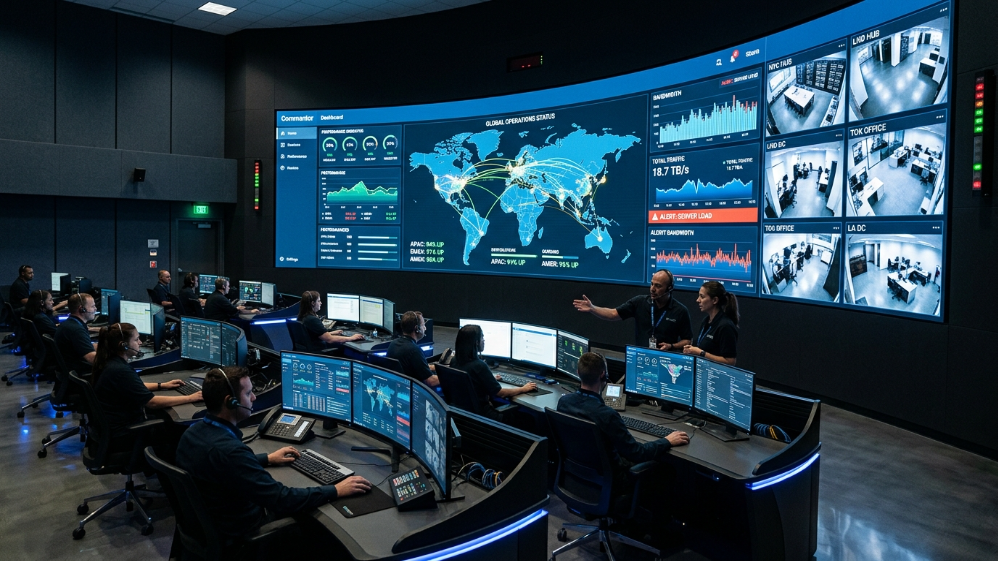
Direct-view LED curved solutions dominate whenever scale,immersion,or environmental resilience matters.Live events gain from flexible cylindrical or concave configurations that wrap content around audiences.DOOH advertisers benefit from 2,000+nits brightness that defeats sunlight and weather.Control rooms and command centers leverage wide viewing angles plus modular repair to maintain uninterrupted operations.Pixel pitch options from P1.5 to P3.9,combined with 3840Hz refresh rates,ensure flawless camera capture and viewer engagement.
Hybrid Approaches and Emerging Trends(Mini-LED,MicroLED)
Forward-thinking integrators increasingly deploy hybrid systems—using LCD for secondary information zones and premium DVLED for primary immersive surfaces.In 2026,Mini-LED backlighting improves LCD contrast,while MicroLED begins entering commercial production for ultra-fine pitch applications with even better efficiency and longevity.
How to Choose the Right Curved Display for Your Project–Buyer’s Checklist
Key Specifications to Evaluate(Pixel Pitch,Refresh Rate,Viewing Angle)
Prioritize pixel pitch based on primary viewing distance.Aim for 3840Hz+refresh rates on LED for broadcast compatibility.Verify 160°+horizontal/vertical viewing angles and IP ratings suited to your environment(IP30 indoor,IP65 outdoor).Color gamut coverage near Rec.2020 and HDR10 support ensure content pops as intended.
Installation Best Practices and Common Pitfalls to Avoid
Successful curved LED deployments start with precise structural engineering.Use calibrated mounting frames rated for the total load,maintain consistent ventilation gaps,and perform full color calibration after curvature assembly.Common mistakes include underestimating thermal expansion on large concave installs or mismatching content aspect ratios to the curve radius,which distorts branding visuals.Always conduct on-site mockups with final content before full rollout.
Future-Proofing Your Investment:Trends in Commercial Curved Displays
The industry moves toward finer pitches,greater energy efficiency,and smarter integration.MicroLED adoption accelerates for premium applications,offering superior brightness and lower power draw.Flexible and transparent LED modules expand creative possibilities for architectural integration.AI-driven content optimization and remote monitoring further reduce operational overhead while maximizing viewer impact.
Frequently Asked Questions
What is the main difference between LCD and true LED curved monitors for commercial use?
LCD uses tiled backlit panels with visible seams,while direct-view LED(DVLED)offers seamless,self-emissive modular construction ideal for curved video walls.
Are curved LED video walls worth the extra cost for events and DOOH?
Yes—the enhanced immersion,higher brightness,and bezel-free design typically deliver stronger audience engagement and faster ROI in high-visibility applications.
Which pixel pitch is best for a curved LED display in retail?
P1.5–P2.9 strikes the best balance for most retail and lobby installations,balancing sharpness with cost at typical 3–8 meter viewing distances.
How long do commercial curved LED walls actually last in 24/7 operation?
Quality DVLED systems routinely exceed 50,000–100,000 hours with proper thermal management and brightness optimization.
Can existing LCD video walls be upgraded to curved LED?
Yes,in most cases.Modular LED designs allow phased replacements or complete overhauls with minimal structural changes.
Expert Verdict
For the majority of B2B curved display projects in 2026 and beyond,choose direct-view LED when impact,scalability,or operating conditions demand excellence.Reserve LCD for tightly budgeted,small-scale indoor applications.Match the technology rigorously to your specific viewing distance,ambient light,and content goals—then partner with an experienced supplier who understands both the engineering and the commercial outcomes.The right choice doesn’t just display content.It drives measurable business results.
References:
National Association of Broadcasters (NAB) — Display Technology & Broadcast Standards