Table of Contents
ToggleLED screen prices in Peru typically range from $800–$2,200/m² for indoor displays and $1,500–$4,500/m² for outdoor, depending on pixel pitch, import tariffs, and local installation complexity. The final installed cost is usually 35–60% higher than the panel unit price alone, due to Peru-specific logistics, altitude considerations, and customs duties.
If you’re budgeting for a project in Lima, Arequipa, or anywhere along the Andean corridor, this guide is written to give you the numbers other suppliers won’t put on paper — and the technical reasoning behind every price tier.
What Drives LED Screen Prices in Peru: 4 Factors That Local Suppliers Won’t Always Tell You
Most buyers come to Peru’s LED market with a single number in mind — the per-square-meter panel price quoted by a Shenzhen exporter. That number is real, but it accounts for perhaps 50–65% of your actual project cost. The remaining gap is where projects go over budget.
Here’s what actually determines price.
1. Pixel Pitch & Panel Configuration — A $600/m² Decision You’re Making Without Realizing It
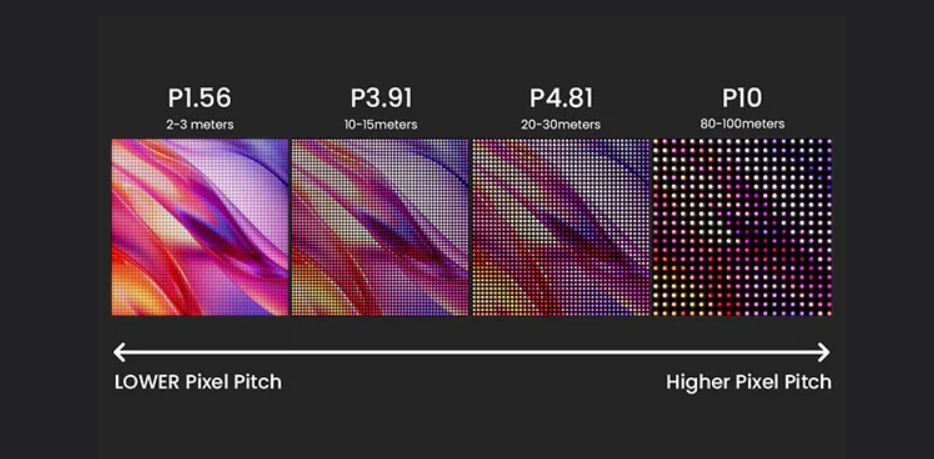
Pixel pitch is the single biggest technical lever on cost. It defines the density of LED chips per square meter, which directly drives component count, PCB complexity, and manufacturing yield rates.
In practical terms for the Peru market in 2026:
| Pixel Pitch | Application | FOB Shenzhen Price |
|---|---|---|
| P1.8 (indoor fine-pitch) | Control rooms, high-end retail, broadcast studios | $1,800–$2,200/m² |
| P2.5 (indoor standard) | Corporate lobbies, shopping malls, event stages | $1,100–$1,500/m² |
| P3 (indoor large-venue) | Auditoriums, sports facilities, conference rooms | $850–$1,100/m² |
| P4 (outdoor/semi-outdoor) | Outdoor advertising, facades, transit hubs | $1,200–$1,800/m² |
| P6 / P8 (outdoor billboard) | Highway billboards, large-format advertising | $900–$1,400/m² |
P1.8 (Indoor Fine-Pitch)
$1,800–$2,200/m² FOB Shenzhen. Used in control rooms, high-end retail, and broadcast studios. The price premium is real — at this density, a single defective chip is visible to the naked eye from 2 meters, so manufacturing tolerances are significantly tighter.
P2.5 (Indoor Standard)
$1,100–$1,500/m². The workhorse of corporate lobbies, shopping malls, and event stages in Lima. Solid balance between viewing distance (3–6m) and cost.
P3 (Indoor Large-Venue)
$850–$1,100/m². Appropriate for auditoriums, sports facilities, and large conference rooms where viewing distances exceed 5m.
P4 (Outdoor / Semi-Outdoor)
$1,200–$1,800/m². Most common for outdoor advertising installations, building facades, and transit hubs.
P6 / P8 (Outdoor Billboard)
$900–$1,400/m². Standard for highway billboards and large-format advertising where viewing distances exceed 10m.
The critical mistake buyers make is specifying a finer pitch than the application requires. A retail store that installs P1.8 instead of P2.5 is spending an extra $700/m² for no perceptible visual benefit at typical viewing distances.
Beyond pixel pitch, cabinet configuration matters. The industry has largely standardized around 500×500mm and 500×1000mm aluminum die-cast cabinets for rental and fixed-install respectively. Non-standard cabinet sizes — required for irregular facade installations or custom architectural projects — trigger tooling surcharges of $150–$400 per cabinet mold, which compounds quickly across large projects.
2. Import Tariffs & DAM Costs — The Hidden 12–18% Cost Layer
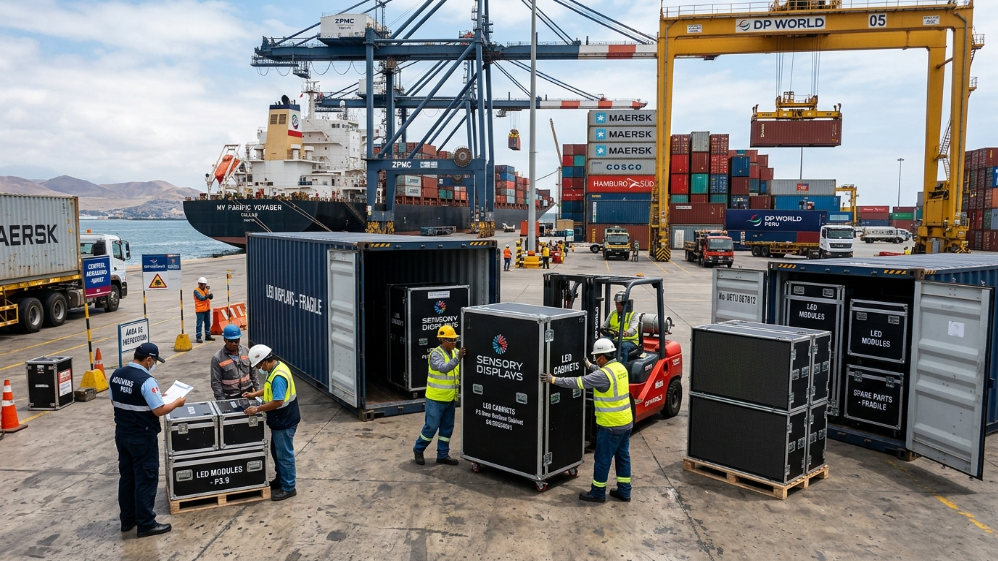
Peru applies import duties on LED display equipment under HS Code 8528.52 (monitors and displays) and related subheadings.
As of 2026, the combined effective cost of importing an LED screen system into Peru — factoring in ad valorem duty, IGV (Peru’s 18% VAT equivalent), and customs agent fees — adds 12–18% on top of CIF Lima value for most commercial-grade systems.
The process flows through a Declaración Aduanera de Mercancías (DAM) at Callao port.
What most buyers don’t factor in:
| Cost Item | Typical Cost |
|---|---|
| Customs agent (agente de aduana) fees | $200–$450 per shipment |
| Port handling and warehouse release | $180–$350 per container |
| SENASA/MINCETUR inspection surcharges | $100–$200 |
| Banking fees for L/C or T/T wire transfers | 0.1–0.25% of transaction value |
Additional Details
- Customs agent (agente de aduana) fees: $200–$450 per shipment, regardless of cargo value
- Port handling and warehouse release (ENAPU/APM Terminal): $180–$350 per container, with additional daily storage charges if DAM processing is delayed
- SENASA/MINCETUR inspection surcharges if electronics are flagged for secondary inspection: add 3–5 business days and $100–$200
- Banking fees for L/C or T/T wire transfers in USD: typically 0.1–0.25% of transaction value, rarely itemized in supplier quotes
The practical result: a system quoted at $50,000 FOB Shenzhen will land in your warehouse in Lima at approximately $60,000–$64,000 before installation begins.
Any quote from a supplier that doesn’t clarify Incoterms is a quote you cannot trust.
3. Brand Tier Reality: What You’re Actually Buying at Different Price Points
The LED display market has three broadly distinct supplier tiers, each with a different risk-reward profile for Peruvian buyers.
| Tier | Representative Brands | Typical FOB Price (P4 Outdoor) | Key Differentiator |
|---|---|---|---|
| Tier 1 (Global) | Absen, Unilumin, Leyard, Daktronics | $1,600–$2,200/m² | Full international warranty support, bin-matched LEDs, 5-year replacement parts guarantee |
| Tier 2 (Established OEM) | Liantronics, Verypixel, Radiant | $1,100–$1,600/m² | Solid quality, factory audit accessible, 3-year warranty with parts availability |
| Tier 3 (White Label / OEM) | Unnamed Shenzhen OEM factories | $750–$1,100/m² | Low upfront cost, high variability in component quality, limited post-sale support |
The Tier 3 risk is not theoretical.
In the Peru market specifically, the after-sales support gap becomes acute because:
- Replacement modules must be re-imported, triggering the full DAM process again (3–4 weeks minimum)
- Bin-mismatched replacement modules cause visible color uniformity issues on repaired sections
- Controller firmware updates require direct factory communication, which Tier 3 suppliers rarely maintain beyond 18 months post-sale
For permanent outdoor installations with a 5–7 year operational lifespan, Tier 1 or strong Tier 2 is almost always the financially rational choice once you price the total cost of ownership over the asset’s life.
4. Refresh Rate & Driving IC — Why Broadcast Screens Cost More Than Scoreboard Screens
This is a cost driver that never appears on a standard quote sheet, yet it can represent a $200–$500/m² price gap between visually similar-looking products.
Refresh rate — the number of times per second the display redraws its image — matters enormously for camera-visible applications.
A screen with a 3,840Hz refresh rate (required for broadcast and content production) uses a more expensive driving IC than a screen running at 960Hz (adequate for most advertising and information displays).
The driving IC — the chip that controls each row of LEDs — accounts for 8–15% of a panel’s total bill of materials.
Recommended Refresh Rates
| Application | Recommended Refresh Rate |
|---|---|
| Advertising and retail | 1,920Hz |
| Stage and concert environments | 3,840Hz minimum |
| Broadcast studios and TV sets | 3,840Hz–7,680Hz |
Additional Notes
- Advertising and retail: 1,920Hz is sufficient. No need to pay for 3,840Hz.
- Stage and concert environments: 3,840Hz minimum if cameras will be on-site.
- Broadcast studios and TV sets: 3,840Hz–7,680Hz required.
The price difference versus an advertising-grade screen at the same pixel pitch is typically $350–$600/m².
The driving IC brand also signals overall component quality. ICND2153, MBI5252, and SITI’s ST2221C are current-generation ICs used in quality production.
Screens built on older or clone ICs — a common cost-cutting measure in Tier 3 products — show higher rates of uniformity degradation after 12–18 months of operation.
Peru-Specific Cost Variables: What Makes Pricing Different From Chile or Colombia
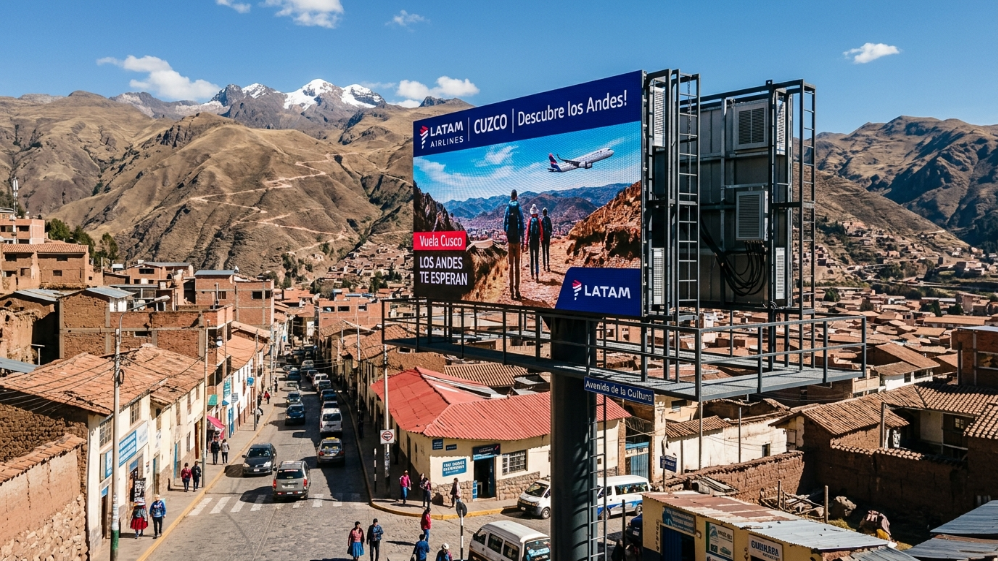
Peru is not a standard LED display market.
Three geographic, regulatory, and infrastructural factors create cost pressures that no generic “LED screen price” guide will address — and that any serious buyer operating in this market needs to quantify before committing to a project budget.
Altitude & Climate: The Andes Premium
This is the most consistently underestimated variable for projects outside Lima.
Peru’s major secondary cities sit at dramatically different elevations than coastal Lima:
| City | Altitude | Primary Cost Impact |
|---|---|---|
| Lima (coastal) | 150m | Baseline — no altitude adjustment required |
| Arequipa | 2,335m | +$120–$200/m² for enhanced cooling & sealed cabinet spec |
| Cusco | 3,399m | +$180–$320/m² — full IP65 enclosure + derating of power supplies mandatory |
| Puno | 3,827m | +$220–$380/m² — highest-risk environment |
| Juliaca | 3,825m | Same as Puno tier |
At altitudes above 2,500m, air density drops significantly, reducing the efficiency of passive and convective cooling in LED cabinets.
Power supply components must be derated by 15–25% to maintain reliable operation — meaning a power supply rated for 500W at sea level should not be run above 375–425W at Cusco altitude.
Suppliers who don’t flag this are either unaware or unconcerned with your long-term equipment health.
Additionally, Andean UV radiation levels are substantially higher than coastal Lima, which accelerates the degradation of front-of-screen protection materials unless UV-resistant grades are specified.
Expect a 3–5% additional materials cost for properly altitude-rated components.
Lima Port Logistics: What “CIF Lima” Actually Means for Your Timeline
Callao port is Peru’s primary import gateway, and understanding its operational reality is essential for project planning.
| Logistics Factor | Typical Impact |
|---|---|
| Average DAM clearance time | 5–12 business days |
| Channel rojo inspection | Additional 5–10 business days |
| Port congestion surcharges | $150–$400 additional costs |
| Inland freight to Cusco/Arequipa | $800–$2,200 per shipment |
Key Logistics Risks
- Average DAM clearance time: 5–12 business days for electronics under routine processing
- Channel rojo (red channel) inspection: triggered approximately 15–20% of the time for electronics shipments
- Port congestion surcharges: common during Q4 and around Peruvian national holidays
- Inland freight from Callao to Cusco or Arequipa: adds $800–$2,200 per shipment depending on cargo volume and road conditions
For projects with hard installation deadlines — a hotel opening, a stadium event, a government project tender — these variables are not optional considerations.
Budget a minimum 6-week import buffer from PO confirmation to on-site delivery for any project outside Lima, and 4 weeks for Lima-based projects.
2026 Peru LED Screen Price Reference Table: By Use Case & Pixel Pitch
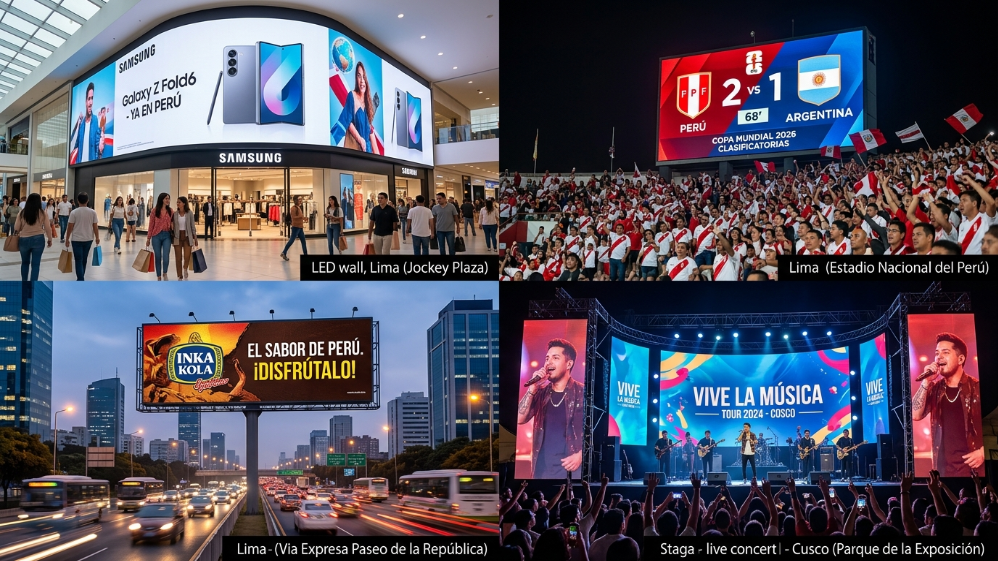
Before moving to total cost of ownership, here is a consolidated reference table for landed, installed pricing in the Lima market.
These figures reflect CIF Lima + customs + standard ground-floor installation but exclude civil works, structural steel, and content management software.
| Application | Pixel Pitch | Panel Price (FOB) | Landed Lima (est.) | Installed Cost (Lima) |
|---|---|---|---|---|
| Corporate lobby / retail (indoor) | P2.5 | $1,100–$1,500/m² | $1,380–$1,870/m² | $1,600–$2,300/m² |
| Control room / broadcast (indoor) | P1.8 | $1,800–$2,200/m² | $2,250–$2,740/m² | $2,700–$3,400/m² |
| Outdoor advertising (urban) | P4 | $1,200–$1,800/m² | $1,500–$2,240/m² | $1,900–$2,900/m² |
| Highway billboard | P6–P8 | $900–$1,400/m² | $1,120–$1,740/m² | $1,500–$2,300/m² |
| Rental / event stage | P3.9 | $1,000–$1,400/m² | $1,250–$1,740/m² | $1,450–$2,100/m² |
| High-altitude outdoor (Cusco / Arequipa) | P6 | $900–$1,400/m² | $1,120–$1,740/m² | +$180–$380/m² surcharge |
All prices in USD.
Installed cost includes mounting structure (standard wall-mount or floor stand), power distribution, control system (NOVASTAR or LINSN), and basic cabling.
Structural steel towers, civil foundations, and generator sets are priced separately.
The Real Cost of Owning an LED Screen in Peru: Hidden Expenses Most Quotes Ignore
Purchasing an LED screen is a capital expenditure decision that will follow your project for 5–8 years.
The unit price is the entry point — total cost of ownership (TCO) is the number that should govern your decision.
In the Peru market, the gap between the two is wider than in most Latin American countries.
Power Consumption: The Bill That Never Appears in a Quote
LED screens consume power continuously.
A 20m² P6 outdoor screen running at 50% average brightness (typical for a Lima street-facing billboard operating 16 hours/day) will draw approximately 3.2–4.0 kW in normal operation.
At Lima’s current commercial electricity rate of approximately $0.12–$0.16/kWh (ENEL/Luz del Sur commercial tariff, 2026), the annual electricity cost for this single screen works out to:
| Consumption Type | Estimated Value |
|---|---|
| Daily consumption | ~55 kWh |
| Annual consumption | ~20,000 kWh |
| Annual electricity cost | $2,400–$3,200/year |
Over a 5-year ownership cycle, that is $12,000–$16,000 in electricity alone — often exceeding the original panel cost for smaller installations.
This figure is almost never mentioned in a supplier quote.
Spare Parts: The Real Cost of a Failed Module After Warranty Expires
Standard Chinese OEM warranties are 2–3 years for panels, often with clauses requiring return shipping to China for claims.
In practice, for Peru-based operators, the realistic spare-parts strategy is:
- Keep 3–5% of total module count as on-site spares
- For a 20m² P6 screen with 500×1000mm cabinets, stock 4–6 spare modules at $180–$320 each
- Re-import cost per emergency parts shipment: $350–$600 plus DAM re-processing
- Bin-matching risk increases after 2+ years due to LED bin variation between production batches
The practical advice: negotiate a 5-year spare parts package at point of purchase.
Tier 1 suppliers (Absen, Unilumin) can commit to this.
Tier 3 OEM suppliers almost never can.
The Peru Technician Gap: An Underpriced Risk
Peru has a limited pool of certified LED display technicians.
Outside Lima, qualified maintenance engineers are effectively unavailable on-demand.
Implications
| Service Type | Estimated Cost |
|---|---|
| Preventive maintenance contract | $1,200–$2,400/year |
| Emergency callout | $600–$1,500 per incident |
| Remote diagnostics capability | Reduces on-site visits by 40–60% |
Remote diagnostics capability — offered by Tier 1 brands via cloud-connected controllers — generates real cost savings over the ownership cycle.
Content Management Software: The Subscription That Compounds
A display without content management software is a screen that shows nothing useful.
Evaluate CMS costs carefully:
| CMS Option | Estimated Cost |
|---|---|
| NOVASTAR VPlayer / NovaCMS | $0–$300/year |
| Third-party enterprise CMS | $400–$1,200/screen/year |
| Custom content creation | $500–$3,000/month |
CMS Platforms Mentioned
- NOVASTAR VPlayer / NovaCMS
- Scala
- Signagelive
- Broadsign
For a single-screen installation, budget $800–$2,000/year for content operations as a realistic floor.
Simulated TCO Scenario: 20m² Outdoor P6 Billboard, Lima, 5-Year Ownership
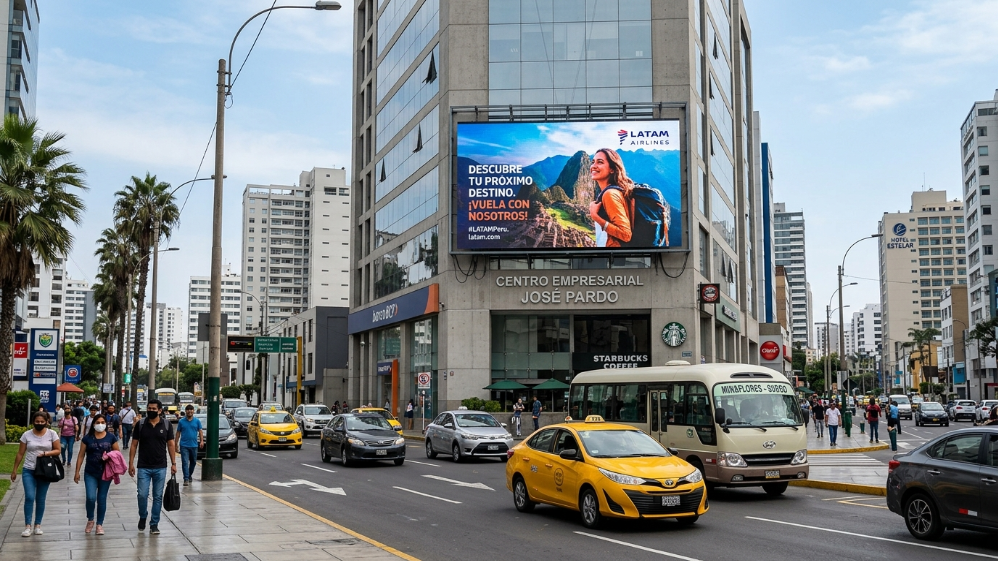
To make these figures concrete, here is a worked example for one of the most common installation types in the Lima market.
Project specs: 20m² outdoor LED billboard, P6 pixel pitch, Tier 2 supplier, installed on a commercial building facade in Miraflores.
| Cost Item | Year 0 (Purchase) | Annual (Y1–Y5) | 5-Year Total |
|---|---|---|---|
| Panel + cabinet (20m² × $1,300/m²) | $26,000 | — | $26,000 |
| Import duties, DAM, freight | $5,200 | — | $5,200 |
| Installation (structure + wiring) | $8,000 | — | $8,000 |
| Municipal permit (Miraflores) | $1,200 | $400/yr renewal | $2,800 |
| Electricity | — | $2,800/yr | $14,000 |
| Maintenance contract | — | $1,800/yr | $9,000 |
| Spare parts inventory | $1,200 | $300/yr avg | $2,700 |
| CMS + content production | — | $1,200/yr | $6,000 |
| Total | $41,600 | $6,500/yr | $73,700 |
Key takeaway: The panel unit price — $26,000 — represents 35% of the 5-year total cost.
A buyer who optimizes only on Day 0 purchase price and selects an inferior Tier 3 product to save $5,000 upfront may face $15,000–$25,000 in additional maintenance, parts re-import, and early replacement costs over the same 5-year cycle.
The math is rarely in favor of the cheapest quote.
Frequently Asked Questions: LED Screen Prices in Peru
Q: How much does a 10m² outdoor LED screen cost fully installed in Peru?
A: For a standard P6 outdoor screen at 10m², expect a total installed cost of $19,000–$29,000 in Lima, including import duties, steel mounting structure, power distribution, and control system.
High-altitude cities like Cusco or Arequipa add $1,800–$3,800 to that range due to altitude-rated components and inland freight.
Q: Can I import an LED screen directly from China to Peru without a local distributor, and is it cheaper?
A: Yes, direct import is legally straightforward via a formal DAM declaration at Callao.
You will save the distributor margin (typically 15–25%), but absorb the full customs agent cost, logistics coordination, and — critically — lose any local warranty support.
Direct import makes sense only if you have in-house technical staff capable of installation and ongoing maintenance.
For most buyers, a distributor with local presence reduces TCO.
Q: Is it cheaper to rent or buy an LED screen for a 3-day event in Lima?
A: For a single event under 5 days, rental is almost always cheaper.
Lima rental rates run approximately $80–$150/m²/day for P3.9 event-grade panels, inclusive of technician support.
Purchasing a comparable system at $1,450–$2,100/m² installed only becomes cost-effective if you run 15+ event-days per year over a 2–3 year horizon.
Below that threshold, rental delivers better capital efficiency.
Q: Are there LED screen manufacturers based in Peru, or is everything imported?
A: There are no LED screen manufacturers in Peru as of 2026.
The entire market is import-dependent, primarily from Shenzhen-based suppliers.
Several Lima-based distributors and integrators assemble steel structures locally and provide installation services, but LED panels, cabinets, power supplies, and control systems are universally imported.
This structural reality is why logistics planning and supplier after-sales commitment are more important in Peru than in markets with domestic supply chains.
Conclusion: Why the Unit Price Is the Wrong Number to Optimize
The LED display market in Peru rewards buyers who think in systems, not components.
A $900/m² P6 panel and a $1,400/m² P6 panel can look identical on a spec sheet.
The difference lives in the driving IC, the LED bin tolerance, the power supply derating spec, and whether the supplier will answer the phone in 2027 when a module fails on your rooftop installation in Arequipa.
Optimize for installed cost plus 5-year operating cost, not panel price.
For most commercial installations in Peru, the purchase decision that saves $8,000 on Day 0 and costs $25,000 over five years is not a bargain — it’s a liability.
The variables that determine your real cost — altitude, customs channel risk, spare parts availability, technician access, and content management requirements — are project-specific.
No published price guide, including this one, can replace a detailed engineering assessment of your actual site conditions and operational requirements.
Because installation environments, viewing distances, and altitude profiles vary significantly across Peru, we recommend contacting our engineering team for a precise, no-cost custom quotation tailored to your specific project parameters.
About SoStron
Marketing Strategic Director at Sostron