If you need a fast answer: the four LED billboard formats that dominate global outdoor advertising in 2026 are the Bulletin (14×48 ft), Poster (10×22 ft), Junior Poster (6×12 ft), and Spectacular/Custom (20×60 ft and up). But a feet dimension alone tells you almost nothing about what you’re actually buying—it’s the pixel pitch, cabinet configuration, and structural load rating behind that number that determine whether your project ships on budget or blows through it.
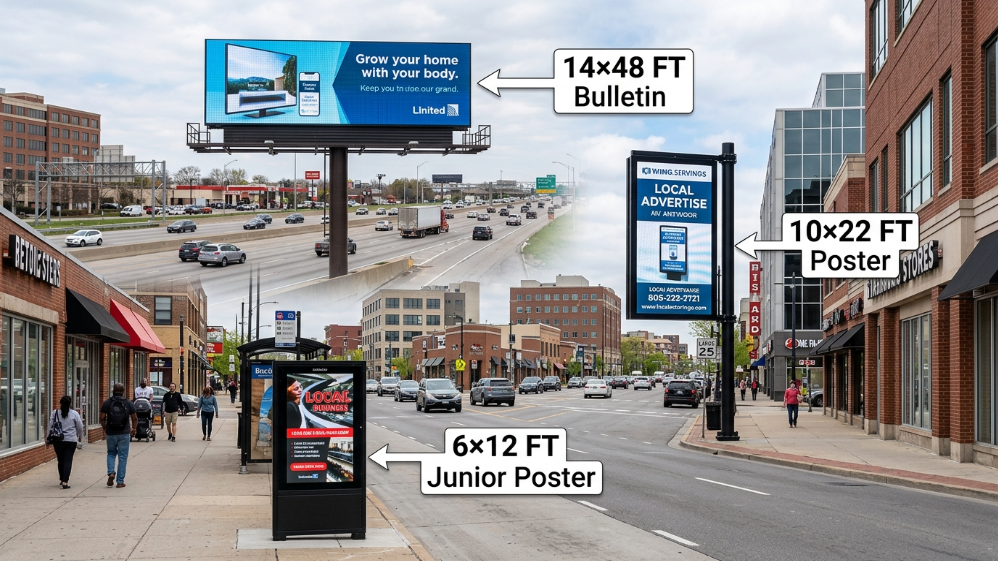
| Format | Standard Size (ft) | Area (sq ft) | Typical Application |
| Junior Poster | 6×12 | 72 | Local retail, pedestrian zones |
| Poster | 10×22 | 220 | Urban streets, mid-traffic corridors |
| Bulletin | 14×48 | 672 | Highways, national brand campaigns |
| Spectacular | 20×60+ | 1,200+ | Times Square-tier, high-density urban |
That table is where most articles on this topic stop. It’s also where most procurement mistakes begin. Based on our experience specifying and manufacturing LED display cabinets for system integrators across North America, the Middle East, and Southeast Asia, the single biggest source of RFQ rework isn’t the size itself—it’s buyers locking in a feet dimension before confirming whether the cabinet grid, pixel pitch, and steel structure can actually deliver it. A DOOH advertiser who orders a 14×48 ft display without checking module compatibility can end up with a screen that’s structurally sound but visually soft at highway speed, or worse, one that doesn’t divide evenly into standard cabinet sizes at all, forcing custom fabrication and a six-to-eight week schedule slip.
Why “Standard Sizes” Don’t Always Apply to LED Displays
Traditional billboard sizing—the 14×48, the 10×22, the 6×12—comes from the printed vinyl era, when press sheet dimensions and mounting frame conventions locked the industry into fixed formats. LED displays don’t share that constraint. An LED billboard is built from a grid of modular cabinets, typically in 960×960mm or 500×500mm units, which means the “standard” feet sizes you see quoted everywhere are really just the legacy dimensions the market expects, not a physical limitation of the technology itself.
This distinction matters commercially. A system integrator bidding on a municipal contract may be required to match an existing 14×48 ft bulletin footprint for zoning compliance—in which case the standard size is non-negotiable and the LED cabinet grid has to be engineered around it. An event rental company or a DOOH network building a new site, on the other hand, has no such constraint and can specify a size driven entirely by cabinet efficiency, shipping logistics, and viewing distance. Knowing which category your project falls into changes the entire sourcing conversation with your supplier.
How to Convert Feet Dimensions Into LED Engineering Specs
This is the part of the sizing conversation that determines your actual bill of materials, and it’s where most sizing guides go quiet. A feet dimension is a marketing-facing number; a system integrator needs the engineering-facing numbers underneath it.
Cabinet Count
A 960×960mm cabinet converts to roughly 3.15×3.15 ft. For a 14×48 ft bulletin, that works out to approximately 5 cabinets high by 15 cabinets wide—75 cabinets total, before accounting for edge trimming or a custom border row. Get this math wrong at the quoting stage and you either under-order cabinets or end up with an uneven final row that has to be masked or custom-cut, both of which erode your margin on a fixed-bid project.
Pixel Pitch and Resolution
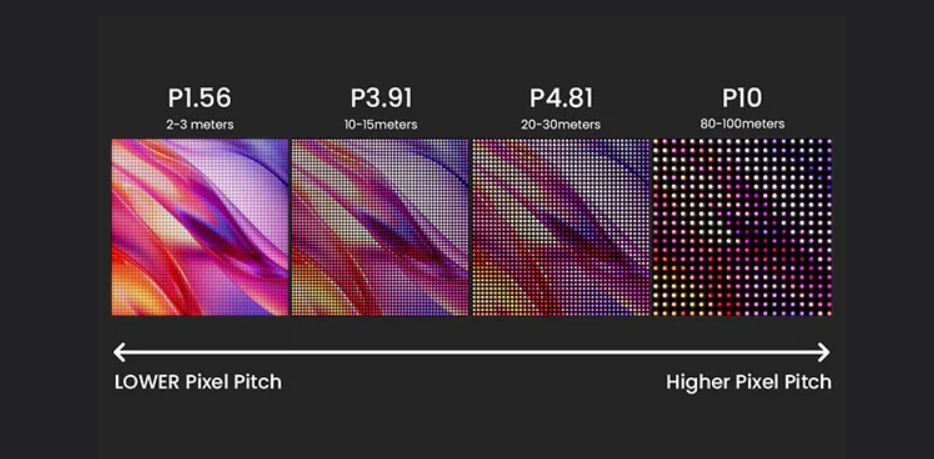
Pixel pitch—the distance in millimeters between the centers of adjacent LEDs—is what determines whether your 14×48 ft display reads as crisp or blurry at its intended viewing distance. According to AVIXA’s viewing distance guidance, the commonly used shorthand is that pixel pitch in millimeters should roughly match the minimum comfortable viewing distance in meters divided by ten. For a highway bulletin viewed from 100+ feet, a coarser P10–P16 pitch is not a compromise—it’s the correct engineering choice, because finer pitch at that distance adds cost without adding perceivable clarity. For a street-level poster viewed from 20–30 feet, you need P6–P8 to avoid visible pixelation.
| Format (ft) | Typical Viewing Distance | Recommended Pixel Pitch | Approx. Resolution |
| 6×12 (Junior Poster) | 20–40 ft | P4–P6 | ~460×920 px |
| 10×22 (Poster) | 40–80 ft | P6–P8 | ~380×840 px |
| 14×48 (Bulletin) | 100–300 ft | P10–P16 | ~260×880 px |
| 20×60+ (Spectacular) | 150–400 ft | P10–P20 | ~500×1,500 px |
The commercial takeaway (feature-to-benefit): a finer pixel pitch is not automatically the “better” spec—it’s the more expensive spec, and specifying it for a viewing distance that doesn’t require it is a common way integrators quietly lose margin on a bid they should have won on price. Matching pitch to actual viewing distance, not to whatever the client assumes is “higher quality,” is where an experienced supplier earns their advisory role rather than just their manufacturing fee.
How to Choose the Right LED Billboard Size for Your Application
Pixel pitch and cabinet math answer the “can we build it” question. This section answers the one that actually determines your RFQ: “what size should we even be specifying?” The right answer depends entirely on who’s standing in front of the screen and how fast they’re moving past it.
Application Scenarios
-
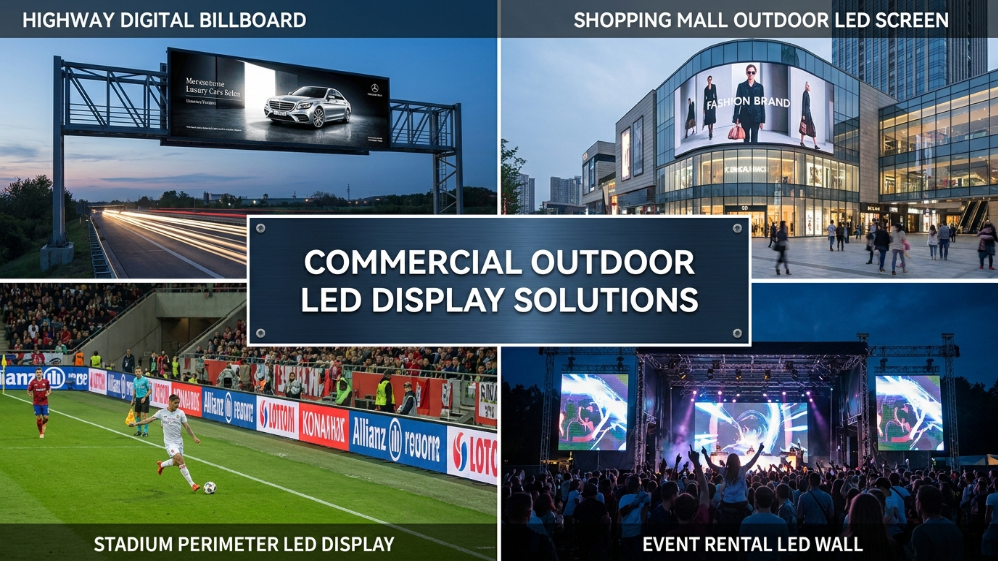
DOOH Advertising Networks: Networks operating in pedestrian or mixed-traffic corridors generally perform best on the Poster format (10×22 ft) or a custom variant close to it. The audience is walking or in slow traffic, dwell time is a few seconds at most, and the format needs to sell well against digital-out-of-home CPMs—which means brightness (6,000+ nits for daylight readability) and content refresh rate matter more than raw screen area.
-
Event and Rental Companies: Event and rental companies live by a different rule entirely: weight and shipping cube beat everything else. A modular LED wall built for touring or temporary installs is rarely specified in feet at all—it’s specified in cabinet count, because the crew needs to know how many road cases fit in the truck, not how many square feet the wall covers. If your business is rental, ask your supplier for cabinet weight-per-panel and stacking configuration before you ask about pixel pitch.
-
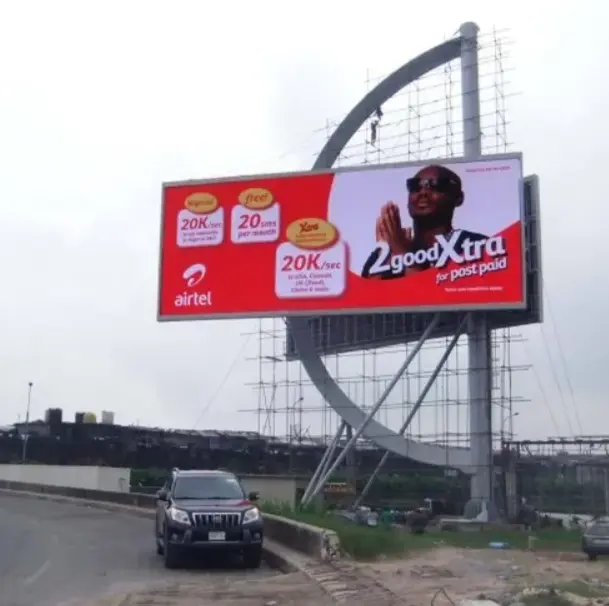
Highway and Roadside Operators: Operators are the segment where the Bulletin format (14×48 ft) genuinely earns its “standard” status—it’s sized for a 3-to-5 second glance at 60+ mph, and deviating from it usually creates a compliance problem with local outdoor advertising authorities before it creates a technical one.
-
Stadium and Sports Perimeter LED: Stadium displays are the outlier case: aspect ratio matters more than absolute size, because the display has to match broadcast camera framing. A perimeter ribbon board might be only 3–4 ft tall but run 200+ ft in length—a shape no “standard” billboard chart accounts for.
Structural & Regulatory Requirements Behind Every Standard Size
Here’s where feet dimensions stop being a design decision and start being a liability question. A 14×48 ft LED bulletin is not a poster stuck to a wall—it’s roughly 670 square feet of steel, aluminum, and electronics catching wind load at height, and every jurisdiction treats it accordingly.
Engineering Considerations
-
Steel structure and wind load: The larger the format, the more the mounting structure—not the display itself—drives project cost. According to structural guidance commonly applied in outdoor sign engineering, a Bulletin-class display typically requires wind load certification rated for 90–150 mph gusts depending on region, and the steel frame is engineered to that rating before a single LED module is mounted. Skipping a local structural engineer review on anything above Poster size is one of the most expensive mistakes a first-time buyer makes—not because the LED hardware fails, but because the permit gets rejected after the frame is already fabricated.
-
IP rating and weatherproofing: Outdoor LED billboards need an IP65-rated front and IP54-rated rear cabinet as a baseline; anything less invites moisture ingress that shows up as dead pixels within a single rainy season. This is a feature-to-benefit point worth stating plainly to a buyer: paying for proper IP-rated cabinets up front costs less than a single emergency panel replacement crew dispatched to a highway-adjacent structure eighteen months later.
-
Local zoning and size regulations: Many municipalities cap advertising structure size independently of the LED industry’s “standard” sizes—some cities restrict digital bulletins to well under the 672 sq ft Bulletin benchmark, others prohibit new digital billboards near residential zones regardless of size. Confirm permitted dimensions with local planning authorities before finalizing cabinet counts, not after.
LED Billboard Size vs. Brightness, Resolution & Cost—What Buyers Should Compare
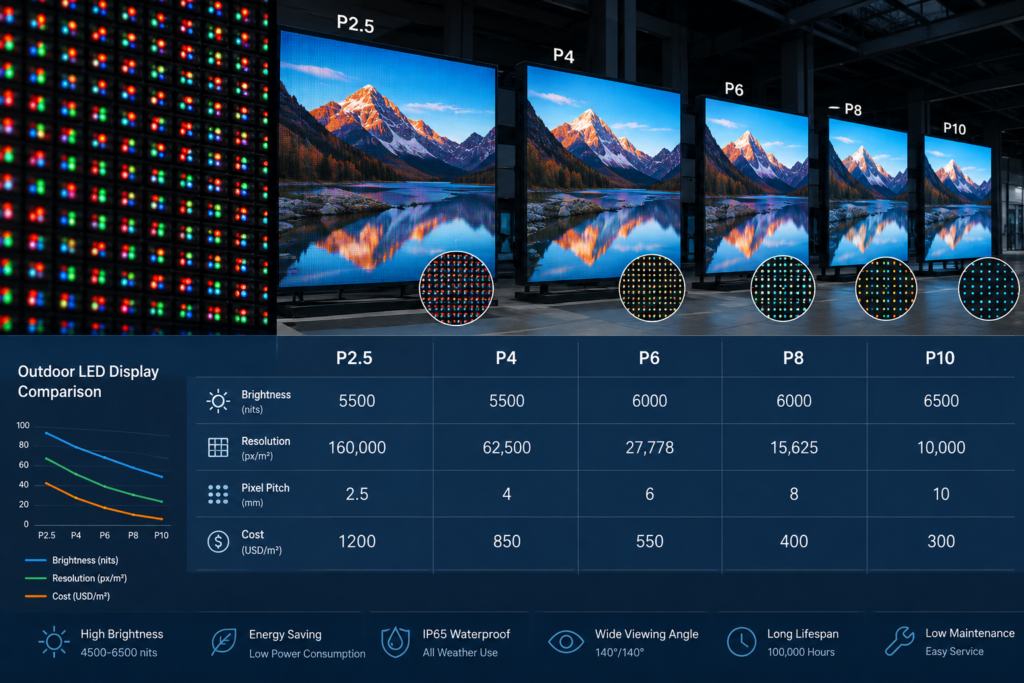
Size, pitch, and brightness move together, and buyers who optimize one in isolation usually overpay on another.
| Format (ft) | Total Pixels (approx.) | Min. Brightness (nits) | Relative Install Cost Driver |
| 6×12 | ~420,000 | 4,000–5,500 | Structure minimal; content resolution is main cost |
| 10×22 | ~320,000 | 5,500–6,500 | Balanced—pitch and structure roughly equal cost weight |
| 14×48 | ~230,000 | 6,500–8,000 | Structure and shipping dominate; pitch cost is lower per sq ft |
| 20×60+ | ~750,000+ | 7,000–9,000+ | Structure, power infrastructure, and logistics dominate |
Note the counterintuitive line in that table: total pixel count doesn’t scale linearly with size, because larger-format displays intentionally use coarser pixel pitch. A Bulletin-class 14×48 ft screen has fewer total pixels than a much smaller Junior Poster—and that’s correct engineering, not a downgrade. The commercial lesson for a buyer comparing quotes: if two suppliers are pricing the same feet dimension wildly differently, check whether they’re quoting the same pixel pitch before assuming one is simply cheaper.
Frequently Asked Questions
What is the most common LED billboard size used in the US market?
The 14×48 ft Bulletin format remains the dominant standard for highway and interstate advertising, though 12×24 ft and 10×20 ft formats are increasingly common in urban and suburban DOOH deployments where full highway-scale footprint isn’t available.
How do I calculate pixel pitch for a custom LED billboard size that isn’t a standard format?
Divide your intended viewing distance (in meters) by roughly 10 to get a workable pixel pitch in millimeters—this is a starting estimate, not a final spec, and should be confirmed against your content type (text-heavy content needs finer pitch than motion graphics at the same distance).
Can LED billboard sizes be fully customized beyond the standard formats?
Yes—because LED displays are modular, cabinet-based systems, custom sizing is standard practice for system integrators. The constraint isn’t the LED technology, it’s usually local zoning limits or the mounting structure’s engineering rating.
What size LED screen do I need for highway visibility at 60+ mph?
A minimum of 14×48 ft (Bulletin format) with P10 or coarser pixel pitch is the industry baseline for legible content at highway speed and typical 100+ foot viewing distances.
How much does an LED billboard cost per square foot at standard sizes?
Cost per square foot generally decreases as size increases, since structural and power infrastructure costs are semi-fixed—but total project cost still rises sharply above Poster size due to steel structure, permitting, and installation logistics.
Expert Verdict
If your project has to match an existing zoning footprint, build to the standard feet dimension and engineer the cabinet grid around it. If it doesn’t, stop starting the conversation with square footage—start with viewing distance and content type, let those dictate pixel pitch, and let pixel pitch dictate the size. Every RFQ we’ve seen go over budget followed the reverse order.
References:
OAAA Technical Specifications & Out of Home Advertising Guidelines
AVIXA Display Image Size Recommendations (DISCAS) / Display Viewing Distance Guidelines