Colombia Outdoor LED Screen: The Complete B2B Buyer’s Guide to Sourcing, Specs & Compliance
If you’re sourcing an outdoor LED screen for Colombia right now, here is what you actually need to know before talking to any supplier:
| Decision Factor | Minimum Requirement for Colombia | Why It Matters |
|---|---|---|
| Brightness | ≥6,500 nits | Equatorial sun + high-altitude UV; screens under 5,000 nits wash out visibly |
| IP Rating | IP65 (front) / IP54 (rear) minimum | Andean rain seasons; coastal humidity near Barranquilla or Cartagena demands full ingress protection |
| Pixel Pitch | P6–P8 for highways; P4–P6 for retail/malls | Viewing distance formula: min. distance (m) = pixel pitch (mm) × 1,000 / 3,438 |
| Certifications | CE + RoHS mandatory; FCC accepted by DIAN | Missing docs = customs hold or post-install ICONTEC fine |
| Operating Temp | −20°C to +60°C | Bogotá sits at 2,600 m; thermal cycling between cold nights and direct sun stresses driver ICs |
| Controller | NovaStar/Linsn with remote CMS | Essential for DOOH operators managing multi-screen networks |
Get those six parameters wrong and you are not looking at a suboptimal purchase—you are looking at customs rejection, municipal fines, or a screen that turns gray-white by noon on Carrera 7.
We have worked on outdoor LED installations across Bogotá, Medellín, and Cali. The same mistake repeats itself, project after project: buyers compare price per square meter from three Chinese manufacturers, pick the lowest quote, then discover the hard way that the modules shipped without valid CE documentation, or that the 5,000-nit brightness spec was measured at factory temperature—not at 35°C after four hours of direct sun. One Medellín integrator we spoke with had a 48 m² P8 billboard installed on Avenida El Poblado pulled down by local authorities within six weeks because the structural mounting lacked ONAC-recognized load certification. The screen itself was technically fine. The paperwork wasn’t.
This guide was built to close that gap. It covers every technical and commercial decision a system integrator, DOOH operator, or event AV company needs to make when sourcing a Colombia outdoor LED screen—from pixel pitch selection to customs compliance to total cost of ownership modeling.
What Is Driving Colombia’s Outdoor LED Screen Market in 2026?
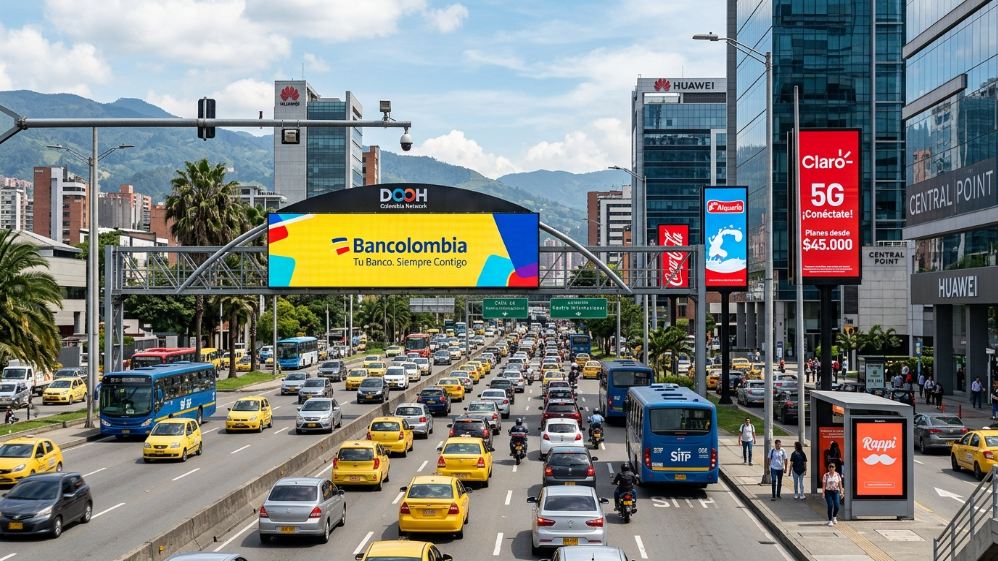
The numbers are hard to ignore. The global DOOH advertising market was valued at $20.74 billion in 2024 and is on track to reach $39.12 billion by 2030, compounding at 10.7% annually. Colombia sits at the front of that LATAM wave. Bogotá’s urban densification, the ongoing expansion of Medellín’s metro system, and a surge in event-driven out-of-home campaigns across the Caribbean coast are all creating consistent demand—not just for screens, but for high-spec outdoor screens that can run 18 hours a day under equatorial UV without performance degradation.
Local distributors have served this market adequately for a decade. But their margin structures mean that an equivalent P8 SMD display costs 2.5× to 3× more when bought through a Bogotá intermediary versus a direct OEM relationship with a Shenzhen manufacturer. That delta matters enormously when a DOOH operator is deploying 10 to 40 screens across a city network. Based on our experience with procurement projects in the COP 800M–2,000M range, a direct-source strategy with proper compliance support consistently delivers a 30–45% cost reduction over the project lifetime without compromising on technical quality.
The shift is already happening. Colombian integrators and advertising companies are increasingly bypassing local intermediaries—but they need a reliable framework to do it safely.
How to Choose the Right Outdoor LED Screen for Colombia’s Climate
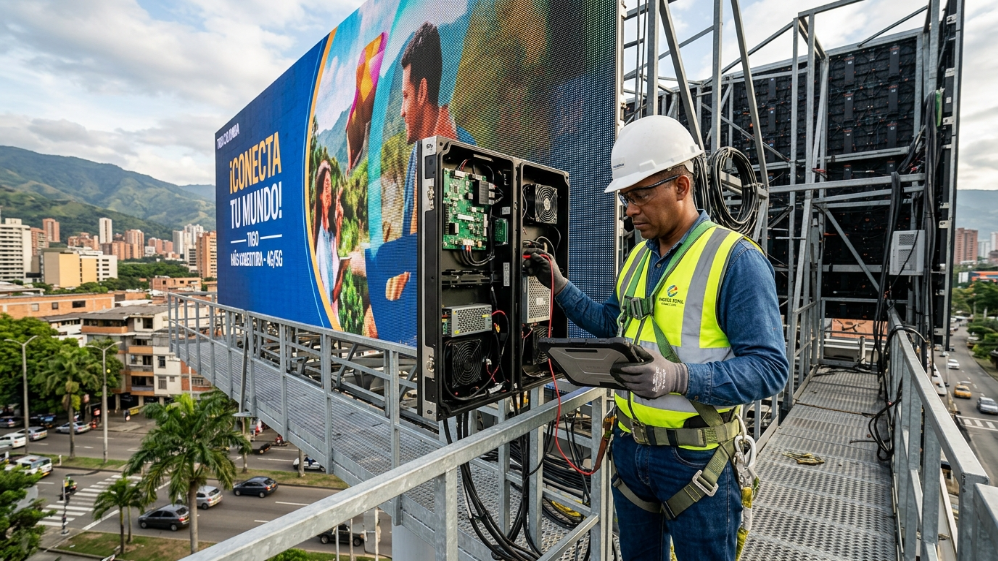
This is where most buying decisions go wrong, and it goes wrong because specifications are read without context.
Pixel Pitch: Which P-Value Actually Works in Colombia?
Pixel pitch is the center-to-center distance between LED clusters, measured in millimeters. A P6 screen has 6 mm between pixels; a P10 has 10 mm. Smaller pitch = higher resolution = higher cost. The engineering rule is simple: minimum comfortable viewing distance equals roughly 1,000 times the pixel pitch in meters. A P8 display looks sharp from 8 meters away. Below that, individual pixels become visible and the image breaks down.
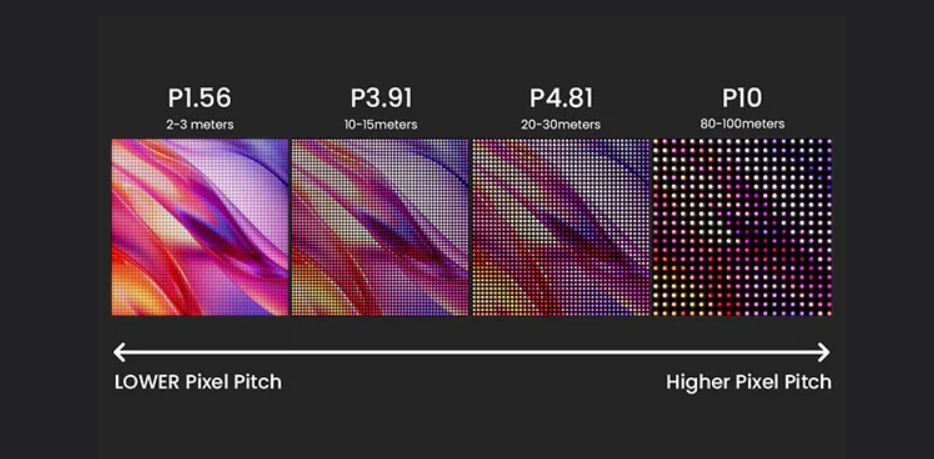
For Colombian deployments, the practical mapping looks like this:
| Application | Recommended Pitch | Typical Viewing Distance | Commercial Rationale |
|---|---|---|---|
| Highway billboard (autopista) | P10–P16 | 15 m–50 m | Long distance; large pixel pitch cuts cost and weight; DIP modules better for rain exposure |
| Urban street-level billboard | P6–P8 | 6 m–20 m | Pedestrian + vehicle traffic; SMD 3-in-1 preferred for color uniformity |
| Shopping mall exterior (Unicentro, El Tesoro) | P4–P6 | 3 m–10 m | Slow-moving foot traffic; brand-quality visuals essential; COB tech increasingly viable |
| Event/rental screen (ferias, conciertos) | P3.9–P5 | 5 m–15 m | Fast setup; lightweight magnesium alloy cabinet critical; IP65-rated front panel |
| Stadium perimeter (Estadio El Campín) | P8–P10 | 10 m–30 m | Continuous 90-min runtime; wide viewing angle ≥140° horizontal required |
One detail that gets overlooked consistently: refresh rate. For any screen that will be photographed or filmed—event stages, sports venues, press conference backdrops—specify a minimum 3,840 Hz refresh rate. Below that, camera shutters capture visible scan lines. That spec costs almost nothing extra at the manufacturing stage and saves significant client relationship damage on the back end.
Brightness: Why 6,000 Nits Is the Floor, Not the Target
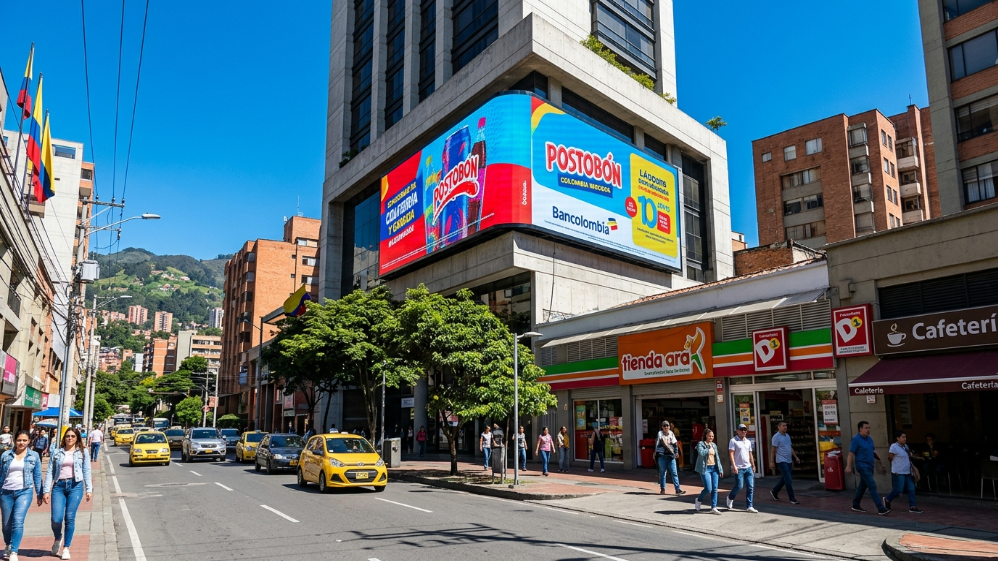
At sea level in a temperate climate, 5,000 nits is often considered sufficient for outdoor use. Colombia changes that calculation in two ways.
First, the country sits between 4°N and 12°N latitude. Direct normal irradiance at solar noon in Bogotá frequently exceeds 900 W/m². At that ambient light level, a screen outputting 5,000 cd/m² loses roughly 30–40% of its perceived contrast versus a shaded environment. The display doesn’t go dark—it goes flat, losing the color depth and punch that makes digital signage worth the investment.
Second, Bogotá’s altitude (2,600 m above sea level) introduces an underappreciated thermal problem. Thinner air means less convective cooling of LED modules and driver ICs. A screen spec’d for sea-level operation will run 8–12°C hotter at Bogotá altitude under equivalent solar load. Sustained high temperature accelerates LED lumen depreciation—a screen rated for 100,000 hours at 25°C may deliver only 70,000–80,000 effective hours in Bogotá’s thermal conditions if cooling isn’t specifically engineered for altitude.
The practical specification: target 7,000–8,000 nits peak brightness for any screen installed in Bogotá or the Coffee Region highlands. This gives headroom for auto-dimming (which NovaStar’s TB60 controller handles via ambient light sensor) while protecting long-term lumen output. Coastal installations in Barranquilla or Cartagena—lower altitude, higher humidity—can reasonably spec at 6,500 nits, but must prioritize IP67-rated rear enclosures given the salt-air corrosion risk that standard IP54 rear panels don’t adequately address.
IP65 vs. IP67: Does Colombia’s Rain Season Demand the Higher Standard?
Short answer: it depends on where the screen is mounted, not just where it’s installed.
IP65 means the enclosure is fully dust-tight and withstands low-pressure water jets from any direction—adequate for most urban billboard applications where the screen face is angled away from direct rainfall and protected by a top visor. IP67 adds submersion resistance to one meter for 30 minutes, which matters in two specific Colombian scenarios: ground-level installations near flood-prone vías (Bogotá’s Calle 26 corridor floods three to five times annually during temporada de lluvias), and coastal deployments within 500 meters of the Caribbean or Pacific shoreline where salt spray infiltration is a slow but consistent killer of standard SMD modules.
The rear enclosure is where most integrators cut costs unwisely. A screen with an IP65-rated front panel and an IP43-rated rear box is, in practice, a screen with IP43 weather protection. Specify IP65 front and IP54 rear as a minimum for any Colombian outdoor deployment. For Cartagena, Barranquilla, and Santa Marta installations, require IP65 on both faces and verify that the aluminum cabinet uses a corrosion-inhibiting powder coat—not bare anodizing—on all external surfaces.
Colombia Outdoor LED Screen Pricing: What Should You Actually Budget?
This is the question most suppliers deflect with vague ranges. Based on direct procurement data from projects executed in 2024–2026, here is what the numbers actually look like:
| Configuration | Factory Gate Price (USD/m²) | Landed Cost Colombia (USD/m²) | Notes |
|---|---|---|---|
| P10 DIP, highway billboard | $280–$420 | $390–$580 | Cheapest per m²; heavy cabinet; DIP better for heavy rain exposure |
| P8 SMD 3-in-1, urban outdoor | $480–$650 | $660–$890 | Most common for Bogotá/Medellín street installs |
| P6 SMD, retail/mall exterior | $720–$950 | $980–$1,280 | Higher resolution; NovaStar controller typically bundled |
| P4 COB, premium retail facade | $1,400–$1,900 | $1,850–$2,500 | COB construction = superior UV/humidity resistance; 5-yr lifespan advantage |
| P3.9 rental panel (magnesium cabinet) | $900–$1,200/panel | $1,150–$1,550/panel | Priced per panel (~0.5 m²); weight ≤10 kg/panel critical for rigging |
“Landed cost Colombia” factors in ocean freight from Shenzhen (approximately $180–$240/CBM to Buenaventura or Barranquilla), DIAN import duties (typically 5–15% depending on HS code classification of LED modules), and local port handling. It does not include structural steel, electrical installation, or content management system licensing—budget an additional 25–40% of hardware cost for a turnkey deployment.
One figure worth internalizing: a correctly specified 20 m² P8 urban billboard, fully installed and operational in Bogotá, should run COP 180M–280M all-in. If a supplier quotes you materially below COP 150M for the same spec, the gap is coming from somewhere—usually certification shortcuts, lower-bin LEDs, or a controller brand with no Spanish-language technical support.
Certifications & Compliance: What You Must Have to Clear Colombian Customs
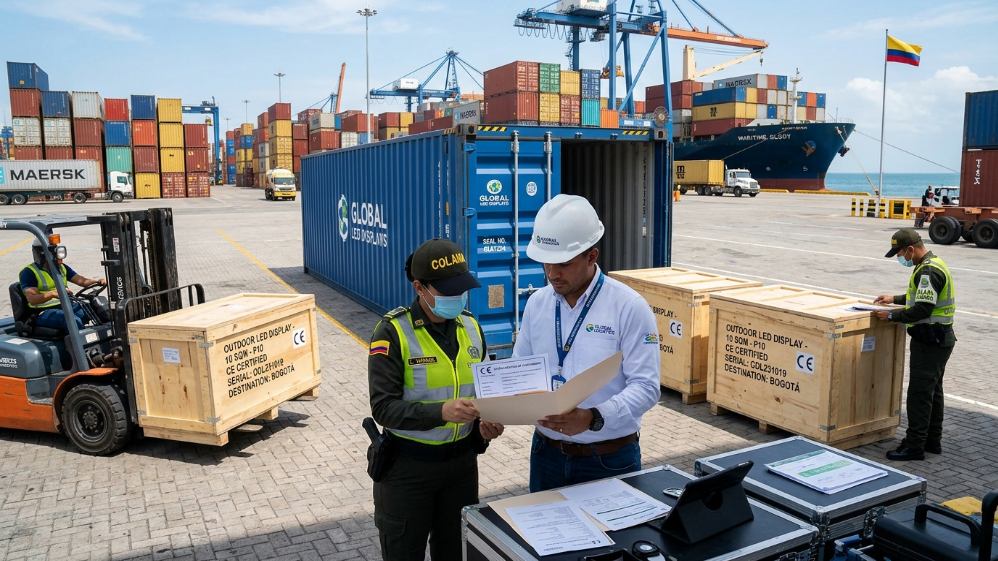
This section alone is worth the read. Customs clearance at Buenaventura or Bogotá’s El Dorado cargo terminal is not complicated—if you have the right paperwork assembled before the container ships.
DIAN (Colombia’s customs authority) does not have a specific LED display certification requirement. What it does enforce is that electrical and electronic products meet one of the internationally recognized safety standards: CE marking (EU), FCC Declaration of Conformity (US), or UL listing. In practice, CE + RoHS is the most straightforward path for Chinese OEM manufacturers and is accepted without challenge by DIAN inspectors.
Where Colombian-specific compliance becomes critical is post-import, at the municipal installation permit stage. Bogotá’s Secretaría Distrital de Planeación and Medellín’s Departamento Administrativo de Planeación both require structural load calculations and, increasingly, photometric certification showing that the screen’s maximum brightness output complies with light pollution ordinances—typically capped at 300–500 cd/m² in residential-adjacent zones at nighttime. A NovaStar or Linsn controller with scheduled auto-dimming profiles directly addresses this requirement and should be specified explicitly in permit applications.
ICONTEC’s role here is often misunderstood. ICONTEC does not certify LED screens directly—it develops the technical standards framework. ONAC (the national accreditation body) is the entity that accredits Colombian testing laboratories. For most B2B buyers, the practical implication is: your international CE certification is sufficient for import; engage a local electrical engineer to stamp the installation drawings for municipal permits.
5 Questions Your B2B Buyers Are Actually Searching—Answered Directly
Q1: What pixel pitch is best for an outdoor LED screen in Colombia?
For highway and large-format applications viewed from 15+ meters, P10 is the cost-optimal choice. For urban street-level billboards in Bogotá or Medellín with mixed pedestrian and vehicle audiences, P6–P8 delivers the resolution needed without overcapitalizing. Never specify below P4 for any installation where viewing distance exceeds 5 meters—the cost premium buys resolution the audience physically cannot perceive.
Q2: How much does an outdoor LED billboard cost in Colombia in 2026?
A 20 m² turnkey P8 urban billboard—screen, steel structure, electrical connection, controller, and installation—runs approximately COP 180M–280M ($45,000–$70,000 USD) in Bogotá. Highway P10 billboards at equivalent size come in 30–40% lower. Beware any quote significantly below these figures; the savings almost always come from certification or component quality, not supplier efficiency.
Q3: Do I need ICONTEC certification to install an outdoor LED screen in Colombia?
Not for import clearance. CE + RoHS is sufficient for DIAN. For municipal installation permits in major cities, you need locally stamped structural and electrical drawings—not ICONTEC product certification. Confirm permit requirements with the relevant Secretaría de Planeación before signing supplier contracts, as requirements vary between Bogotá, Medellín, and Cali.
Q4: How long does shipping from China to Colombia take?
Ocean freight from Shenzhen to Buenaventura averages 28–35 days; to Barranquilla, 32–40 days. Add 7–14 days for DIAN clearance. Realistic door-to-site timeline: 45–55 days from confirmed purchase order. For event-driven deployments with fixed deadlines, either pre-order with buffer or explore air freight for smaller rental screen shipments—at $8–12/kg, it’s expensive but predictable.
Q5: What brightness (nits) is required for outdoor LED screens in direct Colombian sunlight?
Specify a minimum of 6,500 nits for sea-level coastal cities. For highland installations in Bogotá, Manizales, or the Coffee Region—where UV irradiance is higher and thinner air reduces module cooling efficiency—target 7,000–8,000 nits peak output with automatic ambient-sensor dimming. Anything below 5,500 nits will visibly wash out during the 10:00–15:00 solar window, precisely when street-level foot traffic and advertising value peak.
Expert Verdict
The Colombia outdoor LED screen market rewards preparation and penalizes shortcuts in equal measure. The buyers who execute well share three habits: they lock in technical specs before talking price, they treat compliance documentation as a hard deliverable (not an afterthought), and they build the controller and CMS selection into the initial RFP rather than treating it as an accessory.
If you are entering this market in 2026, the single highest-leverage decision you can make is sourcing a COB or high-bin SMD P6–P8 module with verified CE/RoHS documentation from a manufacturer who has shipped to LATAM before—and pairing it with a NovaStar controller that your operations team can manage remotely. That combination covers your technical baseline, your compliance exposure, and your long-term operating cost in one decision.
The screens that fail in Colombia don’t fail because of bad technology. They fail because the buyer trusted a spec sheet without asking what conditions it was tested under.
References:
Global Out of Home Media Forecast Reports
IEC 60529 – Degrees of Protection Provided by Enclosures (IP Code)