Table of Contents
ToggleEvery procurement manager who has priced out an outdoor billboard has hit the same wall: one supplier quotes P6, another insists on P10, a third pushes a “premium” P4 panel with no explanation of why. Nobody in that conversation is lying to you exactly—but nobody is doing the math for your specific site either. That gap between generic advice and site-specific engineering is where budgets get wasted and where billboards end up looking either blurry from the road or absurdly overspecified for a screen nobody stands close to.
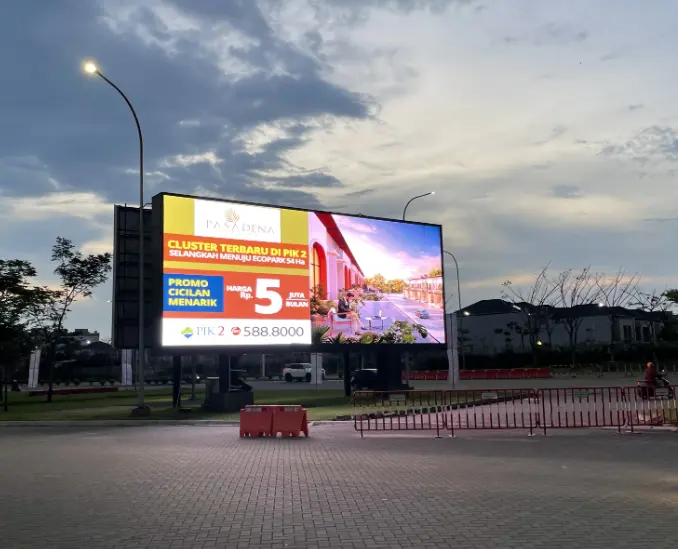
At Sostron, we close that gap by running the viewing-distance and brightness calculation before we ever recommend a panel, not after a client has already committed to steel and shipping. For most roadside and highway billboard installations, the best pixel pitch for outdoor billboard applications falls between P8 and P16, depending on your viewer’s traffic speed and installation height. Urban commercial displays viewed from sidewalks perform better at P4 to P6. There is no single “correct” number—only the right number for your specific viewing distance, brightness requirement, and budget.
| Application | Viewing Distance | Recommended Pixel Pitch | Priority |
|---|---|---|---|
| Highway billboard (60+ mph traffic) | 100 ft+ | P10–P16 | Brightness & durability |
| Urban commercial street | 20–50 ft | P4–P6 | Balance of clarity & cost |
| Stadium facade / large format | 50–100 ft | P8–P10 | Structural load & cost efficiency |
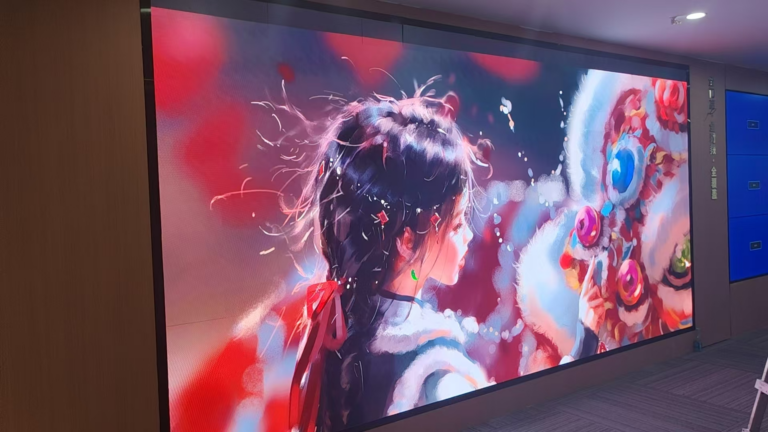
| Pedestrian plaza | Under 20 ft | P2.5–P4 | Image sharpness |
What’s Actually Inside a Panel Rated for Outdoor Sun and Rain
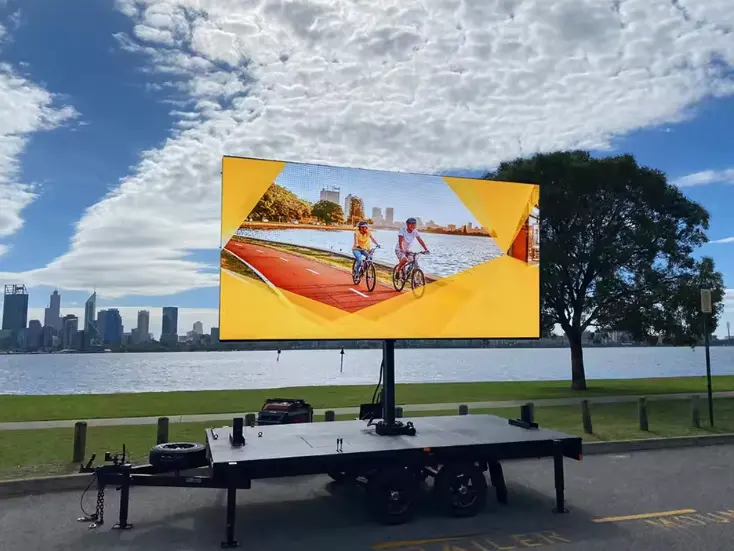
Before pixel pitch means anything, the hardware carrying it has to survive weather most indoor displays never see. Every Sostron outdoor cabinet starts as a die-cast aluminum enclosure sealed to IP65, tested against driving rain and dust ingress rather than just rated for it on paper.
The LED modules themselves go through a 72-hour aging test—dead-pixel checks, brightness consistency, color uniformity—before a single cabinet ships, and the driver ICs are selected for thermal stability so brightness doesn’t drift as ambient temperature swings 40°C between a winter morning and a summer afternoon on a rooftop billboard.
None of that shows up on a pixel pitch spec sheet, but it’s the difference between a screen that still looks correct in year seven and one that’s already showing color banding by year two.
Material choice, module sealing, and structural mounting design are engineering decisions made long before anyone picks a pitch number—and they’re the reason two “identical” P10 panels from different factories can perform completely differently once installed.
Why Project Teams Keep Coming Back to Sostron
Here’s the honest answer: because we’ve been on-site for the failures, not just the installs.
Our engineering team has specified and manufactured outdoor LED displays for advertising operators, DOOH networks, and system integrators across North America, the Middle East, and Southeast Asia, and that field exposure changes how we quote a project.
We don’t hand a client a pixel pitch chart and walk away—we ask for viewing distance, traffic pattern, and site orientation first, then build a CAD-based recommendation around those numbers.
According to viewing-distance research published by AVIXA, there is no universally “right” pixel pitch—the correct spec is entirely a function of the viewing experience you’re designing for, and that’s exactly the philosophy our proposals are built on.
It’s a slower first conversation than sending over a price list, but it’s the reason our repeat-client rate on outdoor projects stays high: buyers who’ve been burned once by a mis-specified panel don’t want a second guess, they want a calculation.
Pixel Pitch, Decoded: The Spec That Decides Whether a Billboard Reads Clean or Reads Cheap
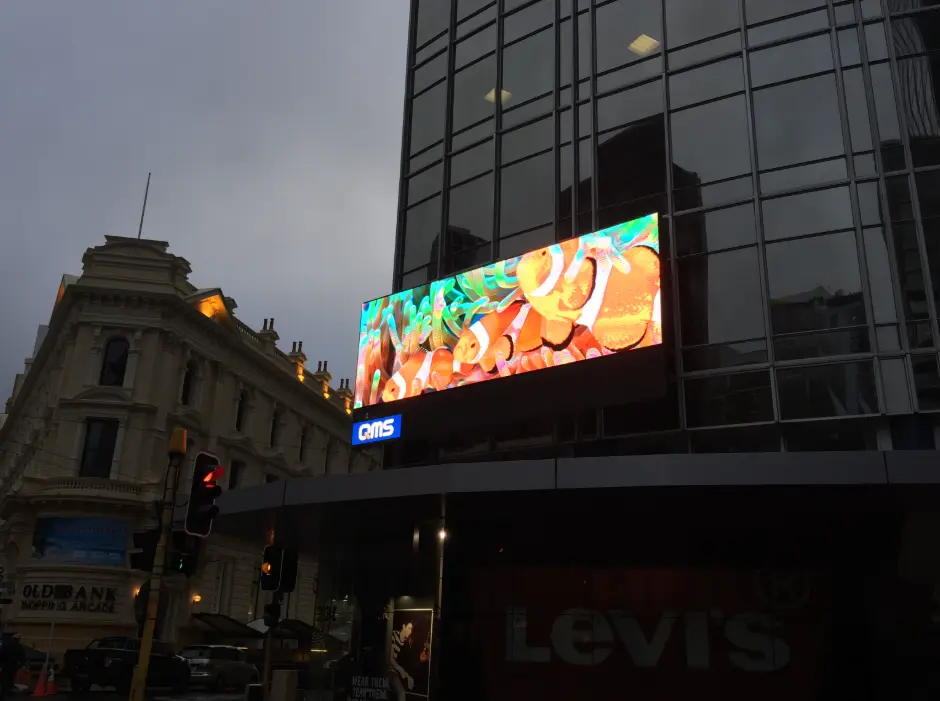
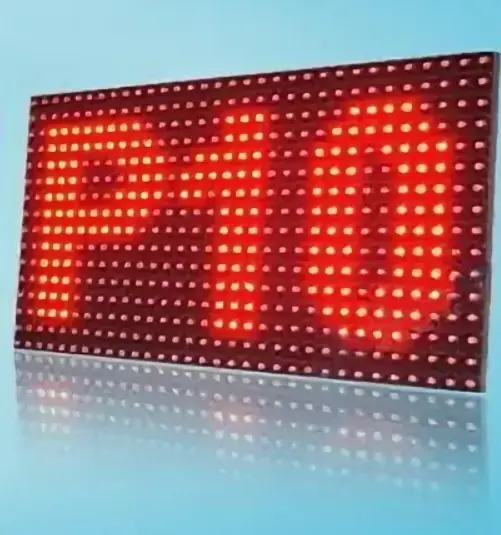
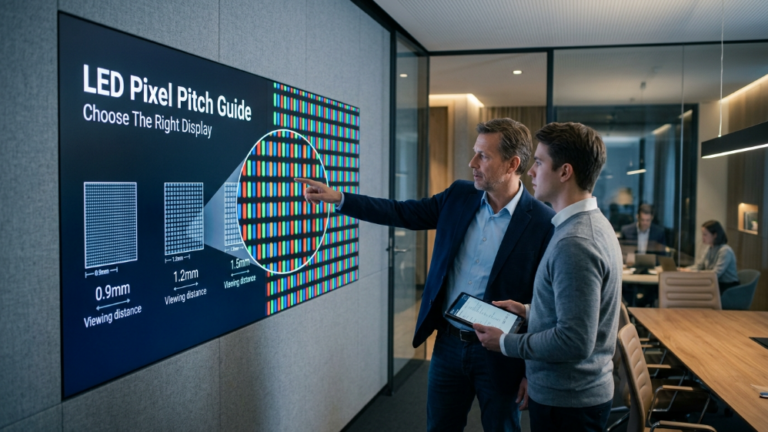
Pixel pitch is the center-to-center distance between two adjacent LED pixels, measured in millimeters. A P10 display has 10mm between pixel centers; a P4 display has 4mm.
That single number quietly drives three outcomes at once—resolution, unit cost, and minimum viewing distance—and misjudging any one of them shows up the moment the billboard goes live.
A finer pitch packs more LEDs into the same panel area, which raises both manufacturing cost and power density. That’s not a problem on a P2.5 lobby wall eight feet from a receptionist’s desk. It’s a real problem on a 200-square-meter highway billboard where the nearest viewer is thirty meters away and will never resolve the extra detail anyway.
The Smaller-Is-Always-Better Trap, and Where It Actually Costs You
A finer pixel pitch only pays off when your audience is physically close enough to notice it.
Past a certain distance, the human eye simply stops resolving individual pixels no matter how fine the pitch gets, so any resolution beyond that threshold is money spent on nothing.
The practical shortcut we use on-site, and one that lines up with the formulas published by Linsn LED’s viewing-distance guide, is roughly 1mm of pixel pitch per meter of minimum viewing distance—a P10 panel stays comfortably legible from 10 meters out, and a P16 panel holds its own from 16 meters.
For a highway billboard where the nearest reader is a driver forty meters away, chasing a sub-P6 pitch doesn’t buy clarity. It buys a bigger invoice.
What a Mis-Specified Panel Actually Costs Once It’s Installed
We’ve walked into post-installation site reviews where the client picked a pitch straight off a generic online chart, without ever measuring their actual traffic speed or viewing angle.
The outcome cuts both ways: text that reads as a blur to drivers moving at 60 mph, or—just as often—a needlessly fine pitch that inflated the project budget by 30–40% for resolution nobody on the ground could ever perceive.
Both mistakes are entirely avoidable with a proper viewing-distance calculation before the RFQ stage, not after cabinets are already off the production line.
Three Numbers We Ask For Before Recommending Any Pitch
Instead of starting from a chart, we start from three inputs specific to the site itself.
Start With the Distance Your Nearest Viewer Actually Stands
This is the dominant variable, full stop.
Measure the distance from the display face to the nearest point your audience will realistically stand, sit, or drive from—the minimum, not the average.
A working formula we use in early-stage proposals: optimal viewing distance (meters) = pixel pitch (mm) × 2 to 3.
A P8 panel reads comfortably clear from roughly 16–24 meters; a P16 panel needs 32–48 meters to look equally sharp.
Closer than that range, drop to a finer pitch. Consistently farther, and a coarser pitch saves real money without costing you any perceived quality.
Match the Pitch to How Fast—and How Long—People Are Looking
A billboard on a highway shoulder, read by drivers doing sixty, has fundamentally different demands than a static storefront screen read by pedestrians standing still.
Fast-moving traffic needs bold, high-contrast content and can tolerate—even benefits from—a coarser pixel pitch, since fine detail simply disappears at speed anyway.
Slower pedestrian environments justify a finer pitch, because viewers linger long enough to actually register detail and video content rather than just a silhouette and a headline.
The Bill Doesn’t End at Purchase: Power, Cooling, and Ten-Year Cost
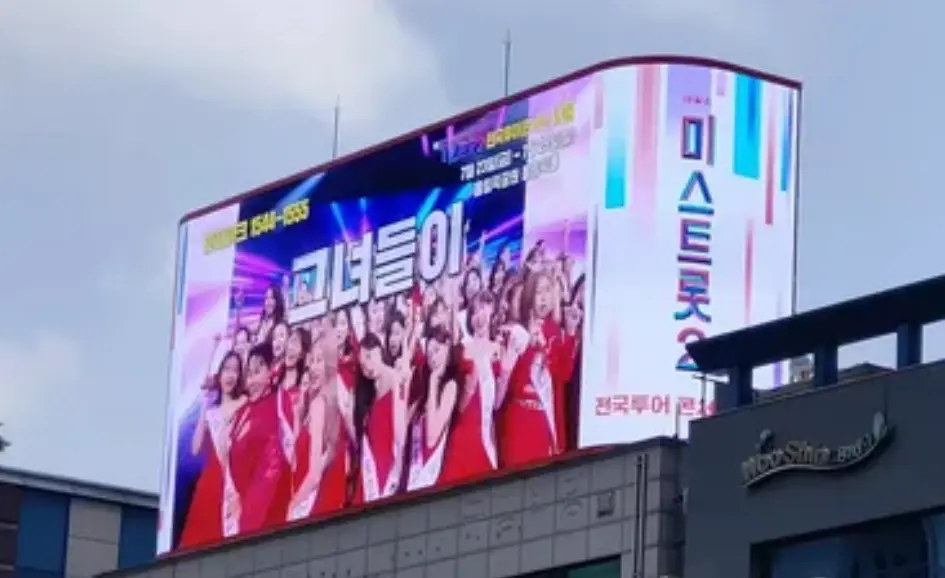
Purchase price is one line item among several.
Pixel pitch also drives power draw, cooling load, and long-term maintenance access—a finer-pitch outdoor panel packs more driver ICs into the same cabinet footprint, which means higher power density and, in hot climates, a real cooling burden across a ten-year service life.
When we scope outdoor projects for advertising operators, we model cost per square meter alongside projected energy consumption and spare-parts availability, because the cheapest panel on the quote isn’t always the cheapest panel to actually run.
A P10 highway billboard, for example, typically draws meaningfully less power per square meter than a P6 panel producing the same brightness—a detail that matters enormously once you’re covering an electricity bill for a hundred-square-meter structure running around the clock.
Pixel Pitch by Application: What We Actually Spec, Project by Project
Viewing distance sets the floor for pixel pitch, but brightness, IP rating, and structural cost all move in lockstep with it.
The table below reflects the specification ranges our engineering team works within across advertising, transportation, and stadium projects.
| Pixel Pitch | Typical Application | Min. Viewing Distance | Brightness Needed | Relative Cost/m² |
|---|---|---|---|---|
| P4–P6 | Urban commercial street, retail plaza | 15–25 ft | 5,000–6,500 nits | High |
| P6–P8 | Transportation hubs, mid-size facades | 25–40 ft | 6,000–7,500 nits | Medium-High |
| P8–P10 | Highway billboards, stadium fascia | 40–80 ft | 6,500–8,500 nits | Medium |
| P10–P16 | Rooftop billboards, large facades | 80–150 ft | 7,000–10,000 nits | Low-Medium |
Notice that brightness climbs as pitch increases—not because a coarser pitch is inherently dimmer, but because these longer-throw installations tend to sit in more direct, unobstructed sunlight and need higher nits to stay legible at midday.
Pixel pitch and brightness are a package deal outdoors; specifying one without the other is exactly how billboards end up looking washed out on a sunny afternoon despite hitting the “correct” resolution on paper.
Why Every Guide You’ve Read Gives You a Different Number
Part of the disagreement across manufacturer content comes down to panel generation, not opinion.
Legacy SMD (Surface-Mounted Device) packaging historically needed a coarser pitch outdoors just to hold up structurally, which is where a lot of the older 16–20mm guidance you’ll still find online originated—including references in older material from Unilumin’s technical blog.
COB (Chip on Board) packaging changes that math.
Encapsulating the LED chip directly onto the PCB improves impact resistance and moisture protection, which has pushed viable outdoor pixel pitch meaningfully finer than what SMD-era guides recommend, without sacrificing the ruggedness outdoor installations demand.
If a source’s recommendation reads unusually coarse compared to everything else you’ve found, it’s worth checking whether it’s still anchored to SMD-era assumptions rather than current packaging technology.
Inside a Real Project: Reworking a Highway Billboard Spec From P6 to P10
On a recent highway-facing billboard project, the client’s initial brief called for P6, chasing sharper resolution “just to be safe” after reading a generic online chart.
Our engineering review told a different story: the nearest realistic viewing point—the highway shoulder—sat at roughly 45 meters, with traffic moving at 55–65 mph.
Running the viewing-distance formula against that input pointed clearly to P10 as the practical resolution ceiling, with P8 as the finest pitch that still made financial sense given the distance.
Switching the spec to P10 cut panel cost by close to a third and reduced power draw accordingly, with zero measurable loss in on-road legibility during post-install testing at highway speed.
The pattern holds across nearly every highway-adjacent project we scope: resolution beyond what the viewing distance actually supports is a cost center, not a quality improvement—and it’s usually the first thing worth challenging in a client’s initial brief.
Where We See Buyers Get This Wrong, Again and Again
Applying Indoor Logic Outdoors
Indoor fine-pitch reasoning—closer viewers, controlled lighting, no direct sun—simply doesn’t transfer to a billboard viewed from a moving vehicle in full daylight.
Ignoring Long-Term Energy and Maintenance Cost
A marginally cheaper panel with a finer pitch can end up costing more to run and service over a decade than a coarser, better-matched alternative.
Skipping Certification and Burn-In Verification
IP65 protection and a documented aging test—72 hours checking dead pixels, brightness consistency, and color uniformity—matters more outdoors than almost any number on a datasheet, because field failures under real weather are what actually erode ROI.
How to Pressure-Test a Supplier’s Recommendation Before You Sign
Ask for a CAD-based viewing-distance simulation specific to your installation height and angle, not a generic chart pulled from a blog post.
Request the actual aging-test data and IP-rating certification documents rather than accepting brightness and durability claims at face value.
Any supplier confident in their own engineering will hand both over without hesitation—and any supplier that hesitates just told you something worth knowing before you commit.
Questions We Get Asked on Nearly Every Outdoor Project
What is the best pixel pitch for a billboard viewed from a highway at 60 mph?
P8 to P16 is typical, with the exact figure depending on the nearest viewing distance—generally P10 for distances around 40–50 meters.
Is P10 or P16 better for a large stadium facade?
P10 offers sharper detail for closer seating tiers; P16 is more cost-efficient for upper-tier or long-throw viewing where fine detail won’t register anyway.
Does COB technology allow a finer pixel pitch outdoors than traditional SMD?
Yes—COB’s encapsulated packaging improves impact and moisture resistance, making finer outdoor pitches (P4–P6) more durable and viable than older SMD-era outdoor panels of the same pitch.
How much does pixel pitch affect total outdoor billboard project cost?
Significantly—dropping one pitch tier, say P10 to P8, can raise panel cost by 25–40%, plus higher power draw over the display’s entire service life.
What pixel pitch is best for a billboard in a pedestrian shopping district?
P4 to P6, since pedestrian viewers typically stand or walk within 15–30 feet—close enough to notice finer detail than highway traffic will ever pick up on.
The Bottom Line From Our Engineering Desk
Skip the generic chart.
The best pixel pitch for outdoor billboard applications is the finest pitch your actual minimum viewing distance can justify—not the finest pitch your budget technically allows, and not a number copied off someone else’s spec sheet.
Run the viewing-distance math first, layer in brightness and IP requirements second, and let cost-per-square-meter break the tie.
In our experience, that order is what separates a billboard that performs cleanly for a decade from one that generates a change order six months after it’s installed.
Why Project Teams Choose to Build With Sostron
We design, manufacture, and support LED displays from a single facility in Shenzhen, which means the engineer who reviews your viewing-distance calculation is working from the same production floor that builds and burn-in tests your panels—not a sales office relaying specs from a factory three time zones away.
That proximity between design and production is why our outdoor projects consistently land on-spec the first time, from DOOH advertising networks to stadium fascias to highway billboards shipped across five continents.
If you’re comparing pixel pitch options for a specific site, our outdoor LED display range walks through the panel series—including our energy-efficient Ares Series—built specifically around the brightness, IP, and pitch combinations covered in this guide.
And if your project has a viewing distance, budget, or timeline that doesn’t fit neatly into a chart, our engineering team is a direct line away—send over your site details and traffic pattern, and we’ll return a CAD-based recommendation rather than a generic quote.
References:
AVIXA — How to Choose the Right Pixel Pitch
Caltrans — Outdoor Advertising Report: Changeable Message Signs

About SoStron
Marketing Strategic Director at Sostron