LED panels have become one of the most impactful investments a modern church can make — replacing aging projector systems, elevating live worship experiences, and powering hybrid services for both in-person and online congregants. But before your leadership team signs a purchase order, the first question is always the same: how much does a church LED panel actually cost?
The answer depends on far more than square footage. Pixel pitch, installation environment, content software, structural rigging, and ongoing maintenance all factor into total cost of ownership. In 2026, LED technology is becoming the preferred option for churches seeking to future-proof their AV systems and create a more engaging worship experience.
This guide breaks down real 2026 pricing data, key buying considerations, size-specific cost estimates, and proven strategies to stretch your church’s technology budget.
Why More Churches Are Choosing LED Panels
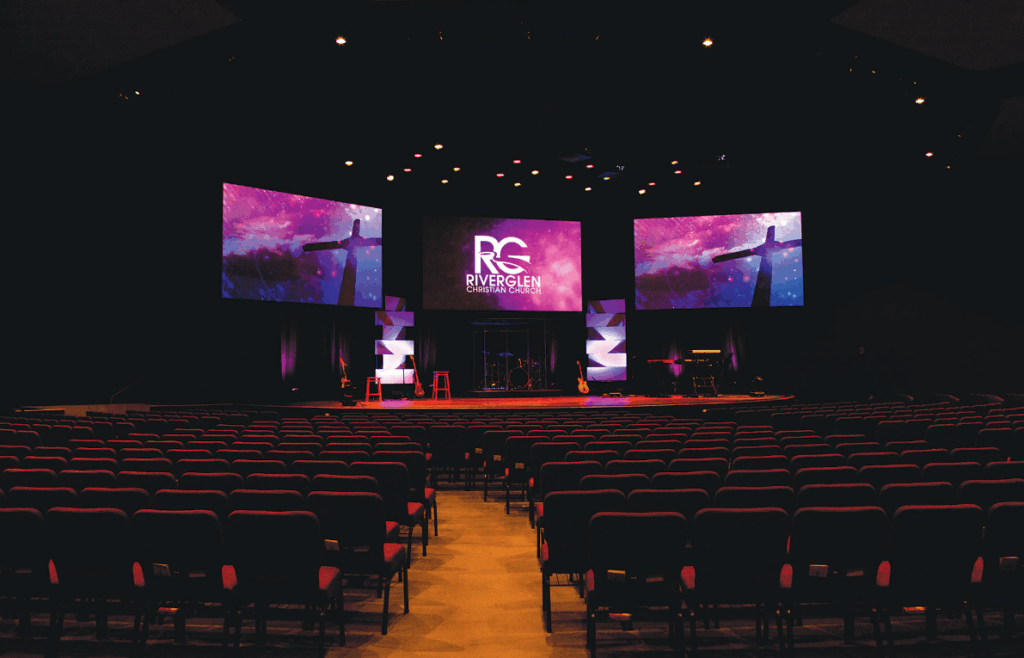
Technology has rapidly become central to church operations, worship experiences, and outreach — especially as hybrid and virtual attendance models remain common. High-quality AV systems, including LED displays, interactive digital signage, and live-streaming infrastructure, are now considered core elements of modern church design.
Here’s why congregations across the U.S. are upgrading to LED in 2026:
Enhanced Worship Experience LED panels deliver bright, vivid visuals for scripture, song lyrics, and video content that projectors simply cannot match in ambient light conditions. A key lesson from recent installations: you need a minimum of 1,200 nits brightness — churches that installed 800-nit screens discovered they became unreadable during morning services when natural light comes through stained glass windows.
Hybrid Ministry Compatibility Churches are designing services for both in-person and online congregants simultaneously, with LED walls delivering a polished, camera-friendly backdrop that translates professionally to live streams.
Energy Efficiency and Durability LEDs consume 30–50% less power than traditional projectors, with a rated lifespan of up to 100,000 hours — significantly reducing maintenance costs over a 10-year horizon.
Flexibility Across Events From Sunday services to Easter productions, funerals to youth events, a single LED wall system adapts seamlessly to every use case with software-driven content switching.
Pro Tip: For sanctuaries with a 30–60 ft viewing distance, a pixel pitch of P2.5–P4mm delivers the best balance of image clarity and cost-efficiency. Use this formula: viewing distance in feet ÷ 3.5 = maximum pixel pitch in mm.
Key Factors That Influence LED Panel Pricing
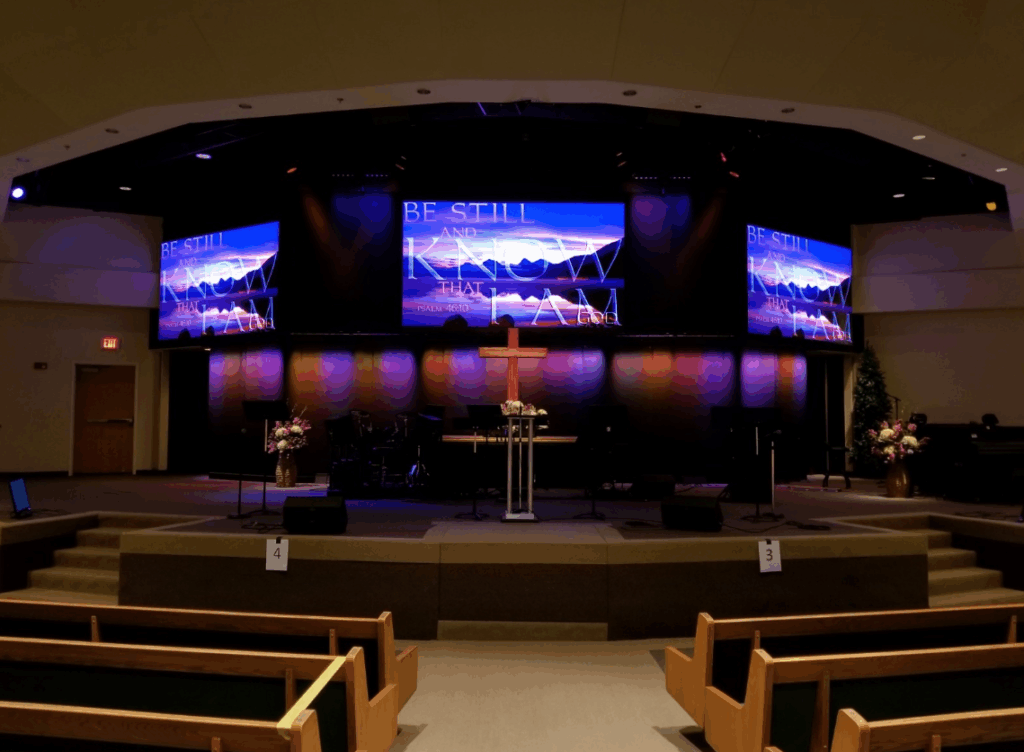
There is no single price for church LED panels. Indoor LED walls typically range from $1,200 to $2,800 per square meter, while outdoor LED walls run $2,500 to $4,000 per square meter, with mounting structures, electrical work, and professional installation adding further to the total cost.
Here are the variables that move the needle most:
Screen Size
The single largest cost driver. A compact 10×6 ft indoor panel starts around $10,000–$15,000 installed, while a large stage-wide backdrop (20×13 ft or larger) can range from $30,000 to $100,000+ depending on specification.
Pixel Pitch (P-Value)
A smaller pixel pitch delivers higher resolution but at higher cost — a P3.9 panel is significantly cheaper than a P1.8 screen at the same size. A P3.9 10×6 ft display typically costs $10,000–$12,000, whereas a P1.9 equivalent runs $25,000–$30,000.
P4 panels cost approximately 22% less than P3.2 while delivering 92% equivalent clarity at viewing distances of 40 ft or more — making them a smart choice for mid-sized sanctuaries.
Indoor vs. Outdoor Installation
Outdoor-ready panels require weatherproofing (IP65+), higher brightness output (5,000–10,000 nits), and more robust structural mounting — typically adding 30–40% to the base panel cost.
Control Systems & AV Integration
Switchers, media servers, camera feeds for IMAG (Image Magnification), and broadcast streaming integrations can add $2,000–$15,000 depending on complexity.
Installation & Rigging
Budget 10–20% of the panel cost for professional labor, rigging, and structural engineering — higher for elevated or flown configurations. Hidden costs that 60% of church LED quotes omit include rigging certifications ($800–$2,000 for engineered hanging systems) and anti-glare treatments ($15/sq.ft. for wide-angle diffusion film.)
Content Software Compatibility
Most churches run ProPresenter or MediaShout for worship content. Confirm that the LED wall’s native resolution supports 16:9 output — 90% of sanctuary walls are 4:3, and a forced aspect ratio mismatch can waste up to 30% of your screen real estate.
Cost Estimates for Church LED Panels
Use these figures as a planning baseline. Prices reflect 2026 U.S. market rates for installed turnkey systems.
Small Church (50–150 Seats)
- Recommended Setup: 8×5 ft or 10×6 ft indoor P3.9–P4.8 display
- Panel Cost: $8,000–$14,000
- Full Installed Cost (including mounting + basic AV): $10,000–$18,000
- Best Use: Single screen for lyrics, scripture, and sermon slides
Medium Church (150–400 Seats)
- Recommended Setup: 14×8 ft or 16×10 ft indoor P2.9–P3.9 display
- Panel Cost: $18,000–$30,000
- Full Installed Cost: $22,000–$38,000
- Best Use: Main stage backdrop + possible IMAG side screens
Large Church (400–1,000+ Seats)
- Recommended Setup: 20×12 ft or larger P2.5–P2.9 display, potentially with flanking screens
- Panel Cost: $35,000–$75,000
- Full Installed Cost: $45,000–$100,000+
- Best Use: Full stage production, broadcast-quality live streaming, multi-campus simulcast
Mega Church / Arena-Style Campus
- Recommended Setup: Custom multi-screen configuration with center-hung or flown displays
- Full Installed Cost: $100,000–$500,000+
Hidden Costs Checklist: Transportation and freight ($500–$3,000), on-site calibration and tuning (10–15% of panel cost), annual maintenance contract ($800–$2,500/year), and spare module inventory (5–10% of panel cost recommended).
Practical Ways to Reduce LED Panel Costs
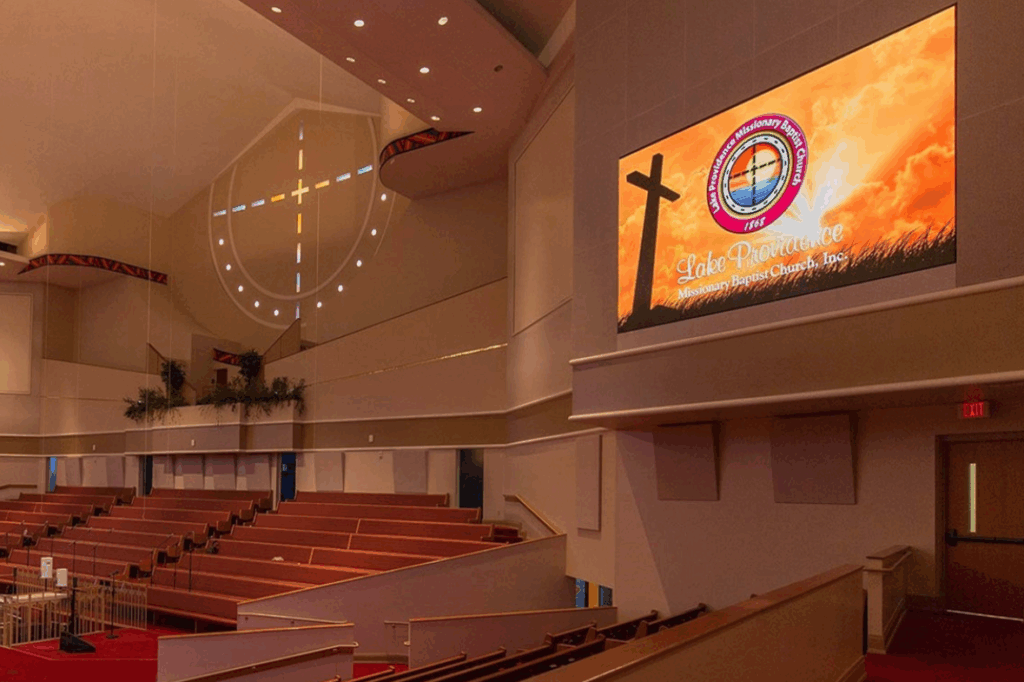
Managing budget is critical for churches. Here are five strategies to save money:
-
Go Modular: Modular LED panels make future repairs and upgrades cheaper, saving around 20% in long-term maintenance.
-
Consider Rentals: For seasonal events (Christmas, Easter), rentals cost $50–$100 per panel per day—about a third of the purchase cost.
-
Choose Local Vendors: Local suppliers save $200–$500 on shipping and speed up service.
-
Leverage Group Buying: Teaming up with other churches can earn you 5–10% discounts.
-
Select Energy-Efficient Models: Panels under 300W per square meter cut electricity bills by up to 20% over time.
Case in point: A mid-sized U.S. church rented a 13×6 ft LED wall for Easter services at one-third the purchase price, with excellent results.
Real-World Examples
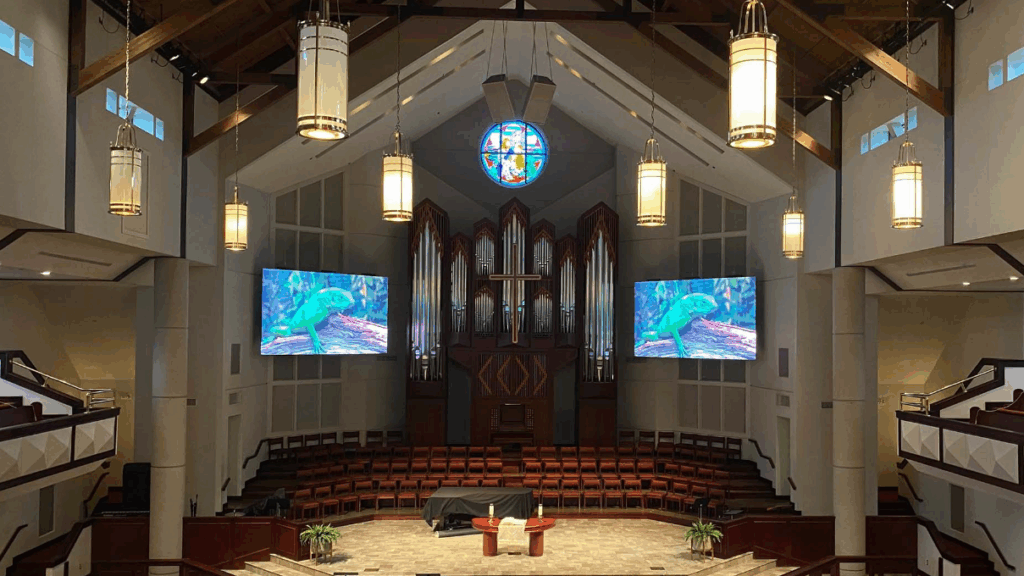
Budget constraints are real for most congregations. Here are five proven strategies to maximize impact per dollar:
Go Modular from Day One Choose panel systems with standardized, replaceable modules. Modular designs reduce long-term repair costs by approximately 20% and allow you to expand the wall over time as the church grows — rather than replacing the entire system.
Use Rentals for High-Season Events For Christmas, Easter, and special productions, rental LED panels run $50–$100 per panel per day — roughly one-third the annualized cost of purchase. Many churches rent premium panels for two or three key events while using a more modest permanent installation for weekly services.
Source Factory-Direct Working directly with a manufacturer like Sostron — which operates a 15,000㎡ production facility in Shenzhen with 14+ years of church and worship venue experience — eliminates distributor margins and can reduce panel costs by 20–35% versus buying through a local AV reseller.
Phase Your Investment Install the main center screen first, then add flanking IMAG screens in a second phase 12–18 months later. This spreads capital expenditure while still delivering an immediate upgrade to the worship experience.
Choose Energy-Efficient Panels Panels rated under 300W per square meter cut electricity costs meaningfully over a 10-year period — worth factoring into your TCO analysis when comparing bids.
Case Study: A mid-sized Texas church (400 seats) phased their LED investment over two years — starting with a 16×9 ft P3.9 center stage wall for $22,000, then adding two 6×4 ft side IMAG screens in year two for $12,000. Total spend: $34,000 over 24 months, versus a $45,000 upfront quote for the full system.
Real-World Church LED Installation Examples
Texas Mid-Sized Church (2024–2025) Installed two P3 LED walls (15×10 ft each) for approximately $65,000 total, including professional AV integration and rigging. Congregation engagement and social media sharing of services increased significantly in the first quarter following installation.
California Mega Church (2025) Added a 30×15 ft P2.9 LED wall as a primary stage backdrop for $150,000. The investment has supported a 40% increase in online viewership as the wall provides a broadcast-quality background for weekly live streams and special event productions.
Midwest Community Church (2026 — Small Budget) Leveraged a verified 2025 configuration for 200-seat worship spaces: a core LED system with 5–8 panels at P3.9–P4.8 specification, achieving 500–800 nits brightness with 20% energy savings, for a total installed cost under $8,000.
LED Screen vs. Projector: The 2026 Decision Framework
Many churches still debate whether to upgrade from a projector to LED. Here’s the current reality:
LED screens are the clear winner for most churches today, especially mid-sized to large congregations upgrading their tech. They deliver a more reliable, engaging, and future-proof worship experience with superior brightness, consistency, and lower long-term headaches. LED walls are especially popular in churches that prioritize live streaming, video production, and a modern worship experience, as they provide a polished, professional look that translates well both in-person and online.
Choose LED if:
- Your sanctuary has uncontrolled ambient light (windows, skylights)
- You livestream services or record video content
- You want a system that lasts 10+ years with minimal maintenance
- You run multiple event types with varying content needs
Consider projector if:
- Budget is under $5,000 and the sanctuary is fully light-controlled
- You have a temporary or rented space
- Installation is not practical (historic building, no rigging points)
Frequently Asked Questions
Q: What size LED panel does my church need?
A: Depends on your sanctuary size. Small churches: 2–3m²; medium: 5–10m²; large: 10m²+. As a rule of thumb, 1mm pixel pitch = 1m optimal viewing distance.
Q: How long do LED panels last?
A: High-quality LEDs last up to 100,000 hours (about 11 years if running 24/7). Regular maintenance extends lifespan.
Q: How do I pick a reliable vendor?
A: Look for companies with church installation experience. Ask for case studies, reviews, and a live demo. Provide you with a wholesale guide for Chinese LED display screens.
Q: How long does installation take?
A: Small projects: 1–2 days; medium/large setups: 3–5 days, depending on complexity.
7. Conclusion: Choosing the Right LED Panel for Your Church
LED panels are transforming worship, helping churches deliver powerful messages and connect with congregations more effectively. While pricing varies by size, pixel pitch, and installation environment, smart planning can keep costs under control. By choosing modular systems, working with local suppliers, and considering rentals when appropriate, churches can maximize both impact and value.
LED panels are not just a trend—they’re shaping the future of church worship. How do you see LED technology changing your church’s experience?