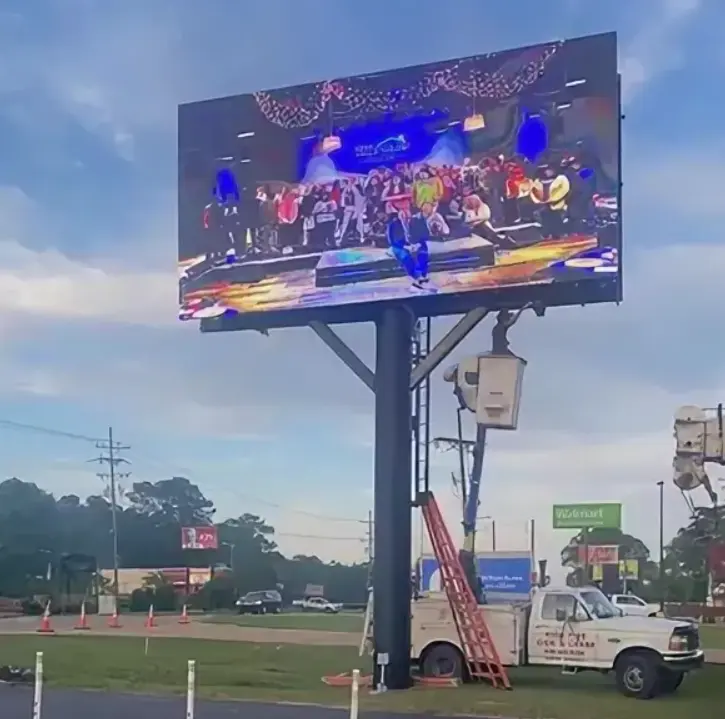
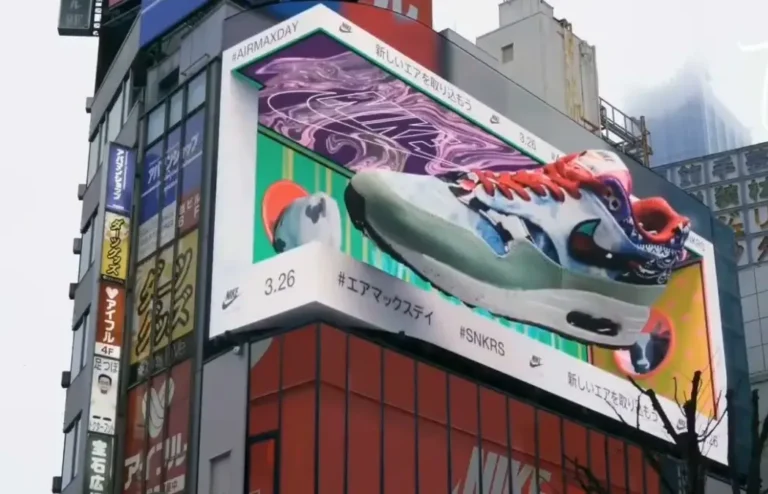
Quick Answer
A Trade Show LED Display is a modular direct-view LED system used for exhibition backwalls, product demonstrations, brand presentations, immersive booth designs, hanging displays, LED posters, and interactive installations. The right system is not simply the display with the smallest pixel pitch or highest brightness. It should be selected according to booth size, closest viewing distance, content type, screen dimensions, installation method, event frequency, logistics, and total cost.
For most indoor exhibitions, fine-pitch LED in the P1.5–P3.9 range can be relevant, but the correct pitch depends on viewing distance and content. Current event-industry guidance consistently recommends selecting pixel pitch from the nearest meaningful viewing position rather than choosing the smallest available pitch.
The total budget also goes beyond LED cabinets. Depending on the project, buyers may need to account for the control system, structure, freight, material handling, installation, electrical service, rigging, technician support, spare parts, and content equipment.
| Buying Question | What to Check First |
|---|---|
| What pixel pitch do I need? | Closest viewing distance + content detail |
| What screen size do I need? | Booth dimensions + viewing area + content format |
| Should I rent or buy? | Number of exhibitions + transport + storage + reuse |
| How much will it cost? | Hardware + event services + logistics + venue costs |
| What specifications matter? | Pitch, brightness, refresh rate, resolution, weight, power |
| What can go wrong? | Venue rules, rigging, electrical limits, signal, installation and spares |
What Is a Trade Show LED Display?
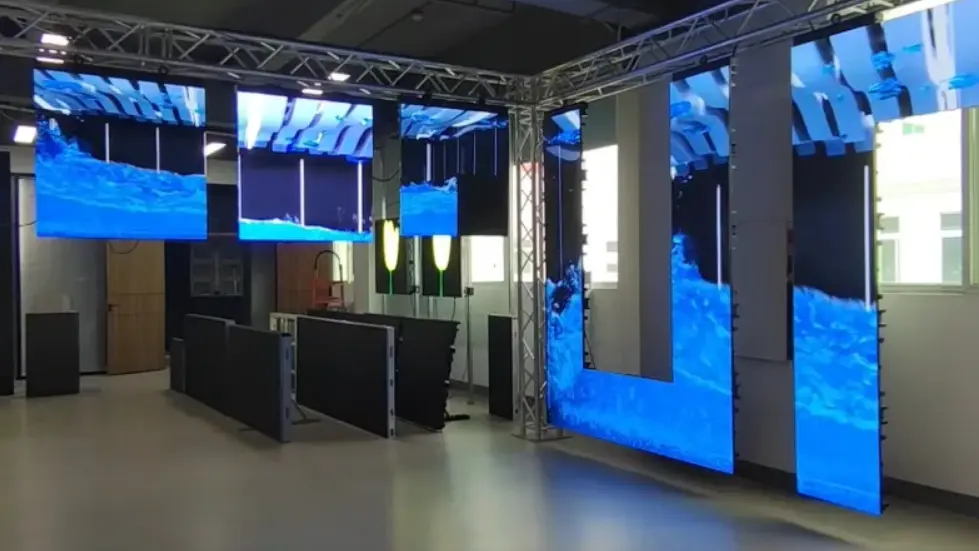
A trade show LED display is a modular LED video system designed to present moving images, product demonstrations, presentations, branding, live feeds, data, and other visual content inside or around an exhibition booth.
Unlike a conventional printed backdrop, an LED display can change content throughout the event without replacing physical graphics. Depending on the configuration, exhibitors can build:
- Flat LED video walls
- Fine-pitch LED backwalls
- Curved or creative LED walls
- LED towers
- Hanging LED displays
- Floor LED displays
- LED poster displays
- Multi-screen configurations
- Immersive booth environments
The important point for a B2B buyer is that the LED display is part of the exhibition system, not an isolated piece of hardware.
The screen has to work with the booth structure, power supply, content system, installation schedule, venue rules, and transportation plan.
Why Use an LED Display at a Trade Show?
The strongest reason to use LED is not simply that moving images are more attractive than printed graphics.
The more useful business advantage is content flexibility.
One display can be used for:
- Product videos
- Brand films
- Product demonstrations
- Sales presentations
- Live camera feeds
- Product specifications
- Customer stories
- QR codes
- Social media feeds
- Real-time data
- Event schedules
- Multiple product campaigns
This allows the same physical display to support different stages of the visitor journey.
For example, a booth can use a short brand video to attract attention from the aisle, detailed product content for visitors who enter the booth, and technical specifications during a sales conversation.
That makes the display more useful than treating it as a large digital poster.
Which Trade Show LED Display Format Should You Choose?
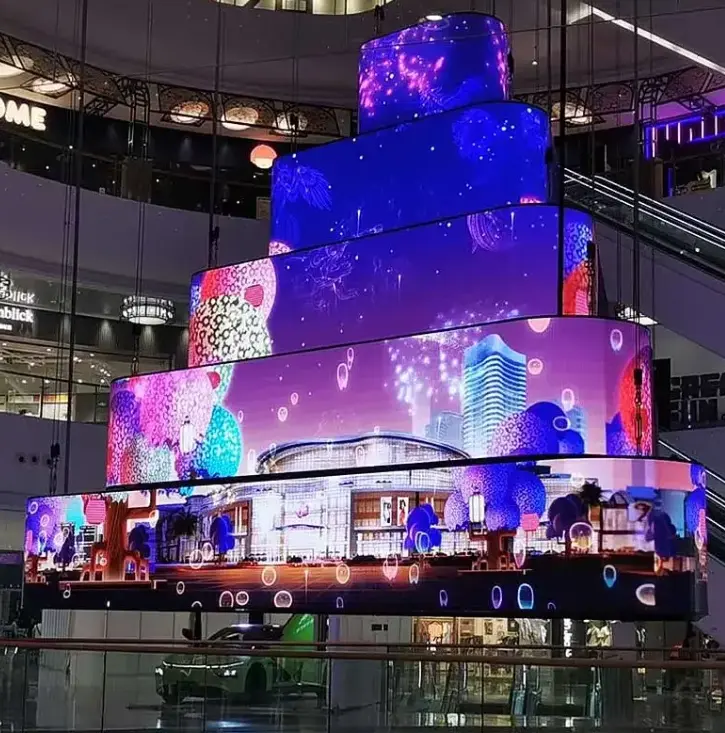
The best format depends on how the screen will be used and how much physical space is available.
| Display Format | Best Use | Main Advantage | Main Consideration |
|---|---|---|---|
| LED video wall | Main booth backdrop | Large visual canvas | Requires structural and technical planning |
| LED poster | Small booths and product zones | Compact and portable | Smaller visual area |
| Curved LED | Premium or immersive booths | Flexible booth geometry | More complex design |
| Hanging LED | Island booths | Visible from multiple directions | Rigging and venue approval |
| Floor LED | Interactive installations | Extends content into the floor | Requires suitable floor-rated system |
| LED tower | Entrance or product zones | Strong vertical presence | Occupies valuable floor space |
| Multiple LED posters | Modular booth layouts | Easy content zoning | Multiple units require content coordination |
LED Poster vs LED Video Wall
An LED poster can make sense when the booth needs a vertical digital display without building a large wall.
Sostron’s sPoster, for example, is designed as a foldable LED poster and can also be linked into larger display configurations. Its manufacturer information describes HDMI connectivity, cascading and centralized control options.
Sostron sPoster Foldable LED Poster Screen
A modular LED wall becomes more attractive when the objective is to create a large backwall, immersive surface, or custom booth architecture.
What Pixel Pitch Should You Choose for a Trade Show LED Display?
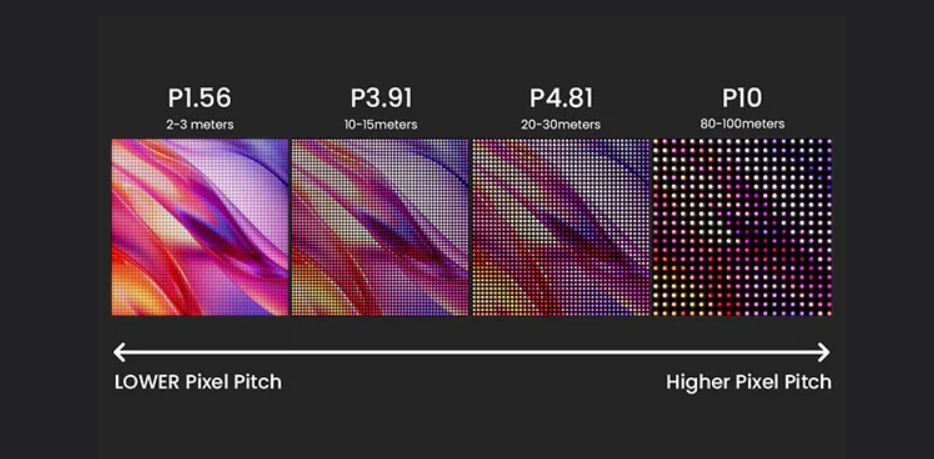
Pixel pitch is the distance between the centers of adjacent LED pixels, measured in millimeters.
A smaller pitch places pixels closer together and increases pixel density. This generally improves fine-detail reproduction at close viewing distances, but it also tends to increase system cost.
The mistake is to ask:
“What is the smallest pixel pitch available?”
A better question is:
“How close will the nearest important viewer stand, and what level of detail must that viewer see?”
Current trade-show LED guidance emphasizes this viewing-distance approach rather than treating a particular pitch as universally correct.
P1.5 vs P1.9 vs P2.5 vs P2.9 vs P3.9
| Pixel Pitch | General Positioning | Typical Decision Logic |
|---|---|---|
| P1.5 | Very fine pitch | Very close viewing, premium visual detail |
| P1.9 | Fine pitch | Close-viewing exhibitions and detailed content |
| P2.5 | Fine pitch | Common consideration for indoor exhibition walls |
| P2.9 | Mid fine-pitch | Useful when viewers are somewhat farther away |
| P3.9 | Larger pitch | More suitable when viewing distance is greater |
These are planning categories, not mandatory application rules. Actual selection should consider screen size, content, viewing distance, ambient light, camera use and budget.
A Practical Viewing-Distance Method
A common industry rule of thumb is to relate pixel pitch to the minimum viewing distance, but there is no single universal formula or industry standard that applies to every LED display. Different suppliers and AV engineers use different calculation methods. Use any formula only as an initial planning reference, then validate the actual LED wall with the intended content, screen size, viewing distance, and camera requirements.
For a trade show, measure:
- The closest point where visitors can stand.
- The normal conversation distance.
- The farthest meaningful viewing position.
- Whether the display will be photographed or filmed.
- Whether the content contains small text or detailed graphics.
Then compare candidate pitches.
Do not automatically pay for a finer pitch if visitors cannot perceive the additional resolution.
Is P1.9 Better Than P2.5 for a Trade Show?
Not automatically.
P1.9 provides a higher pixel density than P2.5, which can benefit close viewing and detailed content. But if the audience normally stands several meters away and the display primarily shows large video graphics, the visual difference may not justify the additional cost.
A useful procurement test is to place the actual:
- Product text
- Logo
- Fine lines
- Human faces
- Product photography
- Presentation slides
on both candidate displays and evaluate them from the closest meaningful viewing position.
This is more reliable than choosing based only on the specification sheet.
Does a Smaller Pixel Pitch Mean 4K?
No.
Pixel pitch does not automatically determine whether an LED wall is 4K.
The final resolution depends on:
- Physical screen dimensions
- Pixel pitch
- Number of cabinets
- Pixel resolution per cabinet
- Processor configuration
- Input resolution
- Content format
For example, a P2.5 wall can have enough physical pixels for a particular 4K application, while another P2.5 configuration may not.
Therefore, a supplier should provide the proposed wall’s actual:
- Width
- Height
- Pixel dimensions
- Aspect ratio
- Processor configuration
- Input/output resolution
before the content team creates final artwork.
What Size LED Screen Do You Need for a Trade Show Booth?
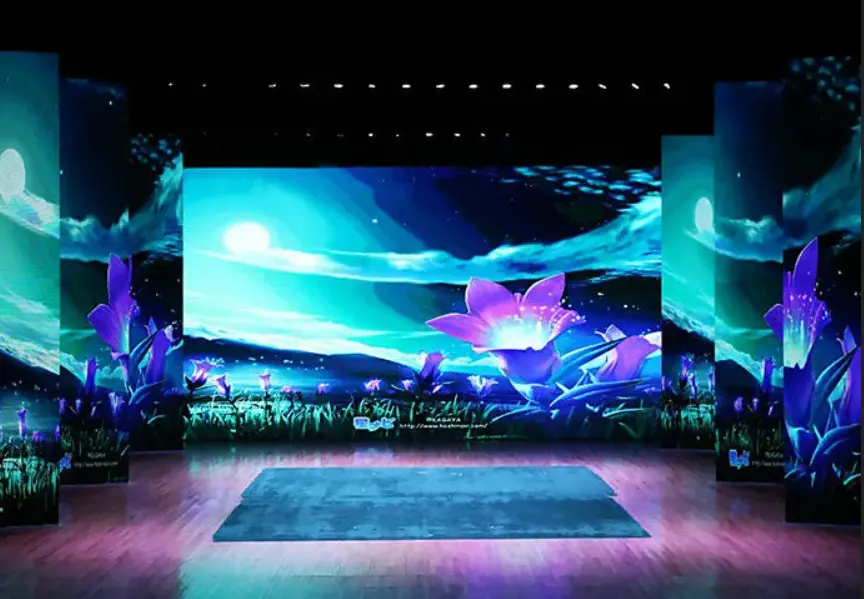
Screen size should be determined by booth geometry and viewing behavior, not by a standard screen size.
A 10×10-foot booth, for example, does not automatically require a particular LED wall.
Before specifying the display, determine:
- Booth width
- Booth height
- Available wall area
- Visitor approach direction
- Nearest viewing position
- Product display location
- Meeting area
- Storage area
- Required aisle clearance
- Whether the display is floor-supported or suspended
10×10 Booth
A small inline booth often benefits from a controlled LED backwall rather than using every available inch for a screen.
The display needs to leave enough room for:
- Product displays
- Staff
- Visitor circulation
- Counters
- Storage
- Branding
- Safety access
A smaller screen with appropriate pixel pitch can outperform an oversized wall that makes the booth feel cramped.
10×20 Booth
A 10×20 booth gives more flexibility.
Possible configurations include:
- Large rear LED wall
- LED wall plus product demonstration zone
- Two display zones
- LED poster plus main video wall
- Curved LED feature
- Meeting area with separate presentation screen
The important question is not simply “How large can the LED wall be?”
It is:
How much display area improves communication without reducing usable booth space?
Island Booth
An island booth can support more ambitious configurations because visitors can approach from several directions.
Possible applications include:
- Four-sided LED towers
- Suspended LED structures
- Curved walls
- Large central LED volumes
- Floor LED
- Multiple synchronized screens
However, island booths also introduce more complicated structural, electrical and rigging requirements.
How Much Does a Trade Show LED Display Cost?
There is no responsible universal price for a trade show LED display.
A quote can vary significantly according to:
- Screen area
- Pixel pitch
- Cabinet type
- Indoor/outdoor specification
- Processor
- Structure
- Rental duration
- Shipping distance
- Installation requirements
- Venue labor
- Electrical service
- Rigging
- Technician support
- Content requirements
Current trade-show suppliers publish package prices and rental benchmarks, but these are supplier-specific references rather than universal market prices. Some published packages also explicitly exclude labor, shipping, electrical service or material handling.
Therefore, buyers should compare complete project quotes, not only the LED cabinet price.
What Should Be Included in the Total Cost?
A useful B2B budgeting model is:
Total Trade Show LED Cost = Hardware + Control + Structure + Logistics + Event Services + Operating Costs
| Cost Category | What It May Include |
|---|---|
| LED hardware | Cabinets, modules, power supplies |
| Control system | Processor, sending card, receiving cards, media equipment |
| Structure | Ground support, brackets, frame, hanging structure |
| Installation | Assembly, alignment, testing |
| Freight | Air/sea/ground transportation |
| Customs | Duties, brokerage or import-related charges where applicable |
| Venue services | Material handling, electrical, labor |
| Rigging | Hoists, truss, safety equipment and labor where required |
| Technician | Setup, operation or emergency support |
| Content | Production, formatting and playback equipment |
| Maintenance | Spare modules, power supplies and receiving components |
| Storage | Between events if the system is purchased |
Not every project requires every category.
The point is to prevent the common procurement error of comparing a hardware-only price with a turnkey exhibition quote.
Supplier-Listed Price Example
As a supplier-listed benchmark rather than a universal market price, Airborne Visuals currently lists a 10×10 LED video-wall booth package at $14,500–$16,667. Another 10×10 package from the same supplier specifies that labor, shipping, electrical, rigging, material handling and other third-party services are excluded. Actual pricing varies by display specification, event city, rental period, booth structure and venue requirements.
Should You Rent or Buy a Trade Show LED Display?
The answer depends primarily on how often you will use it and how you will move it.
Renting May Make More Sense When:
- You attend only a few exhibitions.
- Shows occur in different cities.
- You do not want to store LED cabinets.
- You need local installation.
- You need venue coordination.
- You want access to different pixel pitches.
- You want to avoid long-term equipment ownership.
Buying May Make More Sense When:
- You attend exhibitions frequently.
- The same LED configuration can be reused.
- You have storage capability.
- Your team or contractor can handle installation.
- Freight between events is manageable.
- You want control over the hardware.
- The display will also be used for other events or corporate applications.
There is no credible universal statement such as “renting always saves 50%.”
The correct comparison is:
Rental TCO over the expected number of events
versus
Purchase price + logistics + storage + maintenance + depreciation/obsolescence.
What Technical Specifications Matter Most?
1. Pixel Pitch
Controls how finely pixels are packed and strongly influences close-viewing image quality.
2. Brightness
Indoor exhibition halls vary considerably in ambient lighting.
There is no single brightness number that is correct for every booth.
A display near strong architectural lighting, windows or high-output exhibition lighting may require a different operating range from a display in a controlled environment.
The better approach is to specify brightness according to:
ambient light + content + viewing conditions + camera requirements.
3. Refresh Rate
Refresh rate matters particularly when the display will be photographed or filmed.
A higher refresh rate can help reduce visible scan-related artifacts, but camera results also depend on:
- Camera shutter speed
- Camera frame rate
- LED scan architecture
- Driver IC
- Processing
- Brightness settings
For camera-heavy trade shows, test the actual LED system with the intended camera setup instead of relying on the refresh-rate number alone.
4. Cabinet Weight
Weight affects:
- Transport
- Booth structure
- Ground support
- Rigging
- Installation labor
- Handling
For hanging systems, structural calculations and venue requirements become especially important.
5. Cabinet Dimensions
Common rental systems use modular cabinets that can be assembled into different screen sizes.
Smaller cabinets can provide greater configuration flexibility, while larger cabinets may reduce the number of connections and installation steps.
6. Maintenance Access
Front maintenance can be valuable when the rear of the LED wall is inaccessible because it is installed against a booth wall.
Always ask:
Can the module, power supply and receiving electronics be serviced in the actual booth configuration?
How Do Power Requirements Affect a Trade Show LED Display?
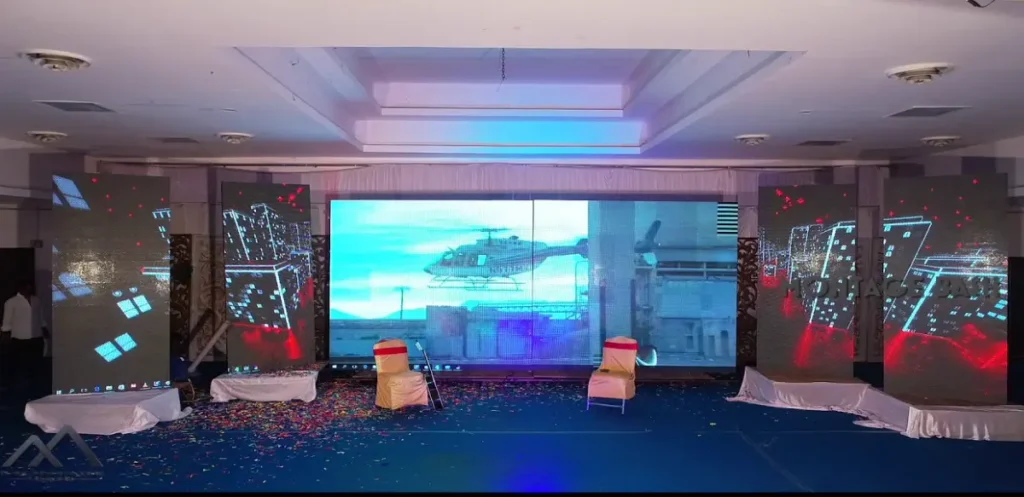
Power should be calculated from the actual LED system specification rather than a generic watt-per-square-meter assumption.
Ask the supplier for:
- Maximum power consumption
- Typical or average power consumption
- Operating voltage
- Total screen area
- Processor/control-system power
- Recommended electrical capacity
Sostron’s Hima product information, for example, publishes separate maximum and average power figures for its listed configurations rather than presenting one universal consumption figure.
The distinction matters because electrical planning based only on average consumption may underestimate peak requirements.
What Installation Issues Should Trade Show Buyers Plan For?
Installation is one of the easiest costs to underestimate.
Before shipping the display, confirm:
- Booth drawings
- Screen dimensions
- Cabinet weight
- Ground-support requirements
- Hanging-point requirements
- Electrical capacity
- Load-in time
- Setup deadline
- Testing window
- Dismantling schedule
- Venue contractor requirements
- Labor rules
- Safety requirements
Venue requirements can vary significantly. For example, the NAMM Show’s current guidelines state that rigging, electrical and related labor requirements can depend on the service provider, location, collective bargaining agreements and scope of work.
This is why an LED supplier’s hardware quote should not be treated as proof that the equipment can automatically be installed at the destination venue.
Do You Need Rigging for a Trade Show LED Display?
Not necessarily.
A display can be:
- Ground-supported
- Wall-mounted
- Integrated into booth structures
- Suspended
Suspended systems introduce additional requirements for:
- Approved rigging points
- Structural loads
- Safety cables
- Hoists
- Venue approval
- Qualified labor
The exact requirements are venue-specific.
For a booth where overhead rigging is difficult or expensive, a ground-supported LED wall may be a more practical solution.
What Safety Standards Should Buyers Check?
LED displays contain electrical and electronic equipment, so product safety requirements matter.
IEC 62368-1:2023 is an international product-safety standard covering audio/video and information and communication technology equipment. IEC currently lists a corrected 2025 version of the 2023 edition.
However, one product standard does not automatically mean that a display satisfies every requirement of a particular exhibition venue.
Buyers should separately confirm applicable:
- Electrical requirements
- Fire requirements
- Rigging requirements
- Venue regulations
- Local codes
- Product certifications required for the destination market
Ask the supplier to provide the documentation relevant to the actual product being quoted.
What Content Works Best on a Trade Show LED Display?
LED technology does not fix weak content.
The content should be designed around the physical screen.
Effective Trade Show Content
- Short product videos
- Product demonstrations
- Large product imagery
- Animated diagrams
- Brand stories
- Customer use cases
- Technical highlights
- QR codes
- Live presentations
- Social media
- Real-time data
Avoid Overloading the Screen
A large LED wall can display a great deal of information, but that does not mean it should.
For visitors walking past a booth, content should be readable quickly.
For visitors already speaking with sales staff, the display can switch to more detailed content.
This suggests using multiple content layers:
Attention → Interest → Demonstration → Technical Detail → Conversion
How Should You Prepare Content for the LED Wall?
Before finalizing video production, obtain the actual LED canvas resolution from the supplier.
Do not assume that a physically wide LED wall is automatically 16:9.
A modular LED wall may have a physical aspect ratio such as:
- 16:9
- 32:9
- 12:7
- Custom panoramic ratio
The content should match the actual pixel canvas.
Ask the supplier for:
- Exact pixel dimensions
- Aspect ratio
- Input resolution
- Processor scaling information
- Safe area
- Supported signal formats
- Content delivery deadline
This prevents the common problem of creating a 16:9 video for a display that is not 16:9.
How Can You Reduce Trade Show LED Costs?
The cheapest LED display is not necessarily the lowest-cost solution.
1. Choose Pixel Pitch From Viewing Distance
Do not pay for fine pitch that your audience cannot meaningfully perceive.
2. Avoid Oversizing
A huge wall may look impressive but can consume booth space, power, freight capacity and budget.
3. Standardize Reusable Configurations
If you attend multiple exhibitions, standard cabinet sizes and repeatable configurations can simplify transport and setup.
4. Compare Complete Quotes
Ask every supplier to identify:
- Hardware
- Processor
- Structure
- Installation
- Freight
- Venue labor
- Electrical
- Rigging
- Technician
- Content equipment
5. Plan Spare Parts
For repeated events, consider carrying appropriate spare:
- LED modules
- Power supplies
- Receiving cards
- Cables
- Connectors
The exact spare quantity should be based on the system design and supplier recommendation.
Can One LED Display Be Reused for Multiple Trade Shows?
Yes, modular rental-style LED systems are particularly suited to repeated assembly and different configurations.
A reusable system can potentially be deployed as:
- 3×2 m backwall
- 4×2.5 m presentation wall
- Curved display
- Product demonstration screen
- Corporate event backdrop
The economic value comes from reuse, not simply from owning the equipment.
For frequent exhibitors, the important question is:
How many events can the same inventory support before a different configuration or technology becomes necessary?
This should be considered when selecting cabinet dimensions, pixel pitch and maintenance design.
What Should You Ask an LED Supplier Before Ordering?
Use this procurement checklist.
Display
- What pixel pitch is quoted?
- What is the exact cabinet size?
- What is the cabinet weight?
- What is the actual screen resolution?
- What is the brightness specification?
- What is the refresh rate?
- Is the display indoor or outdoor rated?
Control
- Which processor is included?
- What input formats are supported?
- What is the maximum input resolution?
- Is scaling included?
- Is signal redundancy available?
Installation
- Is the system ground-supported or suspended?
- What structure is included?
- Who installs it?
- Who dismantles it?
- Is an onsite technician included?
Logistics
- How is the equipment packaged?
- Are flight cases included?
- What is the packed weight and volume?
- Who handles freight?
- Who handles venue material handling?
Maintenance
- Is front maintenance possible?
- What spare parts are recommended?
- What warranty applies?
- What technical support is available?
Content
- What is the exact pixel canvas?
- What aspect ratio is required?
- What content format is recommended?
- Can the system accept live camera or laptop input?
A Practical Trade Show LED Display Decision Matrix
| Your Situation | Recommended Direction |
|---|---|
| Small booth, limited floor space | LED poster or compact fine-pitch wall |
| Visitors stand very close | Consider finer pixel pitch |
| Visitors stand farther away | Consider a larger pitch to control cost |
| Detailed product content | Fine pitch + adequate screen size |
| Large brand video wall | Modular rental LED |
| Frequent exhibitions | Compare purchase against multi-event rental TCO |
| One-off event | Rental may reduce ownership burden |
| Camera-heavy booth | Prioritize refresh/camera testing |
| Curved booth design | Flexible or curved rental LED |
| Overhead installation unavailable | Ground-supported system |
| Interactive floor experience | Floor-capable rental LED |
| Multiple exhibitions | Reusable modular cabinet system |
Sostron Trade Show LED Display Solutions
Sostron develops and manufactures commercial LED display systems for applications including indoor displays, outdoor displays, rental LED, fine-pitch LED and customized commercial solutions. Its product portfolio includes rental-oriented systems designed for event and exhibition applications.
For compact exhibition applications, Sostron’s sPoster provides a foldable LED poster format that can operate as an individual display or be combined into larger configurations.
For modular rental and event configurations, the Hima Series is offered in multiple pixel-pitch configurations and is positioned for exhibitions, events and interactive applications. Sostron lists 500×500 mm cabinets and indoor pitch options including P1.5, P1.9 and P2.6 on its current product information.
Explore Sostron Hima Rental LED Display
For flexible rental configurations, Sostron also offers the sPad Pro 2, which the company’s exhibition solution page positions for flat, curved, hanging and stacking applications.
Explore Sostron Rental LED Displays
A Sostron-Published U.S. Brand Activation Project
Sostron’s published exhibition and event materials describe a 100 m² P1.9 GOB LED video wall deployed by a North American integrator for a U.S. brand activation. The published project information highlights GOB protection and front-access maintenance for a high-traffic environment. This is a documented Sostron project reference, but it should not be treated as a universal trade-show specification.
This is useful as a project reference, but it should not be interpreted as proof that the same configuration is appropriate for every trade show. Booth size, viewing distance, content and venue conditions still determine the correct specification.
Trade Show LED Display FAQ
What is the best pixel pitch for a trade show LED display?
There is no universal best pixel pitch. For indoor exhibitions, P1.5, P1.9, P2.5 and P2.9 are all potential options depending on viewing distance and content. Choose the pitch from the closest meaningful viewing position, then validate the actual content on the proposed display. A finer pitch is not automatically better if visitors cannot perceive the additional resolution.
How much does a trade show LED display cost?
The cost depends on screen area, pixel pitch, cabinet design, processor, structure, rental period, shipping, installation, venue labor, electrical service, rigging and technician support. Published supplier prices should be treated as supplier-specific benchmarks rather than universal market prices. For procurement, compare the complete project cost rather than the LED hardware price alone.
Is P1.9 or P2.5 better for a trade show?
P1.9 can provide better close-range detail, while P2.5 may offer a more economical balance when visitors stand farther away. The better choice depends on viewing distance, content detail, screen size, camera use and budget. Testing the actual content at the closest viewing position is preferable to selecting solely from a specification sheet.
Should I rent or buy an LED display for a trade show?
Renting can make sense for occasional exhibitions because installation, storage and logistics may be handled as part of the event service. Buying can become more attractive when the same equipment will be reused across many events. Compare expected rental costs across the planned events against purchase, transportation, storage, maintenance and equipment lifecycle costs.
What size LED screen do I need for a 10×10 booth?
There is no universal screen size for a 10×10 booth. The correct size depends on wall dimensions, booth layout, viewing distance, product displays, visitor circulation and whether the screen is ground-supported or suspended. A screen that occupies the entire available wall is not automatically the most effective configuration.
What refresh rate should a trade show LED display have?
The appropriate refresh rate depends on the application. If the display will be photographed or filmed, a higher-refresh system may reduce visible artifacts, but camera settings and LED scan architecture also matter. For camera-heavy exhibitions, test the actual display with the intended camera rather than treating refresh rate as the only performance criterion.
Do I need an onsite technician?
Not every exhibition requires an onsite technician, but technical support can be valuable for complex installations, large LED walls, live inputs, camera feeds or strict event schedules. Confirm whether installation, calibration, operation, troubleshooting and dismantling are included in the supplier’s quote.
What hidden costs should I include in the budget?
Potential additional costs include freight, customs, material handling, electrical service, rigging, installation, dismantling, technician labor, structure, content equipment, spare parts and storage. Venue-specific labor and rigging rules can also affect the final cost. Always request an itemized quote.
Expert Verdict: How Should You Buy a Trade Show LED Display?
The right trade show LED display is not the biggest screen, the highest brightness, or the smallest pixel pitch you can afford.
Start with five questions:
- How close will visitors stand?
- What content must they see clearly?
- How large can the display realistically be within the booth?
- Will you rent it once or reuse it across multiple events?
- What will the complete installed and operational cost be?
Then select the pixel pitch, cabinet format, screen size, processor, structure and support model around those requirements.
For B2B buyers, the most important comparison is therefore not simply price per square meter.
It is:
How much business value will this complete LED system deliver for the space, events and operating model in which it will actually be used?
Sostron focuses on commercial LED display manufacturing, product development, engineering support, customized display solutions, installation guidance and after-sales technical support for global projects. The appropriate solution should ultimately be specified from the real booth drawings, viewing distances, content requirements and destination-venue conditions rather than from a generic product recommendation.
References:
OSHA — Electrical Standard for Exhibitions, Fairs and Similar Events