The FAQ provides detailed information about LED product features, common questions and answers about LED, as well as purchasing considerations for LED, aiming to provide you with a comprehensive understanding and guidance.
2026 Indoor LED Screen Price Guide: Save 30% on B2B Sourcing
When budgeting for large-scale projects in 2026, the question isn’t just about the bottom line—it’s about the “why.” Why does one P1.2 screen cost $3,000 more than another that looks identical on paper?
With 16 years of engineering and manufacturing under our belt, we’ve seen that the 30% price gap usually hides in the internal architecture and long-term OPEX. For 2026, expect the market range to sit between $1,500 and $12,000 per square meter, depending on how much “future-proofing” your project requires.
2026 Technical & Pricing Benchmark
The following table serves as a “cheat sheet” to help you decode manufacturer quotes and identify where you can safely cut costs versus where you should invest.
Technical Dimension
Core Influencing Factors
Price Impact
Estimated Price Range (USD/sqm)
B2B Commercial Value (FAB)
Pixel Pitch
P0.93 vs. P2.5
Very High
$1,500 (P2.5) – $12,000+ (P0.9)
Determines viewing distance; P1.5 and below (Fine Pitch) is now the 2026 corporate standard.
Packaging
COB Flip-Chip vs. SMD
High
+25% to 40% Premium for COB
COB (Chip-on-Board) offers 25,000:1 contrast and “touch-safe” durability for high-traffic areas.
Driver Architecture
Common Cathode vs. Conventional
Medium
+10% Initial Cost
Common Cathode reduces heat by 20% and saves up to 50% in electricity—paying for itself in 18 months.
Structural Design
Cableless vs. Traditional
Medium
+15% Initial Cost
Ultra-slim (30mm-42mm) profiles eliminate messy wiring an
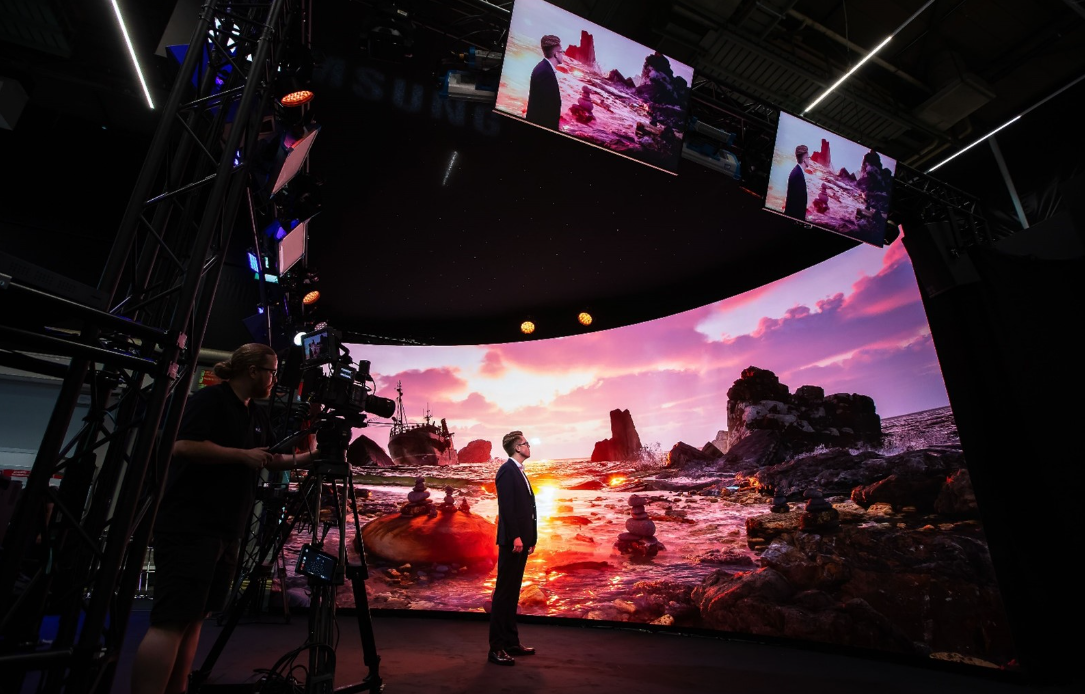
If you’re seeking display solutions for high-end retail stores, corporate conference rooms, or XR virtual studios, but are troubled by pain points like high power consumption, pixel vulnerability, or limited installation space, then simply looking at a “price list” is far from enough. Based on our practical experience providing seamless indoor screens for global top luxury brands like Audemars Piguet, Panerai, and Dior, this article will deeply analyze the engineering logic hidden behind the prices.
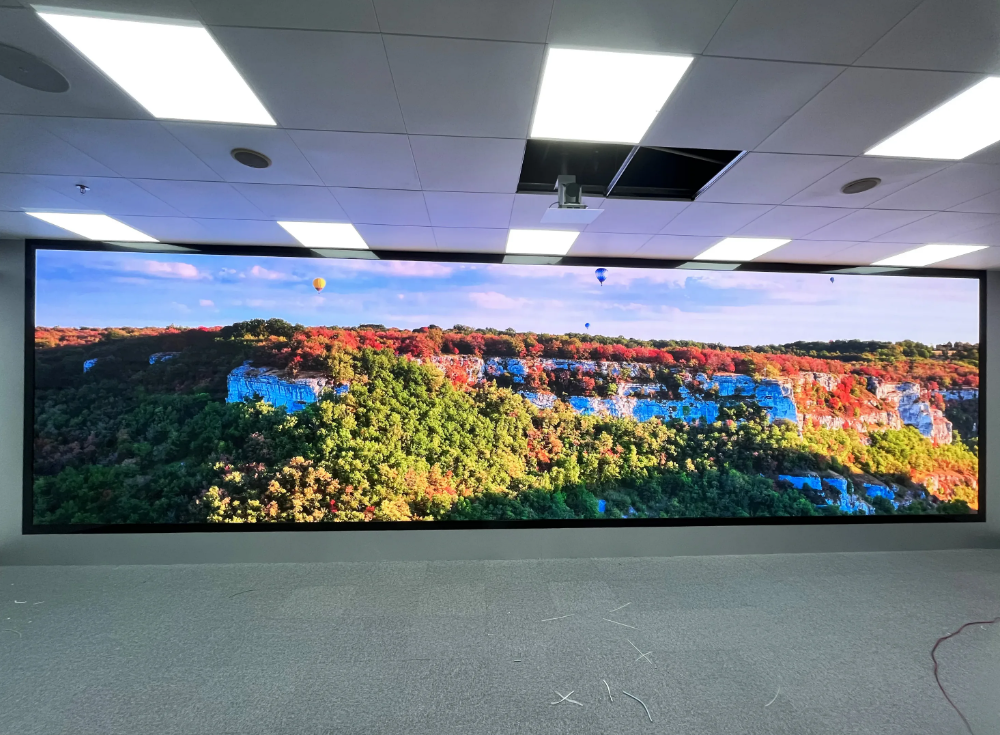
indoor LED display wall
Decoding the 2026 Indoor LED Display Market: Why Price is More Than Just a Number
In the context of B2B procurement in 2026, “price” is no longer just the initial acquisition cost (CAPEX); more integrators are focusing on Total Cost of Ownership (TCO).
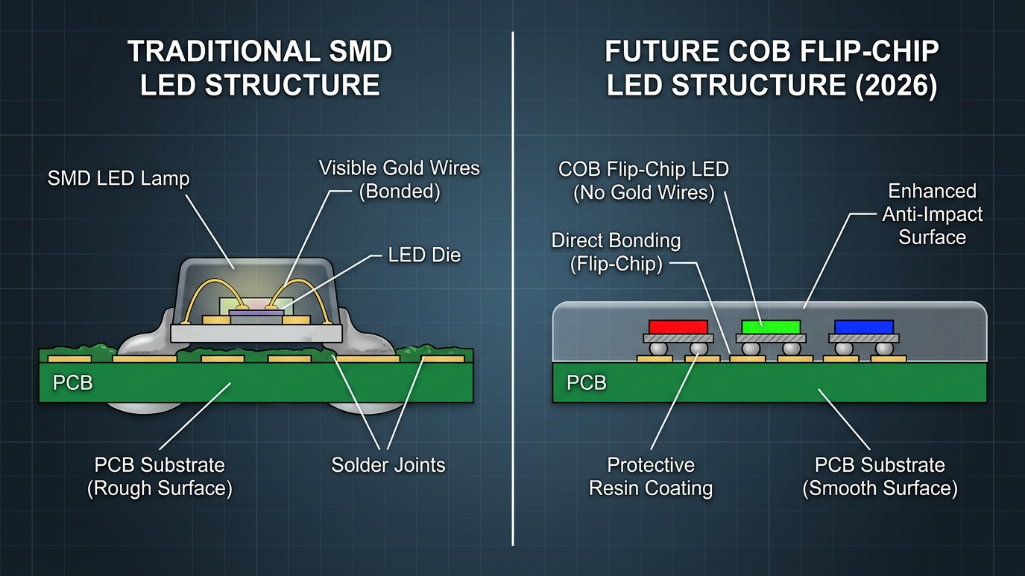
1. The Leap from Traditional SMD to COB Flip-Chip Technology
In the past, indoor screens primarily adopted SMD (Surface Mount Device) technology. However, by 2026, COB flip-chip technology has become the standard configuration for high-end application scenarios (such as monitoring centers and flagship stores).
Technical Principle: Eliminates gold wire welding and directly encapsulates chips onto the PCB board.
Commercial Value: This technology not only brings HDR-level color reproduction and 8K ultra-clear resolution support but, more importantly, solves the industry’s persistent problem of “pixel dropping.” For B2B buyers, this means significantly reduced high labor maintenance costs in the later stages.
2. Common Cathode Technology: Not Just Environmental, But a Money-Saving Calculation
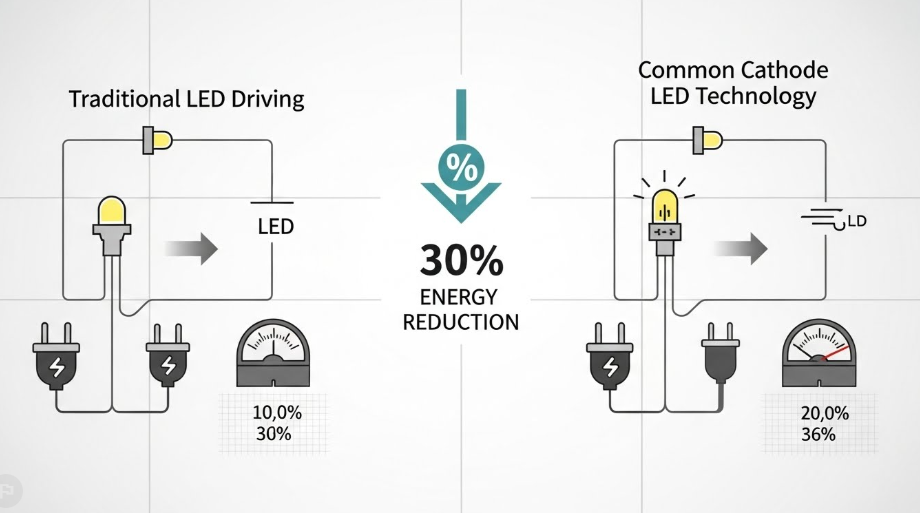
Common cathode vs traditional drive
We’ve found that many DOOH advertisers often overlook long-term operating electricity costs when purchasing. Sostron’s ARES series adopts Common Cathode Technology.
Engineering Details: By precisely distributing voltage to red, green, and blue chips, effectively reducing the generation of ineffective thermal energy.
ROI Analysis: This can directly cut operating costs by up to 50%. In 2026, with fluctuating energy prices, this is not only responding to environmental calls but a substantial profit boost.
How Indoor LED Screens Work: Key Components That Influence Your Quote
As an LED engineer, I often tell clients: screen surface flatness is just the tip of the iceberg; the true value differences lie in the engineering construction and material choices inside the cabinet.
1. Balance Between Pixel Pitch and Visual Immersion
The item with the greatest variation in price lists is always Pixel Pitch.
Cobra Series (P0.93-P1.56): Adopts 16:9 golden ratio (27″ panel) design, capable of perfectly assembling into standard FHD or 4K screens. For corporate conference rooms, this means you no longer need complex signal conversion equipment, thereby saving system integration costs.
Reta 2 Series (P1.25-P2.5): Although the pitch is slightly larger, its 30mm ultra-thin profile and die-cast aluminum body make it the ultimate value-for-money choice for high-end retail and conference rooms.
2. Cableless Design: The Second Revolution in Stability
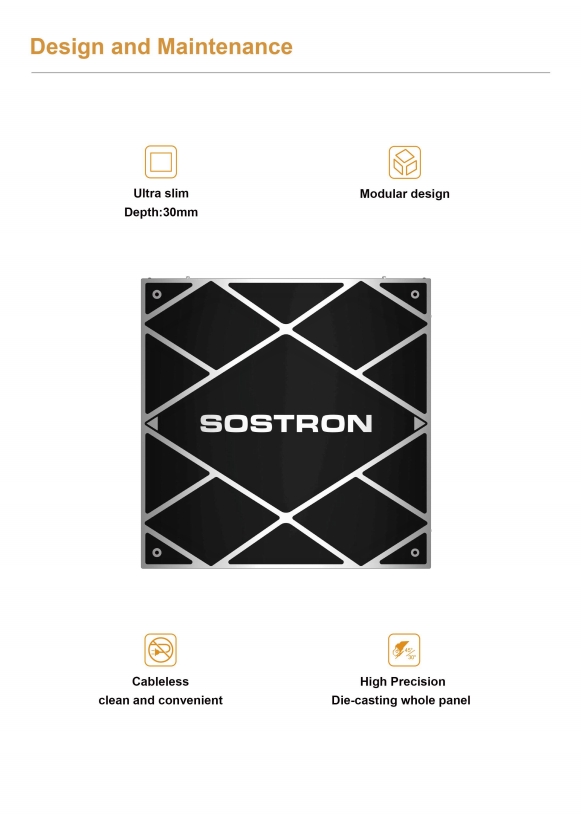
Small pitch LED Display – Reta2
Traditional LED cabinets are filled with data cables and power cables inside. These cables are prone to loosening after transportation vibration or long-term heating, causing screen artifacts.
Sostron Solution: Both our Reta 2 and Cobra series adopt Cableless Design.
Benefit: Replacing messy internal wiring with board-to-board connectors ensures ultimate internal cleanliness and higher electrical stability. For control room buyers requiring 7/24-hour uninterrupted operation, this is a non-negotiable must-have.
3. Cabinet Material: Die-Cast Aluminum vs Carbon Fiber
Advances in materials science have directly changed the cost structure of logistics and installation.
Die-Cast Aluminum: Provides excellent flatness and heat dissipation performance, widely used in series such as Storm Pro.
Carbon Fiber Technology: For touring and large event planning companies, weight equals money. Sostron’s Carbon Family reduces single panel weight to 5KG.
Experience-Based Sharing: Using carbon fiber cabinets, a 100-square-meter stage installation can reduce on-site labor requirements by about 30% and significantly reduce expensive international shipping costs.
2026 Indoor LED Screen Pricing Breakdown: Factors That Scale the Cost
When obtaining 2026 price quotes, you need to evaluate whether the “premium” is reasonable based on the following three key dimensions:
1. Refresh Rate and Visual Performance
To adapt to XR virtual production and high-end photography needs, refresh rates have evolved from standard 3840Hz to 7680Hz.
Technical Impact: Higher refresh rates mean no scan lines appear under camera lenses, with smoother color transitions.
Application Scenarios: Such as the Hima series, which not only possesses high contrast but also supports use as LED floor screens, naturally having higher driver chip costs behind it than ordinary commercial displays.
2. Brightness Standards and Heat Dissipation Solutions
Indoor screen brightness is typically between 600-1200 nits, but if you need transparent screens (such as the Crystal series) for glass showcase windows, brightness needs to reach up to 6500 nits to resist direct sunlight.
Sostron Advantage: Through fanless quiet operation technology, it can maintain environmental quiet even during high-brightness operation, which is crucial for high-end office environments.
3. Quality Assurance and International Certification (EEAT Endorsement)
A low-price quote often cuts corners in quality inspection links.
According to Our Standards: Every Sostron screen leaving the factory must undergo 100% full inspection, including module/cabinet aging tests, waterproof/compression tests.
Compliance: Products with ETL/FCC/CE/CCC/RoHS certifications, although slightly higher in compliance costs, ensure your projects can be delivered smoothly in any global market (such as the United States, UAE, Australia, etc.), avoiding customs detention or legal compliance risks.
Sostron’s Indoor LED Solutions: Tailored Estimates for Every B2B Sector
In 2026 procurement decisions, choosing the right series is more meaningful than simply comparing price sheets. Based on shipping data from Sostron’s 15,000㎡ modern production base, we classify indoor LED displays into four core dimensions to match different project budgets and technical requirements:
1. Ultimate Picture Quality and Flagship Technology (High-End Commercial)
If you’re pursuing 4K or 8K ultra-retina experience, the Cobra series is your first choice.
Technical Core: Adopts COB Flip-Chip Technology.
Key Parameters: Provides ultra-small pitch from P0.93 to P1.56, with an amazing 25,000:1 contrast ratio.
Commercial Value: Its cableless design ensures internal structural stability, and the 16:9 golden ratio panel (27 inches) makes it the perfect choice for standard resolution assembly.
2. Lightweight Aesthetics and Retail Integration (Premium Retail & Corporate)
For luxury retailers extremely sensitive to space, the Reta 2 series provides highly competitive ROI.
Physical Characteristics: Its thickness is only 30mm-42mm, one of the slimmest solutions currently on the market.
Installation Advantage: Adopts full front maintenance design and cableless technology, eliminating messy internal wiring and significantly reducing installation difficulty.
Application Scenarios: Perfectly suited for wall-mounted installation requirements in high-end conference rooms and retail spaces.
3. Event Rental and XR Virtual Production (Rental & Creative Stages)
Standard 1920HzVisible Scan Lines
Camera Flicker: Visible black bars (rolling shutter effect) when filmed.
Content Loss: Fast-moving content may appear blurry or tearing.
Not Broadcast Ready: Unsuitable for professional live streaming or TV.
3840Hz / 7680HzBroadcast Grade
Flicker-Free: Crystal clear image on all cameras (1/2000s+ shutter speed).
Smooth Motion: Perfect for fast video playback and sports.
XR Ready (7680Hz): Essential for virtual production and XR studios.
For event rental companies that frequently disassemble and assemble, we reduce your long-term labor costs through material innovation.
Carbon Family: Single cabinet weight is only 5KG, which means faster setup speed and lower transportation costs in large-scale tours.
Hima Series: A true “all-rounder,” supporting 90-degree right-angle assembly and LED floor screen function, making it an ideal choice for building XR virtual production studios.
4. Creative Display and Commercial Transparent Solutions (Creative & Special Apps)
Crystal (Transparent Screen): Possesses 40%-82% high transparency, weighs only 14.5KG/sqm, with maximum brightness up to 6500 nits, very suitable for glass showcase display.
sPad Pro2 (Foldable Curved Screen): Supports cylindrical installation with minimum diameter of 1.2 meters, requiring only 8 panels to form a 360-degree cylindrical screen, greatly releasing creative space in architectural design.
Application Scenarios: Maximizing ROI with the Right LED Technology
As a manufacturer with over 6,000 successful cases, we’ve summarized ROI optimization recommendations for three core application scenarios in 2026:
1. Luxury Brand Retail
Sostron has provided seamless indoor screen solutions for brands like Dior, Audemars Piguet, and Panerai. In these scenarios, price is often secondary to visual performance.
Expert Recommendation: Prioritize the Cobra series. Its anti-impact COB packaging can withstand accidental touches in public spaces, while True color HDR can accurately reproduce product details, directly enhancing brand premium.
2. Global Tours and Music Festivals
In the Chile music festival project, our Carbon Family P4.8 screen won customer favor with its 7680Hz ultra-high refresh rate and 5KG lightweight design.
Decision Logic: For rental companies, weight directly relates to loading and unloading labor costs. Although carbon fiber technology has a slightly higher initial purchase price, cost recovery can be achieved through saved logistics costs in the first three rental tours.
3. Corporate Offices and Smart Education
Our P1.8 movable conference screens and P2.5 classroom screens are gradually replacing traditional projectors.
Selection Tips: Choosing All-in-one products with integrated audio solutions can significantly shorten deployment time and improve the turnover efficiency of multi-function halls.
Buyer’s Checklist: What to Ask Before Finalizing Your 2026 LED Purchase
To ensure the quote you receive isn’t just a low-price trap, please verify the following five dimensions:
Check Point
Industry Benchmark
Sostron Standard
Commercial Risk Warning
Heat Dissipation Technology
Traditional Drive
Common Cathode
Ordinary drives generate heat that accelerates LED attenuation, causing color deviation
Stability Design
Massive Cabling
Cableless
Physical wiring is prone to loosening, being the root cause of 70% indoor screen failures
Refresh Rate
1920Hz
3840Hz-7680Hz
Low refresh rates cause obvious water ripples during camera shooting or live streaming
Quality Control
Sampling Inspection
100% Full Inspection
Sampling inspection cannot eliminate brand image damage caused by individual pixel dead points
Compliance
Basic CE
ETL/FCC/CE/RoHS/CCC
Lack of international certifications can lead to projects failing fire and electrical audits in North America or European markets
FAQ: Common Questions About Indoor LED Screen Prices
Q1: Why is the 2026 quote for COB technology higher than SMD?
A: COB Flip-Chip removes traditional wire bonding, achieving extreme reliability and resistance to dust, moisture, and impact. While the initial price is 20%–40% higher, the failure rate is significantly lower than SMD, reducing long-term maintenance costs.
Q2: Can Common Cathode technology really save 50% on electricity?
A: Yes. By independently allocating voltage to RGB chips, the ARES Series reduces wasted power. This cuts electricity bills and extends the screen’s lifespan by keeping components cool.
Q3: Why is a 5KG Carbon Fiber cabinet vital for rental businesses?
A: Labor costs are rising. A lightweight design allows a single person to complete an installation, shortening setup windows and reducing the load-bearing requirements for stage structures.
Expert Verdict: When procuring indoor LED displays in 2026, do not be misled by “floor prices.” For long-term fixed installations, insist on Cableless and Common Cathode technologies. For high-end visual presentation, COB Flip-Chip is the gold standard.
SoStron Display is a premier LED display manufacturer dedicated to turning vision into reality. The company specializes in manufacturing state-of-the-art LED products and developing smart display solutions. Powered by their proprietary Domedea intelligent control system, SoStron delivers seamless, wireless (Wi-Fi) remote management that transforms standard hardware into high-value, intelligent display networks—no matter the distance.