Regarding the question Which is better TFT or LED screen? the answer is not absolute; it depends entirely on whether your engineering project requires “ultimate seamless visual impact” or a “budget-friendly display for static data.” To save you time, please refer directly to our 1-second selection conclusion table for B2B buyers below:
Table 1: Rapid Decision Table for TFT vs. LED in B2B Scenarios
| Commercial Application Scenario | Preferred Technology | Core Winning Reason |
| High-end Retail Stores / Flagship Visual Walls | LED (dvLED) | Seamless splicing (Bezel-less) for excellent brand immersion. |
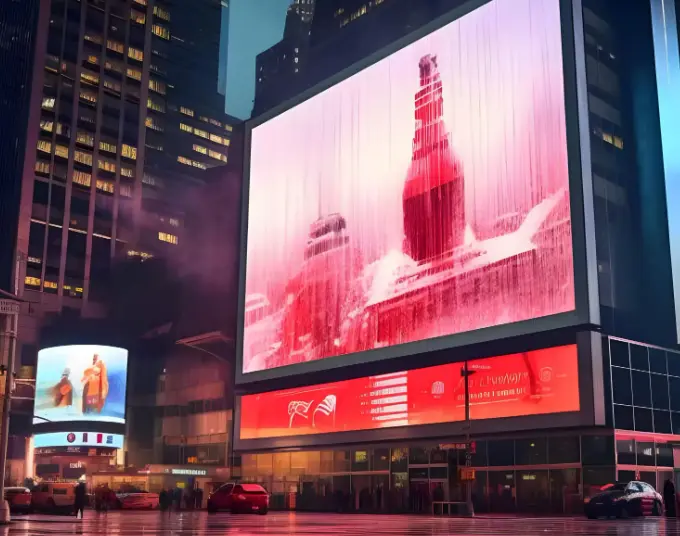
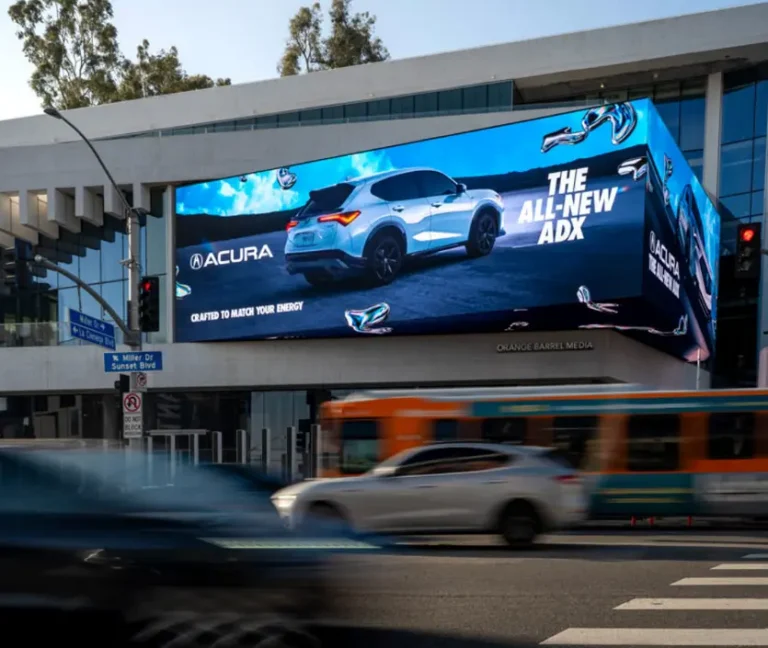
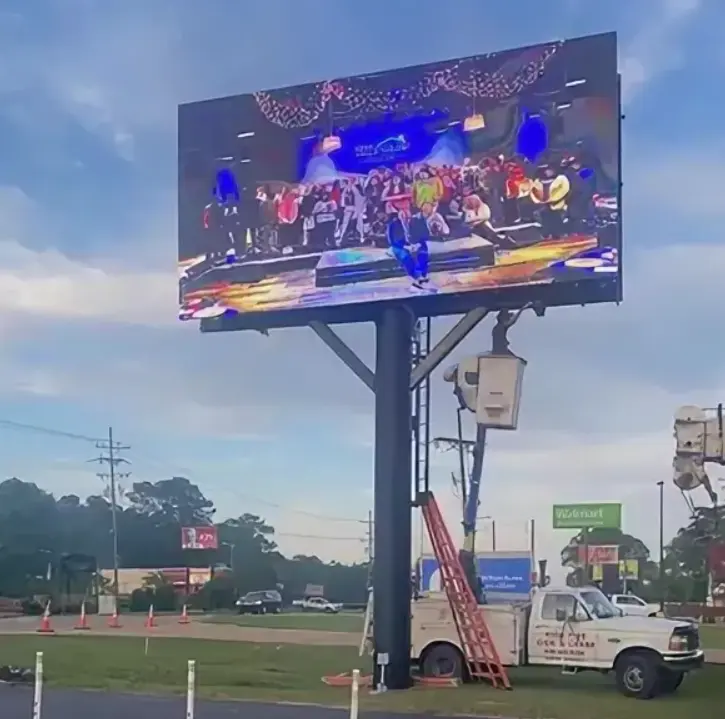
| Outdoor Digital Out-of-Home (DOOH) Billboards | LED (dvLED) | Ultra-high brightness (over 5,000 Nits) and strict waterproof protection (IP65). |
| Basic Security Monitoring / Data Control Rooms | TFT (LCD) | Displays static tables without image persistence; low initial procurement cost; high tolerance for bezels. |
| Stage Rental / Broadcast Studios | LED (dvLED) | High refresh rate eliminates flickering; die-cast aluminum cabinets for fast assembly/disassembly. |
Based on our practical experience delivering over 500 large-scale commercial Audiovisual (AV) projects worldwide over the past decade, we have found that 90% of system integrators and procurement managers are misled by consumer-grade information online. When you inquire with suppliers in China or overseas, the “LED” they refer to is absolutely not the “LED-backlit display” on your laptop, but rather Direct View LED (dvLED). Confusing these two concepts will lead to disastrous selection errors for your project.
This article will strip away obscure physical formulas and analyze the competition between these two technologies directly from the perspectives of Business Return on Investment (ROI) and engineering implementation.
Clearing the Terminology Fog: What Exactly Are TFT and LED Screens?
Before entering the fierce performance showdown, we must precisely define these two display entities within a B2B context.
TFT (TFT-LCD) Splicing Walls: The Mature Backlight Compromiser
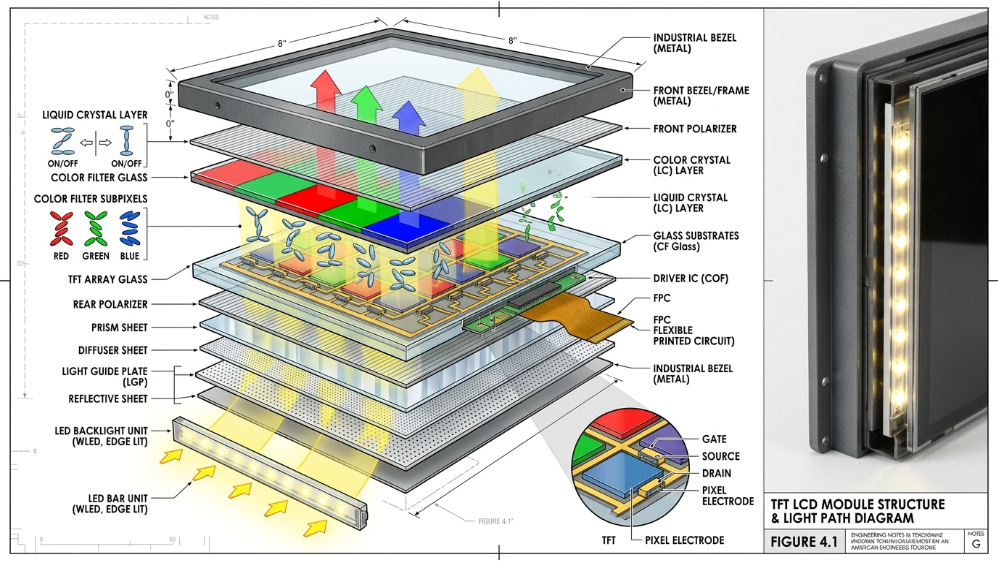
TFT (Thin Film Transistor) is an active-matrix technology for Liquid Crystal Displays (LCD). In the field of large commercial screens, we usually refer to them as TFT-LCD splicing screens.
Its working principle is like a sophisticated “shadow play”: there is a bottom layer of LED backlight that emits light constantly. This light passes through a liquid crystal layer and color filters to finally form an image on the surface.
-
Commercial Characteristics and Limitations: Because they must rely on a backlight layer and the deflection of liquid crystal molecules, TFT screens cannot achieve absolute pure black. More critically, to contain the internal liquid crystal fluid, TFT panels must have physical borders (Bezels). Even with the world’s top craftsmanship today, the bilateral seam can only be compressed to 0.88mm. The bezel is a physical limit that TFT cannot cross.
LED (dvLED) in B2B Context: The Game-Changing Self-Emitting Body
Forget about backlight panels. In commercial large-screen engineering, LED refers to Direct View LED (dvLED).
In this technology, every single pixel is a tiny, independent light-emitting body. Modern commercial dvLEDs typically use SMD (Surface Mount Device) or DIP (Dual In-line Package) packaging technology to arrange thousands of light-emitting diodes directly on a PCB board. What is SMD led display? What is DIP led display?
-
FAB Value Transformation: Since it is Self-emitting, dvLED does not require filters or physical borders.
-
Feature: It can be spliced infinitely like Lego bricks into any size or shape.
-
Business Benefit: For high-end mall atriums or corporate lobbies, this means your brand promotional videos will not be fragmented by ugly black lines (Bezel-less Video Wall), presenting 100% perfect visual integrity and significantly enhancing the brand’s premium feel.
Furthermore, Pixel Pitch (e.g., P1.2, P1.5) is the core parameter for measuring dvLED clarity. The smaller the pitch, the higher the resolution, which also implies a higher manufacturing cost.
TFT vs. LED Display: Deep Comparison of Core Performance
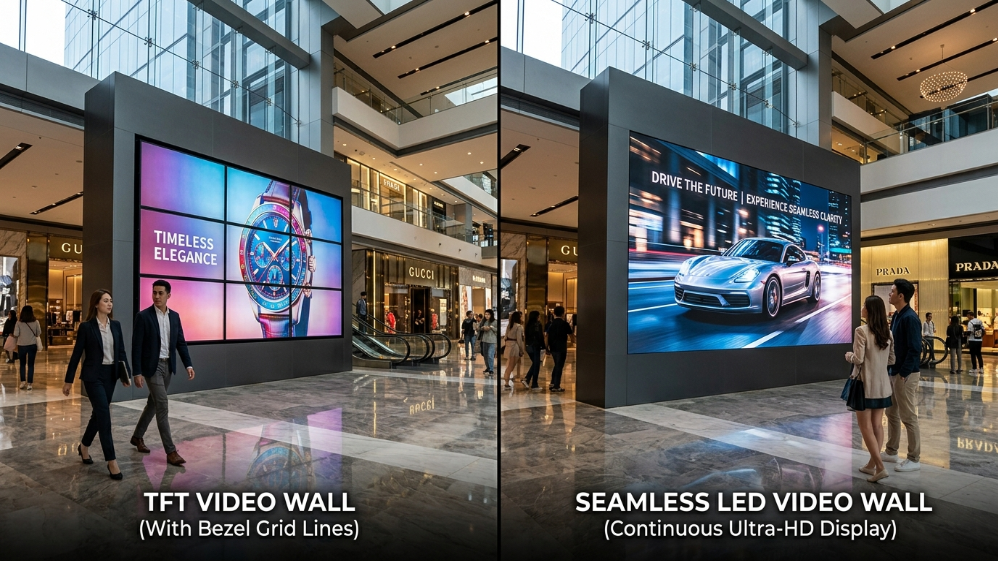
To intuitively demonstrate the differences in engineering parameters, please refer to the measured performance comparison chart below.
Table 2: Deep Comparison of Core Physical Performance for Commercial Screens (2026 Benchmark)
| Performance Metric | TFT-LCD Splicing Screen | Direct View LED (dvLED) | Commercial Difference Assessment |
| Max Brightness (Nits) | Typically 500-700 cd/m² | Indoor 1,000+; Outdoor up to 10,000 cd/m² | LED dominates in strong light. |
| Physical Bezel | 0.88mm to 3.5mm | Truly Seamless (0mm) | LED provides a flawless visual experience. |
| Contrast Ratio | Approx. 1,200:1 to 4,000:1 | Extremely High (10,000:1+) | LED presents true pure black. |
| Protection Level | Usually Indoor Use Only | Both Indoor/Outdoor (Easily IP65) | LED is the only choice for outdoor billboards. |
Brightness & Outdoor Visibility (Nits): The Absolute Force for Grabbing Attention
In commercial displays, brightness is justice. The standard unit for brightness is Nits (equivalent to cd/m²).
TFT screen brightness peaks are usually locked between 500 and 700 Nits. If you place one inside a south-facing glass window, the screen will instantly become a black mirror under direct sunlight, making the advertisement content completely invisible.
Conversely, dvLED is a true “light chaser.” Indoor small-pitch LEDs easily break through 1,000 Nits, while outdoor LED large screens reach 5,000 to 10,000 Nits.
-
Business Value: According to data from the 2025 Global Digital Out-of-Home (DOOH) Equipment White Paper, in strong outdoor light environments, every 20% increase in screen brightness increases the audience’s gaze duration by an average of 1.5 seconds. Combined with the IP Rating common in outdoor LEDs (such as IP65 dust and water resistance), it ensures your advertising assets output “powerfully” 7/24 in heavy rain or scorching sun, maximizing the ROI of every advertising slot.
Visual Integrity and Splicing Gaps (Seamless Integration): Saying Goodbye to Visual Fragmentation
Imagine this: You spent 100,000 USD to produce an exquisite 3D naked-eye special effect advertisement, but during playback, a clear black line runs across the face of the main character—this is the Achilles’ heel of TFT splicing screens.
Although TFT suppliers have been aggressively marketing the “Ultra-narrow bezel” concept, whether it is 3.5mm or 0.88mm, the grid-like visual fragmentation remains when a dozen screens are spliced together. This easily causes loss or distortion of key information when displaying maps, faces, or precision data charts.
If you ask any professional AV engineer: “When building a large immersive conference center or a high-end flagship store, Which is better TFT or LED screen?” they will point to LED without hesitation.
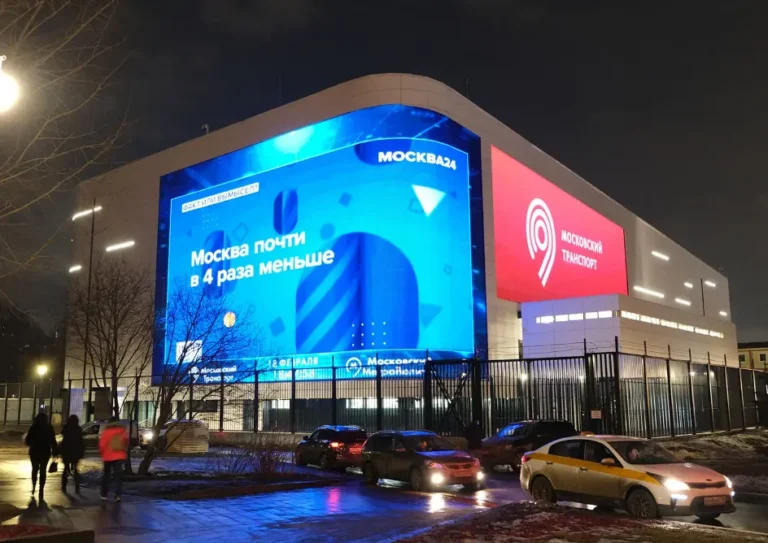
dvLED achieves a 100% Seamless Video Wall through precision die-cast aluminum cabinet structures. Whether it is a flat giant screen, an inner curved cylinder, or a 90-degree right-angle corner, LED ensures the image extends perfectly like a single canvas, fully releasing the visual impact of creative content.
Contrast Ratio & Color Gamut: Who Can Provide the Ultimate Pure Black?
Because the backlight behind the TFT-LCD panel is always on, even when displaying a black screen, a very faint light leaks out. This results in the “black” displayed by TFT screens actually being a “dark gray,” with contrast ratios usually hovering around 4,000:1.
Direct View LED uses pixel-level light control. When dvLED needs to display pure black, the corresponding light-emitting diodes physically turn off.
-
Business Value Transformation: This self-emitting characteristic gives LED nearly infinite contrast (above 10,000:1). in high-end beauty brand launches or luxury stores, LED can accurately restore the deep texture and color saturation of products, firmly locking the eyes of high-net-worth customers.
Refresh Rate & Flicker: Strict Requirements for Broadcast Studios and Virtual Production
In “People Also Ask” search intents, we find many buyers focusing on “which is better for the eyes.” In high-intensity B2B commercial environments, this is actually a technical battle over Refresh Rate.
Ordinary TFT screens have a refresh rate of usually 60Hz. This is fine for the naked eye, but if used as a background wall, severe black scanning lines (Moire patterns) will appear on the image when captured by high-definition cameras.
Modern commercial LED screens come standard with ultra-high refresh rates of 3,840Hz or even up to 7,680Hz.
-
Business Value Transformation: High refresh rates completely eliminate flickering. If your project is a broadcast news studio, an e-sports arena, or the popular XR Virtual Production, LED is the only technical solution that ensures clean, stable images for the lens and is friendlier to the eyes of hosts working for long hours.
Which Should You Choose for Your Commercial Project?
Stripping away the parameter competition, let us return to engineering implementation. Answering Which is better TFT or LED screen based on specific project scenarios is the safest approach for system integrators.
Outdoor Digital Advertising (DOOH) and Large Commercial Landmarks
-
Primary Recommendation: Direct View LED (dvLED)
-
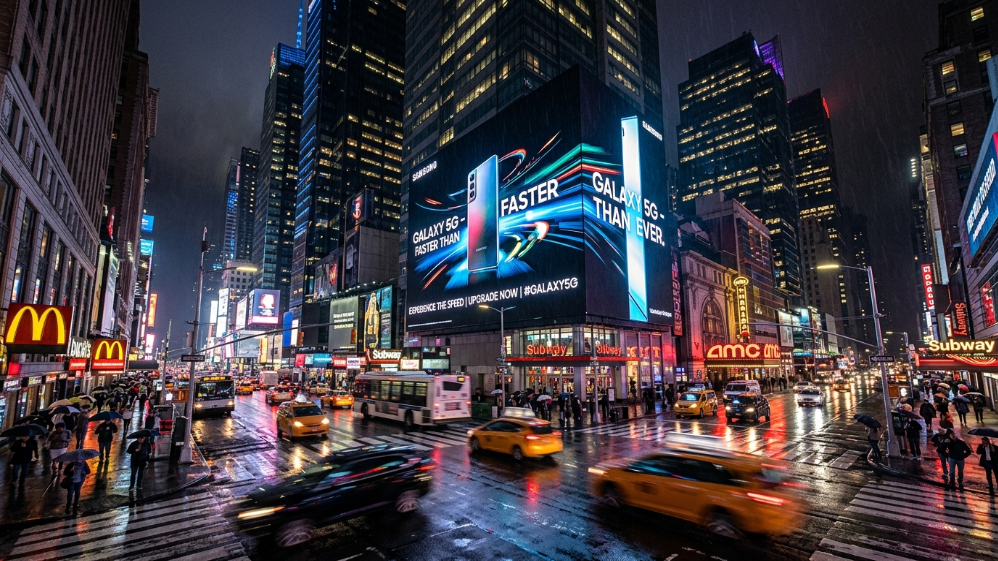
Reason: TFT is completely “unsuited” for the outdoors. Faced with heavy rain, extreme cold, or high salt spray environments, the precision glue-filling process and sealed cabinets of LED displays easily reach IP65 or even IP68 protection levels. Combined with brightness levels reaching tens of thousands of nits, LED is the only solution for outdoor digital billboards and building illumination (3D naked-eye screens). LED vs. LCD: Who is the king of outdoor viewing?
Security Control Rooms and Enterprise Data Centers
-
Depends on Budget and Needs
-
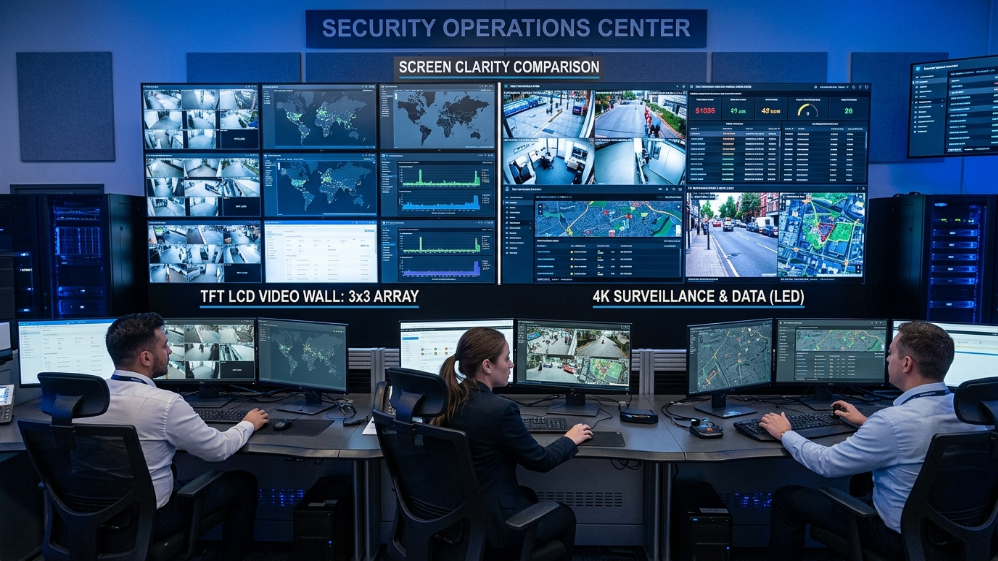
Reason: If your monitoring room is primarily used to display static Excel tables or security camera feeds and the budget is extremely limited, TFT-LCD splicing walls remain a cost-effective defensive choice because they lack the risk of “burn-in” caused by playing static images for long periods.
-
However, if you are building a national-level power grid command center or high-end corporate headquarters with extremely high requirements for image integrity and detail, Fine Pixel Pitch LED (e.g., P0.9-P1.5) is rapidly replacing TFT. Seamless splicing allows the display of massive amounts of data without visual obstacles.
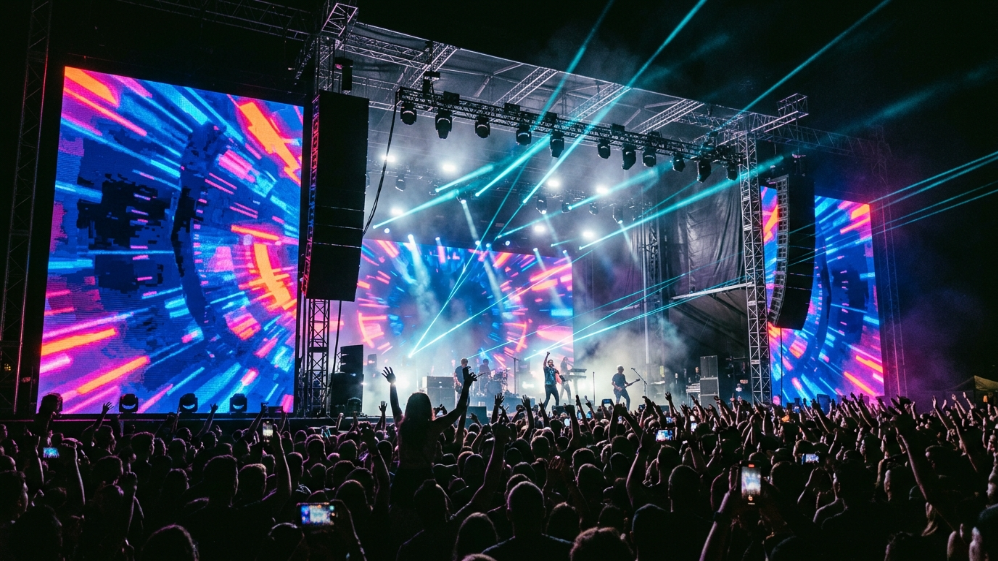
Stage Rental, Exhibitions, and Live Events
-
Primary Recommendation: Direct View LED (dvLED)
-
Reason: Event planning companies need efficiency and flexibility. Rental-type LED screens use lightweight die-cast aluminum cabinets, supporting fast single-person locking and disassembly. Whether building a circular dome or an irregularly shaped stage background, the flexibility of LED is something the heavy TFT LCD screen can never match.
Cost Calculation: TFT or LED, Which is More Cost-Effective?
In procurement meetings, “Is it expensive?” is always the ultimate question. B2B decision-making must avoid looking only at the initial quote while ignoring the Total Cost of Ownership (TCO).
Table 3: Evaluation of TFT and LED Lifecycle and Total Cost of Ownership (TCO)
| Cost Dimension | TFT-LCD Splicing Screen | Direct View LED (dvLED) | Engineer Insight |
| Initial Procurement Cost | Low (Hundreds to thousands of dollars per panel) | Higher (Depends on pixel pitch; small pitch is more expensive) | TFT initial investment is extremely friendly to SMEs. |
| Theoretical Lifespan | Approx. 50,000-60,000 hours | Easily exceeds 100,000 hours | LED lifecycle is nearly double that of TFT. |
| Post-Maintenance Cost | High (Dead pixels or broken screens usually require replacing the whole panel) | Low (Supports single-module or even single-pixel repair) | LED’s front-maintenance design significantly cuts repair downtime. |
| Average Power Consumption | Relatively constant, slightly higher | Dynamic energy saving, better overall efficiency ratio | LED’s self-emitting nature is extremely power-efficient when displaying dark images. |
According to our engineering data modeling, although a large TFT screen’s initial construction cost in the first year might be 30%-50% cheaper than small-pitch LED, over a project operation cycle of 5-8 years, LED’s TCO curve will cross with TFT around the third year due to its extra-long life and low maintenance costs.
Specifically, we must emphasize the Front Serviceable feature of LED: When a single LED bead is damaged, an engineer only needs to use a magnetic tool to remove and replace a single palm-sized module from the front of the screen, taking less than 2 minutes. Once a TFT panel is damaged, you must disassemble the entire heavy dozens-of-inches screen, which may even require days of downtime.
Frequently Asked Questions (FAQs) About TFT and LED Screens
To further eliminate your doubts during technical selection, we have compiled 5 core questions most frequently asked by system integrators:
Q1: In long-term commercial environments, which is better for the eyes (more comfortable), TFT or LED?
For security personnel who need to monitor screens at close range for long periods, if the LED pixel pitch is not small enough and the brightness is too high, it easily causes glare; in this case, low-brightness TFT is more comfortable. However, for conference rooms or studios, high-refresh-rate LEDs eliminate flickering, significantly reducing neural fatigue in human eyes.
Q2: Can I directly upgrade and replace my existing TFT splicing wall with a large LED screen?
Absolutely. Due to the modular design of LED cabinets, they are usually thinner and lighter than a TFT system of the same area. We can even reuse your original load-bearing structure for the TFT wall through customized brackets, significantly shortening the renovation period.
Q3: Can TFT screens be used in outdoor or semi-outdoor environments?
Definitely not. Ordinary TFT screens cannot resist outdoor UV rays and cannot reach IP waterproof ratings. More critically, the lack of brightness means they are almost like a black screen under outdoor light. Outdoor scenarios must choose LED.
Q4: Are LED video walls more power-hungry than TFT LCD splicing walls?
This is a common misconception. LED power consumption is dynamic; when displaying black or dark images, the corresponding lamp beads do not emit light or consume power. In contrast, TFT backlights must run at full load regardless of the image’s brightness. On average, modern LED systems often have better overall energy efficiency than traditional TFT splicing walls.
Q5: What is the difference between Fine Pitch LED and ordinary LED?
In commercial indoor applications, screens with a pixel pitch of less than P2.5 (2.5mm) are usually called Fine Pitch LEDs. The smaller the pitch, the more pixels are accommodated in the same area, solving the “grainy” defect of traditional LEDs when viewed up close. It is the strongest substitute for TFT in high-end indoor scenarios.
Engineering Director’s Selection Assertion
In the world of B2B AV engineering, technology itself is neither good nor bad; there is only the “expensive price of using it in the wrong scenario.”
If your current budget is strictly limited to X thousand dollars and the project is merely for a background monitoring room to display static security footage, buy a TFT-LCD splicing wall, accept its bezels, and invest the saved money into a better video processor.
But if your project is a welcome lobby for commercial real estate, a flagship store ready to stun the audience, or a broadcast studio that needs to face the camera directly, do not hesitate—choose Direct View LED (dvLED) immediately. Its seamless splicing, ultimate colors, and extra-long lifespan will transform your space into a true money-making machine.
Do not let a poor screen ruin your million-dollar creative content. Contact our structural engineering team now to get a free LED Audiovisual design plan and TCO accounting list based on your project site drawings.
References:
IEEE Xplore Digital Library – Display Technology Standards & Research
U.S. Department of Energy – Solid-State Lighting & Display Efficiency Research