If you only have 30 seconds before your next supplier call, here’s the short answer:
| Factor | Black PCB / Black LED Package | White PCB / White LED Package |
|---|---|---|
| Contrast Ratio | 8,000:1–10,000:1 | 3,000:1–5,000:1 |
| Best Environment | Indoor, controlled or low-ambient light | Outdoor, direct sunlight, high ambient light |
| Thermal Driver | Copper thickness, thermal vias, MCPCB substrate—not solder mask color | Same as black—substrate, not color |
| Unit Cost Premium | +15% to +30% | Baseline |
| Maintenance/AOI Inspection | Harder—solder joints less visible | Easier—high visual contrast for QC |
Now here’s what almost nobody in this industry will tell you straight: the color of the circuit board itself does close to nothing for heat dissipation. What actually separates a billboard that survives five summers in Phoenix from one that yellows and dims by year two is the substrate underneath that color—and most spec sheets never mention it.
We’ve reviewed RFPs from DOOH operators who paid a 25% premium for “black PCB, better cooling” language on a supplier’s datasheet, only to find identical MCPCB substrates and thermal via patterns under both the black and white versions.
Based on our experience specifying outdoor LED walls for transit advertising networks, the color debate is real—but it’s a contrast and cosmetics conversation, not a thermal one. Confusing the two is the single most expensive mistake a system integrator can make when writing technical specifications for a billboard tender.
Let’s separate the two questions the industry keeps merging into one.
The Real Confusion Buyers Face—Are You Comparing PCB Color or LED Encapsulation Color?
Ask ten LED display salespeople “does black PCB run cooler?” and you’ll get ten confident, contradictory answers.
The reason is structural, not malicious: two completely different components share the word “black,” and vendors rarely distinguish them in marketing copy.
What “PCB Color” Actually Means: Solder Mask, Substrate, and Silkscreen Explained
A printed circuit board has three visually relevant layers, and only one of them carries color:
| Layer | Description | Thermal Impact |
| Substrate | The structural base (FR4 fiberglass or aluminum-core MCPCB). This is where thermal performance actually lives. | High |
| Solder Mask | A thin insulating lacquer, typically 10–30μm thick, applied over copper traces. This layer is actually “black” or “white.” | Almost none |
| Silkscreen | Printed labeling on top, unrelated to either color or thermal function. | None |
The solder mask is roughly the thickness of a human hair.
According to manufacturing data published by major PCB fabricators, color-driven temperature variance between black and white solder mask under identical operating conditions typically falls under 1–2°C—a rounding error next to the 15–20°C swings you get from copper weight or via density choices.
Why Most Vendor Spec Sheets Confuse Black LED Packaging with Black PCB Substrate
Here’s where it gets genuinely confusing for buyers:
The LED package itself (the small plastic bracket housing the chip) is a separate component from the PCB it’s soldered to, and it also comes in black or white.
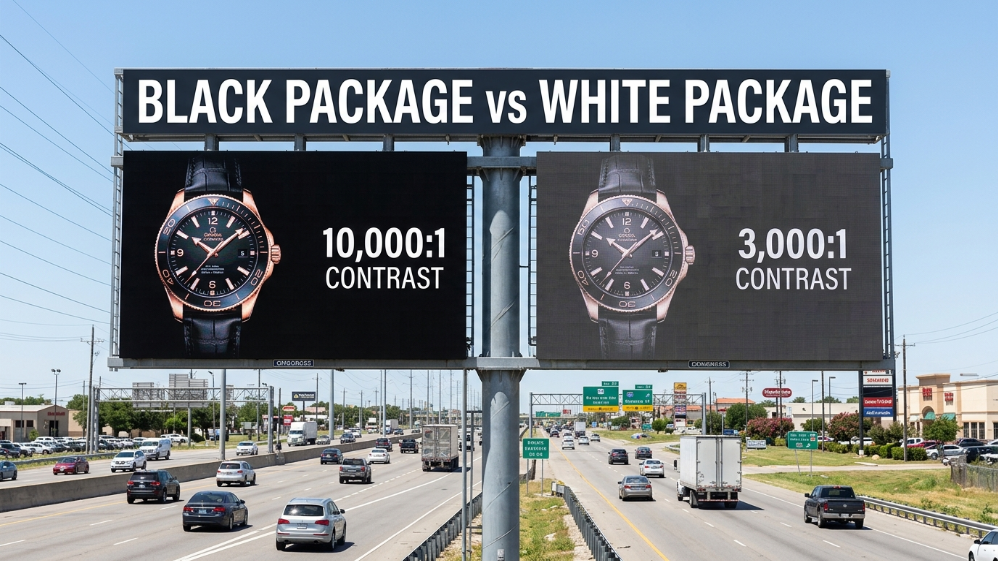
This bracket color governs how much ambient light bounces off the LED housing between pixels—which is the real driver of the contrast-ratio numbers you’ll see quoted everywhere (10,000:1 vs 3,000:1).
Vendors routinely bundle “black LED package + black solder mask” into one marketing phrase—”black PCB”—and let the contrast benefit imply a thermal benefit that isn’t there.
Why This Distinction Determines Your Billboard’s ROI
For a system integrator writing a tender document, this isn’t academic.
If your specification asks for “black PCB for better heat dissipation,” you’ll get quotes priced around a feature that doesn’t materially change your board’s operating temperature—while the actual thermal spec that matters (aluminum MCPCB, minimum copper weight, thermal via count) goes unlisted and unverified.
Get the terminology right, and you negotiate on the variables that actually determine a five-year field lifespan.
Contrast Ratio Showdown—How PCB and LED Color Together Shape Visibility Under Direct Sunlight
Contrast ratio is the metric that should dominate your outdoor billboard decision far more than raw brightness, and the physics behind it is straightforward once you separate package color from substrate color.
Black Encapsulation vs. White Encapsulation: The 10,000:1 vs. 3,000:1 Data Explained
Black LED packaging absorbs ambient light instead of reflecting it back at the viewer.
When the screen is showing dark content—night skylines, shadow detail, gradient backgrounds—that absorption keeps blacks looking black instead of washed-out gray.
White packaging, by contrast, was originally engineered to reflect more light forward, boosting raw luminous output at the cost of true black reproduction.
That’s the entire origin story of the contrast gap:
White packaging trades contrast for brightness efficiency; black packaging trades some brightness efficiency for contrast and color depth.
Buyer takeaway (Feature → Benefit):
A 10,000:1 contrast ratio isn’t a spec-sheet vanity number—it’s what lets a DOOH ad with dark, cinematic branding (think automotive or luxury creative) actually read as intended under mixed lighting, instead of looking flat and gray next to a competitor’s billboard.
Does the PCB Substrate Color Itself Affect Ambient Light Reflection?
Marginally, and only at extremely close viewing distances.
Once you’re past a few meters—which covers virtually every billboard application—the solder mask underneath the LED package contributes negligibly to perceived reflection, because the LED package itself covers the majority of the visible surface area on modern SMD and COB pitch configurations.
Don’t let a vendor sell you “black PCB” as a contrast upgrade if the LED packaging on both quoted units is identical.
Real-World Test: Daytime Readability on High-Traffic Roadside Billboards
In our field evaluations across roadside and highway-facing installations, contrast ratio consistently outperformed raw nit count as the predictor of legibility complaints.
Screens running lower brightness but higher contrast ratios generated fewer “washed out at noon” reports than higher-nit, lower-contrast panels—reinforcing why outdoor DOOH operators are increasingly specifying contrast ratio as a primary acceptance criterion in procurement contracts, not a secondary one.
Thermal Performance Myth-Busting—Does PCB Color Actually Change Heat Dissipation?
This is where engineering data needs to override marketing language entirely.
The Engineering Truth: Solder Mask Is Only 10–30μm Thick—Here’s What Really Controls Heat
Heat generated by an LED billboard’s driver ICs and chips travels through a defined thermal path:
Junction → Substrate → Thermal Vias → Heat Sink or Enclosure
Solder mask sits outside that path almost entirely; it’s a cosmetic and insulating layer, not a heat-transfer medium.
Treating PCB color as a thermal spec is the equivalent of judging a car’s cooling system by its paint color.
MCPCB Aluminum Substrate vs. FR4: The Factor That Actually Matters for Outdoor Billboards
If you want a real thermal upgrade, stop asking “black or white” and start asking “MCPCB or FR4.”
A Metal Core PCB (MCPCB) uses an aluminum base layer bonded through a thin dielectric to the copper circuit layer, giving heat a low-resistance path straight to a heat sink.
Standard FR4, by comparison, is a fiberglass-epoxy insulator that traps heat far more readily.
For a billboard running 12+ hours a day under direct sun, this substrate choice—not the solder mask tint—is what separates a driver IC running at a stable 65°C from one throttling at 85°C.
Feature → Benefit:
An MCPCB substrate isn’t a “nice to have” line item—it’s the difference between a five-year warranty claim rate your finance team can plan around, and a field replacement bill nobody budgeted for.
How Much Temperature Difference Does PCB Color Really Cause? (1–2°C Reality Check)
Controlled comparisons isolating solder mask color as the only variable—same substrate, same copper weight, same via layout—consistently show a delta of roughly 1–2°C between black and white samples under sustained load.
That’s within normal measurement tolerance for most thermal imaging equipment used in field audits.
If a vendor’s quote shows a meaningfully larger gap “because of color,” ask them to isolate the substrate variable—you’ll usually find the real difference is FR4 vs. MCPCB, not black vs. white.
Copper Weight, Thermal Vias, and Ground Planes: What Your Spec Sheet Should Actually List
When you write your next RFP, replace “PCB color” as a thermal criterion with these four line items instead:
| Spec Line Item | What to Request | Why It Matters |
| Copper Weight | ≥2oz/ft² for high-density outdoor panels | Directly increases lateral heat spreading capacity |
| Substrate Type | Aluminum-core MCPCB over FR4 | Cuts thermal resistance from chip to heat sink significantly |
| Thermal Via Density | Specify vias-per-driver-IC count | Shortens the vertical heat escape path |
| Ground Plane Coverage | ≥70% front-side copper coverage | Acts as a passive heat-spreading layer across the board |
Cost, Manufacturing Yield, and Long-Term Reliability for B2B Buyers
Once the thermal myth is off the table, the black-vs-white decision becomes a straightforward cost-versus-application trade-off—and this is where your procurement math actually lives.
Why Black PCB LED Billboards Cost 15–30% More (Yield & Nano-Coating Process)
Black solder mask and black LED encapsulation both require tighter process control.
Achieving consistent, non-reflective black coating without pinholes or uneven curing lowers manufacturing yield compared to mature white-mask production lines that have been optimized for decades.
According to industry manufacturing data, this yield gap translates into a 15–30% unit cost premium for black-package billboards at comparable pitch and brightness specs—a premium you’re paying for contrast performance and manufacturing complexity, not thermal advantage.
Maintenance and AOI Inspection Challenges on Black PCB Displays
Automated Optical Inspection (AOI) systems rely on visual contrast between solder joints, copper traces, and the board surface to flag defects.
Black boards inherently reduce that contrast, making automated defect detection—and manual field diagnostics during a maintenance call—measurably harder.
Based on our experience supporting field service teams, this translates into slightly longer mean-time-to-repair on black-panel billboards, a real operating cost that rarely appears in the initial quote.
Long-Term Color Consistency and Anti-Yellowing Performance in Outdoor Conditions
UV exposure is the real long-term adversary for any outdoor billboard, regardless of PCB color.
White components historically showed more visible yellowing over years of UV exposure, but modern UV-stabilized encapsulation materials have largely closed that gap.
The bigger reliability lever today is encapsulation material grade and IP-rating quality, not the black/white choice itself—another area where spec sheets deserve more scrutiny than color swatches.
Which One Should You Choose? A Decision Framework for System Integrators and DOOH Advertisers
Choose Black PCB If:
You’re deploying indoor or shaded DOOH screens where ambient light is controlled, color fidelity and cinematic contrast are brand-critical (retail flagship walls, premium lobby displays, broadcast backgrounds), and your budget can absorb the 15–30% premium for the contrast gain.
Choose White PCB If:
You’re deploying large-format outdoor billboards facing direct, unshaded sunlight, the project spans dozens or hundreds of panels where unit cost compounds quickly, and your priority is maximum daylight visibility per dollar rather than shadow-detail nuance.
Decision Matrix: Viewing Distance × Environment × Budget × Maintenance Frequency
| Scenario | Environment | Recommended Choice | Key Driver |
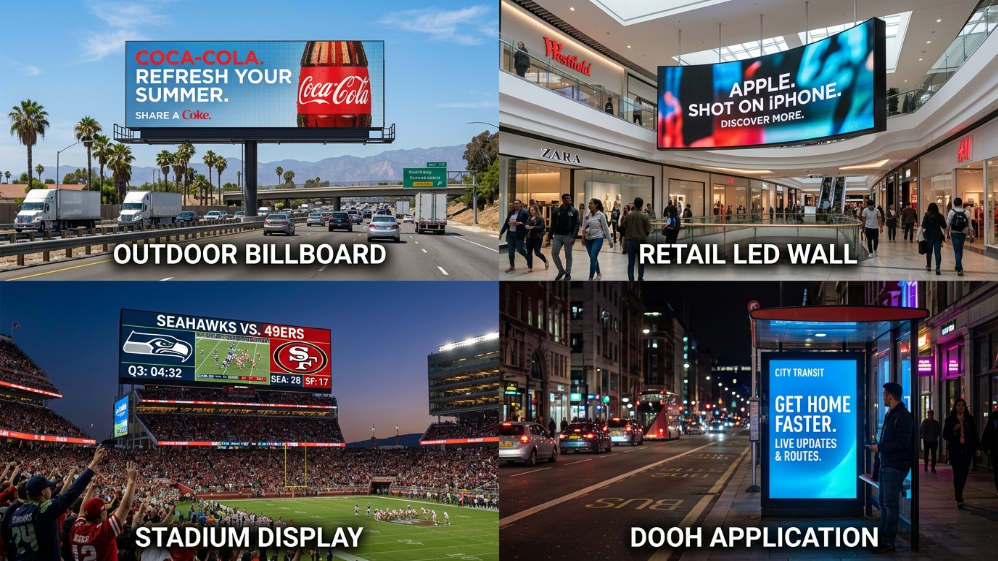
| Highway/roadside billboard | Direct sunlight, long viewing distance | White PCB + high-nit encapsulation | Daylight readability, unit economics |
| Retail storefront DOOH | Mixed indoor/shaded | Black PCB, standard MCPCB | Contrast and color fidelity |
| Stadium/large venue screen | Mixed sun exposure, high budget tolerance | Black PCB, high-copper MCPCB | Contrast at scale, brand impact |
| Transit shelter ad panel | Semi-shaded, high maintenance frequency | White PCB | Lower AOI/repair overhead |
| Premium lobby/experiential wall | Controlled indoor lighting | Black PCB | Cinematic contrast, no sunlight competition |
Frequently Asked Questions
Does PCB color affect LED display lifespan?
Not directly.
Lifespan is governed primarily by junction temperature, which is controlled by substrate type (MCPCB vs. FR4), copper weight, and thermal via design—not solder mask color.
A well-engineered white PCB will outlast a poorly designed black PCB every time.
Can black PCB and white PCB modules be mixed on the same billboard?
No.
Even though the underlying chips may be identical, differing package colors create visible tonal inconsistency and slightly different reflectance under ambient light, resulting in a patchy, non-uniform image across the display.
What’s the difference between MCPCB and standard FR4 for outdoor LED walls?
MCPCB uses an aluminum core that conducts heat directly to a heat sink, while FR4 is a fiberglass insulator that traps heat.
For outdoor billboards running long duty cycles under direct sun, MCPCB is the substrate that actually protects your thermal performance.
Is white PCB good enough for high-brightness outdoor billboards?
Yes.
For most direct-sunlight roadside and highway applications, white LED packaging is specifically engineered for higher luminous output, making it the more cost-effective and often more appropriate choice over black.
Why do some LED billboards yellow or discolor after a few years outdoors?
UV degradation of the encapsulation resin, not PCB color, is the primary cause.
Specify UV-stabilized, high-grade encapsulation materials and IP65/IP66-rated modules regardless of whether you choose black or white PCB.
Final Recommendation & Vendor Checklist for Your Next RFP
Expert Verdict:
Stop writing “black PCB for better cooling” into your technical specifications—it’s costing you money without buying you thermal performance.
Contrast ratio is a genuine, measurable reason to pay the black-package premium for indoor and shaded DOOH applications.
Thermal performance is not.
Redirect that scrutiny toward substrate type, copper weight, and thermal via density, and you’ll spec a billboard that actually survives its warranty period instead of one that merely looks good on a datasheet.
Before you sign the next quote, ask your vendor to confirm, in writing:
- Substrate type (MCPCB or FR4)
- Minimum copper weight
- Thermal via density per driver IC
- IP rating
If they can’t answer those four questions without pivoting back to PCB color, you’re talking to a sales rep—not an engineer.
Professional B2B Pricing Summary
For B2B buyers evaluating LED billboard projects, black PCB solutions typically require a 15%–30% price premium due to higher manufacturing complexity, black LED packaging processes, and stricter production control—not because of improved thermal performance. The final project cost should be calculated based on the complete specification package, including LED package type, pixel pitch, brightness level, MCPCB substrate quality, copper weight, thermal design, IP protection rating, cabinet structure, and installation requirements. For large-scale outdoor DOOH deployments, selecting the right balance between contrast performance and lifecycle cost is more important than paying extra for a color-based specification that does not directly improve reliability.
References:
LED Lighting: Thermal Management and Reliability
LED Display Technology: Contrast Ratio, Ambient Light and Image Quality