An effective LED billboard cooling system design starts with one principle: do not choose a fan, air conditioner, or heat sink first. Calculate the thermal load first, then design the heat path, airflow, enclosure, and control strategy around the worst credible operating conditions. For a typical outdoor billboard, the cooling architecture may combine passive heat dissipation, aluminum structures, forced-air ventilation, temperature-controlled fans, or HVAC/heat-exchanger technology depending on power density, ambient temperature, solar radiation, enclosure sealing, and operating hours.
| Project condition | Preferred thermal approach | B2B benefit |
|---|---|---|
| Moderate heat load and good natural convection | Passive heat dissipation | Lower energy and maintenance costs |
| High-brightness outdoor billboard | Forced-air cooling | Removes internal heat without oversized HVAC |
| Dusty outdoor environment | Filtered forced-air system | Reduces contamination while maintaining airflow |
| Sealed or high-heat enclosure | Heat exchanger or HVAC | Better temperature control under extreme loads |
| 24/7 DOOH operation | Intelligent thermal control | Reduces unnecessary cooling energy and downtime |
| Hot climate + direct solar exposure | Thermal design + active cooling | Protects electronics and improves operating stability |
The reason this matters is simple: an LED billboard is not just a large video screen. It is a continuously operating electrical system installed inside a weather-resistant enclosure and exposed to sunlight, wind, dust, rain, and seasonal temperature changes. Every watt that does not leave the system efficiently eventually becomes a thermal-management problem.
Why Does an Outdoor LED Billboard Need a Cooling System?

An LED display converts electrical energy into visible light, but not all input power becomes useful optical output. The remainder ultimately appears as heat within the LEDs, driver ICs, power supplies, receiving cards, cables, and other electronic components.
According to thermal-management research published by Electronics Cooling, controlling LED junction temperature is fundamental to maintaining component life, brightness stability, and color consistency. The same source identifies natural convection, forced-air cooling, heat exchangers, air conditioning, heat spreading, and high-conductivity materials as different approaches to LED thermal management.
This leads to an important engineering distinction:
Heat dissipation is not the same as cooling.
Heat dissipation describes how heat moves away from a component. Cooling describes the complete system used to maintain acceptable temperatures.
For a commercial LED billboard, the thermal path can be viewed as:
LED chip → PCB/module → cabinet structure → internal air → enclosure → ambient environment
If any stage in this path becomes a bottleneck, internal temperature rises.
That affects more than LED lifetime. Excessive heat can accelerate degradation of power supplies and driver electronics, increase brightness instability, create color-uniformity problems, and increase maintenance frequency. For a DOOH operator, the commercial consequence is straightforward: thermal failure can become advertising downtime.
How Does LED Heat Affect Billboard Reliability?
The most important temperature inside an LED package is the junction temperature (Tj) rather than simply the temperature measured on the cabinet surface.
A cabinet can feel relatively cool while a semiconductor junction or power component is operating much hotter.
Thermal design therefore needs to consider several temperature points:
- LED junction temperature
- LED module temperature
- PCB temperature
- Driver IC temperature
- Power supply temperature
- Receiving card temperature
- Cabinet internal temperature
- Ambient temperature
These temperatures are connected through the system’s thermal resistance.
A simplified thermal path is:
Tj → thermal interface → PCB → heat-spreading structure → cabinet → ambient air
Lower thermal resistance means heat can move through the system more effectively.
For B2B buyers, the commercial value is not simply “better cooling.” Lower thermal resistance can help the display maintain stable performance without relying on unnecessarily large fans or air-conditioning capacity.
Why Is Outdoor LED Thermal Design Harder Than Indoor Display Cooling?

Indoor LED displays normally operate in relatively controlled environments. Outdoor billboards do not have that luxury.
An outdoor display may simultaneously experience:
- High ambient temperature
- Direct solar radiation
- High display brightness
- Continuous operation
- Wind and changing airflow
- Dust and sand
- Rain and humidity
- Restricted cabinet ventilation
- High internal power density
The cooling system therefore needs to remove internally generated heat while the outdoor environment is sometimes actively adding heat to the enclosure.
That is why outdoor LED display cooling should be treated as a heat-balance problem rather than a fan-selection problem.
How Is LED Billboard Heat Load Calculated?
Before selecting a cooling method, engineers need to estimate the amount of heat that must be removed.
The first input is normally the display’s electrical power consumption.
For example, if an outdoor LED display has a maximum power consumption of 650 W/m² and covers 50 m², the theoretical maximum electrical input is:
650 W/m² × 50 m² = 32,500 W
or:
32.5 kW
Not all operating conditions will continuously reach this maximum. Content, brightness settings, pixel utilization, refresh behavior, and power architecture can produce significantly different real-world loads.
This is why professional specifications should distinguish between:
- Maximum power consumption
- Average power consumption
- Typical operating power
- Standby or low-brightness consumption
A current outdoor LED product specification, for example, may list maximum and average power separately; one outdoor model published online specifies 650 W/m² maximum consumption and 200 W/m² average consumption.
That distinction has direct commercial value.
If a billboard operator sizes electrical infrastructure, cooling equipment, and operating costs using only the maximum figure, the system may be unnecessarily oversized. If the engineer designs only around average consumption, however, the system may struggle during maximum-brightness or worst-case environmental conditions.
The correct approach is to use both operating and worst-case values for different engineering decisions.
What Components Contribute to LED Billboard Heat?
The LED modules are only part of the thermal equation.
A complete thermal-load assessment should consider:
| Heat source | Thermal significance | What it means for the buyer |
|---|---|---|
| LED modules | Primary distributed heat source | Determines cabinet and module thermal design |
| Driver ICs | Localized heat generation | Poor heat paths can create hot spots |
| Power supplies | Concentrated electrical heat | Can become a major cabinet hot spot |
| Receiving cards | Smaller electronic load | Still important in enclosed cabinets |
| Cables/connectors | Usually secondary | Poor electrical design can create localized heating |
| Internal controllers | Depends on architecture | Adds to total enclosure heat |
| Solar radiation | External heat gain | Can substantially raise cabinet temperature |
This is where a common purchasing mistake appears.
Two LED displays with the same pixel pitch and screen area can have very different thermal requirements because their power density, cabinet structure, brightness, electrical architecture, and thermal paths are different.
Maximum Power vs. Average Power: Which Should Engineers Use?
Use average power to understand normal energy consumption.
Use maximum power to test whether the system can survive demanding operating conditions.
For cooling design, the engineer should also establish a design operating point between those two extremes based on:
- Maximum brightness
- Expected content
- Daily operating schedule
- Ambient temperature
- Solar exposure
- Cabinet orientation
- Installation geometry
- Display ventilation
- Required reliability margin
A billboard operating eight hours per day in a mild climate should not automatically receive the same cooling architecture as a 24/7 DOOH screen operating at high brightness in a desert environment.
That is the difference between a product specification and an engineered solution.
How Does Solar Radiation Change LED Billboard Cooling Requirements?
Outdoor LED displays receive heat from two directions.
Inside-out:
Electrical energy becomes heat.
Outside-in:
Solar radiation heats the display structure and front surface.
The second factor is frequently underestimated.
A recent 2026 high-temperature validation test for a double-sided outdoor LED display used 55°C ambient temperature and 1,100 W/m² solar irradiance for continuous exposure. The reported maximum LED surface temperature reached approximately 89°C, while monitored power-supply temperatures reached 82–93°C.
This is not a universal operating condition for every billboard. It is a useful engineering reminder: ambient temperature alone does not describe the thermal environment.
A screen installed in direct sunlight can have a significantly different thermal load from the same screen installed under shade.
Therefore, a serious thermal design should evaluate:
Ambient temperature + solar radiation + internal electrical heat + enclosure characteristics
rather than using ambient temperature as the only input.
Which Cooling Method Is Best for an LED Billboard?
There is no universal “best” cooling method.
The correct choice depends on heat load, climate, enclosure construction, IP requirements, maintenance access, dust exposure, and operating schedule.
The four main approaches are:
- Passive cooling
- Forced-air cooling
- Heat-exchanger cooling
- Air-conditioning/HVAC
When Is Passive Cooling Enough?
Passive cooling relies on:
- Natural convection
- Aluminum cabinet structures
- Heat-spreading surfaces
- External fins
- Cabinet geometry
- Natural airflow around the enclosure
There are no moving cooling components in a purely passive system.
That can reduce:
- Fan replacement
- Mechanical failure points
- Noise
- Energy consumption
- Routine maintenance
Some modern outdoor LED products specifically use passive thermal designs and claim operation without external air conditioning.
But passive cooling should never be selected simply because it sounds more efficient.
The engineering question is:
Can the cabinet remove the required heat under the project’s worst-case thermal condition?
If the answer is no, passive cooling alone is not enough.
When Should an LED Billboard Use Forced-Air Cooling?
Forced-air cooling introduces fans or blowers to move air through the cabinet.
A basic airflow architecture is:
Cooler ambient air → intake → heat-generating components → internal airflow path → exhaust → outside environment
The commercial advantage is straightforward: forced airflow can remove substantially more heat than relying only on natural convection when the enclosure and ambient conditions are properly designed.
Modern outdoor LED products commonly combine fans with convection vents, internal airflow channels, aluminum heat-spreading components, and direct cooling around power supplies.
However, adding fans creates new engineering requirements.
The system must account for:
- Fan CFM
- Static pressure
- Air inlet area
- Exhaust area
- Filter resistance
- Dust accumulation
- Fan lifetime
- Fan failure detection
- Airflow direction
- Internal hot spots
A fan with a high headline CFM rating is not automatically a good cooling solution.
Air must actually pass through the hot zones.
If the cabinet has poor internal airflow, the fan may move a large volume of air around a relatively cool area while leaving a power supply or driver section overheated.
How Should Airflow Be Designed Inside an LED Billboard Cabinet?
Airflow design is where thermal management becomes a cabinet-engineering problem.
A simple but effective concept is to create a defined airflow path rather than allowing air to circulate randomly.
Air Intake and Exhaust
A typical architecture may use lower or side intake points and upper exhaust points, taking advantage of the fact that heated air naturally rises.
The exact configuration depends on:
- Cabinet orientation
- Screen structure
- Fan location
- Module arrangement
- Maintenance access
- Waterproofing
- Structural constraints
The objective is not simply to “move air.”
The objective is to move cooler air across the components that generate the most heat and then remove that heated air before it recirculates.
How Do You Prevent Hot Spots?
Hot spots often occur around:
- Power supplies
- Driver electronics
- Dense LED modules
- Enclosed cable compartments
- Poorly ventilated cabinet corners
- Areas behind structural barriers
A good airflow design therefore needs to consider internal obstructions.
Baffles and air ducts can be used to guide air toward high-heat zones. Conversely, poorly positioned partitions can create dead zones where hot air remains trapped.
A modern outdoor LED cabinet may combine aluminum structures, dedicated airflow channels, cooling fans, vents, and direct-contact cooling around power supplies to reduce component aging and maintain stable operation.
For a large commercial billboard, this matters because a small thermal weakness repeated across dozens or hundreds of cabinets becomes a system-level reliability problem.
How Do IP Ratings Affect LED Billboard Cooling?
Outdoor LED displays often require protection against dust and water. IP65 is a common reference point for outdoor LED products, with current outdoor models specifying IP65 protection on the front and rear of the cabinet.
But thermal design and environmental protection can pull in opposite directions.
A more tightly sealed cabinet helps protect electronics from:
- Rain
- Dust
- Sand
- Moisture
- Contaminants
Yet a highly sealed enclosure also restricts the natural exchange of internal and external air.
This creates an engineering trade-off:
| Design priority | More ventilation | More sealing |
|---|---|---|
| Heat removal | Better | More difficult |
| Dust ingress | Higher risk | Lower risk |
| Water protection | More difficult | Easier |
| Natural convection | Better | Reduced |
| Fan maintenance | Higher | Potentially lower |
| Extreme climate reliability | Depends on design | Depends on heat-exchange method |
The solution is not simply “maximize ventilation” or “maximize sealing.”
It is to design the thermal path and environmental protection together.
In dusty environments, for example, filtered forced-air cooling may be more appropriate than unrestricted ventilation. In a highly sealed enclosure, an air-to-air heat exchanger or HVAC system may be more appropriate because internal heat must be transferred without continuously exchanging contaminated outside air.
How Should an Engineer Select the Cooling Architecture?
A practical selection process can start with five questions:
1. How much heat is generated?
Calculate the relevant electrical load.
2. How hot can the installation environment become?
Use the project’s actual climate and site conditions rather than a generic “outdoor” label.
3. How much solar radiation does the display receive?
Orientation, shading, surrounding buildings, and billboard geometry all matter.
4. Does the cabinet need to exchange air with the environment?
This determines whether direct ventilation is practical.
5. What reliability and maintenance level does the operator require?
A billboard generating revenue 24/7 should be evaluated differently from a temporary event display.
The resulting decision can be summarized as follows:
| Thermal condition | Cabinet requirement | Cooling approach | Business outcome |
|---|---|---|---|
| Low heat + mild climate | Open thermal path | Passive | Lowest maintenance |
| Moderate heat + normal outdoor use | Ventilated cabinet | Fan-assisted | Balanced cost/reliability |
| High heat + dusty environment | Controlled airflow | Filtered forced air | Better contamination control |
| High heat + sealed cabinet | Closed thermal path | Heat exchanger | Environmental isolation |
| Extreme heat + high internal load | Controlled enclosure | HVAC or advanced heat management | Maximum thermal control |
| 24/7 high-brightness DOOH | Redundant/monitored system | Intelligent active cooling | Reduced downtime risk |
Based on our experience with commercial LED display projects, the cooling system should be treated as part of the display architecture from the beginning — not as an accessory added after the cabinet has already been designed. Pixel pitch, brightness, power architecture, cabinet material, IP protection, airflow and installation environment influence one another. Changing one late in the project can force changes elsewhere.
That principle becomes especially important when moving from a single cabinet to a large billboard network. A small increase in power consumption per square meter may appear insignificant on a product datasheet, but across 100 m² and thousands of operating hours, it affects both thermal load and operating expenditure.
The next engineering step is therefore more specific: convert the calculated heat load into the airflow, CFM, fan capacity, and cooling capacity required by the actual LED billboard.
How Do You Calculate CFM for an LED Billboard Cooling System?
Once the heat load is known, the next question is practical: how much air must actually move through the cabinet?
CFM, or cubic feet per minute, describes volumetric airflow. For a forced-air LED cooling system, it connects the heat that must be removed with the allowable temperature rise of the air passing through the enclosure.
A simplified engineering relationship is:
CFM ≈ Heat Load ÷ (1.08 × Allowable Air Temperature Rise)
when heat load is expressed in BTU/h and temperature rise is expressed in °F.
For SI calculations, engineers can instead work from air density and specific heat:
Q = ṁ × Cp × ΔT
where:
- Q = heat to be removed
- ṁ = mass airflow
- Cp = specific heat of air
- ΔT = allowable temperature rise
This is more useful than choosing a fan solely from its advertised CFM.
Why Fan CFM Ratings Alone Are Not Enough
A fan’s rated airflow is normally measured under defined laboratory conditions. Once that fan is installed behind an LED cabinet, actual airflow can be reduced by:
- Filters
- Louvers
- Heat sinks
- Narrow airflow passages
- Cabinet pressure losses
- Ducts
- Bends
- Protective grilles
- Dirty filters
Therefore, engineers should evaluate both CFM and static pressure.
A high-CFM fan operating against excessive resistance may deliver considerably less airflow than its headline specification suggests.
Recent technical guidance for outdoor LED cooling similarly emphasizes that actual air-conditioning and ventilation selection should begin with the display’s real power consumption and internal heat load rather than cabinet size alone.
A Practical Airflow Design Example
Consider a hypothetical 50 m² outdoor billboard with a calculated thermal load of 20 kW.
The engineer does not simply divide 20 kW by an arbitrary fan rating.
Instead, the design should establish:
- Total thermal load
- Maximum outdoor ambient temperature
- Maximum acceptable cabinet temperature
- Allowable air temperature rise
- Airflow resistance
- Required operating margin
- Fan redundancy
The resulting airflow requirement can then be converted into a combination of fans rather than one oversized fan.
For a commercial installation, several smaller fans can also provide useful redundancy. If one fan fails, the system may continue operating at reduced thermal capacity rather than immediately losing all ventilation.
That distinction matters for a 24/7 DOOH network, where a cooling failure can become a revenue interruption rather than merely a maintenance ticket.
How Should LED Billboard Cooling Be Designed for Hot Climates?
The basic thermal equation changes dramatically when an LED billboard is installed in a hot climate.
A display operating at 25°C ambient and one operating at 45°C ambient do not have the same thermal margin, even if every electrical specification is identical.
Recent 2026 industry guidance increasingly treats high-temperature operation as a procurement specification rather than an afterthought, particularly for Middle Eastern, southern U.S., African, and other high-heat installations.
Designing for 45°C, 50°C and 55°C Ambient Conditions
A manufacturer may specify an operating range such as -20°C to +50°C, but that number should not be interpreted as permission to ignore solar loading.
The engineer should ask:
- Is the temperature rating based on ambient air?
- Was the display tested at full brightness?
- Was the test performed continuously?
- Was direct solar radiation included?
- What was the internal cabinet temperature?
- What were the power-supply temperatures?
- Was thermal throttling allowed during testing?
These questions separate a meaningful thermal specification from a marketing number.
For extreme climates, the cooling architecture may require:
- Higher-capacity fans
- Temperature-controlled fan speed
- Higher-temperature-rated power supplies
- Improved cabinet heat spreading
- Reflective or thermally optimized cabinet surfaces
- Greater rear clearance
- Filtered airflow
- Heat exchangers
- Cabinet-mounted HVAC
- Automated brightness reduction during extreme conditions
The correct solution depends on the project rather than the climate label alone.
How Does Solar Radiation Affect a Hot-Climate Billboard?
Direct sunlight can create a second thermal load on top of electrical heat.
That means a billboard in a desert environment may face:
High ambient temperature + solar radiation + LED electrical heat + power-supply heat
all at the same time.
This is why thermal simulation or worst-case field testing is valuable for high-value installations. Recent 2026 thermal-management guidance specifically recommends treating solar load, ambient temperature, airflow restrictions, dust, exhaust recirculation, and nearby structures as part of the thermal design brief.
For a B2B buyer, the benefit is tangible: a cooling system designed around actual site conditions is less likely to require emergency modifications after installation.
How Should You Design Cooling for a Double-Sided LED Billboard?
Double-sided billboards deserve separate consideration because two display surfaces can generate heat inside one structural system.
The challenge becomes greater when both faces operate simultaneously at high brightness.
A double-sided structure may contain:
- Two LED module banks
- Two sets of power supplies
- Multiple receiving cards
- A central structural frame
- Restricted airflow channels
- Internal service corridors
If heated air from one side is allowed to recirculate toward the other side, the cooling system can lose a substantial portion of its effectiveness.
What Is the Best Airflow Layout for a Double-Sided Billboard?
The objective should be to establish a controlled thermal path for each display face.
A conceptual design might look like:
Ambient air → intake → LED module/power zone → exhaust → outside
for one face, with an independently managed airflow path for the second face.
The exact arrangement depends on the cabinet structure and maintenance configuration.
For double-sided installations, engineers should specifically inspect:
- Central hot zones
- Power-supply placement
- Air intake location
- Exhaust location
- Air recirculation
- Structural obstructions
- Fan redundancy
- Access for filter replacement
- Temperature sensor position
The important principle is simple:
Do not assume that doubling the number of fans automatically doubles cooling performance.
Airflow needs a destination.
How Do Cabinet Materials Affect Thermal Performance?
Cabinet material is part of the thermal system, not merely a structural decision.
Aluminum is widely used because it combines relatively low weight with high thermal conductivity. It can help spread heat from localized sources and increase the surface available for heat rejection.
Steel can provide excellent structural strength, but its thermal behavior and mass are different. A steel enclosure therefore needs to be evaluated as part of the complete cooling architecture rather than judged by material alone.
For buyers, the relevant question is not:
“Is aluminum better than steel?”
It is:
“How does the complete cabinet transfer heat from the components to the ambient environment?”
That requires looking at:
- Cabinet thickness
- Heat-spreading surfaces
- Thermal interfaces
- Internal air channels
- External surface area
- Ventilation
- Power-supply placement
- Installation clearance
A premium material cannot rescue a poor airflow path.
Likewise, a properly engineered steel structure can perform reliably when the thermal system has been designed correctly.
How Can Intelligent Temperature Control Improve LED Billboard Reliability?
Cooling continuously at maximum speed is rarely the most efficient approach.
A better architecture uses temperature sensors to determine how much cooling is actually required.
For example:
- Low temperature → low fan speed
- Rising temperature → increased fan speed
- High temperature → maximum cooling
- Critical temperature → alarm / brightness protection / system response
This is a form of thermal management, rather than simple ventilation.
Where Should Temperature Sensors Be Installed?
Sensor placement should focus on representative and high-risk thermal zones.
Potential locations include:
- Power supply compartment
- Rear of high-load LED modules
- Upper cabinet area
- Air outlet
- Central cabinet zone
- Known hot spots
A single sensor positioned directly beside a fan intake can produce a misleadingly low temperature reading.
For a large billboard, multiple sensors can provide a more useful thermal map.
Can CMS Be Used for Thermal Monitoring?
For large commercial LED networks, thermal monitoring can be integrated into broader remote device management.
A smart CMS can potentially monitor:
- Cabinet status
- Brightness
- Device alarms
- Temperature data
- Communication status
- Cooling-system faults
The commercial advantage is obvious: operators can identify abnormal temperature behavior before it becomes a black screen.
Sostron’s solution architecture can combine LED display hardware with smart CMS control, remote technical support, and project-level engineering assistance. For a distributed DOOH network, that makes thermal monitoring part of operational management rather than an isolated maintenance task.
LED Billboard Cooling System Maintenance: What Should Operators Check?
Even a well-designed cooling system eventually loses performance if airflow paths are neglected.
The maintenance schedule should include:
| Inspection item | What to check | Typical consequence of neglect | Business impact |
|---|---|---|---|
| Cooling fans | Noise, vibration, RPM, startup | Reduced airflow or complete failure | Thermal shutdown |
| Air filters | Dust loading and blockage | Higher pressure drop | Lower CFM |
| Intake vents | Obstructions and contamination | Restricted air supply | Higher cabinet temperature |
| Exhaust vents | Hot-air discharge | Recirculation | Reduced cooling efficiency |
| Temperature sensors | Readings and alarms | False thermal data | Delayed intervention |
| Power supplies | Temperature and condition | Localized hot spots | Component failure |
| Cabinet seals | Gaskets and water ingress | Moisture contamination | Electrical reliability risk |
| Internal airflow | Hot spots and dead zones | Uneven cooling | Premature component aging |
How Often Should Cooling Fans and Filters Be Checked?
There is no universal interval because dust loading varies enormously between locations.
A roadside billboard in a clean urban environment is not equivalent to one beside a construction site or in a dusty desert region.
The maintenance plan should therefore be based on:
- Dust concentration
- Operating hours
- Fan runtime
- Filter pressure drop
- Temperature trend
- Seasonal conditions
A practical strategy is to inspect airflow and filter condition more frequently during the first operating season, then adjust the interval based on actual contamination data.
This is cheaper than discovering during a heatwave that a clogged filter has quietly reduced cooling capacity for months.
How Does Cooling Design Affect LED Billboard TCO?
Cooling equipment is only one component of the total cost.
For a B2B billboard operator, the more meaningful calculation is:
Cooling TCO = Equipment + Energy + Maintenance + Replacement + Downtime Risk
Consider the full operating period.
A low-cost fan system may have:
- Low initial investment
- Low power consumption
- Moderate maintenance
An HVAC system may have:
- Higher capital cost
- Higher energy consumption
- Higher service requirements
- Better temperature control under extreme conditions
Neither is automatically cheaper.
The correct decision depends on the project’s thermal load and operating environment.
Five-Year and Ten-Year Cooling Economics
For a large DOOH project, evaluate:
- Initial cooling hardware
- Electrical infrastructure
- Fan or HVAC energy consumption
- Replacement components
- Filter maintenance
- Technician labor
- Emergency repair
- Lost advertising revenue during downtime
This is where efficient LED architecture can produce benefits beyond electricity savings.
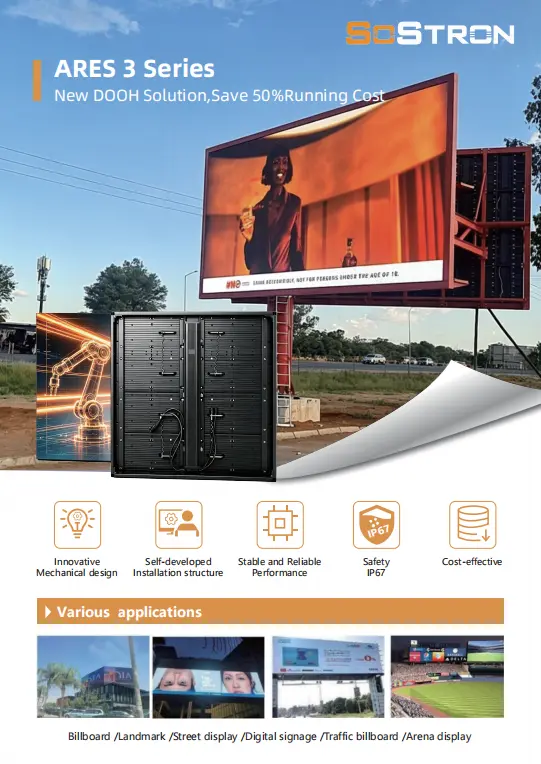
For example, Sostron’s Ares 3 outdoor LED display uses common-cathode technology and is designed around lower heat generation and energy consumption. Sostron specifies passive convection for most climates below 40°C and recommends temperature-controlled axial fans for extreme desert conditions.
The business logic is important:
Lower electrical consumption → lower thermal load → smaller cooling requirement → lower operating cost.
That is a much stronger value proposition than simply saying a product is “energy efficient.”
How Should Buyers Specify Thermal Performance in an LED Billboard RFQ?
Thermal requirements should appear in the RFQ before the supplier submits the final proposal.
Do not simply write:
“Outdoor LED display, IP65, 6,500 nits.”
That is not enough to engineer the cooling system.
A stronger RFQ should request:
| RFQ requirement | What the supplier should provide | Why it matters |
|---|---|---|
| Maximum power | W/m² and total system load | Determines peak thermal load |
| Average power | W/m² under defined conditions | Estimates operating cost |
| Operating temperature | Minimum and maximum ambient | Establishes thermal envelope |
| Brightness | Maximum and normal operating level | Influences power demand |
| Cooling method | Passive, fan, HVAC, heat exchanger | Defines thermal architecture |
| Airflow | CFM and static pressure where applicable | Verifies ventilation capacity |
| Cabinet IP rating | Front/rear rating | Defines environmental protection |
| Temperature monitoring | Sensor location and alarm logic | Enables preventive maintenance |
| High-temperature test | Test temperature and duration | Validates worst-case performance |
| Fan specification | Bearing type, life, redundancy | Assesses long-term reliability |
| Maintenance | Filter/fan access and replacement | Predicts service cost |
| Thermal documentation | Test data or thermal images | Provides evidence beyond marketing claims |
This is especially important for system integrators. A supplier that cannot clearly explain how heat travels through the cabinet may have a visually impressive product but an incomplete engineering solution.
What Should B2B Buyers Ask an LED Billboard Manufacturer?
Before approving a large outdoor display project, ask the manufacturer these questions:
1. What is the maximum and average power consumption per square meter?
Do not accept only one number.
2. What ambient temperature was used for thermal validation?
Ask for the actual test condition.
3. How is solar radiation considered?
This is particularly important for exposed billboards.
4. What cooling method is used?
Determine whether it relies on passive convection, forced air, heat exchange, or HVAC.
5. What is the actual airflow under operating resistance?
For fan-cooled cabinets, ask for both CFM and static-pressure information.
6. What happens if a cooling fan fails?
A commercial billboard should have a defined response rather than an uncontrolled thermal failure.
7. How are temperature alarms handled?
Ask whether the system provides local or remote monitoring.
8. What maintenance access is required?
A cooling system that technically works but requires difficult access can become expensive over its service life.
Why Choose Sostron for Engineered Outdoor LED Billboard Solutions?
For a commercial LED project, the right supplier should contribute more than a cabinet quotation.
Sostron operates as a global LED display manufacturer and commercial display solution provider, supporting project consultation, product selection, engineering assistance, manufacturing, installation guidance, and after-sales technical support.
For outdoor billboard projects, the engineering process can include:
Project requirements → Viewing distance → Pixel pitch → Brightness → Power analysis → Thermal design → Cabinet configuration → Structural requirements → Manufacturing → Testing → Installation support
This approach matters because cooling cannot be separated from the rest of the LED system.
For example, increasing brightness can increase power demand. Higher power demand increases heat. More heat may require greater airflow. Greater airflow can affect dust protection. A more sealed cabinet may then require a heat exchanger or HVAC system.
Every design choice has consequences.
Sostron’s Ares 3 is one example of this system-level approach: the product combines common-cathode architecture, energy-saving design, thermal management, automatic brightness control, and project-specific engineering considerations rather than treating energy consumption and cooling as separate problems.
For international projects, Sostron can also support considerations such as local wind-load requirements, cabinet configuration, installation method, power distribution, and remote technical assistance.
The goal is not to sell the most complicated cooling system.
The goal is to engineer the simplest thermal architecture that remains reliable under the project’s actual worst-case conditions.
LED Billboard Cooling System Design FAQ
How do you design an LED billboard cooling system?
Start by calculating maximum and typical electrical power consumption, then estimate the resulting heat load. Add site-specific factors such as ambient temperature, direct solar exposure, cabinet sealing, airflow resistance, and operating hours. From there, select passive cooling, forced-air ventilation, a heat exchanger, or HVAC. Validate the design against worst-case conditions rather than relying only on the manufacturer’s nominal temperature rating.
Do LED billboards need cooling fans?
Not always. A properly engineered outdoor LED display may use passive heat dissipation when its power density, cabinet structure, ambient temperature, and installation conditions allow sufficient natural convection. Higher-power or high-temperature applications may require forced-air cooling. The correct decision should be based on thermal load and temperature margin, not simply on whether the display is classified as “outdoor.”
How many CFM does an LED billboard need?
There is no universal CFM value because airflow depends on heat load and allowable temperature rise. Engineers can calculate the required airflow from the thermal load and then adjust for static pressure created by filters, vents, ducts, and cabinet restrictions. Fan selection should therefore consider both CFM and static pressure; a fan’s free-air CFM rating alone does not guarantee adequate cabinet airflow.
Do outdoor LED billboards need air conditioning?
Most outdoor billboards do not automatically require air conditioning. Passive or forced-air cooling can be sufficient when the cabinet is properly designed and the climate is moderate. HVAC becomes more relevant for high thermal loads, fully sealed enclosures, extreme ambient temperatures, or installations where outside air cannot safely enter because of dust or contamination. A heat exchanger can be an alternative when environmental isolation is required.
How do you prevent an LED billboard from overheating in a hot climate?
Start with low thermal-load LED architecture, appropriate cabinet heat dissipation, adequate airflow, and temperature monitoring. Then account for direct solar radiation, ambient temperature, dust, exhaust-air recirculation, and installation clearance. For extreme climates, use temperature-controlled fans, heat exchangers, or HVAC where justified. High-temperature validation should be performed under realistic brightness and environmental conditions rather than using ambient temperature alone.
Expert Verdict: Design the Thermal Path, Not Just the Fan
A reliable outdoor billboard does not stay cool because someone installed a powerful fan.
It stays reliable because the entire thermal path was engineered correctly:
Electrical efficiency → heat generation → thermal conduction → airflow → heat rejection → temperature monitoring → maintenance.
For B2B buyers, the best cooling system is therefore not necessarily the cheapest, largest, or most sophisticated one. It is the one that keeps every critical component within its intended operating range under the project’s worst realistic conditions, while minimizing energy, maintenance, and downtime over the display’s service life.
That is the standard Sostron recommends for any serious LED billboard project: calculate first, engineer second, specify third — and never let the cooling system become an afterthought.
References:
University of Maryland — LED Thermal Management and Reliability
Rensselaer Polytechnic Institute — Heat Transfer in LED Systems