Quick Answer
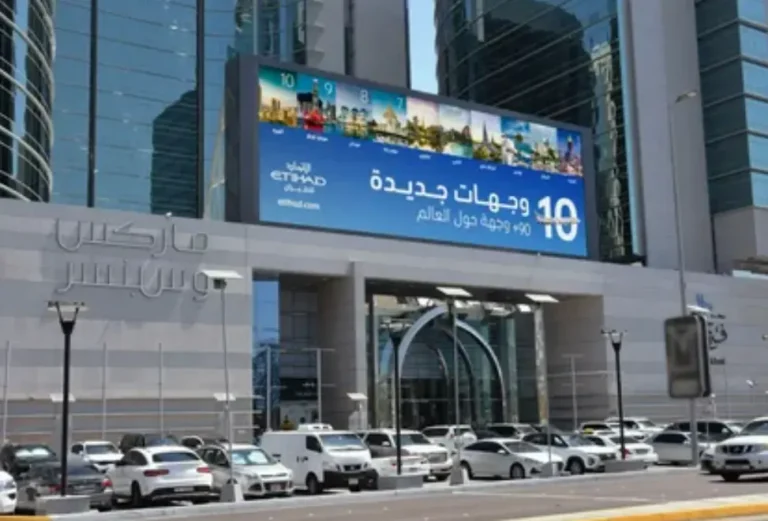
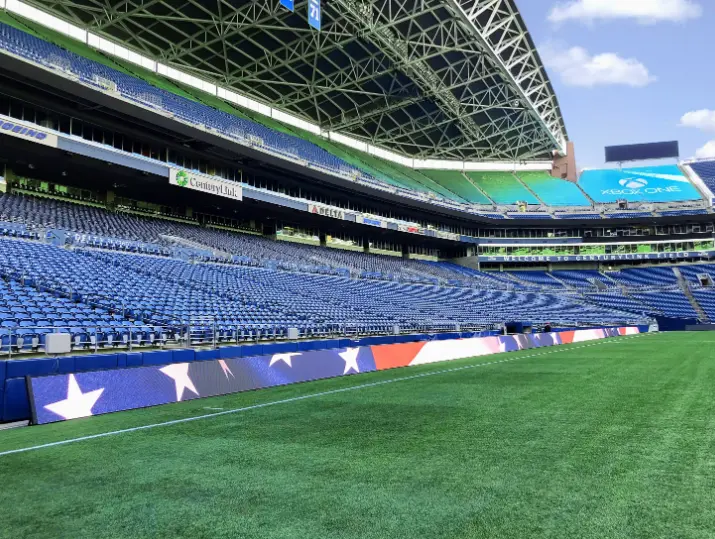
A Perimeter LED Display is a low-height outdoor LED advertising system installed around the playing or competition area of a stadium, arena, or sports venue. Unlike a standard outdoor billboard, it must balance advertising visibility with athlete safety, spectator sightlines, outdoor protection, and broadcast performance.
There is no single reliable market-wide price for a perimeter LED display because quotations can refer to very different scopes. Hardware-only prices published by suppliers can be several hundred dollars per square meter, while higher-spec stadium systems and complete projects can reach well above $1,000 per m² once specialized cabinet design, control equipment, structure, logistics, installation, commissioning, and other project costs are included. Published supplier prices should therefore be treated as reference figures rather than a universal installed-project price.
For a professional stadium, the most important purchasing variables are usually pixel pitch, brightness, refresh rate, scan mode, protection, player-safety design, cabinet dimensions, power consumption, control redundancy, maintenance access, and total project scope.
At a Glance
| Item | Practical Guidance |
|---|---|
| Main application | Stadiums, arenas, football pitches, athletics venues, sports events |
| Common pixel pitches | P6.25, P6.67, P8, P8.33, P10 and application-specific options |
| Brightness | Must be selected for actual outdoor lighting and camera conditions |
| Refresh rate | 3,840Hz is commonly specified for professional sports-oriented systems, but refresh rate alone does not guarantee broadcast performance |
| Protection | Outdoor systems require an appropriate enclosure protection rating and site-specific weather design |
| Safety | Soft protection, cabinet stability, pitch clearance and sightlines matter |
| Price | Highly dependent on specification and whether the quote is hardware-only or project-level |
| Main hidden costs | Structure, control, electrical work, shipping, customs, installation, commissioning, spare parts and maintenance |
| Best buying method | Compare complete specifications and scope, not only $/m² |
What Is a Perimeter LED Display?
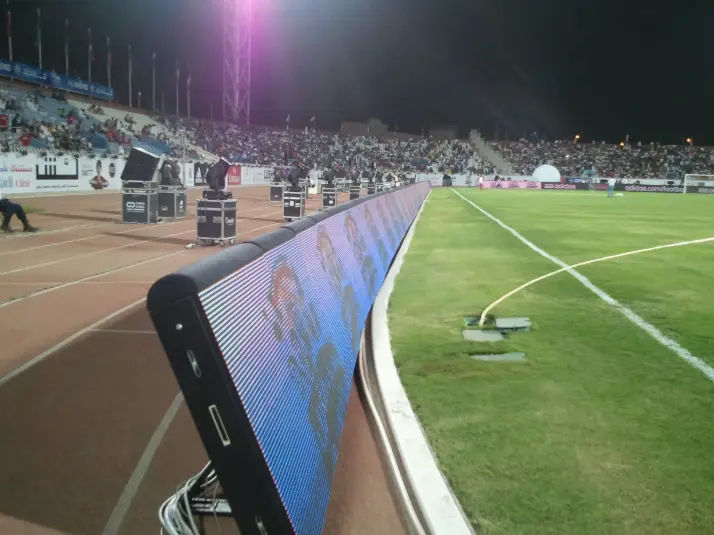
A perimeter LED display is a modular LED screen designed to run along the boundary of a sports field or competition area.
It is commonly used for:
- Football and soccer stadium advertising
- Basketball arenas
- Rugby venues
- Athletics competitions
- Tennis and other sports
- Indoor or outdoor sports events
- Sponsor advertising
- Event information
- Broadcast-oriented commercial content
The important distinction is that a perimeter LED display is not simply a conventional outdoor LED billboard turned sideways.
A stadium perimeter system operates close to athletes, spectators, cameras, advertising operators, and venue infrastructure. Its mechanical structure, protection, display height, control system, and operating procedure therefore have to be designed around the venue.
FIFA’s stadium guidance, for example, emphasizes player safety, spectator sightlines, pitch-side space, and the positioning of advertising boards. FIFA recommends sufficient level surface around the field to reduce collision risk and states that advertising boards should not interfere with spectator sightlines or emergency movement.
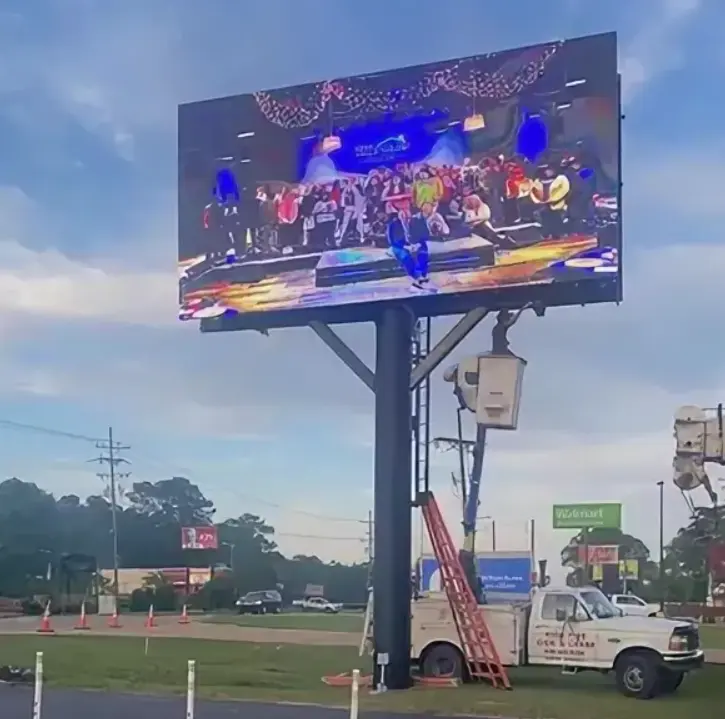
How Is a Perimeter LED Display Different From a Standard Outdoor LED Billboard?
| Factor | Perimeter LED Display | Standard Outdoor LED Billboard |
|---|---|---|
| Typical position | Pitch-side / competition perimeter | Roadside, building, commercial site |
| Main audience | Spectators + broadcast viewers | Road users, pedestrians, customers |
| Physical environment | Close to athletes and field operations | Usually separated from public activity |
| Safety design | High priority | Site-dependent |
| Cabinet height | Often designed around stadium advertising geometry | Usually larger fixed structures |
| Broadcast considerations | Important for professional sports | Usually secondary |
| Maintenance | Must minimize disruption to events | More flexible scheduling |
| Content | Sponsor loops, branding, match/event content | Advertising and digital signage |
| Installation | Requires venue-specific planning | Depends mainly on structure and site |
| Commercial objective | Sponsorship + event advertising | Advertising inventory / signage |
That distinction is important when comparing supplier quotations. A cheaper generic outdoor display may not provide the mechanical and operational features required for pitch-side use.
How Much Does a Perimeter LED Display Cost?
There is no single standard Perimeter LED Display price that can accurately describe every project.
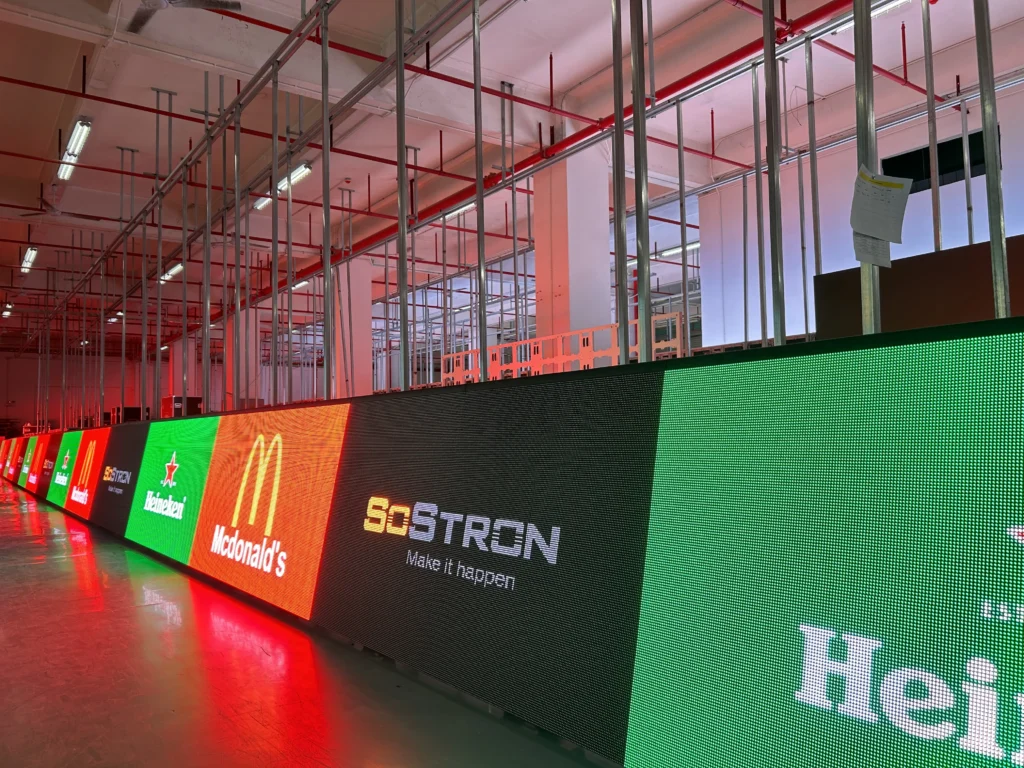
Public supplier listings currently show substantial variation in stadium perimeter LED hardware pricing. For example, one current supplier-published reference lists approximately $650–$850/m² for P6.67, $550–$700/m² for P8, and $400–$550/m² for P10. These figures are supplier-published reference prices, not universal market prices or turnkey project quotations. Actual costs depend on specification, order volume, control equipment, structure, logistics, installation, and local project conditions.
For procurement, use the following model rather than treating a web-listed price as a turnkey quotation:
Total Project Cost = LED Display Hardware + Control System + Structure + Electrical Work + Logistics + Customs + Installation + Commissioning + Spare Parts
What Does a Perimeter LED Display Quote Usually Include?
Ask the supplier to identify each item separately.
| Cost Component | Typical Scope |
|---|---|
| LED display hardware | Cabinets, LED modules, receiving cards, power supplies |
| Control system | Video processor, sending equipment, receiving equipment and software |
| Mechanical system | Support structure, brackets, protection and connection hardware |
| Electrical system | Distribution, cabling and protection equipment |
| Logistics | Packing, freight, insurance and related transport |
| Customs | Duties, taxes and local clearance where applicable |
| Installation | Mechanical installation, wiring and configuration |
| Commissioning | Testing, calibration and system setup |
| Spare parts | Modules, power supplies, receiving cards and other recommended spares |
| Maintenance | Local service, remote support or service contract |
A supplier quoting $600/m² for display hardware and another quoting $1,500/m² for a more complete system may not actually be offering comparable products.
Why Does Perimeter LED Display Price Vary So Much?
The largest cost drivers normally include:
- Pixel pitch
- LED and module configuration
- Brightness
- Cabinet construction
- Player-safety protection
- Refresh and driving technology
- Weather protection
- Control and redundancy
- Screen dimensions
- Installation conditions
- Shipping distance
- Local electrical and structural requirements
A useful procurement rule is:
Compare scope before comparing price.
A lower $/m² figure is not necessarily a lower total project cost if it excludes the control system, structural work, installation, spare parts or other required components.
What Pixel Pitch Is Best for a Perimeter LED Display?
Pixel pitch is the distance between adjacent LED pixels, measured in millimeters.
A smaller pixel pitch provides higher pixel density and can produce more detailed images at closer viewing distances. A larger pixel pitch reduces pixel density and can be more economical when the audience is farther away.
Current stadium-oriented products are available in configurations such as P6.25, P6.67, P8, P8.33 and P10, depending on the manufacturer and application. Sostron’s current Stadium Perimeter LED product, for example, lists P6.25, P8.33 and P10 configurations. The appropriate pitch should be selected from actual spectator distance, camera position, screen height, content requirements and budget rather than from pixel pitch alone.
P6.25 vs P8.33 vs P10
| Pixel Pitch | General Advantage | When It May Make Sense |
|---|---|---|
| P6.25 | Higher pixel density | Closer spectators, more detailed content, demanding visual requirements |
| P8.33 | Balance between detail and cost | Many professional stadium applications |
| P10 | Lower pixel density and potentially lower hardware cost | Longer viewing distances and simpler advertising content |
These are selection directions, not universal rules.
The correct pitch should be determined from:
- Minimum spectator viewing distance
- Camera position
- Screen height
- Content type
- Required image detail
- Budget
- Venue lighting
- Broadcast requirements
Why Is Pixel Pitch Not Enough?
Suppose two stadiums both choose P8.
One may place the screen relatively close to the main camera and expect detailed sponsor graphics. The other may have a much greater camera distance and use simple brand logos.
The same pixel pitch can therefore produce different practical results.
Buyer insight: ask the supplier to evaluate the actual viewing geometry instead of simply recommending the smallest available pixel pitch.
What Brightness Does a Stadium Perimeter LED Display Need?
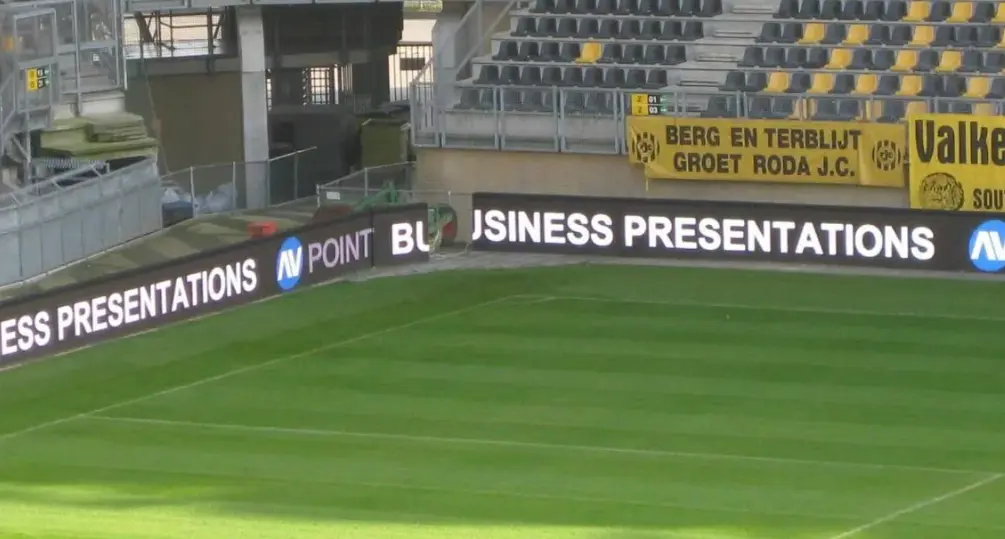
Brightness is normally specified in nits, or cd/m².
Outdoor perimeter displays need enough brightness to remain visible under daylight, but maximum brightness should not be treated as the only quality metric.
A professional configuration should consider:
- Direct sunlight
- Cloudy conditions
- Night matches
- Floodlighting
- Camera exposure
- Automatic brightness control
- Audience comfort
- Local light regulations
Sostron’s current Stadium Perimeter LED product specifies 6,500 nits for its listed configurations. This is manufacturer-provided product data, not a universal stadium standard.
For comparison, Sostron’s Ares outdoor LED product currently lists up to 10,000 nits, but that product is a general fixed outdoor LED platform rather than a direct substitute for a pitch-side perimeter system.
Why Is Excessive Brightness Not Automatically Better?
A display that is brighter than necessary can increase power consumption and may create undesirable visual conditions at night.
The practical objective is:
Sufficient daylight visibility + controlled nighttime output + stable camera performance.
For a professional project, ask for the display’s:
- Maximum brightness
- Typical operating brightness
- Brightness adjustment method
- Calibration procedure
- Nighttime operating strategy
What Refresh Rate Is Needed for Sports Broadcasting?
Refresh rate describes how frequently the display can update its image.
Professional stadium systems often specify 3,840Hz or higher, but buyers should not treat refresh rate as a standalone guarantee of broadcast quality.
Camera performance can also depend on:
- Scan mode
- PWM driving
- Gray scale
- Brightness setting
- Camera shutter speed
- Camera exposure
- Calibration
- Signal processing
- Synchronization
Sostron’s current Stadium Perimeter product specifies a 3,840Hz refresh rate, while its Ares 2 outdoor platform lists configurable refresh rates from 3,840Hz to 7,680Hz.
Why Does Broadcast Testing Matter?
UEFA’s Stadium Lighting Guide states that LED pitch perimeter display systems should be assessed during installation and tested before broadcast events so that the display does not affect camera balance or exposure.
That means:
“3,840Hz” should be treated as one specification in a broadcast-performance package, not as a complete broadcast certification.
For a stadium project, request an actual camera test under representative lighting conditions.
Why Does a Perimeter LED Display Need a Soft Protection System?
Player safety is one of the clearest differences between a professional perimeter LED system and a conventional outdoor billboard.
A player can run into a pitch-side board at high speed. The display therefore needs physical protection that reduces the consequences of accidental contact.
Depending on the system, this can include:
- Soft rubber masks
- Impact-absorbing surfaces
- Protected cabinet edges
- Stable support structures
- Suitable screen height
- Appropriate pitch-side clearance
Sostron’s Stadium Perimeter LED product uses a soft protection mask and a 90cm-high cabinet design.
Does the Soft Mask Replace Proper Site Design?
No.
A soft mask is only one component of a safe installation.
The venue still needs to consider:
- Distance from the playing area
- Player movement
- Ground conditions
- Support structure
- Spectator access
- Emergency access
- Sightlines
- Local safety requirements
FIFA’s stadium guidance specifically connects advertising-board placement with player safety and spectator sightlines. It also recommends adequate level space beyond the field of play before perimeter advertising boards are placed.
Engineering insight: do not approve the LED cabinet before the venue confirms the complete pitch-side geometry.
How High Should a Perimeter LED Display Be?
There is no universal height that applies to every sport and competition.
UEFA’s current 2026/27 Champions League regulations specify a continuous pitch-perimeter advertising system at least 246m long and 90cm high, with fully closed corners and no gaps for systems meeting its stated requirements.
Sostron’s Stadium Perimeter LED product uses a 90cm display height and a 1600 × 900mm cabinet.
However, UEFA competition requirements should not be confused with a universal global manufacturing standard.
Other sports organizations and competitions can have different requirements. World Athletics regulations, for example, specify a maximum 1.2m height for certain perimeter boards at non-stadium events.
What Should Buyers Check?
Before manufacturing, confirm:
- Competition regulations
- Venue regulations
- Sport-specific requirements
- Local authority requirements
- Camera sightlines
- Spectator sightlines
- Player safety distances
- Emergency access
- Advertising content requirements
The contract specification and applicable competition rules should prevail over a generic supplier recommendation.
What Does IP65 Mean for a Perimeter LED Display?
IP ratings are defined under IEC 60529, the international standard for degrees of protection provided by electrical equipment enclosures.
For procurement purposes, do not simply write:
“The screen is waterproof.”
Instead, request the actual IP rating and clarify which part of the system and which direction of exposure the rating applies to.
For example, Sostron’s current Stadium Perimeter product lists IP65, while its Ares fixed outdoor product specifies a different front/rear protection configuration.
These specifications should not be mixed.
Why Does Front vs Rear Protection Matter?
A stadium display can experience:
- Rain
- Wind-driven moisture
- Dust
- Cleaning water
- Humidity
- Temperature changes
But the front and rear of the cabinet may experience different environmental conditions.
Ask the supplier for:
- Front IP rating
- Rear IP rating
- Test basis
- Cabinet sealing design
- Drainage design
- Operating temperature
- Maintenance requirements
IEC 60529 defines the IP Code classification framework; it does not mean that every IP65 product is identical in construction or suitable for every installation environment.
How Much Power Does a Perimeter LED Display Consume?
Power consumption is a major TCO consideration for a large stadium installation.
Sostron’s current Stadium Perimeter product lists:
- Maximum power consumption: 680W/m²
- Average power consumption: 120–200W/m²
These are manufacturer-provided specifications for that product configuration.
Do not calculate annual electricity cost using maximum power as though the screen operates at maximum output continuously.
A practical estimate can use:
Estimated Annual Energy = Screen Area × Average Operating Power × Operating Hours
For example, if a project uses 300m² of display and the supplier’s documented average power assumption is 160W/m²:
300m² × 0.16kW/m² = 48kW
If the system operates for 6 hours per day:
48kW × 6 hours = 288kWh/day
This is an example calculation, not a prediction of actual consumption.
Actual energy use depends on:
- Content brightness
- Brightness control
- Operating hours
- Pixel pitch
- LED technology
- Power management
- Ambient lighting
- Screen utilization
Why Does Average Power Matter More Than Maximum Power for TCO?
Maximum power is useful for:
- Electrical design
- Distribution sizing
- Peak-load planning
- Safety margins
Average power is more useful for:
- Electricity budgeting
- Operating-cost estimates
- Comparing energy efficiency
Ask the supplier to provide both.
What Is the Total Cost of Ownership of a Perimeter LED Display?
The purchase price is only the first part of the investment.
A professional TCO model should consider:
1. Hardware
- LED modules
- Cabinets
- Power supplies
- Receiving cards
- Cables
- Control components
2. Control System
- Video processor
- Sending cards
- Receiving cards
- Control software
- Signal distribution
- Redundant signal paths where required
3. Mechanical Structure
- Support frames
- Brackets
- Connection hardware
- Protective components
- Venue-specific structural work
4. Installation
- Mechanical installation
- Electrical installation
- Configuration
- Testing
- Commissioning
5. Logistics
- Packaging
- Inland transport
- Ocean or air freight
- Insurance
- Customs clearance
- Local delivery
6. Maintenance
- Replacement modules
- Power supplies
- Receiving cards
- Preventive maintenance
- Emergency service
7. Electricity
Large perimeter systems can operate for many hours during training, matches, advertising periods, and other events.
8. Downtime
Downtime has a commercial cost when the screen is part of a sponsorship or advertising package.
This is why the lowest initial quotation should not automatically be treated as the lowest-cost solution.
What Hidden Costs Should Buyers Ask About?
Before approving a quotation, ask:
| Question | Why It Matters |
|---|---|
| Is the controller included? | Some low quotations exclude control equipment |
| Is the structure included? | Stadium installation may require venue-specific support |
| Is installation included? | Labor can materially change project cost |
| Is commissioning included? | A display can be installed but still require calibration |
| Are spare parts included? | Reduces future downtime |
| Is freight included? | Shipping can materially change landed cost |
| Are customs and taxes included? | These vary by destination |
| Is electrical distribution included? | Peak power affects infrastructure |
| Is broadcast testing included? | Important for televised sports |
| Is local service available? | Matters during match operations |
| What does the warranty cover? | Parts-only and full-system warranties differ |
Who Should Buy a Perimeter LED Display?
A perimeter LED system makes sense when the venue needs a combination of:
- Sponsor advertising
- Dynamic content
- Match-day advertising rotation
- Broadcast visibility
- High outdoor visibility
- Frequent content changes
- Multiple advertisers
- Long-term venue operation
Typical buyers include:
- Stadium owners
- Sports clubs
- Arena operators
- Sports marketing agencies
- Event organizers
- AV integrators
- Advertising operators
Who May Not Need One?
A full perimeter LED system may be unnecessary if:
- The venue only needs a single advertising billboard;
- The screen will rarely change content;
- There is no requirement for pitch-side advertising;
- The available viewing distance does not justify a higher specification;
- A static sign meets the commercial requirement;
- The venue cannot provide suitable electrical or structural infrastructure.
This is an important purchasing distinction.
The right question is not “What is the most advanced LED screen available?” but “What specification does the venue actually require?”
When Is a More Expensive Configuration Justified?
A higher-cost configuration can be justified when the project has specific requirements such as:
Broadcast-heavy operation
Higher refresh performance, appropriate scan technology, calibration, and camera testing become more important.
Close viewing distances
A smaller pixel pitch may provide a visible improvement in image detail.
High environmental exposure
Higher protection and appropriate mechanical design may reduce operational risk.
Intensive advertising operation
Reliable control, spare parts, maintenance access, and redundancy become more valuable.
Professional competition
Competition-specific requirements may dictate dimensions, installation geometry, operating procedures, or system testing.
The premium should therefore be connected to a measurable requirement, not simply a longer specification sheet.
What Should You Ask a Perimeter LED Supplier?
Use this checklist before requesting a final quotation.
Technical Specification Checklist
- Pixel pitch
- LED package
- Cabinet dimensions
- Cabinet weight
- Active display height
- Brightness
- Refresh rate
- Scan mode
- Gray scale
- Viewing angle
- Front IP rating
- Rear IP rating
- Average power
- Maximum power
- Operating temperature
- Maintenance method
Stadium Safety Checklist
- Soft protection mask
- Cabinet-edge protection
- Structural stability
- Pitch-side clearance
- Emergency access
- Spectator sightlines
- Player safety assessment
- Venue approval
Broadcast Checklist
- Camera test
- Refresh-rate specification
- Scan-mode specification
- PWM information
- Brightness control
- Calibration procedure
- Signal redundancy
- Match-day testing procedure
Commercial Checklist
- Hardware price
- Controller price
- Structure price
- Installation price
- Shipping
- Customs
- Spare parts
- Warranty
- Local service
- Commissioning
What Do UEFA and FIFA Guidelines Mean for Perimeter LED Buyers?
Competition-specific regulations should be reviewed before the display is manufactured.
UEFA’s current Champions League regulations contain detailed pitch-perimeter requirements, including a continuous system of at least 246m and 90cm height for the specified competition context. UEFA also requires the system to be fully visible from the main camera position and requires testing and colour calibration under match lighting conditions.
UEFA’s Stadium Lighting Guide separately states that pitch perimeter display systems should be tested before broadcast events so that they do not affect camera balance or exposure.
FIFA’s stadium guidance emphasizes the relationship between advertising boards, player safety, spectator sightlines, field-of-play dimensions, and emergency movement.
These documents should be treated as competition and stadium planning references, not as a universal specification for every sports venue.
Why Does This Matter During Procurement?
If a supplier designs the screen before the venue confirms the applicable rules, the project may later require:
- Cabinet redesign
- Different screen height
- Different perimeter geometry
- Additional clearance
- Revised support structures
- Additional testing
- Reinstallation
That can turn a seemingly inexpensive quotation into a much more expensive project.
How Should You Compare Perimeter LED Display Suppliers?
Do not compare suppliers using only:
Price per square meter
Instead, create a technical-commercial comparison.
| Evaluation Area | What to Compare |
|---|---|
| Display | Pixel pitch, brightness, refresh, scan |
| Safety | Soft protection, cabinet design, stability |
| Weather | IP rating and environmental specifications |
| Broadcast | Camera testing and calibration support |
| Power | Average and maximum consumption |
| Maintenance | Front/rear access and spare parts |
| Control | Processor, signal path and redundancy |
| Engineering | Drawings, configuration and commissioning |
| Compliance | Applicable certificates and documentation |
| Commercial | Complete scope and exclusions |
| Service | Warranty and after-sales support |
| Experience | Verifiable relevant projects |
What Evidence Should a Supplier Provide?
A serious RFQ response should be supported by documentation such as:
- Technical datasheet
- Cabinet drawings
- Power calculations
- Structural information where applicable
- Protection specifications
- Test reports where applicable
- Warranty terms
- Spare-parts recommendation
- Installation scope
- Commissioning procedure
If a supplier makes a claim such as “broadcast-ready,” ask what that means technically and what evidence supports it.
Sostron Stadium Perimeter LED Display
Sostron provides a dedicated Stadium Perimeter LED Display designed for football stadiums, sports arenas, and other sports venues.
The current Stadium product page lists:
- P6.25, P8.33 and P10 configurations
- 1600 × 900mm cabinet
- 90cm cabinet/display height
- 6,500 nits brightness
- 3,840Hz refresh rate
- IP65 protection
- 120–200W/m² average power consumption
- 680W/m² maximum power consumption
- Front/rear maintenance
- Soft protection mask
These are current Sostron product specifications, not universal industry requirements.
For projects where the stadium requires a general fixed outdoor LED billboard rather than a dedicated pitch-side system, Sostron also offers the Ares outdoor LED platform. Its current product information lists configurations from P3.9 to P10.4, up to 10,000 nits, and a 7,680Hz refresh-rate specification.
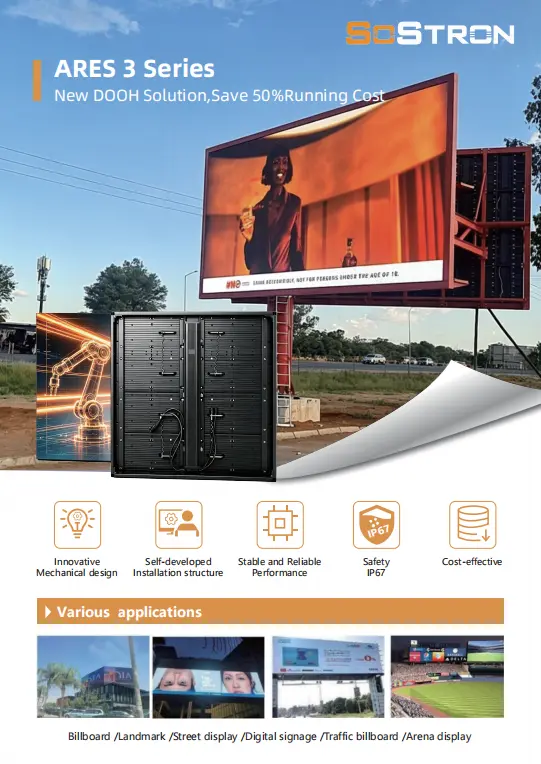
The two product families should be evaluated according to their intended application rather than treated as interchangeable products.
For a dedicated sports application, see Sostron’s Stadium Perimeter LED Display.
For fixed outdoor advertising applications, see the Ares 3 Outdoor LED Display.
For a verified stadium installation example, see Sostron’s France Stadium Custom LED Display Upgrade Project.
A Verified Sostron Stadium Project
Sostron’s published case portfolio includes a 2026 stadium project in France using the sPad Pro2 P3.9 rental LED display. The project involved multi-section suspended installation, high-altitude hoisting, rapid ground pre-assembly, and broadcast-oriented display requirements. The published project specification lists a 500 × 500mm cabinet, 7.5kg cabinet weight, 7,680Hz refresh rate and 16-bit grayscale.
This project is an indoor stadium LED installation rather than a pitch-side perimeter LED project, so it should not be used as evidence that the same configuration is suitable for every perimeter application. It does, however, provide a verifiable example of Sostron’s stadium installation and engineering experience.
Frequently Asked Questions
How much does a Perimeter LED Display cost?
There is no universal price because suppliers may quote hardware-only products or complete stadium systems. Published supplier prices can range from several hundred dollars per square meter to more than $1,000/m² depending on configuration and scope. Installation, control equipment, structure, logistics, electrical work, commissioning and spare parts can add substantially to the final project cost. Always request an itemized quotation rather than comparing a single $/m² figure.
What pixel pitch is best for a stadium perimeter LED display?
P6.25, P8.33 and P10 are examples of currently available stadium-oriented configurations. A smaller pitch provides higher pixel density, but the best choice depends on viewing distance, camera position, screen height, content detail and budget. For procurement, ask the supplier to evaluate actual spectator and camera geometry instead of choosing the smallest pitch automatically.
Is 3,840Hz enough for sports broadcasting?
A 3,840Hz refresh rate is commonly specified for professional sports-oriented LED systems, but it should not be treated as a complete broadcast-performance guarantee. Scan mode, PWM, gray scale, brightness, camera settings, calibration and signal processing can also affect camera performance. A camera test under representative match lighting is a more useful validation step.
What IP rating should a perimeter LED display have?
The appropriate rating depends on the cabinet design and installation environment. IEC 60529 provides the framework for IP enclosure classifications. Buyers should ask for separate front and rear protection specifications and supporting documentation rather than relying only on the phrase “waterproof.”
Why does a stadium LED display need a soft mask?
A perimeter display is installed close to athletes, so accidental impact is an important design consideration. A soft protective mask can reduce the severity of contact and help protect the LED modules. It does not replace proper pitch-side clearance, structural stability, venue safety assessment or compliance with applicable regulations.
What should be included in a perimeter LED quotation?
At minimum, ask for separate pricing and scope for the LED display, control system, mechanical structure, electrical work, installation, logistics, commissioning, spare parts and warranty. Also ask whether taxes, customs, local installation and venue-specific structural work are excluded.
Is a Perimeter LED Display better than a standard outdoor billboard?
They serve different purposes. A perimeter display is designed for pitch-side advertising and sports-venue operation, where player safety, viewing geometry and broadcast performance can be important. A standard outdoor billboard may be more appropriate for roadside, building-mounted or general commercial advertising applications where those stadium-specific requirements do not apply.
Buyer Takeaway
A Perimeter LED Display should be purchased as a stadium display system, not simply as an LED cabinet.
Start with the venue:
- Confirm the sport and competition.
- Confirm the applicable regulations.
- Map spectator and camera viewing distances.
- Determine the required screen height and pitch-side clearance.
- Select pixel pitch based on viewing geometry.
- Specify brightness for actual lighting conditions.
- Validate refresh, scan and camera performance.
- Confirm soft protection and mechanical safety.
- Calculate average and maximum power requirements.
- Compare the complete project cost, not only the LED price per square meter.
The most useful quotation is not necessarily the one with the lowest initial $/m² figure. It is the one where the buyer can clearly see what is included, what is excluded, which specification solves which problem, and what the venue will need to operate the system over its service life.
Sostron develops and manufactures LED display systems and provides product development, engineering support, customized solutions, installation guidance and after-sales technical support for commercial LED display projects. For stadium applications, the appropriate configuration should be determined from the venue’s actual dimensions, operating conditions, technical requirements and applicable regulations.
References:
UEFA Stadium Lighting Guide 2023 — LED Pitch Perimeter Display Systems
FIFA Football Stadiums Guidelines — Pitch Dimensions & Surrounding Areas