Quick Answer
A LED video wall for a control room is a large-format direct-view LED display designed to present multiple operational data sources, video feeds, dashboards, maps, alarms, and other critical information on a seamless viewing surface. Unlike a conventional digital-signage screen, a control-room LED wall must be evaluated as part of a complete system that includes pixel pitch, viewing distance, video processing, signal distribution, power, maintenance access, thermal management, and service support.
There is no single universal price for a control-room LED video wall. The project cost depends on the display area, pixel pitch, processing architecture, mounting structure, installation, shipping, commissioning, spare parts, and service requirements. A supplier quote should therefore be evaluated as a complete system cost, not simply as a price per square meter.
For operators who sit relatively close to the display and need to read detailed maps, text, dashboards, or camera feeds, fine-pitch LED can provide a seamless large-format workspace. However, a smaller pixel pitch is not automatically the best choice. The correct specification depends on the nearest viewing position, content type, wall dimensions, room lighting, and required image detail.
For control-room projects, buyers should pay particular attention to:
- Pixel pitch and viewing distance
- Brightness and low-brightness image quality
- Refresh rate and image stability
- Color uniformity and calibration
- 24/7 operating requirements
- Power and signal redundancy
- Front or rear service access
- Video processing and source management
- Installation and commissioning
- Spare-parts and after-sales support
- Total cost of ownership (TCO)
ISO 11064-5 specifically addresses displays and controls in control-centre design, while ISO 11064-6 covers environmental factors such as lighting, thermal conditions, air quality, acoustics, and vibration. These standards reinforce an important procurement principle: the LED wall should be specified as part of the control-room environment, not as an isolated display product.
What Is an LED Video Wall for a Control Room?
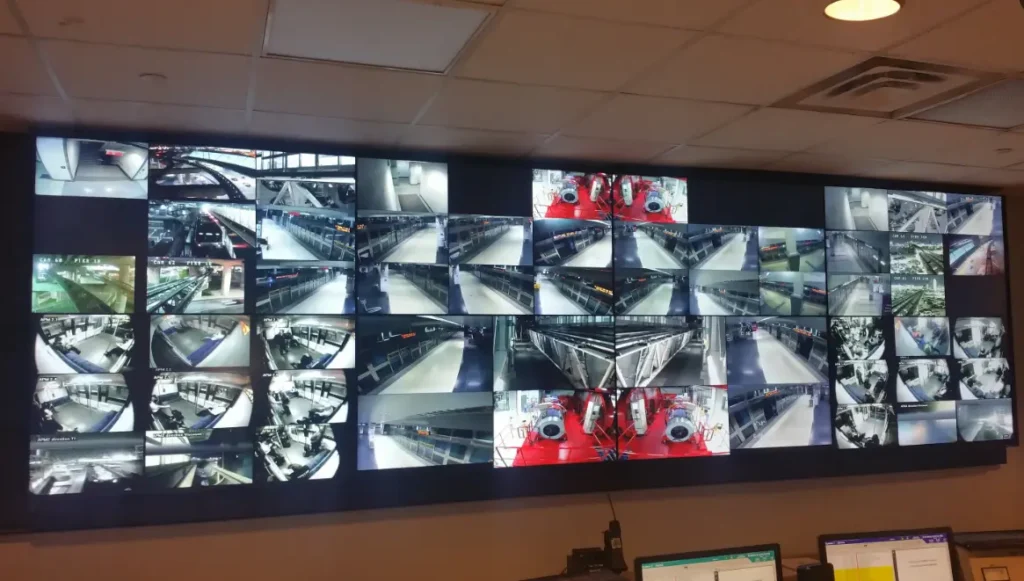
An LED video wall for a control room is a modular direct-view LED display assembled from multiple LED cabinets to create one large visual surface without the prominent bezels found between conventional LCD panels.
Typical applications include:
- Network Operations Centers (NOCs)
- Security Operations Centers (SOCs)
- Traffic management centers
- Utility and power-control rooms
- Emergency command centers
- Transportation dispatch centers
- Industrial control rooms
- Surveillance and security monitoring rooms
- Public-safety operations centers
The display may show several sources simultaneously, such as:
- Live camera feeds
- Geographic information system (GIS) maps
- Network monitoring dashboards
- SCADA interfaces
- Traffic information
- Alarm panels
- Weather information
- Video conferencing
- Operational KPIs
The key difference between a normal indoor LED display and a control-room LED wall is therefore not simply the cabinet or pixel pitch.
It is the operational requirement around the display.
A control-room system needs to remain visually consistent, serviceable, and predictable while operators use it for extended periods. That changes how the display should be specified.
How Much Does a Control Room LED Video Wall Cost?
There is no reliable single 2026 market price that applies to every control-room LED video wall.
A project quotation normally depends on:
| Cost Component | What Affects the Cost |
|---|---|
| LED display | Pixel pitch, cabinet design, LED package, wall area |
| Video processor | Number and type of inputs, outputs, scaling and processing requirements |
| Control system | Source management, switching, windowing and integration |
| Mounting structure | Wall construction, dimensions and access requirements |
| Power system | Distribution and redundancy requirements |
| Signal cabling | Distance, signal type and system architecture |
| Installation | Site location, labor and installation complexity |
| Shipping | Volume, weight, destination and logistics |
| Customs | Country-specific import requirements and taxes |
| Calibration | Factory and onsite calibration requirements |
| Spare parts | Recommended spare modules and electronic components |
| Commissioning | Testing, configuration and handover |
| Service | Warranty, technical support and response requirements |
A Practical Pricing Formula
For budgeting purposes, buyers can think of the project as:
Total Project Cost = Display + Processing + Structure + Installation + Logistics + Commissioning + Spares + Service
This is a cost model, not a fixed market price.
If a supplier quotes only a USD/m² LED cabinet price, ask what is excluded before comparing it with another supplier.
A lower panel price may not represent a lower project cost if the quotation excludes processing, structure, installation, commissioning, spare parts, or other required equipment.
Why Pixel Pitch Has Such a Large Effect on Price
Smaller pixel pitch generally means a higher LED density and more pixels across the same physical area.
For example, a P1.25 display contains substantially more pixels per square meter than a P2.5 display.
That can improve close-viewing detail, but it also means buyers should ask whether the additional pixel density is actually useful for the operators.
Do not select the smallest available pixel pitch simply because it has the highest nominal resolution.
The correct question is:
What is the smallest visual detail that operators need to read from the nearest viewing position?
Who Should Buy an LED Video Wall for a Control Room?
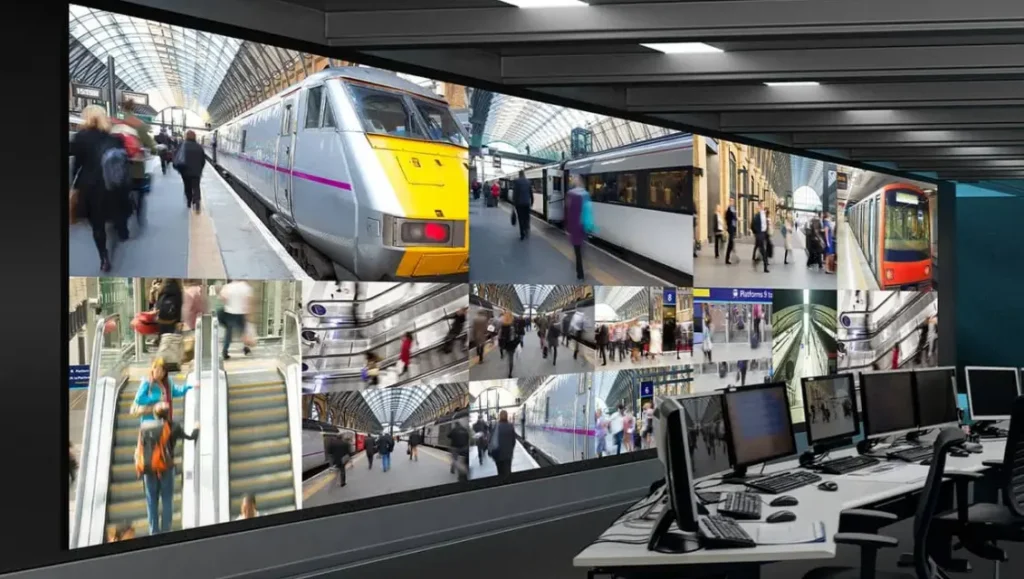
An LED video wall is particularly relevant when a control room needs a large, continuous visual surface for multiple simultaneous information sources.
It can be appropriate when:
- Operators need to view information across a large wall.
- Content frequently crosses the boundaries between individual sources.
- A seamless visual surface is important.
- The room requires a large viewing area.
- Multiple operators need to see the same information.
- The system will operate for long periods.
- Future expansion or unusual wall dimensions are anticipated.
Who May Not Need Direct-View LED?
LED is not automatically the correct technology for every control room.
A conventional LCD video wall may remain appropriate where:
- The wall is relatively small.
- Operators sit far enough away that bezel lines are not operationally important.
- Initial acquisition cost is the dominant consideration.
- The content is normally separated into individual screens.
- Existing infrastructure is designed around LCD panels.
The technology decision should therefore be made after defining the operational requirements rather than before them.
How Do You Choose Pixel Pitch for a Control Room?
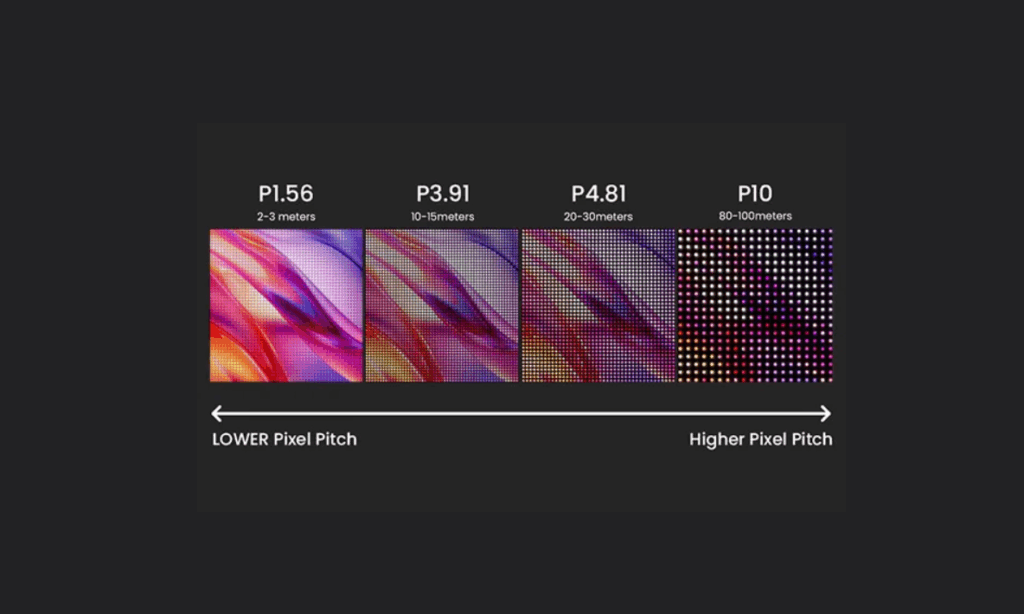
Pixel pitch is the distance between the centers of adjacent LED pixels, measured in millimeters.
A smaller pitch produces a higher pixel density and can support more detailed content at closer viewing distances.
However, pixel pitch should never be selected independently.
The main inputs are:
- Nearest operator viewing distance
- Smallest text or graphic element that must remain readable
- Type of content
- Wall dimensions
- Source resolution
- Viewing angle
- Budget
- Expected future use
What Pixel Pitch Is Suitable for Close Viewing?
Fine-pitch LED products are commonly considered for control rooms where operators may sit relatively close to the main wall.
As a practical product-selection range rather than a universal control-room standard, fine-pitch configurations such as P1.25–P1.9 can be considered when operators need detailed content from relatively close viewing positions. Larger pixel pitches may be appropriate as viewing distance increases or when the displayed content does not require the same level of fine detail. The final choice should be validated against the actual room layout, content and operator viewing task.
The final selection should be validated with the actual room layout.
Sostron’s current Reta 2 small-pitch LED display is offered in P1.25, P1.5, P1.6, P1.8, P2.0 and P2.5 configurations. Its published specifications include 600–800 nits calibrated brightness and a 7,680 Hz refresh rate. These are Reta 2 product specifications, not universal control-room requirements, so the appropriate configuration should still be selected according to viewing distance, content and system design.
Does Smaller Pixel Pitch Always Mean Better?
No.
A smaller pixel pitch provides higher pixel density, but the buyer may receive little practical benefit if operators are several meters away and the content does not contain fine visual details.
Consider two rooms with identical 30 m² LED walls:
- Room A: Operators sit close to the wall and constantly read small text and detailed maps.
- Room B: Operators sit farther away and primarily monitor large camera feeds and status graphics.
Room A may justify a finer pitch.
Room B may not.
This is one of the easiest ways to avoid unnecessary capital expenditure.
How Does Viewing Distance Affect LED Video Wall Selection?
Viewing distance determines how easily the human eye can distinguish individual pixels and how useful a particular pixel density becomes.
A simplified way to think about the relationship is:
Closer viewing → greater need for pixel density
Farther viewing → less need for extremely fine pixel density
But viewing distance should not be reduced to a single mathematical formula.
For control rooms, the closest operator position is usually more important than the average distance.
The specification process should identify:
- Closest workstation
- Typical workstation
- Farthest workstation
- Operator eye height
- Horizontal viewing angle
- Vertical viewing angle
- Smallest important content
This is consistent with the broader control-centre design approach in ISO 11064, which treats displays and controls as part of the overall human-system environment.
LED vs. LCD Video Wall: Which Is Better for a Control Room?
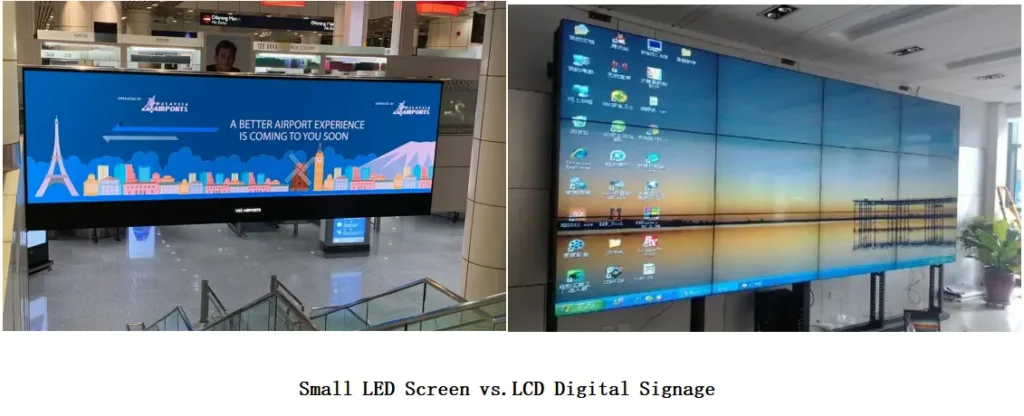
Neither technology is universally better.
The decision depends on the room, content, viewing distance, wall size, maintenance requirements, and budget.
| Factor | Direct-View LED | LCD Video Wall |
|---|---|---|
| Visible bezel | Essentially seamless display surface | Visible bezels between panels |
| Large continuous content | Strong fit | Bezel lines can interrupt content |
| Pixel pitch | Available in fine-pitch configurations | Determined by panel technology |
| Large custom walls | Highly scalable | More dependent on panel dimensions |
| Initial hardware cost | Often higher for fine-pitch systems | Often lower |
| Maintenance | Modular LED components | Panel-based replacement |
| Close viewing | Fine-pitch configurations can be suitable | Depends on panel size and pixel density |
| Power | Configuration-dependent | Configuration-dependent |
| Service access | Depends on cabinet design | Depends on mounting and panel design |
| Best choice | Large seamless visualization where justified | Smaller or cost-sensitive applications where bezels are acceptable |
When Does LED Have a Stronger Case?
LED becomes particularly compelling when the control room needs:
- A large seamless visual canvas
- Content spanning multiple information sources
- Custom wall dimensions
- Close viewing with fine-pitch requirements
- High visual continuity
- Modular serviceability
When Might LCD Make More Sense?
LCD can remain a practical choice for smaller installations where:
- Budget constraints are significant.
- Operators are relatively far from the wall.
- Content is normally divided into independent windows.
- Bezel lines do not interfere with operational tasks.
The right procurement decision should therefore compare system requirements and lifecycle cost, not just display technology names.
Which LED Specifications Matter Most in a 24/7 Control Room?
Not every specification on an LED datasheet has the same operational value.
The following deserve particular attention.
Brightness
Indoor control rooms generally do not need the extreme brightness levels associated with outdoor LED billboards.
Excessive brightness can be counterproductive in a controlled indoor environment, particularly when operators spend long periods looking at the wall.
The target should be appropriate brightness with stable image quality rather than maximum brightness.
Sostron’s current Reta 2 product information lists a calibrated brightness range of 600–800 nits. This is product-specific information, not a universal control-room requirement.
Refresh Rate
Refresh rate describes how frequently the display refreshes its image.
A sufficiently high refresh rate can help provide stable motion and reduce issues when content is captured by cameras.
For a control room, however, refresh rate should be considered together with:
- Camera systems
- Content sources
- Processing equipment
- Camera shutter settings
- Signal path
- Actual application requirements
A high refresh-rate figure alone does not guarantee better system performance.
Sostron currently lists up to 7,680 Hz refresh rate for the Reta 2 product family. Again, this should be treated as a published product specification, not a minimum industry requirement.
Color Uniformity and Calibration
A large control-room wall magnifies inconsistencies.
Small differences between cabinets can become more noticeable when a large map, camera image, or uniform background spans multiple cabinets.
Ask the supplier about:
- Factory calibration
- Cabinet-to-cabinet consistency
- Brightness uniformity
- Color calibration
- Replacement-module calibration
- Onsite commissioning
The final point matters because replacing a module should not create a visibly different patch on the wall.
Contrast and Low-Brightness Performance
Control rooms are not always operated at maximum brightness.
Night shifts, dimmed environments, and mixed lighting conditions make low-brightness image quality important.
A useful specification review should therefore consider:
- Grayscale performance
- Color consistency at lower brightness
- Black-level appearance
- Contrast
- Ambient light conditions
This is more useful to a control-room buyer than simply choosing the largest contrast-ratio number on a datasheet.
What Redundancy Does a Control Room LED Wall Need?
Redundancy should be specified at the system level.
Simply adding a second power supply does not make an entire video wall redundant.
Depending on the operational requirements, buyers may evaluate redundancy for:
- Power
- Signal paths
- Video processors
- Receiving components
- Network paths
- Critical control equipment
- Spare LED modules
Why Does Redundancy Matter?
Consider a large wall displaying operational information.
If a single electronic component fails, the buyer needs to know:
- What part of the wall is affected?
- Does the rest of the wall continue operating?
- Is there an automatic failover?
- Can the faulty component be replaced quickly?
- Is a spare available onsite?
- Does replacing it require removing surrounding cabinets?
These questions are more meaningful than simply asking whether a product is “high reliability.”
Avoid the “Zero Downtime” Trap
No display system should be assumed to have zero downtime simply because the supplier uses the word “redundant.”
Instead, request a documented failure-response architecture.
Ask:
What happens if one power supply, receiving component, processor, or LED module fails during operation?
The supplier should be able to explain the failure mode and recovery procedure.
Front Service or Rear Service: Which Is Better?
The correct maintenance method depends on the physical installation.
Front Service
Front-service cabinets allow technicians to access modules from the front of the wall.
This can be valuable when:
- The wall is mounted directly against a structural surface.
- There is limited space behind the display.
- The control room layout does not allow a rear maintenance corridor.
Rear Service
Rear access can simplify access to some system components, but it requires sufficient space behind the wall.
Before choosing the cabinet, confirm:
- Available rear clearance
- Maintenance corridor dimensions
- Module replacement method
- Power-component access
- Receiving-card access
- Cable routing
- Structural access
A cabinet that is inexpensive to purchase can become expensive to maintain if technicians cannot reach the failed component efficiently.
What Video Processing System Does a Control Room Need?
The LED wall is only the visible part of the system.
The processing architecture determines how information gets from multiple sources to the wall.
A control-room system may include:
Sources → Signal Distribution → Processing → LED Receiving System → LED Cabinets
Depending on the application, sources may include:
- Computers
- Cameras
- Video servers
- GIS systems
- Network sources
- Video conferencing
- Monitoring systems
- Other control-room workstations
Why Does Processing Matter?
Suppose a control room needs to display six camera feeds, two maps, an alarm dashboard, and a network-monitoring interface simultaneously.
The LED wall needs a system capable of receiving, processing, positioning, and switching those sources.
The buyer should therefore ask:
- How many inputs are required?
- What input formats are supported?
- How many independent windows are needed?
- Can windows be moved and resized?
- Is source switching required?
- Is KVM integration required?
- Is processor redundancy needed?
- What happens if the primary processor fails?
The LED cabinet specification alone cannot answer these questions.
How Should Control-Room Lighting and Environment Be Considered?
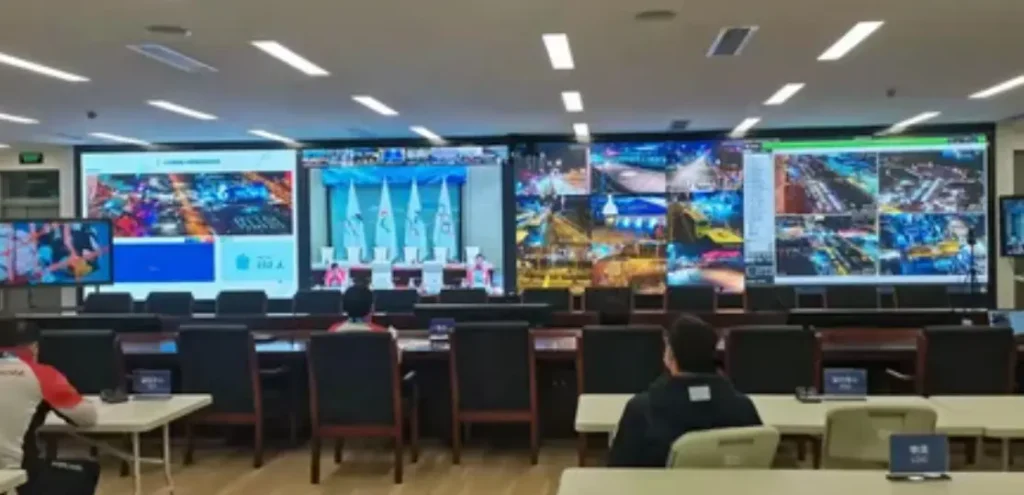
The control room itself affects display performance.
ISO 11064-6 covers environmental requirements for control centres, including thermal conditions, air quality, lighting, acoustics, vibration, and related environmental considerations. The standard remains current following its 2024 review.
This matters because the LED wall should be evaluated together with:
- Ambient lighting
- Direct sunlight
- Reflections
- HVAC performance
- Room temperature
- Airflow
- Acoustic requirements
- Operator workstation placement
Why Does Lighting Matter?
If the room is too bright, the display may require higher brightness.
If the room is dim, excessive brightness can create an uncomfortable viewing environment.
The objective is not:
maximum brightness
but:
appropriate brightness for the room and content.
How Do You Calculate the Total Cost of Ownership?
The purchase price is only one component of the financial decision.
A control-room LED wall should be evaluated over its expected operating period.
CapEx
Initial capital expenditure may include:
- LED display
- Video processor
- Signal equipment
- Mounting structure
- Power distribution
- Cabling
- Installation
- Commissioning
OpEx
Operating expenditure may include:
- Electricity
- Preventive maintenance
- Spare parts
- Replacement modules
- Technical support
- Software or control-system costs where applicable
Risk Cost
For a critical control room, also consider the financial impact of:
- Extended downtime
- Emergency service
- Delayed spare parts
- Inaccessible components
- Unsupported controllers
- Obsolete electronics
Example TCO Model
The following is an example calculation structure, not a market price:
| Cost Category | Year 0 | Annual / Recurring |
|---|---|---|
| LED display | Project quote | — |
| Processing | Project quote | — |
| Structure | Project quote | — |
| Installation | Project quote | — |
| Shipping & customs | Project-specific | — |
| Commissioning | Project-specific | — |
| Electricity | — | Based on measured/quoted consumption |
| Maintenance | — | Contract-dependent |
| Spare parts | Initial stock | Replacement-dependent |
| Service | — | Contract-dependent |
The important point is that buyers should compare suppliers using the same scope of supply.
A USD/m² comparison is not meaningful if one supplier includes installation and processing while another quotes LED cabinets only.
What Should Buyers Ask LED Video Wall Suppliers?
Before requesting final quotations, prepare a technical specification rather than simply asking:
“How much is a 40 m² LED wall?”
A stronger RFQ should specify:
Display
- Required wall dimensions
- Pixel pitch
- Viewing distance
- Brightness target
- Refresh rate
- Color and grayscale requirements
- Cabinet dimensions
- Service method
- Operating environment
Processing
- Number of sources
- Input formats
- Number of windows
- Required resolutions
- Switching requirements
- KVM requirements
- Redundancy requirements
Reliability
- 24/7 operating requirement
- Power architecture
- Signal redundancy
- Spare-parts strategy
- Failure-recovery process
Installation
- Mounting method
- Structural requirements
- Cabling
- Power distribution
- Calibration
- Commissioning
- Acceptance testing
Commercial
- Warranty
- Service scope
- Spare-parts availability
- Technical support
- Response terms
- Shipping
- Customs responsibilities
- Payment terms
This approach makes supplier comparisons much more reliable.
When Is a More Expensive Configuration Justified?
A more expensive configuration can be justified when the additional specification solves a real operational problem.
For example:
| Upgrade | May Be Justified When |
|---|---|
| Smaller pixel pitch | Operators need to read fine details from close positions |
| Higher processing capacity | Many sources must be displayed simultaneously |
| Redundant power | Operational continuity requirements justify additional resilience |
| Front service | Rear access is restricted |
| Additional spare parts | Fast recovery is operationally important |
| More advanced calibration | Large uniform content makes visual differences unacceptable |
| Higher processing redundancy | Failure of the primary processor would create significant operational risk |
The key question is:
What operational problem does the additional specification solve?
If the answer is unclear, the buyer may be paying for a specification that has little practical value.
What Is a Practical Control-Room LED Specification Checklist?
Use the following checklist before approving a purchase:
| Category | Questions to Confirm |
|---|---|
| Application | What content will be displayed? |
| Viewing distance | What is the closest operator position? |
| Pixel pitch | Is the pitch justified by viewing distance and content? |
| Wall size | What are the exact width and height requirements? |
| Brightness | Is it appropriate for the room? |
| Refresh rate | Is it suitable for camera/video content? |
| Calibration | How are replacement modules calibrated? |
| Processing | How many sources and windows are required? |
| Redundancy | Which components need failover? |
| Service | Can modules be replaced from the front? |
| Power | What are typical and maximum requirements? |
| Thermal | Can the room HVAC support the installation? |
| Structure | What mounting system is required? |
| Installation | Who supplies and installs the structure and cabling? |
| Commissioning | What tests are performed before acceptance? |
| Spares | Which components should be kept onsite? |
| Warranty | What is actually covered? |
| Service | What support is available after installation? |
| Logistics | Who handles shipping, customs and local delivery? |
| TCO | What are the expected recurring costs? |
What Sostron LED Display Could Be Considered for Control-Room Applications?
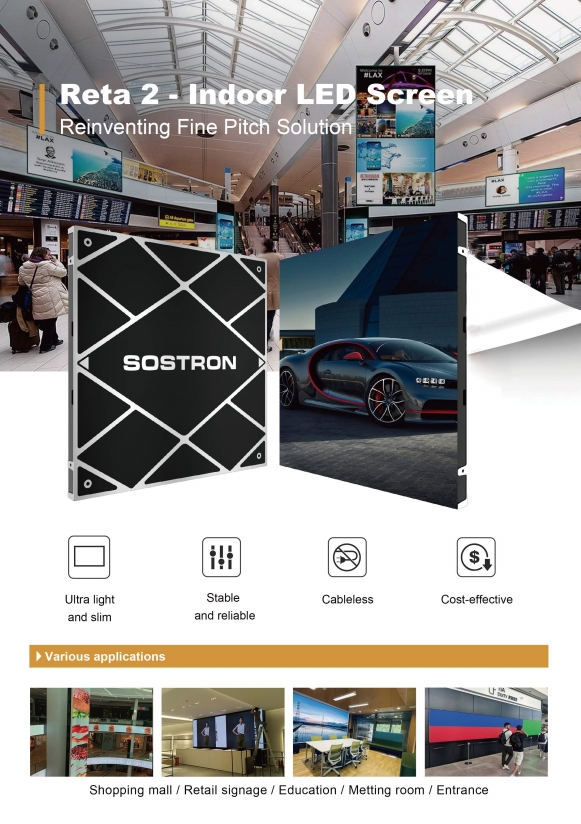
Sostron’s Reta 2 small-pitch LED display is one documented product option for indoor fine-pitch applications.
The current product page lists pixel-pitch options from P1.25 to P2.5 and describes a modular, cable-free cabinet design. Published specifications include 600–800 nits calibrated brightness and up to 7,680 Hz refresh rate.
These specifications should be treated as current Reta 2 product data, not as universal minimum requirements for every control-room project.
For a control-room project, the appropriate Reta 2 configuration should still be selected according to:
- Viewing distance
- Wall size
- Content type
- Required resolution
- Processing architecture
- Maintenance access
- Operating environment
- Project budget
Sostron also maintains an indoor LED solution section that can be used to evaluate related indoor-display configurations.
How Should Buyers Evaluate Sostron Project Experience?
Project experience is most useful when it is specific and verifiable.
Sostron publishes a case library covering LED installations across commercial, sports, entertainment, transportation and other environments.
For a control-room procurement project, however, buyers should distinguish between:
- General LED installation experience
- Indoor fine-pitch experience
- Large-format video-wall experience
- Control-room experience
- Relevant processing and integration experience
A supplier’s general LED portfolio is useful evidence of manufacturing and installation capability, but it should not automatically be treated as evidence of experience with every type of mission-critical control environment.
When evaluating a supplier, ask for relevant documentation that can be independently verified.
What Should a Control-Room LED Acceptance Test Include?
A strong commissioning process should test more than whether the wall turns on.
Depending on the project specification, acceptance testing can include:
Visual
- Pixel uniformity
- Color consistency
- Brightness consistency
- Dead or abnormal pixels
- Cabinet alignment
- Seam appearance
Signal
- All specified input sources
- Resolution handling
- Window switching
- Source routing
- Processor behavior
Reliability
- Power redundancy
- Failover functions
- Module replacement procedure
- Controller recovery
Installation
- Mechanical stability
- Cable management
- Power distribution
- Grounding and safety requirements
Operational
- Control interface
- User workflow
- Source switching
- Preset configurations
- Operator training
The final acceptance criteria should be agreed in the contract before installation begins.
FAQ: LED Video Wall Control Rooms
How much does an LED video wall for a control room cost?
There is no universal price because control-room LED projects vary in pixel pitch, wall area, processing, structure, installation, logistics, redundancy and service scope. A reliable budget should therefore use a complete project quotation rather than a generic USD/m² figure. If a supplier provides a benchmark price, confirm whether it is an estimate, hardware-only price, or complete installed-system price.
What pixel pitch is best for a control room?
The best pixel pitch depends primarily on the closest operator viewing distance, smallest important content, wall dimensions and source resolution. Fine-pitch configurations such as P1.25–P1.9 may be relevant to close-viewing applications, but a smaller pitch is not automatically better. Sostron’s current Reta 2 range covers P1.25 to P2.5, allowing the configuration to be matched to the application.
Is LED better than LCD for a control room?
Neither technology is universally better. Direct-view LED provides a seamless large-format surface and can be advantageous where content spans a large wall or where bezel lines would interfere with viewing. LCD can remain suitable for smaller or more cost-sensitive installations. The decision should consider viewing distance, content, wall size, maintenance, processing and total cost.
Can an LED video wall run 24/7?
LED systems can be designed for continuous operation, but 24/7 suitability depends on the specific product, thermal design, power architecture, operating environment, maintenance plan and control system. Buyers should verify the manufacturer’s published operating specifications rather than assuming every indoor LED product is suitable for continuous critical operation.
Does a control-room LED wall need redundant power?
Not every project requires the same redundancy level. However, if continued operation is important, buyers should evaluate power redundancy alongside signal, processor and spare-component strategies. The supplier should explain exactly what happens when a power component fails and whether the remaining system continues operating.
Is front maintenance important for a control-room LED wall?
It can be extremely important when the LED wall is mounted against a wall or other structure with limited rear access. Front-service modules can allow technicians to replace components from the display side. Before purchasing, confirm the actual maintenance method and required clearance.
What video processor does a control-room LED wall need?
The processor should be selected according to the number of sources, required resolutions, window layouts, switching requirements, signal types and redundancy architecture. There is no single processor specification suitable for every control room. The processor and LED wall should be designed as one system.
What hidden costs should buyers include?
Beyond the LED cabinets, consider video processing, mounting structure, power distribution, cabling, installation, shipping, customs, commissioning, spare parts, maintenance and service. Software or content-control equipment may also apply depending on the system architecture.
Should I choose the smallest pixel pitch available?
Not necessarily. Smaller pixel pitch can improve close-viewing detail but generally increases pixel density and may increase project cost. If operators are far from the wall or primarily view large graphics and video feeds, an unnecessarily fine pitch may provide limited practical benefit.
What should I ask an LED video wall supplier before ordering?
Ask for a complete technical and commercial scope covering pixel pitch, viewing distance, brightness, refresh rate, calibration, processing, redundancy, service access, power consumption, installation, commissioning, spare parts, warranty, technical support, shipping and customs responsibilities.
Final Buying Advice
The right LED video wall for a control room should not be selected by comparing pixel pitch or price per square meter alone.
A better procurement sequence is:
Define the operational task → measure viewing distances → identify the smallest critical content → select pixel pitch → size the wall → specify brightness and image performance → design processing → define redundancy → plan maintenance → calculate TCO → compare complete supplier quotations.
This approach helps prevent two common purchasing mistakes:
Over-specification: paying for extremely fine pixel pitch, processing capacity or redundancy that the application does not require.
Under-specification: saving on the initial quotation while creating future problems with service access, processing capacity, spare parts, calibration or system reliability.
For control-room projects, the cheapest LED wall is not necessarily the lowest-cost system over its operating life. Conversely, the most technically advanced configuration is not automatically the best investment. The useful question is whether each specification solves a real operational requirement.
Sostron develops and manufactures LED display products for indoor and outdoor applications and provides engineering support, customized display solutions, installation guidance and after-sales technical support. Its current product portfolio includes small-pitch indoor LED products such as Reta 2, while its published case library documents LED installations across multiple application environments.
For a control-room project, the most useful next step is to provide the supplier with the wall dimensions, nearest viewing distance, content types, required operating schedule, source count, maintenance access and project location. Those inputs allow the display, processing architecture and total project scope to be specified around the actual operational requirement rather than around a generic LED price.
Price note: Control-room LED video wall pricing is project-specific. Any price shown by a supplier should be checked to determine whether it is a hardware estimate, industry benchmark, or complete project quotation. Installation, structure, processing, shipping, customs, commissioning, spare parts and service can materially change the final project cost.
References:
- ISO 11064-5:2008 — Ergonomic design of control centres — Part 5: Displays and controls. The standard remains current following its 2022 review and provides requirements and recommendations for displays, controls and their interaction in control-centre hardware and software.
- ISO 11064-6:2005 — Ergonomic design of control centres — Part 6: Environmental requirements for control centres. The standard was reviewed and confirmed in 2024 and addresses thermal environment, air quality, lighting, acoustics, vibration and related environmental considerations.
- Sostron Reta 2 — current published product information for the small-pitch indoor LED display.