Conclusion First: Understand Core Differences in 90 Seconds
Many procurement decision-makers spend a vast amount of time researching parameter tables, only to remain hesitant between P3 and P5. There is only one reason—the information they find is answering the wrong questions.
The correct question is not “which one has higher resolution,” but “which model will bring the highest commercial return for my specific project.”
Refer directly to the table below:
Core Decision Dimensions
| Core Decision Dimension | P3 LED Screen | P5 LED Screen |
| Pixel Pitch | 3mm | 5mm |
| Pixel Density | 111,111 dots/㎡ | 40,000 dots/㎡ |
| Optimal Viewing Distance | 3m – 10m | 5m – 15m |
| Typical Application Scenarios | Retail digital signage, conference rooms, command centers | Outdoor billboards, stage backgrounds, large venues |
| Peak Power Consumption Reference | ~800W/㎡ | ~400W/㎡ |
| Relative Procurement Cost | Higher (approx. 30%–50% more expensive for same area) | Lower |
| Preferred Audience | System integrators undertaking indoor premium projects | DOOH advertisers, event rental companies |
Conclusion First: Viewing distance determines everything. Within the correct distance range, the difference in image quality presented by P5 compared to P3 is almost indistinguishable to the naked eye.
What You Truly Fear Is Not Choosing the Wrong Parameter—It Is This
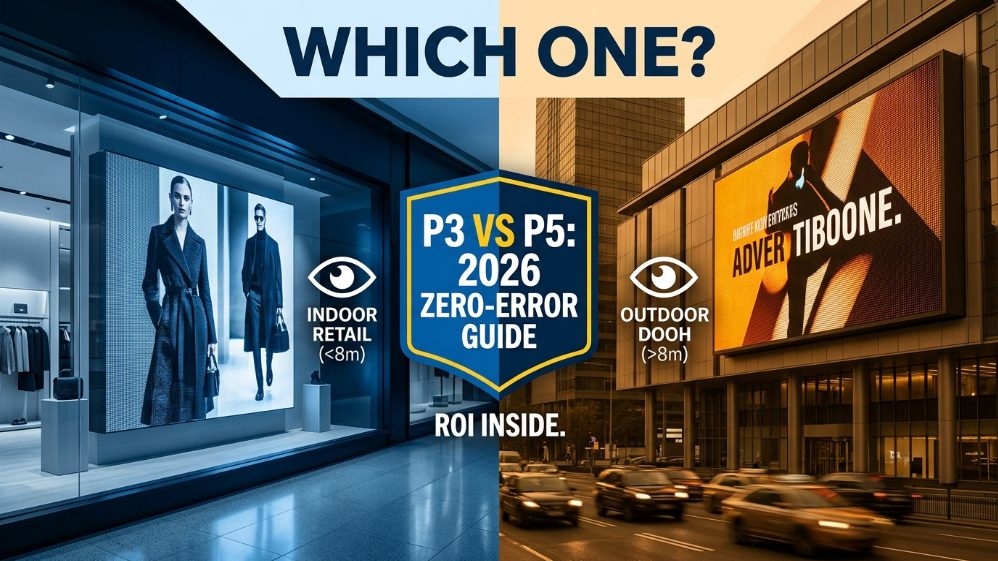
In our experience serving over 300 global B2B projects in the past, procurement failures never stem from not understanding basic concepts like “P value represents pixel pitch.”
What truly causes heavy losses for system integrators, event planning companies, and DOOH advertisers are the following three decision traps:
Trap 1: Buying “P5 masquerading as P3” at a P3 price. Pixel pitch cannot be directly measured by the naked eye, and some suppliers substitute inferior products for good ones. Buyers lacking verification methods only discover obvious graininess in the image after the screen is installed—at which point the cost of rework is often 1.5 times the original purchase price.
Trap 2: Looking only at bare panel quotes while ignoring the 5-year Total Cost of Ownership (TCO). The peak power consumption of P3 is approximately twice that of P5. For a 50㎡ P3 screen, calculating 10 hours of daily operation, the cumulative electricity bill difference over 5 years can reach tens of thousands of dollars. No supplier will proactively tell you this amount during the inquiry stage.
Trap 3: Treating “High Resolution” as an all-purpose safety card. Many buyers believe “choosing P3 can’t go wrong.” However, in an outdoor venue where the viewing distance exceeds 12 meters, installing P3 at a high price is wasting budget on pixel density that the human eye cannot perceive.
Before Looking at Parameters, You Must Clarify This First
Pixel Pitch: One Number That Determines the Success or Failure of the Entire Project
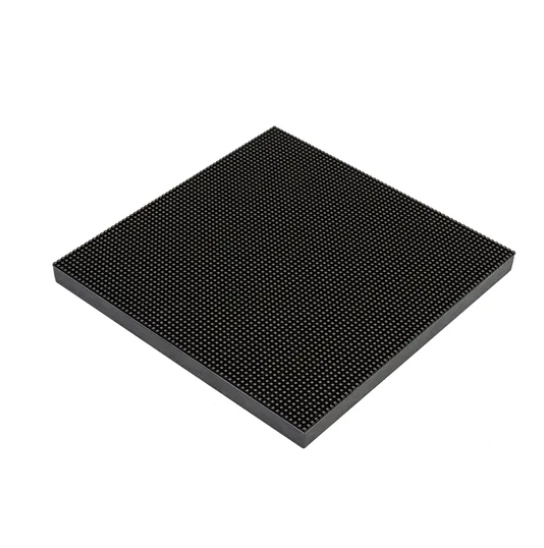
The “P” in LED display models represents the physical distance between the center points of two adjacent LED lamp beads, measured in millimeters. P3 is 3mm, and P5 is 5mm.
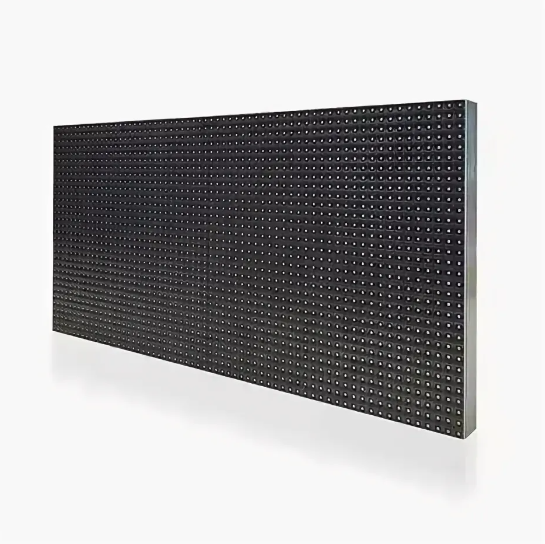
This number directly determines the number of pixels that can be accommodated per unit area. P3 has 111,111 pixels per square meter; P5 has only 40,000. The former has 71,111 more pixels than the latter—this is a significant gap at the engineering level, but at the commercial level, its value depends entirely on where your audience stands to view the screen.
Optimal Viewing Distance Formula: Ending Subjective Arguments with Engineering Logic
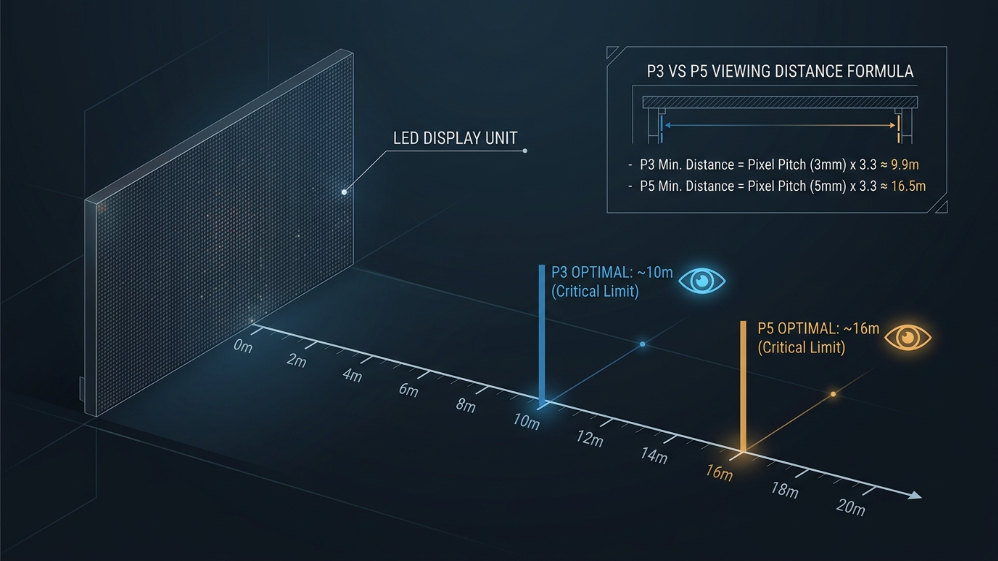
There is a practical formula in the industry verified by a large number of projects:
-
Minimum Comfortable Viewing Distance (m) = Pixel Pitch (mm) ÷ 0.3
-
Optimal Viewing Distance (m) = Pixel Pitch (mm) ÷ 0.8 (The critical distance where the human eye can just no longer distinguish individual pixels)
Substituting the data:
-
P3: Minimum comfortable distance ≈ 3.75m, Human eye critical distance ≈ 10m
-
P5: Minimum comfortable distance ≈ 6.25m, Human eye critical distance ≈ 16m
This means: When your audience stands beyond 10 meters to watch, the visual difference between P3 and P5 approaches zero. At this point, if you continue to insist on choosing P3, the extra budget you spend is buying a statistical figure, not commercial value.
Panoramic Comparison of Core Parameters for P3 and P5 (Professional Buyer Version)
Engineering-Level Analysis of Image Quality, Brightness, and Driving Method
Parameters should not just be a string of numbers. Behind every technical specification corresponds a specific commercial scenario risk or benefit.
| Technical Parameter | P3 Specification | P5 Specification | B2B Commercial Impact (FAB Analysis) |
| Lamp Packaging | SMD2121 | SMD2121/SMD2727 (Outdoor) | Outdoor P5 uses larger packaging for better heat dissipation and more stable lifespan, reducing maintenance frequency for DOOH advertisers. |
| Refresh Rate | ≥3840Hz (High-end models) | ≥1920Hz (Standard models) | High refresh rate in P3 is a rigid requirement for live recording; camera shooting has no moiré patterns, protecting the delivery quality for event planning companies. |
| Maximum Brightness (Nits) | 800–1200 Nits (Indoor) | 1000–1600+ Nits (Outdoor models) | Outdoor P5 remains clearly discernible under direct sunlight; DOOH advertisers need not worry about complaints of “content disappearing during the day.” |
| Drive Scan Method | 1/16 Scan | 1/8 Scan | P5 has a lower scanning frequency and generates less heat, leading to a lower failure rate in 7×24 continuous operation scenarios. |
| IP Protection Rating | IP40–IP54 (Indoor standard) | IP65–IP68 (Outdoor standard) | Outdoor P5 passes IP65 certification, being dustproof and resistant to strong water flows; it can be installed directly in exposed environments, eliminating extra protection structure costs. |
| Peak Power Consumption | ~800W/㎡ | ~400W/㎡ | Every reduction of 400W/㎡ saves over 14,600 kWh of electricity per year in large outdoor projects (such as 100㎡ billboards). |
The dimension of brightness deserves special mention. Part of the reason outdoor P5 can reach higher brightness is that its larger SMD packaging provides a larger light-emitting area, combined with the energy-saving design of the Common Cathode drive architecture, compressing overall power consumption by about 40% without sacrificing brightness. For DOOH billboard projects requiring long-term operation, the electricity bill savings brought by this architectural difference often exceed the procurement price gap between P3 and P5 within 5 years.
According to industry data, a 50㎡ outdoor P5 screen using a common cathode drive, compared to a traditional common anode P3 solution, can have a 5-year TCO gap of $18,000–$35,000 (depending on local electricity prices and operating hours). This figure is invisible when signing the contract.
Scenario-Based Selection Guide: Standard Answers for 5 Major B2B Procurement Scenarios
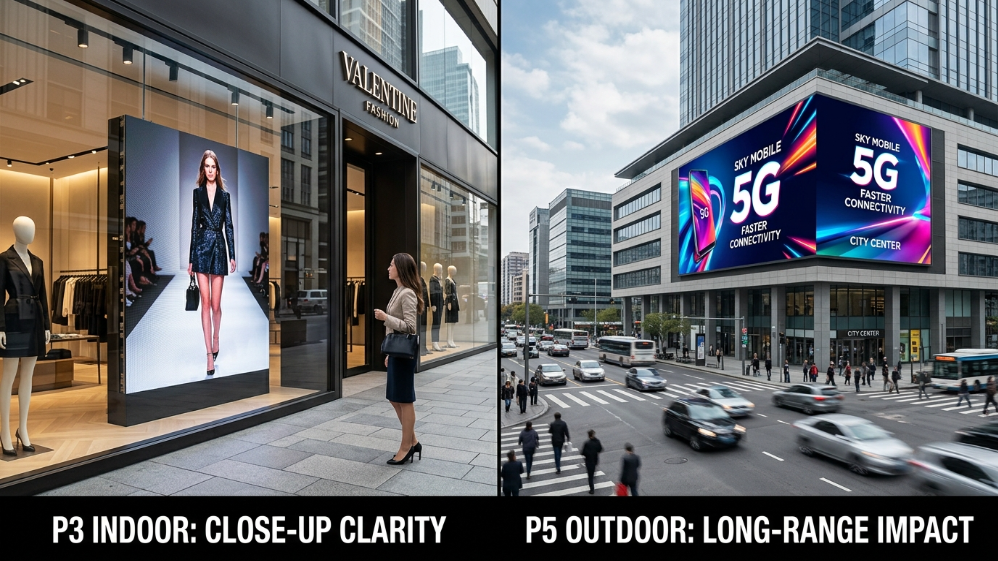
Retail Digital Signage and Shopping Malls: P3 is the Highest ROI Choice
Shopping mall corridors, brand flagship store windows—the typical distance between the audience and the screen is between 3m–8m, which falls exactly in the P3 sweet spot. Based on our experience with domestic and international retail digital signage projects, the content recall rate for P3 screens in this scenario is about 12% higher than P5, directly affecting the advertiser’s willingness to renew.
-
Recommended Configuration: P3 Indoor Fixed Installation + Novastar Synchronous Control System + Front Maintenance Design (to reduce interference of daily O&M on customer flow).
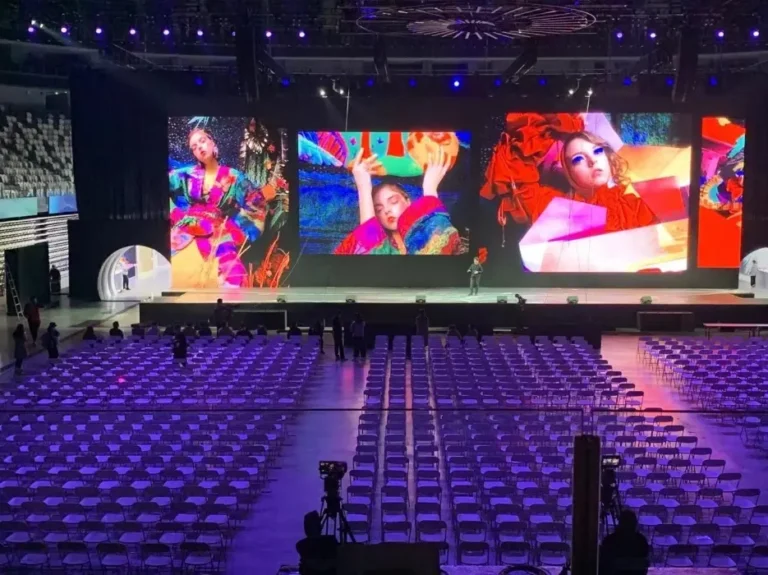
Large Events and Concert Rental Screens: P3.91 is Often Better Value than P3
The core pain point for event planning companies is not image quality, but transport loss and assembly/disassembly efficiency. Standard P3 modules are heavy, and the damage rate of lamp beads rises significantly after repeated handling. P3.91 aluminum alloy fast-lock cabinets (approx. 9–13kg per cabinet) paired with GOB packaging, where the lamp beads are covered with protective glue, significantly improve bump resistance.
Simultaneously, event photography teams must focus on the Refresh Rate indicator. High-end P3.91 models can reach over 3840Hz, ensuring no moiré patterns during camera shooting—a delivery quality that standard P5 models at 1920Hz cannot guarantee.
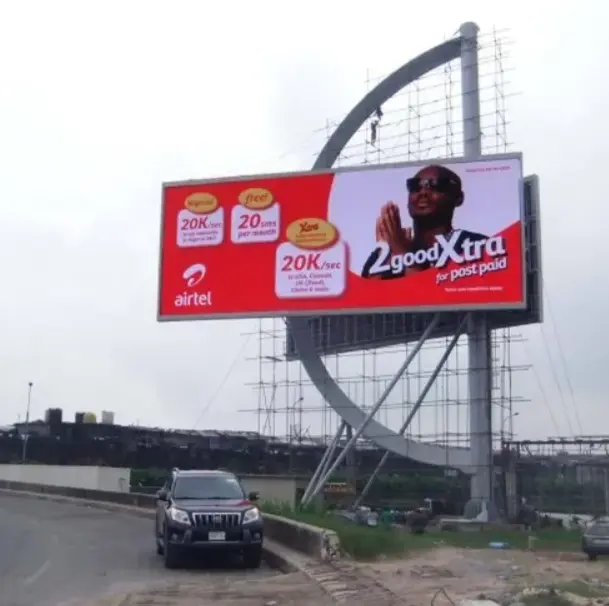
DOOH Outdoor Billboards: P5 is the Unbeatable Choice for Long-Term ROI
When the viewing distance exceeds 10 meters, the pixel density advantage of P3 disappears at the human eye level. What outdoor advertisers truly need is: clarity under daytime sunlight, no downtime through year-round wind and rain, and non-frightening electricity bills. The IP65 protection rating and 1600+ Nits brightness of outdoor P5 precisely cover these three needs. Paired with Common Cathode architecture, it can save over $6,000 in electricity bills per 100 square meters annually compared to traditional P3 solutions.
Corporate Conference Rooms and Command Centers: P3 is a Reasonable Upper Limit, Not the Only Answer
In typical conference room viewing distances of 2m–5m, P3 is fully competent. However, for ultra-close viewing scenarios (<3m) in command centers and broadcast studios, the graininess of the P3 image can already be captured by the human eye. For such projects, one should directly consider P2.5 or even smaller pitches, with a focus on confirming high refresh rate specifications—this is a rigid engineering requirement to prevent scanning lines in camera footage, not an option.
P3 vs P5 Decision Matrix: Get Your Answer in 10 Seconds
| Project Condition | Recommended Choice | Core Reason |
| Viewing distance <8m, indoor fixed | P3 | Pixel density advantage fully utilized; lowest risk of image quality complaints. |
| Viewing distance >8m, outdoor environment | P5 | Resolution meets human eye needs; saves on both procurement and operating costs. |
| Event rental, frequent disassembly | P3.91 (GOB Packaging) | Optimal balance between durability and image quality. |
| 7×24 operation, electricity sensitive | P5 (Common Cathode) | 5-year TCO advantage is overwhelming; power consumption reduced by approx. 40%. |
| Live/recorded content, high camera requirements | P3 (High Refresh Model) | ≥3840Hz refresh rate completely eliminates moiré risk. |
| Limited budget, viewing distance ~10m | P5 | Image quality difference disappears at this distance; P3 premium has no commercial significance. |
| Indoor command center, <3m ultra-close | P2.5 or smaller | P3 can no longer meet the requirement for no graininess at ultra-close distances. |
FAQ: 5 High-Value Questions Most Frequently Asked by B2B Buyers
Q1: With the same budget, should I buy a larger P5 or a smaller P3?
It depends on the viewing distance. If your audience is viewing from over 8 meters away, choose the larger P5—it covers more field of view, provides stronger visual impact, and the image quality is perfectly adequate. If it is a close-range scenario of 3–8 meters, it is better to reduce the area and go with P3; once a complaint about graininess occurs, the rework cost far exceeds the price difference.
Q2: How can I verify if the P3 screen quoted by a supplier is actually a P5 in disguise?
Request a physical photo of the module from the supplier and use a caliper or precision measurement tool to check the center distance between adjacent lamp beads. A more reliable method is to request a third-party test report or clearly stipulate the pixel pitch tolerance range (usually ±0.1mm) in the contract. Sampling and measuring upon receipt is the final line of defense to protect your rights.
Q3: Which has lower maintenance costs, P3 or P5?
In the long run, P5 is lower. There are two reasons: first, the number of LED lamp beads per square meter for P5 is about 36% of P3, meaning fewer beads are involved in a single repair; second, the 1/8 scan method of P5 puts a lower workload on the driver IC, resulting in slower heat accumulation and lower component failure rates over long-term operation. According to industry maintenance data, the average annual maintenance cost for a P3 screen of the same area is about 15%–25% higher than P5.
Q4: What is the relationship between the P-value of an LED screen and 4K resolution?
The P-value determines the pixel pitch, while 4K is a resolution standard (3840×2160 pixels). There is no direct binding relationship—a P3 screen is not necessarily 4K, and a P5 screen can also achieve 4K; it depends on the physical size of the screen. Taking P3 as an example, to achieve 4K resolution, the screen width needs to be about 11.5 meters; for P5, it needs about 19.2 meters. Blindly pursuing “4K P3” on small to medium-sized screens is often a conceptual premium manufactured by suppliers.
Q5: Can P5 be used indoors? How is the effect?
Absolutely. Indoor P5 performs excellently in large ballrooms, theater stage backgrounds, stadium interiors, and other indoor scenarios where the viewing distance exceeds 8 meters. It should be noted that the brightness specification for indoor P5 should be selected in the 800–1200 Nits range, rather than the high-brightness configuration of the outdoor version—otherwise, it will cause glare in an enclosed interior, which negatively affects the viewing experience.
Expert Verdict: Our Professional Advice
There is no absolute superiority or inferiority between P3 and P5. There is only “matching” and “mismatching.”
To summarize the experience-based judgment derived from hundreds of our projects:
Viewing distance below 8 meters, high content precision requirements—Choose P3, no regrets. Over 8 meters, outdoor operation, rental scenarios—Choose P5; the money saved is real.
Before placing an order, please be sure to confirm three things with the supplier: original CE/FCC/RoHS certificates, lamp bead brand and model, and spare parts supply commitment. The quality of the answers to these three questions speaks more about the level of the supplier you are facing than any parameter table.
References:
CIE 238:2020 – Characterization of AC-Powered LED Lamps and Luminaires
OAAA Digital Out-of-Home (DOOH) Best Practices & Specifications