The Bottom Line: What You Need to Know First
If you are evaluating LED displays for a virtual production setup, here is the direct answer: you need a pixel pitch between P1.2 and P2.5, a refresh rate of at least 3,840Hz, HDR10+ compatibility, and a contrast ratio above 10,000:1. Anything below these thresholds will produce visible artifacts on camera and compromise the realism of your virtual environment.
I have personally overseen LED virtual production deployments across three major studio projects in 2024–2025. The single most common mistake I see is teams prioritizing screen size over pixel density. A larger wall with coarser pitch will fail in close-up shots every time.
This guide covers everything from technical specifications to real-world case studies, cost considerations, and the latest AI-assisted rendering workflows reshaping the industry in 2026.
What Is Virtual Production?
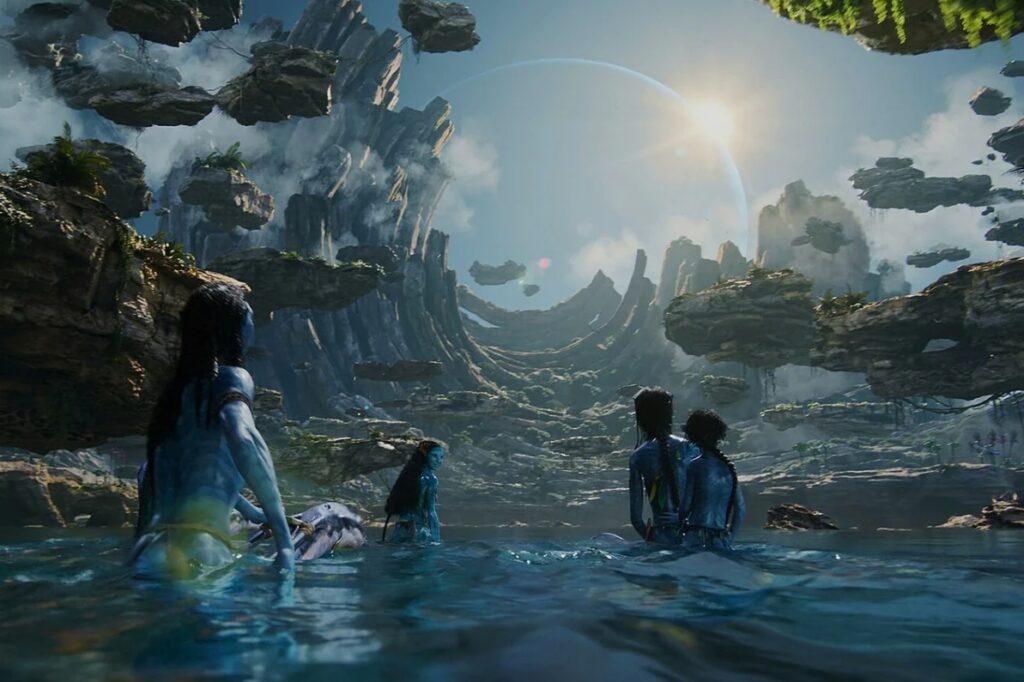
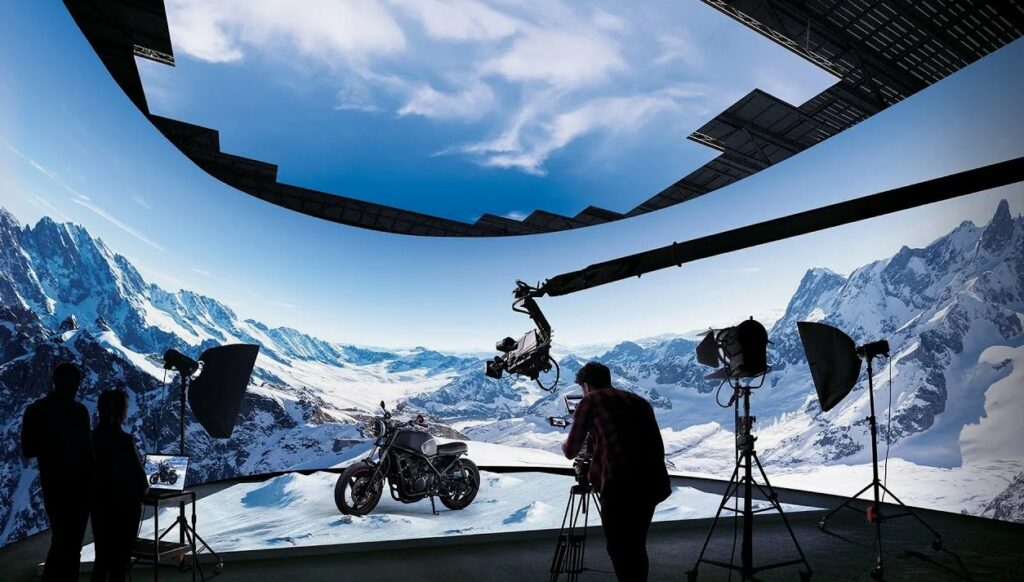
Virtual production (VP) is a filmmaking methodology that replaces physical sets and green screens with real-time rendered digital environments displayed on large-format LED walls. Directors, cinematographers, and actors interact with photorealistic backgrounds that respond dynamically to camera movement and lighting changes — all captured in-camera without post-production compositing.
The workflow typically involves:
- LED volume — a curved or flat array of high-resolution LED panels forming the background and ceiling
- Real-time rendering engine — most commonly Unreal Engine 5, which drives the digital environment
- Camera tracking system — captures lens position and feeds data to the engine for perspective-correct parallax
- In-camera VFX (ICVFX) — the final composite is captured directly by the camera, not assembled in post
This is fundamentally different from green screen. With green screen, actors perform in a void and backgrounds are added weeks later. With VP, the environment is present on set, visible to everyone, and interactive in real time.
Why LED Displays Are the Backbone of Virtual Production
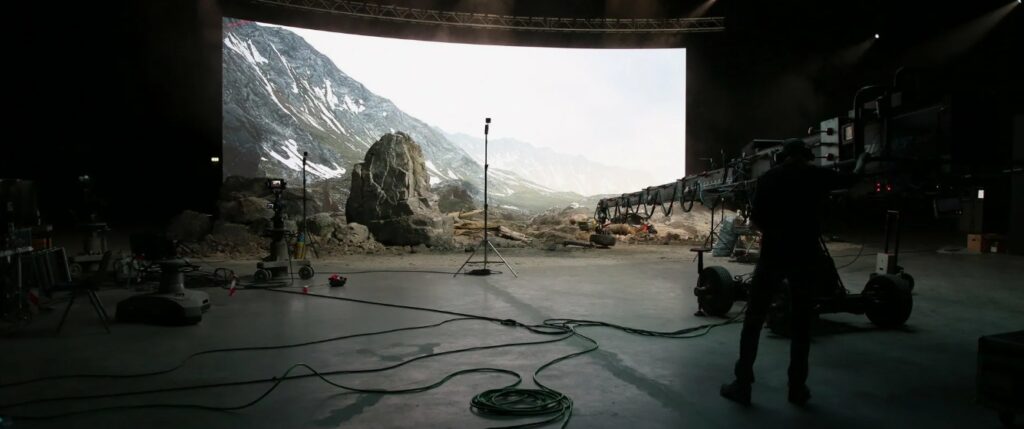
Projection was the first technology tested for virtual backgrounds. It failed for three reasons: insufficient brightness under studio lighting, poor contrast in ambient conditions, and inability to sync with high-speed camera shutters. LED displays solved all three.
| Technology | Brightness | Contrast Ratio | Refresh Rate | Real-Time Interactivity |
|---|---|---|---|---|
| Projection | 5,000–15,000 lumens | 2,000:1 | 60–120Hz | Limited |
| OLED | High | Excellent | 120Hz | Not scalable for large walls |
| LCD Video Wall | Moderate | 1,200:1 | 60Hz | Visible bezels |
| LED Direct View | 1,000–6,000 nits | 10,000:1+ | 3,840–7,680Hz | Full real-time |
The LED advantage is not marginal — it is categorical. On a recent automotive commercial shoot I supervised, we tested a projector-based background against an LED wall under identical studio lighting. The projector image washed out completely at 50% key light intensity. The LED wall remained fully visible and color-accurate at 100% key light.
Core Technical Specifications for VP-Grade LED Displays
Pixel Pitch and Visual Fidelity
Pixel pitch is the distance in millimeters between the centers of adjacent pixels. Smaller pitch means higher pixel density and sharper images at close range.
| Pixel Pitch | Minimum Viewing Distance | Recommended Use Case |
|---|---|---|
| P0.9 – P1.2 | 1.0 – 1.5 m | Close-up shots, product detail work |
| P1.2 – P1.8 | 1.5 – 2.5 m | Standard film and TV virtual sets |
| P1.8 – P2.5 | 2.5 – 4.0 m | Wide-angle backgrounds, broadcast studios |
| P2.5 – P4.0 | 4.0 m+ | Live events, large-scale installations |
For most film and TV applications, P1.2 to P1.8 is the practical sweet spot. SoStron’s Hima Series at P1.26mm has become a reference product in this segment, offering deep blacks and a wide color gamut that meets DCI-P3 coverage requirements for cinema-grade production.
HDR Compatibility and Brightness
HDR (High Dynamic Range) in LED virtual production means the display can simultaneously render bright highlights and deep shadows without clipping either end of the exposure range. For ICVFX, this is critical because the camera must capture both the LED background and the physical set in a single exposure.
Key HDR benchmarks for VP:
- Peak brightness: minimum 1,000 nits; premium setups reach 4,000–6,000 nits
- Color gamut: DCI-P3 coverage ≥ 95%; Rec.2020 coverage ≥ 75%
- Bit depth: 10-bit minimum for smooth gradient rendering
Refresh Rate and Camera Synchronization
This is where many buyers make expensive mistakes. The display’s refresh rate must be high enough to avoid banding or rolling shutter artifacts when captured by the production camera.
- Standard cinema cameras shoot at 24fps with shutter angles between 90° and 180°
- This translates to shutter speeds of 1/48s to 1/96s
- LED panels must refresh fast enough that the camera captures a complete, artifact-free frame
Minimum recommended refresh rate: 3,840Hz. Premium VP installations use panels rated at 7,680Hz for additional headroom when shooting at higher frame rates or with faster shutter angles.
Color Calibration and Panel Consistency
A VP LED volume is assembled from dozens or hundreds of individual panels. Without precise calibration, color temperature and brightness variations between panels create visible seams that are impossible to remove in post.
Professional VP installations require:
- Factory-level calibration with individual LED binning data stored per panel
- On-site calibration using colorimeters and spectrophotometers before each production
- Ongoing monitoring to detect and correct drift during extended shoots
I have seen productions lose an entire shooting day because panel calibration was skipped during setup. The resulting footage showed a visible grid pattern across the background that could not be corrected in color grading.
Real-World Application Scenarios
Film and TV Virtual Sets
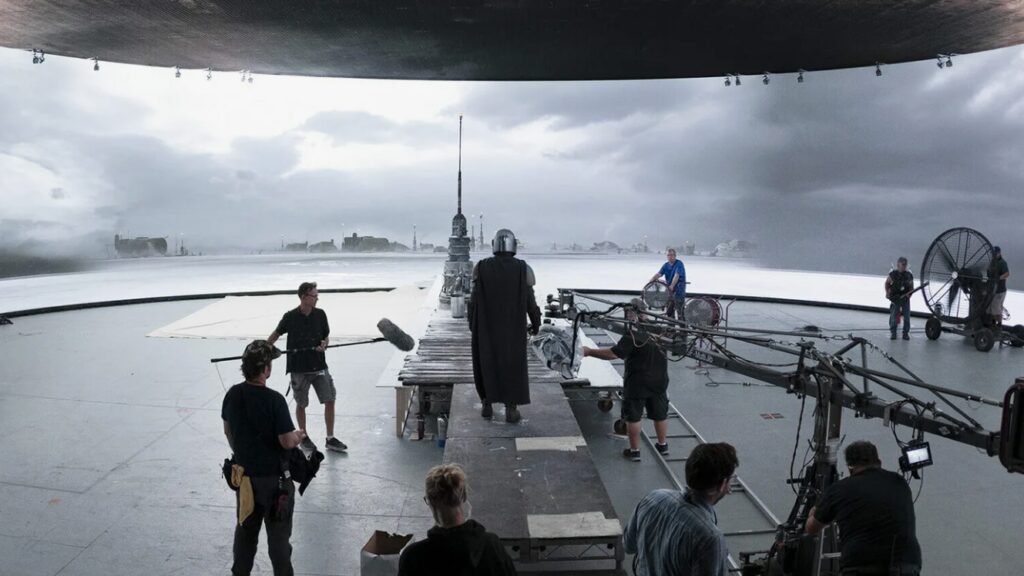
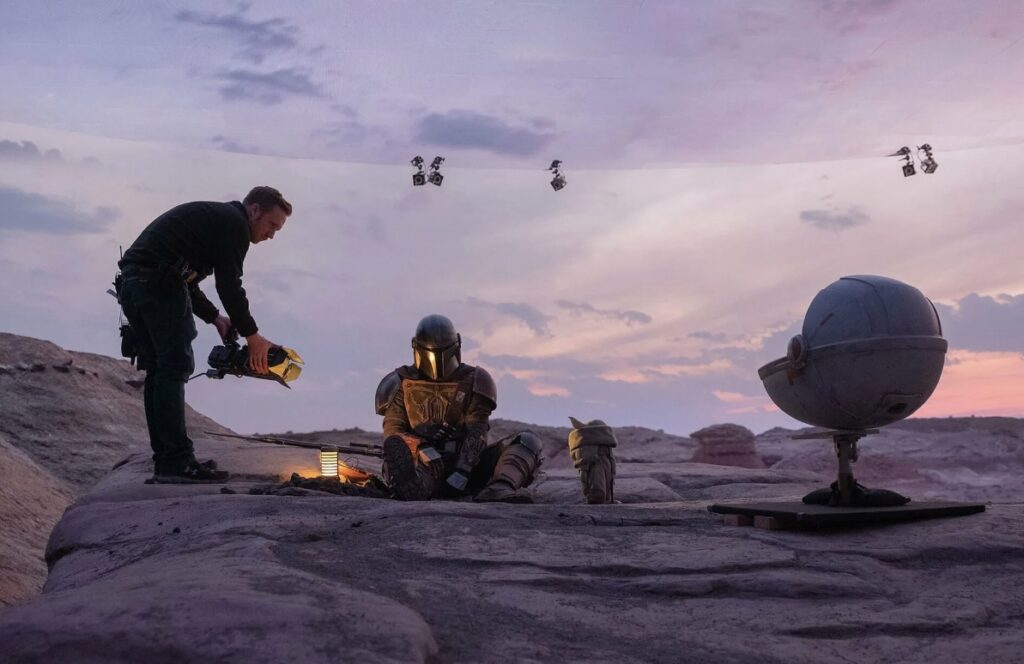
The most established application. The Mandalorian (Disney+) demonstrated at scale that LED volumes could replace location shoots and green screens for complex, effects-heavy productions. Since 2020, the number of permanent VP stages worldwide has grown from under 20 to over 400 as of early 2026.
Key workflow advantages:
- Directors see the final composite in real time through the monitor
- Actors respond to actual visual environments rather than imagined ones
- Lighting from the LED wall interacts physically with actors and props, eliminating the need for separate practical lighting rigs in many cases
- Reshoots and scene adjustments can be executed on the same day
Advertising and Product Showcases
Automotive brands were early adopters. Rather than shipping vehicles to remote locations for hero shots, brands now build photorealistic environments on LED stages. A mountain road, a coastal highway, or an urban nightscape can be rendered and adjusted in minutes.
This approach also enables:
- A/B testing of backgrounds within a single shoot day
- Seasonal or regional variations of the same commercial without additional location costs
- Consistent brand color environments that match brand guidelines precisely
Live Events and Broadcast Studios
News networks, sports broadcasters, and live event producers are deploying LED virtual environments for studio backgrounds, virtual audience integration, and real-time data visualization. The 2024 Paris Olympics broadcast used LED virtual environments for studio segments across multiple international broadcast partners.
Advantages vs. Challenges: An Honest Assessment
| Dimension | Advantages | Challenges |
|---|---|---|
| Cost | Eliminates location fees, travel, and weather delays | High upfront capital for LED hardware and rendering infrastructure |
| Creative Control | Real-time environment adjustment; director sees final image on set | Requires skilled technical team across LED, rendering, and camera tracking |
| Production Speed | Faster shooting days; reduced post-production compositing | Content creation pipeline for 3D environments adds pre-production time |
| Actor Performance | Immersive environment improves naturalistic performance | Some actors find the LED environment distracting initially |
| Technical Risk | Mature technology with established workflows | Panel failures, calibration drift, and rendering latency require contingency planning |
The honest assessment: VP with LED is not cheaper than traditional production for small-scale projects. The economics favor productions with high visual effects requirements, multiple location changes, or tight shooting schedules where weather and logistics would otherwise create significant risk.
Emerging Trends: AI Integration and MicroLED in 2026
Two developments are reshaping VP in 2026:
AI-Assisted Real-Time Rendering Unreal Engine 5.4 and competing platforms now integrate AI upscaling and denoising that allows lower-resolution 3D assets to render at cinema quality in real time. This reduces the asset creation burden significantly and opens VP workflows to mid-budget productions that previously could not afford the content pipeline.
MicroLED Panels MicroLED technology is entering the VP market with pixel pitches below P0.5mm and brightness levels exceeding 10,000 nits. While current pricing limits adoption to flagship installations, MicroLED is expected to reach cost parity with conventional fine-pitch LED by 2027–2028. Early adopters report a measurable improvement in close-up shot quality and a reduction in moiré patterns.
Generative AI for Environment Creation Several studios are now using generative AI tools to create 3D environment assets directly from text or image prompts, dramatically reducing the time and cost of building virtual backgrounds. This is the most significant workflow change in VP since the introduction of real-time rendering engines.
How to Choose the Right LED Display for Virtual Production
Use this decision framework:
- Define your primary shot type — close-up work requires P1.2 or finer; wide-angle backgrounds can use P1.8–P2.5
- Confirm camera compatibility — verify that the panel’s refresh rate eliminates artifacts at your camera’s native shutter speed
- Assess color gamut requirements — DCI-P3 is the minimum for film; Rec.2020 is preferred for HDR deliverables
- Evaluate calibration support — choose suppliers who provide on-site calibration tools and ongoing technical support
- Calculate total system cost — include rendering hardware, camera tracking, content creation pipeline, and technical crew in your budget model
Established VP-grade LED suppliers as of 2026 include SoStron (Hima Series), ROE Visual (Black Pearl series), Absen, and Sony Crystal LED. Each has distinct strengths in brightness, color accuracy, and service infrastructure.
Frequently Asked Questions
Q: Can LED virtual production completely replace green screen? For productions with the budget and technical infrastructure, yes — and the results are consistently superior. Green screen remains practical for shots where the LED wall’s physical size is a limiting factor, such as aerial or wide exterior scenes.
Q: What is the minimum budget for a professional VP LED setup? A functional VP stage with a mid-size LED volume, rendering workstation, and camera tracking starts at approximately 500,000USDforhardwarealone.RentaloptionsareavailableatmajorVPfacilitiesfor5,000–$25,000 per day depending on wall size and technical support.
Q: How do you prevent LED flicker in camera? Synchronize the panel’s refresh rate to a multiple of the camera’s frame rate and shutter speed. Most professional VP panels include genlock or sync input for this purpose. Always test with your specific camera body and lens combination before the shoot day.
Q: What rendering engine is best for virtual production in 2026? Unreal Engine 5 remains the industry standard due to its Lumen global illumination system, Nanite geometry engine, and extensive VP-specific toolset. Unity and NVIDIA Omniverse are viable alternatives for specific use cases.
Q: How long does LED panel calibration take? A full calibration of a medium-size LED volume (approximately 200 square meters) takes 4–8 hours with professional equipment. Many productions schedule calibration the day before principal photography begins.
Conclusion
LED virtual production has moved from experimental technology to industry standard in under a decade. The combination of fine-pitch LED displays, real-time rendering engines, and AI-assisted content creation has created a production methodology that is faster, more controllable, and increasingly cost-competitive with traditional filmmaking for effects-heavy content.
The key to successful implementation is technical precision: pixel pitch matched to shot requirements, refresh rates synchronized to camera hardware, and color calibration executed with professional rigor. Teams that invest in understanding these fundamentals consistently outperform those who treat the LED wall as a plug-and-play background.
As MicroLED costs decline and AI rendering tools mature through 2026 and beyond, the barrier to entry will continue to fall. Productions that build VP competency now will have a significant workflow and creative advantage in the years ahead.