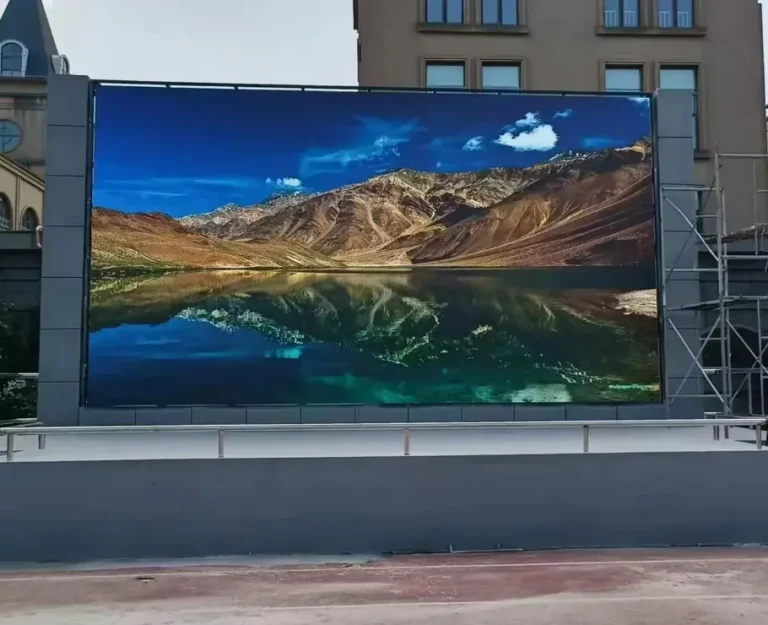
If you’re asking where LED screens are used, the short answer is: almost everywhere you find a message that needs to be seen—from highway billboards and stadium scoreboards to boardrooms, church sanctuaries, and film sets. But which type of LED display, at what pixel pitch and brightness, depends entirely on the environment. Here’s the quick-reference version before we go deep:
| Application | Recommended Display Type | Pixel Pitch | Brightness (Nits) |
|---|---|---|---|
| Outdoor billboards/DOOH | Outdoor fixed LED | P4–P10 | 5,000–10,000 |
| Retail & shopping malls | Indoor fine pitch/transparent | P1.5–P4 | 800–1,500 |
| Stadiums & arenas | Outdoor/semi-outdoor LED | P6–P16 | 4,000–8,000 |
| Corporate meeting rooms | COB/fine pitch indoor | P0.9–P1.9 | 500–800 |
| Concerts & events | Rental LED | P2.6–P4.8 | 1,200–4,000 |
Every row on that table represents a different engineering trade-off, and getting it wrong is an expensive mistake—not a cosmetic one.
That’s the part most buyers underestimate. A pixel pitch that looks perfectly sharp in a supplier’s showroom can turn pixelated and unreadable once it’s mounted forty feet up a stadium facade, or conversely, a spec built for close-range boardroom viewing will blow the budget if it’s oversized for an outdoor billboard nobody stands closer than thirty meters from.
Based on our experience deploying LED display systems across North America, Europe, the Middle East, and Asia, the single biggest cause of post-installation complaints isn’t the panel quality—it’s a mismatch between viewing distance, ambient brightness, and the pixel pitch that was quoted.
According to industry benchmarking from Digital Signage Federation project audits, a significant share of first-generation LED installations are re-specified within two years, almost always because the original selection process skipped viewing-distance and brightness modeling.
That’s a design failure, not a manufacturing one, and it’s entirely preventable at the sourcing stage.
What Is an LED Display Screen?
An LED display screen is a modular visual system built from thousands of individually addressable light-emitting diodes, arranged into cabinets that tile together to form one continuous image.
Unlike a television, it has no single glass panel—it’s an engineered grid of pixel modules, driver ICs, and a power/data backbone, which is precisely what makes it scalable from a two-meter meeting-room wall to a two-hundred-meter stadium facade using the same underlying pixel technology.
How LED Screens Differ From LCD and Projection
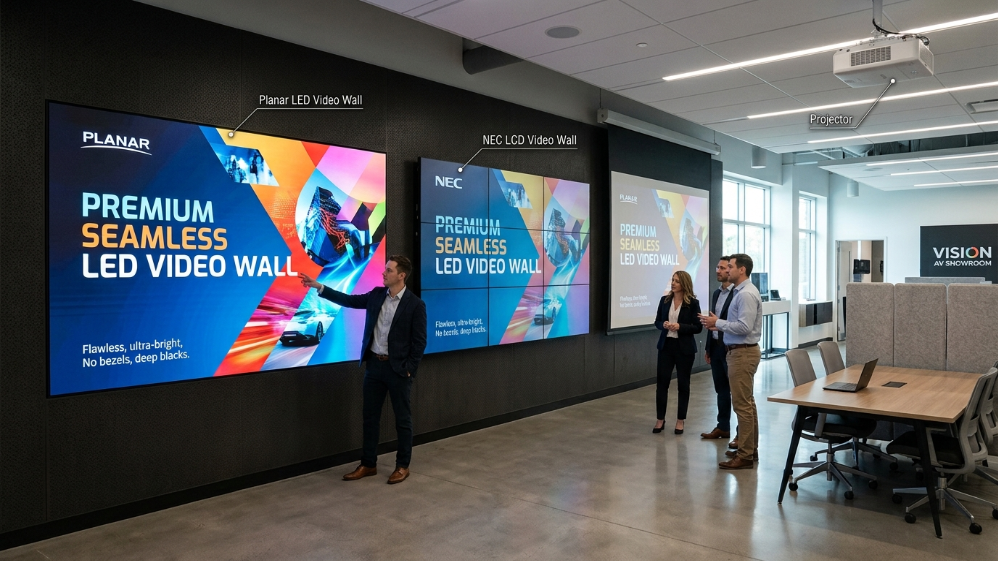
The comparison below is where most buyers make their first strategic decision, often without realizing it:
| Factor | LED Display | LCD Panel | Projection |
|---|---|---|---|
| Brightness ceiling | Very high (up to 10,000+ nits) | Moderate (400–700 nits) | Low, ambient-light sensitive |
| Seamlessness at scale | Fully seamless, unlimited size | Visible bezels beyond 2–3 units | Seamless but needs dark room |
| Outdoor viability | Excellent | Poor | Not viable |
| Maintenance | Front/rear-serviceable modules | Panel replacement | Bulb/lens replacement |
| Lifespan | 80,000–100,000 hours | 50,000–60,000 hours | 3,000–20,000 hours (lamp) |
The FAB logic here matters for a B2B buyer:
High brightness (feature) means the screen stays legible under direct sunlight or bright venue lighting (benefit), which translates directly into ad impressions that actually get seen, or a scoreboard that’s readable in the third deck instead of just the front row.
Seamless tiling (feature) means you can scale a single design across an entire building facade or arena bowl (benefit) without rebuilding the content for bezel gaps.
Long lifespan (feature) reduces the total cost of ownership over a 5–10 year deployment (benefit)—which is the number that actually shows up in a CFO’s approval, not the sticker price of the panel.
Where Are LED Screens Used? 10 Real-World Applications
This is the question most searches are really trying to answer, so let’s go environment by environment, starting with the two highest-volume commercial use cases.
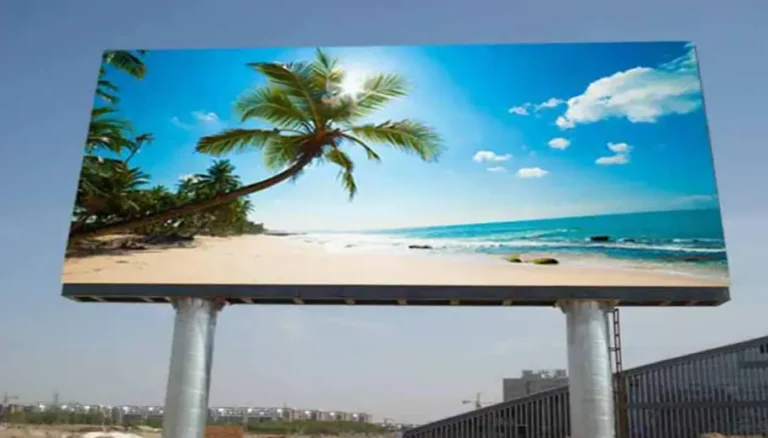
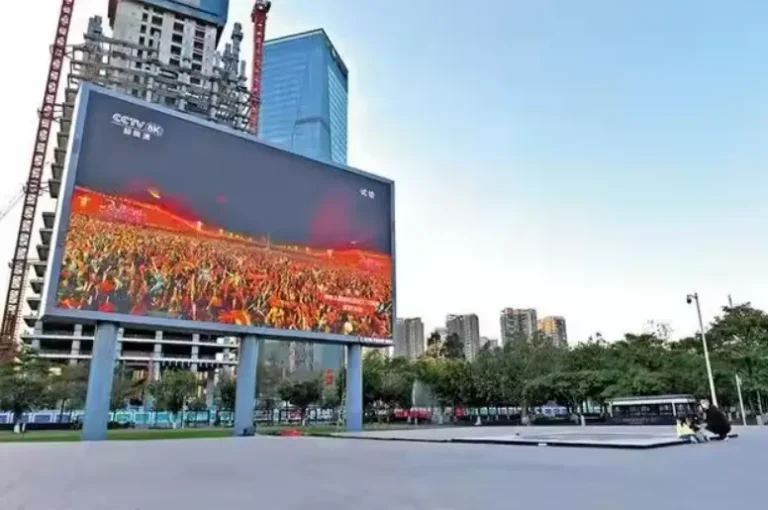
1. DOOH & Outdoor Advertising Billboards
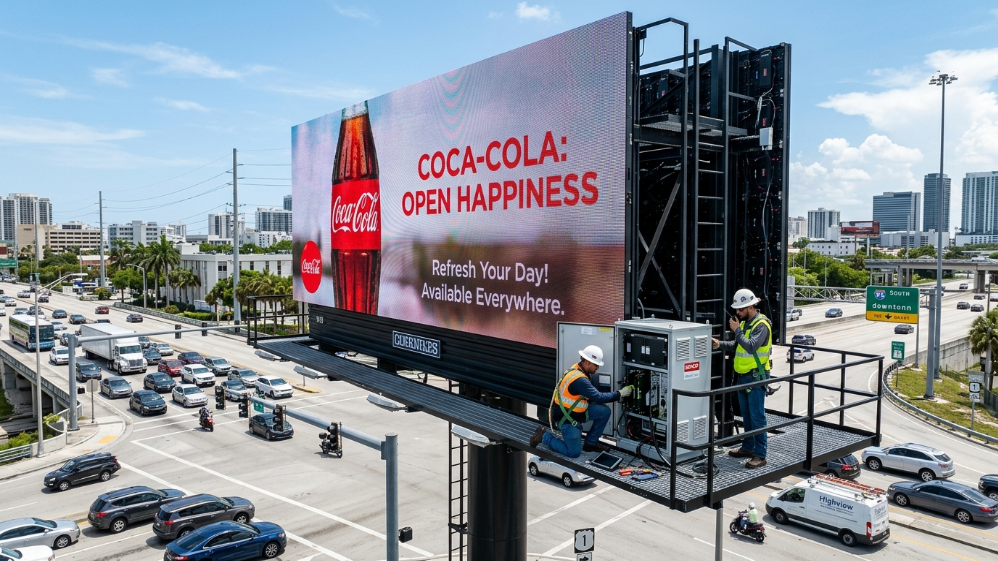
Outdoor advertising is still the largest single deployment category for LED screens globally, and for good reason: a well-specified outdoor LED billboard delivers full-color, high-brightness content that’s legible in direct sunlight, something no other display medium achieves at that scale.
The engineering priorities here are:
| Key Requirement | Recommended Specification |
|---|---|
| Brightness | 5,000–10,000 nits to overcome ambient daylight |
| Protection | IP65-rated enclosure to withstand rain and dust |
| Pixel Pitch | Typically P6 or wider once viewing distance exceeds fifteen meters |
| Operating Time | 16–18 hours per day for many DOOH networks |
Energy-efficient driver design also matters more here than almost anywhere else, since outdoor DOOH networks often run 16–18 hours a day and power cost compounds quickly across a multi-screen network.
2. Retail Stores & Shopping Malls
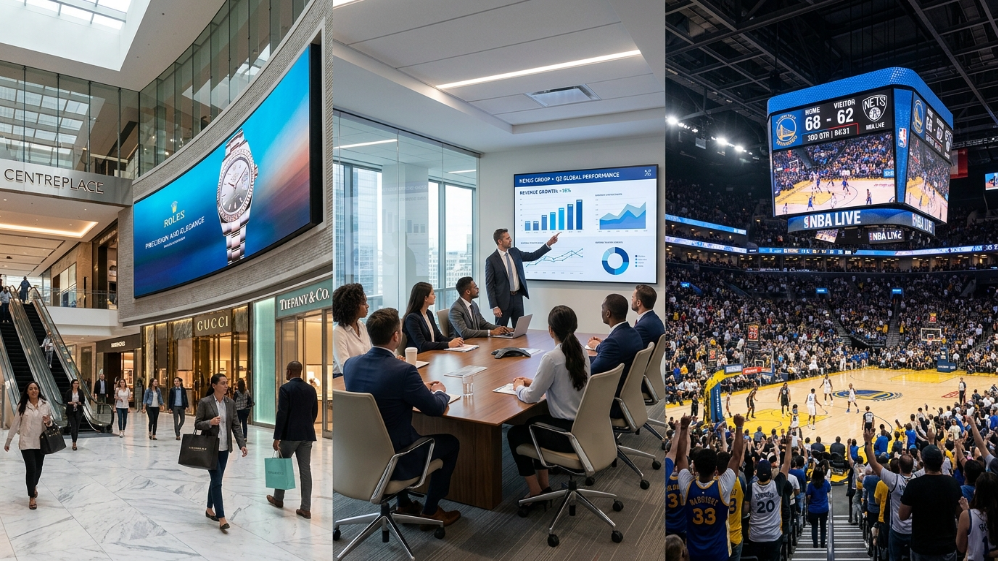
Inside a mall, the calculus flips.
Viewers stand close—often within two to five meters—so resolution becomes the priority over raw brightness.
Fine pitch indoor LED (P1.5–P2.5) or transparent LED at storefront glass lines lets retailers run high-resolution video content that reads as sharp, near-photographic imagery rather than a visible dot grid.
Transparent LED in particular has become a fast-growing retail application because it converts a static shop window into an active advertising surface without blocking natural light or the merchandise behind it—a genuinely different value proposition from a standard indoor screen.
3. Sports Stadiums & Arenas
A stadium screen has to solve two conflicting problems at once: it needs enough brightness to compete with open-sky daylight, yet it’s viewed from wildly different distances depending on whether someone’s in the front row or the upper deck.
That’s why arena scoreboards typically run P6–P16 depending on bowl geometry, paired with weatherized cabinets rated for wind load, not just water ingress.
We’ve found that stadium clients underestimate structural engineering far more often than they underestimate the electronics—a screen is only as reliable as the steel frame holding it against gusts across a fifty-meter span.
4. Corporate Meeting Rooms & Control Rooms
Here, viewers sit within arm’s length of the wall, so COB (Chip on Board) technology increasingly outperforms traditional SMD packaging.
Encapsulating the LED chip directly onto the PCB gives COB panels better impact resistance and a more uniform surface with fewer visible seams—a meaningful advantage in 24/7 control rooms where a single dead pixel is a genuine operational liability, not just a cosmetic flaw.
Fine pitch COB in the P0.9–P1.5 range is now standard for command centers, trading centers, and executive boardrooms.
5. Concerts, Festivals & Stage Rental Events
Rental LED lives or dies on weight and assembly speed, not just image quality.
A cabinet that takes twenty minutes longer per unit to rig becomes a real labor-cost line item once you multiply it across a hundred-panel stage wall touring city to city.
Lightweight die-cast aluminum cabinets in the P2.6–P4.8 range dominate this category because they balance resolution for close-up camera work with a build/strike cycle that has to happen in hours, not days.
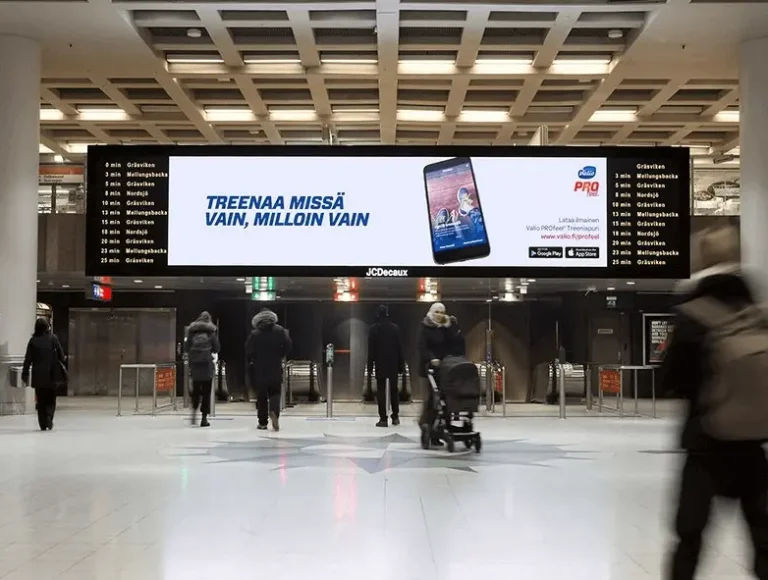
6. Airports, Train Stations & Transit Hubs
Transit displays run continuously, often unattended, in high-footfall corridors—which makes remote monitoring through a CMS platform non-negotiable rather than a nice-to-have.
Operators need real-time visibility into brightness levels, panel health, and content scheduling across dozens of screens from a single dashboard, since a blank departure board in a terminal isn’t a minor bug, it’s a passenger-facing failure.
7. Churches & Places of Worship
Lyric and scripture displays prioritize legibility and even brightness uniformity over raw resolution—congregants at the back need the same clarity as those up front, which favors mid-pitch indoor panels (P2.5–P3) with wide viewing angles over ultra-fine pitch options that offer diminishing returns at typical sanctuary viewing distances.
8. Exhibitions, Trade Shows & Conference Centers
Exhibition LED needs to be modular and reconfigurable, since booth dimensions change show to show.
Flexible and curved cabinet designs let a single inventory of panels form flat walls one week and cylindrical columns the next, which is why exhibition-focused rental fleets increasingly standardize on flexible LED rather than rigid fixed panels.
9. Hotels & Hospitality
Lobby feature walls and event-space displays blend indoor fine pitch with creative shapes—curved columns, ceiling-mounted canopies—where aesthetic integration into architecture matters as much as the spec sheet.
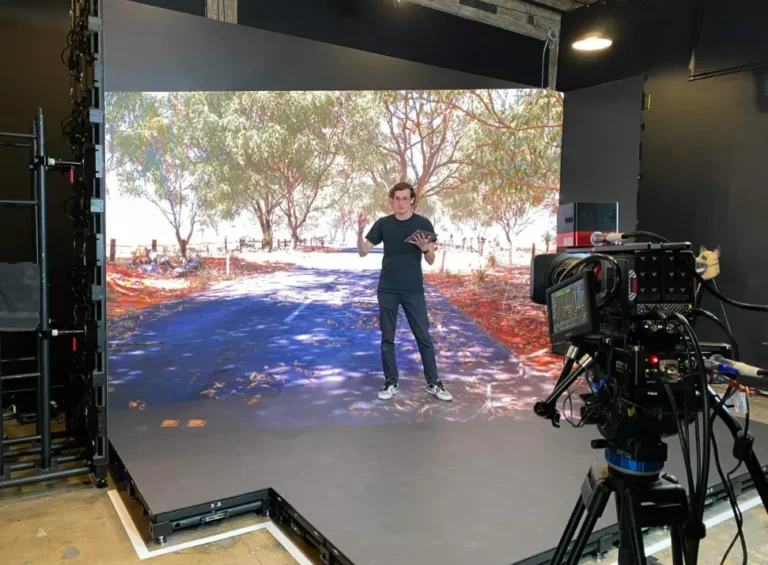
10. Film Studios & XR Virtual Production
Virtual production is the most demanding application on this list.
Camera sensors expose far faster than the human eye, so a wall refreshing at a standard rate will show visible banding on camera even though it looks flawless live.
According to virtual production industry standards adopted across major studios, LED walls used behind camera now require refresh rates of 3,840Hz or higher, along with tight color calibration and low scan distortion, to avoid moiré and flicker in 4K footage.
How to Choose the Right LED Screen for Your Application
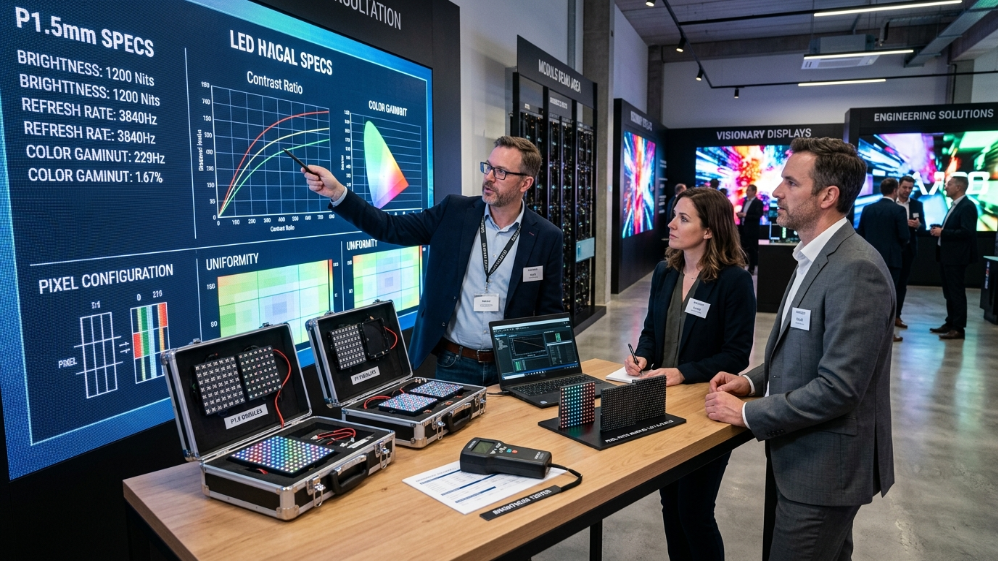
Once you know your environment, three variables decide the spec: how far viewers stand, how much ambient light the screen must compete with, and how much physical protection the installation site demands.
| Variable | Key Question | Practical Impact |
|---|---|---|
| Viewing distance | How close is the nearest regular viewer? | Sets minimum pixel pitch—closer viewers need finer pitch |
| Ambient brightness | Is it direct sun, mixed lighting, or controlled indoor? | Sets nits requirement—outdoor sun needs 5,000+ nits |
| Environmental exposure | Rain, dust, wind load, or climate-controlled? | Sets IP rating and structural/cabinet design |
| Duty cycle | Does it run 24/7 or intermittently? | Sets driver quality and thermal management priority |
| Content type | Static signage vs. fast-motion broadcast/camera feed | Sets refresh rate requirement |
Getting any one of these wrong doesn’t just hurt image quality—it shortens the panel’s usable life and inflates the maintenance budget nobody planned for.
Why LED Screens Remain the Preferred Choice Across Industries
Beyond application-specific specs, three structural advantages explain why LED has displaced LCD and projection almost everywhere budget allows:
Energy-efficient driver ICs lower operating cost over a multi-year deployment, not just the purchase price.
Seamless tiling means a design scales from a small huddle room to a full building facade without re-engineering the content.
CMS-based remote management turns a fleet of screens into one manageable system instead of dozens of individually serviced units—critical for any DOOH network or multi-site retail chain.
Sourcing Checklist: What to Ask an LED Display Manufacturer
Before signing a purchase order, a serious buyer should ask for:
| Inspection Item | Requirement |
|---|---|
| Module-level test data | Dead pixel rate and color uniformity |
| Aging testing | 72 hours is the industry baseline for catching early failures before shipment |
| IP rating documentation | Confirm protection level matches installation environment |
| Refresh rate information | Verify suitability for application requirements |
| Warranty terms | Ensure warranty conditions match the intended usage environment |
Clear documentation on IP rating, refresh rate, and warranty terms specific to the intended environment—not generic marketing specs—is essential before purchasing.
Frequently Asked Questions
What pixel pitch is best for outdoor advertising?
Generally P6–P10 for viewing distances beyond 10–15 meters; finer pitches add cost without a visible resolution benefit at that range.
Can the same LED screen be used both indoors and outdoors?
Not typically—outdoor panels need IP65 protection and much higher brightness, while indoor panels prioritize finer pixel pitch and lower brightness for close viewing.
How long do commercial LED display screens last?
Well-manufactured panels typically run 80,000–100,000 hours before brightness degrades meaningfully, roughly 8–10 years at heavy daily use.
Why do virtual production LED walls need a higher refresh rate?
Camera sensors expose faster than human eyes, so refresh rates below 3,840Hz can cause visible banding or flicker on recorded footage even if the wall looks fine live.
Is COB or SMD better for a control room display?
COB generally performs better in close-viewing, high-uptime environments because it offers better impact resistance and a more uniform surface with fewer visible module seams.
Expert Verdict
If there’s one takeaway from a decade of specifying these systems: buy for the environment, not the showroom demo.
The application dictates pixel pitch, brightness, and protection rating—not the other way around—and any manufacturer unwilling to walk through that math with you before quoting a price is a red flag, not a bargain.
References:
U.S. Department of Energy (DOE) — LED Technology Basics
National Institute of Standards and Technology (NIST)