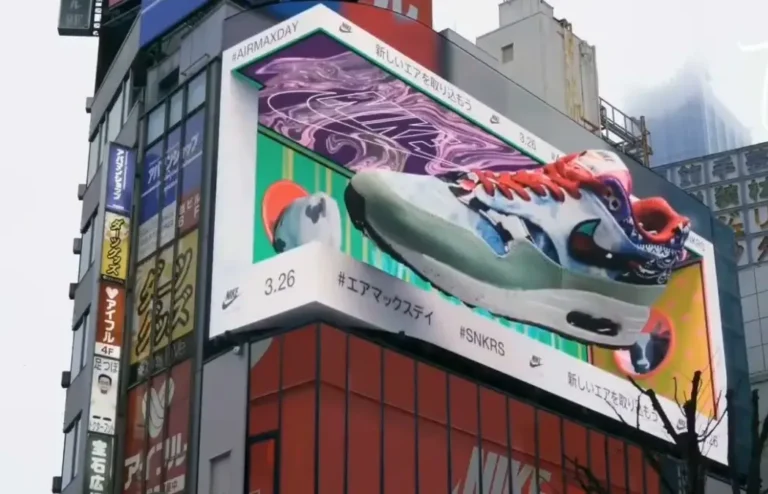
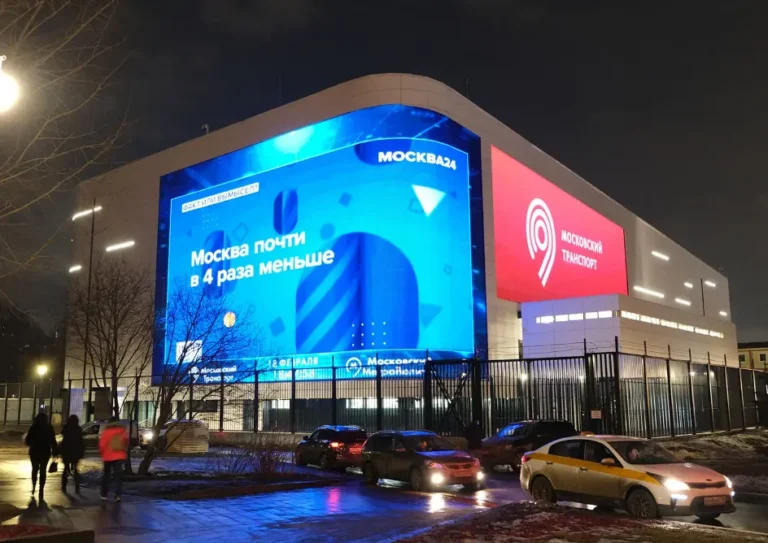
Evaluating the 7000 nits high brightness energy-saving LED price should never stop at the superficial financial trap of “ex-factory price per square meter.” As a Chief LED Display Engineer, I am providing you directly with the real cost and energy consumption benchmarks for high-end DOOH (Digital Out-of-Home) landmark screens in 2026: Outdoor LED displays in the 7,000 to 10,000 nits class utilizing the latest “Common Cathode” energy-saving technology typically have an initial hardware cost between $1,500 and $3,500 per square meter. While the initial procurement cost is approximately 15% to 25% more expensive than traditional high-energy-consuming iron cabinet screens, combined with an electricity saving rate of up to 50%, you can fully recover all hardware premiums through reduced daily Operating Costs in just 18 to 24 months. In the subsequent 5 to 8 years of its lifecycle, it will achieve exponential growth in net profit for you.
Many DOOH advertisers and system integrators complain to me: to ensure absolute advertising visibility under Direct Sunlight at noon, they were forced to upgrade to ultra-high brightness screens, only to have the monthly electricity bill swallow most of the advertising broadcast revenue. Even more terrifying, because traditional high-brightness screens generate huge amounts of heat, serious Light Decay occurs in less than two years of operation. Originally brilliant images become dim and gray, and advertisers demand refunds. According to the latest industry data from internationally renowned outdoor media agencies, more than 60% of outdoor LED screen failures, revenue losses, and premature scrappage worldwide are caused by poor heat management and high Average Power Consumption. Based on our experience accumulating intelligent LED display solutions for over 6,000 projects in more than 90 countries over the past decade, I dare to assert: the only way to solve the commercial deadlock of “eye-popping brightness plus extreme power saving” lies in completely reconstructing the power supply technology of the underlying packaging.
Introduction: The Ultimate Dilemma of DOOH—The Game Between Direct Sunlight Visibility and High Electricity Bills
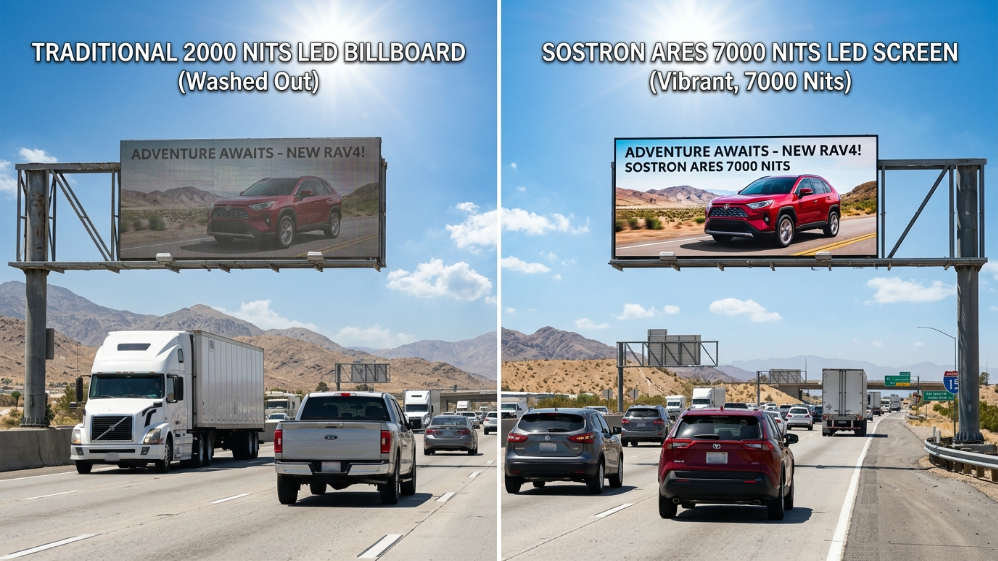
The intersections of modern commercial cities and the sides of highways are the ultimate battlegrounds for brands competing for eyeballs. When advertising sponsors spend millions of dollars to run the latest luxury goods or electric vehicle advertisements, they absolutely cannot tolerate exquisite visuals turning into a dim gray mosaic under the strong light of high noon. This forces engineering contractors and media companies to push the screen Brightness (Nits/Luminance) standards from the 5,000 nits of the past up to 7,000 or even 10,000 nits.
But basic common sense in physics tells us: the higher the brightness, the larger the driving current, and the energy consumption explodes exponentially. Once a traditional DOOH screen operates at full power and high brightness, it is a veritable “electricity tiger.” High electricity bills not only give CFOs extreme headaches, but the massive heat accumulation brought by large currents also accelerates the aging of electronic components. This creates a fatal commercial paradox: blindly increasing brightness to please advertisers while causing screen operators to lose everything on the Total Cost of Ownership (TCO).
Core Working Principle: Cracking the Physics Paradox of “High Brightness + Low Energy Consumption”
To suppress the rotation speed of the electricity meter without sacrificing even one nit of brightness, relying on simple “light sensor automatic dimming” in the broadcast software is far from enough. Real engineering-grade magic happens within the micron-level LED chip power supply circuits.
Disrupting the Game: Common Cathode Technology Explained
For the past decade, 90% of traditional outdoor screens on the market adopted the “Common Anode” power supply mechanism. Its working principle is very simple and crude: the system distributes the same voltage (usually 3.8V or even higher) uniformly to the Red, Green, and Blue (RGB) chips. However, the true physical characteristic is that the red light chip only needs a low voltage of 2.5V to 2.8V to reach extremely high brightness. Where does that extra 1V+ go? The answer is: it is all converted into useless thermal energy on the circuit board and wasted in vain. This is like using a V8-engine heavy truck just to deliver a letter—extremely wasteful and producing a large amount of exhaust gas.
Now, we have fully introduced the industry’s most cutting-edge Common Cathode Technology. Taking the ARES series specially built by Sostron for flagship DOOH as an example, the common cathode architecture directly subverts traditional PCB circuit design. Through precise custom-grade power management ICs, it separately allocates 2.8V low voltage to the red chips and 3.8V voltage to the green and blue chips.
Commercial Value Transformation (FAB): The direct commercial benefit brought by this underlying physical logic of “precise feeding and power supply on demand” is staggering. While ensuring the screen erupts with 7,000 to 10,000 nits of extreme brightness, it can simultaneously cut the screen’s Max Power Consumption and average power consumption by up to 50%. For an outdoor highway large screen with an area of hundreds of square meters, this means saving you tens or even hundreds of thousands of dollars in pure electricity expenditures every year.
Heat Dissipation & Fanless Aluminum Profiles
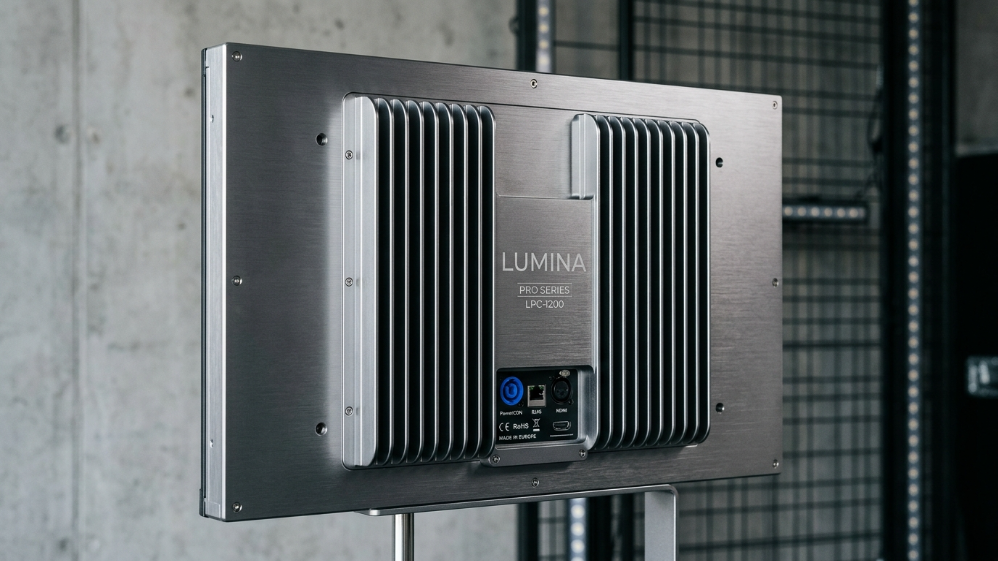
Since common cathode technology cuts off the generation of ineffective heat from the source circuit, we can carry out a drastic reshaping of the screen’s physical protection structure. Heat is always the number one enemy of LED components. To solve the high-temperature accumulation brought by 7,000 nits, traditional outdoor large screens had to stuff noisy industrial exhaust fans inside iron cabinets, or even install high-power industrial air conditioners behind the screens. This not only doubles the extra electricity loss but also introduces a large number of mechanical failure points—if a fan stops rotating in extreme climates like sandstorms or rainstorms, the screen immediately faces the risk of burning out due to overheating.
Commercial Value Transformation (FAB): To completely end this pain point, our engineers adopted an ultimate Fanless Aluminum Profile design. Aviation-grade aluminum profiles have an extremely high thermal conductivity coefficient, which can quickly and uniformly conduct the tiny amount of heat generated during screen operation to the outside air, achieving extreme passive Heat Dissipation. By abandoning mechanical fans that are easily damaged, your screen not only achieves true zero-noise operation but also completely eliminates the risk of short-circuit downtime caused by dust inhalation and moisture intrusion. This “cold screen” operating state greatly slows down the irreversible Light Degradation of LED beads, ensuring your screen can still maintain vivid colors and ultra-high Contrast Ratio that amaze top-tier advertisers even after 5 years of sun and rain.
Deconstructing the Price: Core Factors Determining the Cost of High-Bright Energy-Saving LED Screens
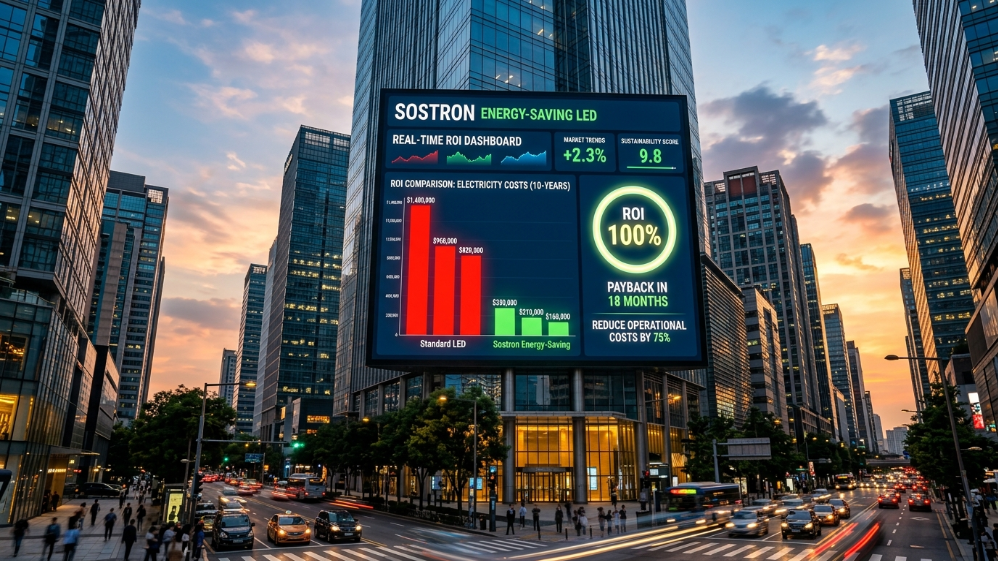
When B2B buyers conduct multinational price comparisons, the most common fatal financial error is staring solely at the “ex-factory unit price per square meter” quoted by suppliers. One must realize that the commercial lifecycle of any high-quality DOOH screen is 7 to 10 years; the initial hardware procurement fee only accounts for less than 40% of its Total Cost of Ownership (TCO), while the remaining 60% of the financial black hole lies in future electricity bills and maintenance/travel expenses.
Initial Hardware Cost vs. TCO of 5-Year Electricity Bills
Let’s calculate a hard-core commercial account for the CFO. Suppose you are preparing a 100-square-meter 7,000 nits outdoor prime location large screen, running at high load for 15 hours a day. A traditional non-energy-saving screen has an average power consumption of about 300W/sqm, with an annual power consumption of about 164,000 kWh. An energy-saving version screen using common cathode technology can have its average power consumption drop to 150W/sqm, requiring only 82,000 kWh per year.
| Comparison Item | Traditional Common Anode Screen | Sostron Common Cathode Screen |
| Initial Purchase Price | Standard | +15% – 20% Premium |
| Average Power Consumption | ~300W/sqm | ~150W/sqm |
| Annual Electricity (100sqm) | 164,000 kWh | 82,000 kWh |
| Maintenance Cost | High (Fans/AC) | Extremely Low (Passive) |
| Full ROI Period | 3 – 4 Years | 1.5 – 2 Years |
Combined with the commercial electricity price benchmark in your city, with a few clicks on a calculator, you can understand how much real money can be saved each year. Data never lies; that 15% to 20% initial hardware procurement premium can be 100% recovered through the high electricity costs saved within the first 18 to 24 months of system operation. Once this break-even point is crossed, every day of power saving thereafter is creating pure additional net profit for your enterprise.
Structural Engineering and Installation Budget
When truly calculating the total pool of the 7000 nits high brightness energy-saving LED price, there is another extremely hidden but often huge category: outdoor load-bearing steel structures and on-site construction fees.
Traditional iron cabinet LED screens are extremely heavy, which requires engineering contractors to pour deep reinforced concrete foundations on rooftops or single columns and weld tons of thick load-bearing steel structures to resist typhoon-level strong winds. In contrast, the new fanless aluminum profile cabinets, with their extremely light and thin physical metallic properties, reduce the total weight of the entire screen by 30% to 40%.
Commercial Value Transformation (FAB): The cliff-like drop in physical weight means you can significantly reduce the amount of specialized steel used for the back installation frame, while lowering the rental grade and duration of large cranes and hoists. This hidden project installation reduction not only further lowers your total engineering cost but also greatly shortens the dangerous period of on-site road closure construction and high-altitude operations. This means your landmark billboard can complete lighting acceptance weeks earlier, enter the merchant attraction stage sooner, and absorb huge outdoor digital advertising revenue as early as possible.
Key Considerations: Choosing the Right Screen for Extreme Outdoor Environments
To accurately evaluate the 7000 nits high brightness energy-saving LED price, we must not only talk about laboratory data in a greenhouse. The real outdoor environment is extremely cruel; blazing sun, salt spray corrosion, and violent storms are constantly eroding your digital assets. When initiating procurement, you must use the following two environmental endurance indicators as non-negotiable engineering standards.
Combating Light Decay and UV Damage
Many low-end screens can indeed reach a blinding brightness of 7,000 nits in the initial installation phase, but often after only one year of operation, their brightness will suffer a cliff-like drop, shrinking to 4,000 nits or even lower. This irreversible physical attenuation is called Light Decay. The culprit leading to this phenomenon is the ubiquitous strong UV Radiation outdoors. Inferior LED bead packaging glue will quickly yellow and embrittle under long-term UV irradiation, blocking the light emitted from the internal chips.
Commercial Value Transformation (FAB): To ensure your DOOH screen remains crystal clear throughout its lifecycle, a portion of the budget you pay must be for “UV Resistance.” High-quality high-bright energy-saving screens use modified silicone or high-performance epoxy resin for sealing, which can effectively resist UV erosion with wavelengths of 280nm-400nm. This ensures that after 5 or even 8 years of operation, your advertising large screen’s brightness attenuation is still controlled within 15%, locking in long-term advertising renewal contracts from high-net-worth brand owners.
IP Rating and Weather Resilience
Outdoors, moisture and micro-dust are the most direct causes of circuit board short circuits. A qualified 7,000-nits class outdoor large screen must have a protection level for both the front and back reaching IP65 or even higher IP Rating standards like IP68.
Commercial Value Transformation (FAB): High IP-rated waterproof and dustproof modules, combined with our aforementioned Fanless Aluminum Profile fully sealed cabinet design, mean that even if the screen encounters the direct sweep of tropical typhoon rain, the internal core ICs and power supply lines remain untouched by water. This structure greatly reduces unexpected maintenance costs caused by extreme weather. For high-altitude specialized operations like highway billboards, every avoided high-altitude crane dispatch is a direct safeguard for your ROI.
Top B2B Solutions by Sostron: Flagship DOOH
As a leading LED display solution provider founded in 2014 with over 16 years of industry team experience worldwide, Sostron has delivered a perfect answer to the engineering pain points of high brightness and energy saving—the Flagship ARES Series.
The ARES series is a high-end outdoor product line specially built for global top landmarks, highways, and 3D Naked-eye displays, with pixel pitches covering P3.9 to P10.4.
-
Up to 10,000 nits Extreme Brightness: Even under direct sunlight in tropical deserts or equatorial regions, the picture remains vivid, transparent, and impeccable.
-
Common Cathode Energy-Saving: ARES is fully equipped with an underlying common cathode precision power supply topology, cutting working heat and power consumption directly by half.
-
Extreme Refresh Rate (3840Hz-7680Hz): Combined with an ultra-high Contrast Ratio, it eliminates any water ripples under mobile phones or professional broadcast camera lenses.
-
Fanless Aluminum Profile Architecture: Abandons all mechanical fans to achieve industrial-grade zero-noise passive Heat Dissipation, significantly extending the screen’s physical lifespan.
Typical Application Scenarios: Maximizing Advertising Revenue
Digital screens only when placed in the right scenario can translate the shocking power of 7,000 nits into a steady stream of advertising rent.
Highway Billboards & Extreme UV Environments
On highways, the audience’s vehicle speed is extremely fast, and the effective visual capture time of the screen is often only a short 3 to 5 seconds. If the screen brightness is less than 7,000 nits, the image is easily swallowed by reflections and fog.
Trust Signal: In the Brazil highway P5 project and the South France outdoor P3.9 project delivered by Sostron, the ARES series screens we deployed withstood the double attack of the South American equatorial sun and the Mediterranean high salt spray climate. Relying on ARES’s common cathode technology, the screens maintained a stable “cold screen” operating state with 10,000-nits brightness year-round without being equipped with any high-power industrial air conditioners, saving the owner huge electricity and inspection fees.
3D Naked-Eye Landmarks in City Centers
The core of 3D naked-eye visual impact relies on extremely black background depth and extremely bright light-and-shadow transitions.
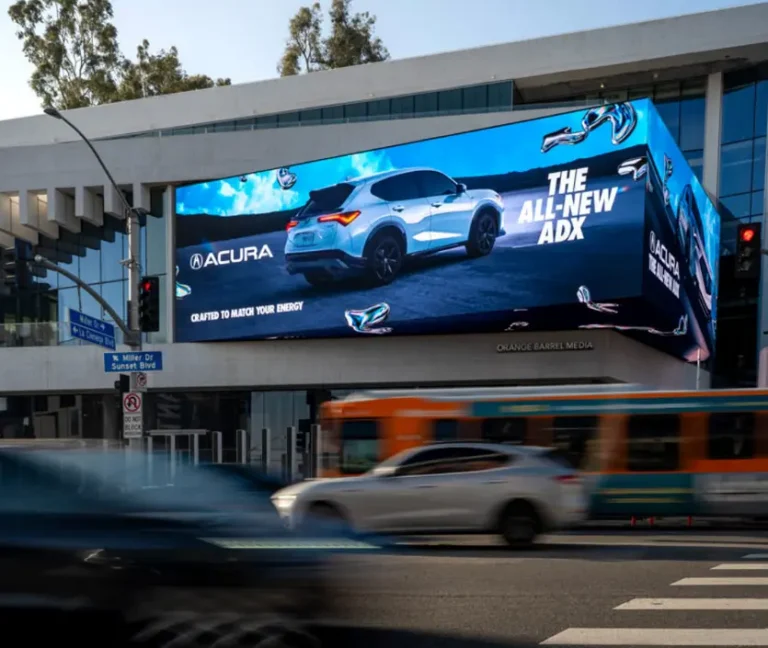
When the ARES series is applied with Seamless Splicing on L-shaped building facades in busy city corners, the ultra-high refresh rate of up to 7,680Hz and peak brightness of 10,000 nits can instantly deceive the human retina. The realistic visual sense of suspension not only attracts countless citizens to take photos and share them, exploding social media traffic, but also gives landmark media operators the absolute confidence to charge sky-high advertising prices to top multinational brands.
Frequently Asked Questions
When B2B buyers conduct project initiation and price approval, the following are the technical and financial questions most frequently asked by executives and CFOs:
Q1: What is the actual power consumption per square meter of a 7000-nit LED screen?
It completely depends on the underlying power supply topology. If it is a traditional common anode iron cabinet screen, the maximum power consumption is usually 800W-1000W/sqm, and the average power consumption is about 300W-400W/sqm. The ARES series using Sostron common cathode energy-saving technology can have its average power consumption directly compressed to 150W-200W/sqm.
Q2: How much more expensive is common cathode LED screen hardware than traditional screens?
Due to the need for more sophisticated custom-grade power management ICs and reconstructed PCB circuits, the initial hardware ex-factory price of common cathode energy-saving screens is usually about 15% to 20% more expensive than traditional old models. However, as long as your screen is lit and running for more than 10 hours a day, this hardware premium can usually be completely offset within 1.5 to 2 years through saved electricity costs.
Q3: How long does it take to achieve ROI for an energy-saving LED billboard?
Based on our actual operational data tracking in high-electricity regions such as Europe, America, Latin America, and the Middle East: considering the initial procurement premium, reduced steel structure construction costs, cut air conditioning electricity expenses, and almost zero late-stage fan repair labor costs, the comprehensive payback period for a high-quality common cathode energy-saving DOOH screen is shortened by 30% to 40% compared to traditional high-energy-consuming screens.
Expert Verdict: The Final Procurement Decision
In the commercial competition of outdoor digital advertising, purchasing “cheap but high power-consuming” low-end outdoor high-bright screens is actually an act of financial suicide that overdraws the company’s future. Real winners never just look at the hardware numbers on the quote; what they respect are the high electricity bills for the next 5 to 10 years and the devaluation black hole brought by light decay.
Secure top-tier outdoor visuals of 7,000 nits or even 10,000 nits, and lock your technical standards firmly onto “Common Cathode” and “Fanless Dissipation.”
Every screen leaving Sostron’s 15,000㎡ modern production base in Shenzhen undergoes hell-level aging full inspections and passes the most authoritative international compliance certifications such as ETL, FCC, CE, CCC, and RoHS. Contact Sostron’s 6 global branches immediately. Simply provide your outdoor project site environment and coordinates, and our senior engineer team will output a scientific DOOH Energy Saving and Carbon Reduction ROI Calculation Report for you within 24 hours, accurately locking in your project’s financial dividends.
References:
IEA – Digitalization and Energy Efficiency in DOOH
ENERGY STAR® – Version 9.0 Displays Specification