Quick Answer
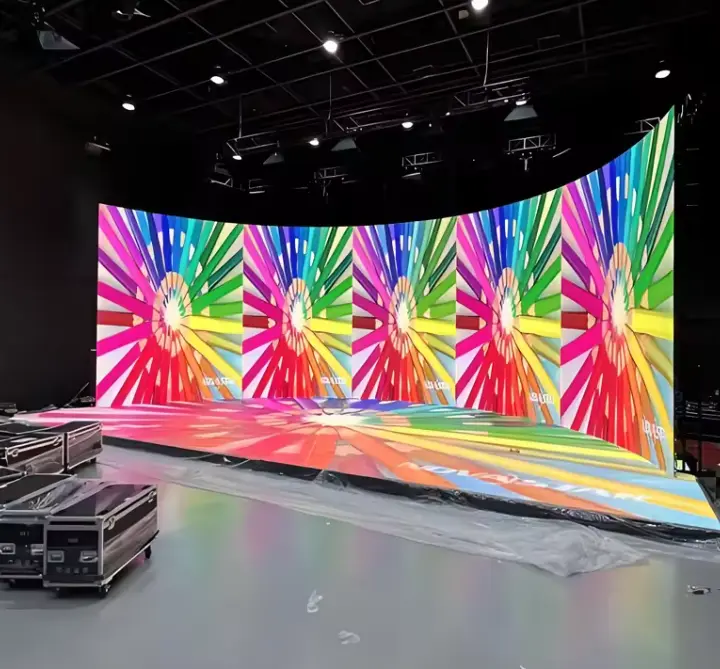
A rolling LED screen is a flexible LED display designed to bend or roll for easier transportation, storage, installation, or creative display applications. Depending on its construction, it may be a flexible LED panel that can be manually rolled, a display designed for repeated mechanical movement, or a complete motorized roll-up LED system.
How much does a rolling LED screen cost? The price depends on pixel pitch, display size, LED packaging, brightness, mechanical construction, control system, and whether the quotation includes installation and other project costs. A specific price should be treated as a verified quotation, an estimate, or an industry benchmark—not a universal market rate.
Rolling LED screens are worth considering when portability, curved surfaces, compact storage, or a specialized installation provides a meaningful advantage. However, they are not automatically the best choice for every project. Buyers must evaluate image quality, mechanical durability, maintenance access, and total cost of ownership before selecting a system.
| Buying consideration | What to evaluate |
|---|---|
| Product type | Flexible LED module, rollable display, or motorized roll-up system |
| Pixel pitch | Viewing distance and image detail |
| Brightness | Indoor or outdoor ambient light |
| Mechanical performance | Bending radius and permitted rolling conditions |
| Price | Hardware configuration and quotation scope |
| Installation | Mounting, support structure, and electrical requirements |
| Long-term cost | Maintenance, spare parts, transportation, and downtime |
This guide explains how rolling LED screens work, what affects their prices, which specifications matter, and how B2B buyers can evaluate suppliers without relying on unsupported performance claims.
What Is a Rolling LED Screen?
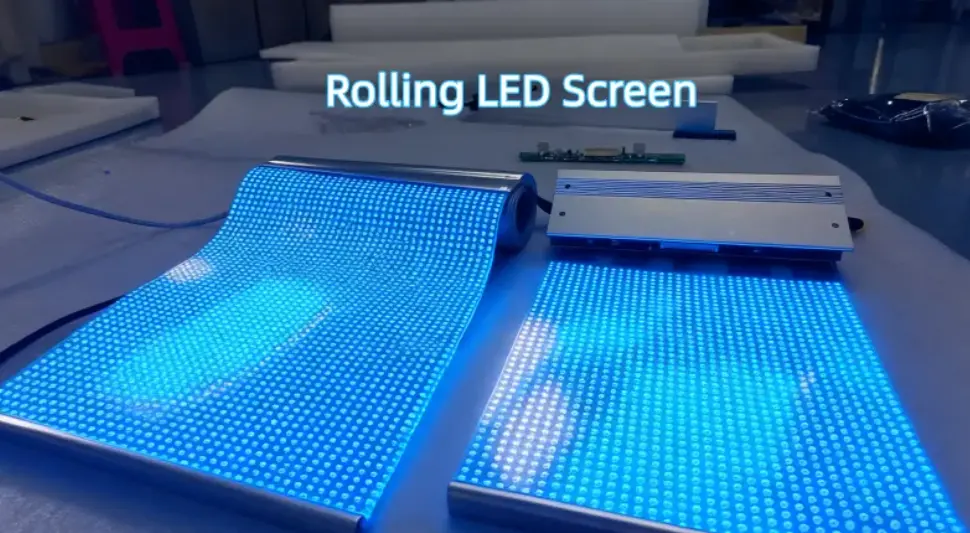
A rolling LED screen is a display system that uses flexible LED modules or a rollable display panel to create a screen that can bend, curve, or be rolled under specified mechanical conditions.
Unlike conventional LED displays built from rigid cabinets, rolling LED displays are designed to accommodate certain non-flat geometries or compact storage requirements.
The term “rolling LED screen” can describe several different product types. Understanding these differences is essential because their mechanical requirements, installation methods, and prices can vary considerably.
What Are the Main Types of Rolling LED Displays?
| Product Type | Main Characteristics | Typical Applications |
|---|---|---|
| Flexible LED module | Conforms to curved surfaces; often installed in a fixed position | Curved walls, columns, creative retail displays |
| Rollable LED panel | Designed to be rolled and unrolled under specified conditions | Portable displays, exhibitions, temporary installations |
| Motorized roll-up LED display | Uses a mechanical roller or motorized enclosure | Retractable displays, specialized commercial installations |
| Flexible rental LED display | Flexible modules combined with a supporting rental structure | Events, stages, temporary creative installations |
These categories can overlap. A flexible LED module may be used in a rolling display, but not every flexible LED module is designed for repeated dynamic rolling.
How Does a Rolling LED Display Work?
A flexible LED display typically combines:
-
LED packages that produce the image.
-
A flexible printed circuit board (FPC) that carries electrical connections.
-
A protective structure that supports the LED components.
-
Driving ICs that control pixel operation.
-
Power and signal connections.
-
A mounting or support system.
The flexible circuit and mechanical structure allow the display to conform to certain shapes.
However, the ability to bend does not mean the screen can be rolled without restriction. The permitted bending direction, minimum radius, rolling speed, and number of mechanical cycles depend on the exact design.
For a deeper explanation of flexible LED modules, see Sostron’s LED Display Soft Module: Specs, Uses & Buying Guide.
How Much Does a Rolling LED Screen Cost?
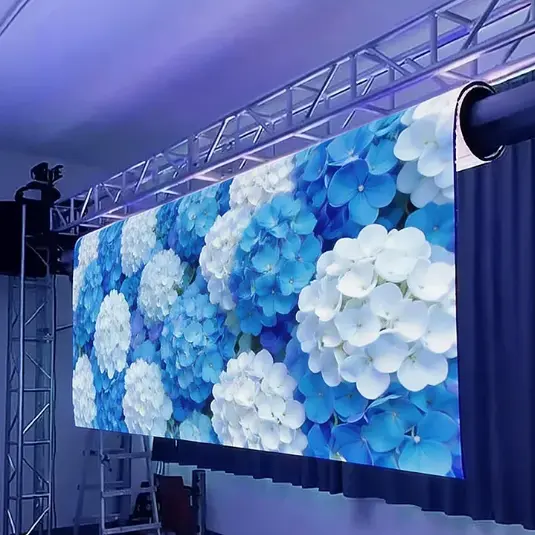
There is no single reliable market price for every rolling LED screen.
A quotation can vary substantially depending on the display configuration, mechanical construction, and project requirements.
For example, a flexible LED module designed for a fixed curved wall is not necessarily comparable to a complete motorized roll-up display with a roller housing, control system, and transportation accessories.
What Are the Main Price Factors?
| Price Factor | Why It Matters |
|---|---|
| Pixel pitch | Smaller pixel pitch generally requires greater pixel density and can increase hardware cost |
| Display size | Larger displays require more modules, power supplies, and supporting components |
| LED packaging | SMD, GOB, and COB configurations have different manufacturing and maintenance characteristics |
| Brightness | Higher brightness requirements can affect LED configuration and power consumption |
| Mechanical design | Flexible substrates, reinforced structures, and motorized mechanisms can increase complexity |
| Control system | Processing, receiving cards, software, and connectivity affect the complete system price |
| Custom geometry | Curved, cylindrical, or irregular installations may require additional engineering |
| Installation | Mounting structures, electrical work, and labor depend on the project |
| Shipping | Flexible displays may require special packaging or transportation arrangements |
Why Can Two Rolling LED Screen Quotes Differ So Much?
Two suppliers may quote the same pixel pitch but offer substantially different systems.
The difference may involve:
-
LED package quality.
-
FPC construction.
-
Module dimensions.
-
Driving IC configuration.
-
Brightness and refresh-rate specifications.
-
Control system.
-
Mechanical protection.
-
Included accessories.
-
Warranty coverage.
-
Quality inspection and testing.
A low price does not automatically indicate poor quality. Likewise, a high price does not automatically indicate better mechanical performance.
The buyer should compare the actual specifications and included components.
How Should Buyers Interpret Rolling LED Screen Price Estimates?
A price estimate should clearly state its assumptions.
For example:
| Price Information | Required Clarification |
|---|---|
| Price per square meter | Is it for modules, a complete display, or a complete installation? |
| Pixel pitch | Which exact configuration is quoted? |
| LED package | SMD, GOB, COB, or another configuration? |
| Control system | Is the controller included? |
| Structure | Is mounting hardware included? |
| Shipping | Which destination and delivery terms apply? |
| Warranty | What parts and labor are covered? |
| Spare parts | Are replacement modules included? |
Sostron’s previously published rolling LED screen price ranges should be treated as preliminary estimates rather than independently verified market averages. Buyers should request a current quotation based on the exact configuration.
Price note: All prices should be confirmed against a current supplier quotation. Estimates may exclude shipping, taxes, installation, structural engineering, and other project-specific expenses.
Which Technical Specifications Should Buyers Compare?
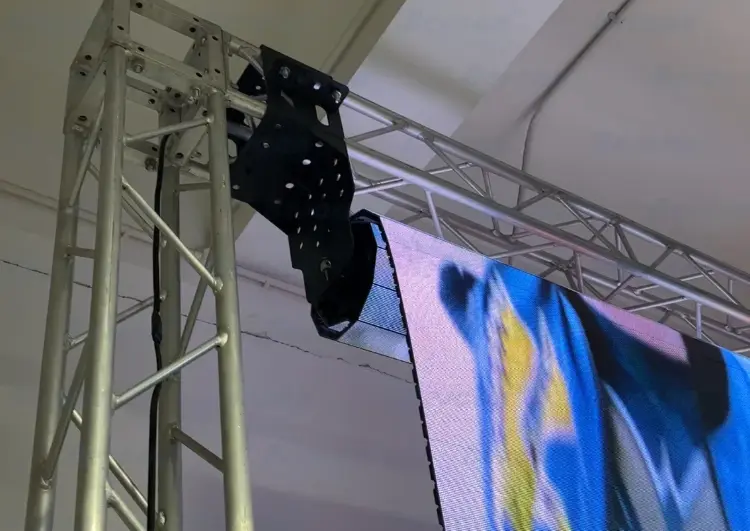
A rolling LED screen should be selected according to its intended application rather than a single headline specification.
Pixel pitch, brightness, refresh rate, mechanical flexibility, and installation requirements all influence the final performance.
Pixel Pitch and Viewing Distance
Pixel pitch is the distance between the centers of adjacent pixels, measured in millimeters.
A smaller pixel pitch generally provides greater image detail at close viewing distances. However, it also increases pixel density and can affect the hardware cost.
| Pixel Pitch | General Application Consideration |
|---|---|
| P1.5–P1.9 | Fine-detail applications and close viewing |
| P2.6 | Professional indoor displays and event environments |
| P3.9 | Larger displays viewed from greater distances |
| P4.8 and above | Applications where viewing distance and budget allow a coarser pixel pitch |
These are general selection categories, not universal recommendations.
The appropriate pixel pitch depends on the actual viewing distance, content, screen dimensions, and audience position.
For example, a retail display viewed from close range may require finer pitch than a stage backdrop viewed from the audience area.
Brightness and Image Quality
Brightness should be selected according to ambient light and the viewing environment.
Indoor displays generally require different brightness levels from outdoor displays exposed to direct sunlight.
When evaluating a rolling LED screen, buyers should confirm:
-
Rated brightness.
-
Brightness measurement conditions.
-
Brightness uniformity.
-
Color consistency.
-
Grayscale performance.
-
Viewing angle.
-
Refresh rate.
-
Camera compatibility, where relevant.
A higher brightness specification is not automatically better.
Excessive brightness in a dark indoor environment can reduce viewing comfort and increase power consumption.
Refresh Rate and Camera Compatibility
Refresh rate describes how frequently the display refreshes its image.
A higher refresh rate can improve the appearance of moving content and may help with camera applications, but the actual result depends on the complete display system.
For broadcast, XR, and professional event applications, buyers should evaluate:
-
Driving IC configuration.
-
Refresh rate.
-
Grayscale performance.
-
Camera shutter settings.
-
Synchronization requirements.
-
Image artifacts during camera testing.
A refresh-rate number alone does not guarantee flicker-free camera footage.
For critical applications, request a demonstration using the intended camera and operating conditions.
What Is the Minimum Bending Radius of a Rolling LED Screen?
The minimum bending radius and allowable rolling cycles depend on the display’s mechanical design, materials, construction, and intended movement. A product’s static bending capability does not automatically establish its suitability for repeated dynamic rolling. Request the manufacturer’s product-specific limits and test documentation before specifying the display for a project.
It is a product-specific mechanical parameter.
A smaller bending radius generally means the display can form a tighter curve, but this does not automatically mean that it can withstand repeated rolling at that radius.
The permitted radius depends on:
-
FPC material and construction.
-
LED package.
-
Protective structure.
-
Bending direction.
-
Mechanical support.
-
Static or dynamic bending conditions.
-
The intended application.
Static Bending vs. Dynamic Rolling
| Mechanical Condition | Description | What Buyers Should Verify |
|---|---|---|
| Static bending | The display remains in a curved position | Permitted radius and duration |
| Dynamic bending | The display repeatedly bends and returns | Test conditions and mechanical durability |
| Rolling | The display is rolled in or out | Roller design, speed, radius, and cycle conditions |
| Twisting | The display experiences torsional deformation | Permitted twisting conditions |
| Flattening | A rolled display is extended into a flat state | Required force and structural stability |
These conditions should not be treated as interchangeable.
A product that can remain curved during installation may not be suitable for repeated rolling.
What Does IEC 62715-6-1 Say About Flexible Display Testing?
IEC 62715-6-1:2018 defines mechanical test methods for flexible display devices, including deformation tests involving bending, rolling, twisting, and stretching.
The standard provides a framework for evaluating mechanical stability under specified test conditions. It does not establish one universal bending radius or mechanical cycle life for every flexible display product.
The relevant test method must be selected according to the application.
IEC+1
For buyers, the practical requirement is straightforward:
Ask the supplier to identify the exact mechanical test performed, the test conditions, and the results for the quoted model.
What Is the Difference Between Bending Radius and Mechanical Cycle Life?
Bending radius describes the permitted curvature.
Mechanical cycle life describes how the product performs after repeated mechanical movement under specified conditions.
A supplier should not claim that a display can be rolled thousands of times without identifying the relevant test conditions.
For a dynamic rolling application, request information about:
-
Test specimen.
-
Bending or rolling radius.
-
Movement speed.
-
Test direction.
-
Number of cycles.
-
Electrical operating conditions.
-
Image quality before and after testing.
-
Any observed mechanical or electrical failures.
This information is more useful than an unsupported statement that a display is “highly flexible” or “designed for unlimited rolling.”
Can a Rolling LED Screen Be Used Indoors and Outdoors?
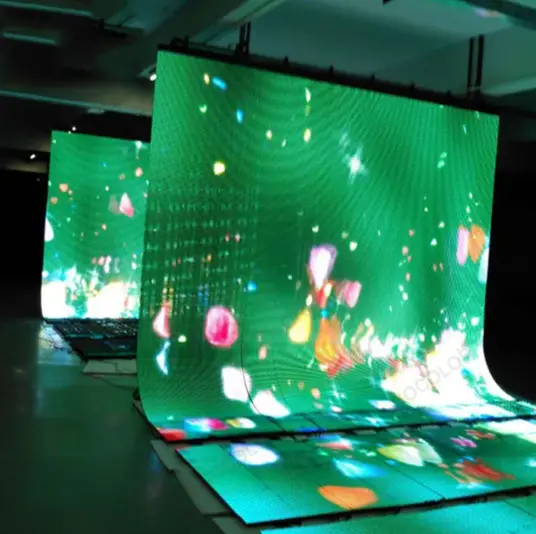
Some rolling LED displays are designed for indoor use, while others may be engineered for outdoor environments.
However, flexibility alone does not establish outdoor suitability.
Outdoor applications require additional consideration of environmental protection, brightness, temperature, moisture, and structural support.
Indoor Rolling LED Display Requirements
Indoor applications may include:
-
Retail displays.
-
Exhibition booths.
-
Curved architectural installations.
-
Corporate events.
-
Creative stage backgrounds.
-
Specialized presentation environments.
For indoor use, buyers should prioritize:
-
Pixel pitch.
-
Viewing distance.
-
Color consistency.
-
Installation structure.
-
Mechanical flexibility.
-
Maintenance access.
-
Operating noise, where relevant.
Fine-pitch displays are often appropriate for close viewing, but the selected configuration should match the actual application.
Outdoor Rolling LED Display Requirements
Outdoor applications require additional engineering considerations.
These may include:
-
Brightness under ambient sunlight.
-
Moisture protection.
-
Dust protection.
-
Temperature range.
-
UV exposure.
-
Wind loading.
-
Structural support.
-
Electrical safety.
-
Maintenance access.
A flexible module intended for indoor use should not be assumed to be suitable for outdoor installation.
What Does IP65 Mean for a Rolling LED Screen?
IP65 is an ingress protection classification.
It indicates protection against dust ingress and protection against water jets under the specified test conditions.
However, an IP rating should be confirmed for the actual assembled product and the relevant exposed components.
A display with an IP65-rated component does not automatically make the entire installation IP65.
For outdoor projects, buyers should confirm the protection rating of the display system, connectors, power components, and any other exposed equipment.
Is a Rolling LED Screen Better Than a Conventional LED Wall?
A rolling LED screen is not automatically better than a conventional LED wall.
The main advantage of a rolling display is its ability to accommodate certain curved geometries or transportation requirements.
A conventional LED wall may be more appropriate when the display is permanently installed on a flat surface and does not require rolling or flexible construction.
| Comparison | Rolling LED Screen | Conventional LED Wall |
|---|---|---|
| Display geometry | Flexible or rollable under specified conditions | Typically rigid cabinet structure |
| Transportation | May reduce storage volume in some designs | Usually transported as cabinets or modules |
| Installation | May require specialized support | Depends on cabinet and mounting system |
| Mechanical complexity | Can be higher for dynamic rolling | Generally lower for fixed installation |
| Maintenance | Depends on module design and access | Depends on front or rear serviceability |
| Cost | Depends on flexibility and system configuration | Depends on pitch, cabinet, and project requirements |
| Best use | Curved, portable, or specialized installations | Standard fixed or rental installations |
Rolling LED vs. Flexible LED Module
A flexible LED module is a component.
A rolling LED display is a system or application that may use flexible LED modules.
This distinction matters because a module that can bend during installation may not be designed for repeated rolling.
Buyers should confirm whether the product is intended for:
-
Fixed curved installation.
-
Temporary curved installation.
-
Repeated transportation.
-
Repeated dynamic rolling.
-
Motorized operation.
Rolling LED vs. Motorized Roll-Up LED
A motorized roll-up LED display typically includes a mechanical system that rolls the display into a compact storage position.
Its engineering requirements may include:
-
Motorized roller.
-
Mechanical housing.
-
Electrical control.
-
Position control.
-
Display support.
-
Safety mechanisms.
-
Transportation protection.
This is different from simply bending a flexible LED module around a curved structure.
The buyer should evaluate the complete system rather than comparing the LED panel alone.
What Is the Total Cost of Ownership of a Rolling LED Screen?
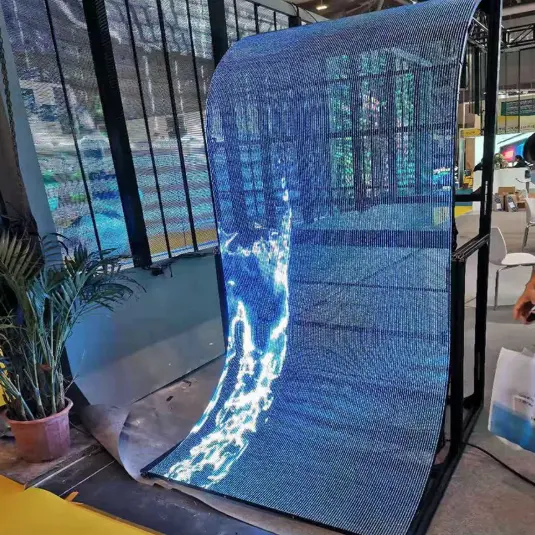
The purchase price is only one part of the total cost of ownership (TCO).
For B2B buyers, the complete project cost should include the equipment, installation, transportation, maintenance, and operating requirements.
Which Costs Should Be Included?
| Cost Category | What to Consider |
|---|---|
| Hardware | LED modules, display panels, cabinets, and mechanical components |
| Control system | Processor, receiving cards, software, and content equipment |
| Structure | Mounting frame, roller housing, support, and reinforcement |
| Installation | Labor, commissioning, and technical support |
| Shipping | Packaging, freight, insurance, and delivery |
| Customs | Import duties, taxes, and local clearance |
| Electrical infrastructure | Power distribution, cabling, and electrical work |
| Maintenance | Inspection, cleaning, repair, and replacement labor |
| Spare parts | Modules, power supplies, receiving cards, and connectors |
| Electricity | Operating power under the intended brightness and usage conditions |
| Downtime | Lost operating time and the cost of service interruptions |
Why Is Maintenance Important?
Rolling LED displays may have different maintenance requirements from conventional LED walls.
For example, a display designed for repeated rolling may require additional attention to:
-
Flexible circuit connections.
-
Mechanical support.
-
Protective materials.
-
Connectors.
-
Roller alignment.
-
Surface damage.
-
Electrical continuity.
The maintenance method depends on the product design.
A front-serviceable module may be easier to maintain in a fixed installation, while a rollable display may require access to additional mechanical components.
Buyers should confirm the maintenance procedure before purchasing.
What Should Buyers Ask About Warranty?
A warranty should clearly define its coverage.
Important questions include:
-
Does the warranty cover LED components?
-
Are FPC-related failures covered?
-
Does it cover mechanical damage?
-
Are repeated rolling operations covered?
-
Are replacement modules included?
-
Does the warranty cover labor?
-
What are the exclusions?
-
Is remote technical support available?
For a display intended for dynamic rolling, warranty coverage should explicitly address the intended mechanical use.
A standard LED display warranty may not automatically cover repeated rolling or bending.
How Should You Evaluate a Rolling LED Screen Manufacturer?
Choosing a manufacturer involves more than comparing prices.
The supplier should be able to explain the product’s mechanical design, operating conditions, and limitations.
Which Technical Documents Should You Request?
| Document | Why It Matters |
|---|---|
| Product datasheet | Confirms the quoted specifications |
| Mechanical drawing | Shows dimensions and mounting requirements |
| Bending specification | Defines permitted curvature |
| Mechanical test report | Provides evidence of tested performance |
| Electrical specification | Confirms power and connection requirements |
| Control system documentation | Explains signal and content management |
| Installation manual | Defines installation procedures |
| Maintenance manual | Explains service requirements |
| Warranty document | Defines coverage and exclusions |
How Can Buyers Verify Mechanical Performance?
For a rolling LED screen, the most useful verification is a demonstration or test report for the exact model.
A supplier should be able to explain:
-
Whether the product is intended for static bending or dynamic rolling.
-
Which direction the display can bend.
-
The permitted bending radius.
-
Whether the display can be rolled while powered.
-
How the display should be stored.
-
What mechanical conditions are excluded from the warranty.
For a critical installation, request a sample or arrange a product demonstration.
A general product video may show that a display can bend, but it does not necessarily establish long-term mechanical durability.
What Should Be Included in a Supplier Quote?
A complete quotation should identify:
-
Exact product model.
-
Pixel pitch.
-
Display size.
-
LED package.
-
Brightness.
-
Refresh rate.
-
Control system.
-
Mechanical structure.
-
Installation accessories.
-
Spare parts.
-
Warranty.
-
Delivery terms.
-
Shipping exclusions.
-
Payment terms.
Buyers should compare quotations using the same configuration and scope.
A quote for flexible modules alone should not be compared directly with a quote for a complete motorized display system.
Frequently Asked Questions
How Much Does a Rolling LED Screen Cost?
The price depends on pixel pitch, display size, LED packaging, mechanical construction, control system, and project requirements.
There is no universal price for all rolling LED screens. Buyers should request a quotation based on the exact configuration and confirm whether installation, shipping, taxes, and structural components are included.
Can a Rolling LED Screen Be Rolled Repeatedly?
Some rolling LED displays are designed for repeated rolling, while others are intended primarily for fixed curved installations.
The permitted number of mechanical cycles depends on the product design and test conditions. Buyers should request mechanical test evidence for the exact model.
What Is the Minimum Bending Radius?
The minimum bending radius is the smallest permitted radius under specified conditions.
It varies by product and should be confirmed in the manufacturer’s technical documentation.
A static bending radius should not automatically be treated as a dynamic rolling radius.
Can Rolling LED Screens Be Used Outdoors?
Some rolling LED displays may be engineered for outdoor use, but not all flexible LED modules are suitable for outdoor environments.
Buyers should confirm brightness, IP rating, temperature range, UV exposure, structural support, and electrical requirements.
How Long Does a Rolling LED Screen Last?
The service life depends on the LED components, mechanical construction, operating conditions, maintenance, and usage frequency.
For displays that are repeatedly rolled, mechanical durability is an important part of the evaluation.
A supplier should distinguish LED component lifetime from the mechanical service life of the complete display system.
Is GOB Better Than SMD for Rolling LED Screens?
GOB can provide additional surface protection compared with conventional exposed SMD packaging.
However, GOB does not automatically make a display waterproof, dustproof, or suitable for repeated rolling.
The actual performance depends on the complete design, materials, and testing.
Buyers should evaluate the benefits of additional protection against maintenance requirements, repairability, and cost.
What Is the Difference Between a Rolling LED Screen and a Foldable LED Screen?
A rolling LED screen is designed to bend or roll under specified conditions.
A foldable LED screen is designed around one or more folding axes.
The mechanical requirements differ, and a product designed for rolling should not automatically be assumed suitable for folding.
Is a Rolling LED Screen Suitable for XR Production?
A rolling LED screen may be considered for specialized XR environments if its image quality, brightness, refresh rate, mechanical configuration, and camera compatibility meet the production requirements.
However, rolling capability alone does not make a display suitable for XR.
For virtual production, buyers should verify the complete display system under the intended camera and production conditions.
Expert Verdict: How Should You Choose the Right Rolling LED Screen?
The right rolling LED screen depends on the project rather than the product name.
Before purchasing, buyers should establish the intended application, viewing distance, display dimensions, and whether the screen needs to be rolled repeatedly or simply installed on a curved surface.
The most important selection criteria are:
-
Product type: Confirm whether the system is a flexible module, rollable panel, or motorized roll-up display.
-
Pixel pitch: Match image detail to the viewing distance.
-
Brightness: Select according to the environment.
-
Mechanical performance: Verify bending radius, rolling conditions, and test evidence.
-
Installation: Confirm mounting, support, and electrical requirements.
-
TCO: Compare the complete system rather than the hardware price alone.
-
Supplier reliability: Request technical documents, warranty terms, and product-specific evidence.
A rolling LED screen can provide meaningful value when its flexibility solves a genuine installation or transportation problem.
However, if the project only requires a conventional flat LED wall, a rigid display may offer a simpler and more economical solution.
The best purchasing decision is the one that matches the display’s actual capabilities to the project’s technical and commercial requirements.
About Sostron
Sostron is a commercial LED display manufacturer and display solution provider based in Shenzhen, China.
The company provides LED display manufacturing, product development, engineering support, customized display solutions, installation guidance, and after-sales technical services for commercial display applications.
Its product portfolio includes indoor LED displays, outdoor LED billboards, rental LED screens, fine-pitch displays, transparent LED displays, and creative LED solutions.
For projects involving specialized display geometry, buyers can discuss their requirements with Sostron’s technical team to determine whether a flexible LED solution or another display configuration is appropriate.
Explore the Sostron LED Display Product Portfolio or contact the company through its official contact page.
These references provide technical context. They do not establish that a particular rolling LED screen model has passed a specific test or holds a particular certification. Product-specific claims should be supported by the manufacturer’s actual technical documentation.
Price Disclaimer: Rolling LED screen prices are configuration-specific. Pixel pitch, display dimensions, mechanical construction, LED packaging, control system, accessories, and project requirements can all affect the quotation. Any indicative price should be treated as a budgeting reference rather than a universal market rate. Confirm whether the supplier’s quotation includes the display hardware, control system, mounting structure, shipping, taxes, installation, warranty, and spare parts. Compare supplier quotations on the same technical and commercial basis. Confirm the display configuration, mechanical limits, control-system compatibility, included accessories, installation scope, delivery terms, warranty coverage, and spare-parts policy. A lower hardware price may not represent a lower total project cost when these items are excluded.
References: