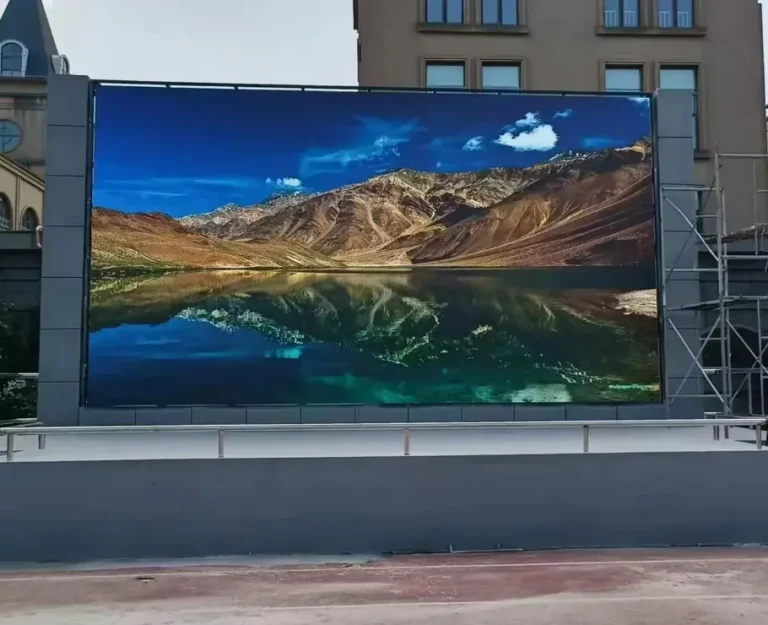
There is no single mandated size for an outdoor perimeter stadium LED screen—but the industry has converged around a narrow set of dimensions for a reason.Most professional installations use a 960×960mm or 1600×900mm cabinet,built from 320×160mm or 400×300mm LED modules,at a pixel pitch between P6.25 and P10.These figures aren’t arbitrary.They’re the product of decades of trial and error across FIFA and UEFA venues,refined until they hit the sweet spot between broadcast image quality,structural handling weight,and installation speed.
| Spec | Industry-Common Range |
| LED Module Size | 320×160mm/400×300mm |
| Cabinet Size | 960×960mm/1600×900mm/1280×960mm |
| Pixel Pitch | P6.25–P10 |
| Cabinet Weight | 25–60 kg per unit |
| Total Perimeter Length(Football) | 200–280 meters |
If you’re specifying a screen for a stadium,arena,or multi-purpose venue,that table is your starting reference point—not your final answer.Based on our experience with pitch-side installations across Europe and the Gulf region,the buyers who get burned aren’t the ones who pick the”wrong”pixel pitch.They’re the ones who never understood that a perimeter LED system is actually three separate sizing decisions stacked on top of each other, and they let a sales rep make all three at once.Get the module-to-cabinet relationship wrong and you’ll be paying for a full re-fabrication mid-project.Get the total run length wrong and your screen either leaves a visible gap at the corner flag or overshoots your budget by 15%.This guide breaks down each layer so you can walk into a supplier conversation asking the right questions instead of accepting the first quote.
Quick Answer:Is There Really a”Standard”Size for Perimeter LED Screens?
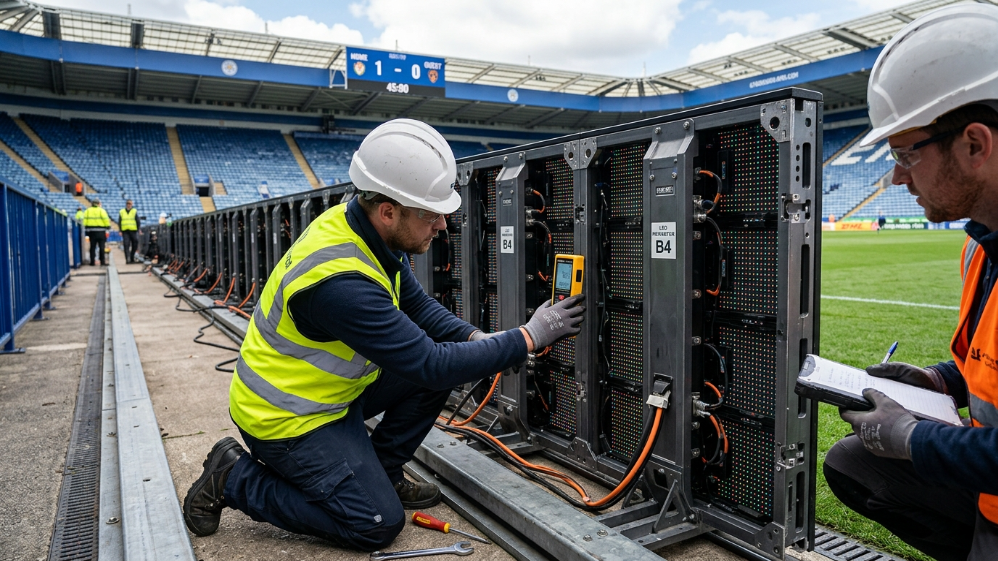
Short answer:no single global standard exists,but three sizing layers are consistently used across the industry,and confusing them is where almost every costly mistake originates.
Layer 1—LED Module
The smallest building block,typically 320×160mm or 400×300mm,housing the actual LED chips and the pixel matrix.
Layer 2—Cabinet
A frame holding multiple modules together,most commonly 960×960mm or 1600×900mm,which determines shipping weight,mounting method,and how fast your crew can assemble the line.
Layer 3—Perimeter Run
The total assembled length around the pitch,usually 200–280 meters for a full football perimeter,which is where your final budget and cabinet count actually get calculated.
Suppliers advertise Layer 1 and Layer 2 specs on their product pages because those are the numbers that make a spec sheet look impressive.But what you’re actually purchasing—and what your finance team is actually approving—is Layer 3.A buyer who asks”what’s your standard cabinet size?”without asking”how many cabinets and what’s my total run length?”is negotiating with incomplete information,and suppliers know it.
How Pixel Pitch Determines Your Screen’s Physical Size and Clarity

Pixel pitch—the distance in millimeters between the centers of two adjacent LEDs—is the single spec that has the most influence on both image quality and your total cost.A smaller pitch packs more LEDs into the same physical area,giving you a sharper image at close range.A larger pitch spaces the LEDs further apart,which lowers manufacturing cost and cabinet weight but requires more viewing distance before the image resolves cleanly.
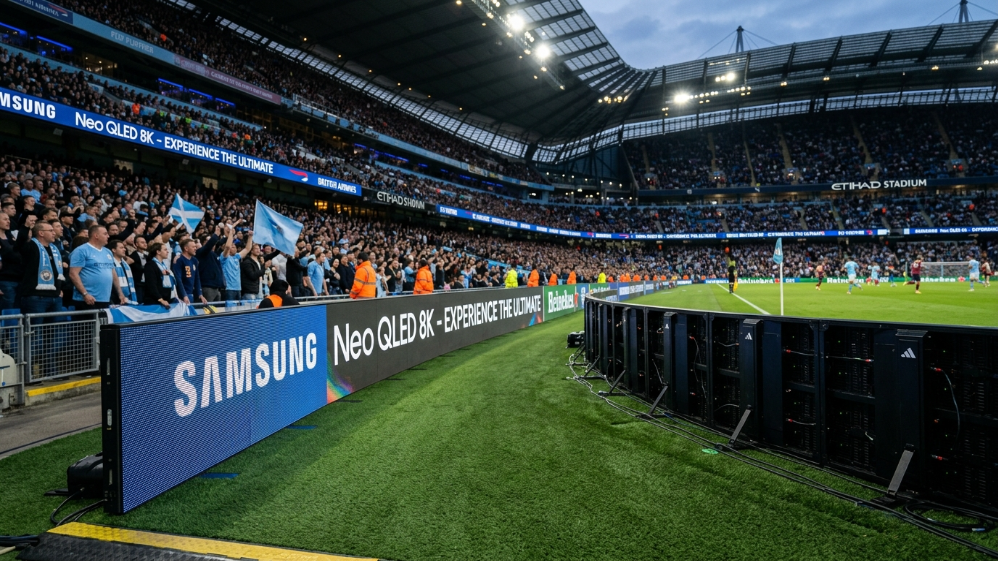
For a pitch-side perimeter screen,the nearest viewer is rarely a spectator—it’s a broadcast camera positioned 10-15 meters back,or a fan in the front row of the lower tier.According to industry viewing-distance guidance,minimum viewing distance in meters roughly equals the pixel pitch in millimeters.That means a P10 screen needs viewers to be at least 10 meters away to avoid seeing individual pixels—which is exactly the geometry of a pitch-side installation,and exactly why P10 remains the volume leader for outdoor stadium perimeters despite finer options being available.
| Pixel Pitch | Typical Use Case | Business Trade-off |
| P6.25 | Closer-seating venues,premium sponsor visibility | Higher resolution,higher module count,higher cost per meter |
| P8.33 | Mid-range stadiums,balanced broadcast+budget | Sharp enough for HD broadcast cameras at standard distances |
| P10 | Standard outdoor perimeter,long viewing distances | Lowest cost per meter,proven broadcast performance,easiest sourcing |
The commercial logic here matters as much as the optical logic.A P6.25 screen isn’t”better”in a vacuum—it’s better only if your seating geometry places fans close enough to justify the premium.Specifying P6.25 for a stadium where the nearest seat is 20 meters back doesn’t improve anyone’s viewing experience;it just adds cost that never converts into visible sharpness.This is a mistake we see repeatedly from buyers who assume pixel pitch works like screen resolution on a laptop—smaller number always better—rather than understanding it as a distance-matched engineering spec.
Does UEFA or FIFA Actually Mandate a Fixed Screen Size?
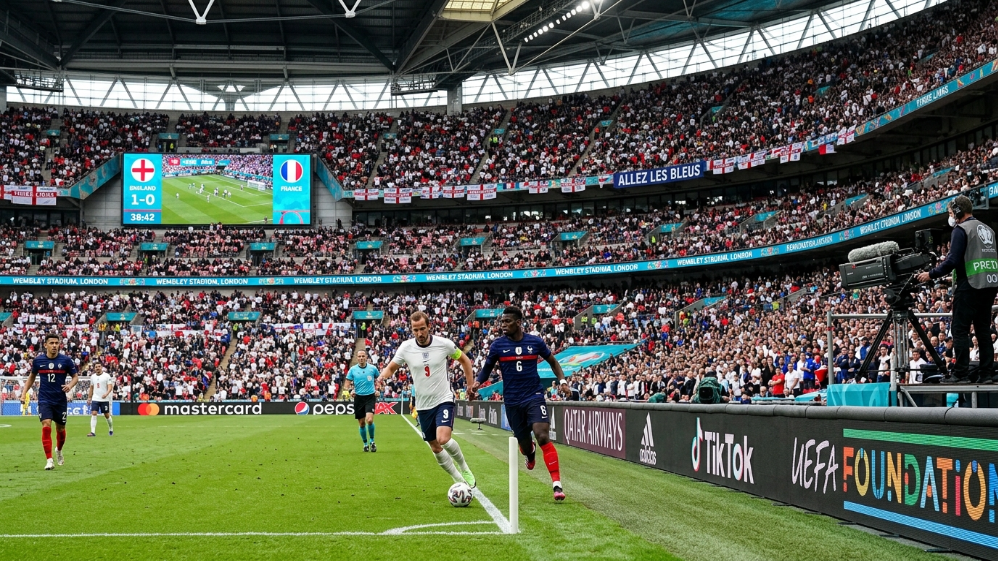
No—and this is one of the most persistent misconceptions in stadium procurement.UEFA’s stadium infrastructure guidance addresses LED perimeter systems primarily through the lens of sightlines,safety clearance,and broadcast integration,not a fixed cabinet dimension.The documentation focuses on where the screen sits relative to the pitch boundary,how it interacts with camera positions and advertising hoarding rotation cycles,and what impact-protection standards the cabinet surface must meet to keep players safe on collision.
What UEFA and FIFA do enforce,consistently across venues we’ve worked with,are player-safety requirements:soft-edge cabinet design,cushioned top padding,and rounded module masks that absorb impact energy rather than transferring it to a player sliding into the boards.A cabinet can be 960×960mm or a custom 1200×800mm and still fail compliance if the surface hardness or edge geometry doesn’t meet contact-sport safety thresholds.Conversely,a screen using an unconventional cabinet size can pass every compliance check if the safety engineering is sound.
The practical takeaway for buyers:don’t let a supplier tell you a specific cabinet size is”UEFA-approved”as a marketing shorthand.Ask instead for the actual impact-absorption test data and the sightline calculation for your specific stand geometry.That’s the compliance conversation that actually protects your investment—and your players.
How to Calculate the Total Size You Need for Your Stadium
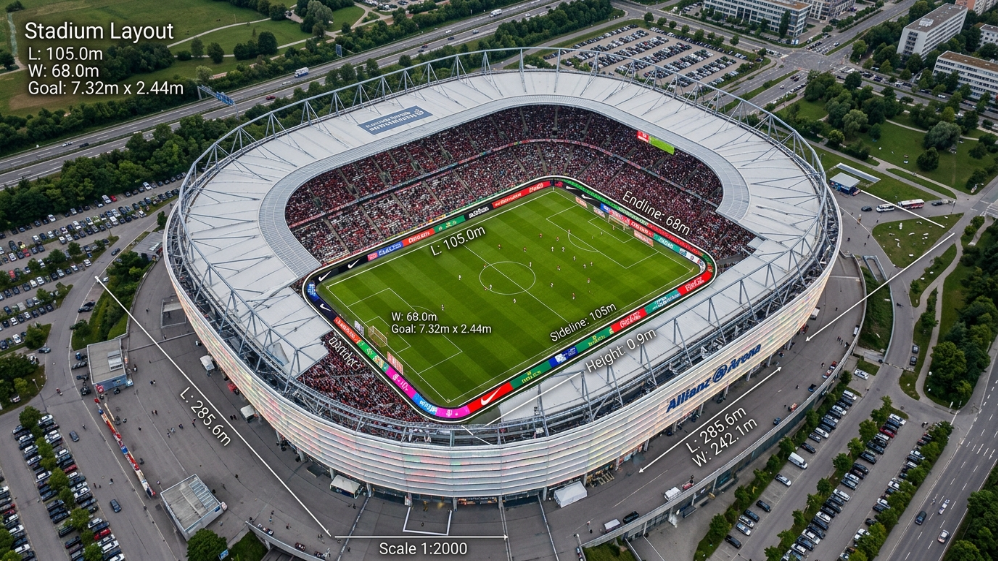
Once you understand the module-cabinet-perimeter hierarchy,sizing your own venue is arithmetic,not guesswork.Start by walking the actual pitch boundary with a measuring wheel rather than relying on published pitch dimensions—corner radii,camera pits,and substitute benches all eat into your usable run length,sometimes by several meters per side.
Divide that measured perimeter length by your chosen cabinet width to get your baseline unit count.A 220-meter run using 1600mm-wide cabinets needs roughly 138 units before you account for corners.Corners are where budgets get revised:a true 90-degree turn either needs a custom-angled cabinet or a small visible seam,and both options carry a cost implication your supplier should quote separately rather than bury in a lump-sum figure.
| Calculation Step | What You’re Solving For | Common Buyer Error |
| Measure the physical perimeter | True usable run length in meters | Using generic pitch dimensions instead of on-site measurement |
| Divide by cabinet width | Baseline number of cabinet units | Forgetting to round up for partial-cabinet gaps |
| Account for corners | Custom vs.standard cabinet cost | Assuming corners are included in the base quote |
| Add signal&power redundancy | Backup cabling and PSU count | Treating redundancy as optional rather than a broadcast requirement |
According to industry benchmarking on comparable installations,a full pitch-side run typically takes a six-person crew three to five days to assemble once cabinets arrive on site,with individual unit swaps taking under 30 minutes when a tool-free locking system is specified.Building that install-time estimate into your procurement timeline—not just the sizing math—is what separates a smooth handover from a delayed season opener.
Standard Sizes by Sport:Football,Basketball,Ice Hockey&Cricket Compared
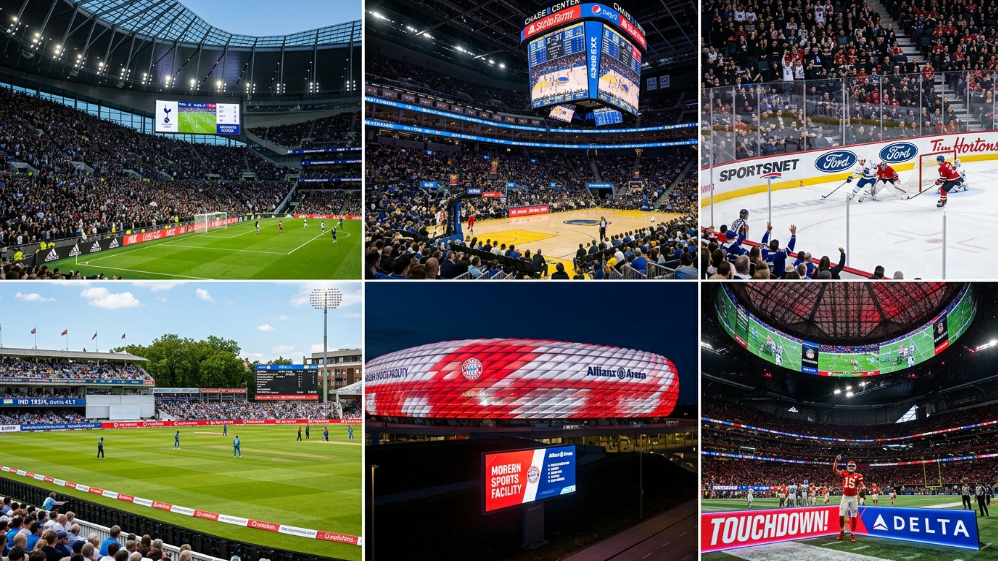
Perimeter sizing logic shifts meaningfully once you move outside football.A basketball arena’s ribbon board sits at seating-rail height rather than ground level,so cabinet height matters more than footprint weight.Ice hockey dasher-board LED systems need reinforced rear bracing to survive puck impacts at close range,which pushes buyers toward thicker,heavier cabinets even at the same pixel pitch.Cricket boundary boards run a longer,gentler curve than a football touchline,making flexible or hinged cabinet joints a practical requirement rather than a nice-to-have.
| Sport | Typical Mounting | Sizing Priority |
| Football/Soccer | Ground-level,full touchline+end zones | Total run length,corner handling |
| Basketball | Rail-mounted at seating edge | Cabinet height,viewing angle from lower bowl |
| Ice Hockey | Dasher board integration | Impact resistance,reinforced rear structure |
| Cricket | Boundary rope perimeter | Curve flexibility,longer continuous runs |
Sizing Mistakes That Cost Buyers Time and Money
Three patterns show up again and again across procurement cycles we’ve reviewed.First,buyers copy a competitor stadium’s spec sheet without an on-site survey,then discover their own venue’s structural mounting points don’t match.Second,teams choose a finer pixel pitch than their seating geometry justifies,paying a premium for sharpness nobody in the stands is close enough to perceive.Third—and most expensive—buyers skip signal and power redundancy to shave the initial quote,only to face a black-screen moment during a broadcast window when a single cable fails.
Standard Size Reference Table
| Parameter | Common Range |
| Module Size | 320×160mm/400×300mm/480×320mm |
| Cabinet Size | 960×960mm/1600×900mm/1280×960mm |
| Pixel Pitch | P6.25–P10 |
| Brightness | 5,000–10,000 nits |
| IP Rating | Front IP65/68,Rear IP54/66 |
| Refresh Rate | 1,920Hz–18,000Hz |
| Cabinet Weight | 25–60 kg/unit |
| Total Perimeter Length | 200–280m(football) |
Frequently Asked Questions
What is the standard pixel pitch for a stadium LED screen?
Outdoor perimeter installations typically use P6.25 to P10,with P8.33 and P10 covering the majority of professional football venues where camera and fan viewing distances exceed 10 meters.
How long is a full football stadium perimeter LED display?
Most professional pitches require 200 to 280 meters of continuous LED run to cover both touchlines and end zones,though exact length depends on camera pit cutouts and substitute bench positioning.
What is the standard module size for perimeter LED screens?
320×160mm and 400×300mm are the two dominant module sizes,chosen because they scale cleanly into the 960×960mm and 1600×900mm cabinet formats most manufacturers stock as standard.
Does a perimeter LED screen need to meet UEFA standards?
UEFA compliance centers on player-safety engineering—soft-edge cabinets,impact-absorbing top padding—and broadcast sightlines,rather than a mandated cabinet dimension.
How much does an outdoor stadium perimeter LED screen cost per meter?
Cost per meter varies with pixel pitch,brightness,and cabinet material,but pixel pitch and total run length are consistently the two largest cost drivers according to supplier quoting patterns across the industry.
Expert Verdict
Treat”standard size”as a starting range,not a fixed spec.If your venue sits at typical broadcast viewing distances,P8.33 or P10 on a 960×960mm or 1600×900mm cabinet will match what most professional stadiums already run—proven,serviceable,and cost-efficient.Deviate from that only when your seating geometry,sport,or venue structure genuinely demands it,and always get the total-perimeter math and redundancy plan quoted separately from the headline cabinet spec.
B2B Procurement & Pricing Advisory Note
From a B2B procurement perspective, stadium perimeter LED screen pricing is highly sensitive to total linear run volume, pixel density, and safety compliance certifications. While entry-level P10 configurations provide the lowest upfront cost per square meter, the Total Cost of Ownership (TCO) is heavily determined by ongoing power consumption, structural compatibility with venue foundations, and local maintenance SLA costs. Procurement officers are strongly advised to demand unit-level breakdowns and ensure that essential mechanical features (such as UEFA-compliant soft-impact masks and dual-receiver power redundancy loops) are quoted as native inclusions rather than high-margin post-bid upsells. To minimize commercial risk, contracts should always bind final milestones to third-party broadcast-readiness certification and local structural safety sign-offs.
References:
UEFA Stadium Infrastructure Regulations – Edition 2018
FIFA Football Stadiums: Technical Recommendations and Requirements