Every producer we’ve ever spoken with arrives at the same wall: the backdrop looked stunning in the room, and then the show footage came back with banding, muddy color, or a pixel grid visible in every front-row photo. That’s not bad luck—it’s a spec sheet built for a concert hall being reused for a runway, and it happens because most rental catalogs never separated the two use cases in the first place.
A fashion show runway LED catwalk stage backdrop lives or dies on three numbers before anything else:
- Refresh rate above 3840Hz to kill camera flicker
- Pixel pitch between P1.9 and P2.9 for viewing distances under three meters
- A grayscale processing depth fine enough to hold garment color true under mixed stage lighting
Get those three wrong and no amount of clever staging saves the footage.
| Requirement | Minimum Spec | Why It Matters on a Runway |
|---|---|---|
| Refresh Rate | ≥3840Hz | Stops rolling bands on broadcast cameras and phone footage |
| Pixel Pitch | P1.9–P2.9 | Matches the closer viewing distance of a front row, not a stadium |
| Color Processing | 16-bit grayscale minimum | Keeps garment color from drifting under changing stage light |
| Cabinet Weight | Under 7kg/m² for touring rigs | Cuts crew time and rigging load between fashion week venues |
We build to this table because we’ve watched what happens when a supplier doesn’t.
At Sostron, our engineering team has spent years on exactly this intersection—display hardware that has to perform for a live audience and a camera lens at the same time—designing modules, driving boards and cabinet frames around that dual demand rather than repurposing a concert-grade product and hoping it holds up under a shutter speed it was never tested against.
Inside the Cabinet: The Materials Nobody Asks About Until Something Fails
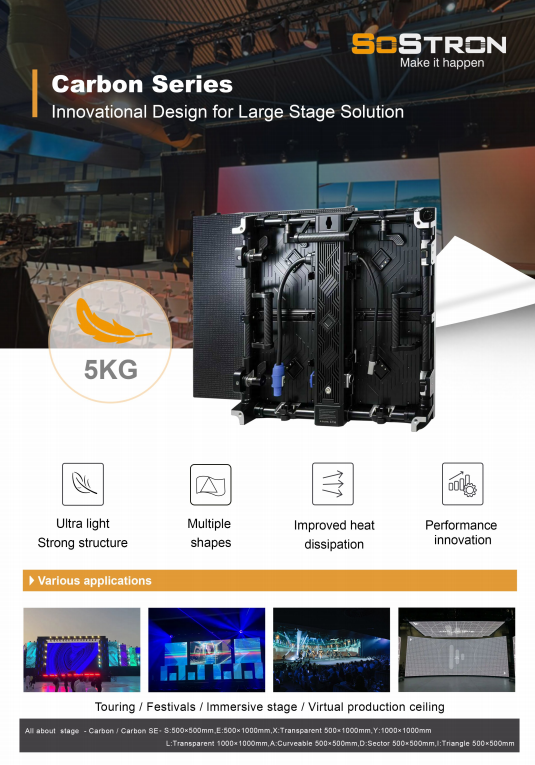
Ask most rental catalogs what their cabinet is made of and you’ll get a shrug.
That’s the wrong answer for a runway backdrop, because the frame material decides how the screen behaves under two forces a stadium wall never faces:
- repeated touring impact
- close-range visual scrutiny
Die-cast aluminum cabinets, machined rather than stamped, hold flatness across a seam line far better than steel-framed alternatives—and flatness at the seam is the difference between an invisible join and a visible dark line running through a model’s silhouette on camera.
The front mask matters just as much:
A matte, anti-glare surface coating keeps stage spotlights from bouncing straight back into the lens, which is a problem projection and gloss-finish panels never fully solve.
None of this shows up on a brochure’s headline spec, and almost none of it gets asked about until a screen has already failed on a touring schedule.
Why Production Teams Keep Calling Us Back
Here’s the honest version of “why choose us”: it isn’t a slogan, it’s a supply chain.
Sostron designs and manufactures out of our own Shenzhen facility, which means the module that goes into a runway backdrop was specified, tested and aged in-house—not sourced from three different vendors and assembled to a rental house’s minimum price point.
Every module runs through a 72-hour aging test before it ships, checked for dead pixels, brightness consistency and color uniformity, because a screen that passes inspection on day one and drifts by week three is a liability nobody in this industry can afford during fashion month.
We’ve supported deployments across North America, Europe, the Middle East and Asia, and the pattern holds everywhere:
The projects that go smoothly are the ones where the manufacturer owns the full chain from module design through installation support, not just the box that gets shipped.
Fabric, Projection, or LED—The Decision Most Riders Get Wrong
Fabric drapes and rear-projection screens dominated runway backdrops for decades because they were cheap and forgiving of error.
Neither survives contact with a modern show rider.
Projection needs near-total blackout to hold contrast, which fights directly against the spotlight-heavy lighting most fashion directors want falling on the models.
Fabric has no light source of its own—it depends entirely on even external illumination hitting a fifteen-meter run, which almost never happens in a real venue, and the result photographs flat no matter how good the garment looks in person.
Design and staging writers covering fashion week production have made similar observations about backdrop lighting limitations—Social Tables’ coverage of runway stage design notes how backdrop and lighting choices directly shape audience sightlines and visual impact, a constraint that only gets harder to manage with static materials.
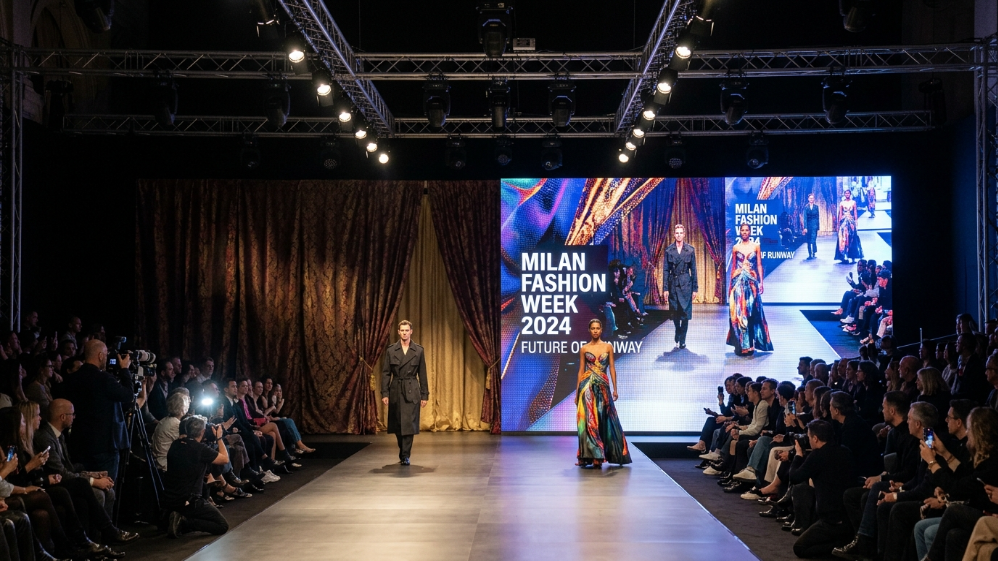
An LED catwalk stage backdrop sidesteps both problems by being self-luminous:
- It holds saturated color and contrast under any house lighting.
- It can shift scene, color temperature and motion graphics between collection segments without touching a single physical prop.
The tradeoff producers don’t always hear about upfront is that “LED” isn’t one product—it’s a spec sheet full of decisions, and this is where sourcing conversations usually go sideways.
The Flicker Nobody Notices Live but Every Camera Catches
Refresh rate is how many times per second the panel redraws its image.
A screen rated at 1920Hz looks perfectly smooth standing in the room.
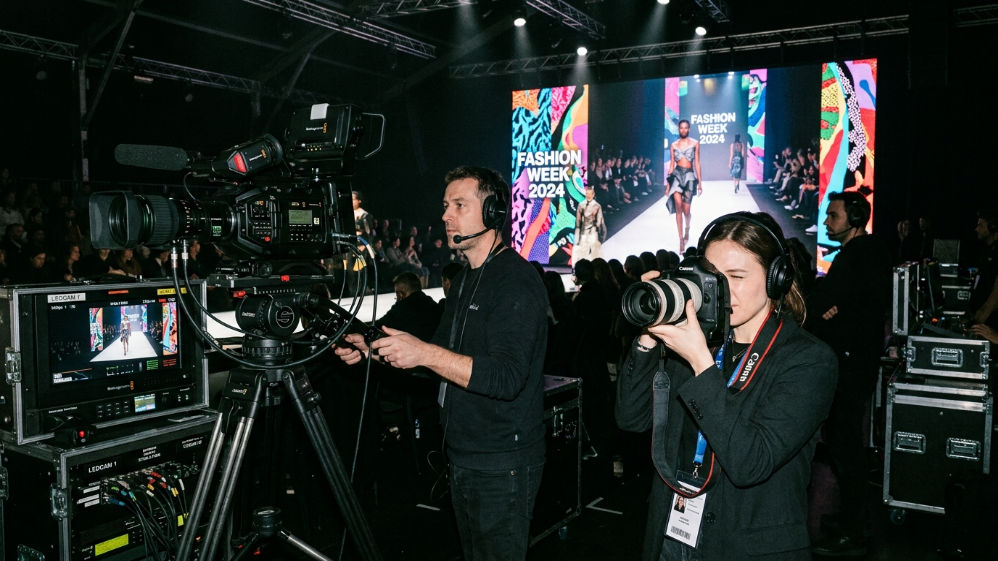
Point a DSLR or a phone at a fast shutter speed toward that same screen and you’ll pull back footage with visible horizontal bands rolling through it—invisible to the eye, glaring in the photos, which for a fashion show is the entire point of the exercise.
Based on our experience specifying screens for televised and livestreamed runway shows, anything under 3840Hz is a gamble the moment a photographer’s shutter speed climbs past 1/250s.
| Feature | Advantage | Benefit |
|---|---|---|
| High-frequency scanning drive at 3840Hz or above | No visible banding at fast shutter speeds or high frame-rate video capture | Every photo and livestream frame is publication-ready straight off the card, without a color-correction pass eating into a brand’s same-day social content window |
How Close Is Too Close? Pixel Pitch and the Front Row Problem
Pixel pitch—the distance in millimeters between LED clusters—sets the minimum comfortable viewing distance before individual pixels stop blending into a smooth image.
Outdoor advertising and concert walls run P3.9 to P6 because the audience sits far back.
A catwalk is a different animal entirely:
Editors and buyers in the front row routinely sit 1.5 to 3 meters from the backdrop, and a T-stage end can bring guests even closer than that.
| Pixel Pitch | Recommended Viewing Distance | Best Fit |
|---|---|---|
| P0.9–P1.5 | 1m+ | Backstage press wall, brand step-and-repeat |
| P1.9–P2.6 | 2m+ | Standard runway backdrop, front-row seating |
| P2.9–P3.9 | 3m+ | Large venue runway, mid-to-back seating |
| P4.8+ | 5m+ | Outdoor fashion event, large public installation |
Pick too coarse a pitch for a small venue and the front row—often the exact press and VIP buyers a brand most needs to win over—sees a pixel grid instead of a clean image.
Pick unnecessarily fine pitch for a large arena and the budget disappears into resolution nobody in the room can perceive.
The right answer always starts with measuring the venue’s actual minimum viewing distance, not defaulting to whatever pitch happens to be sitting in a rental warehouse.
COB or SMD: The Argument That Actually Decides Color Accuracy
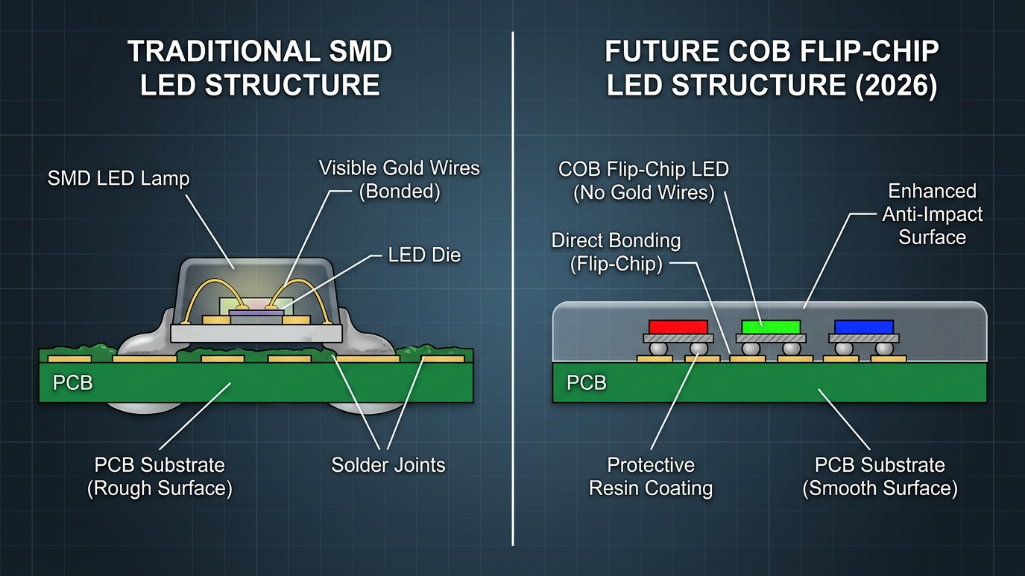
This is where the spec sheet stops being abstract and starts changing how the clothes themselves look.
Standard SMD (Surface-Mounted Device) modules mount red, green and blue diodes as visible individual points on the board surface.
COB (Chip-on-Board) technology embeds the LED chips directly into the circuit board and seals them under a flat protective layer, which changes three things that matter specifically for a runway backdrop:
| Feature | Advantage | Benefit |
|---|---|---|
| Sealed, flush LED surface with no visible diode gaps | Higher contrast ratio, no light bleed between pixels, and greater physical durability during rigging and touring | Garment colors stay consistent whether a guest is seated dead-center or off to the side—a real constraint given that runway seating is fan-shaped, not a single fixed axis like a cinema screen |
COB panels also shrug off the bumps of a touring load-in far better than exposed-diode SMD modules, which matters when the same backdrop is being struck and re-rigged in a different city every few days through fashion month.
Not Every Runway Is a Straight Line
A classic catwalk ends in a T, a cross, or occasionally a full round stage—and a flat rectangular LED wall can’t wrap around any of those without a visible seam or a dead corner.
Flexible cabinet systems solve this by letting individual modules bend along a hinge point, curving inward at a T-stage end or wrapping a circular platform without a gap.
The commercial case is simple:
A curved catwalk backdrop wraps the audience visually from three sides instead of confronting them with one flat plane, which is exactly the immersive brief most fashion directors are chasing when they ask for “something more than a straight wall.”
A flat panel can’t deliver that brief at any price point; a flexible one can, using the same quick-release hardware as a standard flat cabinet.
Transparent LED is worth knowing about too.
Mounted at a runway entrance, it lets models emerge from behind a glowing graphic rather than a solid curtain—a detail that reads well on camera precisely because it’s still uncommon.
Three Cities, Ten Days: What Touring Fashion Week Actually Demands
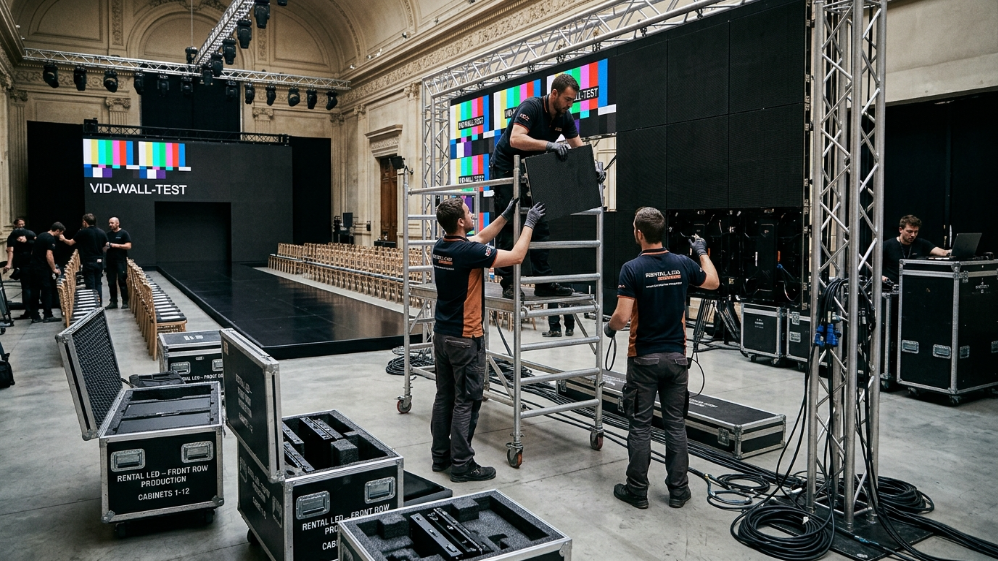
Fashion month means Paris, then Milan, then New York, sometimes inside the same two weeks.
A backdrop that takes six hours to rig isn’t a backdrop a touring production can use twice, and this is the part of the spec sheet rental houses feel most acutely—and the part most manufacturer marketing pages skip past entirely.
| Logistics Factor | What to Specify | Why It Matters on Tour |
|---|---|---|
| Cabinet locking system | Quick-lock, tool-free cam-lock cabinets | Cuts rig time roughly in half versus screw-mounted panels |
| Cabinet weight | Under 7kg/m² | Reduces truss and ground-support load rating and crew headcount |
| Case format | Road-ready flight cases, stackable | Survives repeated air and road freight between venues |
| Cable routing | Front-access, tool-free service | Allows repairs during a twenty-minute changeover, not a full teardown |
| Export documentation | Pre-cleared HS codes, CE/FCC/RoHS certification | Avoids customs delays that can strand a show without its backdrop |
We’ve shipped modular runway systems into three fashion week cities inside a single tour cycle, and the recurring failure point is never the LED technology itself—it’s a supplier who never designed for touring in the first place, sending screw-mount cabinets with no export paperwork ready, turning a two-hour rig into an overnight scramble nobody budgeted for.
Keeping Backdrop, Floor and Sidewalls Talking to Each Other
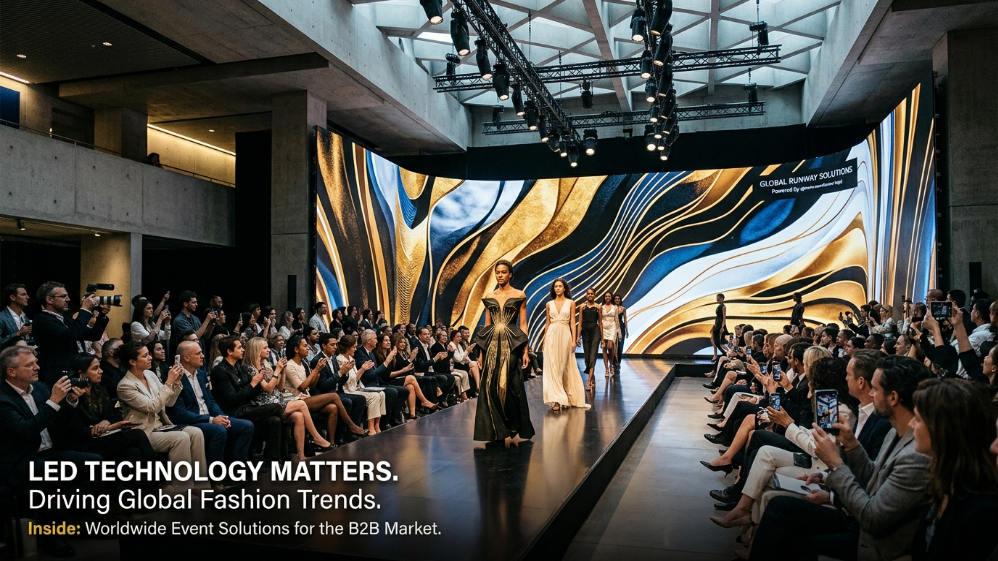
A single backdrop screen is the easy case.
Most contemporary runway productions run a backdrop plus a floor strip or side walls, all of which need to change scene on the same cue as the lighting board and the music track.
Without centralized control software, that synchronization falls to a technician manually triggering screens in sequence—and manual triggering is exactly how visible desync ends up on a livestream feed.
A proper CMS lets one operator:
- Schedule content across every screen from a single timeline.
- Watch brightness and device health in real time.
- Fire scene changes on the same cue point as lighting and audio.
For a producer running six to twelve outfit segments in twenty minutes, that’s not a convenience feature.
It’s the difference between a show that reads as one cohesive statement and one that reads as several screens doing their own thing.
Buy It or Book It? A Straight Answer for Integrators
| Scenario | Recommended Path | Reasoning |
|---|---|---|
| One-off show, single city | Rent from a local AV house | No storage, shipping or maintenance burden for a single use |
| Recurring seasonal fashion weeks | Buy direct from a manufacturer | Amortizes cost across multiple shows within 2–4 seasons |
| Fixed flagship store or showroom | Buy, fixed installation | Rental economics never break even on a permanent install |
| Touring international production | Buy with manufacturer logistics support | Rental houses rarely stock touring-spec cabinets in every city |
The break-even math is simpler than most buyers expect:
At typical rental rates for a fine-pitch runway backdrop, three to four seasons of rental spend covers the outright purchase cost of an equivalent owned system—after which every additional show runs close to pure margin.
A Season on the Road: One Producer’s Backdrop Problem, Solved
A mid-sized European ready-to-wear house came to us mid-season with a familiar complaint:
Their existing rental backdrop looked washed out on livestream, and their AV partner couldn’t explain why.
The venue was small, front row sat under two meters back, and the previous supplier had installed a standard P3.9 concert-grade panel running at 1920Hz—fine for a stadium, wrong on both counts for this room.
We reworked the spec to a P2.6 COB panel at 3840Hz, matched the cabinet weight to their existing truss rating so no rigging changes were needed, and built the show’s six scene changes into a single CMS timeline synced to their lighting cues.
The next show’s livestream came back with clean color and zero banding, and their production lead’s note back to us was simple:
The backdrop stopped being something they had to think about, which is really the whole goal.
Questions We Get Asked Before Every Fashion Week
What pixel pitch is best for a fashion show runway backdrop?
For front-row viewing under three meters, P1.9–P2.6 is the standard call; larger venues with back-seated audiences can run P2.9–P3.9 without a visible loss of clarity.
Can an LED catwalk backdrop curve around a T-stage or round runway?
Yes—flexible cabinet systems bend along hinge points to form concave curves or full circular wraps, something standard flat modules simply can’t do.
Is LED actually better than fabric or projection for a fashion show backdrop?
For any show with photography, livestream or broadcast components, LED wins on contrast, color consistency and scene-change flexibility that neither fabric nor projection can match.
How fast can an LED runway backdrop be installed and struck between venues?
Quick-lock cabinet systems under 7kg/m² typically rig a mid-size backdrop in under two hours with a four-person crew, and strike in roughly half that time.
Does a fashion show LED backdrop need a separate content control system?
Any production running more than one screen—backdrop plus floor or side walls—needs a CMS to keep scene changes synchronized with lighting and music.
Manual triggering carries real desync risk on camera.
The Short Version
If you take one number away from this, make it refresh rate—a beautiful backdrop that bands on every photo and livestream frame has failed at its one job.
Past that:
- Match pixel pitch to your actual front-row distance.
- Specify COB for anything within touching distance of guests.
- Never sign a touring contract with a supplier who can’t hand you a quick-lock cabinet and export paperwork already in place.
The technology is mature.
The sourcing decision is where most productions still get it wrong.
Built in Shenzhen, Running on Runways Worldwide
Sostron designs, manufactures and supports LED display systems from our own facility, which is the part of this business that’s hardest to fake and easiest to feel the absence of when a screen fails mid-tour.
Every module we ship has been through our own 72-hour aging protocol before it leaves the factory, and our engineering team stays on the project from the first CAD layout through on-site installation guidance—not handed off to a third party once the PO clears.
If your production runs on a touring schedule, our rental LED display systems are built around the quick-lock, lightweight cabinet requirements this guide covers in detail, with modules aged and tested before they ever reach a truck.
And if you’re planning a fixed installation—a flagship store runway, a permanent show venue, or a design school stage—our fine pitch and COB display solutions cover the close-viewing color accuracy a front row actually demands.
Either way, talk to our engineering team before the spec sheet is finalized, not after the venue’s already booked.
Price Note
The final price of a fashion show runway LED catwalk stage backdrop depends on several factors, including pixel pitch, display size, cabinet material, refresh rate, LED technology (SMD or COB), rental duration, installation requirements, control system configuration, and shipping conditions.
Fine-pitch COB LED solutions typically require a higher initial investment due to advanced manufacturing processes and superior close-viewing performance, while rental solutions may vary based on event location, production schedule, and technical support requirements.
For an accurate quotation, we recommend confirming your stage dimensions, viewing distance, application scenario, and project timeline with an LED display specialist before selecting the final specification. A properly matched LED system helps avoid unnecessary costs caused by unsuitable resolution, insufficient refresh rate, or repeated upgrades.
References:
IEC 60529 – Degrees of Protection Provided by Enclosures (IP Code)