For a LED billboard Moscow Russia project, the correct buying decision starts with the site, not the screen. Viewing distance, screen size, daylight exposure, pixel pitch, brightness, weather protection, structural design, power consumption, installation, and local advertising requirements all affect the final specification and project cost. Current Moscow supplier listings show outdoor LED solutions commonly offered around P5–P10, with published brightness figures reaching 8,000–10,000 nits and IP-rated outdoor cabinets; published equipment prices vary substantially by specification and configuration.
| Project factor | Typical specification direction | Business benefit |
|---|---|---|
| Viewing distance | Determines pixel pitch | Prevents overspending on unnecessary resolution |
| Daylight exposure | Determines brightness | Keeps advertising content visible |
| Outdoor environment | IP-rated cabinet + thermal design | Reduces weather-related downtime |
| Screen size | Based on viewing angle and site | Maximizes usable advertising area |
| Service method | Front or rear access | Reduces maintenance labor and access costs |
| Content management | CMS / remote control | Allows centralized DOOH operation |
A billboard is therefore not simply a collection of LED modules. It is an engineered advertising asset. For B2B buyers, the objective is to specify enough performance for the location without paying for performance that the audience will never perceive.
How Much Does an LED Billboard Cost in Moscow, Russia?
There is no single reliable price for an LED billboard in Moscow because the quoted equipment can range from a relatively simple outdoor display to a complete engineered structure with power distribution, controller, steelwork, installation and commissioning.
Current Moscow supplier listings illustrate the spread. One supplier lists outdoor LED displays from about RUB 64,000/m², while another lists outdoor models from approximately RUB 55,000/m². Other listings show substantially higher prices depending on pixel pitch, brightness, cabinet configuration and service design. These are current supplier asking prices, not a universal market benchmark or a complete project quotation.
The distinction matters because a low per-square-meter screen price can exclude several project-critical components.
| Cost component | What to verify in the quotation | Why it matters commercially |
|---|---|---|
| LED cabinets / modules | Pixel pitch, LED type, quantity | Determines image quality and screen area |
| Receiving / control system | Controller and receiving cards | Enables stable image transmission |
| Power distribution | Distribution cabinet, cables, protection | Affects electrical safety and operating reliability |
| Steel structure | Included or excluded | Can become a major project cost |
| Transportation | Delivery terms and packaging | Influences landed cost |
| Installation | Labor, lifting equipment, commissioning | Directly affects deployment cost |
| CMS | Included, optional or third-party | Determines remote content management |
| Spare parts | Modules, power supplies, receiving cards | Reduces downtime after installation |
| Warranty / service | Coverage and response process | Affects long-term operating risk |
For a commercial buyer, the relevant figure is therefore total project cost, not simply the LED screen price per square meter.
Equipment Price vs. Complete Project Cost
A useful RFQ should separate at least three layers:
LED display equipment → installation infrastructure → operational requirements
For example, a quotation may appear inexpensive because it covers only cabinets and control hardware while excluding the steel structure, electrical distribution, transport, installation and commissioning.
Based on our experience with international LED display projects, this is one of the easiest ways for buyers to compare quotations incorrectly. Two suppliers can quote the same screen area while offering materially different project scopes.
For a Moscow project, request an itemized quotation rather than accepting a single “LED screen price.”
What Determines the Price of a Moscow LED Billboard?
Screen Size Changes More Than the Number of LED Cabinets
A larger display obviously requires more LED modules and cabinets, but size also affects:
- Steel structure requirements
- Power distribution
- Cable length
- Transportation volume
- Installation equipment
- Maintenance access
- Wind-load calculations
The commercial benefit of increasing screen size therefore depends on the advertising location. A larger screen is valuable when it improves visibility and usable advertising inventory; it is not automatically more profitable simply because it contains more LEDs.
Pixel Pitch Affects Both Image Quality and Budget
Pixel pitch is the distance between the centers of adjacent pixels, measured in millimeters. A smaller pitch places more pixels into the same physical area and can produce finer image detail at closer viewing distances.
Current Moscow outdoor product listings commonly show configurations such as P5, P6.67, P8 and P10.
The commercial question is not:
“What is the smallest pixel pitch available?”
It is:
“What is the smallest pixel pitch the audience actually needs?”
For a roadside billboard viewed from a long distance, moving from a larger pitch to an unnecessarily fine pitch can increase equipment cost without creating a proportional advertising benefit. Conversely, a screen positioned close to pedestrians or a commercial building may require finer pixel density to maintain readable text and detailed imagery.
Brightness Influences Daytime Visibility
Outdoor LED billboards operate under changing ambient light. A screen that looks excellent in a dark showroom can perform very differently under direct daylight.
Current Moscow outdoor listings show products with brightness figures such as 6,500–8,500 cd/m² and individual products advertised at 8,000 nits or more.
Brightness is therefore not simply a specification to maximize.
Higher brightness can improve daytime visibility, but excessive output can increase power consumption and create an unnecessarily harsh viewing experience, particularly after sunset. A practical system should combine sufficient peak brightness with automatic brightness control.
The business benefit is straightforward: the display remains readable when ambient light changes while avoiding the operating cost and visual problems associated with running at maximum brightness continuously.
How Do You Choose Pixel Pitch for an LED Billboard in Moscow?
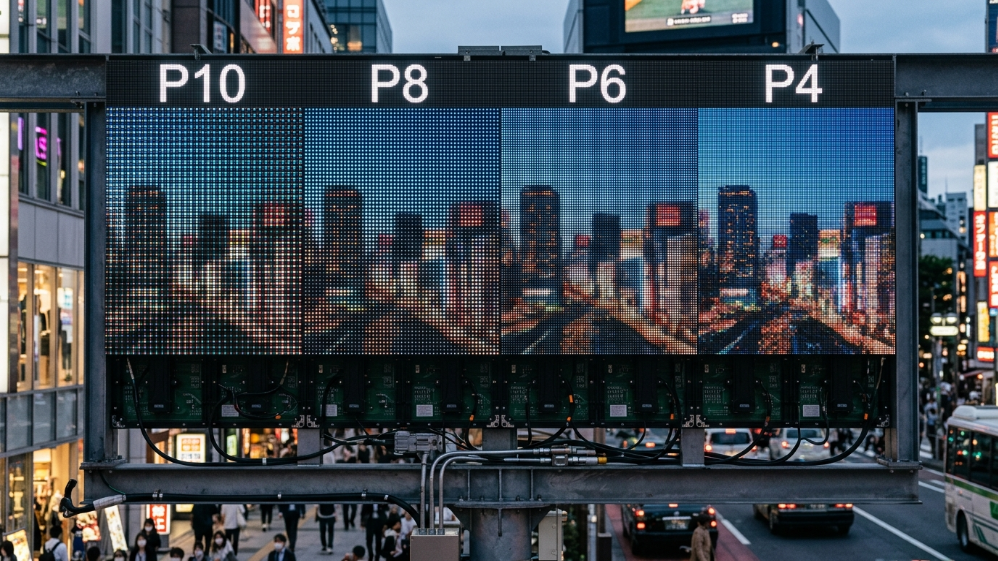
The correct pixel pitch depends primarily on viewing distance, content type, screen dimensions and the intended audience.
A useful starting framework is:
| Application environment | Pixel-pitch direction | Main reason | Commercial implication |
|---|---|---|---|
| Long-distance highway billboard | Larger outdoor pitch | Audience views from farther away | Lower equipment cost per m² |
| Urban roadside advertising | Medium outdoor pitch | Mixed vehicle and pedestrian distances | Balance image quality and cost |
| Pedestrian-facing commercial display | Finer pitch | Shorter viewing distance | Better text and image detail |
| Premium facade / close-view installation | Fine pitch | High visual scrutiny | Higher image quality, potentially higher cost |
These are engineering starting points, not fixed Moscow standards. The actual selection should be based on a site survey.
Why P5 Is Not Automatically Better Than P8 or P10
A P5 display contains a smaller distance between pixels than P8 or P10, so it can reproduce finer details at shorter distances. That sounds better until the viewing geometry is considered.
Imagine a large roadside billboard where most viewers are hundreds of meters away. If the audience cannot resolve the additional pixel density, the additional hardware investment may provide little commercial return.
For a DOOH operator, the better question is:
Does the additional pixel density improve the advertising product enough to justify the additional capital cost?
That is the point at which engineering specification becomes business analysis.
Viewing Distance Should Be Measured Before the Final RFQ
Before selecting pixel pitch, document:
- Nearest regular viewing position
- Typical viewing distance
- Maximum relevant viewing distance
- Vehicle speed, if roadside
- Pedestrian traffic, if applicable
- Content type
- Required text size
- Screen dimensions
A supplier can then recommend a practical pixel-pitch range rather than simply quoting the highest-resolution product.
How Bright Should an Outdoor LED Billboard Be in Moscow?
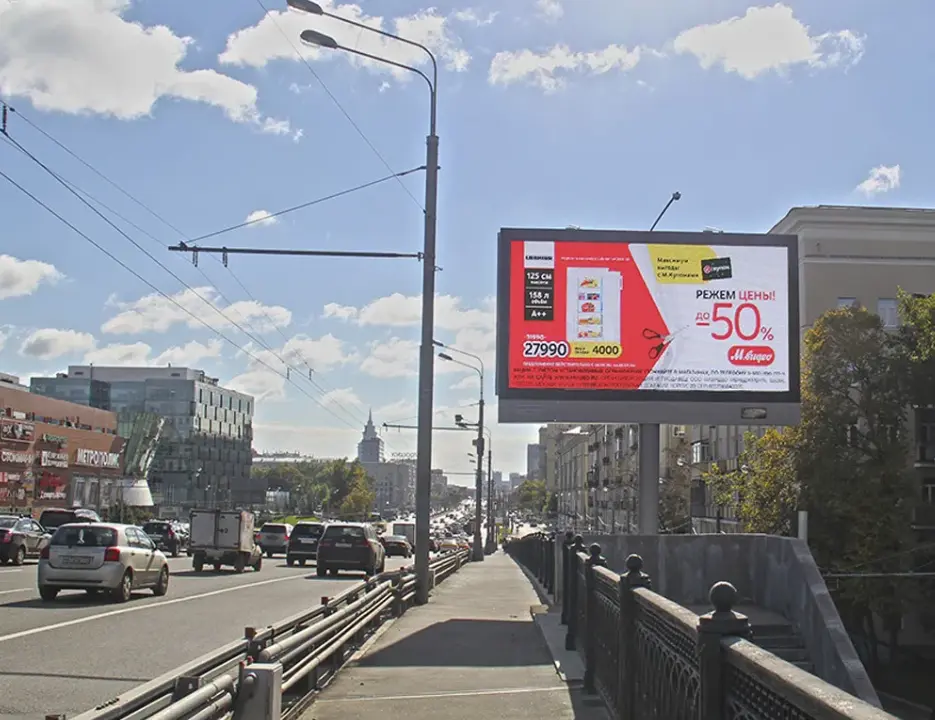
Brightness is normally specified in nits, numerically equivalent to cd/m² for this application.
For an outdoor Moscow installation, the required level depends on:
- Direct sunlight
- Screen orientation
- Building or roadside shading
- Time of day
- Seasonal conditions
- Screen content
- Automatic brightness control
- Viewing distance
Some Moscow suppliers currently market outdoor products in the 6,500–8,500 cd/m² range, while other outdoor billboard products are advertised at 8,000–10,000 nits.
These published figures should be treated as product specifications, not a universal specification for every Moscow billboard.
Why Automatic Brightness Control Matters
An outdoor LED billboard does not need to operate at maximum brightness 24 hours a day.
An ambient-light sensor can allow the system to adjust output according to environmental conditions. During strong daylight, higher brightness helps maintain visibility. At night, reducing brightness can improve viewing comfort and lower electricity consumption.
That creates a direct Feature → Advantage → Benefit chain:
Ambient-light sensor → automatic brightness adjustment → lower unnecessary operating output and more consistent viewing conditions.
For a DOOH operator managing multiple displays, the benefit becomes even larger because brightness management can be incorporated into centralized operating procedures.
What IP Rating Does an Outdoor LED Billboard Need?
An outdoor LED display needs protection against environmental exposure, but the IP rating should not be evaluated in isolation.
Current Moscow outdoor LED listings commonly specify IP65 protection on the front of the cabinet, with some products listing different rear protection levels.
The important point is to verify exactly what the manufacturer means by the stated IP rating.
Why IP65 Matters
IP65 indicates protection against dust ingress and protection against water jets from specified directions. For an outdoor LED cabinet, this supports reliable operation in rain and dusty conditions.
The commercial benefit is reduced exposure to environmental damage and potentially fewer weather-related maintenance events.
However, IP protection does not replace proper engineering.
Check Front and Rear Protection Separately
A buyer should request:
- Front IP rating
- Rear IP rating
- Cabinet sealing method
- Drainage design
- Cable-entry protection
- Power-supply enclosure protection
- Maintenance access arrangement
An LED cabinet can have a strong front enclosure while the overall installation still contains vulnerable power, cable or structural components.
Moscow Weather Requires More Than Waterproofing
An outdoor billboard in Moscow should also be assessed for:
- Snow exposure
- Freeze-thaw cycles
- Temperature variation
- Condensation
- Wind
- Thermal management
- Maintenance access during adverse weather
The LED cabinet is only one component of the outdoor system.
How Should the LED Billboard Structure Be Designed?
The display itself may be factory-engineered, but the supporting structure is site-specific engineering.
A freestanding billboard, building-mounted screen and media facade can have completely different structural requirements.
Steel Structure and Wind Load
The supporting structure must be evaluated according to the actual installation location, geometry, mounting method and applicable local requirements.
Do not allow a supplier to treat a generic steel frame drawing as a substitute for a project-specific structural assessment.
The commercial benefit of proper structural engineering is not simply “safety.” It also protects the investment from avoidable installation problems, excessive vibration, difficult maintenance access and later structural modifications.
Power Distribution Must Be Designed With the Screen
An LED billboard can have a significant electrical load, particularly when operated at high brightness.
A proper quotation should distinguish between:
- Maximum power consumption
- Typical or average power consumption
- Power distribution capacity
- Circuit protection
- Cable requirements
This distinction is important for TCO calculations. Maximum power is useful for electrical system sizing; average power is more useful for estimating routine operating costs.
Front-Service vs. Rear-Service Cabinets
Maintenance access should be decided before construction.
| Service configuration | Technical feature | Business benefit | Possible limitation |
|---|---|---|---|
| Front service | Modules / components accessible from display side | Useful where rear access is restricted | May require suitable front-service hardware |
| Rear service | Components accessed from behind | Convenient for accessible structures | Requires maintenance clearance |
| Hybrid | Different components use different access methods | Greater installation flexibility | More complex specification |
For a building-mounted LED billboard, front maintenance can become particularly valuable if there is no practical working area behind the screen.
What Permits Are Required for an LED Billboard in Moscow?
Technical procurement and advertising compliance should be treated as separate workstreams.
Russia’s advertising legislation specifically regulates outdoor advertising and the installation of advertising structures, including electronic display equipment placed on buildings, structures or elsewhere. Article 19 of the federal advertising law sets requirements for the use and installation of such advertising structures.
That means purchasing the hardware is not the same as obtaining permission to operate the advertising structure.
What Should Be Checked Before Ordering the Screen?
For a Moscow project, the buyer should verify the applicable requirements concerning:
- The proposed installation site
- Ownership or legal rights to the site
- Advertising-structure requirements
- Building or facade restrictions
- Structural documentation
- Electrical requirements
- Traffic-safety considerations
- Local approval procedures
The exact permitting route depends on the site and project circumstances.
A responsible LED manufacturer can provide technical documentation, drawings and equipment specifications for the project, but the manufacturer should not be treated as the authority responsible for approving the advertising location.
For this reason, regulatory verification should take place before finalizing the screen dimensions and structural design.
Should You Buy an LED Billboard From a Moscow Supplier or a China Manufacturer?
Once the site, viewing distance, brightness, weather protection and structural requirements are defined, the next decision is the supply model. For a Moscow project, buyers can work with a local Russian supplier, a China-based LED display manufacturer, or a combination of an overseas factory and local engineering or installation partners.
Current Russian supplier listings show that the local market includes companies providing outdoor screens, advertising structures, installation and service, while some international suppliers serve Russia through factory-direct supply and remote technical support.
The right comparison is therefore not simply local vs. China. It is about which party can take responsibility for each part of the project.
| Evaluation factor | Moscow / Russia supplier | China LED manufacturer | What the buyer should verify |
|---|---|---|---|
| Factory-direct pricing | Depends on business model | Often available | Compare equivalent specifications |
| Local installation | Potentially easier | May require local partner | Who performs commissioning? |
| Custom cabinet design | Supplier-dependent | Often flexible | Confirm engineering capability |
| Technical drawings | Usually available | Usually available | Request before production |
| Spare parts | May be locally stocked | May ship from factory | Stock location and lead time |
| Warranty support | Potentially local | Often remote or partner-based | Written response procedure |
| Project communication | Local language advantage | Depends on supplier | Dedicated technical contact |
| Large-volume procurement | Depends on supplier | Factory capacity may help | Production capacity and QA |
| International logistics | Fewer buyer-managed steps | More coordination required | Incoterms, packaging and transport |
| CMS / remote management | Supplier-dependent | Manufacturer-dependent | Confirm software scope |
The important commercial point is simple: compare the complete supply chain, not the factory price alone.
When Local Support Has Greater Value
A local supplier may be particularly useful when the project requires:
- Local installation crews
- Site surveys
- Immediate maintenance
- Local spare-parts inventory
- Russian-language project coordination
- Existing relationships with contractors
Some Russian suppliers explicitly position themselves around design, delivery, installation, warranty and service.
For an operator managing a large DOOH network, local response capability can have measurable value because a screen that is offline is not producing advertising inventory.
When Direct Factory Procurement Makes Sense
Direct procurement from an LED display manufacturer can become attractive when the buyer needs:
- Multiple screens
- Custom dimensions
- Special cabinet designs
- Energy-saving outdoor products
- Factory-level technical documentation
- Direct production communication
- Long-term spare-parts planning
But the buyer should not assume that a factory quotation automatically includes local engineering responsibility.
Before signing, clarify exactly who handles site engineering, structural verification, customs / logistics, installation, commissioning, warranty and field service.
What Should You Ask an LED Billboard Manufacturer Before Ordering?
A serious RFQ should go considerably deeper than:
“Please quote a P6 outdoor LED screen.”
The supplier needs enough information to engineer the system correctly, while the buyer needs enough information to compare competing quotations on an equal basis.
Technical Questions
Ask the manufacturer to provide:
- Pixel pitch
- LED package type
- Cabinet dimensions
- Cabinet weight
- Brightness
- Refresh rate
- Grayscale
- IP rating
- Maximum power consumption
- Average power consumption
- Operating temperature
- Service method
- Expected LED lifetime
- Controller model
- Receiving-card configuration
For example, a current Russian outdoor manufacturer specification lists P2.5–P10 pixel pitch, 5,500 cd/m² minimum brightness, 1,920–3,840 Hz refresh rate, IP65 protection and an operating range of –45°C to +50°C.
That is useful as a market reference, but it should not be treated as a mandatory Moscow specification. A project specification should be established from the actual site conditions.
Engineering Questions
For a permanent billboard, also request:
- Cabinet layout
- CAD drawings
- Mounting details
- Power distribution diagram
- Data-cable topology
- Steel-structure interface
- Maintenance access requirements
- Grounding requirements
- Recommended spare parts
- Installation instructions
This documentation has a direct commercial benefit: it allows the buyer’s local engineer or contractor to identify problems before equipment arrives at the site.
Commercial Questions
The commercial RFQ should separately state:
- Equipment price
- Packaging
- Shipping
- Installation
- Commissioning
- Warranty
- Spare parts
- CMS
- Training
- Remote technical support
- On-site service, if available
A quotation with ten line items is usually more useful than one attractive number.
What LED Billboard Specifications Should You Request From a Supplier?
The following RFQ framework can be sent to multiple manufacturers to make quotations genuinely comparable.
| Specification | Information to request | Why the buyer needs it |
|---|---|---|
| Screen size | Width × height | Defines advertising area |
| Pixel pitch | mm | Determines pixel density and viewing distance |
| Brightness | Nits / cd/m² | Determines daylight visibility |
| Refresh rate | Hz | Important for camera and video applications |
| IP rating | Front + rear | Defines environmental protection |
| Cabinet | Dimensions + material | Affects structure and logistics |
| Cabinet weight | kg/m² or cabinet | Affects structural calculations |
| Max power | W/m² | Helps size electrical infrastructure |
| Average power | W/m² | Supports operating-cost estimates |
| Operating temperature | °C | Important for outdoor reliability |
| Service method | Front / rear | Determines maintenance access |
| Controller | Brand + model | Defines system compatibility |
| CMS | Functions and license | Determines remote management capability |
| Warranty | Duration + scope | Defines after-sales protection |
| Spare parts | Recommended quantity | Reduces potential downtime |
This specification sheet also helps prevent one of the most common B2B purchasing mistakes: comparing a premium specification from one supplier against a stripped-down quotation from another.
How Does a Moscow LED Billboard Connect to a DOOH Advertising Network?
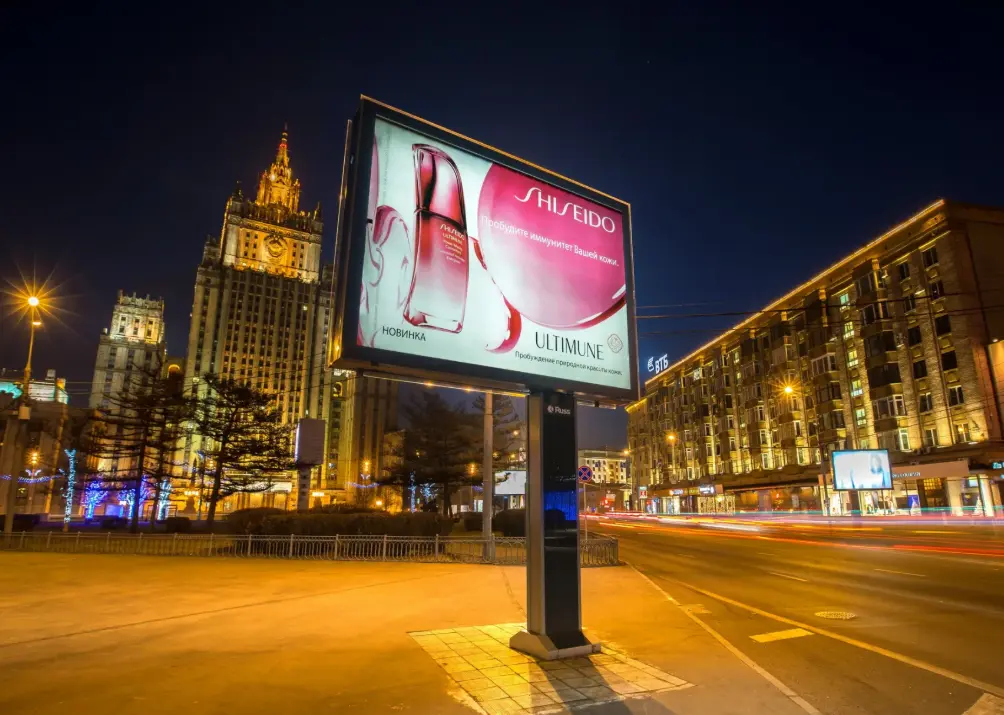
For a single screen, content control can be relatively simple. For a DOOH operator with multiple locations, the control system becomes part of the commercial infrastructure.
A professional CMS can provide:
- Remote content scheduling
- Multi-screen management
- Brightness control
- Device status monitoring
- Content updates
- Remote troubleshooting
The value is operational rather than merely technical. An operator should be able to change advertising content without sending a technician to every billboard.
CMS and Remote Content Scheduling
A typical workflow is:
Content creation → CMS upload → playlist scheduling → remote delivery → screen playback → device monitoring
For a network operator, centralized management can reduce repetitive field work and make advertising inventory easier to control.
4G, Ethernet and Cloud-Based Control
The appropriate communication method depends on the installation.
Possible options include:
- Wired Ethernet
- 4G / LTE
- Wi-Fi for suitable environments
- Cloud-connected controllers
- Hybrid communication architectures
The buyer should ask whether the quoted CMS requires a subscription, whether the software is included, and what happens if the internet connection is temporarily unavailable.
How Can You Reduce the Total Cost of Ownership of an LED Billboard?
The lowest purchase price does not necessarily produce the lowest TCO (Total Cost of Ownership).
For a permanent outdoor billboard, evaluate:
Purchase cost + infrastructure + electricity + maintenance + spare parts + service + replacement risk
Reduce Power Consumption Without Sacrificing Visibility
An outdoor LED display should provide sufficient brightness for the environment rather than operate permanently at its maximum output.
Average power consumption should therefore be requested alongside maximum power consumption.
The distinction matters because maximum power helps size the electrical system, while average power provides a more realistic basis for operating-cost estimation.
Choose Pixel Pitch From the Site
If the audience is far away, an unnecessarily fine pixel pitch can increase capital expenditure without a proportional improvement in perceived image quality.
Conversely, choosing too large a pitch for a close-view installation can compromise text and image detail.
The correct specification is the one that matches the viewing geometry.
Plan Spare Parts Before Installation
For a commercial DOOH screen, common spare parts may include:
- LED modules
- Power supplies
- Receiving cards
- Data cables
- Control components
The exact spare-parts package should be based on the product architecture and maintenance strategy.
The commercial benefit is obvious: a small component inventory can prevent a localized fault from becoming a prolonged screen outage.
Design Maintenance Access Into the Original Structure
Maintenance should never be an afterthought.
If technicians cannot safely reach the back of a screen, rear-service architecture may create unnecessary labor and access costs. Where rear access is impractical, front-service cabinets can simplify maintenance.
The right decision depends on the physical installation.
What Does a Complete LED Billboard Project Include?
A turnkey LED display solution normally extends well beyond the display itself.
Site Survey
The process starts with:
- Screen location
- Viewing distance
- Ambient light
- Mounting surface
- Electrical availability
- Maintenance access
- Environmental exposure
Solution Design
The manufacturer or engineering team can then determine:
- Screen dimensions
- Pixel pitch
- Brightness
- Cabinet configuration
- Controller
- Power architecture
- Service method
Manufacturing and Testing
A permanent outdoor screen should pass appropriate factory inspections before shipment.
Depending on the product and supplier, this may include:
- Module testing
- Cabinet inspection
- Pixel testing
- Color consistency checks
- Power-system testing
- Aging testing
The exact factory QA procedure should be requested in writing rather than assumed.
Delivery and Installation
The project then moves through:
Production → Factory testing → Packaging → International transportation → Site delivery → Installation → Commissioning
For an overseas manufacturer, the buyer should establish responsibility at every handoff.
Sostron’s Approach to LED Billboard Projects in Russia
For international B2B buyers, Sostron’s role can extend beyond supplying LED cabinets.
Sostron positions itself as a Global LED Display Screen Manufacturer & Commercial Display Solution Provider, covering LED display design, manufacturing, solution development, engineering support, installation guidance and after-sales technical support.
That model is particularly relevant when the buyer needs one technical partner to coordinate the display specification rather than purchasing individual components from unrelated vendors.
From LED Screen Design to Manufacturing
Sostron can support the process from application requirements through product selection and manufacturing.
The engineering discussion should begin with:
Application → viewing distance → screen size → pixel pitch → brightness → cabinet → control system
rather than beginning with a product model.
Engineering Documentation and Installation Guidance
For an international installation, technical documentation becomes part of the deliverable.
Depending on the project, buyers should request the documentation required by their local engineering and installation teams, including relevant drawings, cabinet layouts, electrical information and installation guidance.
CMS and Remote Display Management
For DOOH operators, centralized content management can be more important than an impressive hardware specification.
Sostron’s CMS-oriented approach is intended to support functions such as remote control, content scheduling, multi-screen management and device monitoring.
The exact functions, connectivity and licensing should be confirmed against the proposed project configuration before purchase.
What Should You Check Before Buying an LED Billboard in Moscow?
Use this sequence before issuing the final purchase order.
Before Requesting a Quote
Confirm:
- Exact site
- Screen dimensions
- Viewing distance
- Content requirements
- Day / night operating schedule
- Installation method
- Maintenance access
- Electrical capacity
- Local regulatory requirements
Before Signing the Contract
Confirm:
- Final pixel pitch
- Brightness
- IP rating
- Cabinet dimensions
- Weight
- Maximum and average power
- Controller
- CMS
- Warranty
- Spare parts
- Delivery terms
- Installation scope
Before Shipping
Confirm:
- Factory inspection
- Cabinet quantity
- Spare-parts package
- Packing list
- Electrical documentation
- Installation drawings
- Shipping documents
- Commissioning procedure
Before Final Acceptance
Test:
- Dead pixels
- Brightness consistency
- Color uniformity
- Receiving-card communication
- Controller operation
- CMS connection
- Brightness adjustment
- Power system
- Content playback
A professional acceptance process protects both sides because it turns subjective statements such as “good image quality” into measurable inspection items.
FAQ: LED Billboard Moscow Russia
How much does an LED billboard cost in Moscow?
There is no universal Moscow price. Published Russian supplier prices vary according to pixel pitch, brightness, cabinet construction and configuration, while the complete project cost can also include structural steelwork, power distribution, transportation, installation, commissioning and permits. Treat online prices as supplier-specific equipment references, not as a complete project benchmark.
What pixel pitch is best for an LED billboard in Moscow?
There is no single “best” pixel pitch. Select it according to viewing distance, screen dimensions, content type and audience. Larger pixel pitches can make economic sense for long-distance roadside viewing, while finer pitches are more appropriate when viewers are closer. A site survey should precede the final specification.
How bright should an outdoor LED billboard be in Russia?
The required brightness depends on daylight exposure, screen orientation, shading, content and automatic brightness control. Russian outdoor LED products currently advertised in the market include specifications around 5,500–8,000+ cd/m², but these figures should be treated as product examples rather than a universal Moscow requirement.
Can I buy an LED billboard directly from a China manufacturer for installation in Moscow?
Yes, but the procurement scope needs to be clearly defined. In addition to the LED display, the buyer should establish responsibility for structural engineering, transportation, local installation, commissioning, regulatory documentation, spare parts and after-sales support. Direct factory procurement can be commercially useful, but the lowest equipment quotation is not necessarily the lowest project cost.
What should I verify before installing an LED billboard in Moscow?
Verify the proposed location, advertising-structure requirements, structural design, electrical installation, maintenance access and applicable local approvals before production. Russia’s Federal Law on Advertising regulates outdoor advertising structures, so technical procurement should not be separated from the project’s regulatory review.
Expert Verdict
For a LED billboard Moscow Russia project, do not start with the cheapest screen or the smallest pixel pitch. Start with the site, viewing distance, daylight exposure and regulatory conditions; then engineer the LED display, structure, power and CMS around those requirements.
For B2B buyers, the strongest procurement strategy is simple: compare complete project scopes, verify every critical specification, and treat long-term serviceability as part of the LED billboard—not as an after-sales detail.
Price Note
LED billboard prices can vary significantly depending on pixel pitch, screen size, brightness, cabinet design, structural requirements, power systems, installation conditions, transportation, CMS configuration, warranty coverage and local project requirements. Any prices mentioned in this article should therefore be treated as reference figures rather than fixed quotations. Buyers should request a detailed, itemized quotation based on the actual Moscow installation site and confirmed project specifications before making a purchasing decision.
References:
IEC 60529 – Degrees of Protection Provided by Enclosures (IP Code)
Federal Law No. 38-FZ “On Advertising” – Article 19