Quick Answer
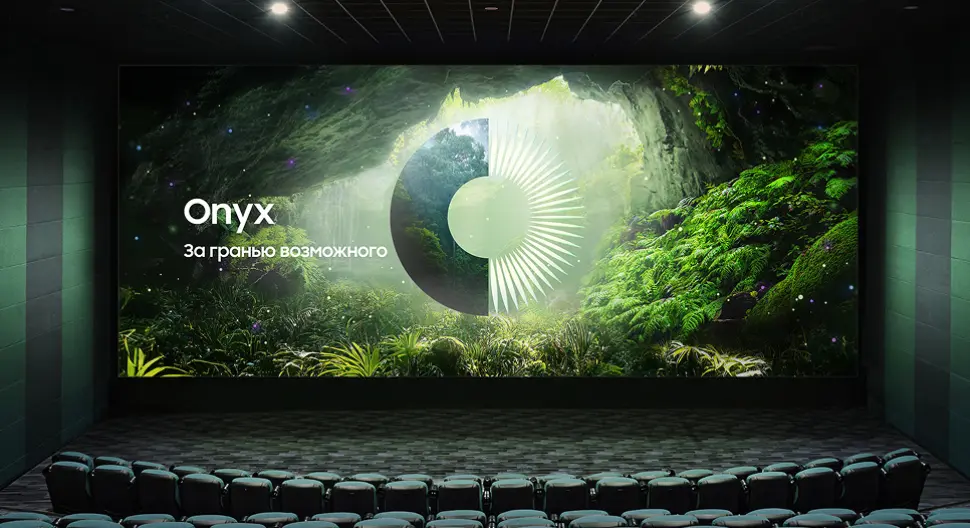
An LED cinema screen is a direct-view LED video wall that replaces the projector, the projection screen and, in most designs, the projection booth. Every pixel makes its own light, so dark areas can switch off completely and brightness stays even across the whole screen. It is most often considered for premium large-format auditoriums, new builds, and rooms that want HDR, bright 3D or lit lounge-style seating.
Operators of standard auditoriums on a tight budget should be cautious. The upfront cost is higher than projection, and the screen changes your sound design, front-wall structure and power planning.
Price is quoted per project, not from a list. The best-known public benchmark is dated: in 2018, Samsung’s first U.S. cinema screen, about 34 ft wide in 4K, was reported at $500,000–$800,000. Projectors at the time were reported at $100,000–$150,000. Treat any current price without a dated source with caution.
In this guide, every number is labelled as a fact (with a source), an estimate or an example.
At a Glance
| Question | Short answer | Type |
|---|---|---|
| How bright is it? | Cinema reference is about 14 fL (roughly 48 nits). Samsung reported about 300 nits (about 88 fL) for its first LED screen. | Fact: manufacturer figure; confirm against the DCI specification |
| Which pixel pitch? | Samsung Onyx uses 1.25, 2.5 and 3.3 mm for its 16.4, 32.8 and 45.9 ft screens. | Fact: Samsung, 2026 |
| What resolution? | DCI 4K is 4096 × 2160 pixels. | Fact |
| Is certification needed? | DCI compliance is the first item to check. | Fact and advice, see below |
| What about sound? | Speakers cannot sit behind a standard LED screen. | Fact: TechSpot |
| What does it cost? | Quoted per project. The 2018 benchmark above is the only widely reported public figure. | Fact (dated) |
| What warranty is typical? | Samsung offers 5 years, extendable to 10. | Fact: manufacturer terms |
What Is an LED Cinema Screen, and How Is It Different from Projection?
A projector throws light across the room onto a reflective surface. An LED cinema screen is built from modular cabinets whose pixels emit light directly. That one difference explains most of the practical trade-offs:
- Contrast: Pixels in dark areas switch off. A projector cannot do this, because its black level depends on the screen and the room.
- Uniformity: There is no lens and no throw distance, so brightness does not fall off toward the edges. Samsung also cites this as a core advantage.
- Room layout: There is no booth and no projection alignment. The screen mounts on the front wall, so load, flatness and service access become design questions.
- Light control: Direct-view screens tolerate more ambient light than projection.
A cinema system is more than a large video wall. It needs cinema-grade processing, calibration, integration with the media server, content protection and a sound plan. Samsung states that its screen integrates with Dolby and GDC media servers. It also states that it uses anti-copy encryption to prevent unlawful redistribution of content.
How Bright Should a Cinema LED Screen Be?
LED manufacturers quote brightness in nits, while cinema standards use foot-lamberts (fL). The table below shows how the figures from public sources compare.
| Figure | In fL | In nits | Source and type |
|---|---|---|---|
| Common cinema reference white | about 14 | about 48 | Fact: confirm in the DCI specification |
| Samsung first U.S. LED screen | about 88 | about 300 | Fact: Hollywood Reporter, 2018 |
| Samsung HDR peak at launch | 146 | about 500 | Fact: 2018 press coverage |
More brightness is not the goal. A cinema screen spends most of its time at a modest white level, so what matters is how clean the dark scenes look, how evenly the screen is calibrated, and how stable it stays over long shows. Vendors quote very different ranges. Ask for measured values at the calibrated cinema white point, not the cabinet maximum.
Which Pixel Pitch Fits Your Auditorium?
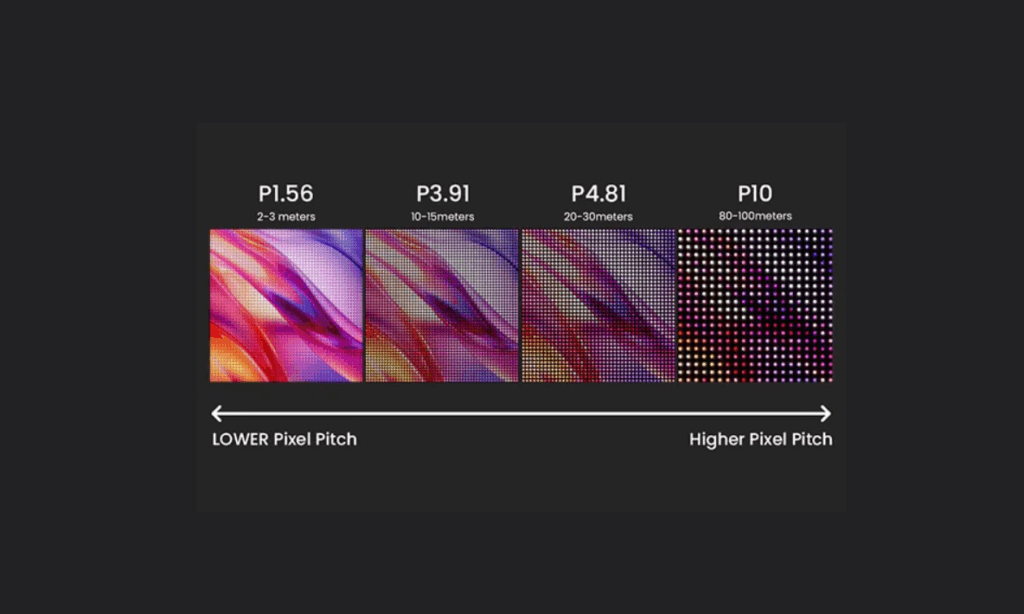
DCI images are fixed at 2K or 4K, so a wider screen simply spreads the same pixels over more area. That is why pitch gets coarser as screens get bigger. It is also why cinema screens are not priced like advertising LED.
| Screen width | Pixel pitch | Source |
|---|---|---|
| 16.4 ft (about 5 m) | 1.25 mm | Samsung Onyx, 2026 |
| 32.8 ft (about 10 m) | 2.5 mm | Samsung Onyx, 2026 |
| 45.9 ft (about 14 m) | 3.3 mm | Samsung Onyx, 2026 |
Check the front rows. If the nearest seats are close, a coarser pitch can show pixel structure in slow, dark scenes. Industry reporting also notes that a non-standard screen resolution requires scaling, which cinema content has not permitted. This was reported in 2018, so confirm current DCI rules with your supplier.
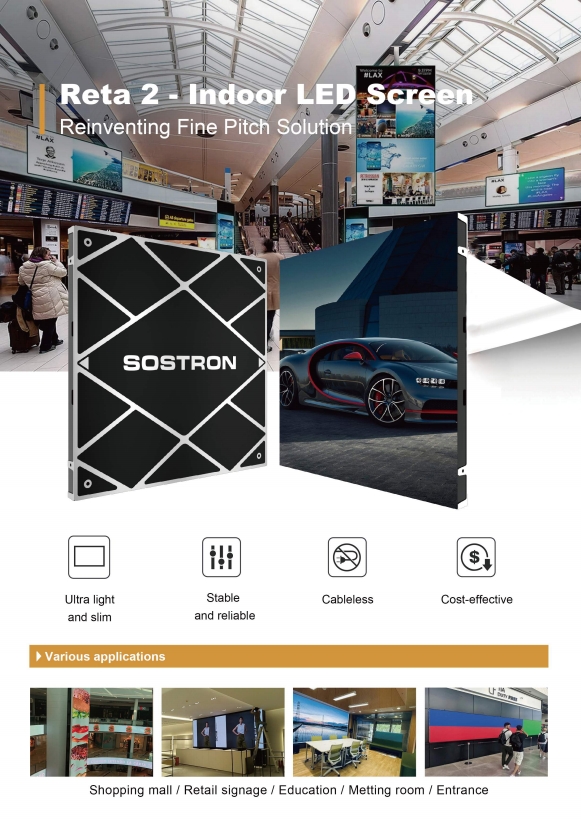
If you are comparing fine-pitch options for a screening room that is not bound by DCI, such as a private or corporate theatre, our Reta 2 fine pitch LED display is one example. It is published with pitches from P1.25 to P2.5 and 600–800 nits after calibration. It is an indoor commercial product, not a DCI cinema screen.
Does an LED Cinema Screen Need DCI Certification?
For commercial cinemas, certification is the first item to check. Samsung said its screen achieved DCI compliance in May 2017, and its 4K model was validated as DCI-certified by 2019. A 2023 Hollywood Reporter report says that several displays, including Samsung and LG models, have since been certified.
When you evaluate a supplier:
- Ask for a certificate that names the exact model, pixel pitch and screen size. A certificate for a different size is not proof for yours.
- Ask which media servers and processors the certified configuration was tested with.
- Ask to visit an operating installation.
Product-safety certificates are a different thing. The certificates Sostron publishes are CE, EMC and RoHS. They are not DCI compliance and should never be accepted in place of it.
LED Cinema Screen vs Projector: Which Fits Your Auditorium?
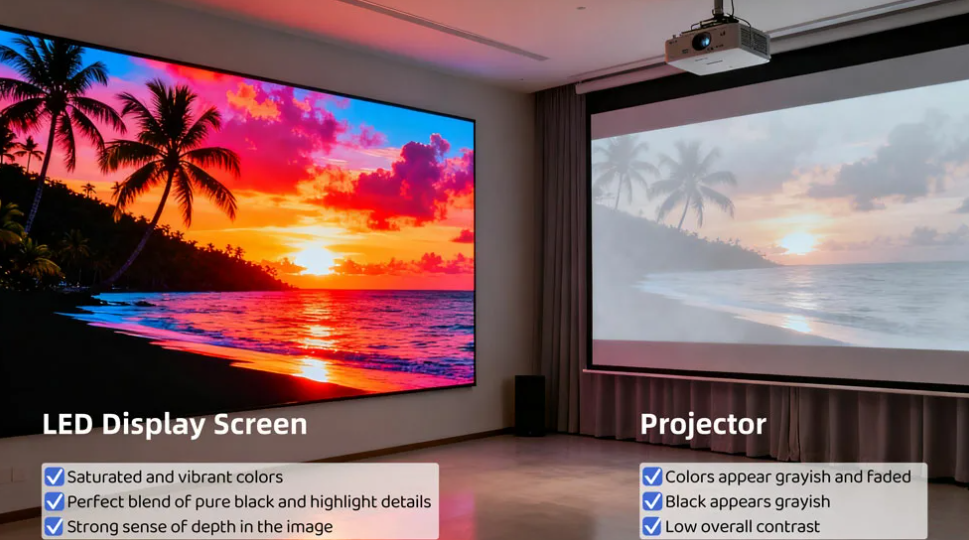
The table compares typical characteristics. Where a point comes from a manufacturer, it is labelled.
| Factor | LED cinema screen | Projector and screen |
|---|---|---|
| Light source | Each pixel emits its own light | One light path projected onto a surface |
| Black level | Pixels can switch off completely | Depends on screen and room darkness |
| Edge uniformity | Even by design; Samsung says projectors can show edge distortion | Can vary with optics and alignment |
| Ambient light | More tolerant | Needs a controlled dark room |
| Projection booth | Not needed | Needed |
| Sound behind the screen | Not possible on a standard panel | Possible with a perforated screen |
| Power and heat | Higher; extra cooling may be needed (TechSpot) | Lower in general; the projector needs its own cooling |
| Maintenance | Module-level service | Light-source and optics service |
| Upfront cost | Higher | Lower |
| Lifespan | Samsung estimated 17 years (manufacturer claim) | Varies by light source |
Where Projection Still Makes Sense
Projection remains the practical choice when the budget is tight, when the screen is used only occasionally, or when the existing room cannot take a heavy front-wall system. LEDINCLOUD, an LED supplier, lists the same cases as poor fits. Major U.S. chains were also not using the technology when the Hollywood Reporter surveyed the market in 2023, so adoption is still selective.
How Much Does an LED Cinema Screen Cost?
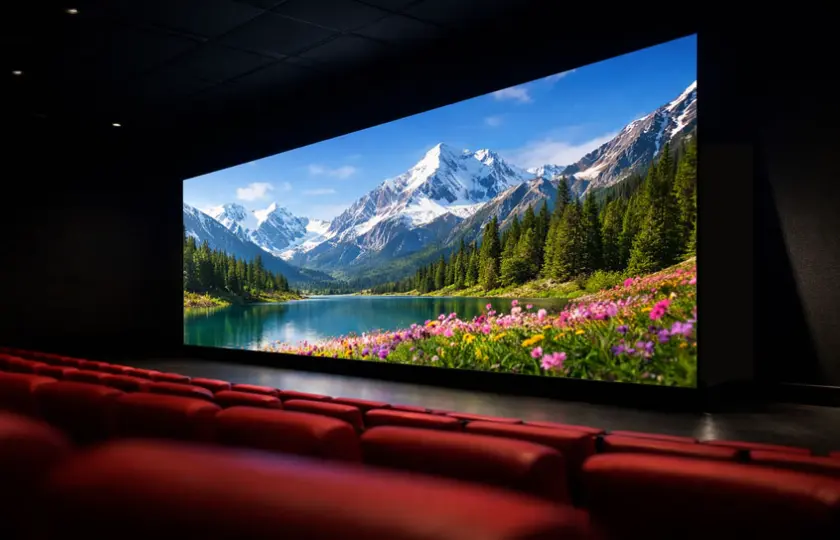
Fact (dated 2018): Samsung said a screen could cost $500,000–$800,000. Press coverage said LED walls cost about 6–8 cents per pixel and projectors $100,000–$150,000. Display Daily reported that a 4K system could reach about $700,000, and that most savings had to come from the LEDs themselves.
Estimate: Public price lists do not exist today, and LED module costs have changed since 2018. Do not use the 2018 figures as a 2026 quote. Ask each bidder for an itemized offer covering the full scope in the next section.
Premium pricing evidence is mixed. Pacific Theatres Winnetka did not charge a premium at launch. Lotte Cinema charged a premium of 2,000 Korean won (about $1.77) in 2018. Model your own market before counting on a surcharge.
Financing exists. Samsung announced a leasing program with CSI Leasing for U.S. customers.
What Does Total Cost of Ownership Include?
The CTO of Timewaying, an LED cinema manufacturer, told Box Office Pro that upfront cost is higher but that total cost of ownership tells a different story. That is a manufacturer’s view. Test it with your own numbers.
| Cost item | What to ask |
|---|---|
| Hardware and processing | Cabinets, cinema-grade processor, spare modules |
| Control and content equipment | Media server, integration, content protection |
| Front-wall structure | Load, flatness, rigging, vibration at high volume |
| Audio redesign | New speaker positions, or an acoustically transparent screen |
| Shipping and customs | Terms, duties, delivery to site |
| Installation and calibration | On-site team, calibration tools, commissioning time |
| Electricity and cooling | Measured power at cinema white point, not maximum |
| Maintenance | Module-level service, spare stock, service response |
| Warranty | Term, extensions, what is excluded |
| Avoided costs | Projector, light-source replacement, screen, booth space |
Ask suppliers to state which items are included in their quote. A low headline price with a narrow scope is the most common procurement risk.
Can Speakers Go Behind an LED Cinema Screen?
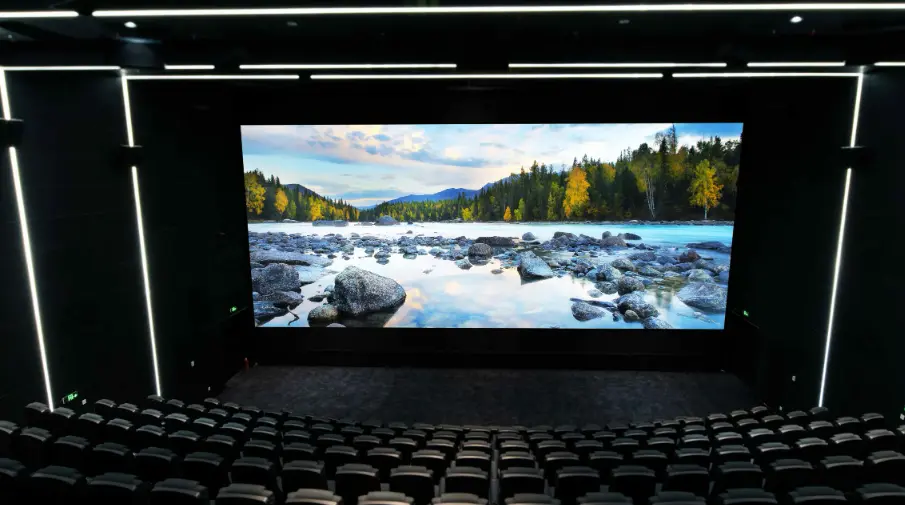
Not behind a standard panel. Traditional cinemas place speakers behind a perforated screen, but an LED wall blocks sound. There are three answers today:
- Speakers around or above the screen. Samsung says its screen works with Dolby Atmos, Meyer Sound, QSC and JBL systems.
- Acoustically transparent LED. Unilumin announced the world’s first acoustically transparent cinema LED screen in June 2024 in Nanjing. Box Office Pro also shows a Cine LEDMAX acoustically transparent screen planned for Washington state.
- Hybrid designs. Confirm how sound is handled before choosing the screen.
What Should You Check Before Installation?
Plan the room around the screen, not the other way round. Start with the front wall: confirm load capacity and flatness with a structural engineer. Plan power, signal and cooling routes. Confirm service access so a single module can be replaced without taking the room out of use.
Finer pitches make flatness more critical. Our installation notes for Reta 2 describe sub-frame leveling and calibration for fine-pitch walls. For very small premium rooms, a COB option such as Cobra, published at P0.93–P1.56 and 600 nits, offers a smoother surface. Its pitch is too fine for large auditoriums.
Who Makes LED Cinema Screens, and How Do You Vet a Supplier?
Public sources name Samsung (Onyx), LG (Miraclass), Unilumin, AOTO, Sostron, Timewaying and others. Examples include a 20 m 4K DCI screen at Zhejiang Times Cinema in Hangzhou and, in 2026, a first in Baghdad and a large screen in Madrid, per Box Office Pro.
Before you shortlist:
- Verify DCI certification for your model and size.
- Visit an operating installation of similar size.
- Compare warranty terms (Samsung’s is 5 years, extendable to 10).
- Confirm spare-module policy and local service.
Is an LED Cinema Screen Right for Your Project?
It is a strong candidate if most of these apply:
- The auditorium is premium or large-format.
- You are building new or doing a full renovation.
- You want HDR, bright 3D or ambient-light flexibility.
- Your budget covers structure, sound and service, not just the screen.
It is a weaker fit if the room is small and budget-limited, or if projection already meets your goals.
Frequently Asked Questions
Can an LED cinema screen replace a projector completely? In some auditoriums, yes. Many cinemas use LED in selected halls and keep projection elsewhere.
Does it need a dark room? It tolerates more ambient light than projection, but dark scenes still look best with controlled lighting.
How long does it last? Samsung estimated 17 years. This is a manufacturer claim, so ask for service data.
Can it show 3D? Samsung says its screen shows 3D with no brightness trade-off, when used with glasses. Ask any supplier to demonstrate this.
Can I convert an existing auditorium? Possibly. It depends on the front wall, power and sound plan.
About Sostron
Sostron is a Shenzhen-based LED display manufacturer, founded in 2014, with product development, engineering support and after-sales service. Its history page lists exports to nearly 100 countries and more than 3,000 completed projects as of 2021. We support custom solutions and installation guidance.
We do not currently list a DCI-certified cinema product. If your project is DCI-governed, we will tell you plainly whether we can support it. For private, corporate or non-DCI screening rooms, send your room dimensions and seating distances and we can discuss fine-pitch options.
Sources: Samsung Insights, 2026 · Hollywood Reporter, 2018 · Hollywood Reporter, 2023 · Box Office Pro, 2026 · TechSpot · Display Daily · Celluloid Junkie