The Decision Most Buyers Get Wrong
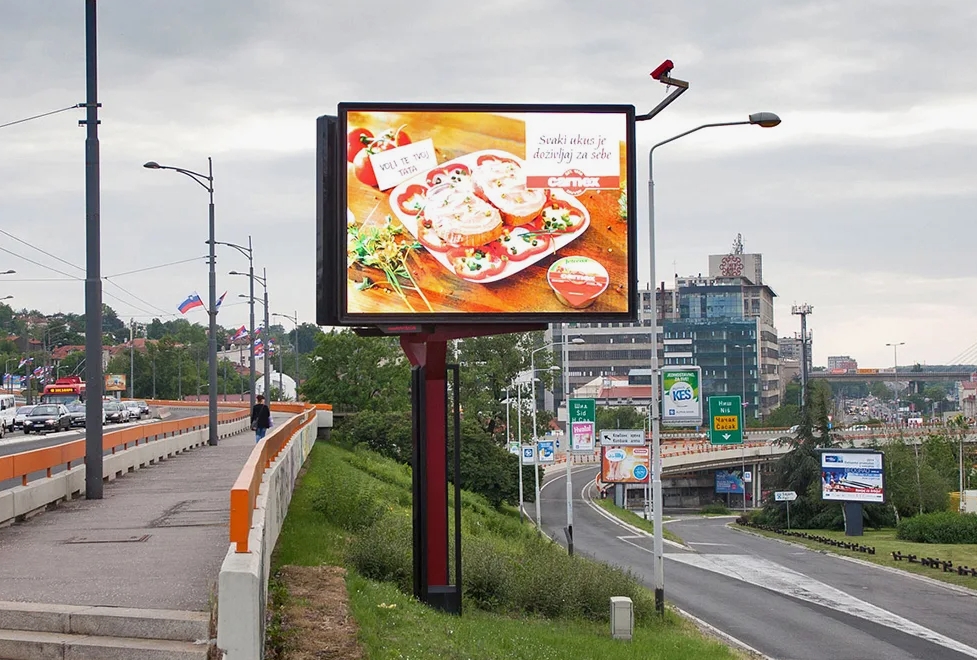
The most common mistake when specifying outdoor LED screen is choosing pixel pitch based on budget rather than viewing distance. A P4 screen installed on a highway billboard viewed at 50 meters is money wasted on resolution the human eye cannot resolve at that distance. A P8 screen installed at a transit station entrance viewed at 6 meters produces visible pixelation that undermines the display’s credibility.
P4 is the right answer for a specific range of applications — and a poor choice outside that range. This guide tells you exactly where P4 belongs, what it costs in 2026, what specifications actually matter for outdoor performance, and how to evaluate suppliers beyond the price-per-square-meter figure on a quotation.
What Is a P4 Outdoor LED Screen?
P4 refers to pixel pitch: the center-to-center distance between adjacent LED pixels, measured in millimeters. A P4 screen has pixels spaced 4mm apart. Pixel pitch determines the minimum viewing distance at which the image appears smooth and continuous to the human eye.
The formula: minimum viewing distance (meters) = pixel pitch (mm) × 1,000 ÷ 3,438
For P4: minimum viewing distance = 4 × 1,000 ÷ 3,438 = approximately 1.2 meters
In practice, the optimal viewing distance for P4 outdoor content is 4–20 meters — close enough to resolve fine detail in text and graphics, far enough that the full screen is visible in a single field of view.
P4 vs. Adjacent Pixel Pitches: When to Choose What
| Pixel Pitch | Min. Viewing Distance | Optimal Range | Best Application | Cost Index |
|---|---|---|---|---|
| P2.5 | 0.7m | 2–8m | Outdoor retail close-range, semi-outdoor | $$$$$ |
| P3 | 0.9m | 3–10m | Building entrance, covered outdoor | $$$$ |
| P4 | 1.2m | 4–20m | Retail facade, transit, mid-size venue | $$$ |
| P5 | 1.5m | 5–25m | Street-level advertising, parking structures | $$$ |
| P6 | 1.7m | 6–30m | Roadside billboard, stadium perimeter | $$ |
| P8 | 2.3m | 8–50m | Highway billboard, large venue scoreboard | $$ |
| P10 | 2.9m | 10–80m | Large-format highway, stadium | $ |
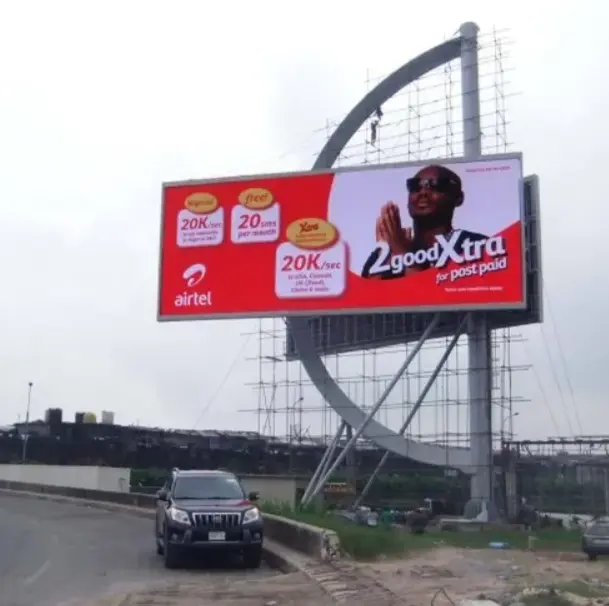
P4 occupies the sweet spot between image quality and cost for the majority of urban outdoor advertising and commercial display applications. It is the most widely specified outdoor pitch in the 5–15 meter viewing range.
Technical Specifications: What Actually Matters for Outdoor Performance
The original article focuses on pixel pitch and brightness. Competing top-ranked articles in this category cover a broader specification set that buyers need to evaluate. Here is the complete picture:
Core Specification Table for P4 Outdoor LED (2026 Standards)
| Specification | Minimum Acceptable | Recommended | Premium |
|---|---|---|---|
| Pixel pitch | P4 (4mm) | P4 (4mm) | P4 (4mm) |
| Brightness | 5,000 nits | 7,000 nits | 10,000 nits |
| Contrast ratio | 3,000:1 | 5,000:1 | 8,000:1 |
| Refresh rate | 1,920 Hz | 3,840 Hz | 7,680 Hz |
| Color gamut | Rec.709 | DCI-P3 90% | DCI-P3 95%+ |
| IP rating (front) | IP65 | IP65 | IP67 |
| IP rating (rear) | IP54 | IP65 | IP65 |
| Operating temperature | -20°C to +50°C | -30°C to +60°C | -40°C to +65°C |
| Viewing angle (H/V) | 120°/60° | 140°/70° | 160°/80° |
| Lifespan | 80,000 hrs | 100,000 hrs | 100,000 hrs |
| Encapsulation | SMD | GOB | GOB/COB |
| Cabinet material | Steel | Aluminum | Aluminum die-cast |
| Cabinet weight (per m²) | 28–35 kg | 22–28 kg | 18–24 kg |
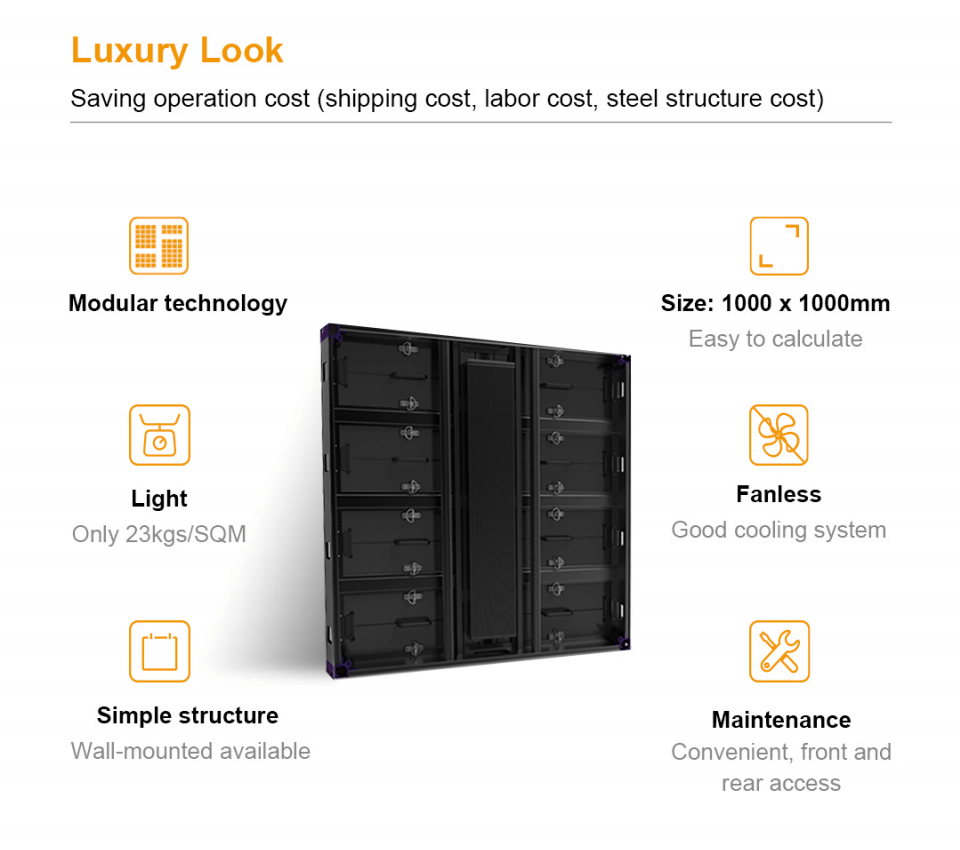
| Maintenance access | Rear only | Front + rear | Front + rear |
Why Refresh Rate Matters for Outdoor Screens
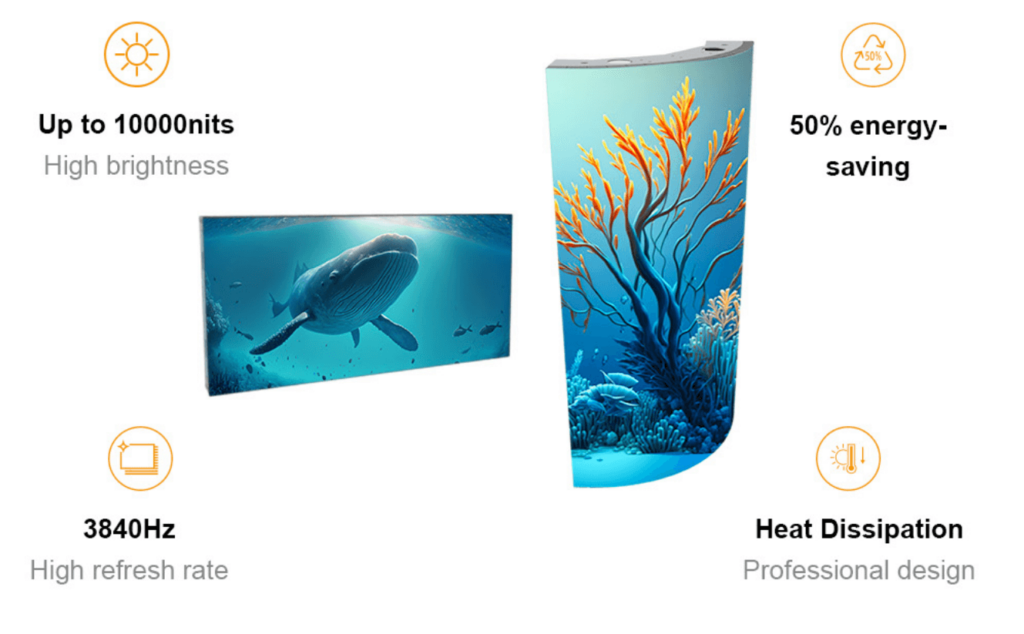
Refresh rate is frequently overlooked for outdoor applications because the human eye cannot perceive flicker above approximately 60Hz. However, cameras can — and in 2026, virtually every outdoor LED installation will be photographed or filmed by smartphones, security cameras, or media crews. A 1,920Hz screen produces visible banding in video recordings. 3,840Hz is the minimum for camera-friendly outdoor installations; specify 7,680Hz for any location where broadcast or professional video capture is expected.
Encapsulation Technology: GOB vs. SMD for Outdoor P4
In 2026, GOB (Glue On Board) has largely replaced bare SMD as the standard encapsulation for outdoor P4 panels. Understanding the difference matters for long-term reliability.
Standard SMD outdoor P4: Individual LED beads soldered to PCB, exposed to the environment. Vulnerable to moisture ingress at solder joints, impact damage from debris, and UV degradation of bead housings over time.
GOB outdoor P4: Optical-grade epoxy resin floods the entire PCB surface, encapsulating all LED beads and solder joints in a single protective layer. Achieves IP65–IP67 without additional housing modifications. Improves impact resistance by 3–5× compared to bare SMD.
| Feature | SMD P4 Outdoor | GOB P4 Outdoor |
|---|---|---|
| IP rating achievable | IP54–IP65 | IP65–IP67 |
| Impact resistance | Moderate | High |
| Moisture protection | Good | Excellent |
| UV resistance | Moderate | Good |
| Contrast (anti-glare) | Standard | Improved (glue reduces reflection) |
| Repairability | Individual bead replacement possible | Module swap required |
| Cost premium vs. SMD | Baseline | +15–25% |
| Recommended for | Covered outdoor, low-impact environments | All outdoor, coastal, tropical, high-traffic |
For any permanent outdoor installation in 2026, GOB is the correct specification. The 15–25% cost premium is recovered within the first year through reduced maintenance and lower failure rates.
Why P4 Is the Most Popular Outdoor Pitch
Brightness for Daylight Visibility
Outdoor LED screens compete with direct sunlight, which measures approximately 100,000 lux at peak intensity. To remain legible, an outdoor LED screen needs sufficient brightness to overcome ambient light reflection. The practical threshold:
- Shaded or north-facing installations: 4,000–5,000 nits sufficient
- Partially sunlit, east/west-facing: 6,000–7,000 nits recommended
- Direct south-facing or equatorial climates: 8,000–10,000 nits required
P4 panels are manufactured across this full brightness range, making them adaptable to any outdoor orientation and climate.
Resolution for Text and Graphics
At 5 meters viewing distance, a P4 screen resolves text at approximately 8-point font size — sufficient for headlines, pricing, and short-form advertising copy. At 10 meters, minimum legible text is approximately 14-point. This covers the majority of outdoor advertising content requirements without the cost premium of P3 or finer pitches.
Structural Efficiency
P4 panels in aluminum cabinets weigh 22–28 kg per m², compared to 35–45 kg per m² for older steel-cabinet designs. This reduces structural load requirements for building facade mounting and ground-support frames, lowering installation cost and expanding the range of structures that can support an LED installation without engineering reinforcement.
Applications: Where P4 Outdoor LED Performs Best
Retail and Commercial Facades
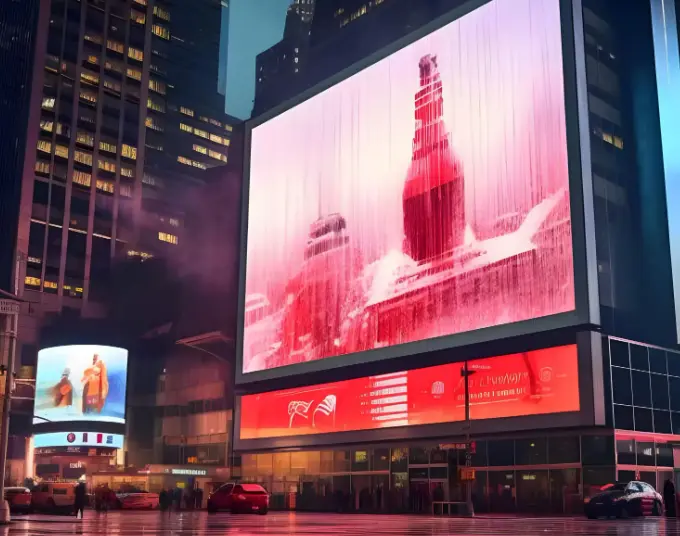
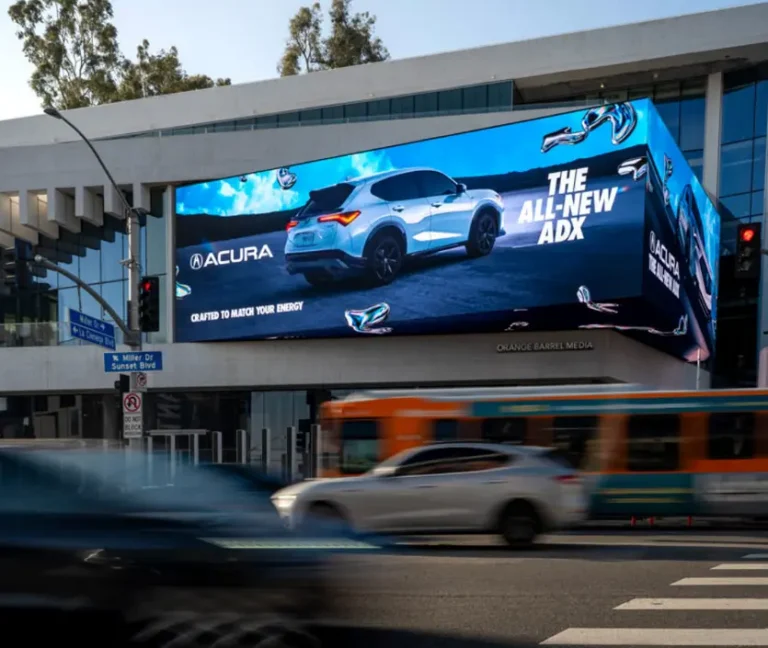
Building-mounted P4 screens at retail entrances, shopping mall exteriors, and commercial plazas are the highest-volume application category. Typical configuration: 10–30m², mounted at 3–6 meters height, viewed from 5–15 meters. Content cycles between promotional advertising, brand video, and wayfinding.
Transit and Transportation Hubs
Bus terminals, metro station entrances, airport curbside, and railway station facades use P4 for passenger information, advertising, and wayfinding. The 4–15 meter viewing range matches typical pedestrian distances at these locations. High refresh rate (3,840Hz+) is important for camera-monitored environments.
Sports Venues and Arenas
Mid-size sports venues — regional stadiums, indoor arenas, racetracks — use P4 for perimeter advertising boards, entrance displays, and concourse screens. For main scoreboard applications at large venues where viewing distances exceed 30 meters, P6–P8 is more cost-appropriate.
Outdoor Events and Temporary Installations
P4 rental-grade panels (lightweight aluminum cabinets, tool-free assembly) are widely used for outdoor concerts, festivals, and sporting events. Viewing distances of 8–20 meters are typical for main stage screens at outdoor events.
Government and Public Information Displays
City squares, government buildings, and public parks use P4 for public information, emergency notifications, and civic event promotion. These installations typically require higher IP ratings (IP67) and extended operating temperature ranges for year-round reliability.
Price Analysis: Full Cost Breakdown for 2026
Hardware Pricing by Configuration
| Configuration | Panel Type | Area | Hardware Cost (USD) | Notes |
|---|---|---|---|---|
| Small facade display | P4 GOB, aluminum | 6–10 m² | 5,000–15,000 | Single-face, front maintenance |
| Medium commercial screen | P4 GOB, aluminum | 15–25 m² | 15,000–40,000 | Standard outdoor billboard format |
| Large building facade | P4 GOB, die-cast | 30–60 m² | 40,000–100,000 | Custom structure required |
| Rental/event screen | P4 GOB, lightweight | 20–40 m² | 25,000–65,000 | Modular, reconfigurable |
| Stadium perimeter | P4 SMD/GOB | 50–200 m² | 60,000–250,000 | Curved or straight configurations |
Full Project Cost Components
Hardware is typically 55–65% of total installed project cost. The remaining budget covers:
| Cost Component | Typical Share | Notes |
|---|---|---|
| LED panel hardware | 55–65% | Per m² panel cost |
| Steel/aluminum support structure | 10–15% | Ground-support or wall-mount frame |
| Electrical installation and cabling | 6–10% | Power distribution, data cabling |
| Control system and processor | 5–8% | Nova Star, Colorlight, or equivalent |
| Installation labor | 5–8% | Rigging, mounting, commissioning |
| Calibration and testing | 2–3% | Color uniformity, brightness calibration |
| Permits and engineering | 3–6% | Structural sign-off, advertising permits |
Worked example — 20m² retail facade, P4 GOB:
- Hardware: $22,000
- Structure and mounting: $4,500
- Electrical and cabling: $2,500
- Control system: $1,800
- Installation labor: $2,000
- Calibration: $800
- Permits: $1,200
- Total installed: approximately $34,800
Control System Options for P4 Outdoor Screens
The control system determines how content is managed, scheduled, and monitored. Three architectures are standard in 2026:
Local PC-based control: Content loaded via USB or LAN from an on-site computer. Lowest cost, no internet dependency. Suitable for single-location installations with infrequent content changes.
Cloud-based CMS: Content uploaded remotely via web platform; screen connects via LAN or 4G/5G. Enables multi-screen network management, scheduled content rotation, and remote monitoring. Standard for retail chains and OOH media operators managing multiple locations.
4G/5G standalone: Screen connects directly to cellular network with embedded SIM. No fixed internet connection required. Ideal for remote locations, temporary installations, and markets with unreliable fixed broadband.
Leading control system brands in 2026: Nova Star (NovaCMS), Colorlight (iSet), Linsn, and Brompton Technology (for broadcast-grade applications).
5-Year Total Cost of Ownership
| Cost Category | P4 GOB Outdoor (20m²) | P4 SMD Outdoor (20m²) | P6 GOB Outdoor (20m²) |
|---|---|---|---|
| Hardware | $22,000 | $18,000 | $14,000 |
| Installation (full) | $12,000 | $12,000 | $11,000 |
| Annual maintenance | 800–1,200/yr | 1,200–2,000/yr | 600–1,000/yr |
| Module replacements (5yr) | 500–1,500 | 1,500–4,000 | 400–1,200 |
| Energy (5yr, 12hr/day) | 3,500–5,000 | 3,500–5,000 | 3,000–4,500 |
| 5-Year TCO | 42,500–55,500 | 44,500–63,000 | 33,000–44,700 |
GOB’s lower maintenance and replacement costs offset its hardware premium within 18–24 months. P6 has a lower TCO for applications where the resolution difference is not perceptible at the installation’s viewing distance.
Supplier Evaluation: 5 Questions to Ask Before Buying
1. What is the actual brightness at 50% content load?
Rated brightness (e.g., 10,000 nits) is measured at 100% white content. Real-world advertising content averages 30–50% brightness. Ask for the brightness specification at typical content load, not peak white.
2. What IP certification documentation can you provide?
Request the specific IP test report for the panel model being quoted — not a general company certification. IP65 and IP67 are tested to IEC 60529; the test report should reference the specific panel SKU.
3. What is the warranty coverage and local service response time?
A 3-year parts warranty is standard. More important: what is the response time for a panel failure, and does the supplier maintain local spare module inventory? A 4-week import lead time for replacement modules is operationally unacceptable for a commercial advertising screen.
4. What LED chip brand is used?
Nationstar, Kinglight, and Cree are the dominant chip brands for outdoor P4 in 2026. Chips from these manufacturers carry consistent color binning (SDCM < 3) and rated lifespans of 100,000 hours. Unbranded or unspecified chips are a reliability risk.
5. Is front maintenance available?
For wall-mounted installations where rear access is impossible, front-serviceable cabinets are essential. Confirm this before purchase — retrofitting front maintenance capability after installation is not feasible.
Conclusion
P4 is the workhorse of the outdoor LED market in 2026 — versatile enough for the majority of commercial applications, cost-effective at scale, and available in GOB-encapsulated configurations that deliver the durability outdoor environments demand. It is the right specification for viewing distances of 4–20 meters, which covers retail facades, transit hubs, mid-size venues, and most urban advertising locations.
Specify GOB encapsulation as standard, confirm IP67 for coastal or tropical climates, require 3,840Hz refresh rate for any camera-facing installation, and get itemized quotes that separate hardware from installation and control system costs. Those four decisions eliminate the majority of post-installation problems.
SoStron’s P4 outdoor LED panels combine GOB encapsulation, 6,000–10,000 nit brightness options, IP65/IP67 ratings, and aluminum die-cast cabinets with front/rear maintenance access. Our engineering team supports projects from specification through installation commissioning across global markets.