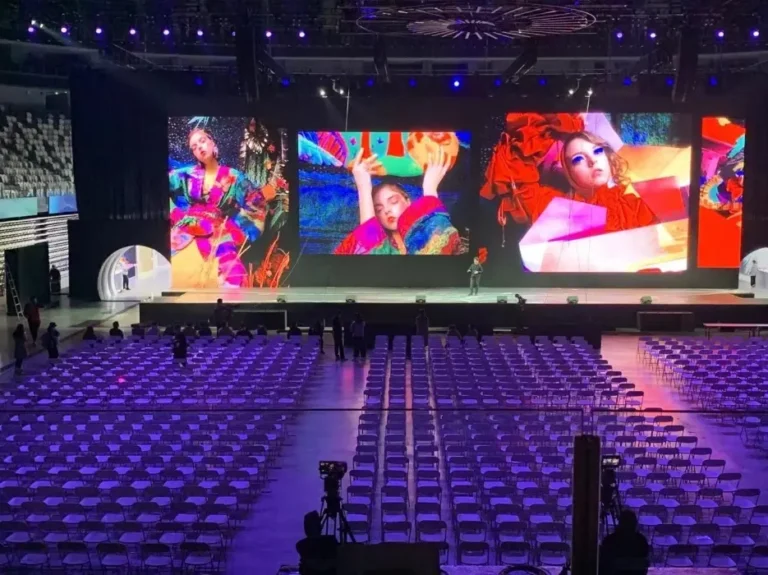
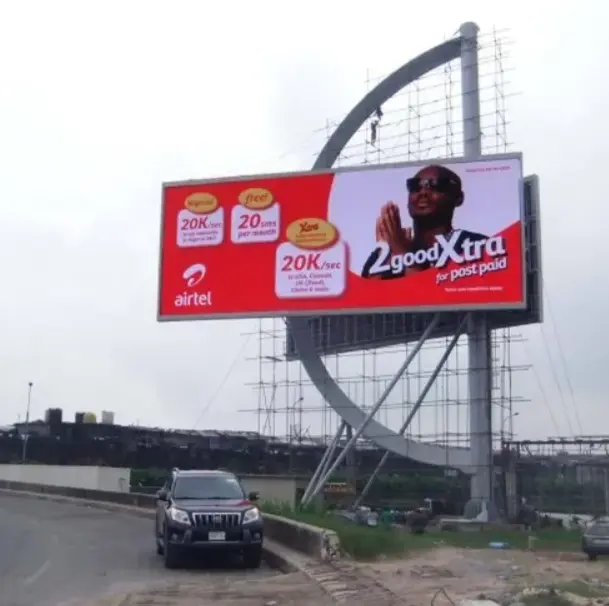
Quick Answer
The main difference between indoor and outdoor LED displays is not simply where they are installed. The two categories are engineered for different combinations of ambient light, viewing distance, weather exposure, thermal conditions, installation structure, and maintenance requirements.
Indoor LED displays are generally optimized for controlled environments, closer viewing distances, finer pixel pitches, lower environmental protection requirements, and architectural integration. Outdoor LED displays are designed to remain visible in strong ambient light while resisting rain, dust, temperature changes, wind exposure, and other site conditions.
| Factor | Indoor LED Display | Outdoor LED Display |
|---|---|---|
| Typical environment | Offices, retail, malls, halls, studios | Billboards, façades, highways, stadiums |
| Brightness | Usually lower than outdoor products | Usually much higher |
| Pixel pitch | Often finer for close viewing | Often larger for longer viewing distances |
| Weather protection | Usually limited | Designed for outdoor exposure |
| IP protection | Application-dependent | Typically higher |
| Cabinet design | Lightweight, slim, architectural | Weather-resistant and structurally robust |
| Thermal design | Controlled indoor conditions | Solar load + wider temperature variation |
| Installation | Architectural / wall / hanging | Wall, pole, steel structure, façade |
| Maintenance | Often easier to access | Requires environmental and structural planning |
| Main buying priority | Image detail and integration | Visibility, durability and reliability |
There is no universal specification that makes a screen “indoor” or “outdoor.” A covered storefront, for example, may have very different requirements from a fully exposed highway billboard. The correct specification should therefore start with the installation environment and audience viewing conditions, then work backward to brightness, pixel pitch, IP protection, thermal design, control system and total cost of ownership.
What Is the Difference Between Indoor and Outdoor LED Displays?
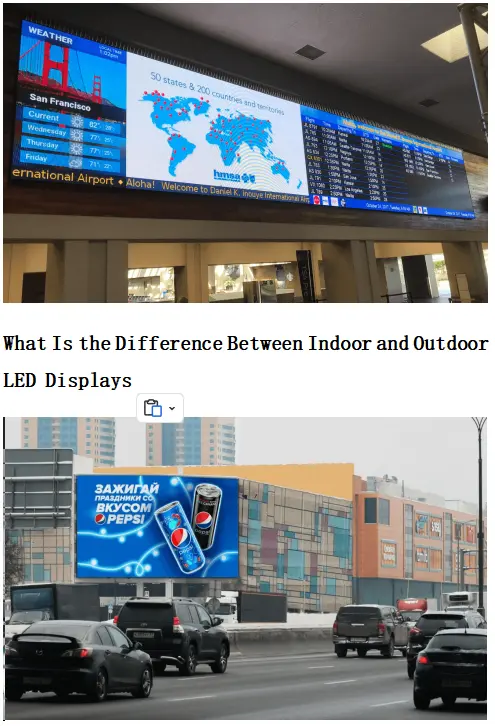
Indoor and outdoor LED displays use the same fundamental LED technology, but their engineering priorities are different.
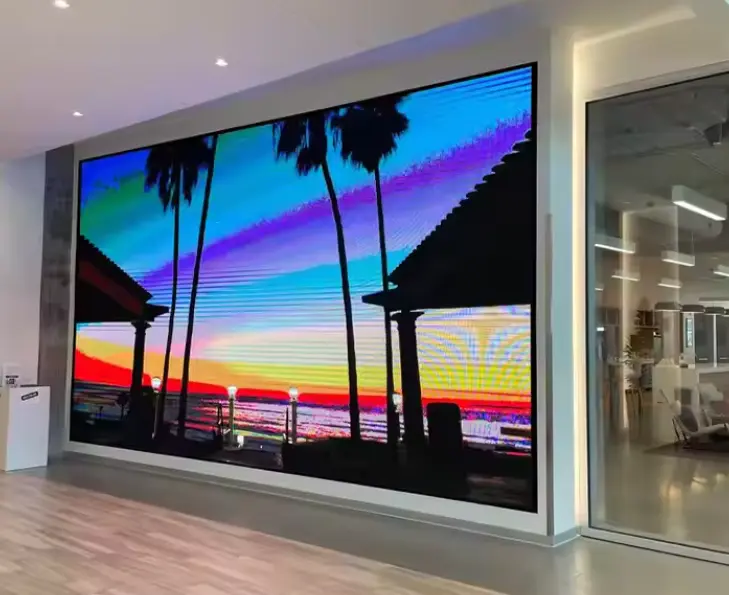
An indoor display normally operates in a relatively controlled environment. It may be installed in a conference room, shopping mall, corporate lobby, exhibition hall, control room, retail store or studio. The display therefore does not normally need the same level of resistance to rain, direct sunlight, wind-driven dust or large outdoor temperature variations.
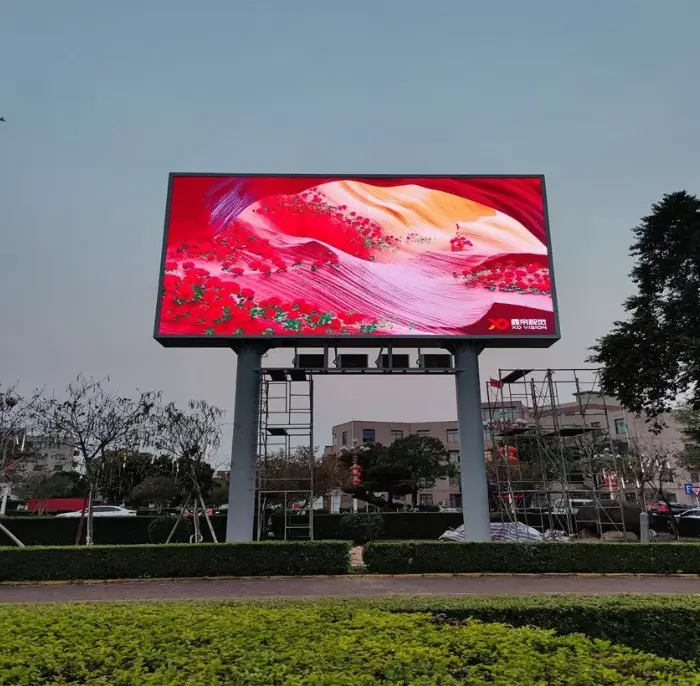
An outdoor LED display must solve a different problem: delivering readable content under environmental stress. Direct sunlight can dramatically reduce perceived contrast, while rain, humidity, dust, heat, cold, wind and corrosion can affect the cabinet, electronics and supporting structure.
This creates a chain of engineering decisions:
Site environment → ambient light → viewing distance → brightness → pixel pitch → protection → thermal design → installation → maintenance → TCO
That is more useful for procurement than simply asking whether a product is labeled “indoor” or “outdoor.”
How Do Indoor and Outdoor LED Screens Compare?
The following comparison provides the fastest way to understand the major differences.
| Specification | Indoor LED | Outdoor LED | Why It Matters |
|---|---|---|---|
| Ambient light | Controlled to variable | Often high, including direct sunlight | Determines required luminance |
| Brightness | Generally lower | Generally higher | Affects daytime readability |
| Pixel pitch | Often smaller | Often larger | Must match viewing distance |
| Weather exposure | Limited | Rain, dust, humidity, solar exposure | Determines cabinet protection |
| IP rating | Application-specific | Usually higher | Helps protect against ingress |
| Cabinet | Lightweight / slim designs common | Weather-resistant / structural designs common | Affects installation |
| Cooling | Controlled environment | Greater thermal challenge | Affects reliability |
| Maintenance | Often convenient | Requires environmental planning | Affects labor and downtime |
| Structural load | Usually lower | Wind and support structure can be significant | Affects engineering cost |
| Content | Detail-heavy, close viewing | Advertising, information, distant viewing | Influences pitch and brightness |
| Camera use | Common in studios/events | Relevant for stadiums/events | Influences refresh/control requirements |
The important point is that these are engineering tendencies, not absolute rules. Product specifications vary significantly between models.
Product specification note: Brightness, pixel pitch, IP rating, power consumption and refresh rate are product- and configuration-specific. The Sostron examples cited in this article are based on published product documentation; they should not be interpreted as universal specifications for all indoor or outdoor LED displays. Final project requirements should be confirmed against the supplier’s current technical datasheet and quotation.
Why Is Brightness Different Between Indoor and Outdoor LED Displays?
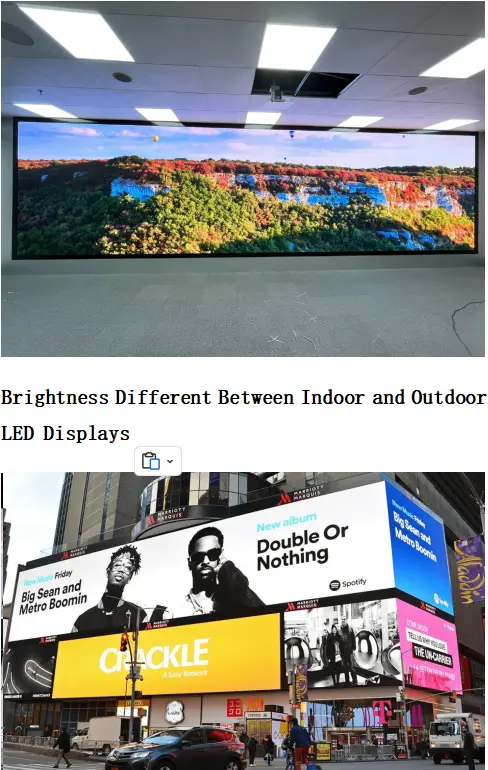
Brightness is one of the most visible differences.
Indoor environments normally do not expose a display to direct sunlight, so excessive brightness can be unnecessary and uncomfortable. For example, Sostron’s current Slim indoor series lists brightness options of 600, 800 and 1,000 nits depending on configuration, while its Reta indoor LED billboard is specified up to 2,000 cd/m² for certain applications.
Outdoor displays need considerably more optical output because sunlight can wash out the image. Sostron’s Ares 3 outdoor LED display is specified with brightness up to 10,000 nits.
These manufacturer figures should be treated as product specifications, not universal indoor and outdoor industry limits.
Why Maximum Brightness Is Not the Same as Required Brightness
A common procurement mistake is to compare the highest brightness number on two datasheets.
The more useful question is:
What sustained brightness is required at the actual installation site?
Brightness requirements depend on:
- Direct or indirect sunlight
- Screen orientation
- Local climate
- Time of day
- Viewing distance
- Content type
- Automatic brightness control
- Desired contrast
- Camera requirements
Running an indoor display at unnecessarily high brightness can increase power consumption and thermal stress. Conversely, an outdoor display with insufficient optical output may remain technically functional but visually ineffective during daylight.
For a project specification, ask the supplier for both maximum brightness and recommended operating brightness.
Does Pixel Pitch Differ Between Indoor and Outdoor LED Screens?
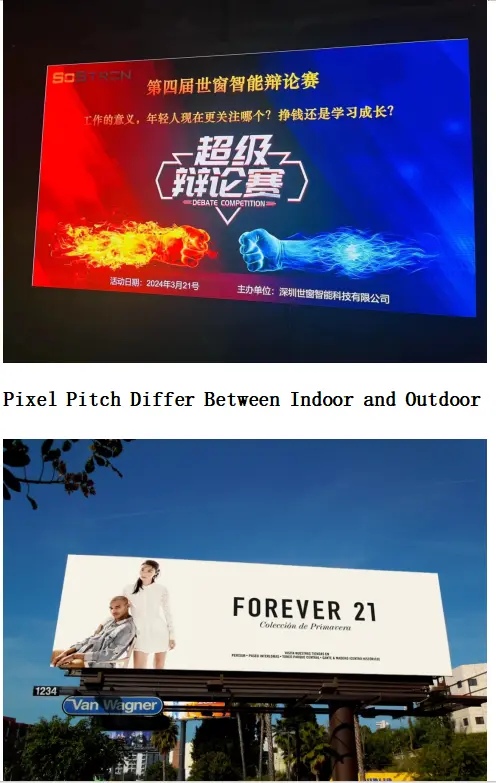
Yes, but pixel pitch should not be selected simply because a display is indoor or outdoor.
Pixel pitch is the physical distance between the centers of adjacent pixels. A smaller pitch creates greater pixel density and can support sharper images at shorter viewing distances.
Indoor displays frequently use finer pitches because audiences may stand only a few meters away. Sostron’s current indoor portfolio includes products such as Slim with P1.5, P1.9 and P2.6 options, as well as fine-pitch products such as Reta 2.
Outdoor displays commonly use larger pitches because viewers are often much farther away. Sostron’s case library, for example, includes an 80 m² P10.4 outdoor billboard project in Kenya.
Why Viewing Distance Matters More Than the Indoor/Outdoor Label
Consider two hypothetical sites:
- A conference-room LED wall viewed from 2–4 meters
- A roadside billboard viewed from tens or hundreds of meters
Even if both screens have the same physical area, the second installation does not necessarily benefit from the same pixel density as the first.
A smaller pixel pitch generally increases pixel density and can increase hardware cost. Choosing a pitch that is finer than the audience can resolve may therefore produce diminishing commercial returns.
Do Not Treat Pixel-Pitch Formulas as Universal Standards
Rules of thumb can help with preliminary planning, but they should not replace an actual site assessment.
The final selection should consider:
- Minimum and average viewing distance
- Screen dimensions
- Content type
- Text size
- Camera use
- Desired image detail
- Budget
- Resolution requirements
For a large outdoor advertising screen, optimizing for practical viewing distance can be more valuable than paying for extremely fine pitch.
Is Pixel Pitch the Same as Resolution?
No.
Pixel pitch describes the physical spacing between pixels. Resolution describes how many pixels are available to reproduce an image.
A large LED screen with a relatively large pixel pitch can still deliver an effective viewing experience when the audience is far away.
Conversely, a fine-pitch indoor wall may require significantly more pixels to maintain image quality at close range.
For B2B buyers, comparing “4K” or “Full HD” alone is therefore insufficient. The physical screen dimensions, pixel pitch and intended viewing distance must be considered together.
Can an Indoor LED Screen Be Used Outdoors?
Generally, an ordinary indoor LED display should not be assumed suitable for a fully exposed outdoor installation.
The issue is not only brightness.
An outdoor installation may expose the display to:
- Direct sunlight
- Rain
- Wind-driven water
- Dust
- High humidity
- Temperature changes
- Solar heating
- Condensation
- Corrosive environments
An indoor product may not have the cabinet sealing, optical output, thermal design or structural characteristics required for those conditions.
What About a Covered Outdoor Installation?
A covered storefront, building entrance or canopy can be different.
If the screen is protected from direct rain and sunlight, the environmental requirements may be lower than for a fully exposed billboard. However, the supplier should evaluate the actual site rather than automatically treating the installation as indoor.
This is where the term semi-outdoor becomes useful.
The specification should consider:
- How much rain can reach the cabinet?
- Is the screen exposed to direct sunlight?
- Is there natural ventilation?
- What is the local temperature range?
- Is the site coastal or industrial?
- Is condensation possible?
- Can maintenance technicians safely access the screen?
The site condition should determine the specification.
Can an Outdoor LED Screen Be Used Indoors?
Technically, some outdoor LED displays can operate indoors, but using an outdoor-rated product does not automatically make it the right choice.
Potential disadvantages include:
- Higher initial hardware cost
- Higher weight
- More substantial cabinet construction
- Higher brightness than necessary
- Potentially greater energy consumption
- Less suitable architectural integration
However, outdoor-rated construction can be justified in unusual indoor or semi-outdoor environments where durability or environmental exposure is unusually demanding.
The correct question is not:
“Is outdoor better than indoor?”
It is:
“Does the additional protection solve a real site requirement?”
If it does not, the buyer may simply be paying for engineering that provides little additional business value.
How Does IP Rating Affect Indoor and Outdoor LED Displays?
IP ratings describe degrees of protection provided by enclosures. IEC 60529 defines the IP Code classification system for protection against solid-particle and liquid ingress.
The first digit relates to protection against solids, while the second digit relates to water ingress.
Outdoor LED displays commonly use higher IP protection than indoor displays because their cabinets face environmental exposure.
However, IP65 should not be treated as a universal minimum requirement for every outdoor LED installation.
The appropriate protection level depends on:
- Exposure to rain
- Cabinet orientation
- Canopy protection
- Drainage
- Installation location
- Maintenance practices
- Dust exposure
- Humidity
- Coastal or industrial conditions
An IP rating is a tested enclosure classification. It does not eliminate every environmental risk.
Why IP Rating Alone Is Not Enough
A coastal billboard, for example, can face corrosion concerns that are not adequately described by an IP number.
Therefore, outdoor procurement should examine:
IP protection + cabinet material + sealing + drainage + connectors + corrosion resistance + thermal design
rather than looking at the IP number in isolation.
How Do Indoor and Outdoor LED Cabinets Differ?
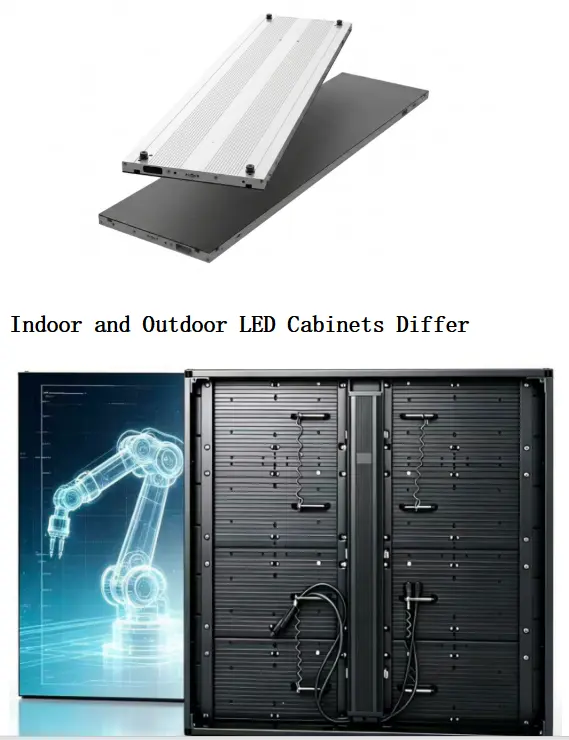
Cabinet construction is another major engineering difference.
Outdoor cabinets commonly prioritize:
- Weather resistance
- Structural rigidity
- Thermal management
- Corrosion resistance
- Service access
- Wind-load considerations
Indoor cabinets can prioritize:
- Low weight
- Slim depth
- Architectural appearance
- Front maintenance
- Flexible installation
- Easy integration with walls and interior structures
Sostron’s current Slim indoor series, for example, uses an aluminum profile cabinet with a listed depth of 27 mm for several configurations and front maintenance. This is a product-specific example of how indoor design can prioritize low profile and architectural integration.
By contrast, outdoor Ares products emphasize high brightness and outdoor-oriented construction.
Why Cabinet Weight Matters
Cabinet weight affects more than transportation.
It can influence:
- Supporting steelwork
- Wall loading
- Installation labor
- Lifting equipment
- Rigging requirements
- Structural engineering
- Long-term mounting stability
For a large billboard, a seemingly small difference in kilograms per cabinet can become significant across the entire installation.
Why Is Thermal Management Different?
Outdoor displays face a combination of higher brightness, direct solar exposure and wider ambient-temperature variation.
The screen can receive heat from two sources:
- Electrical power converted into heat inside the display
- Solar radiation heating the cabinet and internal components
That makes thermal design important for:
- LED components
- power supplies
- receiving cards
- driver ICs
- cabinet electronics
- long-term brightness consistency
Indoor displays also need thermal management. An indoor screen installed inside a poorly ventilated architectural cavity can develop thermal problems even though it is not exposed to sunlight.
What Should Buyers Ask?
Instead of asking only:
“Does the screen have cooling?”
ask:
- What is the specified operating temperature range?
- What is the maximum and average power consumption?
- How is heat removed from the cabinet?
- Is active cooling used?
- Does the installation require ventilation?
- Where are the power supplies located?
- How can cooling components be serviced?
The exact answers should come from the selected product’s technical documentation.
Does Refresh Rate Matter for Indoor and Outdoor LED Displays?
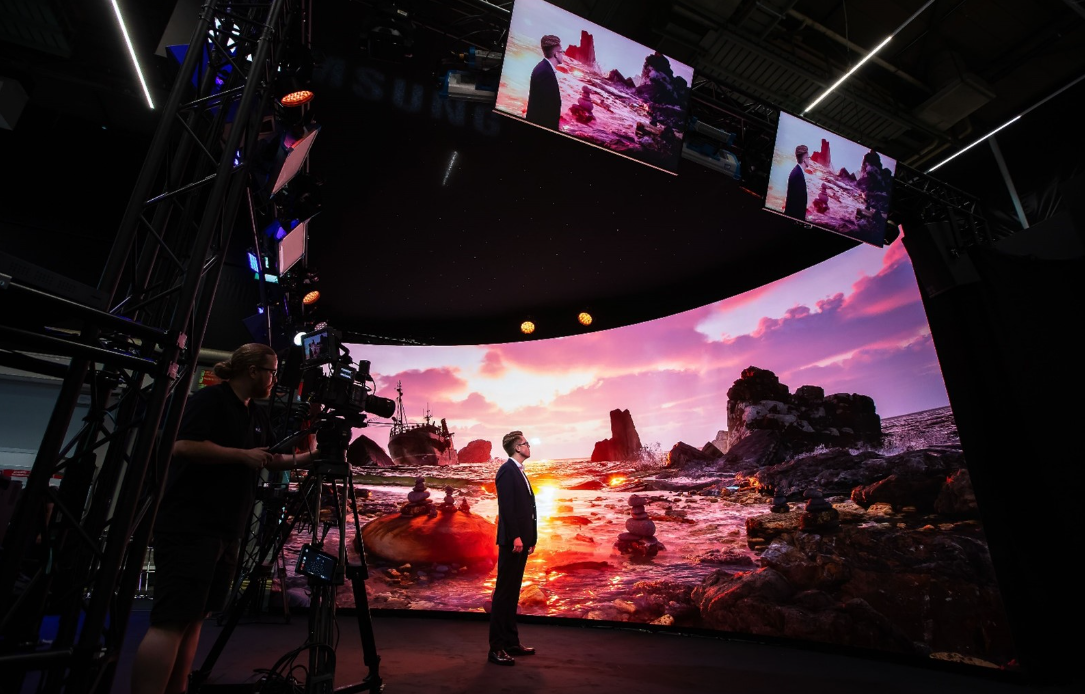
- Camera Flicker: Visible black bars (rolling shutter effect) when filmed.
- Content Loss: Fast-moving content may appear blurry or tearing.
- Not Broadcast Ready: Unsuitable for professional live streaming or TV.
- Flicker-Free: Crystal clear image on all cameras (1/2000s+ shutter speed).
- Smooth Motion: Perfect for fast video playback and sports.
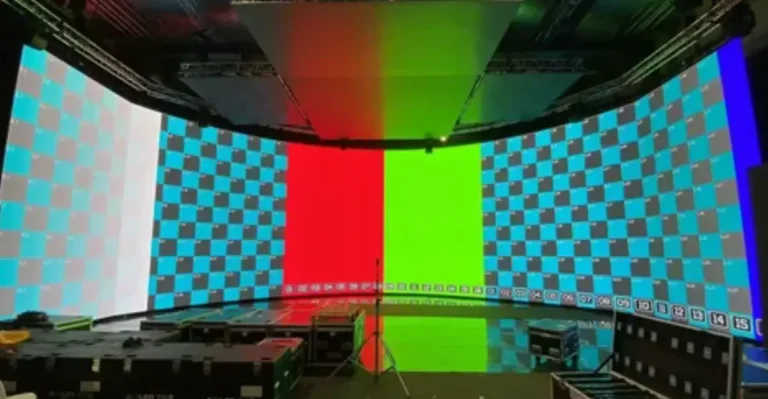
- XR Ready (7680Hz): Essential for virtual production and XR studios.
Refresh rate matters whenever the display is filmed, photographed or used for fast-moving content.
This is particularly important for:
- Broadcast studios
- Sports venues
- Concerts
- Live events
- Corporate presentations
- XR and virtual production
- Camera-facing advertising
A display can look perfectly acceptable to the human eye but behave differently when captured by a camera with a rolling shutter.
Sostron’s current stadium product specification, for example, lists a 3,840 Hz refresh rate for its stadium perimeter display.
However, buyers should not confuse refresh rate with frame rate.
- Frame rate describes how frequently content frames are delivered.
- Refresh rate describes how frequently the display updates.
- Scan method is another separate technical characteristic.
For camera-facing applications, refresh rate should be evaluated against the specific LED product and controller configuration rather than treated as a universal indoor or outdoor requirement. For example, Sostron’s current Ares documentation lists a refresh rate of up to 7,680 Hz, while other product configurations may use different values. Buyers should confirm the final refresh-rate specification for the exact model, pixel pitch and control system selected.
How Do Indoor and Outdoor LED Displays Differ in Control Systems?
Control architecture depends more on the application than simply on whether a display is indoors or outdoors.
Synchronous Control
Synchronous systems are suitable when the LED display needs to reproduce a live source in real time.
Common applications include:
- Conference rooms
- Control rooms
- Broadcast
- Live events
- XR
- Stadium content
Asynchronous Control
Asynchronous systems can store and schedule content locally or through networked management.
They are useful for applications such as:
- Digital advertising
- Retail signage
- Remote outdoor displays
- Scheduled promotional content
Outdoor digital billboards may benefit from remote network management because the screen can be physically distant from the operator.
For procurement, the controller should therefore be evaluated as part of the complete system rather than treated as an accessory.
Are Indoor LED Displays Better for Close Viewing?
Generally, indoor displays are more likely to be designed for close viewing because many indoor applications involve audiences standing relatively near the screen.
Typical examples include:
- Meeting rooms
- Retail stores
- Showrooms
- Museums
- Corporate lobbies
- Exhibition halls
- Broadcast studios
Fine pixel pitch can help preserve text and image detail at close distances.
But “smaller pixel pitch” does not automatically mean “better.”
If the audience is several meters away, moving from one fine-pitch specification to an even finer specification may have limited visible benefit while increasing cost.
The correct target is sufficient image quality for the actual viewing distance, not the smallest pitch available.
Which LED Display Is Better for Retail Stores?
There is no single answer because retail environments vary.
For a typical indoor retail environment, priorities may include:
- Fine pixel pitch
- High image quality
- Good color reproduction
- Slim cabinet design
- Front maintenance
- Architectural integration
- Appropriate brightness
Sostron’s indoor product portfolio includes Slim, Reta, Reta 2 and COB products designed for different commercial applications.
For a storefront directly exposed to daylight, however, the analysis changes. Ambient light, glass reflections, direct sunlight and environmental exposure may require a different configuration.
The store location should therefore be evaluated before choosing the product category.
Which LED Display Is Better for Billboards and DOOH?
Outdoor LED displays are normally the appropriate starting point for fully exposed digital billboards and DOOH installations.
The specification should prioritize:
- Daylight visibility
- Environmental protection
- Structural installation
- Remote control
- Reliability
- Maintenance access
- Power consumption
- Local regulations and permits
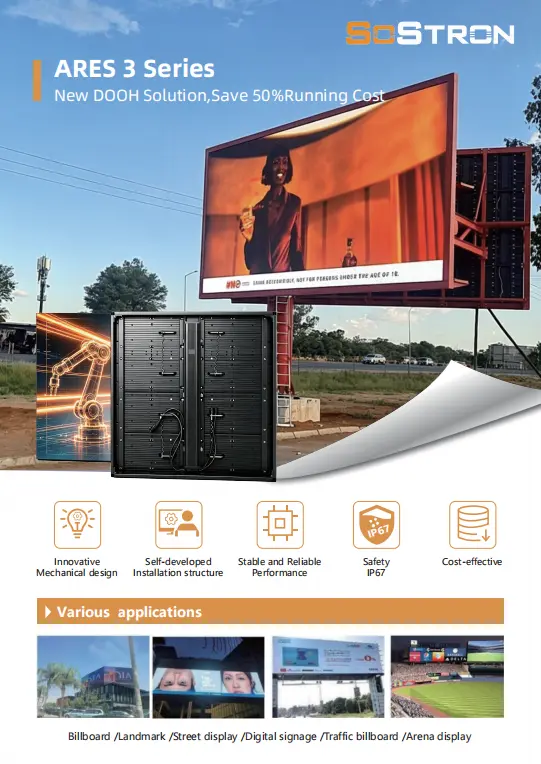
Sostron’s Ares 3 outdoor range is designed for outdoor applications and lists brightness up to 10,000 nits on its product documentation.
For a real project, the required brightness should still be matched to the site’s orientation, ambient light and operating schedule rather than simply selecting the maximum available value.
How Much Does an Indoor vs Outdoor LED Display Cost?
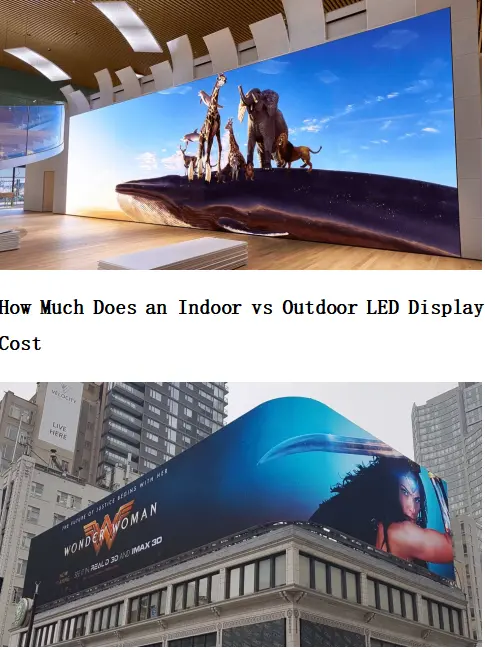
There is no reliable universal price for “an indoor LED screen” or “an outdoor LED screen.”
The quotation depends on the complete configuration and project conditions.
Outdoor systems often require additional engineering for:
- Higher brightness
- Weather protection
- Cabinet construction
- Structural mounting
- Thermal management
- Outdoor-rated electrical components
- Installation
- Maintenance access
Indoor systems may require higher spending on:
- Fine pixel pitch
- High image quality
- Architectural integration
- Special cabinet dimensions
- Front maintenance
- Color performance
- Broadcast or XR specifications
Therefore, a cheaper square-meter quotation is not necessarily the lower-cost project.
What Costs Should Be Included in the TCO?
A realistic B2B comparison should consider more than the LED cabinets.
Hardware
Include:
- LED modules
- Cabinets
- Receiving cards
- Power supplies
- Sending equipment
- Processor/controller
- Spare modules and components
Structure
Depending on the project:
- Steel structure
- Mounting brackets
- Reinforcement
- Rigging
- Wall anchors
- Structural engineering
Installation
Consider:
- Labor
- Lifting equipment
- Electrical installation
- Commissioning
- Calibration
- Site access
Logistics
Depending on the project:
- Packaging
- International shipping
- Insurance
- Customs
- Duties and taxes
- Local transportation
Operation
Include:
- Electricity
- Network connectivity
- CMS or control equipment
- Scheduled maintenance
Maintenance
Consider:
- Replacement modules
- Power supplies
- Receiving cards
- Fans or cooling components where applicable
- Waterproofing/seal inspection
- Cleaning
- Corrosion inspection
- Technician visits
A five- or ten-year TCO model should use actual supplier quotations and site-specific assumptions. If a figure is not available, it should be clearly labeled as an estimate, not presented as a market fact.
When Is the More Expensive LED Configuration Justified?
Higher specifications are justified when they solve a measurable problem.
Higher brightness is justified when:
- The screen faces strong daylight
- Direct sunlight affects visibility
- The viewing environment is unusually bright
Finer pixel pitch is justified when:
- The audience is close
- Text and fine graphics are important
- The screen is used for detailed presentations
- Camera/image quality requirements justify it
Higher IP protection is justified when:
- The cabinet is exposed to rain
- Wind-driven water is likely
- Dust exposure is significant
- The site environment is demanding
Higher refresh rate is justified when:
- Cameras will capture the screen
- The display is used for live production
- Sports or fast-motion content is important
More sophisticated control systems are justified when:
- Multiple content sources are required
- Remote monitoring is needed
- Redundancy is important
- The display is part of a larger AV system
The principle is simple:
Pay for the specification that solves a real project requirement.
What Hidden Costs Should B2B Buyers Watch For?
The quotation can look attractive until project-specific costs appear.
Common hidden or underestimated costs include:
- Steel structure
- Electrical distribution
- Lifting equipment
- Installation labor
- Shipping and customs
- Site preparation
- Network connectivity
- Spare parts
- Maintenance access
- Replacement power supplies
- Weatherproofing
- Corrosion protection
- Structural engineering
- Local permits
For outdoor installations, the supporting structure can become a major project component. For indoor installations, architectural modifications and restricted maintenance access can create unexpected labor costs.
The buyer should therefore compare complete installed-system cost, not only LED cabinet price.
What Should You Ask an LED Display Supplier Before Ordering?
Use the following checklist during technical evaluation.
Site and Environment
- What is the minimum and maximum viewing distance?
- Is the screen fully exposed or partially sheltered?
- Does it receive direct sunlight?
- Is the location coastal or industrial?
- What are the expected temperature and humidity conditions?
Display
- What pixel pitch is recommended and why?
- What is the maximum brightness?
- What is the recommended operating brightness?
- What is the refresh rate?
- What grayscale specification applies?
- What is the expected viewing angle?
Protection
- What IP rating is specified?
- Is the rating for the front, rear or complete cabinet?
- How are connectors and seams protected?
- What maintenance is required to preserve environmental protection?
Power and Thermal
- What are the maximum and average power figures?
- How is heat dissipated?
- What ventilation is required?
- What happens if cooling components fail?
Installation
- What is the cabinet weight?
- What supporting structure is required?
- Is front or rear maintenance available?
- What clearance is required behind the display?
Control
- Is synchronous or asynchronous control recommended?
- What processors/controllers are compatible?
- Is remote monitoring available?
- Can the system support the required input sources?
Commercial
- What is included in the quotation?
- What is excluded?
- What spare parts are recommended?
- What warranty terms apply?
- What after-sales support is available?
- Which costs are estimates rather than confirmed project costs?
This checklist is often more useful than comparing two supplier brochures line by line.
What Are the Best Indoor and Outdoor LED Applications?
Indoor LED Applications
Indoor LED displays are commonly used for:
- Corporate meeting rooms
- Retail stores
- Shopping malls
- Exhibition halls
- Control rooms
- Broadcast studios
- XR and virtual production
- Hospitality venues
- Museums
- Indoor stadiums
For these applications, image quality, pixel pitch, viewing distance, architectural integration and serviceability can be more important than maximum brightness.
Outdoor LED Applications
Outdoor LED displays are commonly used for:
- Digital billboards
- DOOH advertising
- Building façades
- Highways
- Public plazas
- Stadium exteriors
- Transportation environments
- Large commercial advertising
Here, daylight visibility, environmental protection, structural integrity, thermal performance and remote management become increasingly important.
Real Sostron Project Examples
Real project evidence is more useful than generic claims when evaluating indoor and outdoor LED technology.
Sostron’s published case library includes an 80 m² P10.4 outdoor LED billboard project in Kenya, a 100 m² outdoor LED screen project in Botswana, a Brazil highway Ares project, a France stadium LED upgrade and an indoor P2.5 LED project in Mexico.
These cases demonstrate an important procurement principle: the appropriate specification changes with the application, site and viewing conditions.
Sostron’s product portfolio also illustrates this range. Its indoor category includes Slim, Reta, Reta 2 and Cobra products, while its outdoor portfolio includes Ares products designed for outdoor LED billboard applications.
Where project-specific figures are used, buyers should distinguish between published project data and generalized industry recommendations.
How Should You Choose Between Indoor and Outdoor LED Displays?
Use this decision sequence rather than starting with the product catalog.
Step 1: Define the environment
Is the display:
- Fully indoors?
- Semi-outdoor?
- Fully exposed outdoors?
Step 2: Measure ambient light
Determine whether the screen will face:
- Artificial indoor lighting
- Window light
- Indirect daylight
- Direct sunlight
Step 3: Measure viewing distance
Identify:
- Minimum viewing distance
- Typical viewing distance
- Maximum practical viewing distance
Step 4: Define the content
Is the display showing:
- Large advertising graphics?
- Small text?
- Corporate presentations?
- Sports?
- Broadcast content?
- XR content?
- Product details?
Step 5: Select pixel pitch
Use viewing distance and content requirements to determine the appropriate pixel density.
Step 6: Select brightness
Choose enough brightness for the actual environment rather than simply selecting the highest number.
Step 7: Specify environmental protection
For outdoor or semi-outdoor sites, consider:
- IP protection
- Cabinet sealing
- Drainage
- Corrosion
- Temperature
- Solar exposure
Step 8: Plan maintenance
Decide whether the installation requires:
- Front maintenance
- Rear maintenance
- Service corridors
- Modular replacement
- Remote monitoring
Step 9: Calculate TCO
Include hardware, structure, installation, logistics, electricity and maintenance.
Step 10: Compare suppliers
Only after the technical specification is clear should suppliers be compared on price.
This prevents a common procurement mistake: asking suppliers for quotations before defining what the display actually needs to do.
Frequently Asked Questions
What is the main difference between indoor and outdoor LED displays?
The main difference is the environment they are engineered to operate in. Indoor displays generally prioritize close-viewing image quality, fine pixel pitch, low-profile construction and architectural integration. Outdoor displays prioritize daylight visibility, environmental protection, thermal management and structural durability. Brightness, pixel pitch and IP protection should therefore be selected according to actual site conditions rather than category labels alone.
Can an indoor LED display be used outdoors?
An ordinary indoor LED display should not automatically be installed outdoors. Outdoor exposure can require higher brightness, stronger environmental protection, suitable cabinet sealing, thermal management and structural support. A covered or semi-outdoor site may have different requirements, but the supplier should evaluate sunlight, rain exposure, temperature, humidity and installation conditions before confirming suitability.
Can an outdoor LED display be used indoors?
Some outdoor LED products can operate indoors, but they may be unnecessarily bright, heavy or highly protected for a controlled environment. This can increase purchase and operating costs without creating proportional value. Outdoor-rated equipment can make sense where the indoor location has unusual environmental exposure or durability requirements.
What pixel pitch and brightness should I choose?
Start with viewing distance, ambient light and content requirements. Short viewing distances generally favor finer pixel pitches, while bright outdoor environments require higher optical output. Neither the smallest pixel pitch nor the highest brightness is automatically the best choice. The specification should provide enough image detail and visibility for the actual installation without paying for unnecessary performance.
How much does an indoor vs outdoor LED display cost?
There is no universal price because LED display cost depends on pixel pitch, brightness, cabinet design, control equipment, structure, installation, logistics and maintenance requirements. Outdoor systems may require additional environmental and structural engineering, while premium indoor systems may cost more because of fine pixel pitch and architectural integration. Compare total installed cost and TCO rather than only cabinet price per square meter.
Choosing the Right LED Display With Sostron
Sostron provides commercial LED display products and project support across indoor, outdoor, rental, transparent and specialized applications. Its current portfolio includes indoor solutions such as Slim, Reta and Reta 2, as well as outdoor billboard solutions such as Ares.
For B2B projects, the value of working with an experienced LED manufacturer is not simply receiving a panel quotation. A complete project may require product development, configuration advice, engineering support, installation guidance, control-system selection, spare-parts planning and after-sales technical support.
The right indoor or outdoor LED display should therefore be selected from the project requirements outward—not from a generic product category inward.
For a new project, define the site, viewing distance, ambient light, content, maintenance conditions and expected operating schedule first. Those inputs provide the technical basis for selecting the LED display configuration and comparing supplier quotations on an equivalent basis.
References:
IEC 60529:1989+AMD1:1999+AMD2:2013 — Degrees of protection provided by enclosures (IP Code)
NIST — Standard Illumination Source for Display Measurement