If you are budgeting for an LED dance floor, the first decision is not the number of LED panels. It is whether the system is engineered for people to stand, walk, dance, and repeatedly load the surface. A 12 × 12 ft floor covers 144 sq. ft. (about 13.38 m²), but its project cost depends on far more than area: pixel pitch, load-bearing structure, protective surface, control system, installation, transport, and maintenance all affect the final price. For rental buyers, the commercial question is equally important: how many events can the system support before its purchase cost is recovered?
| Buyer question | Practical answer |
|---|---|
| What are LED dance floors made of? | LED modules, PCB/driver electronics, reinforced cabinets, power supplies, control components, and a protective walking surface |
| How do they work? | A controller sends image or lighting data to LED pixels, which produce programmable RGB visuals |
| What does a 12 × 12 ft floor mean? | 144 sq. ft. / approximately 13.38 m² |
| What drives the price? | Pixel pitch, structure, surface, controller, quantity, logistics, installation and service |
| Who should consider buying? | Event rental companies, AV integrators, venues, hotels, clubs and production companies |
The important distinction is simple: a floor-mounted LED display is not merely a conventional LED screen turned horizontally. Its mechanical design, protection, electrical configuration and maintenance strategy have to account for pedestrian traffic and repeated installation.
What Is an LED Dance Floor?
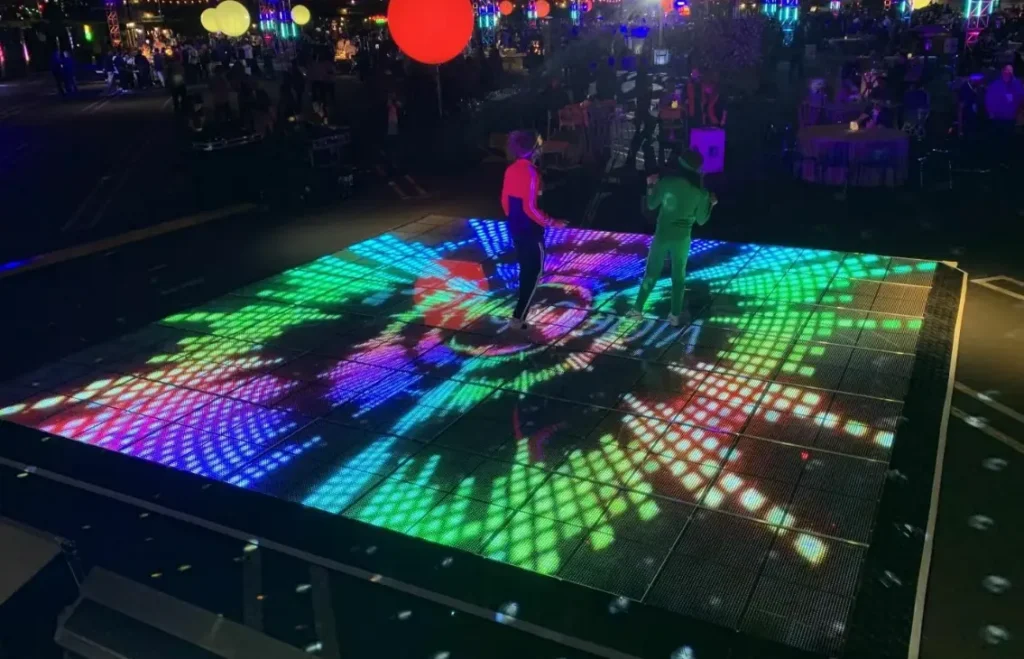
An LED dance floor is a modular LED display system engineered to operate horizontally as a walkable or performance surface. Instead of mounting LED cabinets vertically on a wall, the modules are integrated into a reinforced floor structure and protected by a surface designed to tolerate foot traffic.
Depending on the product architecture, the floor can display solid colors, animated patterns, graphics, logos, music-synchronized effects or video content. More advanced systems can also respond to pressure, movement, sensors or external lighting-control commands.
For an event rental company, that difference has direct commercial value. A conventional LED wall is primarily a visual asset; a floor display can become part of the physical experience, extending the usable display area into the audience environment and creating a visual focal point that is difficult to reproduce with standard screens.
How Is an LED Dance Floor Different From a Standard LED Display?
The most important difference is mechanical rather than visual.
A conventional LED display cabinet is normally designed around vertical installation. Its structure primarily needs to support the cabinet itself and resist environmental forces such as wind when used outdoors. A floor display has a different load path. People, equipment, furniture and sometimes temporary stage structures may impose downward and localized forces on the surface.
That means buyers should examine the tested load-bearing capacity, not simply ask whether a supplier describes the panel as “strong.”
For example, a professional commercial floor-lighting product from ADJ specifies a tempered-glass surface, ABS base, DMX512 control and a rated bearing capacity of 300 kg/m². The specification illustrates an important procurement principle: load capacity, surface construction and control architecture should be evaluated together rather than treated as isolated features.
What Can an LED Dance Floor Display?
An LED floor can be programmed for relatively simple lighting effects or used as a genuine visual display.
Typical content includes:
- RGB color transitions
- Geometric animations
- Moving patterns
- Event logos
- Brand graphics
- Abstract visual effects
- Music-synchronized lighting
- Video and motion graphics on suitable display architectures
For a corporate event, the commercial benefit is brand visibility. For a nightclub, it is atmosphere and repeatable visual programming. For an event rental company, programmable content means one physical asset can be reused across weddings, concerts, exhibitions, product launches and corporate functions.
That flexibility is one reason the control system deserves as much attention as the LED module itself.
What Are LED Dance Floors Made Of?
The answer depends on the product type, but a professional LED dance floor normally combines several layers rather than one “LED panel.”
LED Modules and RGB Pixels
At the visual core are LED pixels, usually built around RGB LED packages. Each pixel contains red, green and blue emitters whose intensity can be controlled to create different colors.
A smaller pixel pitch means pixels are positioned closer together, increasing pixel density and potentially improving image detail at shorter viewing distances.
For B2B buyers, the benefit is not simply “higher resolution.” Pixel pitch should be selected according to viewing distance and content requirements. Choosing an unnecessarily fine pitch can increase capital expenditure without producing a meaningful visual improvement when the audience is several meters away.
PCB Boards and LED Driver ICs
The LEDs are mounted on printed circuit boards, while driver ICs control the electrical behavior of the pixels.
The driver architecture affects grayscale performance, color consistency and how accurately the system reproduces programmed visual changes. This becomes particularly relevant when the floor is filmed by cameras or integrated into a professional stage production.
The commercial payoff is straightforward: better pixel control reduces visible inconsistencies and gives production teams more predictable results.
Reinforced Cabinets and Floor Structures
This is where a genuine LED floor begins to separate itself from a normal display cabinet.
The cabinet or supporting frame must transfer loads safely through the floor structure rather than allowing concentrated pressure to damage the LED modules underneath. Depending on the design, manufacturers may use aluminum structures, reinforced frames, ABS components or combinations of structural materials.
Buyers should ask for the actual tested load rating and understand the test conditions. A statement such as “500 kg capacity” is not enough without knowing whether the figure refers to evenly distributed static load, a localized load, or another test configuration.
Tempered Glass and Protective Surfaces
The top surface is commonly protected by tempered glass or another impact-resistant material. This layer allows the audience to interact with the floor while keeping direct physical contact away from sensitive LED electronics.
The surface can also incorporate anti-slip treatment, scratch resistance and moisture protection depending on the intended application.
These features have an obvious business benefit: fewer surface failures mean fewer repairs, less downtime and lower risk during high-value events.
Power Supplies, Data and Control Components
An LED dance floor is also an electrical and data system.
Power supplies convert incoming electricity into the voltage required by the LED modules. Data cables distribute control signals between panels and controllers, while the control system determines what each pixel should display.
Professional products demonstrate how varied these architectures can be. For example, ADJ’s MDF series specifies DC 24 V operation and DMX512 input, while individual panels can be connected to dedicated power-supply configurations.
This modular approach has a practical advantage for rental businesses: the system can be scaled, transported and configured for different floor sizes rather than being permanently tied to one installation.
How Do LED Dance Floors Work?
At the system level, the process is easier to understand as a signal chain:
Content Source → Controller → Data Network → Driver IC → RGB LED Pixels → Visual Output
The content source may be a lighting console, media server, SD controller, computer, sensor system or other compatible device. The controller interprets the content and distributes the required information to the LED floor.
From Video Content to LED Pixels
Suppose an operator wants a blue-and-white animated pattern to move across a 12 × 12 ft floor.
The content is first created or selected in the control environment. The controller maps that content to the physical arrangement of LED pixels. Data is then distributed to the corresponding modules, where driver ICs regulate individual LED channels.
The result is not a single light source changing color. Thousands of individual pixels can be controlled as a coordinated display.
That distinction matters commercially because it determines whether the floor can be treated as a genuine visual-content platform rather than simply decorative lighting.
How DMX512 Controls LED Dance Floor Effects
DMX512 is widely used in professional lighting environments and can allow a dance floor to communicate with lighting-control equipment.
A typical workflow may look like:
Lighting Console → DMX512 → Floor Controller → LED Panels
The advantage for an event-production company is integration. The floor does not have to operate as an isolated visual product; it can become another controllable element alongside moving lights, stage lighting and other effects.
Commercial floor products demonstrate this architecture in practice. ADJ specifies DMX512 input and multiple DMX channel modes for its MDF series.
How Music Synchronization and Interactive Effects Work
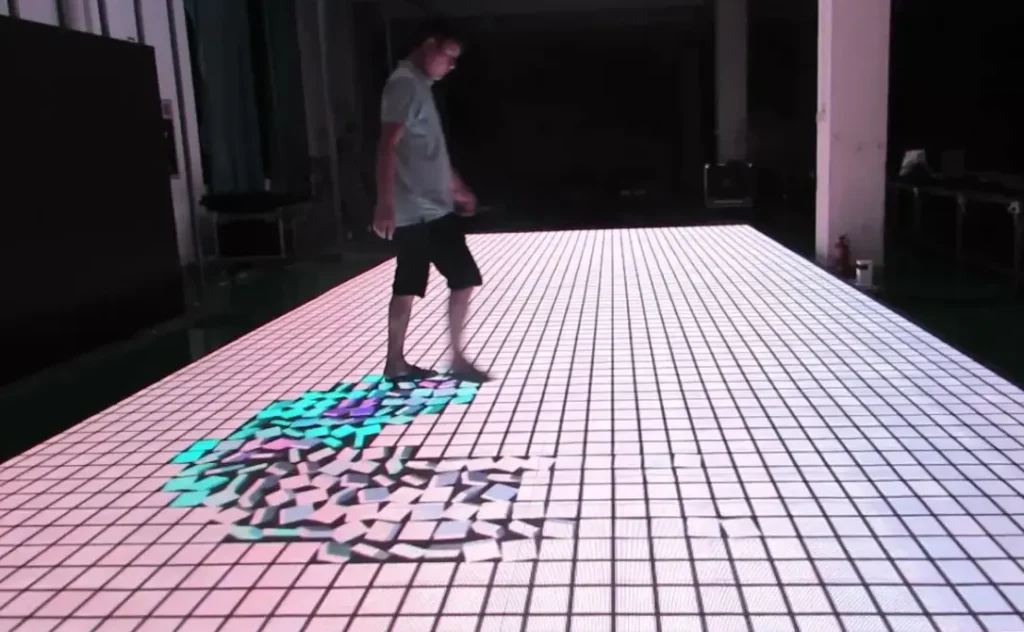
Some systems can operate in sound-controlled modes, while more advanced interactive LED dance floors use sensors or pressure-sensitive technologies to trigger visual changes.
A pressure-responsive system can, for example, illuminate pixels near a person’s footsteps or change an animation according to movement.
The business value is different from ordinary video playback: interaction creates an experience rather than simply displaying content. For retail activations, branded events and entertainment venues, that can increase audience engagement and create highly shareable visual moments.
Why Refresh Rate Matters for Professional Events
Refresh rate describes how frequently the display can update its image. For ordinary human viewing, a very high refresh rate may not always produce an obvious difference. Cameras are less forgiving.
When an LED floor is used for concerts, livestreaming, broadcast production or XR environments, insufficient refresh performance can contribute to visible scanning artifacts or flicker on camera.
For professional buyers, therefore, refresh rate is not merely a specification to compare on a datasheet. It is a production-risk variable. If the floor will frequently appear on camera, its display architecture should be evaluated with the intended camera system and shutter settings rather than judged only by viewing it with the naked eye.
According to the IEC, IEC 62368-1:2023 is a product-safety standard covering audio/video and related electronic equipment and focuses on safeguards against energy sources that could cause injury or property damage. It is not a performance standard for LED dance floors, so buyers should not confuse general electrical product safety with the separate mechanical and installation requirements of a walkable floor system.
This distinction is important. Electrical compliance does not automatically prove floor-load safety. A serious procurement specification should address both.
What Determines LED Dance Floor Performance and Cost?
A useful way to evaluate a floor is to connect every specification to the business result it produces.
| Specification | Engineering impact | B2B benefit |
|---|---|---|
| Pixel pitch | Determines pixel density | Controls image detail and viewing-distance suitability |
| Load capacity | Defines supported floor loading | Reduces mechanical failure risk |
| Protective surface | Shields LED components | Improves durability and event reliability |
| Refresh rate | Controls image update behavior | Reduces camera-related artifacts |
| DMX512 / network control | Enables external control | Simplifies integration with event lighting |
| Power consumption | Determines electrical demand | Affects operating cost and venue planning |
| Modular cabinet design | Enables panel-level service | Reduces downtime and simplifies replacement |
Based on our experience with LED display projects, the most expensive mistake is often not choosing a product that costs too much. It is choosing a product that looks inexpensive on the quotation but requires additional controllers, structural work, replacement modules, specialist labor or logistics after the order is placed.
For that reason, LED dance floors should be evaluated as complete systems rather than as a price-per-panel commodity. The next step is to translate these technical specifications into the number most procurement teams ultimately care about: the actual cost of a 12 × 12 ft installation or rental system.
What Is the Price of a 12×12 LED Dance Floor?
A 12 × 12 ft floor contains 144 sq. ft. (13.38 m²) of usable floor area. However, there is no single universal 12×12 price because “LED dance floor” can describe very different systems—from decorative RGB lighting tiles to professional, load-bearing video-capable floor displays.
Current market examples illustrate the spread. One U.S. rental provider lists a 12×12 ft floor at $1,600 with installation, programmed effects and DMX capability, while another Southern California provider quotes $3,600 for a 12×12 rental including delivery, setup and a lighting technician.
That difference is not necessarily a supplier markup. The scope of the quotation matters.
| Cost factor | Basic event rental | Professional B2B system | Why it changes the price |
|---|---|---|---|
| LED floor panels | Standard RGB | Higher-performance modular display | Determines visual capability |
| Surface | Tempered glass/acrylic | Reinforced anti-slip surface | Affects durability and safety |
| Load capacity | General foot traffic | Higher engineered load rating | Determines suitable applications |
| Controller | Remote/standalone | DMX / PC / network control | Affects integration |
| Installation | Basic setup | Technical installation + testing | Adds labor and reliability |
| Transportation | Local delivery | International freight/cases | Important for mobile systems |
| Technician | Sometimes excluded | Often available | Reduces event-operation risk |
| Spare parts | Limited | Recommended stock | Reduces downtime |
| Custom content | Usually optional | May be integrated | Adds creative capability |
For buyers comparing supplier quotations, the correct question is therefore not “What is your price per square foot?” but:
“What exactly is included in the delivered and operational system?”
How Much Does a 12×12 LED Dance Floor Cost to Rent?
For U.S. event rental markets, published examples currently range from roughly $1,600 to $3,600 for a 12×12 ft rental, depending heavily on location and what is included. One provider explicitly includes professional installation and breakdown, while another includes delivery, setup and a lighting technician.
Other markets can be considerably lower, particularly when the quotation covers equipment only rather than a turnkey event service.
This is why rental buyers should request an itemized quote covering:
- Equipment rental period
- Delivery
- Installation
- Breakdown
- Lighting technician
- Controller
- Custom programming
- Travel charges
- Overtime
- Damage deposit
- Taxes and venue fees
A $1,500 quote and a $3,500 quote may both be commercially reasonable if they represent different service packages.
How Much Does a 12×12 LED Dance Floor Cost to Buy?
Purchase pricing is even harder to generalize because manufacturers sell different architectures.
A current manufacturer listing for a 12×12 interactive floor specifies tempered glass, 500 kg/m² load-bearing capacity, RGB LEDs, PC/DMX control and a 500 × 500 × 70 mm module format. Another manufacturer lists a 12×12-compatible product family with options ranging from 8×8 to 20×20 ft and quotes $3,990 for one configuration, while noting that import duties are excluded.
Those examples should not be treated as a universal purchase-price benchmark. They demonstrate something more useful: the buyer needs to compare the complete specification before comparing the number.
For an international B2B order, the final landed cost may include:
Factory price + packaging + freight + insurance + import duty/tax + local delivery + installation + spare parts + commissioning
That is the number that belongs in your procurement model.
What Factors Determine the Cost of LED Flooring?
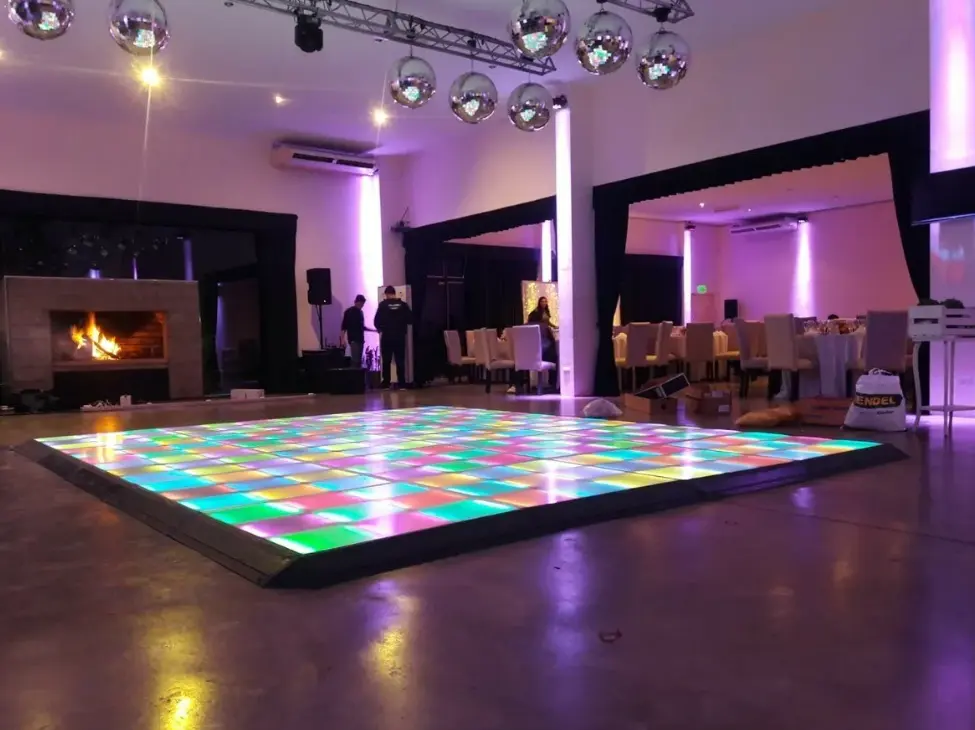
The biggest cost drivers are not necessarily the components that look impressive on a product brochure.
Pixel Pitch and Visual Resolution
For a conventional video LED floor, pixel pitch determines how closely the pixels are packed.
A finer pitch can produce greater image detail and cleaner graphics at shorter viewing distances. That is useful when the audience stands close to the floor or when the display will be photographed at close range.
But finer pitch also means more pixels, more electronics and potentially higher acquisition cost.
For a large event where guests are several meters away and the floor is primarily displaying colors and patterns, paying heavily for extreme pixel density may deliver little additional commercial value.
Engineer’s rule: specify pixel pitch from the viewing distance backward—not from the supplier’s newest product forward.
Load Capacity and Structural Engineering
Load capacity is one of the most important specifications for a floor system.
Published products commonly advertise ratings around 300–500 kg/m², while some specialized systems claim substantially higher capacities. ADJ’s MDF3, for example, specifies 300 kg/m², while other commercial products publish 500 kg/m² or more.
However, buyers should never compare these figures without understanding the test method.
Ask:
- Is the figure static or dynamic?
- Is the load distributed or concentrated?
- What happens at panel joints?
- Is the load rating valid for the complete installed structure?
- Does the manufacturer specify limits for stage equipment or vehicles?
- Is the floor designed for repeated rental deployment?
The business benefit of proper structural engineering is simple: fewer damaged modules, fewer event interruptions and lower liability exposure.
Protective Surface and Impact Resistance
The surface is the part that takes the abuse.
Current products commonly use tempered glass, with some systems using acrylic or other protective materials. For example, ADJ specifies tempered glass, while several manufacturer systems specify 10 mm tempered-glass surfaces.
Look beyond the word “glass.”
A procurement specification should address:
- Thickness
- Tempering
- Slip resistance
- Scratch resistance
- Impact resistance
- Replacement procedure
- Edge protection
- Cleaning requirements
A beautiful floor that requires excessive maintenance is not necessarily a good rental asset.
Refresh Rate and Camera Performance
If the floor will appear in livestreams, broadcasts, concerts or filmed productions, refresh rate becomes more important.
A system specified around 3,840 Hz or higher can provide a more camera-friendly platform than a basic decorative lighting system, although actual camera performance depends on the entire LED/control architecture and filming conditions.
The commercial benefit is straightforward: fewer visible scanning artifacts means fewer compromises for production teams.
For a wedding venue that rarely uses professional cameras, this may be a secondary consideration. For an event production company serving broadcast clients, it can be a procurement requirement.
Control System and Integration
A floor controlled only by a handheld remote is adequate for some private events.
A professional production environment is different.
DMX512, PC control, media-server integration and other networked control approaches allow the floor to become part of a larger lighting ecosystem. Current commercial floor products demonstrate combinations including DMX, PC, sound-active and remote control.
The benefit is operational rather than merely technical: the lighting director can coordinate the floor with the rest of the show instead of operating it as a separate gadget.
Rental vs. Buying an LED Dance Floor: Which Is More Cost-Effective?
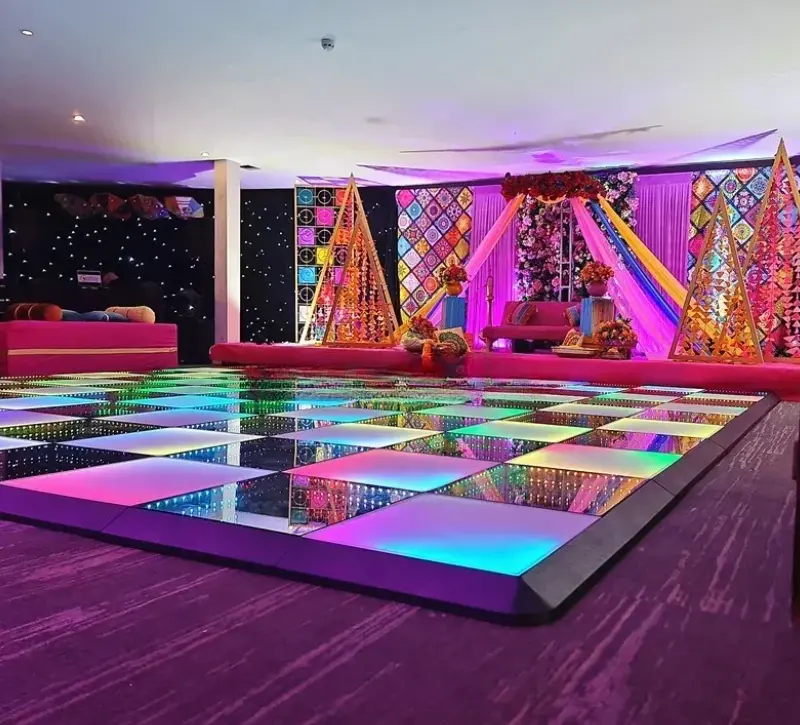
There is no universal winner.
For an organization holding two events per year, buying a complete floor may tie up capital and create storage, maintenance and transportation obligations that make little financial sense.
For an event rental company completing several paid deployments every month, the calculation changes completely.
When Renting Makes More Sense
Renting is usually attractive when:
- The event is one-off.
- Floor size changes from event to event.
- The buyer does not have storage.
- Professional installation is required.
- A lighting technician is needed.
- The organization wants to avoid maintenance.
- The technology is needed only occasionally.
The rental price is effectively paying for equipment access + logistics + labor + operational risk transfer.
When Buying Makes More Sense
Ownership becomes more compelling when the system can generate repeated revenue.
Typical buyers include:
- Event rental companies
- AV integrators
- Production companies
- Hotels
- Nightclubs
- Wedding venues
- Exhibition contractors
- Entertainment facilities
For a rental company, the relevant calculation is:
Payback Events = Total Acquisition Cost ÷ Net Revenue Per Event
Suppose a complete system costs $20,000 and generates $1,500 in contribution margin per event after transport and labor.
The theoretical payback point is:
$20,000 ÷ $1,500 ≈ 13.3 events
That is much more useful than saying “the floor costs $20,000.” The same equipment can be expensive for one buyer and highly profitable for another.
What Specifications Should You Check Before Buying an LED Dance Floor?
A professional RFQ should go beyond price and LED quantity.
| Specification | What to ask the supplier | Business consequence |
|---|---|---|
| Pixel pitch | Exact pitch and pixel density | Determines viewing quality |
| Load rating | Tested kg/m² and test method | Determines safe application |
| Surface | Material, thickness, anti-slip treatment | Determines durability |
| Refresh rate | Actual system specification | Affects camera performance |
| Control | DMX, Art-Net, PC, standalone | Determines integration flexibility |
| Power | Max and typical consumption | Determines venue electrical planning |
| IP rating | Tested ingress protection | Determines environmental suitability |
| Panel weight | Weight per tile/cabinet | Affects transport labor |
| Connection | Magnetic, cable, quick-lock | Determines setup speed |
| Serviceability | Replaceable module/components | Determines downtime |
| Spare parts | Recommended percentage | Protects rental availability |
| Warranty | Coverage and exclusions | Controls long-term risk |
| Certification | Applicable market certifications | Supports compliance |
| Lead time | Production + shipping | Affects event scheduling |
Why a Low Price Per Panel Can Be Misleading
Imagine Supplier A offers a panel at a lower unit price but excludes:
- Controller
- Protective edges
- Flight cases
- Power distribution
- Spare modules
- Shipping
- Installation guidance
Supplier B quotes more per panel but supplies the complete operating system.
Supplier B may actually have the lower total cost of ownership.
This is especially important for international buyers because freight, customs, packaging and replacement logistics can materially change the economics after the factory quotation has been accepted.
Can You Use a Standard LED Display as a Dance Floor?
Technically, a display designed for wall installation should not simply be placed horizontally and used as a walking surface.
A conventional LED cabinet may have adequate visual performance but lack the mechanical reinforcement, protective surface and load-bearing design required for pedestrian use.
The distinction is important:
Display rating ≠ floor rating.
A professional LED dance floor needs an engineered load path from the walking surface through the cabinet or frame and into the supporting ground. The LED module itself should not be treated as the structural element carrying the audience.
This is also why a supplier’s statement that a product is “strong” is not enough. Request the tested load rating and installation instructions.
How to Choose the Right LED Dance Floor for Different Applications
Weddings and Private Events
Prioritize:
- Visual effects
- Appearance
- Easy installation
- Surface finish
- Remote control
- Rental cost
Ultra-high resolution is usually less important than aesthetics and reliability.
Nightclubs
Prioritize:
- High operating hours
- Programmable RGB effects
- DMX integration
- Maintenance accessibility
- Surface durability
- Heat management
The floor is part of the venue’s permanent experience, so reliability becomes more important than one-off installation speed.
Concerts and Festivals
Prioritize:
- Fast setup
- Modular construction
- Load capacity
- High refresh rate
- Control integration
- Transport cases
- Spare parts
For touring companies, every minute saved during load-in and teardown has financial value.
Corporate Events and Product Launches
Branding becomes a major factor.
The system should support logos, coordinated graphics, programmed transitions and integration with the event’s lighting and AV infrastructure.
Event Rental Companies
This is where the purchasing equation becomes most sophisticated.
The best product is rarely the cheapest one. It is the one that balances:
purchase price + durability + setup speed + visual quality + serviceability + rental demand + resale value.
How to Compare LED Dance Floor Suppliers
The supplier’s manufacturing capability matters because the floor is a system rather than a single LED component.
Ask potential suppliers for:
- Product datasheet
- Load-bearing test information
- Surface specification
- Control-system compatibility
- Power requirements
- Installation instructions
- Replacement-module procedure
- Spare-parts recommendation
- Warranty terms
- Relevant certifications
- Production lead time
- Packaging dimensions
- Shipping weight
- Previous project references
A supplier that cannot clearly explain the mechanical structure should not be evaluated purely on its LED price.
LED Dance Floor Total Cost of Ownership: What Buyers Often Miss
The purchase invoice is only the first line of the financial model.
For a rental company, a practical TCO model should include:
TCO = Equipment + Freight + Installation + Storage + Power + Maintenance + Spare Parts + Labor + Downtime
Then compare those costs with expected rental revenue.
Consider a simplified three-year scenario:
| TCO component | Example consideration | Why it matters |
|---|---|---|
| Initial equipment | Floor + controller + accessories | Largest upfront investment |
| Freight | Factory to warehouse | Significant for heavy systems |
| Storage | Cases + floor area | Recurring overhead |
| Power | Event operating hours | Variable operating cost |
| Maintenance | Modules, glass, connectors | Protects system availability |
| Labor | Setup and teardown | Direct event cost |
| Downtime | Failed panels or controllers | Lost rental revenue |
| Spare parts | Modules/PSUs/cables | Reduces emergency procurement |
| Resale value | End-of-life asset value | Reduces effective ownership cost |
The biggest hidden cost for a rental business is often not electricity.
It is downtime.
If a failed controller prevents a $5,000 event deployment from operating, the financial loss can exceed the value of the failed component itself. That is why modular architecture, spare parts and technical support should be treated as commercial specifications rather than after-sales extras.
LED Dance Floor Installation: What Does the Venue Need?
The venue needs more than an empty space.
Before installation, confirm:
- Floor flatness
- Access route
- Door dimensions
- Electrical supply
- Cable routing
- Maximum venue load
- Moisture exposure
- Emergency access
- Setup and teardown time
- Cleaning requirements
Power planning should be based on the maximum system load, not only average consumption.
Likewise, a floor that works perfectly in a dry ballroom may require a different protection strategy for an outdoor event.
Some current commercial products publish IP54–IP55 ratings, while others offer higher protection configurations. These ratings should be checked against the actual installation environment rather than assumed from the phrase “waterproof.”
LED Dance Floor Maintenance and Troubleshooting
A well-designed modular system should make individual component replacement practical.
Common problems include:
Dead or Abnormal Pixels
Possible causes include LED package failure, driver IC problems, PCB damage or connection faults.
Uneven Color
Potential causes include calibration differences, aging components or replacement modules that have not been properly matched.
Power Problems
Symptoms may include:
- Entire panel failure
- Flickering
- Intermittent operation
- Localized brightness loss
Data Signal Problems
If multiple panels fail in sequence, investigate the data path before replacing LED modules. The problem may originate from a controller, cable or signal connection.
Surface Damage
A damaged protective surface should not be treated as cosmetic if it compromises safety or exposes internal components.
For rental businesses, keeping a defined spare-parts inventory is usually more economical than relying on emergency international shipping.
Why Choose SoStron for an LED Dance Floor Project?
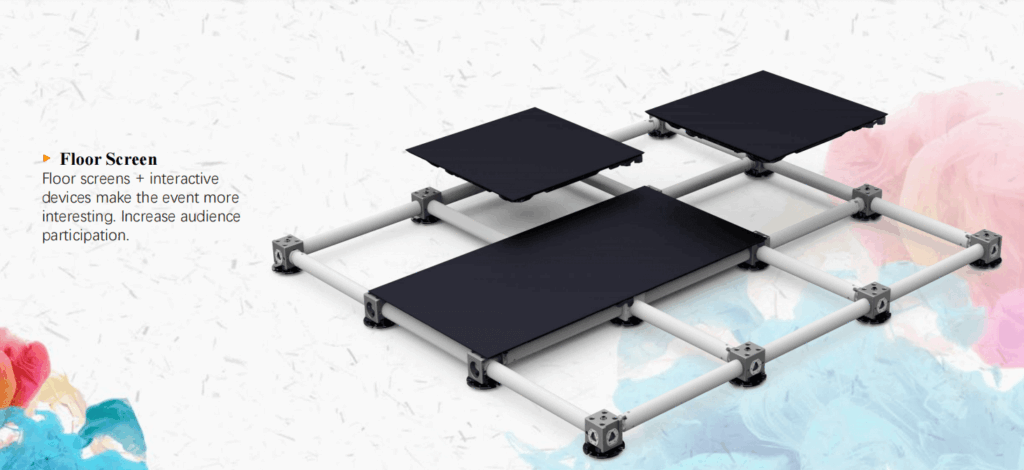
A B2B LED project should start with application requirements rather than a product catalog.
Sostron approaches LED display projects through the full chain:
Project Analysis → Product Selection → Pixel Pitch → Structural Configuration → Manufacturing → Testing → Delivery → Installation Guidance → Technical Support
That approach is particularly relevant when the floor is part of a larger commercial display environment.
As a global LED display manufacturer and commercial display solution provider, Sostron can also apply broader LED engineering experience to applications where the dance floor works alongside LED walls, rental displays, commercial screens or digital signage.
The objective is not simply to supply LED modules. It is to specify a system that can be transported, installed, operated, maintained and eventually return its investment.
LED Dance Floor Buying Checklist
Before approving an order, a B2B buyer should be able to answer all 15 questions below:
- What is the exact floor size?
- What is the required pixel pitch?
- What is the minimum viewing distance?
- What is the tested load-bearing capacity?
- What is the surface material and thickness?
- Is the surface anti-slip?
- What is the refresh rate?
- What is the maximum power consumption?
- What control protocols are supported?
- Is DMX512 supported?
- What is the applicable IP rating?
- How quickly can individual panels be replaced?
- Which spare parts should be purchased?
- What exactly is covered by the warranty?
- What is the total delivered and operational cost?
If a supplier cannot answer these questions clearly, the quotation is not ready for a serious procurement decision.
Frequently Asked Questions About LED Dance Floors
What are LED dance floors made of?
Professional LED dance floors typically combine RGB LED modules, PCB boards, driver ICs, power supplies, reinforced cabinets or frames, data connections and a protective walking surface such as tempered glass. The exact construction varies by product. Commercial examples show combinations such as tempered glass with ABS or reinforced structures, with published load ratings ranging from around 300 kg/m² to substantially higher figures depending on the design.
How do LED dance floors work?
A controller sends lighting or visual data to the floor’s LED modules. Driver ICs regulate the RGB LEDs so individual pixels can produce programmed colors and patterns. Depending on the system, DMX512, PC control, sound activation, remote control or interactive sensors can be used. More advanced systems can synchronize the floor with stage lighting, music or movement.
What is the price of a 12×12 LED dance floor?
A 12×12 ft floor equals 144 sq. ft., but the price depends heavily on whether you are renting or purchasing and what services are included. Current published U.S. rental examples show approximately $1,600 to $3,600 for a 12×12 floor, while international equipment prices vary substantially by configuration, accessories and shipping. Always compare the complete delivered system rather than a panel-only price.
Can people safely walk on LED dance floors?
They can when the system is specifically engineered and rated for pedestrian floor use and is installed according to the manufacturer’s requirements. Buyers should verify load-bearing capacity, protective-surface construction, anti-slip characteristics and structural installation requirements. A conventional wall-mounted LED display should not automatically be assumed to be suitable as a walkable floor.
Is buying an LED dance floor better than renting one?
It depends on utilization. Renting generally makes more sense for occasional events because it avoids storage, maintenance and capital expenditure. Buying can become financially attractive for event rental companies, venues and production businesses that can repeatedly deploy the system. The correct comparison is based on total ownership cost, expected event utilization and net revenue per deployment—not simply the initial purchase price.
Expert Verdict
Buy the system, not the panel.
For a 12×12 LED dance floor, price should come after load capacity, surface safety, control compatibility, serviceability and total delivered cost have been verified. If the floor will generate recurring rental revenue, model its payback by event. If it will serve occasional events, renting may be the more rational capital decision.
For B2B buyers, the strongest specification is rarely the cheapest one. It is the one that can survive the event, integrate with the production system, be repaired quickly—and keep earning money after the first deployment.
References:
OSHA — Walking-Working Surfaces