Every LED display quote looks reasonable on the day you receive it. The trouble starts later—three months in, when a control card fails on a live broadcast wall and nobody can tell you whether the replacement is coming from a warehouse two states away or a factory floor eleven time zones out.
That gap between “who quoted this” and “who actually built it” is where most China vs Local LED display supplier decisions quietly go wrong, and it’s the exact problem our engineering team at Sostron was built to close.
Rather than asking clients to pick a side of the ocean, we design, manufacture, and support the screen ourselves—module, cabinet, and control system—so the accountability doesn’t disappear the moment the container leaves Shenzhen port.
Priority Better Fit
| Priority | Better Fit |
|---|---|
| Lowest unit cost, large volume, custom pixel pitch | China, factory-direct |
| Same-week install, single small screen, no vetting time | Local distributor |
| Multi-region rollout, predictable warranty, engineering support | Verified factory-direct partner with local-level service |
If you’re an integrator sourcing for a DOOH network, an event production company quoting a festival stage, or a facilities manager replacing an aging video wall, that table is the honest starting point.
Everything below explains why—and where the industry’s own comparison guides, including the sourcing framework published by tend to stop short of the full picture.
What’s Actually Inside the Cabinet—And Why the Materials Decide Everything Later
Before any cost comparison means anything, it helps to know what you’re actually buying, because two cabinets that look identical in a spec sheet can behave completely differently after eighteen months outdoors.
The die-cast aluminum housing used on Sostron’s Ares outdoor series isn’t a cosmetic choice—aluminum dissipates heat roughly three times faster than the stamped-steel enclosures still used by budget factories, which matters enormously once a cabinet is sitting in direct sun at 40°C and the LED junction temperature starts climbing.
On the module side, we run COB (Chip-on-Board) packaging on our fine-pitch Cobra series specifically because encapsulating the chip beneath a flat resin surface removes the exposed solder joints that SMD packages rely on.
The practical result, in the field, is a display that survives an accidental bump from a ladder or a cleaning crew without a dead pixel cluster showing up two weeks later.
Every driver IC and receiving card we install is sourced from tier-one component suppliers and run through our own 72-hour aging chamber before it’s approved for cabinet assembly, not spot-checked after a customer complaint arrives.
Why Buyers Choose to Work With Us Instead of Rolling the Dice on a Trading Company
Here’s the honest pitch, without the marketing gloss:
We’ve spent enough years building screens for advertising networks, stadiums, broadcast studios, and retail chains across five continents to know exactly where a China-sourced project typically breaks down—and we built our process to remove those failure points one at a time.
Our engineering team doesn’t hand a client a datasheet and disappear; they run the viewing-distance calculation, the brightness-versus-ambient-light modeling, and the ROI projection before a single module is produced, the same way an in-house engineering department would for a direct hire rather than an outside vendor.
That’s the difference between a factory that manufactures screens and a partner that manufactures outcomes—and it’s a distinction procurement teams increasingly ask about directly, according to import guidance published by LED screen factory‘s 2026 sourcing guide, which notes that supplier verification has become the single biggest bottleneck in the China-import process for first-time buyers.
The Real Reason Price Alone Won’t Predict Your Total Cost
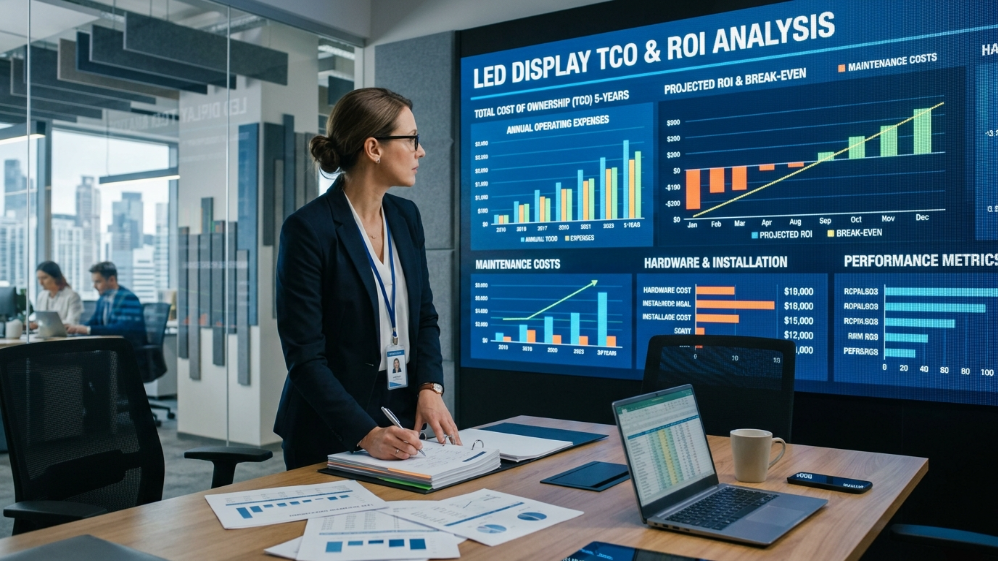
A pixel pitch spec sheet and a price-per-square-meter quote look almost identical across ten different suppliers.
What doesn’t show up on that sheet is who built the driver IC, whether the modules passed a real burn-in cycle, and who picks up the phone when a cabinet fails during a live event.
That gap is where most LED procurement budgets actually get blown, quietly, months after the purchase order is signed.
The Bill That Arrives After the Invoice Is Paid
Buyers who select suppliers purely on unit price frequently discover, too late, that the same quote came bundled with an extended delivery window and thinner warranty coverage—a trade-off documented in independent sourcing analysis from Canadian-LED’s import cost breakdown.
A screen that’s 15% cheaper but arrives three weeks late doesn’t save money; it just moves the cost from your purchase order onto your project calendar, and calendar overruns are almost always the more expensive line item.
Three Buyer Profiles, One Underlying Question
This isn’t an academic comparison.
It’s asked by three specific buyer profiles, each with a different risk tolerance:
- System integrators who need consistent specs across multi-site rollouts
- DOOH operators who need 24/7 uptime and remote diagnostics across a distributed screen network
- Event or stage rental companies who need lightweight cabinets that survive weekly load-in and load-out without cosmetic damage
Strip away the industry jargon and each of these buyers is really asking the same question in a different accent:
If something goes wrong, how fast can I fix it, and who’s actually accountable?
The “Local Manufacturing” Illusion—And Why Shenzhen Still Runs the Show
Here’s the detail most comparison articles skip entirely:
In the overwhelming majority of cases, there is no such thing as a purely “local” LED display.
The component-level manufacturing—LED packages, driver ICs, PCBs, receiving cards—is concentrated almost entirely in one place, and pretending otherwise doesn’t change where the risk actually sits.
One City Supplies Nearly the Entire Industry
Shenzhen hosts the vast majority of the world’s LED display manufacturing capacity, along with the upstream suppliers of LED chips, driver ICs, control systems, and cabinet components that feed that production.
That concentration isn’t an accident of geography; it’s the result of decades of supply-chain compounding, where a factory can source a driver IC, an LED package, and a power supply from three different neighbors within a single afternoon.
A “local” brand in North America or Europe is, in almost every case, sourcing finished modules or complete cabinets from this same supply chain and adding a markup, a logo, and a domestic sales layer on top of it.
The Middleman Hiding Inside Your Quote
This is the distinction that actually determines your risk exposure, and it applies on both sides of the “China vs local” question.
A trading company takes your order, sources the cheapest module that meets spec from whichever factory is available that week, and adds a margin—with no manufacturing accountability if that factory substitutes components.
A factory-direct manufacturer controls the LED module production, cabinet assembly, and aging test in-house, meaning the engineer who designed your pixel pitch configuration is the same organization responsible for the 72-hour burn-in test before it ships.
Translated into commercial terms:
Paying for factory-direct isn’t paying for a brand name—it’s paying for someone who can trace a defect back to a production batch instead of forwarding you a form email.
Distributor, Reseller, or True Manufacturer—Ask Before You Assume
Before comparing costs, ask any local quote a direct question:
Do you manufacture the module and cabinet, or do you import and relabel?
Most will admit, when pressed, to the latter.
That doesn’t automatically disqualify them—a well-run distributor with local stock and trained installers has real value for time-sensitive, small-scale projects.
But it does mean the “local support” you’re paying a premium for is often a service layer sitting on top of the exact same Shenzhen supply chain you’d be sourcing from directly, just with less transparency into which factory actually built your screen.
8 Factors That Actually Decide a China vs Local LED Display Supplier Comparison
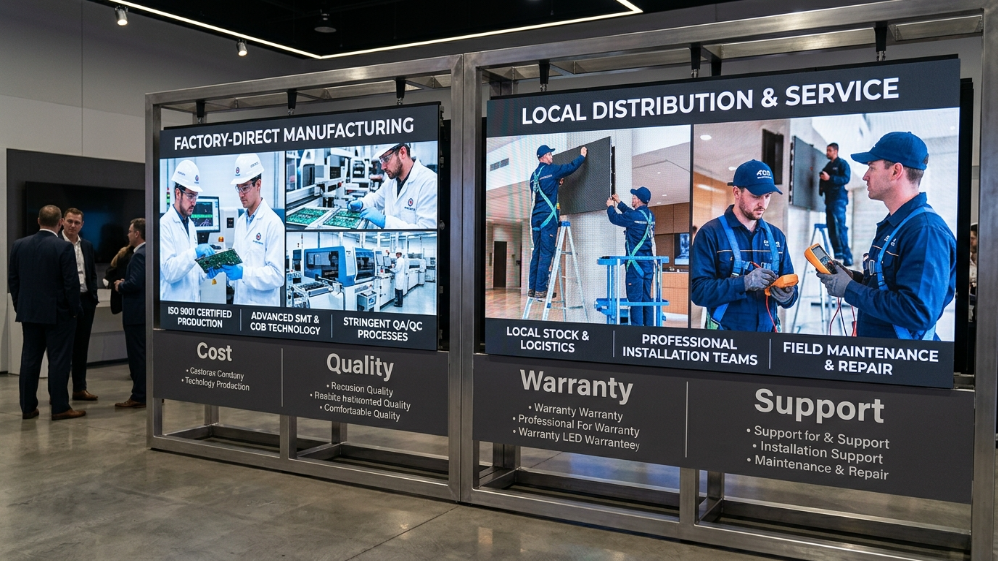
Put the two models next to each other and the trade-offs stop being abstract.
Below is the breakdown our project team walks clients through before any quote is finalized:
| Factor | Factory-Direct China Supplier | Local Distributor/Reseller |
|---|---|---|
| Upfront unit cost | 25–45% lower on comparable specs | Higher, includes distribution markup |
| Total Cost of Ownership (TCO) | Lower long-term if lead time and QC are verified; freight and duties add 5–15% | Predictable but built-in premium absorbs most of the “savings” |
| Lead time | 4–8 weeks production + shipping | Often faster if stocked locally; slower if also imported to order |
| Quality control | Depends entirely on whether the factory runs in-house aging tests | Depends on the manufacturer they resell—rarely disclosed |
| Certification (UL/CE/ETL) | Available from established manufacturers, must be verified per SKU | Usually pre-verified for the local market |
| Warranty response | Remote diagnostics + shipped parts; response time varies by partner | Same-day or next-day physical response typical |
| Spare parts availability | Must be pre-negotiated and stocked regionally | Often on-hand locally |
| Customization depth | High—factories can adjust pixel pitch, cabinet size, brightness curve | Limited to what the distributor already stocks |
The pattern holds up project after project:
China-based, factory-direct sourcing wins on cost and customization; local sourcing wins on immediacy.
Neither wins outright on total risk—which is exactly why the vetting process matters more than the passport stamp on the invoice.
What Can Actually Go Wrong When You Source Straight From China
Vetting a Manufacturer Before the Contract, Not After the Complaint
Ask for the aging test report on your specific batch, not a generic company brochure.
Ask whether the LED module and cabinet are produced in the same facility or subcontracted out.
Suppliers offering unusually low pricing frequently pair it with extended delivery windows and reduced warranty terms—a trade-off that only becomes visible once you ask for it directly, because it’s rarely volunteered upfront.
FOB, CIF, DDP—The Fine Print That Decides Who Owns the Damage
Under FOB terms, risk transfers to you the moment the container leaves the Chinese port, meaning transit damage becomes your insurance claim, not the factory’s problem.
DDP terms shift that burden back to the supplier but cost more upfront.
For any project with a fixed launch date—a stadium opening, a retail rollout—the Incoterm you choose is a risk-allocation decision as much as a pricing one.
The Warranty That Looks Fine on Paper Until You Actually Need It
A warranty that requires shipping a defective driver card back to Shenzhen for inspection before a replacement ships is, functionally, a six-to-ten-week warranty, regardless of what the contract says.
This is the single biggest gap between China-based and local sourcing, and it’s solvable only through pre-positioned regional spare parts and remote diagnostic tools—not through the warranty document itself.
What Can Go Wrong When You Buy “Local” Instead
Local isn’t automatically safer.
A reseller with no manufacturing control can’t adjust pixel pitch, can’t expedite a custom order, and often can’t tell you which factory actually built the panel.
That means you inherit the same supply-chain risk as buying direct, minus the pricing advantage and minus the transparency.
If a claimed “local manufacturer” can’t produce a facility address or aging-test documentation on request, that’s the tell worth walking away from.
A Real Project: What Happens When the Distance Gap Actually Gets Closed
A mid-sized DOOH operator running digital LED billboards across three Gulf-region cities came to us after a previous supplier’s warranty process left two panels offline for over five weeks—long enough to lose a full advertising cycle with a paying client.
We rebuilt their sourcing approach around three changes:
- Pixel-pitch and cabinet specs locked to our in-house Ares production line so every unit came from a single traceable batch.
- A regional spare-parts kit shipped and stocked ahead of installation rather than ordered reactively.
- Our CMS platform configured to flag brightness drift and module faults before they became visible on the street.
The result wasn’t a miracle—it was a supply chain with fewer points where accountability could quietly disappear.
Their next outage, a driver board failure eight months later, was diagnosed remotely and resolved with a pre-stocked part in under 48 hours instead of five weeks.
That’s not a testimonial line; it’s the entire argument for factory-direct sourcing with local-level infrastructure, laid out as a timeline.
The Hybrid Model: Factory Pricing With a Local Support Footprint
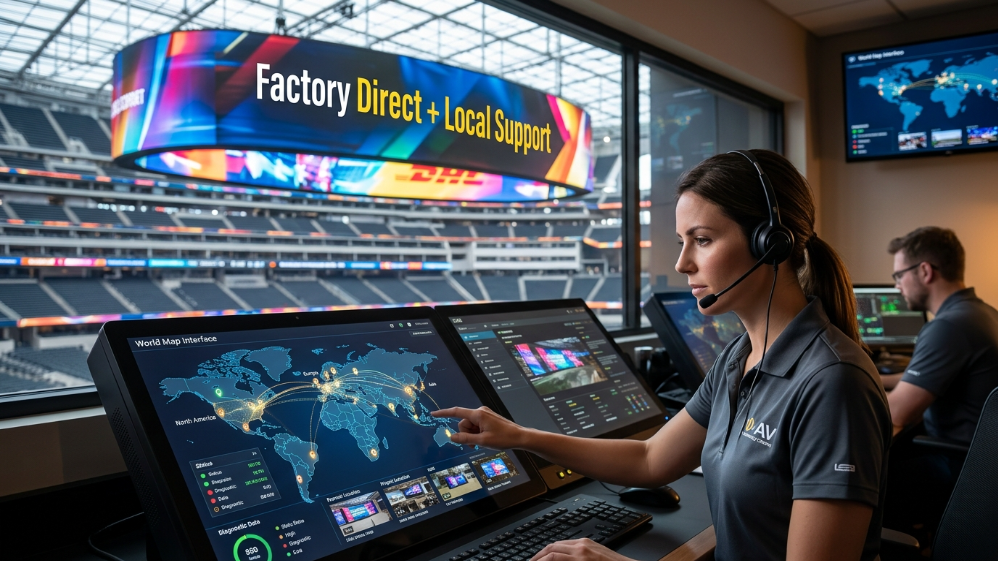
The buyers who report the fewest post-installation problems aren’t choosing China or local in isolation—they’re choosing factory-direct manufacturers who’ve built remote-support infrastructure to close the distance gap.
A CMS platform with brightness monitoring, device-status alerts, and remote content scheduling means a fault gets flagged before it becomes a blank screen during a live event, not after.
Pair that with pre-shipped spare parts, typically 3–5% of unit count, and a documented installation guide, and the “local support” advantage narrows considerably.
You get factory pricing with response times that don’t depend on a container ship crossing the Pacific.
Choosing Your Sourcing Path: A Decision Framework for Different Project Types
Go Factory-Direct in China If:
- You’re procuring at scale.
- You need custom pixel pitch or cabinet dimensions.
- You have the internal capacity—or a trusted partner—to vet the manufacturer properly.
Go Local If:
- You need a single small screen installed within days.
- You have no bandwidth to vet an overseas factory.
- Immediate physical support matters more than cost optimization.
Choose a Verified Factory-Direct Partner Offering Local-Level Support If:
- You’re running a multi-site rollout.
- You’re managing a DOOH network.
- Your project involves downtime costs that directly affect revenue.
This is where most B2B buyers actually land once they weigh the full picture.
A Pre-Contract Checklist for Evaluating Any China-Based Manufacturer
Request three things before signing:
| Evaluation Item | What to Verify |
|---|---|
| Aging-test protocol | Duration, dead-pixel threshold, brightness-consistency tolerance |
| Production capability | Proof of in-house cabinet assembly versus subcontracted production |
| After-sales support plan | Documented spare-parts availability and remote-support process for your region |
A manufacturer that hesitates on any of the three is telling you something worth listening to.
Frequently Asked Questions
Is it actually cheaper to buy an LED display from China after shipping and duties?
Usually yes.
Even after freight, insurance, and import duties, factory-direct pricing typically remains 20–35% below comparable locally-distributed products, though the margin narrows for small orders where shipping costs aren’t offset by volume.
How long does shipping and installation take from a Chinese manufacturer?
Production typically runs 2–4 weeks depending on order size and customization, followed by 3–6 weeks of sea freight or 5–10 days by air, plus installation time on-site.
Can a Chinese LED manufacturer provide local installation and after-sales support?
Yes, if they operate a CMS remote-monitoring platform and have pre-positioned spare parts regionally—this is increasingly standard among established factory-direct suppliers serving international markets.
What certifications should I request before purchasing an LED display?
At minimum, ask for UL or ETL listing for North America, CE marking for Europe, and an IP65 ingress-protection rating for any outdoor-facing installation.
Is buying from a local LED display distributor ever the better choice?
Yes, for small, time-sensitive, one-off projects where speed of physical response outweighs the cost savings of factory-direct sourcing.
Where This Leaves You—And Where We Fit In
The China vs Local LED display supplier question is really a proxy for a different question:
Do you trust the organization behind the invoice to be accountable after the screen ships?
Price alone won’t tell you that.
Aging-test documentation, spare-parts positioning, and remote-support infrastructure will.
At Sostron, that accountability is the business we’re actually in—we design, build, and stand behind every panel that leaves our Shenzhen facility, backed by an engineering team that treats your installation timeline like our own.
If you’re weighing pixel pitch, brightness, and cabinet options for your specific environment, our Outdoor and Rental LED Display product range walks through the specs and use cases by application, from stadium façades to festival stages.
And if remote uptime monitoring and warranty response time are the deciding factor for your project, it’s worth a look at how our CMS control and remote support platform actually works before you finalize any quote—ours or anyone else’s.
References:
National Institute of Standards and Technology (NIST)
International Code Council (ICC)