How much does a customized LED video wall actually cost?
There is no single price per square meter that can accurately answer this question. A standard rectangular LED wall may be priced largely according to pixel pitch and screen area, but a truly customized LED video wall can also require special cabinets, flexible LED modules, custom mechanical structures, pixel mapping, control systems, installation engineering, and project-specific testing.
For a custom LED stage wall, the cost can vary even more because rigging, cabinet weight, refresh rate, camera performance, service access, and transportation may become major parts of the project budget.
For commercial buyers, the most reliable approach is therefore to calculate the LED display as a complete engineered system rather than comparing panel prices alone.
What Is a Customized LED Video Wall?
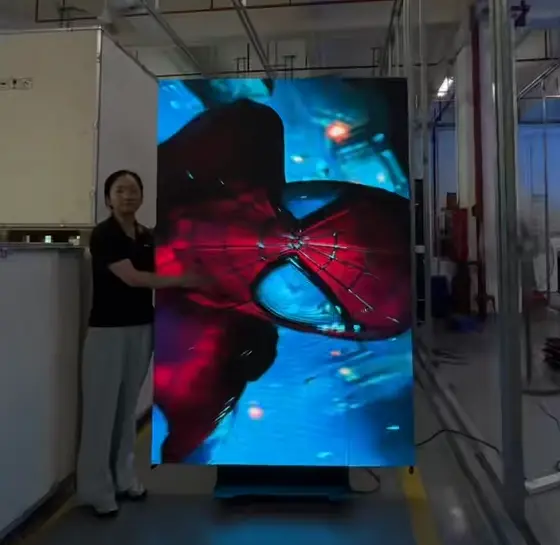
A customized LED video wall is a direct-view LED display engineered around a specific project rather than selected entirely from a standard rectangular product configuration.
Customization can occur at several levels.
A relatively simple project may only require a non-standard screen width and height. More complex installations may require curved cabinets, flexible LED modules, custom PCB layouts, irregular cabinet geometry, special mounting structures, or software-based pixel mapping.
This distinction matters because two LED walls with the same area can have completely different manufacturing and installation costs.
Standard Size Customization
The simplest form of customization changes:
- Screen width and height
- Pixel pitch
- Cabinet quantity
- Cabinet orientation
- Aspect ratio
- Installation configuration
This type of project can often use existing LED modules and cabinets, keeping engineering costs relatively controlled.
Creative and Custom-Shaped LED Displays
A more advanced customized LED video wall may use:
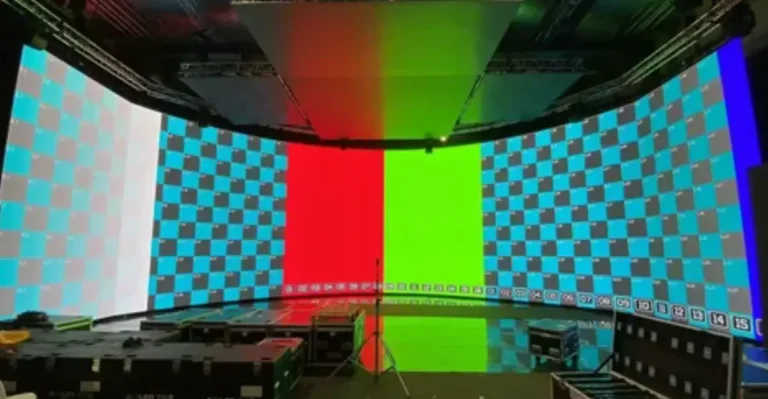
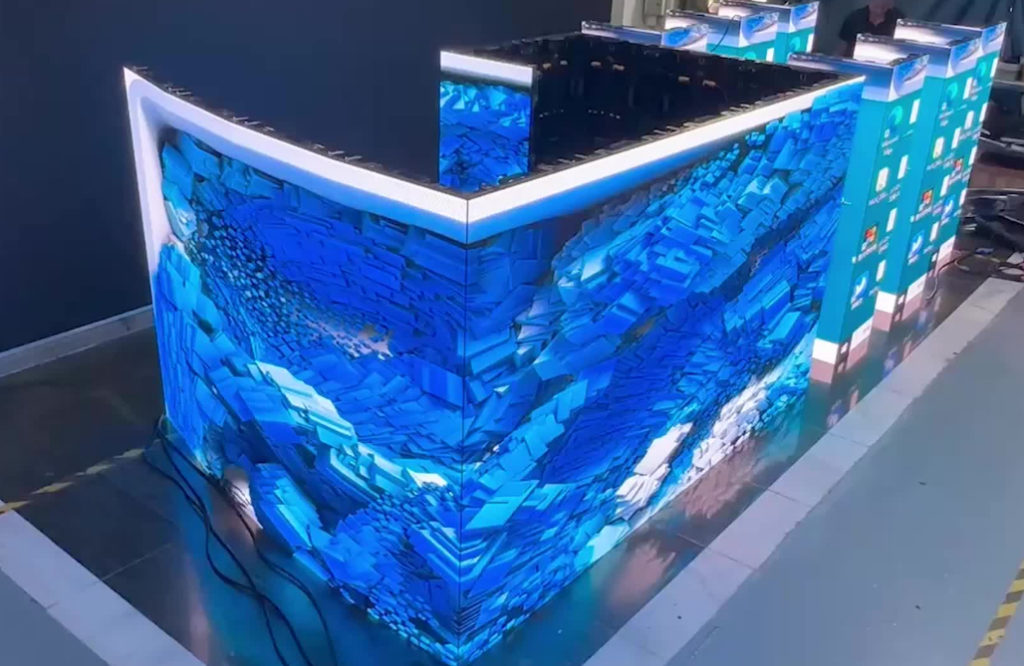
- Curved LED cabinets
- Flexible LED modules
- Cylindrical screens
- Spherical displays
- Ring-shaped screens
- Wave-shaped screens
- Cube structures
- Irregular or free-form displays
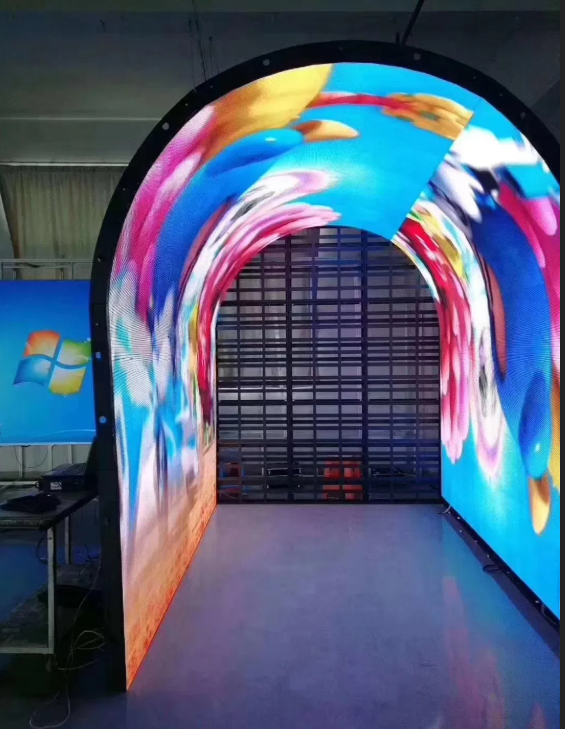
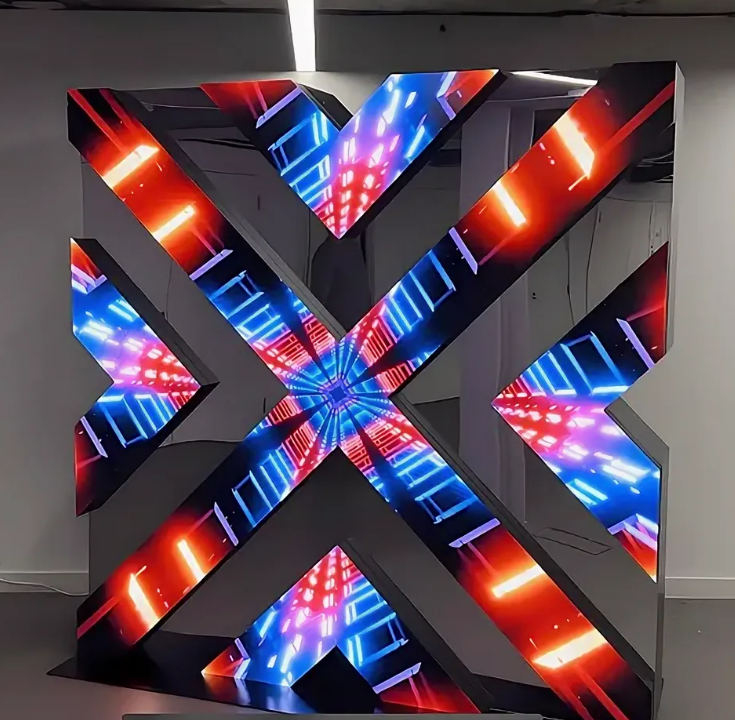
At this level, the shape becomes part of the engineering design. Flexible modules, special PCB geometry, supporting structures, masks, pixel mapping, and prototype testing may all affect the final quotation. Current custom-display manufacturers increasingly treat geometry, mechanical design, and LED electronics as one integrated engineering project.
How Much Does a Customized LED Video Wall Cost?
As a practical budgeting reference, commercial LED video wall projects can range from roughly $350 to $5,000+ per m², depending heavily on pixel pitch, indoor or outdoor requirements, LED technology, cabinet construction, customization, and project scope. Some small indoor installations may begin around $5,000–$10,000, while large or highly customized installations can exceed $100,000. These figures should be treated as planning ranges rather than fixed market prices because custom engineering can substantially change the bill of materials.
For a custom project, it is more useful to divide the budget into several layers:
| Cost Component | Typical Impact on Project Cost |
|---|---|
| LED modules and cabinets | High |
| Pixel pitch | High |
| Screen size | High |
| Custom shape | Medium to Very High |
| Video processor/controller | Medium |
| Mounting or rigging | Medium to High |
| Installation labor | Medium to High |
| Shipping and packaging | Medium |
| Power distribution | Medium |
| Spare parts | Low to Medium |
| Custom engineering/tooling | Low to Very High |
| Maintenance access | Long-term cost factor |
The important point is simple: the LED panel is only one part of the project price.
What Factors Determine Customized LED Video Wall Cost?
1. Pixel Pitch and Viewing Distance
Pixel pitch is one of the most important pricing variables.
Pixel pitch describes the distance between adjacent LED pixels. A smaller pixel pitch creates higher pixel density and allows viewers to stand closer to the screen without seeing individual pixels.
However, smaller pitch also generally requires more LEDs and tighter manufacturing tolerances, increasing the cost.
Typical commercial applications include:
| Pixel Pitch | Typical Application | Relative Cost |
|---|---|---|
| P1.2–P1.9 | Boardrooms, premium indoor displays, XR | High |
| P2.0–P2.5 | Corporate, retail, museums, premium stages | Medium-High |
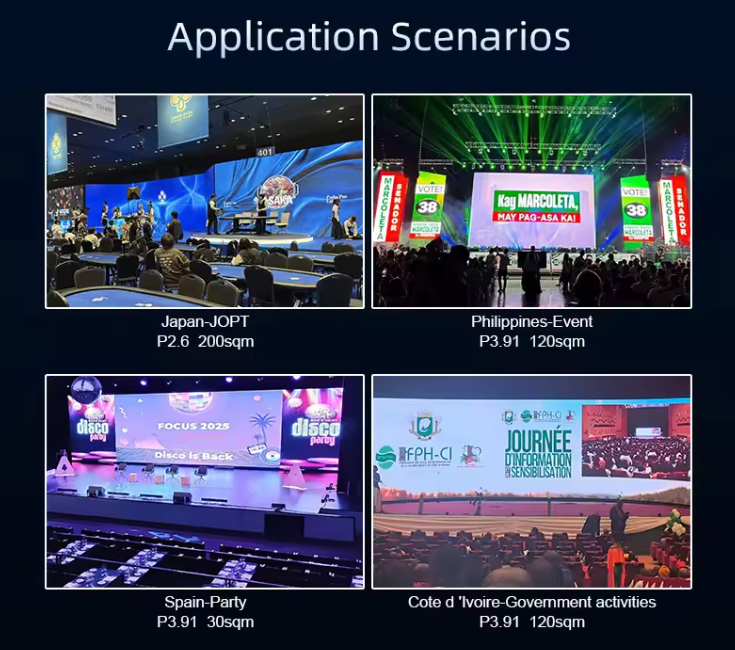
| P2.6–P2.9 | Concerts, stages, events, rental | Medium |
| P3.9 | Large stages, events, rental applications | Medium |
| P4.8–P6+ | Large venues and outdoor viewing | Lower per m² |
The correct question is not:
“What is the smallest pixel pitch available?”
It is:
“What pixel pitch is appropriate for the actual viewing distance?”
For example, selecting P1.5 for a large stage viewed from 20 meters away may increase the project cost without producing a meaningful visual advantage for the audience.
2. Screen Size and Pixel Density
Screen area directly affects the number of LED modules, cabinets, power supplies, receiving cards, cables, and structural components required.
A 10 m × 5 m LED wall contains 50 m² of display surface. But the actual system cost depends on much more than the 50 m² figure.
The cabinet count, cabinet dimensions, pixel pitch, power consumption, processing requirements, installation method, and packaging volume all change with the design.
This is why a professional quotation should normally include a bill of materials (BOM) rather than only a price per square meter.
Custom LED Stage Wall Cost: What Should You Budget For?
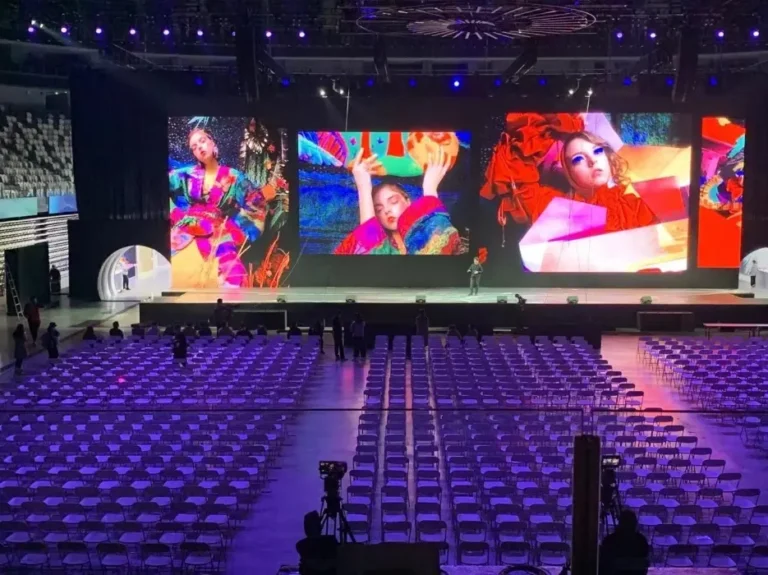
A custom LED stage wall requires additional considerations because stage environments introduce mechanical, camera, transportation, and installation requirements that are not always present in permanent indoor signage.
A stage wall may be:
- A flat LED backdrop
- A curved LED wall
- A concave or convex wall
- A multi-sided LED structure
- An immersive stage backdrop
- A suspended LED matrix
- A lightweight touring LED wall
- An XR or virtual production LED volume
A standard rental stage wall may have a relatively predictable cost structure. A custom stage wall is different because engineering and deployment requirements can become significant cost drivers.
Current market examples show that standard mid-size stage systems can fall in the tens of thousands of dollars, while high-resolution and highly customized installations can reach substantially higher project values.
3. Cabinet Design and Custom Shape
Cabinet construction has a direct influence on both manufacturing cost and installation cost.
For a conventional rectangular LED wall, standard die-cast aluminum cabinets are usually the most straightforward option.
For a curved or creative LED stage wall, the system may require:
- Curved cabinets
- Flexible LED modules
- Special masks
- Custom frame structures
- Custom PCB layouts
- Magnetic mounting systems
- Special connectors
- Customized pixel mapping
The more unusual the geometry, the more engineering is required.
A simple curved wall assembled from existing flexible modules is fundamentally different from a one-off sphere or irregular sculpture that requires custom PCB geometry and structural tooling.
4. LED Technology: SMD, COB and GOB

LED packaging technology can also affect the quotation.
SMD LED
SMD remains widely used for commercial indoor, outdoor, rental, and stage applications because of its mature manufacturing process and broad range of pixel pitches.
COB LED
COB can be attractive for fine-pitch indoor applications where high pixel density, improved surface protection, and close viewing distances are important.
GOB LED
GOB adds protective treatment to the LED module surface and can be useful in applications where impact resistance and durability are important.
The right technology depends on the application rather than simply choosing the most expensive option.
For a touring stage wall, mechanical durability and serviceability may be more important than choosing the smallest possible pixel pitch.
5. Brightness and Indoor vs. Outdoor Requirements
Indoor and outdoor LED video walls have very different technical requirements.
Indoor installations generally operate at lower brightness because ambient light is controlled.
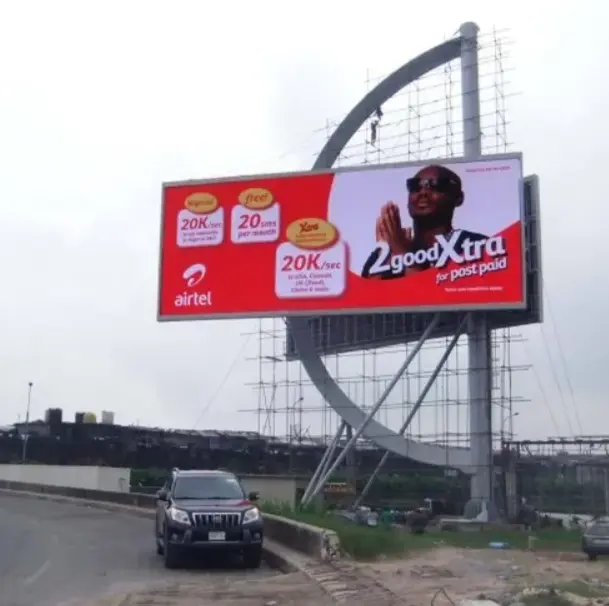
Outdoor LED displays may require substantially higher brightness to remain readable under direct sunlight. They also need greater protection against moisture, dust, temperature variation, and other environmental conditions.
Outdoor customization may therefore require:
- Higher brightness LEDs
- Weather-resistant cabinets
- Higher IP protection
- Improved sealing
- Outdoor power distribution
- Structural reinforcement
- Wind-load consideration
- Specialized installation
IP rating itself can affect custom LED pricing because outdoor protection requires additional engineering and enclosure considerations.
6. Refresh Rate and Camera Performance for LED Stage Walls
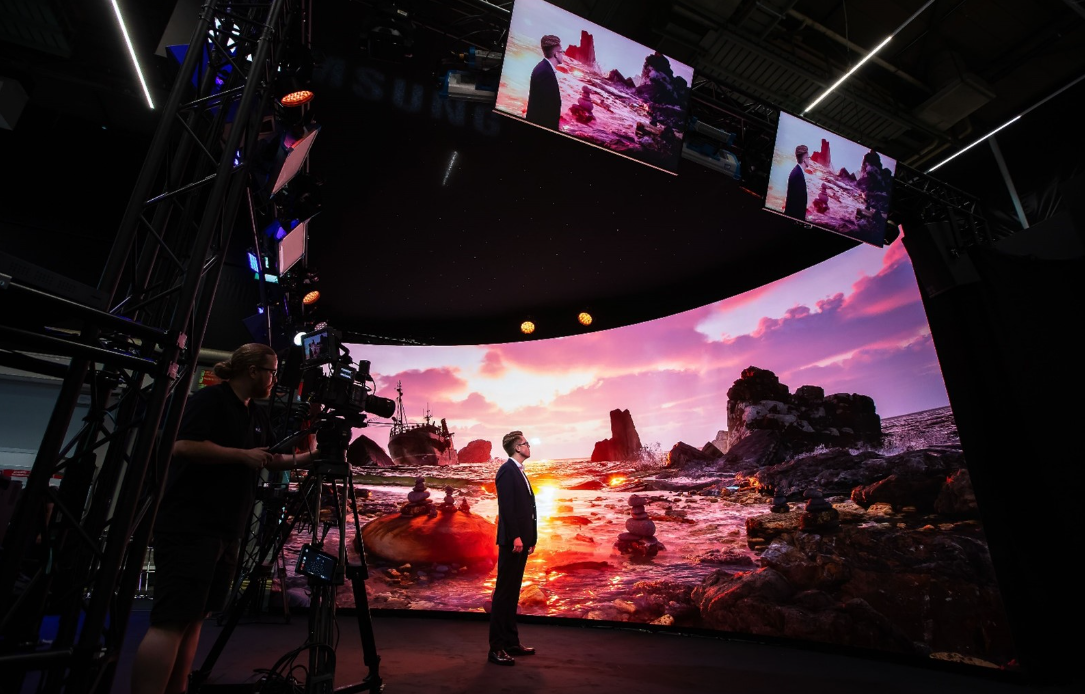
- Camera Flicker: Visible black bars (rolling shutter effect) when filmed.
- Content Loss: Fast-moving content may appear blurry or tearing.
- Not Broadcast Ready: Unsuitable for professional live streaming or TV.
- Flicker-Free: Crystal clear image on all cameras (1/2000s+ shutter speed).
- Smooth Motion: Perfect for fast video playback and sports.
- XR Ready (7680Hz): Essential for virtual production and XR studios.
For a stage LED wall used only by the audience, refresh rate is important.
For a stage wall used with professional cameras, it becomes critical.
Concerts, broadcast productions, IMAG, live streaming, XR, and virtual production can expose problems such as:
- Flicker
- Scan lines
- Rolling bars
- Moiré
- Motion artifacts
- Poor grayscale performance
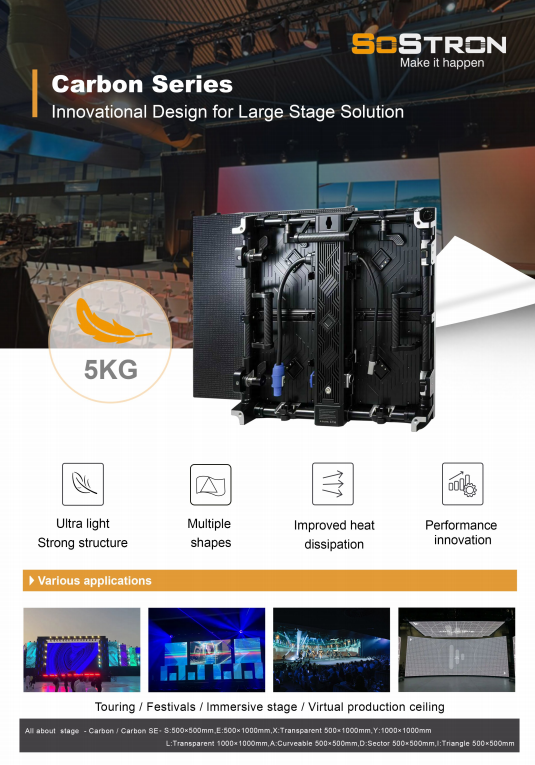
A professional stage LED wall may therefore specify 3840Hz or higher refresh rates, with some advanced systems reaching 7680Hz.
For example, SoStron’s current Carbon stage system specifies 3840Hz–7680Hz refresh rates and integrates camera-oriented technologies such as PWM driver ICs and genlock synchronization.
For camera-facing applications, buyers should evaluate the complete optical and control system rather than treating refresh rate as an isolated specification.
7. LED Wall Rigging and Structural Requirements
A large LED stage wall is a mechanical structure as well as an electronic display.
If the wall is flown above the stage, the project may require:
- Flying bars
- Truss
- Rigging hardware
- Secondary safety systems
- Load calculations
- Venue approval
- Professional installation
Ground-stacked LED walls may instead require:
- Stacking frames
- Base supports
- Safety structures
- Leveling systems
Cabinet weight matters here.
A lighter cabinet can reduce transportation and structural load, which can influence the overall project economics even when the LED cabinet itself costs more.
For touring applications, lightweight carbon-fiber or advanced aluminum cabinet designs can reduce handling and logistics requirements. SoStron’s current Carbon series, for example, positions reduced cabinet weight and rapid rigging as part of its stage-system value proposition.
8. Front Service vs. Rear Service
Maintenance access is often ignored during the initial purchase but becomes important after installation.
If the LED wall is installed directly against a building wall, rear access may be difficult or impossible.
A front-service LED system allows technicians to remove modules and access key components from the front.
For a permanent commercial installation, the correct service method should be determined during the design phase.
A slightly higher initial cabinet cost can sometimes reduce future maintenance labor and downtime.
9. LED Video Processor and Control System
The LED display itself does not determine the complete image-processing capability.
A customized LED video wall may also require:
- Video processor
- Sending card
- Receiving cards
- Signal distribution
- Media server
- Redundant signal paths
- Multi-input switching
- HDR processing
- Scaling
- Genlock
- Remote monitoring
The processor should be selected according to the actual input sources and target output resolution.
For example, a simple digital signage wall and a multi-camera concert production should not necessarily use the same control architecture.
10. Installation, Power and Electrical Work
A quotation that includes only LED cabinets is not necessarily the final project cost.
Installation may include:
- Mounting structure
- Steel frame
- Truss
- Electrical distribution
- Power cabling
- Data cabling
- Signal distribution
- Commissioning
- Calibration
- Testing
- On-site technical support
Large LED walls can also consume significant electrical power at maximum brightness.
For commercial projects, buyers should ask for both average power consumption and maximum power consumption rather than relying on one number.
11. Shipping and Packaging
Custom LED displays can create unusual logistics requirements.
A custom shape may require:
- Custom flight cases
- Protective packaging
- Special transport frames
- Larger shipping volume
- More complicated loading procedures
For rental and touring LED stage walls, packaging design can directly affect operating costs because the same equipment may be transported repeatedly.
A lightweight modular cabinet can therefore create savings beyond the initial screen purchase.
12. Custom Engineering, Prototyping and Tooling
This is one of the biggest differences between a standard LED wall and a truly customized LED display.
Engineering costs may include:
- Concept review
- CAD design
- Cabinet or module design
- Structural calculations
- PCB development
- Prototype production
- Pixel mapping
- Software configuration
- Sample testing
- Final production validation
Not every customized LED project requires all ten stages.
A standard curved wall assembled from existing components may involve relatively little engineering. A one-off architectural LED sculpture can require substantially more design and validation.
This is why buyers should ask suppliers whether their quotation includes NRE (non-recurring engineering), tooling, prototypes, and testing.
How to Calculate the Total Cost of a Custom LED Video Wall
A useful B2B budgeting model is:
Total Project Cost = LED Display + Control System + Structure + Installation + Electrical + Shipping + Engineering + Spares + Commissioning
For example, suppose a project requires:
- 40 m² LED wall
- P2.6 pixel pitch
- Indoor stage application
- Curved configuration
- High refresh rate
- Front-service access
- Custom mounting structure
The buyer should not simply calculate:
40 m² × LED price per m²
Instead, the quotation should separately identify:
| Budget Area | What to Check |
|---|---|
| LED cabinets | Pitch, LED type, cabinet dimensions |
| Customization | Curvature, shape, PCB, structure |
| Processing | Processor, sending/receiving cards |
| Structure | Frame, truss, stacking or rigging |
| Installation | Labor, commissioning, calibration |
| Power | Distribution and cabling |
| Logistics | Packaging, shipping, handling |
| Spare parts | Modules, power supplies, receiving cards |
| Support | Warranty, remote and on-site service |
This approach makes supplier quotations much easier to compare.
Custom LED Video Wall vs. Standard LED Video Wall
Not every project needs a customized solution.
A standard LED wall is usually preferable when:
- The screen is rectangular
- The dimensions fit standard cabinets
- The installation is straightforward
- There is no unusual architectural requirement
- The buyer prioritizes lower initial cost
A customized LED video wall becomes more attractive when:
- The screen must follow architectural geometry
- The stage requires a curved or irregular backdrop
- The display is part of a branded installation
- Immersive content is required
- The available installation space is unusual
- A standard rectangular wall cannot achieve the intended visual design
Customization should solve a real project constraint. It should not be added simply because it sounds more advanced.
How to Reduce Custom LED Stage Wall Cost Without Sacrificing Performance
There are several practical ways to control the budget.
Choose Pixel Pitch According to Viewing Distance
Do not automatically specify the smallest pixel pitch.
If the audience is 15–20 meters away, moving from P2.6 to P1.5 may provide limited practical value while increasing the display cost.
Use Standard Modules Where Possible
If a creative shape can be produced with existing flexible modules or curved cabinets, there may be less need for custom PCB development and tooling.
Standardize Cabinet Dimensions
Non-standard cabinet dimensions can increase production complexity.
Using a modular cabinet architecture where possible can reduce:
- Spare-part requirements
- Replacement time
- Packaging complexity
- Installation complexity
Design Maintenance Access Early
A screen that is difficult to service can become expensive over its lifetime.
Front service, modular components, accessible power supplies, and organized cabling can reduce future labor costs.
Consider the Complete TCO
The cheapest LED panel is not necessarily the cheapest LED wall.
A better comparison is:
Total Cost of Ownership = Purchase + Installation + Logistics + Energy + Maintenance + Downtime
For a permanent commercial installation, this is a much more meaningful purchasing metric than the lowest initial quotation.
How to Compare Quotes From Custom LED Display Suppliers
When comparing suppliers, ask each company to quote the same technical specification.
At minimum, provide:
- Screen dimensions
- Indoor or outdoor location
- Pixel pitch
- Viewing distance
- Required brightness
- Refresh rate
- Installation method
- Front or rear service
- Curved or flat configuration
- Content resolution
- Camera usage
- Control system requirements
- Delivery destination
- Installation requirements
Then ask whether the quotation includes:
- LED cabinets
- Spare modules
- Power supplies
- Receiving cards
- Video processor
- Mounting structure
- Cabling
- Installation
- Commissioning
- Calibration
- Shipping
- Warranty
- Technical support
This prevents the common situation where a supplier appears cheaper simply because important components have been excluded from the original quotation.
What Should a Professional Custom LED Quote Include?
A professional B2B quotation should ideally contain more than one price number.
It should show:
Display Specification
- Pixel pitch
- LED package
- Cabinet dimensions
- Cabinet weight
- Brightness
- Refresh rate
- Grayscale
- Viewing angle
- IP rating
Engineering Specification
- Screen dimensions
- Curvature
- Structure
- Service method
- Rigging or stacking method
- Power requirements
Control Specification
- Processor
- Sending card
- Receiving card
- Input interfaces
- Signal architecture
Commercial Specification
- Unit price
- Engineering cost
- Installation cost
- Shipping
- Spare parts
- Warranty
- Lead time
This level of detail makes it much easier for procurement teams to perform a genuine supplier comparison.
Is a Customized LED Video Wall Worth the Investment?
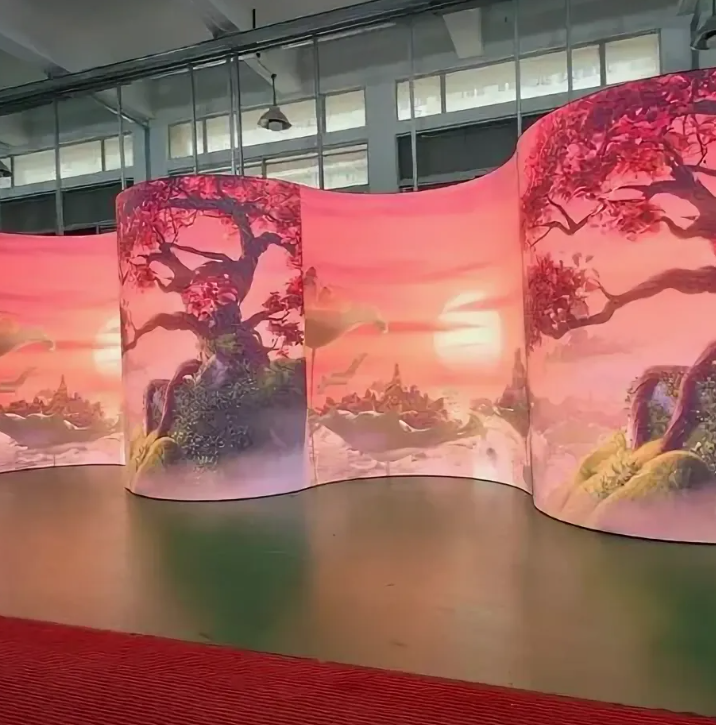
A customized LED video wall makes financial sense when the custom design solves a genuine business or engineering requirement.
For retail, entertainment, architecture, exhibitions, hospitality, sports venues, and stage production, the display may become a major part of the visitor experience rather than simply a screen.
However, customization should always be balanced against:
- Initial investment
- Manufacturing complexity
- Installation requirements
- Maintenance access
- Spare-part availability
- Expected operating life
- Future content requirements
The goal is not to create the most complicated LED wall possible.
The goal is to create the right LED wall for the environment, audience, content, and operating model.
Final Takeaway: How Much Does a Custom LED Stage Wall Cost?
The cost of a customized LED video wall is determined by much more than screen area.
For a commercial project, the major variables are:
Pixel pitch + screen size + LED technology + shape + brightness + refresh rate + control system + structure + installation + logistics + engineering
For a custom LED stage wall, additional factors such as cabinet weight, rigging, camera performance, curved geometry, service access, and transportation can significantly change the final budget.
That is why a reliable custom LED quotation should be based on a complete project specification rather than a generic “$/m²” figure.
If you are sourcing a custom LED video wall, provide the supplier with your screen dimensions, viewing distance, application, indoor/outdoor environment, desired shape, pixel pitch, installation method, and delivery location. With these details, an experienced LED manufacturer can convert the concept into a realistic BOM, engineering plan, and project quotation.
FAQ: Customized LED Video Wall Cost
How much does a customized LED video wall cost per square meter?
There is no universal price. Commercial LED video walls can range from several hundred dollars to several thousand dollars per square meter depending on pixel pitch, LED technology, application, brightness, cabinet construction, and customization. Highly customized projects should be quoted according to the complete system rather than area alone.
What is the biggest cost factor in a custom LED video wall?
Pixel pitch and screen area are major cost factors, but complex shapes can add engineering, mechanical, PCB, tooling, and installation costs. A custom project should therefore be evaluated as a complete engineered system.
How much does a custom LED stage wall cost?
A small or standard stage LED wall may cost tens of thousands of dollars, while large, high-resolution, curved, immersive, or broadcast-oriented systems can reach well above $100,000 depending on the project specification.
Is P1.5 always better than P2.6 for a stage LED wall?
No. The correct pixel pitch depends primarily on viewing distance, content requirements, camera requirements, and budget. For many stage environments, P2.6 or P2.9 can provide an effective balance between image quality and cost.
What information should I provide to get an accurate custom LED quote?
Provide the screen width and height, pixel pitch, viewing distance, indoor/outdoor environment, brightness requirement, shape, installation method, front/rear service requirement, camera usage, destination country, and expected delivery date.
How long can a commercial LED video wall last?
A properly specified and maintained commercial LED display can operate for many years, but actual service life depends on LED quality, operating hours, brightness settings, thermal management, environment, power stability, and maintenance practices. It is better to evaluate expected operating conditions and warranty terms than to rely on one generic lifespan number.
References:
Luminous Intensity Calibrations and Colorimetry of LEDs at NIST
Calibrations of Colorimeters for Display Measurements