Quick Answer
A flexible LED screen can cost significantly more or less depending on its pixel pitch, module design, display size, curvature, control system, and installation requirements. There is no single factory price that applies to every flexible LED display.
For preliminary budgeting, published supplier prices provide a starting point, but they must be compared carefully. A flexible LED module price is not the same as the price of a complete display system, and neither necessarily includes installation, shipping, customs, or commissioning.
Buyers sourcing from a flexible LED screen factory in Shenzhen should compare quotations based on the same specifications and delivery scope.
| Cost Category | What It Covers | Budget Consideration |
|---|---|---|
| Flexible LED Modules | LED modules, flexible PCB, LED packages | Depends on pixel pitch and module design |
| Display Hardware | Modules, power supplies, receiving cards, cables | Confirm which components are included |
| Control System | Sending equipment, video processor, software | Depends on display requirements |
| Custom Structure | Mounting frame, magnetic system, curved support | Depends on geometry and installation |
| Installation | Assembly, alignment, commissioning | Depends on site conditions |
| Logistics | Packaging, freight, customs, delivery | Depends on destination and Incoterms |
| Long-Term Ownership | Maintenance, spare parts, electricity, downtime | Depends on usage and service requirements |
Who should consider flexible LED? Flexible LED displays are particularly suitable for projects requiring curved surfaces, cylindrical columns, creative architectural shapes, or display designs that cannot be achieved easily with conventional rigid LED cabinets.
For a conventional flat video wall, a rigid LED display may offer a more economical and straightforward solution.
How Much Does a Flexible LED Screen Cost per Square Meter?
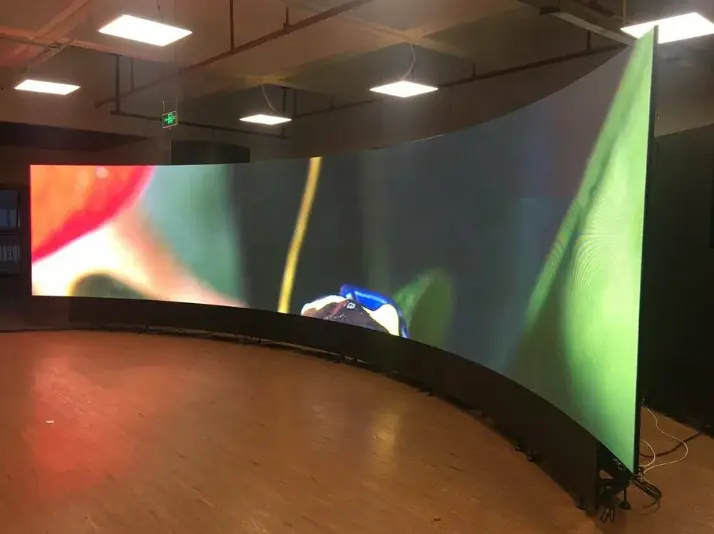
The price of a flexible LED screen is usually quoted according to the display configuration and the scope of supply.
Some manufacturers publish module-only prices, while others quote complete display hardware or turnkey projects. These prices cannot be compared directly.
Flexible LED Screen Price Ranges
The following figures are indicative supplier-published price references, not verified Sostron factory quotations or universal 2026 market averages.
| Product or System Type | Published Price Reference | Price Scope |
|---|---|---|
| Flexible LED modules | Approximately $400–$1,600/m² | Supplier-published module or indoor creative display examples |
| Flexible LED hardware | Approximately $700–$1,200/m² | Hardware-only supplier reference |
| Complete flexible LED system | Approximately $1,500–$5,000/m² | Supplier-published turnkey reference |
These ranges are drawn from publicly available supplier pricing examples, including DOIT VISION, SightLED, and ExcelLED. The products, configurations, and quotation scopes differ. They should be treated as preliminary references rather than directly comparable offers.
A project-specific quotation may fall outside these ranges.
Why Can Flexible LED Screen Prices Differ So Much?
Two flexible LED displays with the same pixel pitch may have different prices because of differences in:
-
LED package and driver IC configuration.
-
Module dimensions and mechanical design.
-
Flexible PCB construction.
-
Brightness and refresh rate.
-
Control system.
-
Mounting structure.
-
Curvature and custom geometry.
-
Order quantity.
-
Warranty and spare parts.
-
Shipping and installation scope.
A lower price does not necessarily mean a better purchasing decision.
For example, a quotation that excludes the mounting structure, control equipment, and commissioning may appear cheaper than a complete system quotation. However, the buyer still needs to budget for those components.
Module-Only vs Complete System Price
| Item | Module-Only | Complete Display Hardware | Turnkey Project |
|---|---|---|---|
| Flexible LED modules | Included | Included | Included |
| Power supplies | Usually excluded | Usually included | Included |
| Receiving cards | Usually excluded | Usually included | Included |
| Sending equipment | Excluded | Depends on quotation | Included if specified |
| Mounting structure | Excluded | Depends on quotation | Included if specified |
| Installation | Excluded | Excluded | Included if specified |
| Commissioning | Excluded | Depends on quotation | Included if specified |
| Shipping and customs | Excluded | Depends on Incoterms | Depends on contract |
Procurement tip: Always ask the supplier to identify exactly what is included in the quoted price.
A factory price is only meaningful when the product configuration, quantity, delivery terms, and included components are clearly defined.
What Factors Affect Flexible LED Screen Prices?
Flexible LED screen prices are influenced by seven major cost factors. Understanding these factors helps buyers identify which specifications are essential and which may increase the budget without delivering meaningful project value.
1. How Does Pixel Pitch Affect the Cost?
Pixel pitch is the distance between the centers of adjacent LED pixels. It determines pixel density and has a significant influence on image detail, hardware configuration, and price.
A smaller pixel pitch generally requires a higher pixel density, which can increase manufacturing complexity and cost.
| Pixel Pitch | Typical Application | Main Purchasing Consideration |
|---|---|---|
| P1.2–P1.5 | Premium indoor displays, close-viewing environments | Fine image detail and higher hardware cost |
| P1.8–P2.0 | Retail, corporate interiors, creative installations | Balance between image detail and budget |
| P2.5–P3.0 | Larger indoor displays and moderate viewing distances | Cost-effective detail for many applications |
| P4.0 and above | Larger creative displays viewed from farther away | Lower pixel density may suit less demanding viewing conditions |
These are general application categories, not fixed viewing-distance rules. The appropriate pixel pitch depends on screen size, viewing conditions, content, and image-quality expectations.
Should You Always Choose a Smaller Pixel Pitch?
No.
A smaller pixel pitch may improve image detail, but it does not automatically create better project value.
For example:
-
A close-viewing retail display may benefit from a finer pitch.
-
A large decorative column viewed from several meters away may not require the smallest available pitch.
-
A creative display with complex geometry may prioritize curvature compatibility over maximum pixel density.
Choosing a pitch that is unnecessarily fine can increase the initial hardware budget without producing a noticeable improvement for the intended audience.
The better approach is to select pixel pitch according to the viewing environment and content requirements.
2. How Do LED Packages and Driver ICs Affect Price?
LED packages and driver ICs influence display performance, manufacturing complexity, and product cost.
Different configurations may affect:
-
Brightness.
-
Grayscale performance.
-
Refresh rate.
-
Color consistency.
-
Power consumption.
-
Reliability.
-
Camera compatibility.
However, these characteristics should not be evaluated through a single specification.
For example, a higher refresh rate may be useful for broadcast environments, but it does not automatically guarantee better grayscale performance or eliminate camera artifacts.
Buyers should request the actual product specifications rather than assuming that every flexible LED module uses the same driver IC or LED package.
3. Does Screen Size or Order Quantity Change the Factory Price?
Screen size affects the quantity of modules, power supplies, control equipment, and structural components required.
Order quantity can also influence the manufacturer’s production planning and procurement costs.
However, there is no universal discount percentage for larger orders.
A large custom-shaped display may require more engineering work than a smaller standard display. Similarly, a small order of a standard module may be easier to manufacture than a larger order involving a new mechanical design.
When requesting a factory quotation, buyers should specify:
-
Required display area.
-
Display dimensions.
-
Module quantity.
-
Number of individual screens.
-
Required production quantity.
-
Whether the project requires custom tooling or a new structure.
4. How Does Custom Geometry Affect the Cost?
Custom geometry is one of the most important considerations when purchasing flexible LED displays.
A simple curved display and a complex architectural installation may require very different levels of engineering.
| Display Geometry | Engineering Consideration |
|---|---|
| Flat display | Conventional mounting and alignment |
| Concave curve | Inner curvature and module compatibility |
| Convex curve | Outer curvature and mounting support |
| Cylindrical display | Continuous curvature and circumference |
| Wave-shaped display | Multiple curvature transitions |
| Complex architectural surface | Custom mounting, mapping, and installation planning |
Flexible LED modules can simplify some curved designs, but they do not eliminate the need for a properly designed mounting system.
The final cost depends on whether the display can use standard modules and mounting components or requires custom engineering.
5. Does Brightness Affect Flexible LED Screen Cost?
Brightness requirements depend on the display environment.
An indoor retail display may not require the same brightness as a screen installed near large windows or in a bright public space.
Higher brightness requirements can influence LED configuration, power design, thermal management, and overall system cost.
Buyers should distinguish between:
-
Rated maximum brightness.
-
Normal operating brightness.
-
Brightness after calibration.
-
Brightness under specific environmental conditions.
A supplier should provide the relevant product specification and clarify the measurement conditions.
Do not assume that the highest available brightness is always the best choice. Excessive brightness in an indoor environment may create discomfort and increase energy consumption.
6. How Does Refresh Rate Affect Price?
Refresh rate describes how frequently the display refreshes its image.
It is an important consideration for:
-
Live events.
-
Broadcast studios.
-
Camera recording.
-
Professional content production.
-
High-speed visual applications.
A higher refresh rate can improve camera performance in some conditions, but the final result also depends on scan ratio, driver IC, grayscale behavior, PWM dimming, camera shutter speed, and synchronization.
For camera-intensive projects, request a demonstration using the intended camera setup.
A refresh-rate specification alone is not sufficient to guarantee flicker-free camera performance.
7. Does the Control System Affect the Factory Price?
The control system is part of the complete LED display solution.
Depending on the project, it may include:
-
Sending equipment.
-
Receiving cards.
-
Video processors.
-
Control software.
-
Signal distribution.
-
Content mapping.
-
Synchronization equipment.
A simple display installation may require a different control configuration from a complex architectural screen.
The control system should be selected according to the screen’s resolution, signal sources, content requirements, and installation layout.
Flexible LED Screen Cost by Pixel Pitch
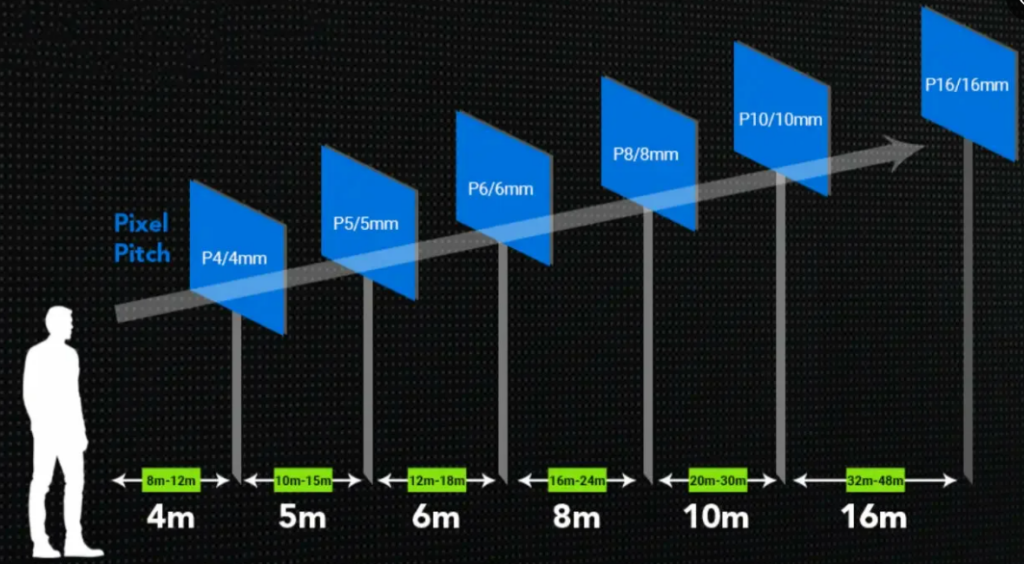
Pixel pitch is an important pricing consideration, but buyers should avoid treating it as the only factor.
A more useful purchasing approach is to compare pixel pitch together with viewing distance, display geometry, brightness, and intended content.
P1.2–P1.5 Flexible LED Displays
Fine-pitch flexible LED displays are generally considered for applications requiring detailed images at relatively close viewing distances.
Potential applications include:
-
Premium retail environments.
-
Creative architectural displays.
-
High-end interior installations.
-
Specialized visual experiences.
These displays may involve more demanding manufacturing and calibration requirements.
However, the actual price depends on the product design, LED package, control configuration, and project scope.
P1.8–P2.0 Flexible LED Displays
P1.8–P2.0 flexible LED displays can be suitable for indoor environments where image detail and creative geometry are both important.
Potential applications include:
-
Retail interiors.
-
Exhibition displays.
-
Corporate spaces.
-
Curved feature walls.
-
Cylindrical columns.
The final specification should be selected according to the intended viewing distance and content.
P2.5–P3.0 Flexible LED Displays
These pixel pitches may be suitable for larger indoor creative displays and applications where viewers are not positioned immediately next to the screen.
They can provide a practical balance between image detail and hardware cost.
However, they are not automatically the most economical option for every project. The required curvature, mounting structure, and control system can still have a significant impact on the final budget.
P4.0 and Coarser Flexible LED Displays
Coarser-pitch flexible LED displays may be suitable for larger decorative installations viewed from greater distances.
Potential applications include:
-
Large architectural features.
-
Decorative columns.
-
Selected exhibition installations.
-
Creative displays where image detail is less critical.
The suitability of a particular pixel pitch should be confirmed against the actual viewing conditions.
How to Choose the Right Pixel Pitch
Before selecting a pixel pitch, confirm:
-
The nearest expected viewing distance.
-
The farthest expected viewing distance.
-
The type of content.
-
Whether the display contains text or fine details.
-
The required display dimensions.
-
The target curvature.
-
The project budget.
A technically suitable specification is generally more valuable than selecting the smallest pixel pitch available.
Is Flexible LED More Expensive Than Rigid LED?
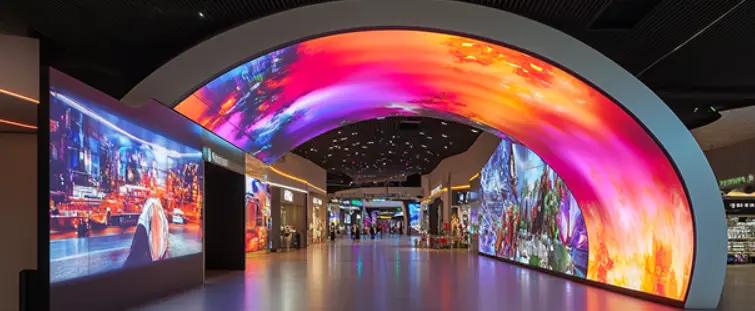
Flexible LED displays may cost more than comparable rigid LED displays because of their flexible substrate, mechanical design, and specialized mounting requirements.
However, the cost difference depends on the products being compared.
A flexible LED display is not necessarily more expensive than every rigid LED solution, and it is not always the best choice for a curved installation.
Flexible LED vs Rigid LED Cost Comparison
| Comparison | Flexible LED | Rigid LED |
|---|---|---|
| PCB Structure | Flexible substrate | Rigid substrate |
| Curved Surfaces | Designed for compatible curvature | May require segmented cabinets |
| Flat Wall Installation | Can be used when appropriate | Often straightforward |
| Custom Geometry | Suitable for selected creative shapes | May require custom cabinets or segmentation |
| Mounting | Requires compatible support | Depends on cabinet design |
| Initial Hardware Cost | Configuration-dependent | Configuration-dependent |
| Installation Complexity | Depends on curvature and structure | Depends on cabinet and mounting design |
| Maintenance | Product-specific | Product-specific |
When Is Flexible LED Worth the Extra Cost?
Flexible LED may be worth considering when:
-
A display must follow a curved architectural surface.
-
A cylindrical column needs continuous visual coverage.
-
A creative design requires a shape that conventional rigid cabinets cannot easily achieve.
-
The project prioritizes a seamless visual appearance across a curved surface.
-
The design requires a custom display geometry.
In these situations, flexible LED may simplify parts of the display design or provide a visual result that would be difficult to achieve with conventional cabinets.
However, the display still requires proper structural support, installation planning, and maintenance access.
When Is Rigid LED the Better Choice?
Rigid LED may be a better option when:
-
The display is installed on a conventional flat wall.
-
Standard cabinet dimensions fit the project.
-
The project prioritizes straightforward installation.
-
The required geometry does not justify a flexible module.
-
The budget is particularly sensitive to initial hardware cost.
For many conventional flat LED video walls, rigid LED cabinets remain a practical and cost-effective solution.
Flexible LED vs Alternative Display Solutions
The choice is not limited to flexible and rigid LED.
Depending on the project, alternatives may include:
-
Conventional LED video walls.
-
Custom-shaped rigid LED cabinets.
-
Projection systems.
-
Other architectural display technologies.
The right solution depends on the required image quality, geometry, brightness, installation conditions, and maintenance strategy.
What Is the Minimum Bending Radius of a Flexible LED Screen?
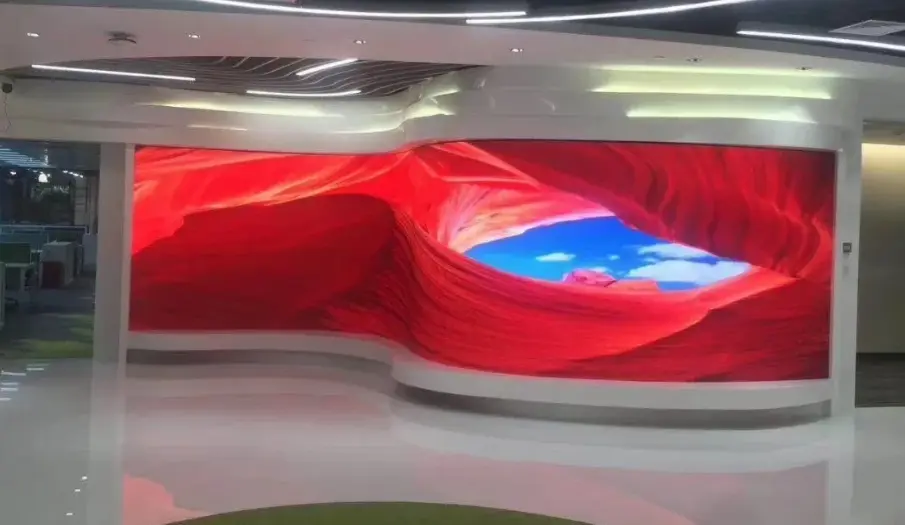
The minimum bending radius is a product-specific mechanical specification. It must be confirmed against the manufacturer’s technical documentation and the intended installation conditions.
IEC 62715-6-1:2018 specifies mechanical test methods for evaluating deformation-related stability in flexible display modules, including bending, rolling, twisting, and stretching. It does not establish one universal minimum bending radius for all flexible LED displays. Its applicability to a specific LED display product should be verified rather than assumed.
The allowable curvature of a flexible LED module depends on its construction, bending direction, mechanical support, electrical interconnections, and the manufacturer’s specified limits. Buyers should distinguish between a radius used in a mechanical test and the minimum radius approved for installation.
The allowable curvature depends on:
-
Flexible PCB construction.
-
Module dimensions.
-
Mechanical support.
-
LED package.
-
Electrical interconnections.
-
Mounting design.
-
Bending direction.
-
Product-specific engineering limits.
Buyers should request the actual technical documentation for the intended module.
Minimum Bending Radius vs Minimum Cylinder Diameter
These terms describe related but different dimensions.
| Term | Meaning |
|---|---|
| Minimum Bending Radius | The specified radius of curvature |
| Minimum Cylinder Diameter | The diameter of a cylindrical surface |
| Concave Bending | The display curves inward |
| Convex Bending | The display curves outward |
For a cylindrical installation, the required curvature must be compatible with the module’s mechanical design.
A display intended for a large-radius curve may not be suitable for a narrow column.
The supplier should confirm whether the required geometry is within the product’s approved bending range.
Can Flexible LED Modules Be Bent Repeatedly?
Not necessarily.
A flexible module designed for installation on a curved surface is not automatically designed for repeated bending.
Repeated mechanical stress can affect:
-
Flexible PCB traces.
-
Solder joints.
-
LED packages.
-
Connectors.
-
Mechanical support components.
Buyers should confirm whether the product is intended for permanent installation, repeated bending, or temporary reconfiguration.
Do not assume that a module can be repeatedly folded simply because it is described as flexible.
How to Check Curvature Compatibility Before Ordering
Before placing an order, provide the manufacturer with:
-
Required screen dimensions.
-
Target curvature.
-
Cylinder diameter or specified radius.
-
Concave or convex orientation.
-
Installation method.
-
Required module layout.
-
Maintenance access requirements.
A supplier should confirm the proposed design against the actual product specifications.
For projects involving complex architectural surfaces, a mechanical drawing or installation layout can be more valuable than a general product brochure.
What Are the Hidden Costs of a Flexible LED Screen?
The initial hardware quotation is only one part of the total project budget.
A complete flexible LED installation may require additional costs for structure, control equipment, logistics, installation, and long-term maintenance.
Custom Frame and Mounting Costs
The mounting structure must support the display and maintain the required geometry.
Depending on the project, the structure may involve:
-
Steel or aluminum components.
-
Custom mounting frames.
-
Magnetic mounting systems.
-
Mechanical support.
-
Alignment adjustments.
-
Access provisions for maintenance.
A flexible module does not eliminate the need for structural engineering.
For cylindrical and architectural installations, the mounting design should be confirmed before the display hardware is ordered.
Control System and Content Mapping Costs
The control system must support the display’s required resolution, signal sources, and layout.
Custom-shaped displays may also require additional content mapping and configuration.
The project budget should account for:
-
Video processing.
-
Sending equipment.
-
Receiving cards.
-
Signal distribution.
-
Control software.
-
Content mapping.
-
Commissioning.
The exact equipment depends on the display design and system requirements.
Shipping and Installation Costs
Flexible LED modules are not necessarily cheaper to transport than conventional LED modules.
The final logistics cost depends on:
-
Order quantity.
-
Packaging dimensions.
-
Shipment weight.
-
Destination.
-
Freight method.
-
Insurance.
-
Customs requirements.
-
Delivery terms.
Installation costs may also vary according to the site.
For example, a display installed on an accessible indoor wall may require less installation work than a display mounted on a high architectural surface.
Buyers should confirm whether the quotation includes installation, commissioning, and on-site technical support.
Maintenance, Spare Parts, and Electricity Costs
Long-term ownership costs may include:
| Cost Component | What to Consider |
|---|---|
| Spare Modules | Availability and replacement cost |
| Power Supplies | Replacement and service requirements |
| Receiving Cards | Compatibility and availability |
| Maintenance Labor | Access and repair complexity |
| Electricity | Operating brightness and usage hours |
| Downtime | Commercial impact of display failure |
| Warranty | Coverage, exclusions, and service conditions |
The actual maintenance requirements depend on the product design and installation environment.
A display with difficult maintenance access may have higher service costs even if its initial hardware price is relatively low.
Flexible LED Screen Total Cost of Ownership
Total Cost of Ownership (TCO) is a useful way to compare complete display solutions.
Rather than comparing only the initial hardware price, buyers should evaluate:
-
Hardware.
-
Control system.
-
Structure.
-
Installation.
-
Shipping.
-
Customs.
-
Maintenance.
-
Electricity.
-
Spare parts.
-
Content and control equipment.
-
Downtime.
-
Warranty and service conditions.
A lower initial quotation does not necessarily result in a lower long-term project cost.
For B2B buyers, the best purchasing decision is often the solution that meets the technical requirements while maintaining predictable installation, maintenance, and operating costs.
How Do You Compare Flexible LED Screen Factory Quotes?
When sourcing a flexible LED screen from a manufacturer, buyers should compare quotations using the same product specifications and supply scope.
A quotation that appears cheaper may exclude components required to complete the installation.
What Should a Flexible LED Screen Quotation Include?
A professional quotation should identify the following items.
| RFQ Item | Information to Confirm |
|---|---|
| Pixel Pitch | Exact pixel pitch |
| Display Dimensions | Width, height, and total area |
| Module Dimensions | Exact module size |
| LED Package | LED configuration |
| Brightness | Rated specification and measurement conditions |
| Refresh Rate | Rated specification |
| Curvature | Required radius or cylinder diameter |
| Control System | Brand, model, and included equipment |
| Power Supplies | Quantity and specification |
| Receiving Cards | Quantity and compatibility |
| Mounting Structure | Included or excluded |
| Content Mapping | Included or excluded |
| Spare Parts | Quantity and pricing |
| Installation | Included or excluded |
| Commissioning | Included or excluded |
| Warranty | Duration, coverage, and exclusions |
| Lead Time | Production and delivery schedule |
| Shipping | Freight method and destination |
| Incoterms | EXW, FOB, CIF, DAP, or DDP as applicable |
This checklist helps buyers identify missing components before comparing prices.
How to Compare Flexible LED Screen Quotations Fairly
Flexible LED screen quotations should be compared on a like-for-like basis. A lower price per square meter does not necessarily represent a lower total project cost if the quoted products differ in technical specifications, included components, or delivery scope.
Before comparing supplier offers, confirm the following:
-
Technical equivalence: Match pixel pitch, module dimensions, LED configuration, brightness, refresh rate, and the specified bending requirements.
-
Supply scope: Confirm whether power supplies, receiving cards, sending equipment, video processors, mounting structures, spare parts, and control software are included.
-
Mechanical and installation requirements: Check whether the quotation covers custom frames, curvature adaptation, content mapping, installation, and commissioning.
-
Commercial terms: Compare the same order quantity, currency, named delivery location, Incoterms edition, and applicable shipping and import costs.
-
Warranty and service: Review warranty duration, exclusions, spare-part availability, technical support, and maintenance responsibilities.
If two quotations differ in any of these areas, identify the differences before treating the prices as comparable. Request a revised quotation with the same technical specifications and supply scope where necessary.
For international procurement, compare the expected delivered project cost rather than the factory price alone. EXW, FOB, CIF, DAP, and DDP quotations allocate transportation, insurance, and import-related responsibilities differently. Confirm the applicable Incoterms rules and named location in each contract.
How to Compare EXW, FOB, and Other Delivery Terms
Delivery terms affect the responsibilities of the buyer and supplier.
| Incoterm | General Consideration |
|---|---|
| EXW | Buyer generally takes responsibility for arranging collection and subsequent transportation |
| FOB | Seller delivers the goods on board the vessel at the agreed port under the applicable Incoterms rules |
| CIF | Seller arranges cost, insurance, and freight to the named destination port, subject to the applicable rules |
| DAP | Seller arranges delivery to the named destination, while the buyer generally handles import clearance and duties |
| DDP | Seller generally assumes responsibility for delivery and import clearance, including applicable duties |
The exact responsibilities depend on the named place, contract, and applicable Incoterms edition.
Buyers should not compare an EXW quotation with a DDP quotation as though they represent the same delivered cost.
For international purchases, confirm the applicable Incoterms edition and the named delivery location.
How to Evaluate a Flexible LED Screen Manufacturer
A factory’s ability to manufacture flexible LED modules is only one part of supplier evaluation.
Buyers should also consider:
-
Product-specific technical documentation.
-
Mechanical design capabilities.
-
Quality control procedures.
-
Testing and calibration processes.
-
Spare parts availability.
-
Warranty conditions.
-
Engineering support.
-
Installation guidance.
-
Communication during project development.
-
After-sales service arrangements.
Ask for documentation that supports the supplier’s claims.
For example, if a manufacturer states that a module supports a particular bending radius, request the relevant technical specification or mechanical drawing.
If the project requires camera-friendly performance, request a demonstration or test using the intended camera conditions.
Flexible LED Screen RFQ Checklist
Before requesting a quotation, prepare the following project information.
Project Information
Providing these details allows a manufacturer to evaluate the project more accurately and prepare a quotation that is easier to compare with other suppliers.
Is a Flexible LED Screen Worth the Investment?
A flexible LED screen can be a valuable investment when its mechanical flexibility solves a real design or installation problem.
However, flexibility alone does not justify a higher price.
The purchasing decision should be based on the project’s geometry, visual requirements, installation conditions, and long-term operating needs.
Applications Where Flexible LED Creates Value
Flexible LED displays may be suitable for:
-
Retail feature walls.
-
Curved architectural displays.
-
Cylindrical columns.
-
Exhibition installations.
-
Creative indoor environments.
-
Selected stage and event installations.
-
Immersive visual experiences.
These applications may require display surfaces that conventional rigid LED cabinets cannot easily achieve without segmentation or custom mechanical structures.
Project Conditions That May Increase Costs
The following conditions may increase the total project budget:
| Project Condition | Potential Cost Impact |
|---|---|
| Complex Curvature | More demanding mechanical design |
| Custom Module Dimensions | Additional manufacturing requirements |
| Difficult Installation Access | More installation work |
| High Brightness Requirements | Different hardware configuration |
| Fine Pixel Pitch | Higher hardware cost |
| Complex Content Mapping | Additional configuration |
| Specialized Control Requirements | Additional equipment |
| International Delivery | Freight and import-related costs |
These are potential cost drivers, not fixed surcharges.
The actual impact depends on the product configuration and project conditions.
Flexible LED Screen vs Alternative Display Solutions
Before purchasing, consider whether the project truly requires a flexible LED display.
| Project Requirement | Potentially Suitable Solution |
|---|---|
| Conventional flat display wall | Rigid LED display |
| Continuous curved surface | Flexible LED display |
| Cylindrical architectural feature | Flexible LED or custom-shaped LED solution |
| Large decorative surface | Flexible LED or segmented rigid LED |
| Complex immersive environment | Project-specific LED solution |
| Budget-focused flat installation | Conventional rigid LED |
The best solution is the one that meets the project’s visual and engineering requirements without introducing unnecessary cost or complexity.
Frequently Asked Questions
How Much Does a Flexible LED Screen Cost per Square Meter?
Flexible LED screen prices vary significantly by pixel pitch, display dimensions, mechanical design, control system, and project scope. A quote for flexible LED modules is not directly comparable to a quote for a complete display system or a turnkey installation.
When comparing supplier quotations, confirm whether the price includes LED modules, cabinets or supporting structures, power supplies, control equipment, installation materials, shipping, taxes, and on-site services. Any published price range should be treated as an indicative reference unless it is supported by a current, clearly defined quotation.
Is Flexible LED More Expensive Than Regular LED?
Flexible LED may cost more than comparable rigid LED displays because of its flexible substrate, specialized mechanical design, and mounting requirements.
However, the actual price difference depends on the products being compared.
For flat installations, rigid LED may be more economical. For curved or cylindrical displays, flexible LED may provide a more suitable solution.
What Is the Minimum Bending Radius of a Flexible LED Screen?
The minimum bending radius depends on the specific flexible LED module.
Different products may support different curvatures, bending directions, and installation methods.
Buyers should request the manufacturer’s technical documentation rather than assuming that all flexible LED screens have the same bending capability.
Can Flexible LED Screens Be Used Outdoors?
Some flexible LED products may be designed for outdoor applications, but outdoor suitability must be confirmed for the specific model.
Buyers should verify:
-
Environmental protection rating.
-
Brightness.
-
Temperature range.
-
Moisture resistance.
-
Mounting requirements.
-
Power and control system design.
Do not assume that an indoor flexible LED module is suitable for outdoor installation.
What Is Included in a Flexible LED Screen Factory Price?
A factory price may refer to modules only, complete display hardware, or a turnkey project.
The quotation should clearly identify whether it includes:
-
LED modules.
-
Power supplies.
-
Receiving cards.
-
Sending equipment.
-
Video processor.
-
Mounting structure.
-
Spare parts.
-
Shipping.
-
Installation.
-
Commissioning.
A factory price should always be compared with another quotation using the same scope.
How Much Does It Cost to Install a Flexible LED Screen?
Installation costs depend on the display dimensions, curvature, mounting structure, site access, installation location, and commissioning requirements.
A simple indoor installation may require less work than a complex architectural display.
Without project-specific information, a universal installation price would be misleading.
What Is the Difference Between Flexible LED and Soft LED Modules?
Flexible LED and Soft LED Module are terms that are often used interchangeably in the industry.
However, different manufacturers may use these terms for products with different mechanical designs.
Buyers should confirm the module dimensions, flexible PCB construction, bending direction, mounting method, and minimum bending radius for the specific product.
Is a Flexible LED Screen Suitable for a Cylindrical Column?
Flexible LED displays can be suitable for cylindrical columns when the module’s bending capability matches the required cylinder geometry.
Before ordering, confirm the column dimensions, target curvature, module layout, mounting structure, and maintenance access.
The manufacturer should verify the proposed configuration against the product’s mechanical specifications.
How Do I Get a Flexible LED Screen Factory Price from Shenzhen?
To obtain a project-specific quotation, provide:
-
Required display dimensions.
-
Pixel pitch.
-
Intended application.
-
Required curvature.
-
Indoor or outdoor installation.
-
Destination.
-
Required control system.
-
Installation requirements.
-
Delivery terms.
The more complete the project information, the easier it is for the manufacturer to provide a meaningful quotation.
Expert Verdict: How to Choose the Right Flexible LED Screen
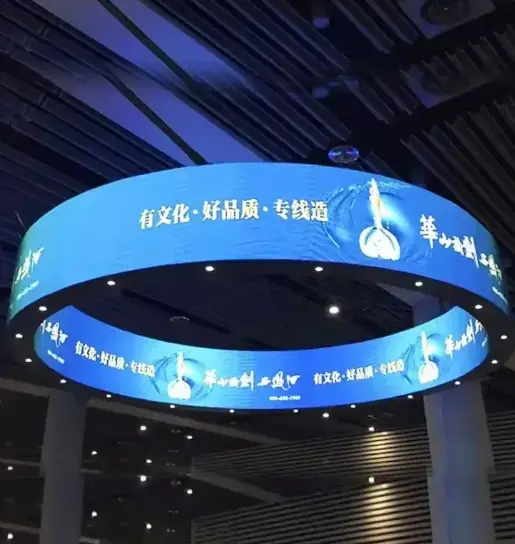
The right flexible LED screen is not necessarily the one with the lowest price or the smallest pixel pitch.
For B2B buyers, the purchasing decision should begin with the project requirements.
A flexible LED display is worth considering when its mechanical flexibility provides a genuine advantage for the intended installation.
For conventional flat display walls, rigid LED may offer a more straightforward and economical solution.
Before placing an order, confirm the following:
-
The required pixel pitch matches the viewing conditions.
-
The module supports the required curvature.
-
The mounting structure is suitable for the installation.
-
The control system meets the display requirements.
-
The quotation clearly identifies included and excluded components.
-
The delivery terms are understood.
-
Warranty, spare parts, and maintenance requirements are documented.
The most reliable purchasing decision comes from comparing technically equivalent quotations, not simply comparing the price per square meter.
About Sostron
Sostron is a commercial LED display manufacturer and display solution provider based in Shenzhen, China.
The company provides LED display products and project-related support for commercial applications, including product development, manufacturing, engineering support, installation guidance, and after-sales technical service.
For projects involving flexible LED displays, the appropriate product configuration depends on the required pixel pitch, display geometry, installation conditions, and control system.
Buyers can explore Sostron’s LED display product range or learn more about flexible LED display technology.
For technical questions involving flexible modules, bending requirements, or installation design, consult the relevant product specifications and confirm project requirements with the manufacturer.
Price Disclaimer: All prices mentioned in this article are indicative supplier-published references or estimates, not binding Sostron quotations. Actual flexible LED screen prices depend on product configuration, pixel pitch, order quantity, display geometry, control system, mounting structure, delivery terms, and installation requirements. Supplier-published prices may represent different quotation scopes and should not be compared directly. Contact Sostron for a project-specific quotation based on your technical requirements and delivery conditions.
References:
IEC 62715-2:2022 — Flexible Display Devices: Essential Ratings and Characteristics