Quick Answer
A DOOH LED display is a digital LED screen used for advertising or other commercial communication outside the home. Unlike a static billboard, it can display changing content remotely and can form part of a broader Digital Out-of-Home (DOOH) media network. The IAB defines DOOH as digital media used for marketing outside the home, combining digital screens with dynamic content, data integration and audience targeting; programmatic buying is an available capability, but it is not a requirement for a screen to qualify as DOOH.
For buyers, the important question is not simply which LED screen has the highest brightness or smallest pixel pitch. The correct configuration depends on viewing distance, ambient light, screen size, content type, structural conditions, maintenance access, power consumption and the commercial role of the display.
| Item | Practical guidance |
|---|---|
| Definition | Digital LED media used for advertising or commercial communication outside the home |
| Main applications | Billboards, highways, retail, transit, urban panels, landmarks and other public spaces |
| Pixel pitch | Select according to viewing distance, content and screen scale rather than choosing the smallest pitch automatically |
| Brightness | Must be matched to sunlight and viewing conditions; higher is not always better |
| Weather protection | Outdoor installations require an enclosure and protection strategy appropriate to the site |
| Main cost drivers | LED hardware, controller, structure, installation, logistics, electrical work, permits and ongoing operation |
| Major OPEX factors | Electricity, maintenance, spare parts, connectivity and content management |
| Programmatic DOOH | Requires compatible media/ad-tech infrastructure; an LED screen itself does not automatically provide programmatic buying |
| Best buyer | Media owners, OOH operators, advertisers, property owners and organizations needing remotely managed outdoor digital content |
| Main procurement risk | Buying hardware before defining the site, commercial model and total cost of ownership |
A useful way to think about the purchase is:
DOOH business model → site conditions → LED specification → infrastructure → content/control system → TCO → supplier evaluation.
What Is a DOOH LED Display?
A DOOH LED display is an LED-based digital display deployed in an out-of-home environment for advertising, information or other commercial communication.
The distinction matters because DOOH describes the media application, not a particular LED technology.
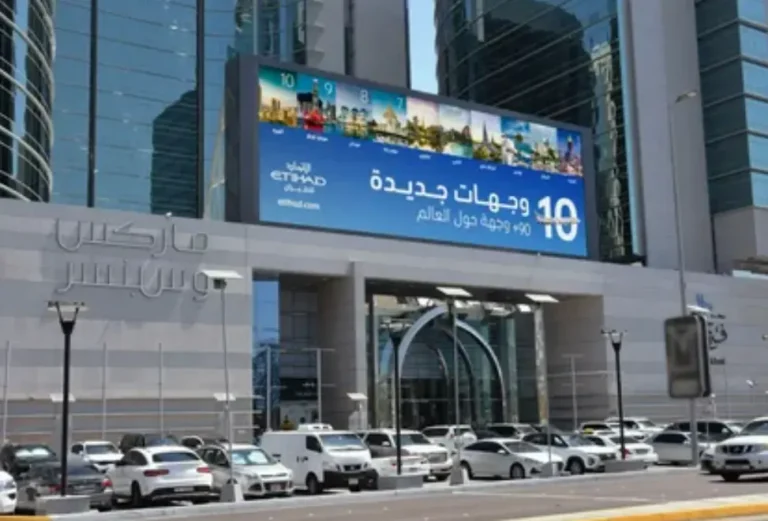
A large roadside LED billboard can be DOOH. So can a digital screen at a transit location, a retail display, a street-level urban panel or another digital screen in a public or commercial environment. The IAB’s current definition specifically includes outdoor areas, transit, retail and other public or commercial placements.
A typical DOOH LED system contains more than LED modules. Depending on the project, it may include:
- LED cabinets and modules
- receiving cards and sending equipment
- video controller
- media player
- CMS
- network connection
- power distribution
- steel or aluminum supporting structure
- sensors or monitoring equipment
- remote-management software
- content/ad-serving integrations
This distinction is important during procurement. A supplier quoting only the LED cabinets has not necessarily quoted a complete DOOH installation.
How Is DOOH Different From Traditional OOH?
Traditional Out-of-Home (OOH) advertising can use static printed or physically changed advertising media. DOOH replaces the static creative with a digital display capable of changing content electronically.
| Feature | Static OOH | Basic Digital Display | DOOH Network |
|---|---|---|---|
| Content | Static | Digital | Digital |
| Remote updates | No | Usually yes | Yes |
| Scheduling | Manual | Basic scheduling | Advanced scheduling possible |
| Data integration | Limited | Possible | Core capability in many networks |
| Audience targeting | Limited | Limited to moderate | Can incorporate contextual or audience data |
| Programmatic buying | No | Not necessarily | Available |
| Measurement | Traditional OOH methods | Screen/play data | Audience, impression and attribution frameworks can be incorporated |
The important point is that programmatic buying is not what creates the screen’s physical DOOH capability. IAB explicitly identifies programmatic buying as a capability rather than a core requirement of DOOH.
What Is the Difference Between DOOH, Digital Signage and pDOOH?
These terms are often mixed together during LED procurement.
DOOH
Digital Out-of-Home describes the media category: digital media displayed outside the home.
Digital Signage
Digital signage is a broader display application. It may be used in:
- corporate buildings
- stores
- schools
- hotels
- factories
- hospitals
- public spaces
Not every digital-signage deployment is an advertising-oriented DOOH network.
pDOOH
Programmatic DOOH refers to automated or data-driven buying and selling of DOOH advertising inventory.
A useful conceptual model is:
LED display = physical media surface
CMS/media player = content delivery layer
SSP = supply-side media infrastructure
DSP = demand-side buying infrastructure
pDOOH = automated transaction layer
This separation prevents a common procurement mistake: assuming that buying a high-end LED screen automatically creates access to programmatic advertising demand.
Where Are DOOH LED Displays Used?
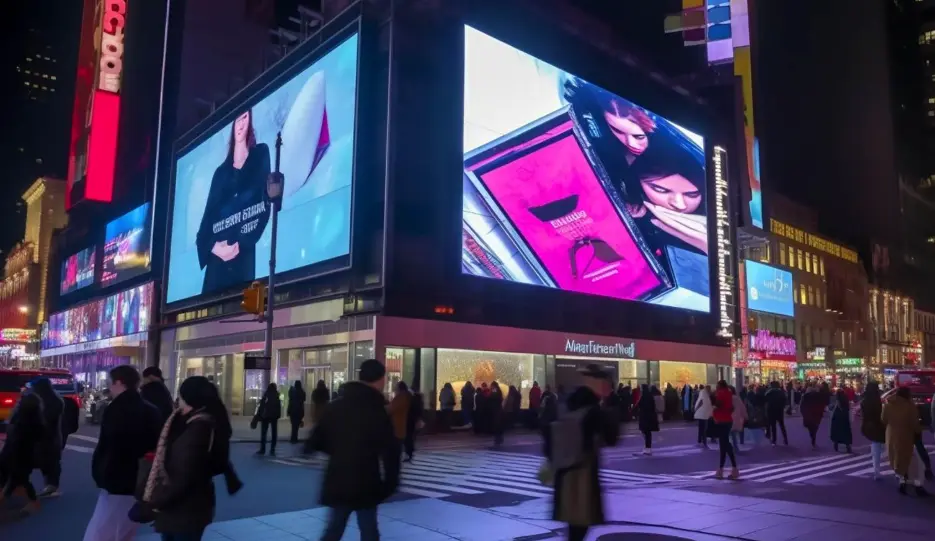
DOOH LED displays can be deployed in many environments, but the engineering requirements vary considerably.
Roadside and Highway Billboards
Large-format outdoor LED billboards are one of the most recognizable DOOH applications.
The engineering priorities normally include:
- long viewing distances
- high ambient light
- wind exposure
- structural loading
- weather protection
- remote content management
- service access
- reliable continuous operation
Pixel pitch should therefore be selected according to the actual viewing environment rather than simply choosing the smallest available pitch.
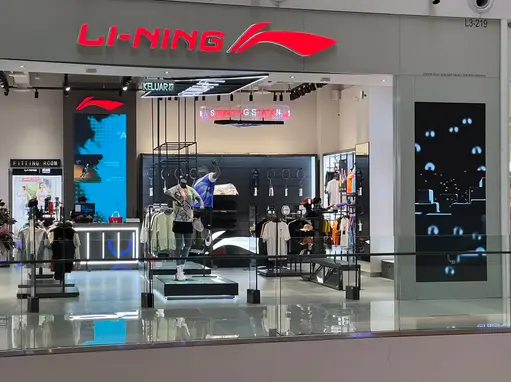
Retail and Commercial Districts
Retail environments may use:
- building façades
- storefront displays
- transparent LED
- digital billboards
- pedestrian-facing screens
Here, viewing distance can be shorter than on a highway, making resolution and visual detail more important.
The physical architecture can also matter more because the display may need to integrate with a building façade rather than a dedicated billboard structure.
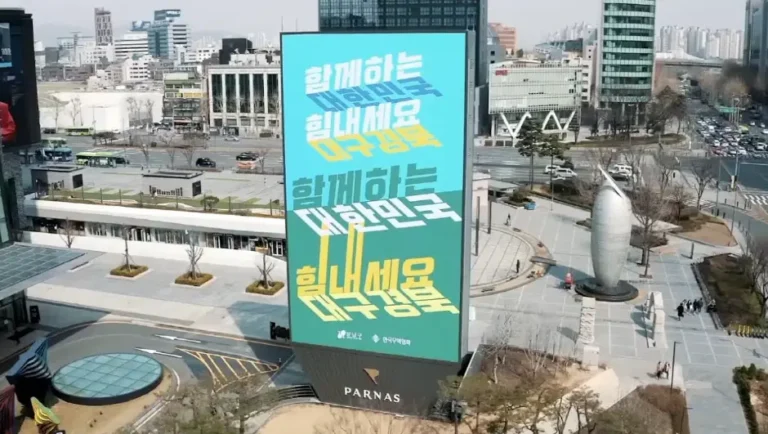
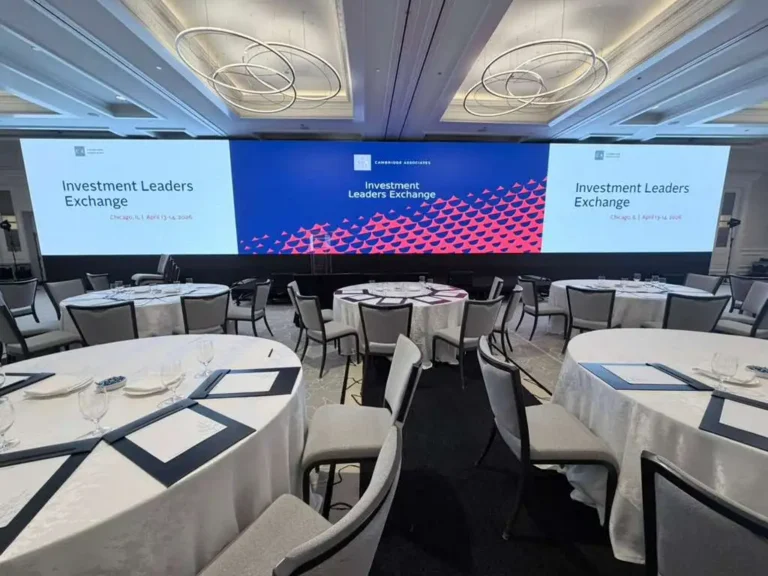
Transit and Public Spaces
DOOH screens can appear in:
- airports
- train stations
- bus shelters
- transport hubs
- pedestrian areas
These projects can prioritize:
- viewing angles
- high dwell time
- content scheduling
- network reliability
- remote monitoring
- integration with broader media systems
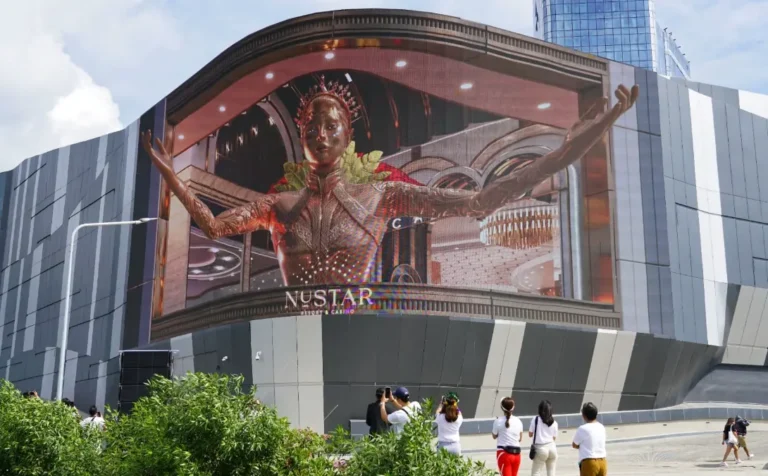
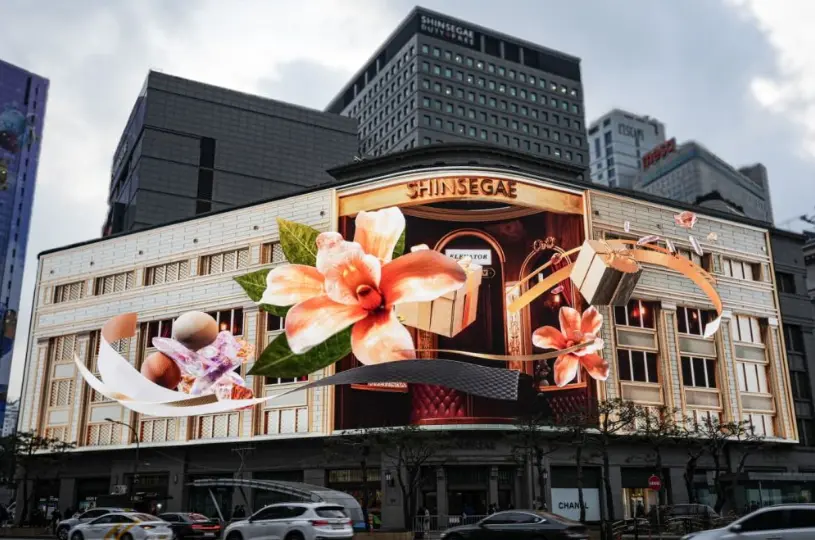
Landmarks and 3D LED Displays
Large-format and creative LED displays can be used to create landmark advertising experiences.
In these projects, the LED specification is only one part of the design. Cabinet geometry, structural engineering, content production and viewing angles can become equally important.
How Do You Choose the Right Pixel Pitch for a DOOH LED Display?
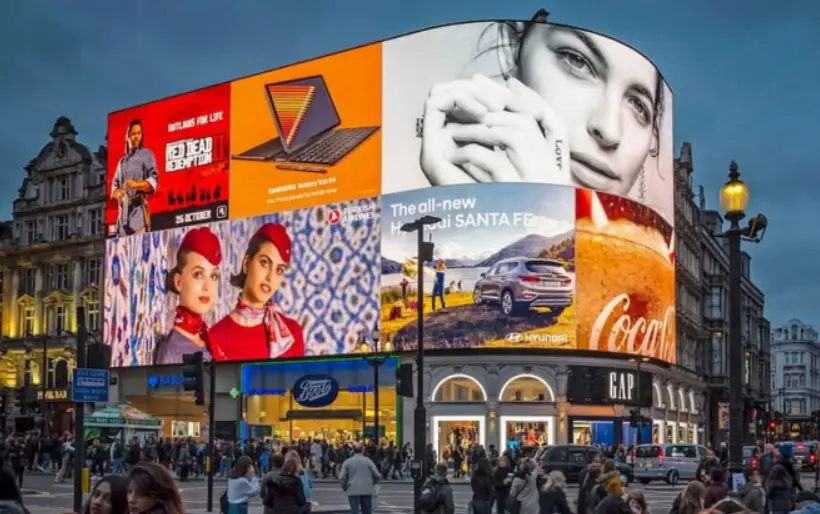
Pixel pitch is the distance between the centers of adjacent pixels, normally expressed in millimeters.
A smaller pixel pitch provides greater pixel density, but it also normally increases hardware cost.
The correct question is therefore not:
“What is the smallest pixel pitch available?”
It is:
“What pixel density does the audience actually need at the intended viewing distance?”
Pixel Pitch vs. Viewing Distance
A practical starting point is to relate:
pixel pitch → viewing distance → screen dimensions → content detail
For a large roadside billboard viewed from a substantial distance, a relatively large pitch can be appropriate.
For a pedestrian-facing display where people may stand much closer, a smaller pitch may be justified.
However, pixel pitch should not be selected using a single universal mathematical rule. Optical design, content, cabinet geometry, viewing angle and environmental conditions also affect the perceived image.
Why Smaller Pixel Pitch Is Not Automatically Better
Suppose two outdoor LED displays are available:
- Display A: larger pixel pitch
- Display B: smaller pixel pitch
Display B will not automatically produce better business results.
If most viewers are hundreds of meters away, paying substantially more for a much finer pitch may generate little additional advertising value.
The additional resolution becomes more valuable when:
- viewers are closer
- screen dimensions are relatively small
- detailed creative is important
- cameras capture the display
- the installation is integrated into an architectural environment
Engineering principle: optimize pixel pitch for the audience, not for the specification sheet.
How Bright Should a DOOH LED Display Be?
Outdoor LED displays must remain readable under changing ambient light.
Direct sunlight creates a fundamentally different environment from an indoor display.
Sostron’s current outdoor Ares product documentation lists brightness up to 10,000 nits, while Ares 2 lists brightness up to 7,500 nits and Ares 3 lists configurations up to 10,000 nits. These are manufacturer specifications for those product series, not universal requirements for every DOOH installation.
Why Maximum Brightness Is Not the Whole Story
A screen running at maximum brightness continuously can increase:
- power consumption
- heat generation
- operating cost
- thermal stress
Therefore, a better design considers:
ambient light + automatic brightness control + viewing environment + content + energy consumption
For example, a roadside billboard may require high daytime output but substantially less brightness after sunset.
This is why brightness should be treated as a controlled operating parameter, not merely a headline specification.
Does IP Rating Matter for Outdoor DOOH?
Yes.
An outdoor DOOH display can be exposed to:
- rain
- dust
- humidity
- condensation
- temperature variation
- coastal salt exposure
- wind-driven water
The appropriate ingress-protection strategy depends on the actual enclosure and installation.
Do not treat an IP number as a complete weather-resistance guarantee. Buyers should also examine:
- cabinet construction
- module sealing
- cable interfaces
- power supply protection
- drainage
- installation orientation
- maintenance procedures
Sostron’s Ares 3 documentation specifies IP65 protection, while its current Ares 3 documentation describes IP68 protection for the relevant product construction. These are product-specific specifications and should be checked against the exact configuration being quoted.
Does Refresh Rate Matter for DOOH?
Refresh rate becomes particularly important when the screen is photographed or filmed.
For roadside viewing, refresh rate should be specified according to the content and capture environment rather than treated as a simple “higher is better” metric. Its importance increases when the display is photographed or filmed, used for live events, or integrated into broadcast production.
For:
- live sports
- broadcast environments
- professional photography
- video production
- high-speed camera capture
refresh rate becomes much more important.
Sostron’s current Ares 2 documentation specifies 3,840–7,680 Hz, while its Ares 3 documentation specifies refresh rates up to 7,680 Hz, depending on configuration.
The buyer should therefore specify refresh rate according to the application rather than simply requesting the highest number available.
How Does Power Consumption Affect DOOH TCO?
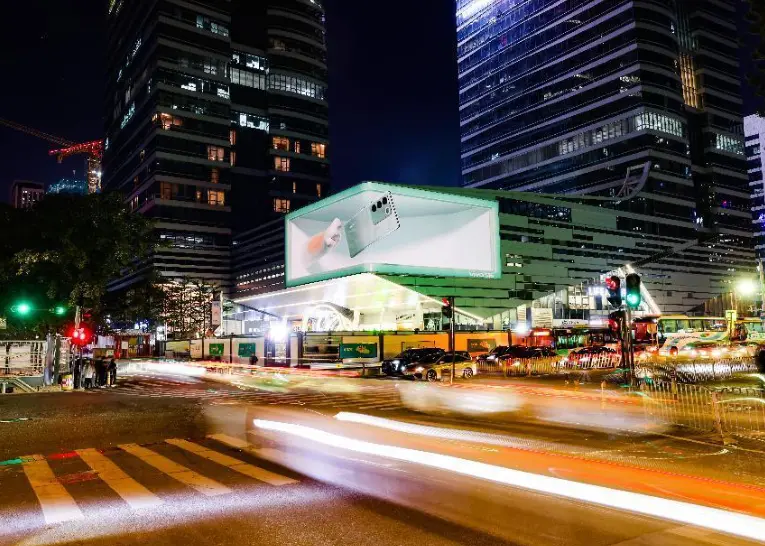
Electricity is easy to underestimate because an LED billboard may operate for thousands of hours every year.
The correct calculation should distinguish between:
- maximum power consumption
- average operating power
- brightness schedule
- operating hours
- local electricity tariff
A simple calculation is:
Annual electricity cost = average power (kW) × operating hours × electricity rate
Example
Assume a display has:
- average operating power: 20 kW
- operation: 16 hours/day
- electricity rate: $0.15/kWh
This is an example calculation, not a market benchmark.
Annual energy consumption would be:
20 × 16 × 365 = 116,800 kWh
Annual electricity cost:
116,800 × $0.15 = $17,520
Change the screen size, brightness schedule, average power or electricity tariff, and the result changes immediately.
This is why a quote based only on purchase price can be misleading.
Does Common-Cathode Technology Reduce DOOH Operating Costs?
Common-cathode LED architecture can reduce power consumption by controlling the electrical supply to the red, green and blue LED chips differently from conventional common-anode approaches.
Sostron’s Ares 2 documentation states a 40% lower power-consumption claim, while its Ares 3 documentation states a 50–60% power-reduction claim for its Common Cathode 2.0 implementation. These are manufacturer claims and should be evaluated against the exact operating conditions, brightness settings and configuration.
For a DOOH operator, the important question is not:
“Does common cathode sound more advanced?”
It is:
“How much electricity will this specific configuration consume under my actual operating schedule?”
Ask suppliers for both:
- maximum power consumption
- expected/average power consumption under a defined brightness and operating scenario
That makes competing quotations easier to compare.
What Does a DOOH LED Display Cost?
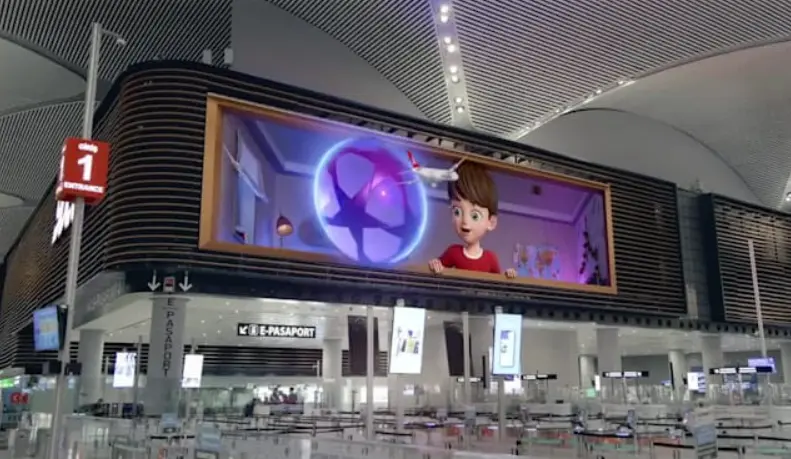
There is no single reliable global price for a DOOH LED display.
A project quotation can vary substantially because the screen itself is only one part of the total investment.
The complete cost can include:
| Cost Component | What Can Affect It |
|---|---|
| LED display | Pixel pitch, cabinet design, brightness, LED components |
| Controller | Resolution, processing capability, redundancy and features |
| Media player | Content format, network requirements and software |
| CMS | Number of screens, users, scheduling and monitoring requirements |
| Steel structure | Screen dimensions, wind load, location and structural design |
| Electrical system | Distribution, cabling, protection and site capacity |
| Installation | Access, lifting equipment, labor and working conditions |
| Shipping | Volume, weight, destination and Incoterms |
| Customs | Destination-country rules and applicable duties/taxes |
| Permits | Local advertising, building and structural requirements |
| Connectivity | Wired, cellular or other network connection |
| Spare parts | Recommended replacement inventory |
| Maintenance | Access, labor, inspection and replacement costs |
For this reason, quoting a universal “DOOH LED price per square meter” without defining the configuration can create a false sense of precision.
What Should Be Included in an RFQ?
Before requesting prices, provide:
- screen width and height
- intended location
- viewing distance
- outdoor or indoor environment
- required brightness
- target pixel pitch
- front/rear maintenance requirements
- operating hours
- local voltage
- connectivity requirements
- content-management requirements
- structural information
- installation scope
- shipping destination
- warranty expectations
- spare-parts requirements
A supplier can then quote a project rather than simply a box of LED cabinets.
What Is the Total Cost of Ownership of a DOOH LED Display?
The TCO of a DOOH installation should be considered over its operating period rather than at the moment of purchase.
CAPEX
Initial investment may include:
- LED display
- controller
- media player
- CMS
- structure
- electrical infrastructure
- installation
- transportation
- customs and taxes
- permits
OPEX
Ongoing expenses may include:
- electricity
- network connectivity
- CMS/software
- maintenance
- spare parts
- cleaning
- inspections
- technician visits
- structural maintenance
Revenue-Side Variables
For a media owner, another layer matters:
- advertising inventory
- number of ad slots
- occupancy
- campaign frequency
- audience
- location
- screen uptime
- measurement capability
This creates a more useful business model:
TCO = CAPEX + accumulated OPEX
while the commercial return depends on:
advertising revenue × occupancy × operating availability
No supplier can guarantee a specific ROI without knowing the location, advertising rates, occupancy and operating conditions.
How Should You Think About DOOH LED ROI?
ROI should be calculated from the economics of the media asset rather than from the LED display alone.
A simplified example is:
Annual gross advertising revenue = available advertising inventory × average selling value × occupancy
Then subtract:
- electricity
- maintenance
- connectivity
- software
- site costs
- other operating expenses
The remaining contribution can be compared with the initial investment.
Why Uptime Matters
A screen that is technically impressive but frequently unavailable is a poor media asset.
For this reason, buyers should consider:
availability + serviceability + spare parts + remote monitoring
alongside brightness and pixel pitch.
This is one reason maintenance access can have financial value.
A front-service display may be preferable where the rear of the cabinet is inaccessible. Conversely, a rear-service installation may make sense where there is sufficient maintenance space.
What Does a Complete DOOH LED Display Solution Include?
A commercial DOOH installation normally has several layers.
1. LED Display
The physical display provides:
- brightness
- resolution
- viewing angle
- environmental protection
- mechanical structure
2. Video Processing and Control
The controller manages:
- input signals
- resolution
- scaling
- synchronization
- screen configuration
3. Media Player
The media player provides the content playback layer.
4. CMS
A CMS can enable operators to:
- upload content
- schedule campaigns
- manage multiple displays
- monitor device status
- remotely update content
Sostron also publishes documentation showing remote CMS connection and content publishing workflows for connected LED displays.
5. Network
Depending on the project, connectivity may use:
- wired internet
- Wi-Fi
- 4G/5G
- other network infrastructure
The choice depends on the location and reliability requirements.
6. Advertising Technology
A larger DOOH network may connect the display environment to:
- SSP
- DSP
- ad server
- audience data
- campaign measurement
The important distinction is that hardware compatibility does not equal automatic access to every programmatic platform. Integration requirements should be confirmed with the relevant software and media partners.
Can an LED Billboard Support Programmatic DOOH?
Yes, but the LED display is only one component.
A programmatic workflow may look conceptually like:
Advertiser → DSP → DOOH marketplace/SSP → ad-serving system → media player/CMS → LED display
The exact architecture varies between media operators and technology providers.
The IAB’s DOOH definition confirms that programmatic buying can be part of DOOH, while its measurement guide emphasizes the industry’s continuing need for consistent approaches to measurement, audience data and attribution.
For a new DOOH network, ask the technology supplier:
- Which DSPs or SSPs are supported?
- Is an API available?
- How is campaign scheduling handled?
- How are proof-of-play records generated?
- What happens if connectivity fails?
- Can campaigns continue from local storage?
- How is screen health monitored?
- What measurement data is available?
This is more useful than simply asking whether a CMS is “programmatic-ready.”
How Is DOOH Advertising Measured?
Measurement is becoming a major part of the DOOH ecosystem.
The IAB’s 2025 DOOH Measurement Guide notes that measurement practices remain fragmented and addresses topics ranging from data collection and impression calculation to attribution, incrementality and cross-channel measurement.
For buyers and media owners, this means a screen should not be evaluated solely on:
- resolution
- brightness
- screen size
The media system may also need to support reliable information about:
- campaign plays
- scheduled impressions
- audience estimates
- location
- time of day
- campaign duration
- proof of play
- attribution methodology
Measurement methodology should be documented rather than assumed.
What Site Conditions Should Be Checked Before Installing a DOOH LED Display?
Buying the screen before checking the site is one of the easiest ways to create unnecessary project costs.
Viewing Distance and Sightlines
Document:
- nearest audience
- typical audience
- farthest useful audience
- vehicle speed
- pedestrian direction
- obstructions
- viewing angle
Ambient Light
Check:
- direct sunlight
- reflected sunlight
- surrounding buildings
- nighttime environment
- automatic brightness requirements
Structural Conditions
A large outdoor LED display creates:
- dead load
- wind load
- dynamic effects
- attachment requirements
The supporting structure must therefore be engineered for the actual site.
Do not assume that the weight of the LED cabinet is the only structural variable.
Electrical Infrastructure
Confirm:
- available voltage
- electrical capacity
- distribution location
- cable length
- grounding
- surge protection
- local electrical requirements
Maintenance Access
Determine whether technicians can safely access:
- LED modules
- power supplies
- receiving cards
- cables
- controllers
A screen that looks inexpensive at purchase can become expensive if every repair requires special access equipment.
What Permits and Regulations Apply to DOOH LED Displays?
There is no universal DOOH permit checklist.
Requirements can depend on:
- country
- state/province
- municipality
- zoning
- road authority
- building regulations
- advertising regulations
- electrical regulations
- structural engineering requirements
Therefore, buyers should not treat a generic online statement such as “a billboard needs X permit” as sufficient.
The project team should verify requirements with the relevant local authorities before installation.
The same principle applies to product compliance.
For example, an international electrical/electronic product standard and a national advertising permit serve different purposes. They should not be presented as interchangeable “certifications.”
Which LED Display Standards and Certifications Should Buyers Check?
The exact documents depend on the destination market and product configuration.
Potential areas of review include:
- electrical safety
- electromagnetic compatibility
- environmental restrictions
- ingress protection
- structural requirements
- local electrical regulations
The buyer should request the actual test reports or declarations relevant to the project rather than relying on a generic “CE/FCC/RoHS” statement.
This distinction is important because compliance markings and certifications are not universal substitutes for local installation approval.
What Should You Ask a DOOH LED Display Manufacturer?
A useful RFQ should go beyond price.
Technical Questions
- What pixel pitches are available?
- What is the actual brightness range?
- What are maximum and average power figures?
- What is the refresh rate?
- What is the IP rating?
- What are the operating temperature limits?
- Is front maintenance available?
- Is rear maintenance available?
- What is the cabinet weight?
- What is the cabinet size?
Control Questions
- Which controller is included?
- Which media player is recommended?
- What CMS is used?
- Can multiple screens be centrally managed?
- Is remote monitoring supported?
- What happens if the network goes offline?
- Is programmatic integration supported?
- Which APIs or protocols are available?
Commercial Questions
- What is included in the quotation?
- Is the steel structure included?
- Is installation included?
- Is commissioning included?
- What are the shipping terms?
- What spare parts are recommended?
- What is the warranty?
- What is the after-sales response process?
Evidence Questions
Ask the supplier to provide:
- relevant product datasheets
- applicable test reports
- installation references
- project photographs
- maintenance documentation
- power data
- warranty terms
A supplier that cannot clearly separate tested specification, manufacturer claim and estimate makes technical comparison more difficult.
What Real-World DOOH Projects Can Teach Buyers
First-hand project evidence is more useful than generic statements when it is documented with enough technical detail.
Kenya: 80 m² P10.4 Outdoor Billboard

Sostron documents an approximately 80 m² P10.4 outdoor LED billboard in Kenya, installed on a unipole structure for commercial advertising. The project illustrates why large roadside DOOH installations need to consider not just display resolution but also structural design and long-distance visibility.
The lesson is not that P10.4 is universally the correct pitch.
The lesson is:
A large roadside screen can use a relatively large pixel pitch when the screen scale and viewing environment support that choice.
Brazil Highway Project
Sostron’s documented Brazil highway project specifies a brightness of at least 6,500 nits, a steel pillar structure with wind-resistant reinforcement, IP65 protection and remote wireless/4G cloud-based control.
This illustrates an important procurement principle:
brightness + weather protection + structure + remote control must be considered as one system.
The screen is not operating in isolation.
Sostron’s Outdoor Product Engineering
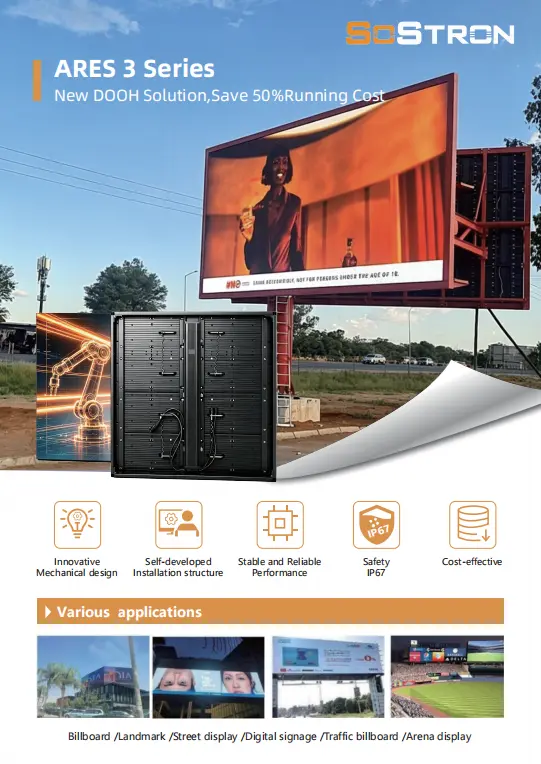
Sostron’s current Ares outdoor range is positioned specifically for fixed outdoor applications. The Ares documentation lists up to 10,000-nit brightness and an aluminum cabinet design, while Ares 2 emphasizes common-cathode architecture, a 20 kg/m² design and up to 7,500-nit brightness. Ares 3 documentation lists configurations reaching up to 10,000 nits and emphasizes energy efficiency and dual-side service access.
These figures should be treated as Sostron product specifications, not as universal DOOH industry benchmarks.
How Do You Choose Between a Higher-Spec and Lower-Spec DOOH Display?
A higher specification is justified when it solves a real project requirement.
Higher Brightness May Be Justified When:
- the screen receives intense direct sunlight
- the installation has difficult viewing conditions
- the content requires strong daytime contrast
Smaller Pixel Pitch May Be Justified When:
- viewers are closer
- screen dimensions are limited
- detailed creative is important
- the screen is photographed frequently
Higher Refresh Rate May Be Justified When:
- cameras capture the screen
- the venue supports broadcast production
- live video is important
Lower Power Consumption May Be Justified When:
- the screen operates many hours each day
- local electricity prices are high
- the network contains many displays
- long-term OPEX matters
Front Maintenance May Be Justified When:
- the screen is wall-mounted
- rear access is difficult
- downtime must be minimized
The correct approach is therefore:
requirement → specification → cost → business consequence
rather than:
maximum specification → maximum price.
Who Should Buy a DOOH LED Display?
A DOOH LED display can make sense for:
- outdoor advertising operators
- media owners
- property developers
- retail networks
- transport operators
- commercial districts
- brands operating their own digital media network
- organizations requiring dynamic outdoor communication
The strongest business case generally exists where the display has a clear role in generating or supporting recurring commercial value.
Who May Not Need a Large DOOH LED Display?
A large outdoor LED billboard may be unnecessary when:
- the audience is small
- viewing distance is short
- content changes rarely
- there is no commercial media strategy
- the site cannot support the required structure
- local regulations make the installation impractical
- a smaller digital signage format meets the communication objective
The cheapest LED screen is not necessarily the cheapest solution.
If a smaller display can deliver the same communication objective, buying a larger screen simply increases CAPEX and potentially OPEX.
A Practical DOOH LED Procurement Checklist
Before signing a purchase order, confirm the following.
Site
- Viewing distance documented
- Sightlines checked
- Ambient light assessed
- Wind conditions assessed
- Structural design reviewed
- Electrical capacity confirmed
- Maintenance access confirmed
- Local permits checked
LED Display
- Pixel pitch selected for actual viewing conditions
- Brightness specified
- IP protection specified
- Refresh rate specified where necessary
- Cabinet dimensions confirmed
- Cabinet weight confirmed
- Front/rear maintenance confirmed
- Operating temperature documented
Control System
- Controller specified
- Media player specified
- CMS specified
- Network method specified
- Remote monitoring confirmed
- Offline playback confirmed
- Programmatic requirements documented if applicable
Commercial
- Hardware price confirmed
- Structure price confirmed
- Installation scope confirmed
- Shipping terms confirmed
- Customs/taxes identified
- Spare parts identified
- Electricity assumptions documented
- Maintenance assumptions documented
- Warranty terms confirmed
Evidence
- Datasheet reviewed
- Relevant test documentation reviewed
- Comparable project evidence requested
- Product-specific claims separated from industry benchmarks
- Final configuration recorded in the contract
Frequently Asked Questions About DOOH LED Displays
What is a DOOH LED display?
A DOOH LED display is a digital LED screen used for advertising or commercial communication outside the home. It can display dynamic content and may be integrated with CMS, data and programmatic advertising systems. DOOH describes the media application rather than a particular pixel pitch or LED package.
How much does a DOOH LED display cost?
There is no single universal price. The final project cost depends on pixel pitch, screen size, brightness, cabinet construction, controller, CMS, structure, installation, shipping, customs, electrical work and local requirements. Buyers should request a project-specific quotation rather than relying on a generic price per square meter.
What pixel pitch is best for a DOOH LED billboard?
There is no universal best pixel pitch. Large roadside billboards viewed from long distances can often use larger pixel pitches, while pedestrian-facing or close-view installations may justify finer pitches. The decision should be based on viewing distance, screen size, content and budget.
How bright should an outdoor DOOH LED display be?
Brightness should be selected according to ambient light and the installation environment. Some current Sostron outdoor products specify brightness levels reaching 7,500 or 10,000 nits, but these are product specifications rather than a universal DOOH requirement.
Can a DOOH LED display support programmatic advertising?
Yes, but programmatic DOOH requires compatible media, software and advertising infrastructure. The LED display itself is only the physical output layer. Programmatic buying can connect demand-side platforms with DOOH inventory through the relevant ad-tech ecosystem.
What is the biggest hidden cost in a DOOH LED project?
There is no single hidden cost for every project. Commonly underestimated items include structural work, electrical infrastructure, installation access, transportation, permits, spare parts, electricity and maintenance. A TCO calculation should include these items before comparing suppliers.
What should I ask an LED manufacturer before buying?
Ask for the complete technical configuration, power data, brightness, pixel pitch, IP rating, cabinet weight, maintenance method, controller, CMS, warranty, applicable test documentation, spare-parts recommendations and installation scope. Also ask whether quoted specifications are tested values, manufacturer claims or estimates.
Is a more expensive DOOH LED display always better?
No. A higher specification is useful only when it solves a real requirement. Higher brightness, finer pixel pitch, higher refresh rate or lower power consumption can justify additional cost in specific applications, but unnecessary specifications increase CAPEX without necessarily increasing advertising value.
Sostron DOOH LED Display Solutions
Sostron develops and manufactures commercial LED display solutions for outdoor billboards, indoor displays, rental applications and customized projects. Its current product portfolio includes outdoor Ares, Ares 2 and Ares 3 series, alongside other commercial LED display solutions.
For DOOH projects, the practical approach is to start with the project requirement rather than a predetermined product:
site conditions → screen size → viewing distance → brightness → pixel pitch → power → maintenance → control system → installation
Sostron also documents global LED display projects, including the Kenya outdoor billboard and Brazil highway project, providing project references that can be used when evaluating application-specific requirements.
The objective should not be to specify the most expensive LED display.
It should be to build a display system that provides the required visibility, reliability, maintainability and commercial functionality at an acceptable total cost of ownership.
For a new DOOH deployment, the most useful starting point is therefore a complete project specification—not simply a request for an LED screen price.
References:
Digital Out-of-Home (DOOH): Definition and Core Features