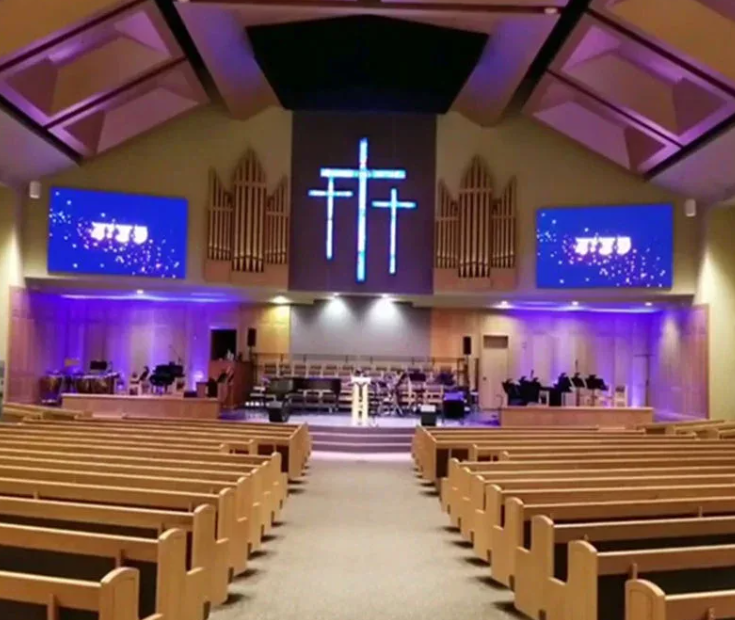
LED (Light Emitting Diode) technology has become the backbone of modern commercial visual systems — from stadium screens to city-scale digital billboards and fine-pitch control room walls. At the heart of every one of these systems sits a component most buyers hear about constantly but rarely have explained in plain terms: the LED chip.
This guide answers the three questions procurement teams and system integrators ask most often: what an LED chip actually is, what it’s used for in commercial display and signage projects, and — critically — how long you can expect one to last before it affects your total cost of ownership.
What Is an LED Chip? Basic Principles
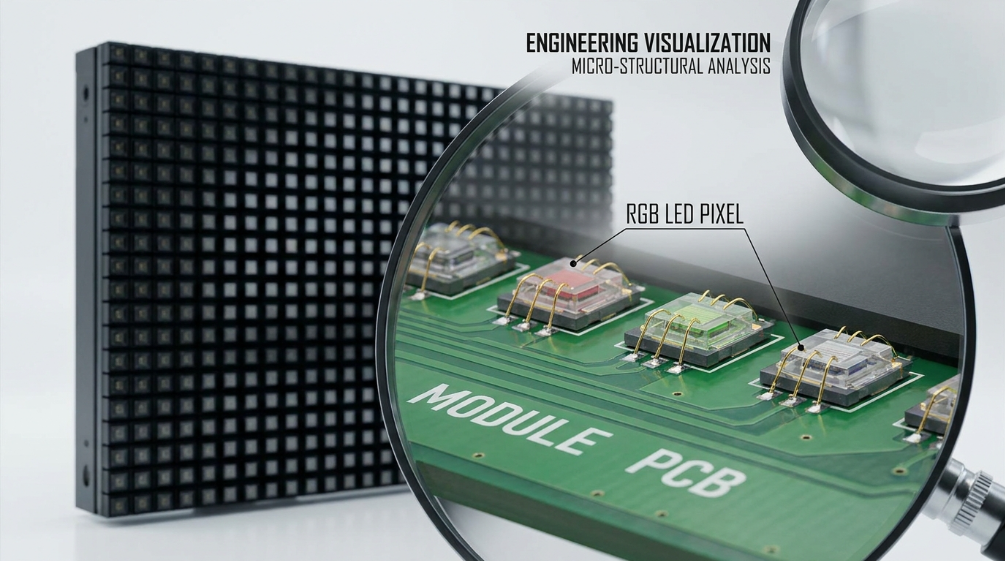
An LED chip is a semiconductor device that produces light through electroluminescence: when voltage is applied, electrons and positive holes recombine within the chip’s active layer, releasing energy in the form of visible light. The specific semiconductor material and doping elements used determine the wavelength — and therefore the color — of the emitted light.
In a commercial display context, LED chips are not sold or installed as bare components. They’re packaged (via SMD, COB, or other methods discussed below), mounted onto PCB modules, and assembled into cabinets that form the video wall, billboard, or signage system you actually see. Displays built on this technology fall into single-color, dual-color, and full-color categories, with full-color RGB configurations dominating today’s commercial LED display market.
LED Chip Packaging Technologies for Commercial Displays

This is the single most important distinction for anyone specifying an LED display, and it’s where most buyer confusion happens. The “LED chip” itself is a tiny die — how that die is packaged and mounted onto the display module determines durability, achievable pixel pitch, repairability, and cost. Here’s how the major packaging technologies compare:
| Technology | How It Works | Best For | Trade-off |
|---|---|---|---|
| DIP (Dual In-line Package) | Chip mounted into a through-hole plastic package | Large-format outdoor billboards, long viewing distances | Bulky, coarse pixel pitch (P10+) |
| SMD (Surface-Mounted Device) | 3-in-1 RGB chip package soldered directly to PCB | Rental, staging, general indoor/outdoor (P1.2–P10) | Mature and cost-effective, but more fragile at ultra-fine pitch |
| COB (Chip-on-Board) | Bare chips mounted and resin-sealed directly onto the board, no individual packages | Control rooms, fine-pitch indoor walls (sub-P1.0) | Superior durability, contrast, and heat dissipation; harder to repair at pixel level |
| GOB (Glue-on-Board) | Resin coating applied over an SMD module for impact protection | Rental and touring applications needing SMD’s flexibility with added ruggedness | Adds a manufacturing step and cost |
| IMD (Integrated/In-Mold Device) | Hybrid combining SMD’s field-repairability with COB-like durability | P0.9–P2.0 retail, corporate, XR/virtual production | Balances cost and durability; not as fine as COB at the extreme low end |
| COG (Chip-on-Glass) | Chips mounted on a glass substrate rather than PCB | Ultra-fine pitch (below P1.0), premium fixed installs | High cost, complex manufacturing, points toward MicroLED |
| Flip-Chip | Chip bonded via solder bumps instead of gold wire, eliminating wire-bond failure | Premium COB/fine-pitch modules where reliability and contrast (blackness) matter most | Higher upfront manufacturing precision required |
Why this matters for procurement: the packaging technology, not the raw chip alone, is what your supplier is really quoting you when they mention “LED chip quality.” Two displays using chips from the same wafer can perform very differently depending on whether they’re SMD, COB, or flip-chip packaged.
9 Key Parameters of LED Chips
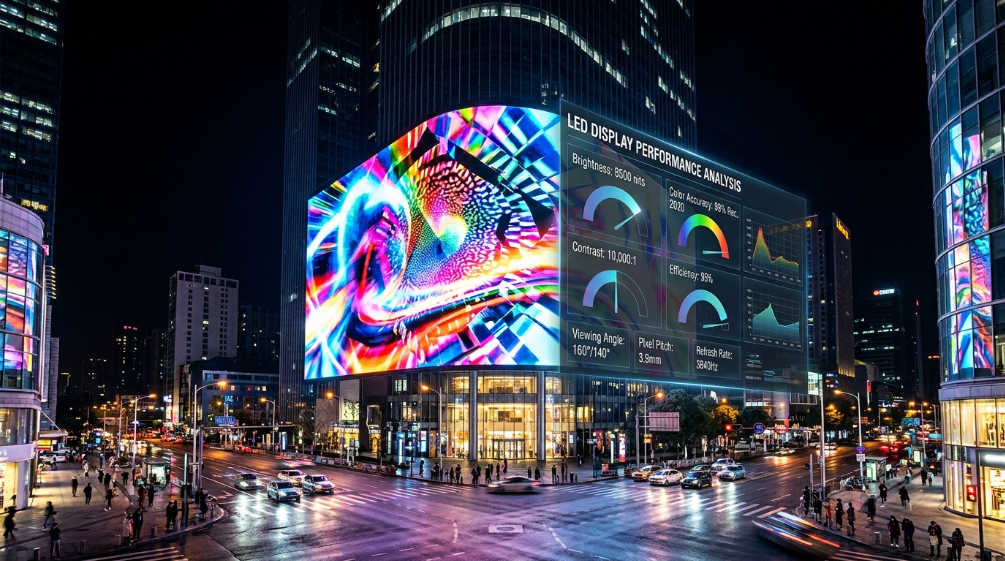
When evaluating LED chips for a commercial display or signage project, these are the parameters that actually determine performance in the field:
- Luminous Efficiency — the ratio of light output to power consumed, typically 100–200 lm/W for display-grade chips.
- Peak Brightness (Nits) — the practical brightness rating buyers should request. Indoor commercial displays typically run 800–2,000 nits; outdoor billboards need 5,000–10,000+ nits to remain legible in direct sunlight, with some high-end outdoor modules exceeding 15,000 nits.
- Color Gamut Coverage — expressed as a percentage of sRGB, DCI-P3, or Rec.2020. Premium flip-chip and COB modules now advertise 90–95%+ DCI-P3 coverage, which matters for broadcast, retail color accuracy, and virtual production applications.
- Spectral Characteristics — determine color output and consistency across the panel.
- Color Temperature — adjustable, typically 2,700K–6,500K.
- Color Rendering Index (CRI) — how accurately the chip reproduces true colors; 80–95 is standard, with CRI ≥ 90 preferred for broadcast and virtual-production environments.
- Operating Temperature Range — typically -40°C to 100°C; directly tied to lifespan (see below).
- Contrast Ratio & Blackness — increasingly emphasized on modern COB/flip-chip data sheets (20,000:1 or higher), since higher contrast is what makes fine-pitch displays look sharp at close range.
- Beam Angle / Viewing Angle — determines usable viewing range; 160°+ horizontal/vertical is now standard on quality display-grade chips.
What Are LED Chips Used For? 3 Core Application Areas
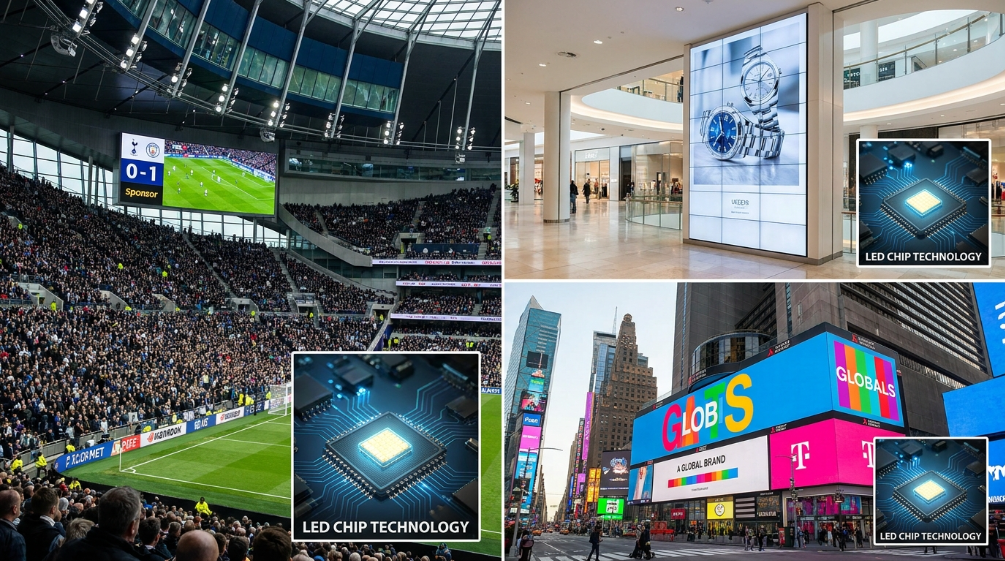
Displays and Digital Signage This is the fastest-growing commercial application. LED chips power outdoor digital billboards, indoor fine-pitch video walls, stadium screens, transparent glass-front displays, and rental LED panels for events and touring productions. Different projects call for different pixel pitches and packaging types — see our guide on pixel pitch and viewing distance to match chip specification to your actual audience distance.
Illumination LED chips remain the core of indoor architectural lighting, outdoor floodlighting, and landscape lighting — the traditional heartland of LED technology.
Indicators and Automotive LED chips are used extensively in traffic signals, vehicle taillights, and instrument panel backlighting, where compact size and long service life are essential.
How Long Do LED Chips Last? A Technical Breakdown
This is one of the most searched — and most misunderstood — questions in the industry. The short answer: a well-specified LED chip in a properly engineered display typically delivers a rated lifespan of 50,000 to 100,000 hours, but the number that actually matters to your budget is real-world years, not lab hours.
The L70/L90 standard, explained
LED chips don’t fail suddenly the way an incandescent bulb does — they degrade gradually, a process called lumen depreciation. The industry uses the IES LM-80 test standard to measure this decay, expressed as:
- L90 — hours until brightness falls to 90% of original output
- L70 — hours until brightness falls to 70% of original output (the industry-standard threshold)
- L50 — hours until brightness falls to 50%
Most commercial LED display manufacturers rate chips at L70. Critically, under the IES TM-21 standard, a manufacturer cannot claim a projected lifespan longer than six times their actual test duration — so an “L70 > 100,000 hours” claim should be backed by at least ~16,700 hours of real LM-80 test data. This is worth asking your supplier for directly.
Real-world lifespan by application
Lab-rated hours and real-world service life are two different numbers. Based on typical commercial usage patterns:
| Application | Typical Real-World Lifespan |
|---|---|
| Indoor fixed-install displays | 6–10 years |
| Outdoor billboards/displays | 3–8 years |
| Rental/touring LED screens | 4–7 years |
What actually shortens LED chip lifespan
- Drive current is the single biggest controllable factor. Chips driven at 60–70% of their maximum rated brightness run cooler and last significantly longer than chips pushed to 100%.
- Thermal management — since degradation is thermally driven, poor cabinet ventilation or high ambient heat accelerates lumen decay well beyond the lab-rated curve.
- Environmental exposure — humidity, dust, and temperature swings degrade outdoor chips faster than the same chips indoors.
- Pixel failure rate — separate from lumen decay, this measures the percentage of individual sub-pixels expected to fail (go dark or shift color) over the warranty period. Reputable manufacturers publish this figure and conduct factory acceptance testing (FAT) with 100% panel inspection before shipment — ask for this documentation before signing off on a large order.
LED Chip Brands: What Buyers Should Know
The chip brand behind your display module has a real impact on color consistency, binning accuracy, and long-term reliability. The most established names in commercial display-grade LED chips include:
- Nichia — generally regarded as the highest-quality, brightest chips on the market, at a premium price point; strong choice for mission-critical, color-critical applications.
- Epistar / Ennostar — Taiwan’s largest LED chip manufacturer; widely used as the base chip in third-party encapsulation, so display quality depends heavily on which factory does the packaging.
- Nationstar — a dominant force in fine-pitch and outdoor display chips, known for vertical integration (controlling chip creation through packaging) and strong brightness stability in harsh outdoor conditions.
- Kinglight — a more cost-conscious alternative, often chosen for entry-level fine-pitch or milder-climate outdoor projects.
None of these brand names alone guarantees quality — the encapsulation factory, binning process, and thermal design around the chip matter just as much. This is why working with a display manufacturer that controls its own module assembly and testing (rather than reselling third-party modules unchanged) tends to produce more consistent results.
4 Development Trends Shaping the Next Generation of LED Chips
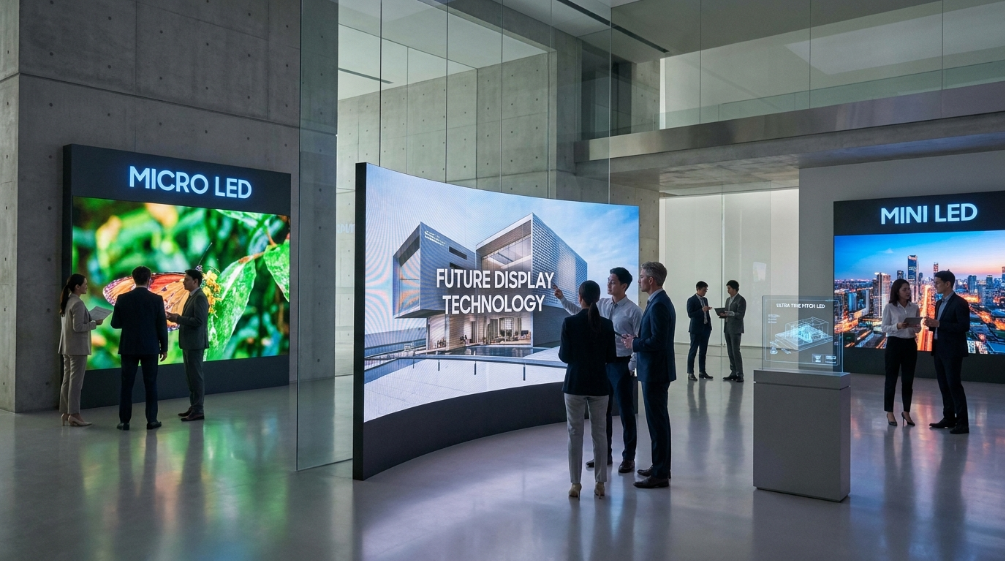
- Mini LED Technology — smaller chips enhance brightness and contrast for higher-density displays.
- Micro LED Technology — chip sizes shrink further, enabling higher resolution and seamless large-format screens; considered the next-generation display technology.
- Flip-Chip and MIP (Micro LED in Package) — eliminating gold-wire bonding in favor of solder-bump connections improves reliability, contrast, and enables mass-transfer manufacturing of true Micro LED at commercial scale — currently the technology to watch for sub-P0.9 displays.
- Smart, Data-Driven Control — dimmability, remote monitoring, and integration with modern control systems to meet the intelligent operation needs of large-scale commercial installations.
Actionable Advice for Procurement Decision-Makers
Before signing off on any LED display or billboard specification, use this checklist:
- Ask for the packaging type, not just “LED chip quality.” SMD, COB, IMD, and flip-chip perform very differently — match the technology to your pixel pitch and viewing environment, not just your budget.
- Request nits, not just “brightness.” Confirm the peak brightness rating matches your ambient light conditions — indoor 800–2,000 nits, outdoor 5,000–10,000+ nits.
- Ask for L70 test data, not just a headline hours figure. A supplier who can show LM-80/TM-21-backed projections is a more reliable long-term partner than one quoting a bare number.
- Separate lumen decay from pixel failure rate. These are two different reliability metrics — request both, along with FAT inspection documentation for your specific batch.
- Confirm drive current strategy. A display engineered to run at 60–70% of maximum brightness will outlast one running at full output, even with identical chips.
- Match chip brand to project risk tolerance. Mission-critical, color-sensitive, or long-service-life projects justify premium chips (Nichia, Nationstar); budget-sensitive short-term deployments may not.
Conclusion
LED chips are the foundational technology behind every commercial display, billboard, and video wall — but “LED chip” is not a single spec you can compare across suppliers on brightness or price alone. Packaging technology, brightness in nits, color gamut, lumen-decay data, and pixel failure rate together determine whether a display performs reliably for years or becomes a maintenance liability within months. As Mini LED, Micro LED, and flip-chip technologies mature, commercial buyers who understand these fundamentals will be far better positioned to specify displays that meet both their visual and total-cost-of-ownership requirements.
References:
Illuminating Engineering Society (IES)